Why CIOs Are Prioritizing AI-Native Integration Platforms in 2026
June 11, 2026CIOs are prioritising AI-native integration platforms in 2026 because AI-enabled platforms (traditional iPaaS with AI features bolted on) cannot deliver the four capabilities enterprise AI strategy requires: native data processing within the compliance boundary, intelligent error handling that eliminates the maintenance tax, autonomous investigation across connected systems, and natural language intelligence for executive and operational decision-making. AI-native platforms are designed around AI as core infrastructure, not as an add-on feature.
TL;DR:
- Gartner’s 2026 CIO Agenda survey shows 78% of enterprise CIOs have AI-native infrastructure as a top-three IT investment priority: up from 31% in 2024. The shift is not driven by AI enthusiasm; it is driven by the recognition that AI capabilities require different infrastructure than automation capabilities.
- “AI-native” and “AI-enabled” are not interchangeable. An AI-enabled platform adds AI features to existing architecture (LLM calls bolted onto workflows, AI dashboards added to monitoring tools). An AI-native platform is designed from the ground up with AI as a core processing layer: with structured output, compliance-safe inference, and confidence-based routing as infrastructure, not features.
- Four business pressures are converging to make 2026 the year CIOs commit to AI-native integration: the compliance pressure (data residency requirements for AI inference), the maintenance economics (AI-assisted operations that reduce the 40-50% engineering maintenance burden), the competitive intelligence gap (executives operating on stale BI data while competitors have real-time AI intelligence), and the AI programme accountability pressure (boards asking “where is our AI ROI?”).
- The platform evaluation criteria that distinguish AI-native from AI-enabled are specific and testable: where does AI inference run? What is the output format of AI nodes? How are confidence thresholds and human review gates configured? Does the AI capability extend to autonomous investigation (Level 3) and multi-agent coordination (Level 4)?
- eZintegrations is built AI-native from Level 1 through Level 4: not an iPaaS with AI features added, but a four-level architecture where AI is core infrastructure at every level.
What is Driving CIO Prioritisation of AI-Native Integration in 2026?
The CIO’s relationship with integration platforms changed in 2026: not because integration changed, but because the CIO’s accountability changed.
For the previous decade, enterprise integration was an IT operational concern: keep the pipelines running, reduce the maintenance burden, extend connectivity to new SaaS applications as they were adopted. Integration platform decisions were made by integration architects and IT operations managers, with CIO visibility only when a major platform change or significant cost reduction was on the table.
In 2026, integration is a strategic CIO concern because the AI programmes that boards are demanding: AI workflow automation, AI agents for operational intelligence, agentic AI for executive decision support: are built on integration infrastructure. The CIO who cannot deliver AI programme outcomes in 2026 is accountable for that failure. And the most common technical reason AI programmes fail to deliver is that the integration infrastructure they depend on cannot support them.
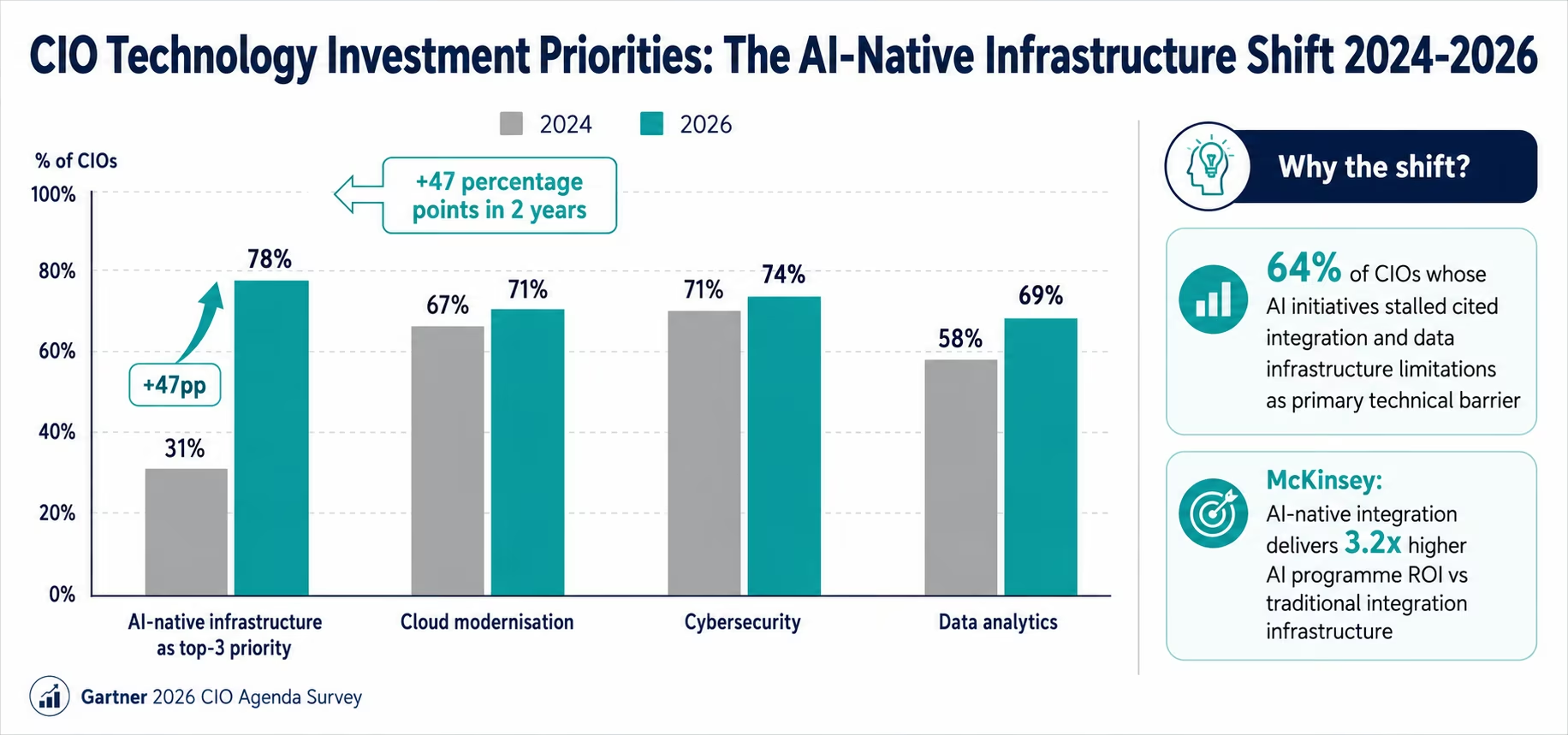
According to Gartner’s 2026 CIO Agenda survey, 78% of enterprise CIOs have AI-native infrastructure as a top-three IT investment priority: up from 31% in 2024. This is a 47-percentage-point increase in two years. The survey also found that 64% of CIOs who had AI initiatives stall in 2024-2025 cited “integration and data infrastructure limitations” as the primary technical barrier: ahead of model quality, talent availability, and budget constraints.
McKinsey’s State of AI 2025 report provides the business context: enterprises that deployed production AI programmes in 2025 with an AI-native integration foundation reported 3.2x higher ROI on their AI investments than those deploying AI on top of traditional integration infrastructure. The platform is not incidental to the AI outcome: it determines it.
This is what drove CIO attention to integration platforms in 2026: not a preference for modern architecture, but accountability for AI programme ROI: and the data showing that the platform choice is the primary determinant of whether that ROI is delivered.
AI-Native vs AI-Enabled: The Distinction That Matters
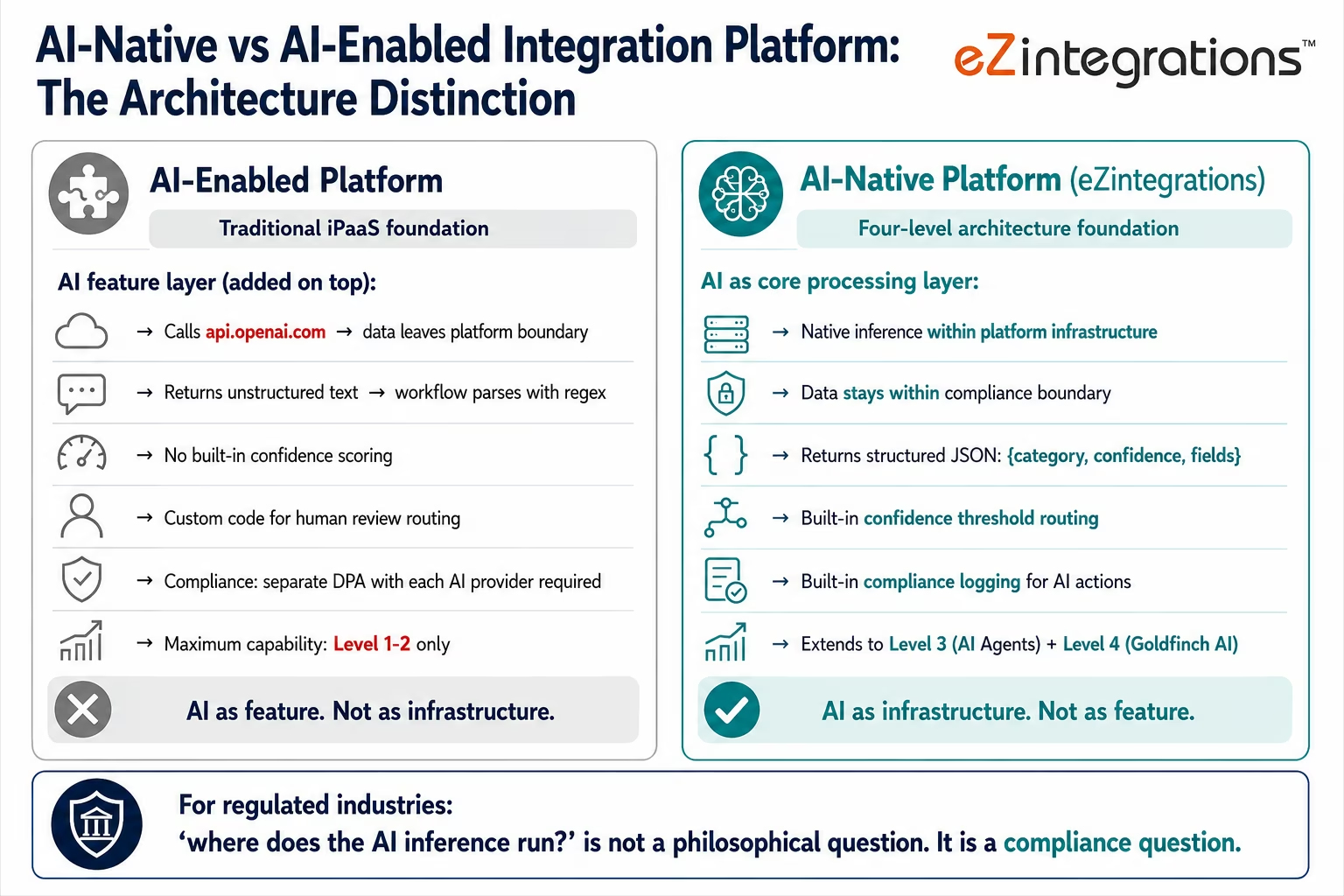
“AI-native” and “AI-enabled” describe fundamentally different integration architectures: and the distinction determines whether an integration platform can actually deliver the AI programme outcomes a CIO is accountable for.
AI-enabled platforms start as traditional integration middleware (workflow automation, connector management, data pipelines) and add AI capabilities as features: an LLM summarisation step added to a workflow, an AI-powered recommendation in the monitoring dashboard, a natural language interface layered on top of the configuration UI. The AI is an enhancement to existing architecture.
The practical consequences of the AI-enabled architecture:
- AI processing happens via external API calls to OpenAI, Anthropic, or Google: which means enterprise data (the contents of the invoice, the customer email, the financial record) leaves the integration platform’s environment and is processed by a third-party AI provider
- AI output is an unstructured text response that the workflow must parse: creating fragility when the LLM provider changes its model or output format
- Confidence thresholds, human review gates, and compliance logging for AI-assisted decisions must be built custom by the enterprise: they are not platform capabilities
- AI capabilities exist at Level 1 and Level 2 only: there is no path to Level 3 AI Agents or Level 4 agentic AI coordination within the same platform
AI-native platforms are designed with AI as core infrastructure: not a feature layer but a processing layer that exists alongside data movement, transformation, and routing as a first-class architectural capability.
The practical consequences of the AI-native architecture:
- AI inference runs natively within the platform’s own processing environment: enterprise data never leaves the platform’s compliance boundary during AI processing
- AI outputs are structured objects (JSON with typed fields, confidence scores, category labels): not text strings to parse
- Confidence thresholds and human review routing are built-in platform configuration: not custom code
- The AI capability extends through all four levels: AI-enriched pipelines (Level 2), autonomous investigation agents (Level 3), and multi-agent coordination (Level 4), within the same platform and the same governance framework
| Criterion | AI-Enabled Platform | AI-Native Platform |
|---|---|---|
| AI inference location | External API (OpenAI, Anthropic, Google) | Native within platform infrastructure |
| Data during AI processing | Leaves compliance boundary | Stays within compliance boundary |
| AI output format | Unstructured text string | Structured JSON with typed fields |
| Confidence scoring | Not available (custom build required) | Built-in platform configuration |
| Human review routing | Custom build required | Built-in platform capability |
| Compliance logging for AI | Custom build required | Native audit trail |
| Maximum AI capability level | Level 1-2 (pipelines with AI nodes) | Level 1-4 (through agentic coordination) |
| Regulated data (PHI, PII, financial) | Requires DPA with external AI provider | Fully within existing compliance framework |
| Migration to AI agents | Requires platform change | Same platform, additional configuration |
The Four Business Pressures Making This a 2026 Priority
CIO technology priorities are driven by business pressure, not architectural preference. Four specific business pressures converged in 2026 to make AI-native integration a board-level IT priority rather than a technical architecture preference.
Pressure 1: The Compliance Pressure on AI Inference
The single most important compliance question for enterprise AI programmes in 2026 is: where does the AI inference run?
For healthcare CIOs: when a document intelligence node processes a clinical document: reading a prior authorisation request, extracting fields from an ADT message, classifying an adverse event report: does that clinical document leave the organisation’s HIPAA-covered environment and travel to OpenAI or Anthropic? If it does, the organisation requires a signed Business Associate Agreement with the AI provider, a privacy impact assessment for each AI use case, and potentially an update to its HIPAA policies and procedures.
For financial services CIOs: when an LLM Classification node processes a customer communication to classify it for compliance monitoring: does the customer’s PII leave the organisation’s financial regulatory boundary? If it does, the GLBA safeguard rules, CCPA, and potentially GDPR create obligations for that data transfer that must be assessed and documented.
For pharma and life sciences CIOs: when a Document Intelligence node reads a clinical trial document to extract adverse event data: does that data leave the 21 CFR Part 11 controlled environment? If it does, the audit trail for that AI action must be established with the external provider, who may not provide the immutable, time-stamped audit trail that 21 CFR Part 11 requires.
These are not hypothetical concerns. They are real compliance assessments that regulated industry CIOs must complete before deploying any AI-enabled integration capability that calls external AI providers.
AI-native integration platforms eliminate this compliance surface. When AI inference runs natively within the integration platform’s own infrastructure: within the same environment that already has HIPAA BAA, SOC 2 Type II, GDPR compliance, and 21 CFR Part 11 audit logging: the AI processing is covered by the existing compliance framework. No separate DPA with an AI provider. No separate privacy impact assessment. No policy update for AI data transfer.
For regulated industry CIOs, AI-native inference is not a preference: it is often the only compliant deployment architecture.
Pressure 2: The Maintenance Economics Pressure
The $3.5 million annual maintenance cost of enterprise integration debt: the 40-50% of integration engineering capacity consumed by monitoring, debugging, credential management, and API update maintenance: is a budget pressure that CIOs have been managing for years without a structural solution.
Previous approaches: hire more engineers (expensive, limited by talent availability), implement better monitoring tools (reduces alert noise but not investigation time), adopt a new iPaaS platform (migrates the estate but does not change the maintenance economics if the new platform has the same manual maintenance model).
AI-native integration changes the maintenance economics structurally. An integration platform with native predictive monitoring (Watcher Tools detecting credential expiry before it causes failures), native intelligent classification (LLM Classification diagnosing root causes in 30 seconds rather than 2-4 hours of manual investigation), and native autonomous remediation (pre-authorised fix types executing without human involvement) reduces the maintenance burden without requiring additional engineers.
The CIO’s maintenance economics calculation changes from:
- Current: 10 engineers × $180K × 45% maintenance fraction = $810K/year in maintenance overhead
- AI-native: 10 engineers × $180K × 22% maintenance fraction = $396K/year in maintenance overhead
The $414K annual difference funds the platform cost with margin remaining: and the recovered engineering capacity (20+ percentage points = 2 engineer-equivalents) is redirected to AI capability delivery and backlog clearance.
CIOs who present the AI-native integration business case with the maintenance economics calculation find the board conversation significantly easier: the platform justification is not “we need AI capabilities” (which the board has been hearing for two years without seeing ROI), it is “we recover $414K in engineering capacity and use it to deliver the AI programmes we committed to.”
Pressure 3: The Competitive Intelligence Gap
The third pressure is strategic: executives at competing organisations are operating on real-time AI-assembled intelligence while most enterprise executives are still waiting for weekly BI reports.
The competitive intelligence gap is the difference in decision quality between an executive who can ask “what is the current status of our top 20 accounts at risk?” and receive a structured answer in 47 seconds from live system data: versus an executive who submits a data request and receives a dashboard 3-5 business days later.
In fast-moving markets: financial services, technology, consumer goods: the quality of decisions made in real time from live data versus decisions made from 5-day-old report data can have measurable revenue impact. The sales leader whose CRM shows stale engagement data makes different (worse) account prioritisation decisions than the sales leader whose AI intelligence feed surfaces account health signals in real time.
According to Harvard Business Review’s 2025 research on AI-first enterprises, organisations that deploy executive AI intelligence capabilities: natural language queries to live business data across connected systems, report 15-20% improvement in the accuracy of strategic forecasting decisions compared to organisations relying on periodic BI reporting.
CIOs whose integration platforms cannot support real-time AI intelligence delivery: because the integration estate is not sufficiently connected, observable, or API-accessible for agent tool registry use: are watching their organisations operate on an intelligence deficit relative to AI-native competitors. This is a strategic conversation that CIOs are now having with their CEOs and boards, not just with their technical teams.
Pressure 4: The AI Programme Accountability Pressure
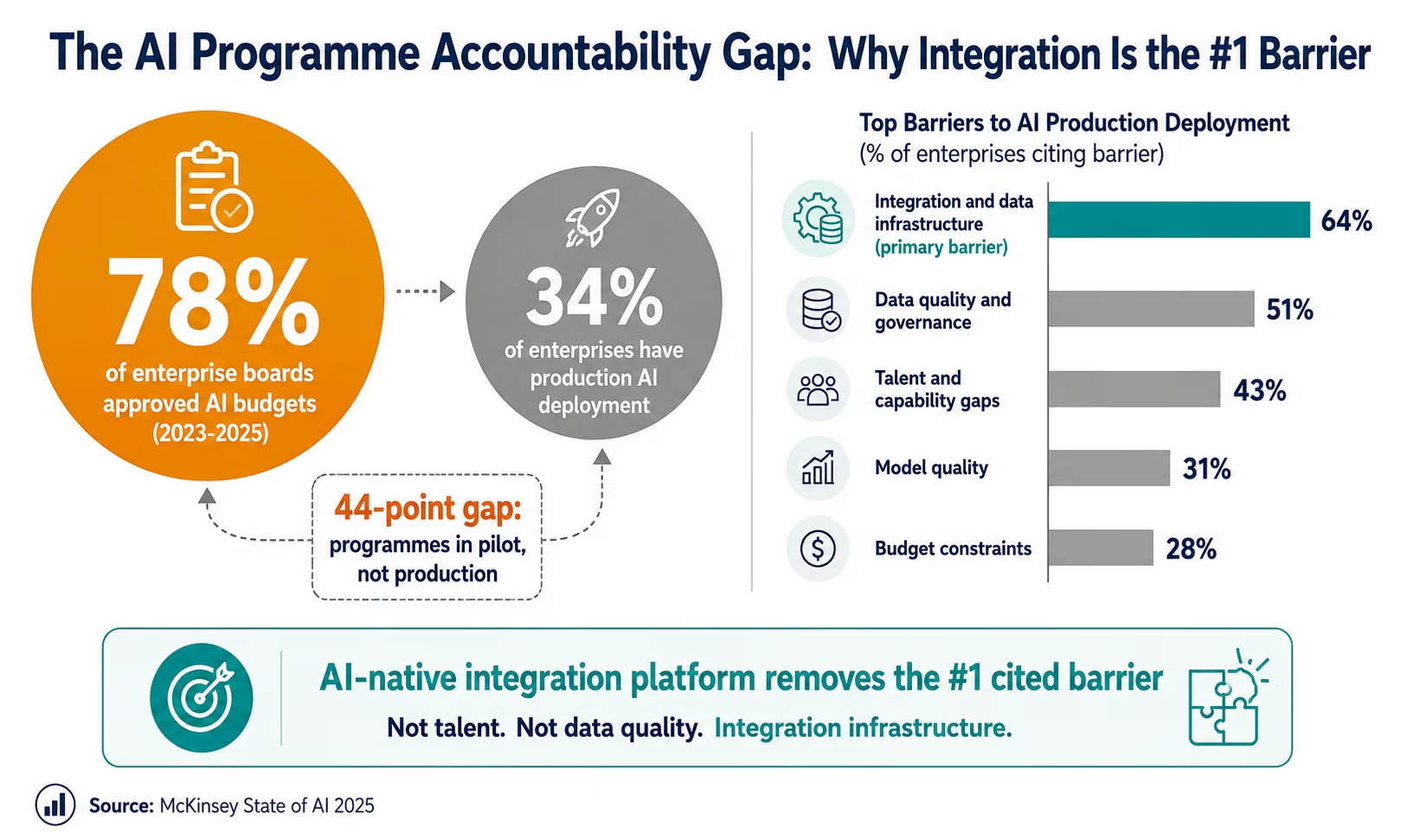
The fourth and most acute pressure is accountability: boards allocated AI budgets in 2023-2025, and in 2026 they are asking for ROI.
McKinsey’s State of AI 2025 reports that 78% of enterprise boards have approved AI programme budgets. Of these, only 34% of enterprises report production AI deployment: the majority are still in pilot or proof-of-concept stages. The gap between approved AI budgets and production AI deployment is the most uncomfortable conversation in enterprise IT in 2026.
The top three reasons AI programmes have not reached production,
according to the same McKinsey research: integration and data infrastructure limitations (64%), data quality and governance issues (51%), and talent and capability gaps (43%). Integration infrastructure is the #1 cited barrier: ahead of talent and ahead of data quality.
CIOs who have been managing this explanation to boards for two years understand the pattern: every AI pilot succeeds in a controlled environment with clean, curated data and a clear API connection. Every AI production deployment encounters the full complexity of the enterprise integration estate, the undocumented flows, the shadow integrations, the point-to-point connections that cannot be registered as agent tools, the AI processing that sends regulated data to external providers in violation of compliance policy.
The AI-native integration platform decision is therefore both a technical decision and an accountability decision. CIOs who deploy AI-native integration infrastructure in 2026 are removing the primary cited barrier to production AI deployment. CIOs who do not are maintaining the barrier: and explaining its continued presence to boards that have been funding AI programmes for three years.
The Eight Evaluation Criteria for AI-Native Integration Platforms
CIOs evaluating integration platforms for AI-native capability should test against eight specific criteria: each of which distinguishes genuinely AI-native platforms from AI-enabled platforms with AI marketing.
1. Where does AI inference run?
Ask explicitly: when my workflow executes an LLM Classification or Document Intelligence node, where does the compute happen? The answer must be: within the platform’s own infrastructure. If the answer is “we call the OpenAI API” or “we use Azure OpenAI Service,” the AI processing is external and your enterprise data travels to that provider during inference.
2. What is the format of AI output?
Request a sample output from the LLM Classification and Document Intelligence nodes. An AI-native platform returns a structured JSON object: {"category": "Billing Issue", "confidence": 0.91, "fields": {"vendor_name": "Acme Corp", "invoice_no": "INV-2241"}}. An AI-enabled platform returns a text string that your workflow must parse with regex or string matching, which breaks when the LLM changes its phrasing.
3. Are confidence thresholds built-in?
Ask: how do I configure a confidence threshold so that high-confidence classifications route automatically and low-confidence classifications route to a human review queue? An AI-native platform has this as a built-in configuration setting. An AI-enabled platform requires you to build this logic in your workflow code.
4. Is there a native human review routing capability?
Related to the above: when AI confidence is below threshold, how does the record reach a human reviewer? An AI-native platform routes to a configurable review queue within the platform, with the AI’s classification pre-populated as a suggestion for the reviewer. An AI-enabled platform requires a custom integration to your ticketing or review system.This is why the MIT Sloan human factor in AI decision-making is relevant for CIO platform evaluation: AI output alone is not enough. Enterprise platforms need confidence thresholds, review queues, and accountable human decision points so AI-supported recommendations are interpreted and approved appropriately.
5. What is the compliance logging coverage for AI actions?
Ask: what audit log is generated for every AI inference action? An AI-native platform generates an immutable, timestamped log entry for every AI node execution: showing what data was processed, what output was produced, and what routing decision was made. An AI-enabled platform may log the workflow execution but not the AI-specific inference actions within it.
6. Does the platform extend to Level 3 AI Agents?
Ask: can I build an autonomous investigation agent within this platform, one that receives a goal and determines its own investigation sequence? An AI-native platform with Level 3 capability has an agent builder that uses the platform’s connected systems as tools. An AI-enabled platform stops at Level 2 (AI-enriched pipelines) and requires a separate agent framework (LangChain, CrewAI, Autogen) for Level 3 capability: which means managing two platforms, two governance frameworks, and two compliance postures.
7. Does the platform extend to Level 4 multi-agent coordination?
Ask: can I build a coordinator-worker multi-agent system within this platform, with a coordinator that dispatches specialist worker agents and synthesises their outputs? A genuinely AI-native enterprise integration platform has this as a built-in capability (Goldfinch AI in eZintegrations). An AI-enabled iPaaS with agent bolt-ons does not.
8. What is the path from Level 1 to Level 4 on a single platform?
This is the strategic evaluation question. The CIO’s roadmap requires: reliable data pipelines today (Level 1), AI-enriched pipelines as workflows mature (Level 2), autonomous investigation agents as the managed estate grows (Level 3), and agentic AI coordination for executive intelligence (Level 4). An AI-native integration platform delivers all four on a single architecture. An AI-enabled platform delivers Level 1-2 and requires a platform migration to reach Level 3-4.
Platform migrations are expensive, disruptive, and technically risky. The CIO who chooses an AI-enabled platform for Level 1-2 will face a migration cost to reach Level 3-4. The CIO who chooses an AI-native platform for Level 1-2 has Level 3-4 available by configuration when the roadmap requires it.
What CIOs Are Getting Wrong About AI-Native Integration
Three strategic mistakes are appearing consistently in enterprise CIO AI-native integration decisions in 2026.The HBR AI-first strategy analysis is useful in this context because it warns that leading with AI as the strategy can create more problems when organisations do not first clarify the business problem, operating model, governance, and infrastructure required to make AI useful.
Mistake 1: Treating AI-Native as a Feature Evaluation
The most common mistake: CIOs evaluate AI-native integration by asking “does the platform have an LLM node?” rather than “where does the LLM inference run and what is the output format?” This collapses the AI-native versus AI-enabled distinction into a feature checklist that both platform types can pass, leading CIOs to select AI-enabled platforms believing they are selecting AI-native ones.
The correct evaluation posture: ask the compliance and architectural questions above. Request a live demonstration of confidence threshold routing, native audit trail generation for AI actions, and the path from Level 2 to Level 3 AI Agent capability within the same platform. These questions expose the architectural distinction that the feature checklist conceals.
Mistake 2: Separating the AI Platform Decision from the Integration Platform Decision
Many enterprises are building their AI capability on a separate AI platform (a commercial agent framework, a vendor-specific AI orchestration tool) that sits alongside their existing integration platform. The integration platform moves data; the AI platform applies intelligence. They are separate tools, managed separately, with separate governance frameworks and separate compliance postures.
This architecture works at pilot scale. It fails at production scale because: the governance boundary between the two platforms is difficult to enforce (which platform is responsible for the compliance audit trail when the AI platform calls the integration platform’s APIs?), the data flowing between them creates compliance exposure points, and the engineering overhead of maintaining two separate platforms with two separate connector libraries is additive rather than economical.
AI-native integration: a single platform that handles both data movement and AI intelligence, eliminates this dual-platform complexity.
Mistake 3: Waiting for Compliance Clarity That Has Already Arrived
Some CIOs are deferring AI-native integration adoption while waiting for “more guidance” on AI data residency and compliance requirements. The guidance is largely available: HIPAA’s covered entity rules apply to PHI processed by AI systems regardless of where the processing occurs, GDPR’s data transfer rules apply to PII processed outside the EU regardless of whether the processor is a traditional software company or an AI company, and SOC 2’s scope covers all systems processing controlled data regardless of the AI content of those systems.
The compliance framework for AI processing exists. The question is not whether it applies: it does: but whether the CIO’s chosen AI platform architecture is compliant under that framework. AI-native integration platforms that process data natively are compliant under existing frameworks. AI-enabled platforms that call external AI providers require explicit assessment and often explicit remediation.
The Four-Level AI-Native Architecture: What to Look For
The architectural hallmark of a genuinely AI-native integration platform is a clear, coherent four-level design where each level is a native capability: not a partner product, a bolt-on, or a separate tool that integrates with the platform.For CIOs comparing integration platform options, the Forrester Integration-Platform-As-A-Service Landscape, Q2 2025 provides broader market context on iPaaS providers and helps frame how modern integration platforms are evolving beyond basic connectivity toward application, data, automation, and AI-ready integration requirements.
Level 1: AI-Native Data Pipelines
Native connectors for REST, GraphQL, WebSocket, Database, Message Queue, and File protocols: with the authentication management, rate limiting, retry logic, pagination handling, and error classification that enterprise-grade connectivity requires. The Level 1 foundation must support the volume, reliability, and protocol coverage of the full enterprise integration estate.
Level 2: AI Workflow Enrichment
Document Intelligence, LLM Classification, Data Analysis, and Semantic Matching as native workflow nodes: with native inference (data does not leave the platform), structured output (confidence scores, typed fields), built-in confidence threshold routing, and native audit logging for AI actions. Level 2 capability is what differentiates AI-native from traditional iPaaS platforms.
Level 3: AI Agents
Autonomous investigation agents that use the platform’s connected systems as tools: receiving goals, determining investigation sequences, executing tool calls, and delivering structured results. The agent tool registry, the autonomous action policy, and the human escalation gate are built-in platform configurations, not custom-built components.
Level 4: Agentic AI Coordination
Coordinator-worker multi-agent architecture: with a coordinator that dispatches parallel worker agents, synthesises their outputs, and delivers results via a natural language Chat UI or an automated Workflow Node. Goldfinch AI of eZintegrations implements this level natively, with 9 pre-built enterprise tools: Knowledge Base Vector Search, Document Intelligence, Data Analysis, Data Analytics with Charts/Graphs/Dashboards, Web Crawling, Watcher Tools, API Tool Call, Integration Workflow as Tool, and Integration Flow as MCP. The tool registry is user-extensible beyond these 9 as self-service.
CIOs evaluating AI-native integration platforms should ask for a demonstration of all four levels: in a live environment with real API connections, before making the platform selection decision. A platform that can demonstrate Level 1-2 in a demo but cannot demonstrate Level 3-4 in the same platform is an AI-enabled platform, not an AI-native one.
How eZintegrations Delivers AI-Native Integration
eZintegrations is designed as an AI-native platform from Level 1 through Level 4: not as a traditional iPaaS with AI capabilities added on top, but as a four-level architecture where AI is core infrastructure at every level.
Native AI inference at every level: Document Intelligence, LLM Classification, Data Analysis, and Semantic Matching all run within eZintegrations’ own processing infrastructure. No enterprise data, PHI, PII, financial records, regulated documents is transmitted to OpenAI, Anthropic, Google, or any external AI provider during processing. For regulated industry CIOs, this is the foundational compliance requirement.
Structured AI output: every AI node returns a typed JSON object: {"category": "Sales Inquiry", "confidence": 0.94, "intent": "Enterprise Evaluation"}: not an unstructured text string. Confidence threshold routing is a built-in workflow configuration setting. Human review queues are native platform capabilities. Compliance logging for every AI node execution is automatic and immutable.
Four-level coherence: the same platform that runs a CRM-to-ERP data sync (Level 1) also runs AI-enriched invoice processing (Level 2), an autonomous account health investigation agent (Level 3), and the Goldfinch AI multi-agent coordinator that answers executive natural language queries (Level 4). No platform migration required as AI programme maturity increases.
Goldfinch AI for the CIO’s intelligence layer: the Chat UI gives executives and operational leaders direct natural language access to live business intelligence from connected systems. Questions answered in under 60 seconds without a data team request. The Workflow Node delivers automated intelligence programmes (account health alerts, integration estate health briefs, pipeline intelligence) without human request.
Compliance architecture for regulated industries: SOC 2 Type II certified. HIPAA BAA available for healthcare data. GDPR compliant for EU customer and patient data. 21 CFR Part 11 support for life sciences. IPSec Tunnel for on-premises enterprise systems. All four AI capability levels operate within this compliance boundary.
Pricing: Level 1+2 at $90/month. Level 3 AI Agents at $120/month. Level 4 Goldfinch AI at $150/month. No platform fee. No connector fee.
Book a free demo AI-native integration for your CIO or IT strategy team. We will walk through the four-level architecture, demonstrate native AI inference with structured output and compliance logging, and show the Chat UI answering a live business intelligence query from your connected systems
Frequently Asked Questions
1. What is an AI-native integration platform and how is it different from an AI-enabled one?
An AI-native integration platform processes AI within its own infrastructure as a core architectural layer. An AI-enabled platform adds AI features to existing middleware architecture: typically by calling external LLM APIs such as OpenAI or Anthropic and returning text responses. The practical differences are structural: AI-native keeps enterprise data within the compliance boundary during processing, returns structured JSON output instead of text that must be parsed, includes built-in confidence threshold routing and human review queues, and extends natively to Level 3 AI Agents and Level 4 agentic coordination without requiring a separate platform.
2. Why are CIOs prioritising AI-native integration in 2026 specifically?
Four business pressures converged in 2026. First, compliance pressure: HIPAA, GDPR, and financial regulations require strict control over AI inference data residency. Second, maintenance economics: AI-assisted operations reduce the 40–50% engineering maintenance burden structurally. Third, competitive intelligence gap: AI-native competitors deliver real-time executive intelligence while traditional enterprises wait for BI reporting cycles. Fourth, AI programme accountability: boards are demanding ROI on AI budgets approved between 2023–2025, with integration infrastructure identified as the number one barrier to production deployment by 64% of CIOs whose programmes stalled.
3. What does "AI inference location" mean and why does it matter for compliance?
AI inference location refers to where the AI computation happens when enterprise data is processed. In AI-enabled platforms, a workflow step such as document processing often sends data to external APIs like OpenAI, meaning the data leaves the enterprise environment. This can trigger regulatory obligations: HIPAA BAA requirements in healthcare, GLBA and CCPA considerations in financial services, and 21 CFR Part 11 compliance in pharma. In AI-native platforms, inference happens within the platform’s own infrastructure, ensuring data remains inside the existing compliance boundary and under existing data processing agreements.
4. What are the eight criteria for evaluating AI-native integration platforms?
The eight evaluation criteria are: where AI inference runs, whether AI output is structured JSON or unstructured text, whether confidence thresholds are configurable natively, whether human review routing is built into the platform, what compliance logging is generated for each AI action, whether the platform supports Level 3 AI Agents within the same system, whether it extends to Level 4 multi-agent coordination, and whether there is a coherent four-level progression from data pipelines to agentic AI on a single platform without requiring migration.
5. How should CIOs present the AI-native integration investment to their boards?
CIOs should lead with maintenance economics rather than AI capability narratives. Boards have heard AI promises for years without consistent ROI. The concrete model is: (engineering team size) × (fully loaded cost) × (maintenance fraction reduction from AI-assisted operations) = annual capacity recovery. For example, a 10-person team at $180K fully loaded cost reducing maintenance from 45% to 22% yields approximately $414K in recovered capacity annually. This recovered capacity funds the platform investment and reallocates engineering effort toward delivering measurable AI programme outcomes.
6. What is Goldfinch AI and what does it deliver for CIOs?
Goldfinch AI is eZintegrations’ Level 4 multi-agent coordination platform that acts as the intelligence layer above the integration estate. It delivers a Chat UI for natural language enterprise queries answered in under 60 seconds across connected systems, a Workflow Node for automated intelligence programmes such as account health alerts and integration status briefings, a coordinator-worker multi-agent architecture for complex cross-system orchestration, and a set of nine native enterprise tools with an extensible tool registry. It is designed to meet enterprise compliance requirements including SOC 2 Type II, HIPAA BAA, GDPR, and 21 CFR Part 11.
Conclusion: The Integration Platform Decision Is Now the AI Strategy Decision
The CIO’s relationship with the enterprise integration platform has changed permanently in 2026. It is no longer an IT infrastructure decision about connectivity and data movement. It is a strategic decision about whether the enterprise can deliver AI programme outcomes that boards are demanding and competitors are deploying.
The AI-native versus AI-enabled distinction is the most consequential platform choice a CIO will make in 2026: because it determines whether the integration platform is an enabler or a ceiling for every AI programme on the roadmap.
An AI-enabled platform delivers Level 1-2 capability with AI marketing. It requires external AI inference that creates compliance exposure for regulated industries. It produces unstructured output that requires custom parsing. It stops at Level 2 and requires a different platform for Level 3-4: which means a migration at the worst possible time, when AI programme scale is increasing and technical debt cannot be added without visible consequence.
An AI-native platform delivers all four levels coherently, with native inference that keeps regulated data within the compliance boundary, structured output that is production-stable, and a governance framework that covers AI actions with the same compliance posture as data movement actions.
The CIO who makes this choice correctly in 2026 has the infrastructure foundation for every AI programme the board will ask for in 2027 and 2028. The CIO who makes it incorrectly will be managing the same explanation: “our integration infrastructure is the barrier”. for another budget cycle.
Book a free demo AI-native integration demo for your CIO or IT strategy team. We will demonstrate all four levels, show native AI inference with compliance logging, and walk through the Chat UI answering a live business intelligence query from your connected systems.