AI Agents for Life Sciences: Autonomous Clinical Regulatory & Supply Workflows
May 20, 2026AI agents for life sciences are autonomous, multi-step reasoning systems that handle complex clinical, regulatory, and supply chain exception workflows end-to-end: retrieving data from Veeva Vault, CTMS, safety databases, LIMS, and ERP systems, reading regulatory and clinical documents, applying domain-specific knowledge, and routing pre-assembled recommendations to qualified human reviewers for decision. eZintegrations deploys GxP-compliant life sciences AI agents with 9 native enterprise tools, configurable confidence thresholds, and mandatory human-in-the-loop gates: handling adverse event triage, regulatory submission gap analysis, clinical data discrepancy investigation, supply chain deviation management, and post-market surveillance intelligence autonomously within 21 CFR Part 11 audit trail requirements.
TL;DR
- Life sciences operations generate some of the most knowledge-intensive, compliance-critical exception work of any regulated industry. Adverse event triage, regulatory submission gap analysis, clinical data discrepancy investigation, and supply chain deviation management all require assembling evidence from multiple systems, applying regulatory knowledge, and routing structured recommendations to qualified professionals.
- The gap between “exception detected” and “qualified professional has everything needed to make a decision” is where AI agents operate in life sciences. The pharmacovigilance analyst should spend her time on clinical assessment, not on manually retrieving narratives from five safety databases. The regulatory affairs scientist should spend his time on submission strategy, not on manually checking 47 data points against CTD format requirements.
- eZintegrations’ Level 3 AI Agents deploy 9 native enterprise tools within a 21 CFR Part 11 and EU GMP Annex 11 compliant architecture. Five life sciences AI agents in this guide: the Adverse Event Triage Agent, the Regulatory Submission Gap Agent, the Clinical Data Discrepancy Agent, the Life Sciences Supply Chain Deviation Agent, and the Post-Market Surveillance Intelligence Agent.
- Level 4 Goldfinch AI coordinates these agents for executive compliance intelligence: VP of Regulatory Affairs, Chief Medical Officer, and VP of Quality asking the Chat UI natural language questions about their live operational and compliance data.
- All AI inference runs natively within eZintegrations: no clinical data, patient information, or regulated records are sent to external AI providers. Human-in-the-loop gates are mandatory for all regulated decisions.
What Life Sciences AI Agents Actually Do (and the Compliance Line They Never Cross)
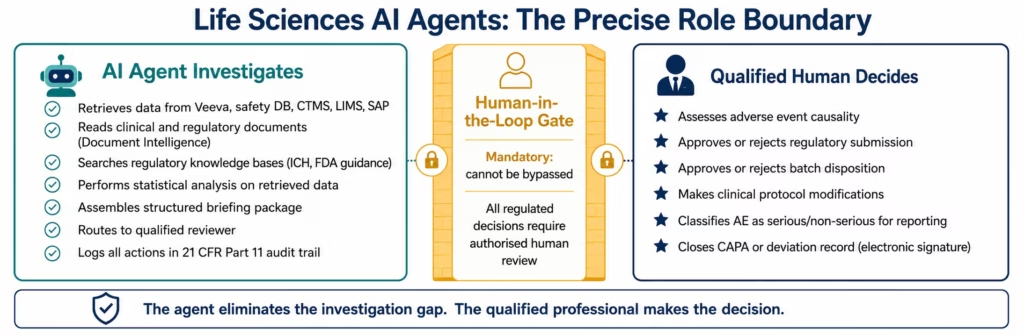
Precision matters in life sciences AI agent design. The compliance framework that governs pharmaceutical, biotech, and medical device operations exists for good reason: patient safety: and AI agents operating in this environment must respect every boundary that framework establishes.
Here is the precise role of AI agents in life sciences operations:
What life sciences AI agents do:
- Retrieve data from multiple regulated and non-regulated systems (Veeva Vault, safety databases, CTMS, LIMS, SAP, ERP) without modifying the source records
- Read clinical and regulatory documents using Document Intelligence, extracting structured data for analysis
- Search regulatory knowledge bases for applicable requirements, precedents, and guidance
- Perform Data Analysis on retrieved data to identify patterns, calculate compliance scores, and surface statistical signals
- Assemble structured briefing packages for qualified human reviewers
- Route completed investigation packages to the appropriate qualified professional
- Log every action, every data access, and every output in an immutable 21 CFR Part 11 compliant audit trail
What life sciences AI agents never do autonomously:
- Assess the causality of an adverse event (the qualified physician or pharmacovigilance assessor does this)
- Submit a regulatory filing or expedited safety report to a health authority
- Approve, reject, or release a batch of pharmaceutical product
- Make clinical study protocol modifications
- Classify an adverse event as serious or non-serious for regulatory reporting purposes
- Close a CAPA or deviation record without qualified person authorisation
The human-in-the-loop gate in eZintegrations is not optional configuration: it is a mandatory architectural element for all life sciences AI agent workflows. The agent investigates, assembles, and briefs. The qualified professional reviews, decides, and authorises.
This distinction protects the integrity of regulated decisions and ensures that AI agents serve as force multipliers for qualified life sciences professionals, not replacements for their judgment.
Before vs After: The AI Agent Transformation in Life Sciences
| Process | Before AI Workflows | After AI Workflows |
|---|---|---|
| Deviation record creation | QA manually transcribes MES deviation data into Veeva Vault (45-60 min per deviation) | MES deviation event triggers AI workflow: data extracted, Veeva record created, routed for review |
| Batch record compilation | QA reviewer manually pulls data from LIMS, MES, SAP, and EM system (4-6 hrs per complex batch) | AI compiles data from all four sources, flags exceptions, routes structured review package (1-2 hrs review) |
| OOS (Out of Specification) routing | LIMS flags OOS result, QA manually opens investigation, manually notifies production (30-45 min) | LIMS OOS event triggers AI workflow: classified by severity, investigation record created, production notified |
| Change control document review | QC reviewer reads change control package PDFs, manually extracts impact assessment data (2-3 hrs per CCR) | Document Intelligence reads CCR package, extracts change description, affected products/systems, impact assessment |
| CAPA initiation | Quality team manually assembles deviation history, lab data, and process records (2-4 hrs) | AI Agent retrieves all relevant records from Veeva, LIMS, and SAP, routes pre-assembled CAPA brief (30-45 min review) |
| Stability data monitoring | Scientist manually reviews stability pull results against specification, updates tracking spreadsheet | AI Workflow monitors stability data in LIMS, flags trending results approaching specification limits |
| Regulatory submission data | Regulatory Affairs manually compiles data from CMC, clinical, and quality systems (weeks per submission) | AI Agent retrieves and assembles submission-relevant data from across systems, routes structured draft for RA review |
| Vendor audit findings | Audit team manually enters findings into quality system, routes follow-up actions (2-3 hrs per audit) | Document Intelligence reads audit report, extracts findings by severity, creates Veeva records automatically |
| Environmental monitoring exceedance | EM system flags exceedance, QA manually investigates, manually routes investigation (45-60 min) | EM exceedance event triggers AI: classified by room and organism, Veeva investigation record created, QA notified |
| Clinical data reconciliation | Clinical data management team manually reconciles source data across EDC, CTMS, and safety database | AI Workflow detects discrepancies across clinical systems, classifies discrepancy type, routes structured reconciliation brief |
The 9 Native Tools Life Sciences AI Agents Use
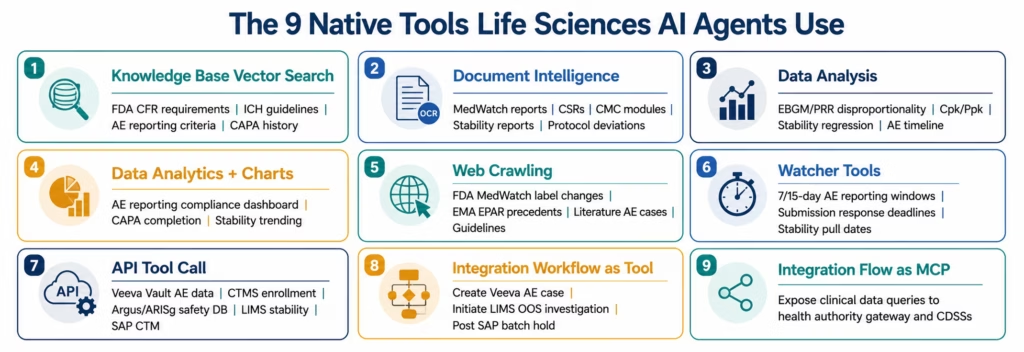
eZintegrations’ Level 3 AI Agents operate through 9 native enterprise tools. Each has specific life sciences applications that make the difference between a surface-level investigation and a comprehensive pre-assembled briefing package.
1. Knowledge Base Vector Search Searches knowledge bases using semantic similarity. In life sciences: the regulatory requirements knowledge base (FDA CFR requirements, ICH guidelines, EMA guidances: searchable by requirement topic), the adverse event regulatory reporting knowledge base (expedited reporting criteria by jurisdiction, product type, and event seriousness), the CAPA history knowledge base (prior deviation root causes and corrective actions by process and product), the clinical trial protocol knowledge base (protocol versions, amendment history, eligibility criteria), and the signal assessment precedent knowledge base (past signal assessments for similar product-event combinations).
2. Document Intelligence Reads unstructured life sciences documents. In life sciences: MedWatch adverse event reports (extracting patient demographics, event description, suspect product, reporter details), clinical study reports (extracting efficacy and safety data points), investigator brochures, CMC module sections (extracting batch data, method descriptions, specification limits), stability study reports (extracting storage conditions, testing intervals, results, trend data), audit reports (finding descriptions, critical/major/minor classification), and clinical monitoring reports (protocol deviations, subject disposition).
3. Data Analysis Performs statistical and analytical calculations. In life sciences: disproportionality analysis for pharmacovigilance signal detection (Empirical Bayes Geometric Mean, Proportional Reporting Ratio), process capability analysis for CMC data (Cpk, Ppk), stability trend analysis (regression, confidence interval for shelf life estimation), clinical data completeness scoring (percentage of required data points populated across EDC), and adverse event timeline analysis (onset, duration, resolution, rechallenge/dechallenge narrative construction).
4. Data Analytics with Charts/Graphs/Dashboards Generates visual summaries. In life sciences: adverse event reporting compliance dashboard by product and market, CAPA completion rate by site and product, stability data graphical trending by storage condition and product, clinical enrollment versus plan by site, and regulatory submission milestone tracking.
5. Web Crawling Retrieves content from web-based sources. In life sciences: monitoring FDA MedWatch for label changes affecting similar products, monitoring EMA EPAR database for relevant precedent decisions, checking published scientific literature for case reports of similar adverse events, monitoring FDA warning letters for related product or process issues, and checking regulatory authority websites for guideline updates relevant to active submissions.
6. Watcher Tools Monitors systems and triggers on specified conditions. In life sciences: monitoring adverse event database for expedited reporting window deadlines (7-day and 15-day thresholds), monitoring regulatory submission tracking system for approaching response due dates, monitoring stability testing schedules for upcoming pull dates and overdue results, monitoring clinical trial enrollment vs plan for sites approaching protocol-mandated pause thresholds, and monitoring Veeva QMS for CAPA action items approaching target completion dates.
7. API Tool Call Calls configured API connectors. In life sciences: the Veeva Vault API call that retrieves all adverse event case data for a product and time period, the CTMS API call that retrieves subject enrollment data and protocol deviation history, the safety database API call (Argus, ARISg, Oracle Empirica) that retrieves expedited safety reports, the LIMS API call that retrieves stability testing results and out-of-trend flags, and the SAP API call that retrieves clinical trial material batch genealogy and disposition records.
8. Integration Workflow as Tool Runs a Level 1 workflow as an agent tool. In life sciences: the agent triggers the “create Veeva adverse event case record” workflow, the “initiate LIMS OOS investigation” workflow, or the “post SAP batch hold” workflow as part of its investigation sequence: subject to human authorisation confirmation.
9. Integration Flow as MCP Exposes life sciences integration capabilities to external AI systems via Model Context Protocol. In life sciences: allows clinical decision support systems or health authority electronic gateway tools to call eZintegrations’ clinical and regulatory data query capabilities as part of their own reasoning.
Life Sciences AI Agent 1: Adverse Event Triage Agent
Pharmacovigilance is where the patient safety stakes of life sciences AI are highest: and where the compliance requirements for autonomous AI are most exacting. The Adverse Event Triage Agent is designed to accelerate the investigation preparation that precedes the pharmacovigilance physician’s clinical assessment, not to replace it.
The pharmacovigilance challenge: adverse event cases arrive from multiple sources (spontaneous reports via MedWatch and EudraVigilance, literature cases, clinical trial cases, company-sponsored programme cases) in variable formats. Before a PV physician can make the causality and seriousness assessment, someone must compile the complete case: all narratives, the patient’s relevant medical history, the suspect product dosing history, the event description and outcome, the reporter information, and the expedited reporting status relative to the applicable regulatory deadline.
For complex cases with multiple narratives across different databases, this compilation takes 60-90 minutes per case. For a PV team processing 40-60 cases per month, this is 40-90 hours of case preparation that precedes the clinical assessment work.
Agent goal: “Compile the complete adverse event case for physician review: all narratives, patient history, product dosing, reporting status, and expedited reporting deadline assessment.”
Agent investigation sequence:
-
API Tool Call (primary safety database: Argus, ARISg, or Oracle Empirica): retrieves all case narratives for this AE case: initial report, follow-up reports, any aggregate narratives, and the case version history.
-
Document Intelligence: reads each narrative document (often PDF or structured text exports) and extracts structured fields: patient demographics, medical history, suspect product and dose, event description, event onset, event outcome, rechallenge/dechallenge information, and reporter details.
-
API Tool Call (CTMS: for clinical trial cases): if the case is from a clinical trial, retrieves the subject’s protocol data, the dosing history in the trial, any relevant medical history from the subject’s study file, and the investigator’s assessment if available.
-
Knowledge Base Vector Search (regulatory reporting requirements): retrieves the expedited reporting criteria applicable to this case: the product type (biologic, small molecule, medical device), the market (US, EU, Japan, rest of world), the clinical setting (trial vs post-market), and the event seriousness classification criteria. Calculates the reporting deadline from the date of initial receipt.
-
Web Crawling (literature search): for cases involving rare or unusual adverse events, the agent retrieves recent published case reports for the same drug-event combination: providing the PV physician with relevant published context for the causality assessment.
-
Data Analysis: compiles the case timeline (event onset relative to dosing, duration, resolution) and checks whether this case meets expedited reporting criteria under each applicable jurisdiction.
The PV physician receives a structured case brief:
- Complete case narrative compilation (all sources)
- Structured data extraction (demographics, medical history, event timeline, product)
- Expedited reporting status and deadline by jurisdiction
- Published literature context
- Case completeness score (are all required fields populated?)
The physician’s role: clinical causality assessment, seriousness determination, and expedited report preparation: informed by a complete pre-assembled case rather than a manually compiled one. Case review time: 20-30 minutes for a complex multi-narrative case versus 60-90 minutes of data compilation plus review.
Life Sciences AI Agent 2: Regulatory Submission Gap Agent
Regulatory submissions: NDA, BLA, MAA, ANDA, PMA: require that the complete body of supporting data meets the applicable regulatory authority’s requirements in format, content, and completeness. Gaps in the submission package: missing data modules, out-of-format sections, data integrity issues, incomplete references: lead to Refuse to File (RTF) letters, Major and Minor Deficiency letters, and Complete Response Letters that set back product approval timelines by months or years.
Manual submission gap review is a high-stakes, high-effort activity: a regulatory affairs scientist must systematically check dozens to hundreds of data points across each CTD module against the applicable regulatory requirements. For a complex NDA or BLA, this review across all modules takes weeks.
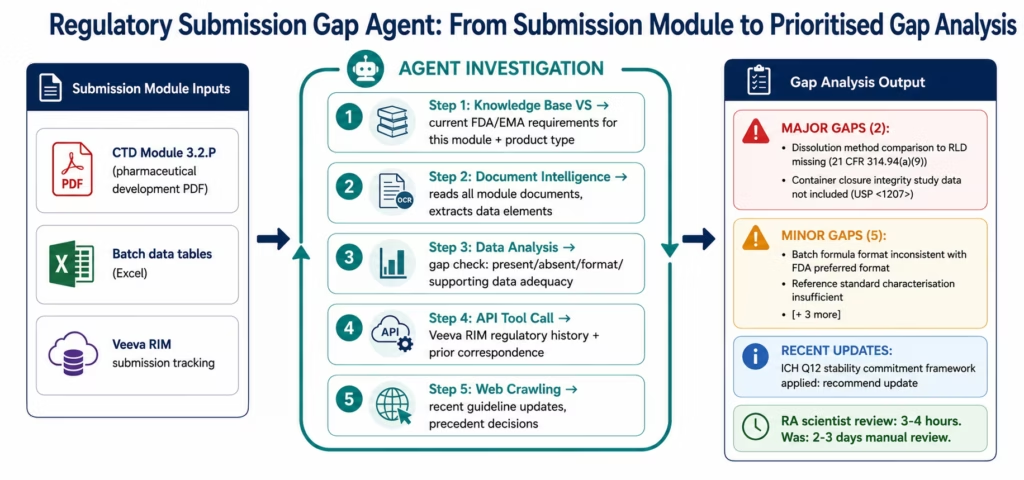
Agent goal: “Review this regulatory submission module against current FDA/EMA requirements, identify data gaps and format issues, and produce a structured gap analysis for the regulatory affairs team.”
Agent investigation sequence:
-
Knowledge Base Vector Search (regulatory requirements): retrieves the current FDA Content of a Complete Submission or EMA Module requirements for this submission type (NDA, BLA, ANDA, MAA), this product category (biologic, small molecule, combination product), and the current guideline versions (ICH M4, ICH Q8-Q12, product-specific guidances). The knowledge base is maintained with current guideline versions: the agent queries against what the regulation requires today, not what the last submission used.
-
Document Intelligence: reads the submitted module sections (PDF eCTD components or Veeva RIM document store), extracting: data tables and their completeness, method descriptions, specification statements, batch data summaries, and cross-references to other modules.
-
Data Analysis: performs the gap check: for each required data element in the applicable guideline, is it present in the submission module? Is it in the required format? Does the data support the claim being made? Produces a structured gap list with severity classification (Major: could result in RTF or deficiency letter; Minor: reviewer request but unlikely to affect approvability; Informational: considered best practice but not required).
-
API Tool Call (Veeva RIM): retrieves the regulatory submission tracking record for this submission: the filing history, any prior correspondence with the health authority, previous deficiency letters and responses, and the current submission timeline.
-
Web Crawling: checks the FDA and EMA websites for any recent guideline updates, draft guidances, or precedent decisions that affect requirements for this submission type or product category: ensuring the gap analysis reflects the most current regulatory expectations.
The regulatory affairs scientist receives a prioritised gap analysis:
- Major gaps requiring immediate attention (with the specific regulatory requirement citation)
- Minor gaps and formatting issues
- Recent guideline changes that affect this submission
- Cross-references to prior health authority correspondence that may inform gap response strategy
Time to prepare this gap analysis manually: 2-3 days for a single CTD module. With the Regulatory Submission Gap Agent: the scientist reviews the pre-assembled gap list in 3-4 hours and applies regulatory strategy judgment to the prioritised findings.
Life Sciences AI Agent 3: Clinical Data Discrepancy Agent
Clinical data quality is foundational to regulatory submission integrity. Discrepancies between the electronic data capture (EDC) system, the clinical trial management system (CTMS), the central laboratory data, the pharmacokinetics database, and the safety database introduce inconsistencies that can delay regulatory submissions and raise reviewer concerns about data integrity.
Manual discrepancy investigation involves the clinical data manager or data quality specialist retrieving the same data point from multiple systems and determining whether a difference is a legitimate data update (the right value was recorded later), an error (the wrong value was recorded), or a systemic data mapping issue (the two systems use different conventions for encoding the same value).
For complex clinical programmes with multiple studies, this is a continuous background activity consuming 20-30% of clinical data management team capacity.
Agent goal: “Investigate this clinical data discrepancy: retrieve the data from all relevant systems, determine the discrepancy type and root cause, and route a structured data query to the appropriate team.”
Agent investigation sequence:
-
API Tool Call (EDC system: Medidata Rave, Oracle Clinical, Veeva Vault CDMS): retrieves the subject’s data record for the discrepancy field: the current value, the audit trail showing all previous values and edit dates, and the reason for change documentation for any edits.
-
API Tool Call (CTMS): retrieves the visit schedule, the expected data points for this visit, and the protocol specification for this data field (is it a required field? what are the valid values or ranges?).
-
API Tool Call (central laboratory or PK database): for laboratory or pharmacokinetic data discrepancies, retrieves the originating laboratory result: the raw value, the unit, the normal range, and the collection date and time.
-
API Tool Call (safety database): for AE-related data discrepancies (where a clinical data field may conflict with a safety database report), retrieves the corresponding adverse event record to check consistency.
-
Document Intelligence: reads any associated source document (clinical notes, case report form pages) that may clarify the intended value, if a scanned source document is available in the document management system.
-
Data Analysis: classifies the discrepancy: legitimate data update (EDC shows a more recent value than the external system: the external system needs updating), data entry error (the EDC value is inconsistent with all other data sources), systemic mapping issue (both systems have valid values but different conventions), or missing data (one system has the value, the other has a missing data indicator).
The data query routes to the appropriate team with the discrepancy type pre-classified, the supporting data from all systems pre-assembled, and the recommended resolution path. Clinical data manager review time: 5-10 minutes per discrepancy versus 45-60 minutes of multi-system manual investigation.
Life Sciences AI Agent 4: Life Sciences Supply Chain Deviation Agent
Clinical trial material (CTM) supply chain deviations carry a unique dimension beyond commercial pharmaceutical deviations: potential patient dosing impact. When a CTM batch deviation occurs, the question is not just whether the product meets specification but whether any study subjects received the potentially non-conforming product: and if so, what was the clinical impact.
The CTM supply chain deviation investigation requires connecting supply chain data (batch genealogy, distribution records, depot inventory), clinical data (subject dosing records from the CTMS and EDC), and quality data (batch release records, deviation details) into a single patient impact assessment.
Agent goal: “Investigate this CTM deviation: assess whether any subjects received the affected material, determine the clinical risk, and route a structured deviation impact brief for medical monitor review.”
Agent investigation sequence:
-
API Tool Call (SAP or clinical supply management system): retrieves the affected batch’s distribution record: which depots or clinical sites received material from the affected batch, the quantities shipped, the shipment dates, and the remaining depot inventory.
-
API Tool Call (CTMS): retrieves the randomisation and dosing records for subjects at the sites that received the affected material: subject IDs, dosing dates, kit numbers dispensed, and the subject treatment assignment (blinded if applicable).
-
API Tool Call (EDC): retrieves clinical data for the potentially affected subjects: any adverse events reported, any protocol deviations, and the subject’s current trial status (ongoing, completed, discontinued).
-
API Tool Call (LIMS/quality system): retrieves the batch release record, the deviation details, the test results for the affected batch, and the proposed disposition recommendation from the quality team.
-
Knowledge Base Vector Search (clinical protocol knowledge base): retrieves the protocol’s stopping rules and dose modification criteria relevant to this deviation type: is there a defined medical monitor review trigger for this type of CTM non-conformance?
-
Data Analysis: calculates the patient impact assessment: how many subjects received the affected material? Over what dosing period? What is the deviation’s potential clinical relevance (e.g., a potency deviation of 5% in a narrow therapeutic index product is clinically different from the same deviation in a broad therapeutic index agent)?
The medical monitor and clinical operations team receive a structured deviation impact brief:
- Number of subjects potentially exposed
- Dosing dates and kit numbers dispensed
- Adverse events reported by potentially affected subjects
- Deviation details and proposed disposition
- Protocol stopping rules and medical monitor review criteria
- Recommended action (continue/pause study, notify subjects, notify health authority)
The medical monitor makes the clinical judgment. The agent ensures she makes it from a complete, pre-assembled evidence package rather than spending 1-2 hours manually building it.
Life Sciences AI Agent 5: Post-Market Surveillance Intelligence Agent
Post-market pharmacovigilance and medical device post-market surveillance are continuous obligations for any approved product. The volume of incoming safety data: spontaneous reports, literature cases, post-market studies, health authority requests: and the analytical requirements for periodic safety update reports (PSURs/PBRERs), periodic benefit-risk evaluation reports, and proactive signal detection exceed the capacity of most PV teams to handle manually at the required quality and speed.
The Post-Market Surveillance Intelligence Agent continuously monitors safety signals and supports the preparation of period safety reports.
Signal detection and triage:
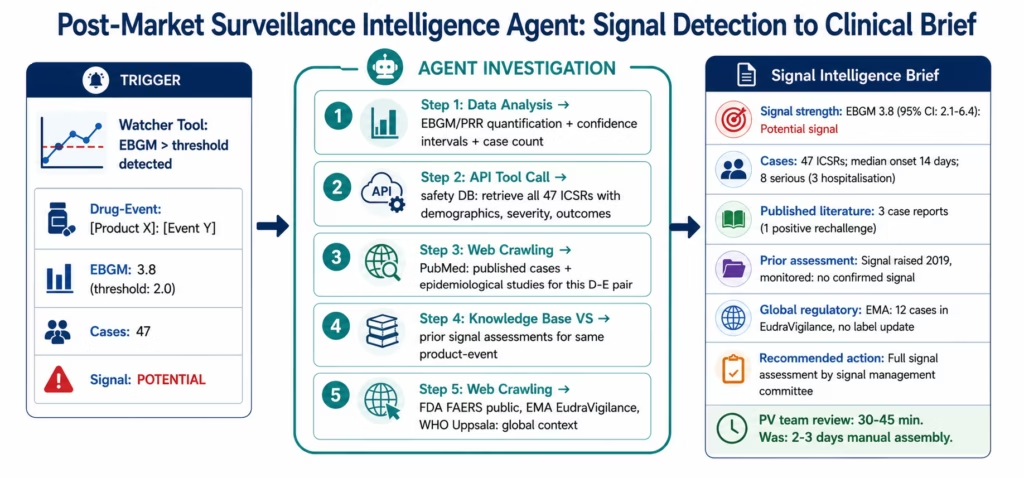
The Watcher Tool continuously monitors the adverse event database for drug-event combinations where the observed reporting rate is statistically elevated above the background rate. When a potential signal is detected (using EBGM or PRR disproportionality measures above the configured threshold), the agent activates:
-
Data Analysis (signal quantification): calculates the EBGM (Empirical Bayes Geometric Mean) and PRR (Proportional Reporting Ratio) for the drug-event combination across the cumulative safety database, with confidence intervals and the corresponding case count.
-
API Tool Call (safety database): retrieves all individual case safety reports (ICSRs) contributing to the signal: patient demographics, event severity, outcomes, time to onset, and any rechallenge/dechallenge information.
-
Web Crawling (literature): searches PubMed and other scientific literature databases for published case reports and epidemiological studies examining the same drug-event combination: providing published context for the signal assessment.
-
Knowledge Base Vector Search (signal precedent knowledge base): searches the organisation’s prior signal assessment records for the same product-event combination: has this signal been assessed before? Was it confirmed, refuted, or assessed as requiring monitoring?
-
Web Crawling (regulatory): checks the FDA FAERS public data, EMA EudraVigilance signals published in EPAR updates, and WHO Uppsala database public signals for the same drug-event combination: providing global regulatory context.
-
Data Analysis (contextual): assembles the cumulative evidence: the disproportionality statistics, the clinical description of the cases, the published literature summary, and the prior signal assessment history. Calculates whether the current evidence meets the threshold for escalation to the signal management committee.
The PV signal assessment team receives a pre-assembled signal intelligence brief: the statistical signal strength, the case description summary, the published literature summary, the global regulatory context, and a signal strength classification (potential signal requiring full assessment, weak signal requiring monitoring, no signal). The PV physician’s time shifts from days of manual literature search and database analysis to reviewing a pre-assembled brief and applying clinical pharmacology expertise to the signal assessment decision.
Level 4: Goldfinch AI for Life Sciences Executive Intelligence
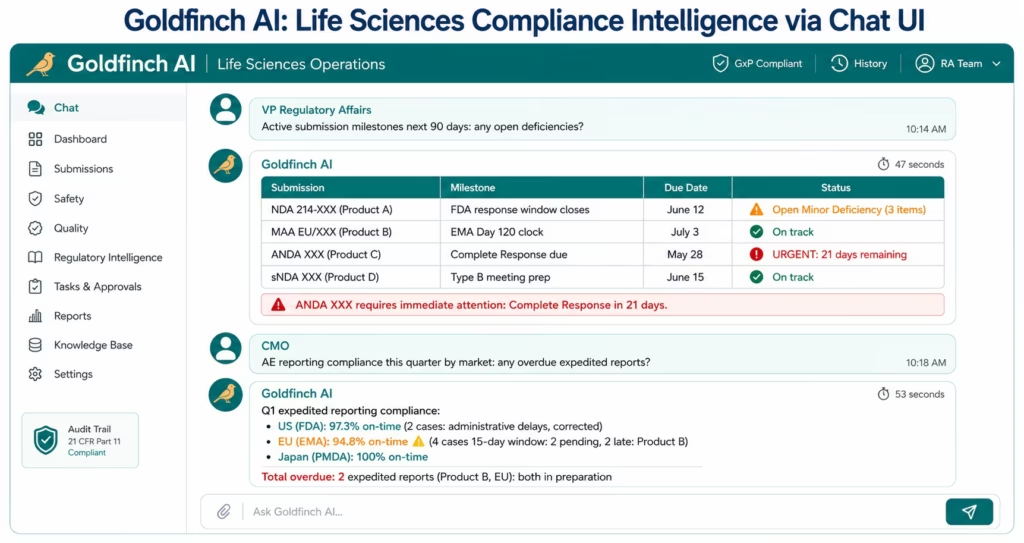
Individual AI agents handle individual investigation types. Goldfinch AI coordinates multiple agents simultaneously and gives life sciences leadership natural language access to live compliance and clinical intelligence.
VP of Regulatory Affairs: Monday morning: “What are our active regulatory submission milestones in the next 90 days, and are there any submissions where we have open deficiencies?”
Goldfinch AI queries the Veeva RIM regulatory tracking system via the Workflow Node, retrieves all submissions with milestones in the next 90 days, identifies any submissions with open deficiency letters or information requests, and returns a prioritised regulatory milestone brief in under 60 seconds. Previously: the regulatory calendar report was prepared by a regulatory coordinator from four different tracking systems the day before the monthly regulatory review.
Chief Medical Officer: quarterly safety review: “What is our adverse event reporting compliance rate by market this quarter, and are there any products where we have overdue expedited reports?”
Goldfinch AI queries the safety database and regulatory tracking system, calculates expedited reporting compliance rates by product and market, identifies any overdue reports, and returns a safety compliance summary in under 60 seconds.
VP of Quality: “How many open CAPA action items do we have by site and what percentage are past their target completion date?”
Goldfinch AI queries Veeva QMS, calculates CAPA completion rates by site, identifies overdue action items with their age and risk level, and returns a quality compliance dashboard in under 60 seconds.
Chief Scientific Officer: “Are there any active safety signals for our commercial portfolio that are currently in formal assessment?”
Goldfinch AI queries the PV signal tracking system, retrieves all signals in formal assessment across the commercial portfolio, and returns a signal management dashboard with the signal strength, the assessment stage, and the next decision milestone.
Workflow Node: automated weekly compliance brief: Every week, the Goldfinch AI Workflow Node coordinator dispatches parallel agents across Veeva QMS, the safety database, the regulatory tracking system, and the clinical supply system. The coordinator synthesises findings and delivers a structured compliance intelligence brief to the life sciences leadership team: overdue regulatory actions, adverse event reporting compliance, CAPA status, and supply deviation alerts: without anyone requesting it.
GxP Governance and 21 CFR Part 11 Compliance for AI Agents
Life sciences AI agents operate in one of the most regulated environments of any enterprise software deployment. Every design decision: how data is accessed, how AI output is generated, how human oversight is implemented, how audit trails are maintained: must reflect the regulatory requirements that govern the handling of clinical and pharmaceutical data.
Data access architecture: source systems never modified:
Every life sciences AI agent retrieves data from validated source systems via their official APIs. The Veeva Vault API, the safety database API, the CTMS API, and the LIMS API are called in read mode: the agent retrieves data without writing to or modifying the source record. The validated state of each source system is preserved. The AI agent’s data retrieval is documented in the eZintegrations audit trail; the source system’s own audit trail documents the data at its source.
21 CFR Part 11 compliant audit trail:
Every agent action: every API call, every Document Intelligence reading, every Knowledge Base search, every Data Analysis calculation, and every routing decision: generates an immutable, timestamped audit log entry in eZintegrations’ system. For adverse event cases and regulatory submissions, these audit log entries document:
- The data source accessed (Veeva Vault, safety database, CTMS)
- The specific records or documents read
- The data extracted or calculated
- The output produced (case brief, gap analysis, signal brief)
- The identity of the agent’s service account
- The timestamp (UTC)
- The identity of the human reviewer who received the brief
This audit trail satisfies 21 CFR Part 11’s requirements for systems that create or modify records that are used in FDA regulated activities, supporting both FDA inspections and internal quality audits.
Mandatory human-in-the-loop for regulated life sciences decisions:
In eZintegrations’ life sciences AI agent configuration, the HITL gate is not optional. For every regulated decision that the AI agent’s investigation supports, the qualified human review step is configured as a mandatory workflow gate before any action that creates or modifies a regulated record:
- Adverse event causality assessment: the PV physician’s clinical assessment is required before any expedited safety report is generated or submitted
- Batch release/rejection: the Qualified Person’s (QP) or quality director’s authorisation is required before any batch disposition change is made in SAP or the quality system
- CAPA closure: the quality professional’s authorised electronic signature in Veeva Vault is required before CAPA closure
- Regulatory submission finalisation: the regulatory affairs director’s review and approval is required before any submission component is finalised in Veeva RIM
SOC 2 Type II certification, HIPAA BAA, and GxP compliance:
eZintegrations is SOC 2 Type II certified. All AI agent processing runs within eZintegrations’ own infrastructure: clinical data, adverse event narratives, patient information, and regulatory documents are not sent to external AI providers. For life sciences organisations where AI agent workflows process data covered by HIPAA (clinical trial data involving US subjects, pharmacovigilance data with identifiable patient information), eZintegrations provides a signed HIPAA Business Associate Agreement (BAA). For EU GMP Annex 11 regulated systems, validation documentation support (IQ/OQ/PQ templates) is provided.
Key Outcomes and Results
Life sciences organisations deploying AI agents across pharmacovigilance, regulatory affairs, clinical data management, and clinical supply report measurable improvements within 60-90 days:
Pharmacovigilance:
- Complex AE case preparation time: 60-90 minutes → 15-20 minutes (AI-compiled case brief)
- Expedited reporting compliance: improved through automated deadline monitoring and case preparation
- Signal assessment initiation: 2-3 days manual assembly → 30-45 minutes AI-assembled brief review
- Case narratives across 5+ sources: manual compilation → automatic multi-source retrieval
Regulatory Affairs:
- CTD module gap analysis: 2-3 days → 3-4 hours (AI pre-assembled gap list with regulatory citations)
- APR/PSUR data package assembly: 6-8 weeks → 2-3 weeks (AI pre-assembled data package)
- Submission milestone visibility: monthly report → real-time Chat UI query
- Response to health authority: deficiency letter review initiated faster with pre-assembled context
Clinical Data Management:
- Clinical data discrepancy investigation: 45-60 min → 5-10 min (AI pre-assembled query context)
- Data reconciliation across EDC, CTMS, safety: periodic exercise → continuous agent monitoring
- CDM team capacity on compilation: 20-30% → under 5% (redirected to data quality judgment)
Quality and Supply Chain:
- CTM deviation patient impact assessment: 1-2 hours → 15-20 minutes AI-assembled brief
- Batch release QP package compilation: 2-3 hours → 45-60 minutes AI-compiled review
- CAPA overdue visibility: monthly review → real-time Chat UI query
- Clinical supply deviation scope determination: manual multi-system → automated genealogy retrieval
How to Get Started
Step 1: Choose your highest-volume qualified-person bottleneck
Identify where your qualified pharmacovigilance scientists, regulatory affairs specialists, or QA professionals spend the most time on data compilation rather than professional judgment. For PV teams: AE case preparation. For RA teams: submission gap analysis. For QA teams: batch release package compilation. The bottleneck with the highest ratio of compilation time to judgment time is your first life sciences AI agent deployment.
Step 2: Build your life sciences knowledge bases
Life sciences AI agents are most effective when they can access domain-specific regulatory knowledge. Before deploying the AE Triage Agent: load the applicable ICH E2x guidelines, FDA expedited reporting requirements (21 CFR 314.81, 21 CFR 600.80), EMA Good Pharmacovigilance Practice (GVP) Module VI requirements, and product-specific reporting requirements into the PV regulatory knowledge base. Before deploying the Regulatory Submission Gap Agent: load the ICH M4 CTD guideline, current FDA and EMA product-specific guidances for your therapeutic area, and your organisation’s submission preparation SOPs.
Step 3: Import the life sciences AI agent template from the Automation Hub
Visit the Automation Hub and filter by Life Sciences / Pharma AI Agents. Import the template for your target use case. Configure your Veeva Vault connection (Vault API with OAuth 2.0), your safety database connection (Argus, ARISg, or Oracle Empirica API), and your CTMS connection (Medidata, Oracle Clinical, Veeva Vault CDMS).
Step 4: Configure GxP-appropriate confidence thresholds and HITL gates
For life sciences AI agents, confidence thresholds should be set conservatively: routes more cases to human review to ensure qualified professional oversight of all regulated records. Configure the mandatory HITL gates for all actions that create or modify regulated records. Establish the RBAC access controls for agent service accounts with minimum necessary access to each source system.
Step 5: Validate and qualify the agent system
For GxP environments, the AI agent system is subject to your computer system validation programme. Prepare the URS, execute IQ/OQ test scripts, and document PQ performance using representative sample cases from your actual production data environment. eZintegrations provides life sciences validation support documentation to accelerate the GxP qualification.
Book a free demo and bring your highest-volume qualification bottleneck. We will show you what AI agent investigation looks like for your specific Veeva Vault, safety database, and clinical systems environment.
FAQs
Life sciences AI agents receive a specific investigation goal such as compiling an adverse event case for physician review, analysing a submission module for gaps, or investigating a clinical data discrepancy, and use enterprise tools to complete the investigation autonomously. These tools include API Tool Call for querying safety databases and clinical systems, Document Intelligence for reading regulatory and clinical documents, Knowledge Base Vector Search for regulatory requirement lookup, Data Analysis for statistical evaluation, and Watcher Tools for monitoring deadline-critical systems. The output is always a structured briefing package that a qualified human professional reviews and approves before any regulated action is taken. All AI inference runs natively within eZintegrations infrastructure, meaning no clinical data, patient information, or regulated records are sent to external AI providers.
Standard Automation Hub life sciences AI agent templates typically go live in 10-15 days from template import to production activation in non-GxP environments. For GxP validated environments, computer system validation adds approximately 6-10 weeks including URS preparation, IQ and OQ execution, and PQ documentation. eZintegrations provides validation support documentation to accelerate qualification timelines. A full life sciences AI agent programme covering adverse event triage, regulatory gap analysis, clinical data discrepancy investigation, and supply chain intelligence generally requires 12-20 weeks in a validated GxP environment.
Yes, eZintegrations provides native integration with Veeva Vault through REST APIs with OAuth 2.0 covering Vault QMS, Vault Safety, Vault RIM, and Vault CDMS. Argus Safety connects through the Argus REST API, ARISg through REST APIs, Oracle Empirica Signal through REST APIs, and Medidata Rave through Medidata REST APIs. Oracle Clinical One and Oracle CTMS are also supported through REST integration. LIMS systems including LabVantage, STARLIMS, Labware, and Watson LIMS connect through REST APIs or database connectors. SAP S/4HANA integration uses OData V4. For on-premises life sciences systems, eZintegrations connects securely through IPSec Tunnel. The API Catalog includes pre-configured authentication and rate-limit handling for major life sciences platforms.
Yes, with appropriate governance controls. Every AI agent action on regulated records generates an immutable 21 CFR Part 11 compliant audit trail entry. Data access remains read-only for validated source systems, meaning the agent does not modify source records in Veeva, LIMS, or safety databases without explicit human authorisation. Mandatory human-in-the-loop gates prevent autonomous adverse event causality assessment, batch disposition, or regulatory submission decisions. eZintegrations provides IQ, OQ, and PQ validation support documentation and operates within SOC 2 Type II certified infrastructure. Native AI inference ensures that regulated data never leaves eZintegrations infrastructure.
Level 2 AI Workflows handle high-volume consistent compliance processing with AI at specific predetermined workflow steps. For example, a deviation is recorded, Document Intelligence extracts the information, LLM Classification assigns severity, and a Veeva record is created. The sequence is fixed and the AI performs specific processing tasks. Level 3 AI Agents handle complex investigations requiring adaptive multi-system reasoning. For example, an adverse event triage agent receiving a complex multi-source case determines which safety databases to query, whether to retrieve clinical trial data, how to handle missing information, and what literature to search based on the evolving investigation context. Workflows are designed for consistent high-volume compliance processing, while agents support complex investigations requiring qualified professional oversight.
The adverse event triage agent prepares and assembles the case data package but does not assess causality, seriousness, or expectedness, which remain clinical and regulatory responsibilities reserved for qualified pharmacovigilance physicians. The agent retrieves narratives, compiles the case timeline, calculates expedited reporting windows, and searches published literature. The pharmacovigilance physician receives a complete pre-assembled case package for clinical assessment. The physician independently performs the causality assessment, seriousness determination, and reporting decision with their electronic signature recorded in the safety database. The AI agent accelerates the preparation and investigation process while preserving all qualified professional regulatory responsibilities. 1. How do AI agents work in life sciences operations?
2. How long does it take to set up a life sciences AI agent?
3. Does eZintegrations work with Veeva Vault, Argus, Medidata, and other life sciences systems?
4. Are life sciences AI agents appropriate for regulated environments including FDA 21 CFR Part 11?
5. What is the difference between Level 2 AI Workflows and Level 3 AI Agents for life sciences?
6. How does the adverse event AI agent work without violating pharmacovigilance regulations?
Conclusion: Life Sciences Expertise, Amplified
The pharmacovigilance analyst who spends 90 minutes compiling a case before spending 20 minutes on the clinical assessment that requires her expertise. The regulatory affairs scientist who spends two days on CTD module gap checking before spending two hours on the regulatory strategy that requires his judgment. The clinical data manager who spends 45 minutes on multi-system data retrieval before spending 5 minutes on the discrepancy resolution that requires her understanding of the data.
Life sciences AI agents change this ratio, consistent with McKinsey & Company research on AI agents in life sciences operations. Not by replacing the pharmacovigilance physician’s clinical assessment. Not by replacing the regulatory affairs scientist’s submission strategy. Not by replacing the QP’s batch release judgment. By eliminating the data retrieval and compilation that currently separates the arrival of an exception from the qualified professional’s ability to make a decision about it.
The PV physician still assesses causality. The RA scientist still makes the regulatory strategy call. The QP still releases the batch. The AI agents ensure they do these things with complete, pre-assembled evidence packages: not with manually compiled case files built from five separate system exports.
eZintegrations deploys five life sciences AI agents within a 21 CFR Part 11 compliant architecture: mandatory human-in-the-loop gates for all regulated decisions, immutable audit trails for every data access and AI action, native AI inference so regulated data never leaves the compliance boundary, and read-only access to validated source systems that preserves their validated state.
Book a free demo and bring your highest-volume qualified-professional bottleneck. We will show you what AI agent investigation looks like for your specific Veeva, safety database, and clinical systems environment.
Import a life sciences AI agent template from the Automation Hub and start today.