AI Workflow Automation for Pharma: Compliance-Ready Intelligent Data Pipelines
May 20, 2026AI workflow automation for pharma builds compliance-ready intelligent data pipelines that connect Veeva Vault, SAP S/4HANA, LIMS, MES, and regulatory submission systems: automating batch record compilation, deviation routing, change control document processing, clinical data reconciliation, and GxP audit trail generation. eZintegrations delivers 21 CFR Part 11 and EU GMP Annex 11 compliant AI workflows with native Document Intelligence, LLM classification, and Data Analysis nodes, all running within eZintegrations’ validated infrastructure without sending regulated data to external AI providers.
TL;DR
- Pharmaceutical and biotech operations generate more compliance-critical, document-intensive data than almost any other regulated industry. Batch records, deviation reports, change control packages, CAPA documentation, and regulatory submissions all require assembling data from multiple systems: Veeva Vault, SAP, LIMS, MES, quality systems: and maintaining a complete, auditable data trail for FDA, EMA, and other regulatory bodies.
- Most pharma organisations close the gaps between these systems with manual data entry, PDF email chains, and spreadsheet-based tracking. These manual processes introduce transcription errors, create audit trail gaps, and consume QA and regulatory affairs capacity that belongs on higher-value work.
- eZintegrations’ Level 2 AI Workflows and Level 3 AI Agents deliver 21 CFR Part 11 compliant intelligent data pipelines for five high-value pharma use cases: batch record compilation and review, deviation management routing, change control document processing, clinical-to-commercial data reconciliation, and regulatory submission data assembly.
- All AI processing runs natively within eZintegrations’ GxP-ready infrastructure: no regulated data is sent to external AI providers. Signed Business Associate Agreement (BAA) available for HIPAA-covered workflows.
- Level 4 Goldfinch AI gives QA Directors, Regulatory Affairs heads, and operations VPs natural language access to live compliance and operational data.
The Pharma Data Pipeline Problem: Compliance at Every Step
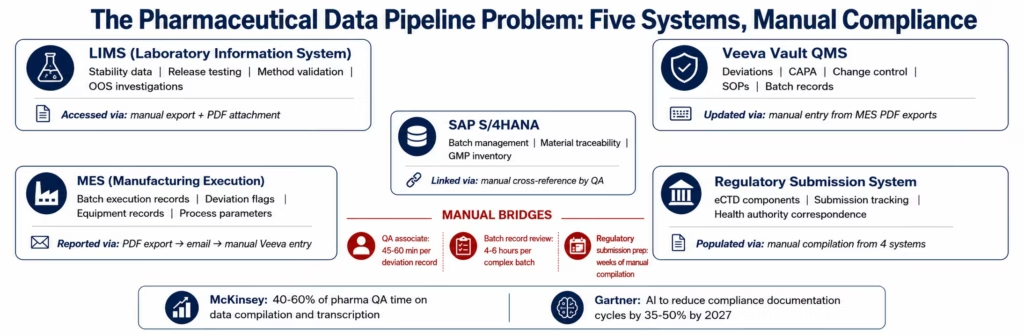
Dr. Priya Nair is the QA Director at a mid-size pharmaceutical manufacturer. Her quality team runs a LIMS for laboratory data, Veeva Vault QMS for quality documentation and CAPA management, SAP S/4HANA for ERP and batch management, a MES for production execution, and a regulatory submission system. Five systems that collectively hold the documentation required to demonstrate product quality, safety, and compliance to FDA and EMA.
When a deviation occurs during batch manufacturing, here is what happens: the MES operator records the deviation in the MES. The QA associate exports the deviation report from the MES as a PDF. She opens Veeva Vault, manually creates a deviation record, uploads the MES PDF, and manually enters the batch number, product code, deviation description, severity, and affected steps from the PDF into Veeva’s structured fields. She then manually retrieves the relevant LIMS test results from the LIMS system, attaches them to the Veeva deviation record, and routes the deviation to the appropriate QA reviewer. Average time: 45-60 minutes per deviation. In a busy quarter, the quality team processes 80-120 deviations.
When a batch record review is due, the QA reviewer manually compiles data from four sources: the MES batch execution record, the LIMS test results for the batch, the SAP material consumption and batch traceability record, and the environmental monitoring data from the facility monitoring system. She checks each data point against the batch manufacturing record specification, documents exceptions, and initiates investigation workflows for any out-of-specification findings. Average time for a complex batch: 4-6 hours.
These are not edge cases. McKinsey estimates that pharma quality and regulatory teams spend 40-60% of their time on data compilation, transcription, and routing tasks that AI workflows can automate. Gartner projects that by 2027, leading pharmaceutical organisations will use AI to reduce compliance documentation cycle times by 35-50%.
The compliance requirement does not go away. Every step still needs an audit trail. Every piece of data still needs to be traceable to its source. Every human decision still needs to be documented. What changes is who does the compilation and routing work: and how long it takes.
Before vs After: AI Workflow Transformation in Pharma
| Process | Before AI Workflows | After AI Workflows |
|---|---|---|
| Deviation record creation | QA manually transcribes MES deviation data into Veeva Vault (45-60 min per deviation) | MES deviation event triggers AI workflow: data extracted, Veeva record created, routed for review |
| Batch record compilation | QA reviewer manually pulls data from LIMS, MES, SAP, and EM system (4-6 hrs per complex batch) | AI compiles data from all four sources, flags exceptions, routes structured review package (1-2 hrs review) |
| OOS (Out of Specification) routing | LIMS flags OOS result, QA manually opens investigation, manually notifies production (30-45 min) | LIMS OOS event triggers AI workflow: classified by severity, investigation record created, production notified |
| Change control document review | QC reviewer reads change control package PDFs, manually extracts impact assessment data (2-3 hrs per CCR) | Document Intelligence reads CCR package, extracts change description, affected products/systems, impact assessment |
| CAPA initiation | Quality team manually assembles deviation history, lab data, and process records (2-4 hrs) | AI Agent retrieves all relevant records from Veeva, LIMS, and SAP, routes pre-assembled CAPA brief (30-45 min review) |
| Stability data monitoring | Scientist manually reviews stability pull results against specification, updates tracking spreadsheet | AI Workflow monitors stability data in LIMS, flags trending results approaching specification limits |
| Regulatory submission data | Regulatory Affairs manually compiles data from CMC, clinical, and quality systems (weeks per submission) | AI Agent retrieves and assembles submission-relevant data from across systems, routes structured draft for RA review |
| Vendor audit findings | Audit team manually enters findings into quality system, routes follow-up actions (2-3 hrs per audit) | Document Intelligence reads audit report, extracts findings by severity, creates Veeva records automatically |
| Environmental monitoring exceedance | EM system flags exceedance, QA manually investigates, manually routes investigation (45-60 min) | EM exceedance event triggers AI: classified by room and organism, Veeva investigation record created, QA notified |
| Clinical data reconciliation | Clinical data management team manually reconciles source data across EDC, CTMS, and safety database | AI Workflow detects discrepancies across clinical systems, classifies discrepancy type, routes structured reconciliation brief |
The Four AI Automation Levels for Pharma
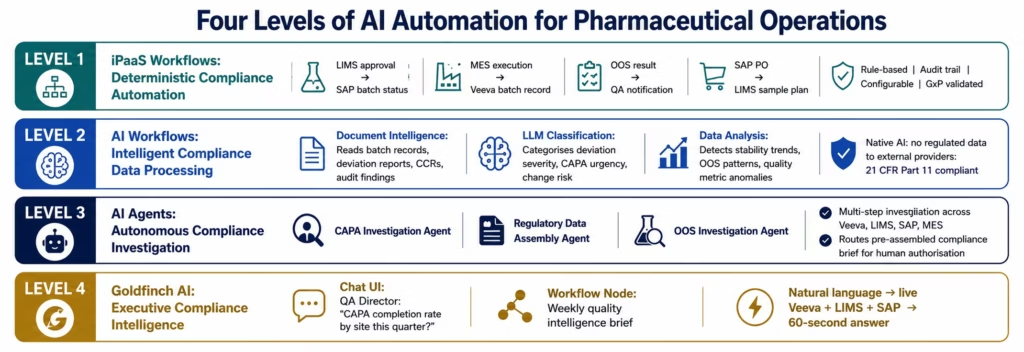
eZintegrations applies AI to pharmaceutical data flows at all four automation levels, each within a compliance architecture appropriate for regulated environments:
Level 1 (iPaaS Workflows): deterministic, rule-based pharma data flows. LIMS test result approved → SAP batch status updated. MES batch executed → Veeva batch record initiated. SAP PO approved → LIMS sample plan triggered. These are high-volume, consistent data flows that run automatically on trigger events. Validated for GxP use with configurable audit logging.
Level 2 (AI Workflows): AI nodes embedded in compliance data pipelines. Document Intelligence reads batch records, deviation reports, change control packages, stability certificates, and audit findings in variable formats: extracting structured data for the quality system without manual transcription. LLM Classification categorises deviation severity, CAPA urgency, and change control risk level. Data Analysis detects statistical trends in stability data, OOS patterns, and quality metrics. All AI inference runs natively within eZintegrations: no regulated data sent to external AI providers.
Level 3 (AI Agents): goal-directed autonomous investigation for complex quality and regulatory exceptions. The CAPA Investigation Agent retrieves deviation history from Veeva, test results from LIMS, and process records from SAP to assemble a CAPA initiation brief. The Regulatory Data Assembly Agent retrieves and packages submission-relevant data from across the pharma system landscape. These agents use 9 native enterprise tools and operate within the same 21 CFR Part 11 compliant audit trail.
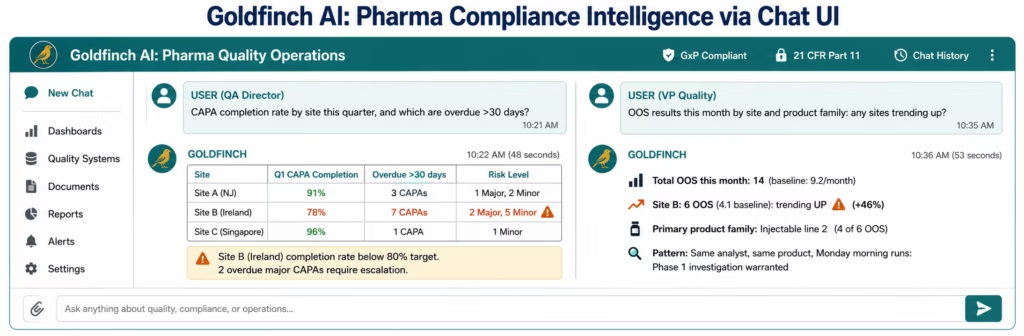
Level 4 (Goldfinch AI): multi-agent orchestration and executive intelligence. The QA Director asks the Chat UI: “What is our CAPA completion rate by site and product line this quarter, and which CAPAs are overdue?” Goldfinch AI queries Veeva QMS via the Workflow Node and returns a formatted answer in under 60 seconds: without a data analyst pulling the report.
AI Workflow 1: Batch Record Compilation and Exception Review
Batch record review is one of the most time-consuming compliance activities in pharmaceutical manufacturing. A pharmaceutical batch cannot be released until the batch record has been reviewed and approved: and the review requires compiling data from multiple systems and verifying that every step was executed within specification.
The traditional process: the QA reviewer manually exports data from each source system, cross-references the data points against the batch manufacturing record, identifies exceptions, and documents the review. For a complex parenteral product with 60+ CPPs (Critical Process Parameters), this takes 4-6 hours.
The Batch Record Compilation AI Workflow:
When a batch execution is completed in the MES and the batch is submitted for QA review:
-
API Tool Call (MES): retrieves the complete batch execution record: every step, every CPP value recorded, every deviation flagged, the equipment used, and the operator records for each operation.
-
API Tool Call (LIMS): retrieves all in-process test results and release testing results for the batch: assay values, purity results, pH, viscosity, sterility test status, endotoxin results, and any OOS or OOT (Out of Trend) flags.
-
API Tool Call (SAP): retrieves the material consumption record: batch numbers of all raw materials and components used, supplier lot numbers, and the SAP goods movement records confirming correct material usage.
-
API Tool Call (environmental monitoring system): retrieves the environmental monitoring data for the manufacturing rooms and time windows associated with this batch: temperature, humidity, viable particle counts, and any exceedances during the batch execution window.
-
Document Intelligence: reads the master batch record specification (the BMR/MBR document from Veeva Vault) to extract the specification limits for each CPP, in-process test, and release test.
-
Data Analysis: compares every recorded value against the specification limit, identifies exceptions (values outside specification), and checks for OOT trends (values within specification but trending toward limits across recent batches of the same product).
-
The compiled batch review package routes to the QA reviewer: every data point pre-populated, every exception pre-flagged with the specific specification limit, and any OOT trends highlighted. The reviewer applies quality judgment: approves, initiates investigation, or rejects: rather than spending hours assembling the data.
QA reviewer’s experience shifts: from 4-6 hours of data compilation to 1-2 hours of substantive quality review. The review is more thorough: the AI consistently checks every data point, while human reviewers under time pressure may miss OOT trends: and faster.
The GxP audit trail: Every AI action in the batch review workflow generates an audit trail entry: the data source accessed, the data retrieved, the comparison performed, and the timestamp. This audit trail satisfies 21 CFR Part 11 requirements for electronic records in GxP environments. The AI’s compilation step is documented: the reviewer’s approval decision is documented: and the complete chain of custody from source data to batch disposition is traceable.
AI Workflow 2: Deviation Management and CAPA Routing
Pharmaceutical deviations: planned and unplanned departures from approved procedures or specifications: require a documented management process: detection, classification, investigation, CAPA initiation if warranted, and impact assessment on product quality. Under FDA 21 CFR 211 and ICH Q10 pharmaceutical quality system guidelines, the deviation management process must be systematic, timely, and fully documented.
Manual deviation management introduces two problems: transcription errors (when deviation data is manually transferred from the MES to the quality system) and routing delays (when classification and assignment depend on a QA associate to manually assess severity and route to the appropriate team).
The Deviation Management AI Workflow:
When a deviation is recorded in the MES, a quality system event fires, or a LIMS OOS result is generated:
-
Document Intelligence reads the source deviation record: whether it is a structured MES event, a PDF deviation form, a LIMS OOS notification, or an operator-written deviation report: and extracts: the deviation description, the affected batch, the affected operation, the product, and any contributing factors noted by the operator.
-
LLM Classification assigns:
- Severity: critical (potential patient safety or product quality impact), major (process deviation with potential quality impact, investigation required), minor (documentation or process deviation with no quality impact)
- Category: process deviation, laboratory deviation, equipment deviation, environmental deviation, material deviation
- Investigation requirement: immediate CAPA required, investigation required with 30-day completion target, justification-only closure acceptable
- Routing destination: QA site lead for critical/major, QA coordinator for minor; product-specific quality team if product-related; manufacturing team notification if production is ongoing
-
API Tool Call (Veeva Vault): triggers the Veeva QMS workflow to create a deviation record with all extracted structured data pre-populated: deviation type, severity, category, affected batch, and investigation assignment. The Veeva record creation is a validated system action: the AI does not bypass Veeva’s quality workflow, it populates the data that feeds into Veeva’s validated CAPA process.
-
API Tool Call (SAP): retrieves the batch status and any related batches that use the same equipment or materials: providing the QA reviewer with the scope of potential batch impact at the time the deviation record is created.
The QA associate’s role shifts from 45-60 minutes of manual record creation and routing to reviewing the AI-created Veeva record, confirming the severity classification, and approving the routing. Time: 10-15 minutes.
The CAPA initiation path: For major and critical deviations, the deviation record automatically triggers the CAPA initiation workflow: not bypassing the human decision to open a CAPA, but ensuring that the data package needed to make that decision is assembled immediately rather than waiting for a QA associate to compile it manually.
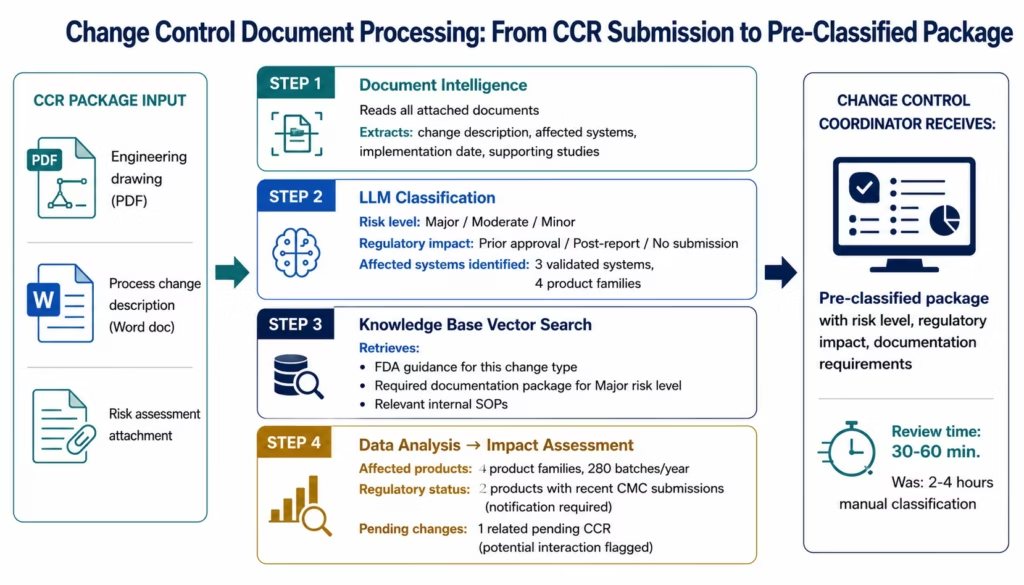
AI Workflow 3: Change Control Document Processing
Change control in pharmaceutical operations is a high-volume, high-documentation process: equipment changes, process parameter adjustments, raw material source changes, facility modifications, and procedure updates all require a documented change control request (CCR) with an impact assessment, approval workflow, and implementation verification.
Processing a change control package typically requires the change control coordinator to read the submitted package, classify the change type and risk level, identify the affected systems and products, route to the appropriate subject matter experts, and initiate the approval workflow in the quality system. For a complex process change with multiple affected systems: 2-4 hours per CCR.
The Change Control AI Workflow:
When a change control request is submitted (as a PDF, a Veeva change record initiation, or an engineering change management system notification):
-
Document Intelligence reads the change control package: the change description, the reason for the change, the proposed implementation date, and any attached supporting documents (engineering drawings, process validation study references, risk assessments).
-
LLM Classification classifies the change:
- Risk level: major (requires full validation or qualification), moderate (requires defined studies or testing), minor (administrative or documentation change only)
- Regulatory impact: requires prior approval submission, requires post-implementation reporting, or no regulatory submission required
- Affected systems: which validated systems are affected? Which product families are impacted? Which SOPs require revision?
-
Knowledge Base Vector Search retrieves the relevant regulatory guidance for this change type (FDA guidance documents, ICH guidelines) and the organisation’s internal change control SOPs to identify the required documentation package for this risk level and change category.
-
Data Analysis retrieves from SAP and Veeva the affected product volumes (how many batches per year are manufactured using the affected equipment or process?), the regulatory filing status for affected products (do any affected products have recent CMC submissions where this change would require notification?), and any pending changes that might interact with this change.
The change control coordinator receives a pre-classified package: the change type and risk level, the required documentation list for this change category, the affected products and their regulatory submission status, and a draft impact assessment structure. Coordinator review time: 30-60 minutes versus 2-4 hours of manual classification and routing.
AI Workflow 4: Clinical-to-Commercial Data Reconciliation
For pharmaceutical companies transitioning products from clinical development to commercial manufacturing, the data reconciliation challenge is significant: clinical data lives in EDC (Electronic Data Capture) systems (Medidata Rave, Oracle Clinical), CTMS (Clinical Trial Management Systems), and safety databases (Argus, ARISg). Commercial data lives in SAP, Veeva Vault, and LIMS. The datasets use different terminologies, different coding conventions (MedDRA coding in clinical versus internal coding in quality), and different data structures.
Manual reconciliation: ensuring that clinical data packages submitted to FDA accurately reflect the clinical database, and that commercial manufacturing specifications accurately reflect what was used in clinical studies: is a multi-week exercise for every NDA or MAA submission.
The Clinical-to-Commercial Data Reconciliation AI Workflow:
For regulatory submissions requiring clinical data:
-
Document Intelligence reads clinical study reports, clinical data listings, and CMC sections from prior regulatory submissions: extracting key data points: batch numbers used in clinical studies, process parameters used, analytical methods applied, and specifications approved.
-
API Tool Call (LIMS): retrieves the corresponding commercial testing data and stability data for the same or bridged analytical methods, mapping clinical study method references to current commercial LIMS methods.
-
API Tool Call (SAP/MES): retrieves the commercial batch manufacturing data for batches manufactured under the same process as the clinical batches, verifying consistency with the clinical manufacturing process parameters.
-
Semantic Matching identifies potential terminology discrepancies between clinical coding (MedDRA terms in clinical summaries) and commercial quality system terminology (internal coding in the QMS), flagging cases where the same attribute is described with different terminology across systems.
-
Data Analysis performs the reconciliation: comparing clinical process parameters against commercial specifications, identifying gaps or changes between clinical and commercial, and flagging items that require explicit bridging justification in the regulatory submission.
The regulatory affairs scientist and clinical data management team receive a structured reconciliation report: the matched data points (confirmed consistent), the flagged discrepancies (requiring bridging documentation), and the items requiring additional information before submission. What previously took 3-4 weeks of manual cross-referencing takes 3-5 days of reviewing AI-compiled reconciliation packages.
AI Workflow 5: Regulatory Submission Data Assembly
Regulatory submissions: NDA, MAA, ANDA, IND annual reports, post-approval change supplements: require assembling data from across the pharmaceutical system landscape: manufacturing data from SAP and MES, quality data from LIMS and the QMS, non-clinical and clinical data from study management systems, and packaging and labelling data from artwork management systems.
For each submission type, regulatory affairs must identify which data points are required, retrieve those data points from the appropriate source systems, verify currency and accuracy, and package them in the required eCTD or Common Technical Document (CTD) format.
The Regulatory Data Assembly AI Workflow:
For annual product review (APR) or product quality review (PQR) submissions:
-
Knowledge Base Vector Search retrieves the regulatory guidance for this submission type and the organisation’s internal regulatory submission SOP, identifying the specific data elements required and their source systems.
-
API Tool Call (LIMS): retrieves release testing data and stability data for all batches of the product manufactured in the review period.
-
API Tool Call (SAP): retrieves batch disposition records, material traceability data, and out-of-specification investigation references.
-
API Tool Call (Veeva Vault QMS): retrieves the deviation history, CAPA summary, change control summary, and complaint data for the product and review period.
-
Document Intelligence reads any referenced clinical or non-clinical study reports and extracts relevant supporting data.
-
Data Analysis performs the statistical analysis required for the APR/PQR: batch release data trending, process capability statistics, stability data trend analysis, and complaint rate trend.
The regulatory affairs team receives a structured data package: all required data elements assembled, statistical analyses performed, and a gap list identifying any data elements that could not be retrieved automatically and require manual input. Submission preparation time is reduced from 6-8 weeks (for a typical APR) to 2-3 weeks (reviewing the AI-assembled package and completing the narrative sections).
Level 3 AI Agents for Complex Pharma Exceptions
Level 2 AI Workflows handle the processing layer: reading, classifying, and routing compliance data through intelligent pipelines. Level 3 AI Agents handle the investigation layer: complex exceptions where the evidence must be assembled from multiple sources and analysed before a quality decision can be made.
CAPA Investigation Agent:
When a major or critical deviation is escalated to formal CAPA:
- Knowledge Base Vector Search (Veeva): retrieves the full deviation history for this product, process, and equipment: all deviations in the past 24 months, their root causes, and the corrective actions applied.
- API Tool Call (LIMS): retrieves the testing data for all batches potentially affected by the deviation, including any OOS or OOT results in the adjacent batch history.
- API Tool Call (SAP): retrieves the material lot traceability for the affected batch: were the same material lots used in other batches? Were those batches already released?
- API Tool Call (MES): retrieves the process parameter history for the affected operation across the past 30 days: is there a pattern suggesting a systemic process drift?
- Knowledge Base Vector Search (quality knowledge): searches the CAPA knowledge base for similar root causes and historically effective corrective actions for this process and deviation type.
- Data Analysis: runs the statistical analysis: does the deviation frequency correlate with specific equipment, shifts, operators, or material lots?
The quality team receives a structured CAPA initiation brief: the deviation history, the affected batch scope, the material traceability, the process parameter analysis, similar past CAPA roots and actions, and a suggested investigation plan. CAPA initiation time: from 2-4 hours of manual data assembly to 30-45 minutes of reviewing an AI-assembled investigational context.
OOS Investigation Agent:
When a laboratory result is flagged as Out of Specification:
- Document Intelligence reads the OOS result notification and extracts the test name, the result, the specification limit, and the test method reference.
- API Tool Call (LIMS): retrieves the full analytical run data for the OOS test: sample preparation records, instrument performance records, analyst qualification records, and any system suitability failures during the run.
- API Tool Call (LIMS historical): retrieves the testing history for this sample type and test from the past 12 months: what is the historical distribution of results? Is this result a genuine outlier or consistent with process variability?
- Knowledge Base Vector Search: retrieves the FDA guidance for OOS investigations and the organisation’s OOS procedure to identify Phase 1 (laboratory) investigation requirements.
The analyst and QA reviewer receive a structured OOS brief: the result in context of historical distribution, the Phase 1 investigation checklist pre-populated with the relevant laboratory data, and the regulatory requirement for the investigation timeline. Phase 1 investigation initiation time: from 30-45 minutes of manual data assembly to 10-15 minutes of reviewing the AI-assembled context.
Level 4: Goldfinch AI for Pharma Operations Intelligence
Goldfinch AI gives pharmaceutical operations leadership natural language access to live compliance and quality intelligence: without waiting for quality metrics reports, regulatory affairs summaries, or analyst-prepared dashboards.
QA Director: monthly quality review: “What is our CAPA completion rate by site this quarter, and which CAPAs are overdue by more than 30 days?”
Goldfinch AI queries Veeva Vault via the Workflow Node, calculates CAPA completion rates by site and product line, identifies overdue CAPAs with their age and the risk level of the underlying deviation, and returns a formatted quality compliance summary in under 60 seconds. Previously: the quality metrics report was assembled by a quality systems specialist the day before the monthly quality review.
VP of Quality: “How many OOS results have we had this month by site and product family, and are any sites trending above their baseline?”
Goldfinch AI queries the LIMS data and Veeva QMS quality records, calculates OOS rates by site and product family, applies trend detection to identify sites with statistically significant OOS rate increases, and returns the analysis with trend flags in under 60 seconds.
Regulatory Affairs Director: “Which of our commercial products have annual product reviews due in the next 90 days, and are the underlying data packages in Veeva up to date?”
Goldfinch AI queries the regulatory submission tracking system and Veeva Vault, identifies products with APR due dates in the next 90 days, checks the completeness status of the data packages, and returns a prioritised APR preparation list.
Workflow Node: automated weekly quality intelligence brief: Every week, the Goldfinch AI Workflow Node coordinator dispatches parallel agents across Veeva QMS, LIMS, SAP, and the deviation tracking system. The coordinator synthesises findings and delivers a structured quality intelligence brief to the QA leadership team: overdue CAPAs, open deviations by severity, OOS rate trends, and stability study alerts: without anyone requesting it.
21 CFR Part 11, EU GMP Annex 11, and GxP Compliance
Every AI workflow and AI agent operating on pharmaceutical data must satisfy the same GxP compliance requirements as any other computerised system in the regulated environment. This is the compliance architecture question that separates a pharma-ready AI workflow platform from a general-purpose automation tool.
21 CFR Part 11 requirements for AI workflows:
21 CFR Part 11 requires that electronic records used in place of paper records must include: audit trails that capture the date and time of operator entries and actions that create, modify, or delete electronic records; system access controls that ensure only authorised individuals can access and modify records; and, for records requiring signatures, 21 CFR Part 11 compliant electronic signatures.
For eZintegrations AI workflows operating on pharmaceutical records, this means:
- Immutable audit trail: every workflow execution that creates, modifies, or routes a regulated record generates an immutable, timestamped audit log entry: the workflow ID, the action taken, the data source accessed, the data retrieved, the record created or modified, and the identity of the service account performing the action. This audit trail cannot be modified after creation.
- Access controls: role-based access control (RBAC) governs which workflows can access which systems, which users can configure workflows, and which records can be modified. Service account credentials are scoped to the minimum necessary access for each workflow: the batch record compilation workflow has read access to LIMS, MES, and SAP, and write access to Veeva batch record creation only.
- Human authorisation gate: AI workflows in eZintegrations do not autonomously approve or reject batches, close CAPAs, or approve change control records. Every regulated disposition decision requires human authorisation within Veeva’s validated workflow. The AI assembles and routes; the qualified person (QP) or quality professional approves.
EU GMP Annex 11 (Computerised Systems):
EU GMP Annex 11 governs the validation and use of computerised systems in pharmaceutical manufacturing and quality. For AI workflows:
- Validation: eZintegrations provides a validation documentation package (IQ/OQ/PQ support documentation) for customers deploying AI workflows in GxP environments. The validation confirms that the system operates as intended: that the Document Intelligence extraction produces accurate results, that the LLM classification is reproducible, and that the audit trail is complete and tamper-resistant.
- Data integrity: EU GMP Annex 11 Paragraph 7 requires that data integrity be maintained throughout the data lifecycle. eZintegrations AI workflows retrieve data from validated source systems (LIMS, MES, SAP, Veeva) via their validated APIs without modifying the source data. The retrieved data is used for assembly and routing: the source records remain in their validated state in the source system.
- Vendor audit: as a software vendor providing a GxP-relevant computerised system, eZintegrations provides audit support documentation and responds to customer quality audits. The SOC 2 Type II report provides third-party validated assurance of security controls.
The AI processing compliance question:
When an AI workflow processes pharmaceutical data: Document Intelligence reading a batch record, LLM classification categorising a deviation severity: where does the regulated data go?
In eZintegrations: the regulated data stays within eZintegrations’ infrastructure. Document Intelligence, LLM classification, Data Analysis, and all AI inference run natively within eZintegrations’ servers. No batch records, no LIMS test data, no deviation reports are sent to OpenAI, Anthropic, or any external AI provider. This is critical for 21 CFR Part 11 compliance: the AI processing occurs within the audited, access-controlled system environment, not in an external AI provider’s infrastructure with its own data handling policies.
Key Outcomes and Results
Pharmaceutical and biotech organisations deploying AI workflows across batch record compilation, deviation management, change control, and regulatory data assembly report measurable improvements within 60-90 days:
Quality Operations:
- Batch record compilation: 4-6 hours (manual) → 1-2 hours (AI-compiled review)
- Deviation record creation: 45-60 minutes (manual) → 10-15 minutes (AI-created, human confirms)
- CAPA initiation data assembly: 2-4 hours → 30-45 minutes (AI-assembled investigational context)
- OOS Phase 1 investigation initiation: 30-45 minutes → 10-15 minutes
Change Control:
- CCR classification and routing: 2-4 hours (manual) → 30-60 minutes (AI pre-classified)
- Impact assessment assembly: manual multi-system lookup → automated product and regulatory impact retrieval
- SME routing accuracy: improved through systematic impact identification
Regulatory Affairs:
- APR/PQR data package assembly: 6-8 weeks → 2-3 weeks (AI pre-assembled)
- Clinical-to-commercial reconciliation: 3-4 weeks → 3-5 days
- Regulatory submission data completeness check: periodic → systematic AI-driven gap identification
Quality Intelligence:
- CAPA compliance visibility: monthly report → real-time Chat UI query
- OOS rate trending: monthly review → continuous monitoring with trend alerts
- APR/PQR due date management: calendar-based → systematic proactive monitoring
How to Get Started
Step 1: Identify your highest-labour compliance data pipeline
Calculate the hours your QA and regulatory affairs teams spend each week on data compilation and transcription tasks: batch record compilation, deviation record creation, change control routing, OOS investigation initiation. The workflow consuming the most QA time on data assembly rather than quality judgment is your first AI workflow deployment.
Step 2: Build your compliance knowledge bases
AI workflows for pharma are most effective with domain-specific regulatory knowledge. Before deploying the deviation management workflow: load the FDA and ICH deviation classification guidance, your organisation’s deviation categorisation SOP, and the product-specific batch manufacturing specifications. Before deploying the change control workflow: load your change control classification matrix and the relevant FDA and EMA guidance documents. The Automation Hub templates include knowledge base structures for pharma: you populate with your organisation’s specific content.
Step 3: Import the pharma AI workflow template from the Automation Hub
Visit the Automation Hub and filter by Pharma / Life Sciences AI Workflows. Import the template for your target use case. Configure your Veeva Vault connection (Veeva API with OAuth 2.0), your LIMS connection (LabVantage, STARLIMS, Labware, or your LIMS REST API or database connector), and your SAP connection (SAP S/4HANA OData V4).
Step 4: Configure GxP-appropriate thresholds and audit trail settings
Set the AI classification confidence threshold for each deviation severity level. Configure the audit trail scope: which fields are logged, at what granularity, with what retention period. For 21 CFR Part 11 environments: enable immutable audit logging for all workflow actions on regulated records. Configure the RBAC access controls for the workflow service accounts.
Step 5: Validate and qualify before production activation
For GxP environments, AI workflow deployment requires validation documentation before production use. Prepare the user requirements specification (URS) for each AI workflow, execute the installation qualification (IQ) and operational qualification (OQ) test scripts against the configured workflow, and document the performance qualification (PQ) results using representative sample data from your actual production environment. eZintegrations provides validation support documentation to accelerate the GxP qualification process.
Book a free demo and bring your highest-labour compliance data pipeline. We will show you what AI workflow automation looks like for your specific Veeva, LIMS, and SAP environment, including the GxP audit trail architecture.
FAQs
Pharmaceutical AI workflows embed AI nodes including Document Intelligence, LLM Classification, and Data Analysis inside compliance data pipeline workflows connecting Veeva Vault, LIMS, SAP, and MES systems. When a deviation is recorded in the MES, Document Intelligence reads the deviation description, LLM Classification assigns the severity and routing category, and the workflow automatically creates the Veeva QMS record with all structured data pre-populated. All AI inference runs natively within eZintegrations infrastructure, meaning no regulated pharmaceutical data is sent to external AI providers. Every AI action on a regulated record generates an immutable 21 CFR Part 11 compliant audit trail entry.
Template configuration and connection setup typically takes 7-14 days including Veeva API configuration in 2-3 days, LIMS and SAP connection setup in 2-3 days, knowledge base build in 3-5 days, and threshold calibration in 2-3 days. GxP validation including IQ, OQ, and PQ generally requires 4-8 weeks depending on organisational SOPs and the number of workflows being qualified. eZintegrations provides validation support documentation including URS templates, IQ and OQ test script templates, and PQ execution guidance to accelerate qualification. Total project timeline from initiation to production activation in a validated GxP environment is usually 8-14 weeks for a single AI workflow.
Yes, eZintegrations provides native Veeva Vault integration using Veeva REST APIs with OAuth 2.0 covering Vault QMS, Vault RIM, and Vault QualityDocs. LIMS integrations are supported through REST APIs for LabVantage, Labware LIMS, STARLIMS, and OpenLab, as well as through database connectors for systems with direct database interfaces. SAP S/4HANA integration uses OData V4 with automatic CSRF token management for write operations covering batch management in PP-PI, quality management in QM, and materials management in MM. On-premises LIMS and SAP systems connect through IPSec Tunnel without requiring internet-exposed system ports.
Yes, eZintegrations is designed for GxP compliance in regulated pharmaceutical environments. For 21 CFR Part 11, every AI workflow action on regulated records generates an immutable timestamped audit trail entry capturing the source data accessed, the action taken, and the service account identity. RBAC access controls govern which workflows can access which records, and human approval gates prevent autonomous approval or disposition of regulated records. For EU GMP Annex 11, eZintegrations provides IQ, OQ, and PQ validation documentation support. Data integrity is preserved because validated source systems such as Veeva, LIMS, and SAP are accessed through official APIs rather than unsupported interfaces. SOC 2 Type II certification provides third-party validation of security controls. All AI processing remains native within eZintegrations infrastructure.
Level 2 AI Workflows handle high-volume consistent pharmaceutical data inputs with AI at predetermined processing steps. For example, a deviation is recorded, Document Intelligence extracts the data, LLM Classification assigns severity, and a Veeva record is created. The sequence is fixed and the AI performs specific compliance tasks. Level 3 AI Agents handle complex investigations requiring adaptive multi-system reasoning. A CAPA Investigation Agent receiving a major deviation escalation may decide to check related material lots, analyse process parameter drift patterns, and retrieve corrective action history from similar past events. Workflows are optimised for high-volume consistent compliance processing, while agents are designed for complex quality investigations requiring adaptive evidence assembly across multiple systems.
Yes, eZintegrations connects to validated pharmaceutical systems such as Veeva Vault, LIMS, MES, and SAP using official validated APIs rather than unsupported direct database access methods. This preserves the validated state of the source systems. The workflow retrieves data from the validated source, processes it within eZintegrations GxP-ready infrastructure, and creates or updates records in destination systems using official validated APIs. The AI workflow itself is subject to your organisation validation programme, and eZintegrations provides IQ, OQ, and PQ support documentation to facilitate qualification. 1. How does AI workflow automation work in pharmaceutical operations?
2. How long does it take to set up a pharma AI workflow including GxP validation?
3. Does eZintegrations work with Veeva Vault, LabVantage, STARLIMS, and SAP for pharma AI workflows?
4. Is eZintegrations compliant with 21 CFR Part 11 and EU GMP Annex 11 for AI workflows?
5. What is the difference between Level 2 AI Workflows and Level 3 AI Agents for pharma?
6. Can eZintegrations AI workflows process data from computerised systems validated under 21 CFR Part 11?
Conclusion: Compliance Data Flows at the Speed Regulators Expect
Dr. Priya Nair’s quality team should spend their time on quality judgment: evaluating deviation risk, designing corrective actions, reviewing batch quality, and making product disposition decisions. They should not spend 45-60 minutes per deviation on data entry that an AI workflow can execute in seconds, or 4-6 hours per batch record on data compilation that an AI pipeline can assemble in minutes.
The compliance requirement does not diminish. Every deviation still needs a quality record. Every batch still needs a complete review. Every CAPA still needs a traceable investigation. What changes is who does the data work: and whether the data arrives at the quality professional fully assembled or one field at a time from four separate systems.
eZintegrations delivers compliance-ready AI workflows for five high-value pharmaceutical data pipelines: batch record compilation, deviation management, change control, clinical-to-commercial reconciliation, and regulatory data assembly: within a 21 CFR Part 11 and EU GMP Annex 11 compliant architecture. Native AI processing keeps regulated data within the compliance boundary. Immutable audit trails satisfy electronic records requirements. Human authorisation gates preserve the quality professional’s decision authority.
Book a free demo and bring your highest-labour compliance data pipeline. We will map your Veeva Vault, LIMS, and SAP environment to Automation Hub templates and demonstrate the GxP audit trail architecture for your specific regulatory context.
Import a pharma AI workflow template from the Automation Hub and start today.