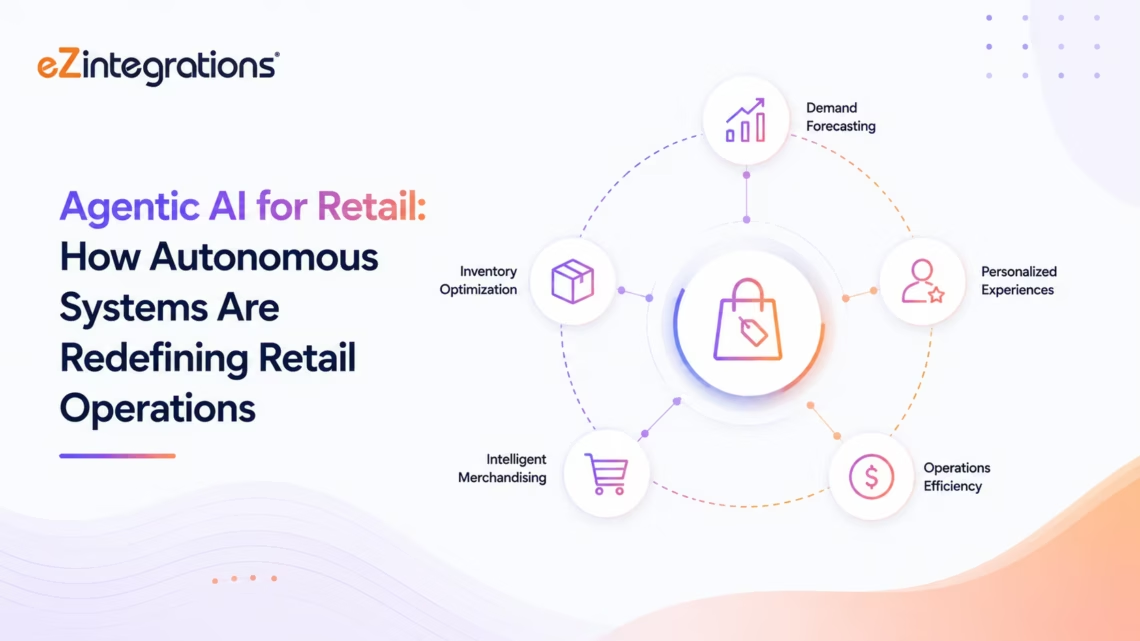
Agentic AI for Retail: How Autonomous Systems Are Redefining Retail Operations
May 18, 2026Agentic AI for retail deploys coordinated networks of specialist AI agents aligned with Multi-agent system principles that monitor inventory, fulfilment, merchandising, and customer operations continuously: detecting emerging risks, correlating signals across the full retail stack, and delivering synthesised intelligence to retail operations leaders via natural language Chat UI. eZintegrations’ Goldfinch AI coordinates specialist worker agents through a Chat UI and Workflow Node: moving retail operations from reactive exception management to autonomous retail intelligence that surfaces stockout risks, fulfilment pattern failures, demand shifts, and marketplace compliance risks before they become customer-visible events.
TL;DR
- Reactive retail management means discovering operational problems after they already cost money: the stockout you find when the order fails to fulfil, the 3PL performance decline you see in the monthly scorecard, the demand acceleration you notice when the SKU is already out of stock, the marketplace compliance breach you discover after Amazon suppresses the listing. The lag between event and discovery is where retail costs accumulate.
- Agentic AI closes that lag, consistent with McKinsey & Company research on agentic AI in retail operations. Not by handling individual exceptions faster: that is Level 3 AI Agents: but by monitoring your entire retail operation continuously at population level: all SKUs, all channels, all carriers, all 3PLs, all simultaneously.
- Goldfinch AI is eZintegrations’ Level 4 multi-agent coordination platform. The Chat UI gives retail operations directors, buyers, and eCommerce VPs natural language access to live inventory, fulfilment, and channel data in under 60 seconds. The Workflow Node runs autonomous intelligence programmes: coordinator agents dispatching parallel worker agents continuously, delivering structured operational briefs automatically.
- Four agentic programmes in this guide: the Inventory and Demand Intelligence Network, the Fulfilment Operations Intelligence Programme, the Merchandising Intelligence Network, and the Customer and Channel Intelligence Centre.
- All processing runs natively within eZintegrations. No retail data sent to external AI providers. SOC 2 Type II certified.
The Reactive Retail Operation: Where Costs Accumulate in the Lag
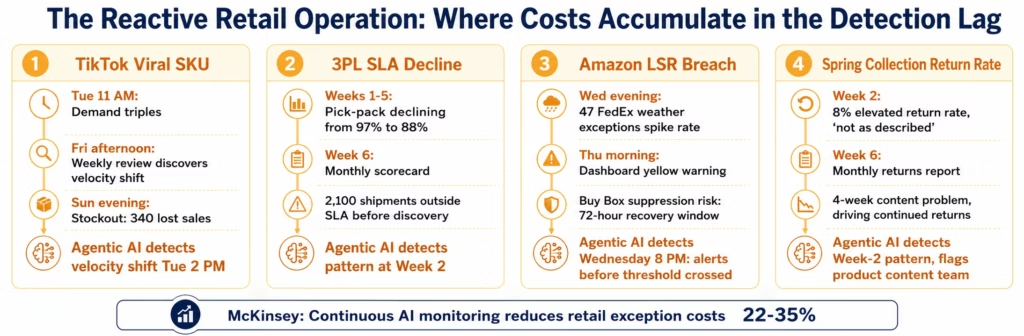
Consider four retail events that most operations teams discover in the wrong order:
Event 1: A trending product on TikTok mentions one of your canvas tote bags at 11 AM on a Tuesday. Sell-through velocity on the SKU triples within 3 hours. By 4 PM, the NJ warehouse has 6 days of coverage left. Your weekly inventory review is Friday. You discover the velocity shift on Friday afternoon. The SKU stocks out Sunday evening. Monday morning: 340 lost sales over the weekend, and a 4-6 week reorder lead time.
Event 2: Your primary 3PL’s pick-and-pack SLA compliance begins declining from 97% to 88% over a 5-week period: not from a single failure, but from a gradual degradation across shift patterns that individually fall within acceptable ranges. It appears in your monthly 3PL scorecard at week 6. By then, 2,100 shipments have been packed outside the SLA window. The customer complaint rate attributable to slow fulfilment has increased 18% over that period. You are looking at the data for the first time when the 3PL account manager meeting is already on the calendar.
Event 3: Your Amazon Late Shipment Rate crosses 4% on a Wednesday evening after a FedEx weather disruption affects 47 shipments in a single day. You discover this Thursday morning when the Amazon Account Health dashboard shows a yellow warning. By then, the metric has been recorded and will affect your account health score for the rolling 10-day window. If the next 72 hours don’t recover the rate through expedited shipping confirmations and carrier resolutions, the Buy Box suppression risk escalates.
Event 4: A new spring collection SKU has an 8% higher return rate in week 2 than the rest of the collection. The concentrated return reason is “not as described.” You see it in the monthly returns report 4 weeks after launch. The product description has been live and driving new purchases for 30 days with a structural content problem that could have been corrected in 48 hours.
In each case, the data existed. The WMS had the inventory movement. The 3PL WMS had the pack timestamps. The Amazon SP-API had the fulfilment rate data. The returns management platform had the return reason codes. The data just was not being monitored continuously, correlated across systems, and routed to the right decision-maker in time.
McKinsey estimates that retail organisations with continuous AI monitoring across inventory, fulfilment, and channel operations reduce their total operational exception costs by 22-35% versus those relying on periodic reporting cycles. Gartner projects that by 2028, over 65% of top-100 global retailers will operate with autonomous AI monitoring across at least three retail operations domains.
What Agentic AI Means for Retail (and Why It Differs from AI Agents)
The architectural distinction between individual AI agents and agentic AI carries specific operational implications in retail.
A Level 2 AI Workflow (covered in the AI workflow retail guide) automates high-volume consistent retail data pipelines: Shopify order to WMS in 30 seconds, returns packing slip processed by Document Intelligence, inventory broadcast to all channels within 60 seconds of movement.
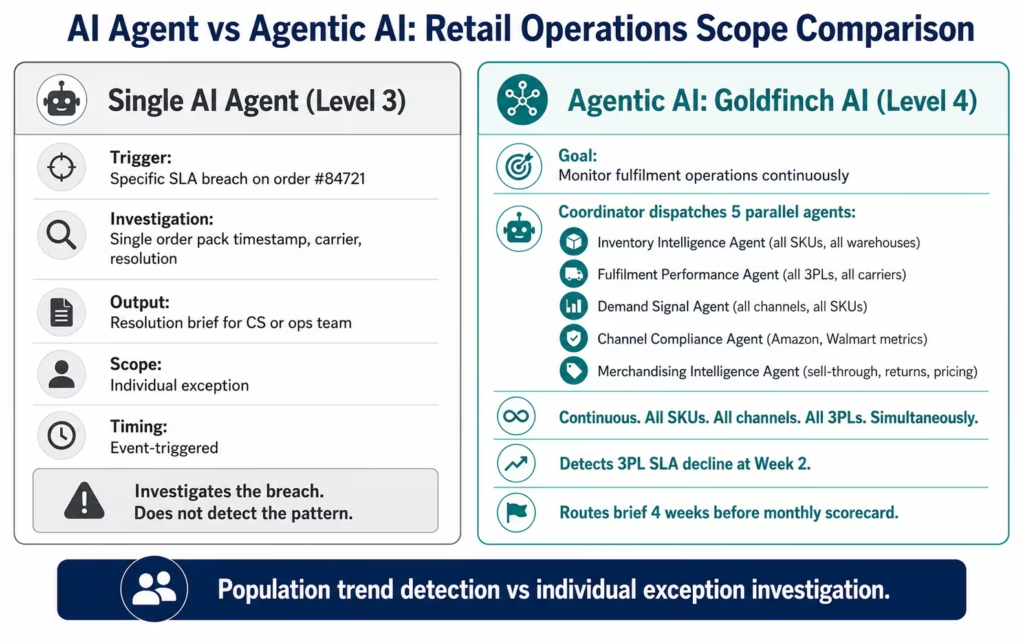
A Level 3 AI Agent (covered in the AI agents retail guide) handles complex individual exception investigations: the Fulfilment Exception Agent retrieves the carrier timeline, OMS address record, and WMS pack confirmation for one specific failed delivery. One exception, one investigation, one pre-assembled brief for human decision.
Level 4 Agentic AI (Goldfinch AI) operates at the programme level. A coordinator agent receives a monitoring goal: not “investigate this carrier exception” but “monitor our fulfilment operations across all 3PLs, all carriers, and all channels continuously, and surface systemic performance risks before they become scorecards.” The coordinator dispatches parallel worker agents across all operational domains simultaneously, receives their findings, and synthesises a unified operational intelligence picture for the retail operations director.
The practical retail difference:
Single AI agent: a 3PL SLA breach on a specific order triggers an investigation. The agent identifies this individual order was packed 4 hours late and routes a resolution brief. Individual case. Event-triggered. Useful.
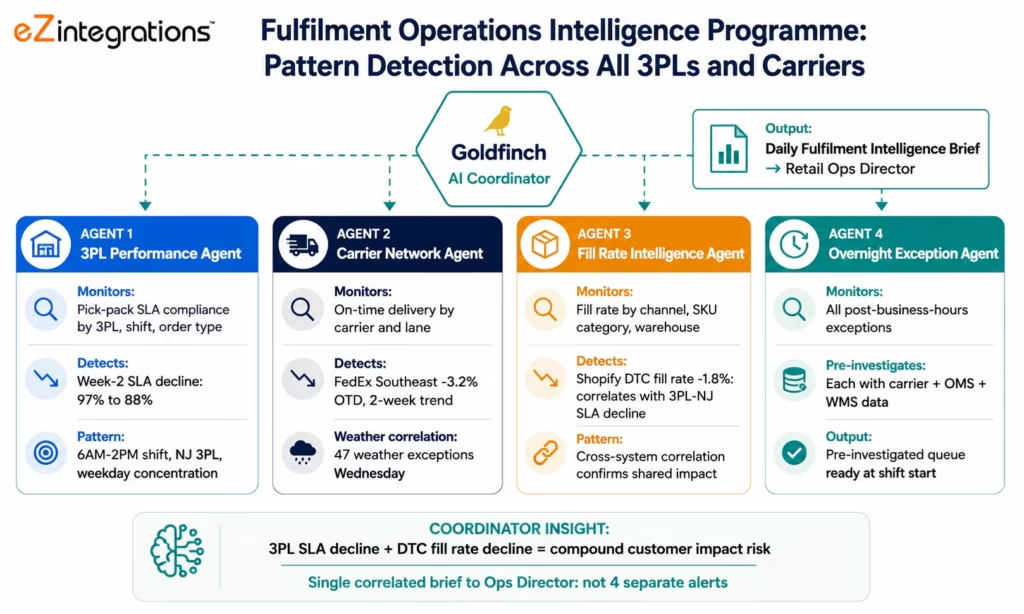
Agentic AI: the Fulfilment Operations Intelligence coordinator monitors all 3PL pick-pack timestamps across all orders continuously. It detects that 3PL-NJ’s aggregate SLA compliance has declined from 97% to 88% over 5 weeks: a pattern that no individual order exception triggers, because no individual late pack is severe enough to trigger an alert. The coordinator correlates this trend with the shift pattern data and identifies that the degradation is concentrated in the 6 AM-2 PM shift on weekdays: a staffing issue, not a random variance. It routes a structured 3PL performance brief to the operations director at Week 2: 4 weeks before the monthly scorecard.
Pattern detection across the population, correlated across time periods, 4 weeks earlier. That is the agentic AI difference, reflecting broader retail AI orchestration trends covered by SupplyChainBrain.
Before vs After: The Agentic AI Transformation in Retail
| Retail Domain | Before Agentic AI | After Agentic AI (Goldfinch AI) |
|---|---|---|
| Viral demand detection | Weekly planning review, SKU stocks out before reorder | Continuous sell-through monitoring, velocity anomaly detected and routed same hour |
| 3PL SLA trend | Monthly scorecard reveals decline 5-6 weeks after onset | Continuous pack timestamp monitoring, trend detected at Week 2 before customer impact |
| Inventory coverage risk | Weekly inventory report, stockouts discovered too late | Continuous days-of-supply monitoring, projected stockout alert days in advance |
| Amazon/Walmart LSR | Dashboard check discovers breach after the fact | Continuous marketplace metric monitoring, pre-threshold alert with contributing orders |
| Return rate anomaly by SKU | Monthly returns report, content problems persist 4+ weeks | Continuous return rate monitoring, SKU-level anomaly detected at Week 2 |
| Cross-channel inventory imbalance | Periodic inventory review, ad hoc transfer decisions | Continuous balance monitoring, coordinator identifies regional imbalance and routes rebalance recommendation |
| Carrier network performance | Monthly carrier scorecard | Continuous lane-level monitoring, carrier performance decline detected within 48 hours |
| New product sell-through vs plan | Weekly merchandising review | Continuous sell-through versus plan monitoring, deviation detected and routed same day |
| Customer segment velocity | Monthly CRM analysis | Continuous order pattern monitoring, high-value segment behaviour shift detected and routed |
| Executive retail query | 2-4 hour analyst report | Chat UI: natural language query answered from live OMS + WMS + channel data in 60 seconds |
The Goldfinch AI Architecture for Retail
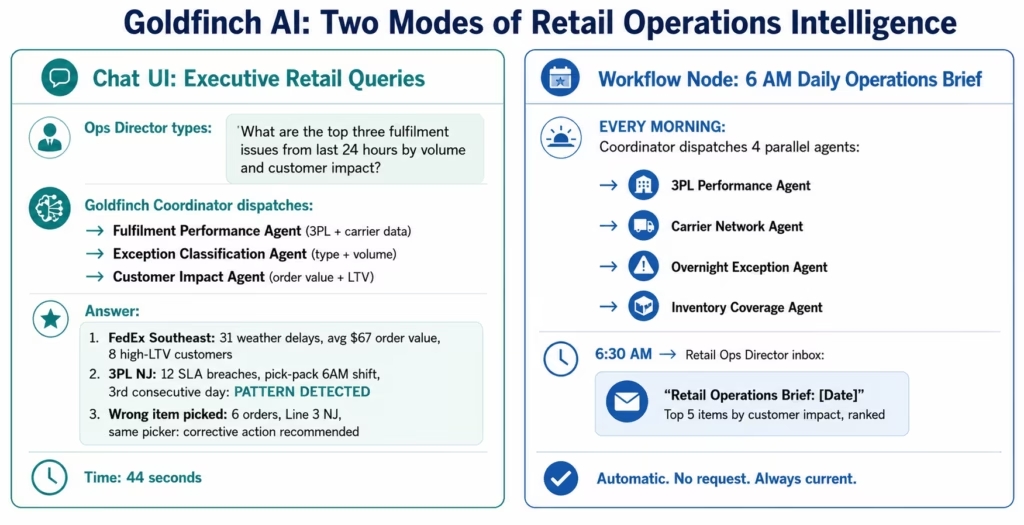
Goldfinch AI operates across retail through two interfaces that together create continuous autonomous retail intelligence:
The Chat UI: natural language access to live retail operational data for executives. The VP of eCommerce types a question. Goldfinch AI identifies which OMS, WMS, carrier, and marketplace data sources are needed, dispatches the appropriate worker agents, receives results, synthesises, and returns a structured answer: typically within 30-60 seconds.
The Chat UI does not query a report from yesterday. When the Merchandise Buyer asks about sell-through for the new collection, Goldfinch AI dispatches agents that retrieve current order data from the live OMS and inventory from the live WMS. The answer reflects the state of the retail operation at the moment of the query.
The Workflow Node: coordinator intelligence embedded in automated retail intelligence programmes. The Workflow Node is how agentic monitoring runs continuously without a human requesting a report.
A Workflow Node deployed in the fulfilment intelligence programme runs every day at 6 AM: it dispatches the 3PL performance agent, the carrier network agent, the fill rate agent, and the overnight exception agent across all shipment data from the prior 24 hours. The coordinator receives findings, correlates across 3PLs and carriers, and produces the daily operations brief: delivered to the retail operations director before the morning standup.
A Workflow Node deployed in the inventory intelligence programme runs every two hours during peak selling periods: the inventory coverage agent and the demand signal agent monitor all active SKUs, flag any coverage or velocity changes requiring attention, and route structured alerts to the inventory planning team in real time.
Agentic Programme 1: Inventory and Demand Intelligence Network
The Inventory and Demand Intelligence Network monitors inventory health and demand signals across all SKUs, all warehouse locations, and all selling channels simultaneously: not just the SKUs that generate alerts, but all of them, continuously.
Worker Agent 1: Inventory Coverage Agent Continuously monitors days-of-supply coverage for all active SKUs at all warehouse locations. Calculates the projected coverage at current sell-through velocity, factoring in the confirmed inbound PO pipeline. The Watcher Tool triggers when any SKU at any location projects to breach the safety stock threshold within the configured warning window.
At population level: the coordinator tracks which SKU categories are showing the highest concentration of coverage alerts, whether coverage compression is regional (one warehouse running thin) or universal (a supply chain constraint), and whether coverage alerts are accelerating (more SKUs entering the warning window each day) or decelerating (the pipeline is catching up).
Worker Agent 2: Demand Signal Intelligence Agent Monitors sell-through velocity for all active SKUs across all channels simultaneously. Maintains a rolling seasonal-adjusted baseline for each SKU and detects statistically significant deviations: both velocity accelerations (demand spikes, viral events, promotional lifts) and velocity decelerations (demand shifts, competitive events, weather impacts on category demand).
For velocity accelerations: the agent immediately cross-checks the inventory coverage (how many days of stock remain at the new velocity?) and the open PO pipeline (is there inbound stock that will cover the demand?). If the projected stockout date falls within the warning window, an expedited alert routes to the inventory planner and the buyer: same hour, not same week.
Worker Agent 3: Replenishment Health Agent Monitors the inbound supply pipeline: open PO confirmation status, supplier lead time variance (are confirmed delivery dates slipping?), and inbound shipment tracking. Flags POs where the confirmed delivery date has slipped past the projected stockout date: giving the procurement team the earliest possible signal to expedite, qualify an alternative supplier, or adjust safety stock levels.
Worker Agent 4: Inventory Balance Agent Monitors inventory distribution across warehouse locations relative to demand by geography. Identifies regional imbalances: a SKU with excess inventory at the CA warehouse and a stockout risk at the NJ warehouse, where the demand for that SKU is higher in the Northeast. Routes a structured rebalancing recommendation: transfer quantity, from/to locations, estimated freight cost, and the projected improvement in fill rate if the transfer is executed.
Coordinator synthesis: The inventory coordinator correlates findings across all four agents. When the Demand Signal Intelligence Agent detects a velocity acceleration on the canvas tote SKU and the Inventory Coverage Agent simultaneously shows that coverage has dropped to 6 days at the NJ warehouse, the coordinator synthesises: this is an urgent, compounding risk: velocity up, coverage down, projected stockout in 4 days at current velocity. Routes a single, correlated intelligence alert with the full picture, not two separate agent outputs that the operations team must interpret independently.
Agentic Programme 2: Fulfilment Operations Intelligence Programme
Individual fulfilment exceptions are handled by the Fulfilment Exception Agent (Level 3). The Fulfilment Operations Intelligence Programme operates at a level above: continuous population monitoring to detect systemic fulfilment performance issues before they appear in monthly scorecards.
3PL Performance Agent: Monitors pick-pack SLA compliance continuously across all 3PL partners by aggregating shipment pack timestamps against the committed SLA window. Tracks the trailing compliance rate at daily, weekly, and shift-level granularity. Detects declining SLA compliance trends: including the gradual degradation that is individually acceptable per shipment but collectively represents a systemic decline in 3PL performance.
The agent identifies patterns that correlate with the SLA decline: specific shifts (weekend performance versus weekday), specific order types (high-item-count orders taking longer than SLA), or specific product categories (bulky items requiring special handling slowing the pick station). Pattern identification is what enables targeted corrective action rather than generic 3PL account manager escalation.
Carrier Network Performance Agent: Monitors on-time delivery rates by carrier and by lane continuously: not at the monthly carrier scorecard level but at the daily level. Detects early patterns in carrier performance: a lane where on-time delivery has declined 3% over a 2-week period, a carrier whose performance in specific geographies correlates with weather events that are visible in the carrier’s service alert feed (Web Crawling).
For Amazon and Walmart marketplace fulfilment: the carrier performance data is directly connected to marketplace compliance metrics. The agent cross-correlates carrier performance with marketplace metric trajectory: surfacing the compound risk before it becomes a marketplace compliance issue.
Fill Rate Intelligence Agent: Monitors fill rate by channel, by SKU category, and by warehouse. Tracks the fill rate trend continuously, identifying fill rate deterioration at the channel or category level before it appears in the weekly report. Correlates fill rate declines with inventory coverage data: is the fill rate declining because of inventory shortfall (a supply problem), or because of an OMS routing issue (an integration problem)?
Overnight Exception Agent: Monitors all fulfilment exception events that occur outside business hours, pre-investigates each exception using the Fulfilment Exception Agent tools (carrier timeline, OMS address, WMS pack record), and delivers a pre-investigated exception queue to the operations team at shift start. The morning standup starts with a structured exception queue, not a raw list of unexamined carrier events.
Coordinator synthesis: The fulfilment coordinator correlates across all four agents. The 3PL SLA decline at 3PL-NJ correlates with the Fill Rate Agent’s detection of a fill rate deterioration on Shopify DTC orders: Shopify orders are routed primarily to 3PL-NJ. The coordinator identifies this as a compound fulfilment risk and routes a single correlated brief to the operations director: “3PL-NJ performance decline is driving measurable DTC fill rate impact: escalation recommended before customer complaint volume increases.”
Agentic Programme 3: Merchandising Intelligence Network
Merchandising intelligence sits at the intersection of demand, pricing, content quality, and competitive positioning. Each domain has its own data source and its own review cadence. Agentic AI monitors all of them simultaneously, surfacing the cross-domain correlations that periodic reporting misses.
Sell-Through Performance Agent: Monitors sell-through rates for all active SKUs against plan, by channel and by week of season. For new product launches: tracks first-week sell-through against the forecast range, flagging products that are significantly outperforming or underperforming their launch forecast within the first 48 hours. For ongoing collection: tracks the sell-through curve against the seasonal template, identifying items that are moving faster than planned (reorder risk) or slower than planned (markdown risk).
Returns Intelligence Agent: Monitors return rates by SKU and by return reason continuously. At the population level, the agent tracks: which SKUs have return rates statistically above the category average, whether the elevated return rate is concentrated in specific size runs, colorways, or channel (indicating a fit or image quality issue), and whether the primary return reason code is “not as described” (content problem), “defective” (product quality problem), or “wrong item” (fulfilment problem). Routes SKU-level return rate anomalies to the appropriate team: content team for “not as described,” quality team for “defective,” operations team for “wrong item.”
Pricing Intelligence Agent: Uses the Web Crawling tool to monitor competitor pricing for key competitive SKUs on a configured monitoring schedule. Tracks price movements, promotional pricing windows, and in-stock/out-of-stock status for competitors. Correlates competitor pricing changes with velocity shifts in the organisation’s own sell-through data: identifying when a demand deceleration is attributable to competitive price undercutting versus organic demand shift.
Product Content Quality Agent: Monitors product page performance indicators (click-through rate from search, conversion rate, and return rate) across all active SKUs. Uses the Watcher Tool to flag SKUs where conversion rate is below category average, which often indicates a content quality issue (poor images, incomplete description, missing size guide). For SKUs with high impressions but low conversion and elevated “not as described” return rates, the agent routes a structured content quality alert to the merchandising team: before the content problem continues to drive returns for another 3 weeks.
Coordinator synthesis: The merchandising coordinator correlates findings from all four agents. A SKU that is underperforming sell-through plan AND has an elevated “not as described” return rate AND has a below-average conversion rate presents a single compound merchandising risk: the content is causing poor conversion, mis-set customer expectations, and elevated returns. The coordinator routes a single compound brief to the merchandising director: not three separate alerts from three separate monitoring tools.
Agentic Programme 4: Customer and Channel Intelligence Centre
Customer behaviour and channel performance are where retail revenue is won and lost. Agentic AI monitors both continuously, surfacing the signals that a weekly dashboard review misses.
Customer Segment Intelligence Agent: Monitors order frequency, average order value, and product mix across customer segments: high-value customers, recent acquirees, at-risk lapsed customers: on a continuous basis rather than a monthly CRM cycle. Detects: high-value customer segment order frequency decline (an early churn signal), new customer segment second-purchase conversion rate change (a post-acquisition experience signal), and high-value customer return rate increase (a product quality signal for the most sensitive customer group).
Channel Attribution Agent: Monitors the revenue contribution and customer acquisition cost by channel: Shopify DTC, Amazon, Walmart, paid social, email, and affiliate. Tracks channel-level changes in conversion rate, cart abandonment, and new customer acquisition cost. Identifies when a channel’s performance metrics are shifting: paid social conversion rate declining, email click-to-purchase rate improving: and routes intelligence to the growth team before a budget reallocation decision misses the signal.
Marketplace Health Agent: Continuously monitors marketplace seller performance metrics across Amazon and Walmart: Late Shipment Rate, Order Defect Rate, Valid Tracking Rate, and Buy Box share. Uses the Web Crawling tool to monitor for marketplace policy changes that might affect seller requirements. When any metric approaches a warning threshold, the agent retrieves the specific contributing orders and routes a pre-threshold intervention brief: giving the marketplace operations team the window to intervene before the metric is recorded as a breach.
Loyalty and Retention Intelligence Agent: Monitors the loyalty programme performance: point accumulation rates, redemption rates, tier progression rates, and lapsed member rates. Identifies cohorts where lapsed member rates are increasing, where tier downgrade rates are above baseline, or where redemption rates suggest programme engagement is declining. Routes structured intelligence to the CRM and loyalty team: before the quarterly CRM review makes the declining engagement visible.
Coordinator synthesis: The customer and channel coordinator correlates findings across all four agents. A high-value customer segment whose order frequency is declining AND whose marketplace health shows Amazon order share declining AND whose return rate on recent orders is increasing presents a compound customer risk: product quality issues affecting the most valuable customer group, visible across multiple signals simultaneously. The coordinator surfaces this as a single compound customer intelligence finding, not three separate monitoring alerts.
Retail Executive Intelligence via Chat UI
The Goldfinch AI Chat UI gives retail leadership natural language access to live operational, merchandising, and customer data: without analyst requests or waiting for weekly reports.
Retail Operations Director: 7 AM daily: “What are the top three operational issues from last 24 hours by customer impact?”
Goldfinch AI queries the Fulfilment Operations Intelligence Programme, retrieves exception volumes with LTV-weighted impact, and returns a structured operations brief in under 60 seconds. The director makes three calls before 8 AM.
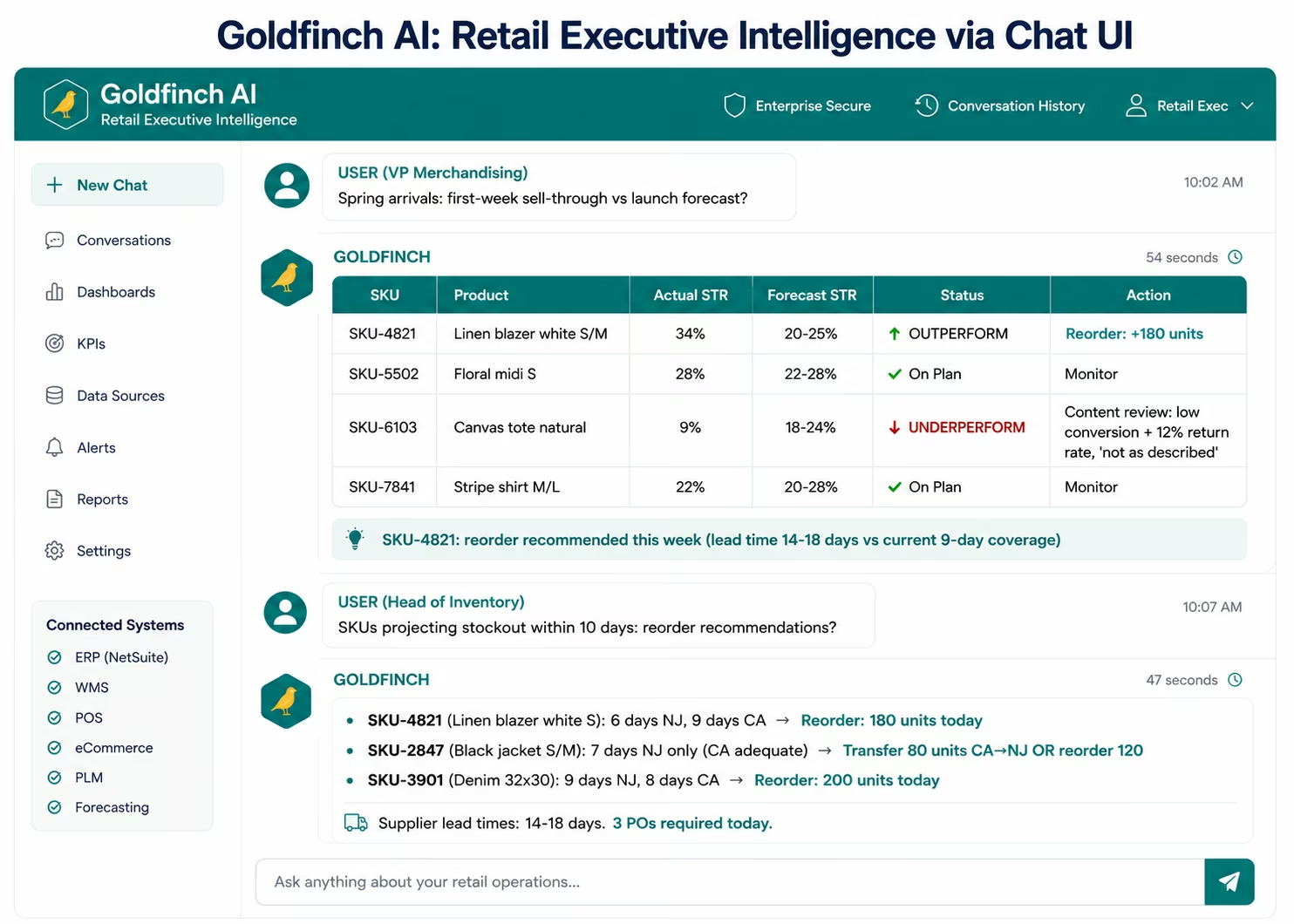
VP of Merchandising: Monday morning: “How are the new spring arrivals tracking against launch forecast after their first week?”
Goldfinch AI queries the Merchandising Intelligence Network sell-through data, compares first-week performance against the launch forecast range for each new SKU, and returns a ranked performance summary: outperformers flagged for potential reorder, underperformers flagged for content review: in under 60 seconds.
VP of eCommerce: “What is our current Amazon and Walmart account health status and are any metrics in the warning zone?”
Goldfinch AI queries the Customer and Channel Intelligence Centre marketplace health data, retrieves all active performance metrics against thresholds, and returns a compliance dashboard in under 60 seconds.
Head of Inventory Planning: “Which SKUs are projected to stock out within 10 days and what is the reorder recommendation for each?”
Goldfinch AI queries the Inventory and Demand Intelligence Network, calculates projected stockout dates for all at-risk SKUs, and returns a prioritised reorder brief with recommended quantities, supplier lead times, and current PO pipeline status in under 60 seconds.
CEO: “Give me a one-page view of the business performance this week: revenue trend, fill rate, top inventory risks, and marketplace health.”
Goldfinch AI queries all four agentic programmes simultaneously, synthesises a structured executive brief, and returns it in under 90 seconds: the data that previously required a Monday morning analyst report.
Governance and Data Security for Agentic Retail AI
Agentic retail AI handles customer data, order history, inventory financial data, and channel performance data that carries both commercial sensitivity and, for EU customer data, GDPR obligations.
Data access scope per agent: Each worker agent is configured with the minimum data access required for its monitoring domain. The Inventory Coverage Agent accesses WMS inventory and OMS demand data: it does not access customer personal data or payment information. The Customer Segment Intelligence Agent accesses aggregated segment metrics: it does not access individual customer payment data. Minimum necessary data access is enforced at the API Tool Call configuration level.
Human-in-the-loop gates for consequential retail decisions: The agentic intelligence programmes surface findings and route recommendations. They do not autonomously execute consequential retail actions:
- The Inventory Coverage Agent identifies a stockout risk and recommends a reorder: the inventory planner approves the purchase order.
- The Returns Intelligence Agent identifies a content quality problem: the merchandising team updates the product page.
- The Marketplace Health Agent flags a metric approaching threshold: the marketplace manager takes the targeted interventions.
- The Customer Segment Intelligence Agent detects declining high-value customer order frequency: the CRM team designs the re-engagement campaign.
The intelligence is autonomous. The commercial decisions remain with human operators.
SOC 2 Type II and GDPR: eZintegrations is SOC 2 Type II certified. All Goldfinch AI processing runs within eZintegrations’ infrastructure: customer order data, inventory data, and channel performance data are not sent to external AI providers. For retail operations with EU customer data, GDPR compliance applies to all customer-related monitoring. For California-based operations, CCPA-relevant customer data handling applies the same access-control and data minimisation architecture.
Key Outcomes and Results
Retail organisations deploying agentic AI programmes across inventory, fulfilment, merchandising, and customer operations report measurable improvements within 60-90 days:
Inventory Operations:
- Viral demand detection to buyer alert: Friday planning review → same-hour velocity alert
- Stockout prevention rate: improved through 10-14 day advance coverage alerts
- Supplier lead time breach detection: PO delivery date → continuous tracking with proactive alert
- Cross-warehouse inventory rebalancing: periodic assessment → continuous automated opportunity identification
Fulfilment:
- 3PL SLA trend detection: monthly scorecard (Week 6) → Week 2 pattern alert
- Carrier lane performance: monthly review → continuous daily monitoring
- Pre-investigated overnight exceptions: raw event queue → structured briefs ready at shift start
- Fill rate correlation with 3PL/carrier issues: manual investigation → automated coordinator cross-correlation
Merchandising:
- New product sell-through tracking: weekly report → 48-hour launch performance alert
- Return rate anomaly by SKU: monthly returns report (4-6 week lag) → Week 2 detection
- Content quality issue identification: returns drive discovery → proactive content alert
- Competitive pricing intelligence: periodic manual check → continuous automated monitoring
Customer and Channel:
- High-value customer churn signal: quarterly CRM review → continuous order frequency monitoring
- Marketplace account health: reactive breach response → proactive pre-threshold intervention
- Channel performance attribution: monthly analysis → continuous real-time monitoring
- Loyalty programme health: quarterly review → continuous engagement monitoring
Executive Intelligence:
- Operations director morning brief: manual analyst assembly → automated 6 AM Workflow Node delivery
- Merchandising query turnaround: 2-4 hours → 54-second Chat UI response
- CEO weekly retail snapshot: Monday morning analyst report → on-demand Chat UI in 90 seconds
How to Get Started
Step 1: Confirm your Level 1-3 retail foundation
Agentic AI monitoring builds on existing eZintegrations retail integration. The Inventory and Demand Intelligence Network requires live WMS inventory data, OMS order and demand data, and eCommerce channel connections. If these are not in place, start with the AI workflow retail guide and the AI agent templates. Goldfinch AI coordination delivers the most value on top of an already-connected retail technology stack.
Step 2: Choose your first agentic programme
The Inventory and Demand Intelligence Network is typically the first deployment: inventory risk and demand signals affect every SKU and channel, and the financial impact of early detection (preventing stockouts, catching viral demand) is immediate and measurable. The Fulfilment Operations Intelligence Programme has the highest customer experience impact for high-volume operations. The Merchandising Intelligence Network has the highest commercial impact for companies launching frequent new collections. Choose based on where your biggest operational blind spots currently are.
Step 3: Configure the coordinator and worker agents
Import the Goldfinch AI retail programme template from the Automation Hub. Configure each worker agent with its data source connections and minimum necessary data access scope. Configure the coordinator’s synthesis rules: how to rank inventory risks by financial exposure, how to correlate supply and demand findings, and what format the intelligence brief should take.
Step 4: Set up the Chat UI for your leadership team
Configure Goldfinch AI Chat UI access for each retail leadership role: Ops Director, VP Merchandising, VP eCommerce, Head of Inventory Planning, CEO. Set the data access scope per role. Brief the leadership team on query patterns: natural language questions produce live structured answers.
Step 5: Activate Workflow Node intelligence programmes
Configure the Workflow Node for the 6 AM daily operations brief, the bi-hourly inventory coverage monitoring during peak periods, and the weekly merchandising performance brief. Activate: the first automated intelligence brief runs on the configured schedule.
Book a free agentic AI retail demo and bring your current retail operational blind spots. We will map your OMS, WMS, channel, and carrier data to a Goldfinch AI programme and demonstrate the Chat UI with your actual retail executive use cases.
FAQs
Agentic AI coordinates multiple AI agents working in parallel toward complex monitoring goals. Individual AI agents (Level 3) handle one exception at a time such as one carrier delivery failure or one inventory replenishment anomaly. Agentic AI (Level 4, Goldfinch AI) deploys a coordinator that dispatches specialist worker agents across your entire retail operation simultaneously, monitoring inventory coverage for all SKUs, fulfilment performance across all 3PLs, sell-through for all products, and marketplace health across all channels while synthesising cross-domain findings for retail leadership. The distinction is individual exception investigation versus population-level continuous monitoring with cross-domain correlation.
Goldfinch AI operates through two interfaces. The Chat UI answers natural language retail queries from live OMS, WMS, and channel data in under 60 seconds such as "What SKUs are projecting to stock out within 10 days?" or "How are spring arrivals tracking against launch forecast?" The Workflow Node runs autonomous scheduled programmes. Every morning at 6 AM, the operations coordinator dispatches parallel agents and delivers the daily operations brief without human request. During peak selling periods, inventory monitoring runs every two hours. Both interfaces use the same coordinator-worker architecture with full data access controls and SOC 2 certified infrastructure.
With the Level 1-3 retail integration foundation already in place including OMS, WMS, and eCommerce channel connections, configuring the Goldfinch AI programme, worker agent data access scopes, Chat UI retail leadership access, and Workflow Node intelligence briefs typically takes 3-6 weeks. A greenfield full-stack deployment generally takes 10-16 weeks. The Automation Hub includes programme-level templates for all four retail agentic programmes.
Four worker agents monitor the retail operation. The Inventory Coverage Agent monitors WMS inventory positions by SKU and warehouse, OMS daily sales velocity, and confirmed inbound PO pipeline from ERP. The Demand Signal Intelligence Agent monitors OMS order velocity by channel and SKU, eCommerce platform sales data from Shopify, Amazon, and Walmart, plus statistical anomaly detection against seasonal-adjusted baselines. The Replenishment Health Agent monitors ERP open PO status, supplier delivery performance history, and inbound shipment tracking by carrier. The Inventory Balance Agent monitors WMS inventory by warehouse versus demand by geography, including freight cost estimates for transfer recommendations.
Yes. Goldfinch AI supports both aggregate intelligence and drill-down investigation with access controls. By default, the Chat UI returns population-level aggregate intelligence including fill rates, sell-through summaries, and ranked risk lists. Drill-down to individual SKU performance history, specific order status, or customer segment detail is available through a secondary query governed by the executive's configured access role. For example, a Head of Inventory Planning asking about aggregate stock-out risk receives the ranked summary first, while drilling into a specific SKU's PO pipeline and supplier history becomes a secondary query within the same Chat UI session.
Yes. The Workflow Node and Watcher Tools operate continuously regardless of business hours. A viral demand event at 11 AM Tuesday is detected and routed to the inventory planner within minutes. A 3PL SLA degradation visible only in Saturday overnight shipment data is incorporated into the Monday morning brief. All overnight carrier exceptions are pre-investigated by the Overnight Exception Agent and delivered as a structured queue at shift start. This 24/7 continuous coverage is the core operational advantage of agentic AI over periodic reporting. 1. What is agentic AI for retail and how is it different from AI agents?
2. How does Goldfinch AI work for retail operations?
3. How long does it take to set up agentic AI for retail?
4. What retail data sources does the Inventory and Demand Intelligence Network monitor?
5. Can Goldfinch AI answer questions about individual SKUs, orders, or customers as well as aggregate performance?
6. Does agentic retail AI operate during evenings and weekends?
Conclusion: From Reactive Operations to Retail Intelligence
The Tuesday TikTok viral event that drives a stockout by Sunday. The 3PL performance decline that builds for 5 weeks before the monthly scorecard reveals it. The spring collection SKU whose content problem drives returns for 30 days before the monthly report surfaces it. The Amazon LSR that crosses the warning threshold on a Wednesday evening.
These are not edge cases. They are the structural consequence of retail systems that generate data continuously but management processes that review it periodically. The gap between data existence and decision visibility is where retail operational costs accumulate, reflecting McKinsey & Company research on autonomous retail operations.
Agentic AI for retail closes this gap. The Inventory and Demand Intelligence Network does not wait for Friday’s planning review to detect Tuesday’s viral demand event: it surfaces the velocity shift within hours. The Fulfilment Operations Intelligence Programme does not wait for the monthly 3PL scorecard: it detects the SLA decline pattern at Week 2. The Merchandising Intelligence Network does not wait for the monthly returns report: it flags the content quality signal at Week 2 with the specific SKU, the specific return reason pattern, and the recommended team to receive the alert.
Your operations director walks into the morning standup with a Workflow Node-generated brief covering the prior 24 hours: pre-investigated exceptions, inventory coverage alerts, and channel performance changes: rather than a raw unexamined event queue. Your merchandise buyer asks the Chat UI a question and receives a live sell-through answer in 54 seconds. Your VP eCommerce gets the weekly Amazon health dashboard in 60 seconds, not after the analyst finishes the Monday report.
eZintegrations deploys Goldfinch AI retail intelligence on top of your existing retail technology stack: SOC 2 Type II certified, GDPR compliant for EU customer data, human-in-the-loop gates on all commercial decisions, native AI inference so no retail data leaves eZintegrations’ infrastructure.
Book a free demo and bring your current operational blind spots. We will show you what continuous retail intelligence looks like for your specific OMS, WMS, and channel stack.
Browse agentic AI retail templates in the Automation Hub to see the programme templates for the Inventory and Demand Intelligence Network, Fulfilment Operations Intelligence Programme, and Merchandising Intelligence Network.