AI Agents for Retail: Autonomous Inventory & Order Management
May 18, 2026AI agents for retail are autonomous, multi-step reasoning systems aligned with Intelligent agent principles that handle complex inventory, order, and customer data exceptions end-to-end: retrieving data from OMS, WMS, ERP, eCommerce platforms, and carrier systems, applying retail domain knowledge, and routing pre-assembled resolution recommendations to the right human for final decision. eZintegrations deploys retail AI agents with 9 native enterprise tools, operating 24/7 across inventory replenishment anomalies, fulfilment exceptions, returns fraud investigations, customer data discrepancies, and marketplace compliance monitoring: without waiting for a human to notice the exception and start investigating.
TL;DR
- Retail operations run on exception management, consistent with McKinsey & Company research on AI agents in retail operations. The most valuable work your inventory planners, fulfilment managers, and customer service teams do is not running standard processes: it is investigating why something went wrong, assembling data from multiple systems, and routing a resolution to the right person. That investigation and assembly work is precisely what AI agents handle faster, more consistently, and at a scale that covers every exception simultaneously: including the ones that arrive at 2 AM.
- eZintegrations’ Level 3 AI Agents deploy 9 native enterprise tools to autonomously investigate retail exceptions: inventory replenishment anomalies, fulfilment failures, returns fraud, customer data discrepancies, and marketplace compliance issues.
- Five retail AI agents in this guide: the Inventory Replenishment Agent, the Fulfilment Exception Agent, the Returns Fraud Investigation Agent, the Customer Data Reconciliation Agent, and the Marketplace Compliance Agent.
- Level 4 Goldfinch AI coordinates these agents into a continuous retail operations intelligence network: giving retail operations directors, merchandise buyers, and VP eCommerce natural language access to live inventory, order, and customer data via Chat UI.
- Deployment: 7-14 days per agent using Automation Hub templates, including knowledge base configuration, OMS and WMS connection validation, and threshold calibration.
What Retail AI Agents Actually Do (and Why They Are Different from Workflows)
The distinction between AI workflows and AI agents determines which retail problems each solves best, reflecting Gartner perspectives on AI agent adoption in retail: and deploying the wrong tool for the wrong complexity level is the most common mistake in retail AI programmes.
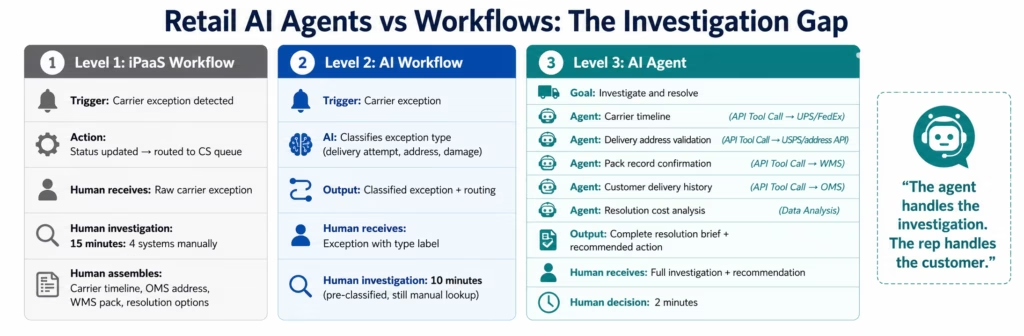
A Level 1 iPaaS workflow does a predetermined thing when a trigger fires. A Shopify order arrives: a WMS pick order is created. A carrier tracking event fires: the OMS status is updated. Deterministic, high-volume, reliable.
A Level 2 AI Workflow adds intelligence at specific predetermined steps. A return is scanned: Document Intelligence reads the packing slip, LLM Classification assigns a condition grade, the ERP return record is created. The sequence is fixed; the AI processes specific data at specific points.
A Level 3 AI Agent receives a goal. “Investigate why this shipment failed to deliver and determine the optimal resolution for the customer.” The agent then decides which systems to query, in what order, based on what it finds: adapting as it discovers the root cause.
The retail difference is material:
Level 2 workflow: a carrier exception fires → exception classified and routed to the customer service queue. The rep still investigates for 15 minutes.
Level 3 AI agent: a carrier exception fires → agent retrieves the full carrier event timeline, checks the OMS delivery address against USPS address validation, reviews the WMS pack record to confirm the right item was shipped, checks the customer’s delivery history for prior issues, calculates the cost of reshipping versus refunding, and delivers a complete resolution brief to the rep. The rep reviews in 2 minutes and acts.
That 13-minute gap between “exception routed” and “investigation complete” is what agents eliminate. At scale across dozens of daily exceptions: including overnight exceptions that nobody investigates until the next shift starts: the compounding impact is significant.
Before vs After: The AI Agent Transformation in Retail
| Exception Type | Before AI Agents | After AI Agents |
|---|---|---|
| Carrier delivery failure | CS rep manually checks carrier, OMS, WMS across 3-4 systems (15-20 min) | Fulfilment Exception Agent delivers complete brief with root cause and resolution recommendation (2-min review) |
| Inventory replenishment anomaly | Inventory analyst manually checks sell-through, lead times, open POs (20-30 min/SKU) | Replenishment Agent retrieves all data, calculates reorder quantity, routes structured brief (5-min review) |
| Returns fraud | Manual review of return history and item details (20-30 min, inconsistent coverage) | Returns Fraud Agent assembles evidence across order history, item data, and fraud patterns (5-min review) |
| Customer data discrepancy | CDM team manually reconciles customer records across platforms (30-45 min/case) | Customer Data Agent retrieves records from all systems, identifies discrepancy type, routes resolution brief |
| Amazon/Walmart SLA breach | Marketplace team discovers breach from periodic dashboard review | Marketplace Compliance Agent monitors continuously, flags approaching thresholds before breach |
| 3PL SLA pattern | Monthly 3PL scorecard reveals systemic issues weeks after onset | Watcher Agent detects statistical breach pattern within 48-72 hours of onset |
| SKU velocity anomaly | Buyer reviews weekly sell-through report, reacts next planning cycle | Replenishment Agent detects anomaly at data ingestion, routes to buyer same day |
| Duplicate customer records | Data team identifies in periodic CRM audit | Customer Data Agent detects on record creation, routes deduplication brief immediately |
| Demand-inventory mismatch | Stockout discovered when order fails to fulfil | Agent detects projected coverage days reaching threshold, routes reorder brief in advance |
| Cross-channel oversell root cause | Manual investigation after customer complaint (45-60 min) | Agent traces root cause to specific sync event, routes structured brief for system correction |
The 9 Native Tools Retail AI Agents Use
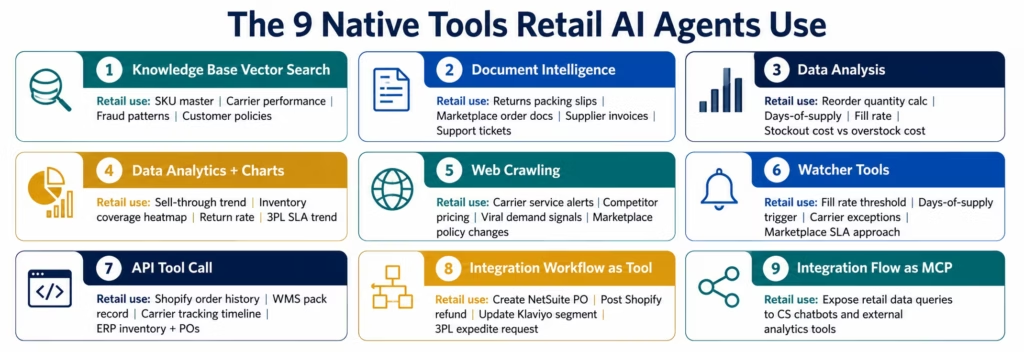
eZintegrations’ Level 3 AI Agents operate through 9 native enterprise tools. Each has specific retail applications that make agent investigations comprehensive rather than superficial.
1. Knowledge Base Vector Search Searches knowledge bases using semantic similarity. In retail: the SKU master knowledge base (product attributes, size runs, seasonal classifications, fulfilment rules), the carrier performance knowledge base (historical delivery performance by lane and carrier, known service disruption areas), the fraud pattern knowledge base (historical returns fraud patterns, high-risk customer signals, suspicious return scenarios), and the customer policy knowledge base (return policy by channel, discount eligibility rules, VIP tier criteria).
2. Document Intelligence Reads unstructured documents. In retail: returns packing slips (extracting order number, SKU, condition, customer return reason), marketplace order documents from PDF or EDI sources (extracting order details for non-API channels), supplier invoices and purchase confirmations (extracting PO number, quantity, unit cost, delivery date), and customer complaint letters or support tickets (extracting the nature of the issue, the order reference, and the customer’s requested resolution).
3. Data Analysis Performs structured calculations. In retail: calculating reorder quantities from sell-through velocity, safety stock, lead time, and open PO pipeline; computing days-of-supply coverage at current velocity by SKU and warehouse; identifying statistical anomalies in return rates by product category; running the fill rate calculation by channel and SKU; and calculating the financial impact of a replenishment decision (cost of stockout versus cost of overstock).
4. Data Analytics with Charts/Graphs/Dashboards Generates visual summaries. In retail: sell-through trend by SKU and channel, inventory coverage heatmap by warehouse and product category, return rate by SKU and return reason, marketplace performance metrics by channel, and 3PL SLA compliance trend.
5. Web Crawling Retrieves content from web sources. In retail: monitoring carrier service alerts (weather disruptions, network outages affecting delivery zones), checking competitor pricing and availability for key competitive SKUs, monitoring brand news and social media for viral demand signals that may affect inventory planning, and checking marketplace policy pages for changes to seller performance requirements.
6. Watcher Tools Monitors systems and triggers on specified conditions. In retail: monitoring OMS for fill rate declining below threshold on specific channels, monitoring WMS for SKUs whose days-of-supply coverage drops below the safety stock trigger, monitoring carrier tracking for specific exception event types (address issues, delivery refusals), monitoring marketplace seller dashboards for performance metrics approaching penalty thresholds, and monitoring customer return rates for SKU-level anomalies.
7. API Tool Call Calls configured API connectors. In retail: the Shopify API call that retrieves a customer’s complete order history and account data, the WMS API call that retrieves the pick confirmation and packed weight for a specific shipment, the carrier API call that retrieves the full event timeline for a tracking number, the OMS API call that retrieves the order’s delivery address and any address validation results, and the ERP API call that retrieves the current inventory position and open purchase orders for a SKU.
8. Integration Workflow as Tool Runs a Level 1 workflow as an agent tool. In retail: the agent triggers the “create NetSuite purchase order” workflow, the “post Shopify refund” workflow, the “update Klaviyo customer segment” workflow, or the “send 3PL expedite request” workflow as part of its investigation and action sequence: subject to human authorisation where configured.
9. Integration Flow as MCP Exposes retail integration capabilities to external AI systems via Model Context Protocol. In retail: allows customer service AI chatbots or external analytics tools to call eZintegrations’ retail data query capabilities as part of their own reasoning.
Retail AI Agent 1: Inventory Replenishment Agent
Inventory replenishment is the foundational cost management challenge in retail, consistent with McKinsey & Company research on retail operations automation. Stockouts lose sales directly. Overstock ties up capital and ultimately requires markdowns. Getting replenishment right requires a continuous calculation across sell-through velocity, safety stock requirements, supplier lead times, open PO pipeline, and seasonal demand patterns: for every active SKU, at every warehouse location, updated continuously.
Most inventory planning teams review replenishment on a weekly or biweekly cycle. The exceptions that warrant immediate attention: a SKU approaching stockout faster than expected, a demand acceleration not reflected in the current open PO: often occur between review cycles and are discovered too late.
Agent goal: “Assess the replenishment status of this SKU at all warehouse locations, calculate the optimal reorder recommendation, and route a structured replenishment brief to the inventory planner.”
Agent investigation sequence (adaptive):
The Watcher Tool continuously monitors the WMS inventory positions. When a SKU’s projected days-of-supply coverage at any warehouse location drops below the configured alert threshold:
-
API Tool Call (WMS): retrieves current on-hand inventory by location and the last 30 days of daily unit movement (picks, receipts, adjustments) for this SKU.
-
API Tool Call (ERP/OMS): retrieves all open purchase orders for this SKU: the PO quantities, the confirmed delivery dates, and the supplier. Retrieves the demand forecast for this SKU for the next 13 weeks.
-
Data Analysis: calculates the net projected inventory position week by week: current on-hand minus projected demand plus expected PO receipts. Identifies the projected stockout date at each warehouse location. Calculates the reorder quantity needed to maintain the target safety stock level through the next replenishment cycle.
-
Knowledge Base Vector Search (SKU master): retrieves the SKU’s supplier lead time, minimum order quantity, and seasonal classification: confirming whether the current velocity is a permanent shift or a seasonal pattern.
-
API Tool Call (ERP purchasing history): retrieves the supplier’s recent delivery performance for this SKU: have recent POs arrived on time, early, or late? If the supplier has been running late, the reorder quantity and timing need to account for extended lead time.
-
Web Crawling (if flagged): for SKUs showing unexpected demand acceleration, the agent optionally retrieves social media and news signals to check whether the velocity increase has an explainable external driver (viral social content, press coverage, celebrity mention).
The inventory planner receives a structured replenishment brief:
- Current inventory position and days-of-supply by warehouse
- Projected stockout date at current velocity
- Open PO pipeline and expected receipt dates
- Recommended reorder quantity and timing
- Supplier lead time and recent delivery performance
- Demand signal context (if applicable)
Decision time: 5 minutes from a complete information package versus 20-30 minutes of multi-system manual lookup. And crucially: the agent runs 24/7, catching the Saturday afternoon demand acceleration that would otherwise not be discovered until Monday morning.
Retail AI Agent 2: Fulfilment Exception Agent
Fulfilment exceptions: carrier delivery failures, wrong items shipped, damaged-in-transit packages: are the most customer-visible retail operational failures, reflecting broader retail supply chain AI trends covered by SupplyChainBrain. Each exception left unresolved within the customer’s expectations window becomes a negative review, a chargeback, or a lost customer. Each exception resolved proactively: with a re-ship or refund initiated before the customer contacts support: becomes a customer experience win.
The challenge: fulfilment exceptions arrive continuously, including overnight and on weekends. The investigations required are multi-system: carrier data, OMS order data, WMS pick confirmation, customer history. Without an agent, the exception sits in the queue until a human begins the investigation.
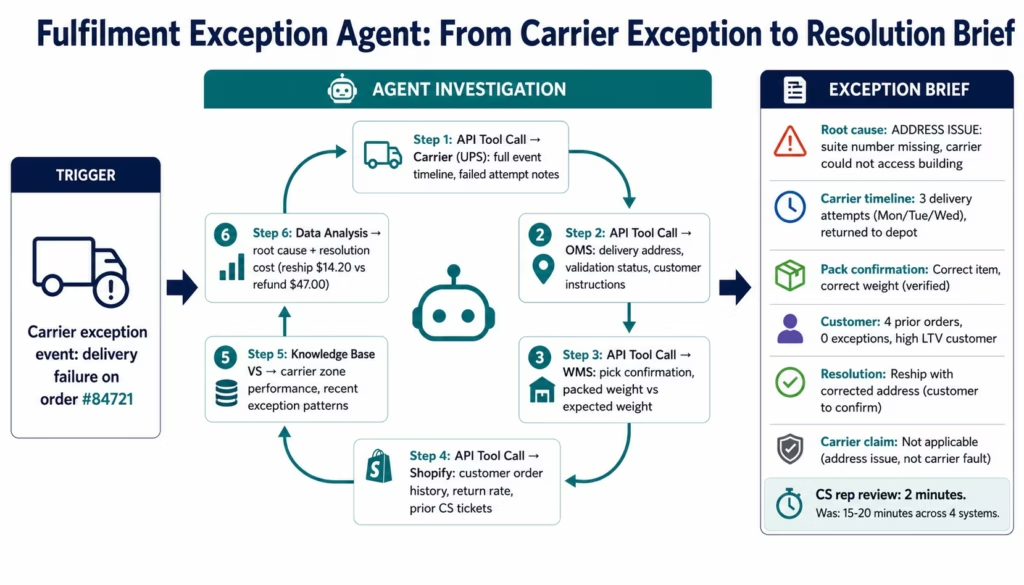
Agent goal: “Investigate this fulfilment exception, identify the root cause, assess the customer impact, and determine the optimal resolution path.”
Agent investigation sequence:
-
API Tool Call (carrier: UPS, FedEx, DHL): retrieves the complete carrier event timeline for the shipment: every scan, every delivery attempt, every exception event, and the carrier agent’s notes on failed delivery attempts.
-
API Tool Call (OMS): retrieves the original order: the delivery address as entered by the customer, any address validation result applied at time of order, the customer’s preferred delivery instructions, and the order value.
-
API Tool Call (WMS): retrieves the pick and pack confirmation: which warehouse picker pulled the order, the packed weight of the shipment (to check against the expected weight of the ordered items), and the packaging type used.
-
API Tool Call (Shopify / eCommerce platform): retrieves the customer’s complete order history, their return rate, and any prior support interactions related to delivery issues.
-
Knowledge Base Vector Search (carrier performance): retrieves the delivery performance history for this carrier and this delivery zone: is this an area with known delivery issues? Has this carrier been reporting elevated exception rates this week?
-
Data Analysis: synthesises the root cause classification: carrier delivery failure, address error, wrong item packed, damaged in transit: and calculates the resolution cost analysis: reshipment cost versus refund, considering the item’s value, the customer’s lifetime value, and the carrier’s claim eligibility.
The customer service team receives a structured exception brief:
- Root cause classification with supporting evidence
- Carrier event timeline
- Pack record confirmation (right item? correct weight?)
- Customer history context (first exception or pattern?)
- Resolution recommendation with cost estimate
- Carrier claim eligibility (if damage or loss)
Rep decision time: 2 minutes from a complete investigation versus 15-20 minutes of manual system lookups. And for overnight and weekend exceptions: the agent investigates immediately, so the rep starting Monday morning has 36 hours of pre-investigated exceptions ready for decision: not a queue of raw events to investigate one by one.
Retail AI Agent 3: Returns Fraud Investigation Agent
Returns fraud costs US retailers an estimated $101 billion annually across all fraud types (National Retail Federation, 2025). For individual eCommerce operators, fraud rates of 5-12% on return volume are common without systematic detection. Manual review at scale is not feasible: there are too many returns, and human reviewers apply inconsistent criteria.
AI agents change this economics. Every return can be assessed for fraud risk indicators, and only cases with elevated signals are routed for human review: keeping false positive rates low while ensuring systematic coverage.
Agent goal: “Assess this return for fraud risk indicators, compile the evidence, and route a structured fraud assessment brief to the fraud review team.”
Agent investigation sequence:
-
API Tool Call (OMS: order history): retrieves the customer’s complete order and return history: every order placed, every return initiated, the return reasons provided, and the refund amounts. Calculates the customer’s lifetime order-to-return ratio.
-
API Tool Call (WMS / returns management platform): retrieves the details of the current return scan: the item’s condition as recorded by the receiving team, any photos taken at the returns station, and the physical weight of the returned package.
-
Document Intelligence: reads the return packing slip and any customer-included documentation, extracting the stated return reason and any condition description provided.
-
Data Analysis: performs the fraud signal analysis across multiple dimensions:
- Does the returned item’s weight match the original shipment’s packed weight? (Empty-box fraud indicator)
- Is the customer’s return rate significantly above the population average for this product category?
- Is there a pattern of high-value returns coinciding with promotional events?
- Does the stated return reason match the item’s condition as recorded?
- Is this customer associated with a known high-risk shipping address or email pattern?
-
Knowledge Base Vector Search (fraud pattern knowledge base): searches the historical fraud case knowledge base for patterns similar to the current case: what characteristics were common in confirmed fraud cases for this product category?
-
Web Crawling (if elevated risk): for high-risk cases, the agent checks whether the shipping address is associated with known fraud activity reported in retail industry fraud databases.
The fraud review team receives a structured assessment:
- Fraud risk score (low / medium / high)
- Specific fraud signals detected (with the supporting data for each)
- Customer order and return history summary
- Recommended action: approve refund automatically, hold pending review, flag account for monitoring
- Financial exposure: the value at risk if the return is fraudulent
The reviewer makes the final authorisation decision: the agent never denies a refund autonomously. Low-risk returns process automatically without review. Medium and high-risk returns get a pre-assembled evidence brief that reduces review time from 20-30 minutes of manual research to 5 minutes of evidence review.
Retail AI Agent 4: Customer Data Reconciliation Agent
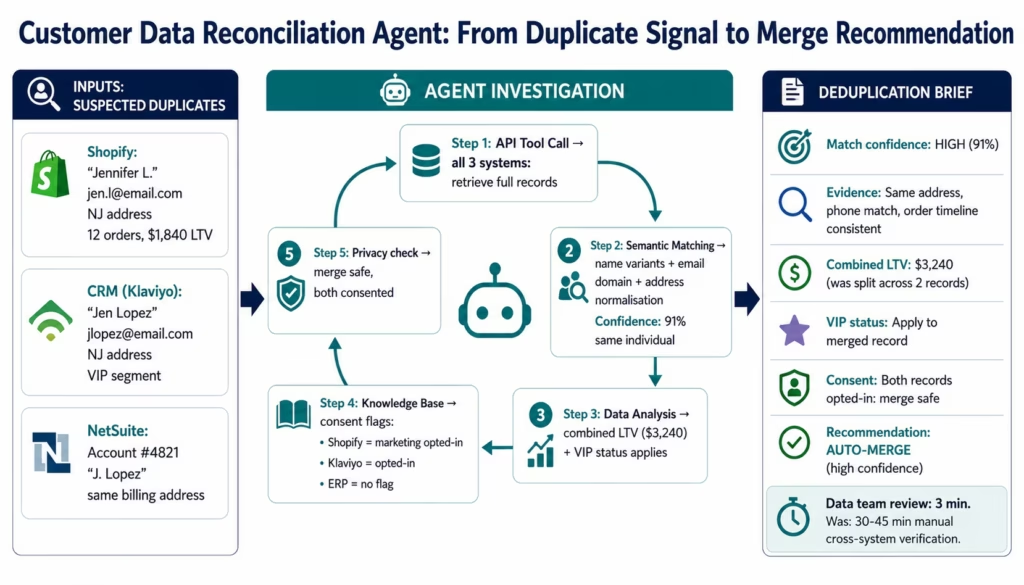
Retail brands running multiple commerce channels: DTC website, Amazon, Walmart, physical retail, wholesale: accumulate customer data across multiple systems that were not designed to share a unified customer record. The same customer may exist in Shopify as “Jennifer L.”, in Klaviyo as “Jen Lopez”, in the CRM as “Jennifer Lopez”, and in NetSuite as a billing account with no name: all representing the same person.
These fragmented customer records create direct operational problems: duplicate communications, inconsistent loyalty programme treatment, inaccurate lifetime value calculations, and inability to personalise across channels. They also create customer experience problems: the customer who calls support after an Amazon order but whose Shopify VIP status the rep cannot see.
Agent goal: “Identify whether these customer records represent the same individual, assess the confidence level of the match, and route a structured deduplication brief to the data management team.”
Agent investigation sequence:
-
API Tool Call (Shopify): retrieves the customer record from Shopify: name, email, phone, shipping addresses, order history, account creation date, and marketing consent status.
-
API Tool Call (CRM: Salesforce, HubSpot, or Klaviyo): retrieves the corresponding record from the CRM, including engagement history, segment membership, and any customer service interaction records.
-
API Tool Call (NetSuite): retrieves the billing and financial record: billing address, payment methods on file, and order history from the ERP perspective.
-
Semantic Matching: applies the semantic matching algorithm to compare the records across all identifying fields: name variants (Jennifer, Jen, J.), email domains, phone number formats, and address normalisation. Calculates a confidence score for the match.
-
Data Analysis: assesses the business impact of the duplicate: what is the combined lifetime value across both records? Does one record have loyalty programme status that should apply to the combined profile? Are there active promotions or suppression flags on one record that should apply to the other?
-
Knowledge Base Vector Search (data governance policies): retrieves the organisation’s data deduplication rules and privacy consent requirements: ensuring the proposed merge respects marketing consent flags and data retention policies.
The data management team receives a structured deduplication brief:
- Match confidence score (high / medium / low)
- Supporting evidence for the match (which fields matched, how closely)
- Combined lifetime value assessment
- Recommended action: auto-merge (high confidence), human-review merge (medium confidence), flag as distinct (low confidence)
- Consent and privacy compliance assessment for the proposed merge
Data team review time: 3-5 minutes for medium-confidence cases versus 30-45 minutes of manual cross-system verification.
Retail AI Agent 5: Marketplace Compliance Agent
Amazon and Walmart impose performance metrics on sellers that, when breached, trigger consequences ranging from listing suppression (losing the Buy Box) to account suspension. The metrics: Late Shipment Rate (LSR), Order Defect Rate (ODR), and Valid Tracking Rate (VTR) for Amazon; On-Time Delivery and Cancellation Rate for Walmart: move continuously as orders are processed and exceptions accumulate.
Manual monitoring through marketplace seller dashboards catches threshold breaches after the fact: the metric has already degraded. Sellers who manage these metrics proactively monitor them continuously and intervene in the specific order exceptions that are pulling metrics down, before the aggregate metric reaches the threshold.
Agent goal: “Monitor our marketplace performance metrics continuously. When any metric approaches a warning threshold, identify the specific orders contributing to the degradation and route a structured intervention brief.”
Agent investigation sequence (continuous monitoring via Watcher Tool):
The Watcher Tool continuously monitors the Amazon SP-API seller performance metrics endpoint and the Walmart Seller API performance dashboard. When any metric’s trailing rate approaches the configured pre-threshold alert level:
-
API Tool Call (marketplace performance API): retrieves the current metric value, the rolling period’s contributing order count, and the specific order IDs contributing to metric degradation.
-
API Tool Call (OMS): retrieves the order records for each degrading order: the ordered items, the fulfilment status, the carrier assigned, and any exception events.
-
API Tool Call (carrier): retrieves the tracking status for each late or unconfirmed shipment: is the shipment in transit (valid tracking, metric will self-correct) or is there a genuine delay that will persist?
-
Data Analysis: calculates the current trajectory: if no intervention is made, what will the metric value be at the end of the rolling period? How many additional exceptions can be absorbed before the threshold is crossed?
-
Knowledge Base Vector Search (marketplace policy): retrieves the current Amazon or Walmart performance metric thresholds, the warning levels, and the specific remediation actions that marketplace policy permits (confirming shipments, appealing metric calculations, requesting account health reviews).
The marketplace operations team receives a structured compliance brief:
- Current metric value and trajectory
- Specific contributing order IDs and their exception types
- Projected metric at end of rolling period if no action is taken
- Recommended interventions (expedite specific shipments, confirm valid tracking for specific orders, contact carrier for resolution on others)
- Time window before threshold breach at current trajectory
The marketplace manager reviews in 5 minutes and takes targeted intervention on the specific orders: not a reactive response to an already-breached metric.
Level 4: Goldfinch AI for Retail Operations Intelligence
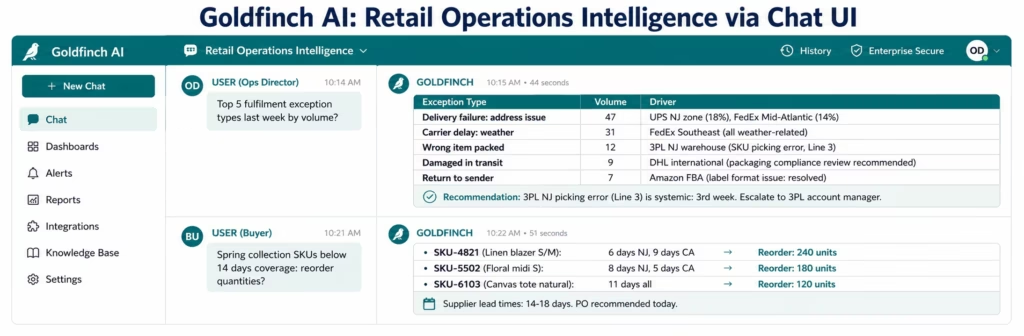
Individual AI agents handle individual exception types. Goldfinch AI coordinates multiple agents simultaneously and gives retail operations leadership natural language access to live inventory, order, and customer data.
Retail Operations Director: Monday morning: “What were our top five fulfilment exception types last week by volume and which carrier or warehouse is driving each?”
Goldfinch AI queries the OMS and carrier data via the Workflow Node, retrieves exception volumes by type, attributes each exception type to the responsible carrier or warehouse, and returns a structured operations brief in under 60 seconds.
Merchandise Buyer: “Which SKUs in the spring collection are currently below 14 days of coverage, and what are the reorder quantities?”
Goldfinch AI queries the WMS inventory positions and OMS sell-through data, calculates days-of-supply for the spring collection by SKU and warehouse, and returns a prioritised reorder list in under 60 seconds.
VP of eCommerce: “What is our Amazon and Walmart Late Shipment Rate this week and are we at risk of any performance warnings?”
Goldfinch AI queries the Marketplace Compliance Agent data from both platforms, retrieves the current LSR and its trajectory, and returns a compliance dashboard with the specific order exceptions contributing to each metric.
Customer Experience Director: “What is our return rate by SKU category this month compared to last month, and which categories are showing the highest increase?”
Goldfinch AI queries the OMS and returns management data, calculates return rates by category and month, identifies the categories with statistically significant increases, and returns the comparison with the top return reason codes for each elevated category.
Workflow Node: automated daily operations brief: Every morning, the Goldfinch AI Workflow Node coordinator dispatches parallel agents: one for overnight fulfilment exceptions (all exceptions that arrived after the last shift closed), one for inventory coverage alerts (SKUs approaching thresholds), and one for marketplace metric status. The coordinator synthesises findings and delivers a structured daily operations brief to the retail operations director by 7 AM: before the first team standup.
Governance and Data Security for Retail AI Agents
Retail AI agents access customer order history, personal delivery addresses, payment data references, and inventory financial data. Appropriate governance is both a business requirement and, for EU-based customers, a legal requirement.
Data access scope per agent:
Each retail AI agent is configured with the minimum data access required for its investigation task. The Fulfilment Exception Agent accesses carrier tracking data, OMS order records, WMS pack confirmations, and customer delivery history: it does not access customer payment data or financial account information. The Returns Fraud Agent accesses return history and order data: it does not access full payment card details. Data access scope is defined at API configuration level and enforced at the Integration Workflow as Tool level.
Human-in-the-loop gates for consequential retail decisions:
AI agents investigate and recommend. They do not autonomously execute consequential retail actions without configured human authorisation:
- The Inventory Replenishment Agent recommends a reorder quantity and timing: the inventory planner approves the purchase order.
- The Returns Fraud Agent assigns a fraud risk score and recommends action: the fraud review team authorises the refund hold or denial.
- The Marketplace Compliance Agent identifies orders contributing to metric degradation: the marketplace manager decides which interventions to execute.
The agent eliminates the investigation time. The human retains the decision authority.
SOC 2 Type II certification and GDPR compliance:
eZintegrations is SOC 2 Type II certified. All AI agent processing runs within eZintegrations’ infrastructure: customer order data, delivery addresses, and return records are not sent to external AI providers. For retail operations with EU customer data (GDPR), eZintegrations’ data processing architecture complies with GDPR requirements for customer personal data. For retail brands operating in California, CCPA-relevant customer data handling follows the same access-control and data minimisation architecture.
Key Outcomes and Results
Retail organisations deploying AI agents across inventory replenishment, fulfilment exceptions, returns fraud, and customer data management report measurable improvements within 30-60 days:
Inventory Management:
- Replenishment exception investigation: 20-30 min (manual) → 5-min review (AI-assembled brief)
- Stockout detection lead time: weekly review → continuous Watcher monitoring with same-day alert
- Weekend/overnight coverage: none → 24/7 agent monitoring with pre-investigated queue for Monday
- Reorder accuracy: improved through real-time velocity data versus weekly snapshot
Fulfilment:
- Exception investigation time: 15-20 min per exception → 2-min review per pre-investigated brief
- Overnight exception queue: raw unprocessed events → pre-investigated briefs ready at shift start
- Carrier root cause attribution: manual cross-referencing → automated per-exception classification
- Customer notification lead time: improved through faster exception investigation cycle
Returns:
- Returns fraud detection coverage: partial manual review → 100% of returns assessed for fraud signals
- Fraud review time: 20-30 min manual investigation → 5-min evidence review
- False positive rate: kept low through multi-signal scoring versus single-indicator alerts
- Returns processing throughput: improved by routing clean returns automatically
Customer Data:
- Duplicate record detection: periodic CRM audit → continuous detection on record creation
- Deduplication resolution time: 30-45 min manual → 3-5 min review
- Cross-channel customer visibility: fragmented → unified recommended profile
- Loyalty programme accuracy: improved through merged lifetime value assessment
Marketplace:
- Metric monitoring: periodic dashboard check → continuous Watcher monitoring
- Threshold breach prevention: reactive (breach then respond) → proactive (intervene before breach)
- Intervention targeting: all orders investigated manually → specific contributing orders surfaced by agent
How to Get Started
Step 1: Choose your highest-volume retail exception type
Count the exceptions your operations, inventory, and customer service teams handle daily. Multiply by the current investigation time per exception. The exception type with the highest accumulated investigation hours per week: and the highest cost of late resolution: is your first retail AI agent deployment. For most retailers, fulfilment exceptions or inventory replenishment events have the highest combined volume and investigation time.
Step 2: Build your retail knowledge bases
Retail AI agents are most effective with domain-specific knowledge they can search. Before deploying the Inventory Replenishment Agent: load your supplier lead time data, minimum order quantities, and seasonal classification matrix into the SKU knowledge base. Before deploying the Returns Fraud Agent: load your historical confirmed fraud cases, classified by fraud type and product category, into the fraud pattern knowledge base. Before deploying the Marketplace Compliance Agent: load the current Amazon and Walmart performance metric thresholds and remediation policies.
Step 3: Import the retail AI agent template from the Automation Hub
Visit the Automation Hub and filter by Retail AI Agents. Import the template for your target exception type. Configure your OMS connection (Manhattan, NetSuite, Shopify), your WMS connection (Blue Yonder, SAP EWM, 3PL Central), and your carrier connections (UPS, FedEx, DHL).
Step 4: Calibrate confidence thresholds
Set the fraud signal threshold for your return category mix. Configure the days-of-supply alert threshold for each velocity tier (fast-moving SKUs need a higher safety buffer). Set the marketplace metric pre-alert threshold at 2-3 percentage points above the marketplace’s warning threshold: giving the team time to intervene before the metric degrades to the warning level.
Step 5: Activate with parallel-run validation
Run the AI agent alongside the existing manual process for two weeks. Operations staff compare their manual investigation outcomes against the agent’s pre-investigation briefs for the same exceptions. Track the match rate between agent recommendations and actual decisions. Adjust knowledge base content or thresholds based on discrepancies before full activation.
Import a retail AI agent template from the Automation Hub and have your first retail AI agent live within two weeks.
Frequently Asked Questions
Retail AI agents receive a specific exception goal and investigate it autonomously using enterprise tools including querying the OMS, WMS, and carrier systems via API Tool Call, reading returns documents with Document Intelligence, searching SKU and fraud knowledge bases via Knowledge Base Vector Search, performing calculations with Data Analysis, and monitoring systems continuously with Watcher Tools. Unlike rule-based workflows that follow predetermined steps, agents adapt their investigation based on what they find. A fulfilment exception where the pack weight does not match triggers additional WMS investigation, while one where the carrier timeline shows a weather event triggers a carrier claim eligibility check. The output is always a structured brief for human review. All processing runs within eZintegrations' SOC 2 Type II certified infrastructure and no customer data is sent to external AI providers.
Standard Automation Hub retail AI agent templates go live in 7-14 days from template import to production activation. This includes OMS and carrier API connection configuration in 2-3 days, WMS connection in 1-2 days, knowledge base build with SKU data, fraud patterns, or carrier performance history in 2-4 days, confidence threshold calibration against sample exceptions in 2-3 days, and parallel-run validation in 2-3 days. A full retail AI agent programme covering inventory, fulfilment, returns, customer data, and marketplace operations typically deploys in 8-12 weeks.
Yes, Supported OMS and eCommerce systems include Shopify using REST API and webhooks, Amazon SP-API, Walmart Seller API, Manhattan Active OMS via REST API, NetSuite using SuiteQL plus REST API, and Salesforce Commerce Cloud via REST API. Supported WMS platforms include Manhattan Active WMS, Blue Yonder WMS, SAP EWM using OData V4, Oracle WMS Cloud, 3PL Central, Shipbob, and ShipHero. Supported carrier APIs include UPS Shipping, Tracking, and Rating APIs, FedEx Ship, Track, and Rate APIs, DHL Express and eCommerce APIs, plus regional carriers. For on-premises WMS deployments, eZintegrations connects via IPSec Tunnel. Agent API Tool Call is pre-configured for each system's authentication model including OAuth 2.0, API key, and SuiteQL for NetSuite.
No, The Returns Fraud Agent produces a fraud risk score and assembles the evidence brief, but it does not autonomously deny or withhold refunds. For low fraud-signal returns, the standard refund workflow proceeds automatically. For medium and high fraud-signal returns, the agent routes a pre-assembled evidence brief to the fraud review team, who make the authorisation decision. This design keeps false positive rates low so customers with legitimate returns are not blocked by automation while ensuring systematic coverage of all returns without manual review capacity limitations. The human-in-the-loop gate for fraud disposition is a mandatory configuration element and not optional.
Level 2 AI Workflows handle high-volume consistent retail data inputs with AI at specific predetermined steps. For example, a return is scanned, Document Intelligence extracts the information, the LLM assigns condition, and the refund is initiated. The sequence is fixed. Level 3 AI Agents handle complex retail exceptions requiring adaptive investigation. The Fulfilment Exception Agent receives a delivery failure and decides which systems to query and in what order based on what it finds, such as checking the carrier timeline first, then the OMS address if the carrier data suggests an address issue, and then the WMS pack record if the carrier data suggests a wrong item. Workflows are best for consistent high-volume retail data processing while agents are best for complex exception cases requiring multi-system reasoning.
Yes, Retail AI agents are triggered by system events including carrier exception events, WMS inventory threshold breaches, marketplace metric changes, return scan events, and by the Watcher Tool's continuous monitoring. They do not require a human to notice an exception and trigger the investigation. A carrier exception arriving at 11 PM Friday is investigated by the Fulfilment Exception Agent immediately and the pre-assembled brief is in the customer service team's queue when they open Monday morning. A SKU approaching stockout on Saturday afternoon triggers the Inventory Replenishment Agent immediately. This 24/7 coverage is one of the most significant operational advantages of agent architecture versus manual exception management. 1. How do AI agents work in retail operations?
2. How long does it take to set up a retail AI agent?
3. Does eZintegrations work with Shopify, Manhattan WMS, NetSuite, and major carriers for AI agents?
4. Does the returns fraud AI agent automatically deny refunds?
5. What is the difference between Level 2 AI Workflows and Level 3 AI Agents for retail?
6. Can retail AI agents operate 24/7 including weekends and overnight?
Conclusion: Retail Operations That Never Sleep
The Saturday afternoon stockout that nobody catches until Monday. The Friday evening fulfilment exception that waits in the queue until Tuesday when the backlog clears. The returns fraud pattern that builds for two months before a human reviewer notices the signal. The marketplace metric that degrades past the warning threshold over a holiday weekend.
These are not hypothetical failures. They are the natural consequence of operating retail systems that generate exceptions continuously but managing those exceptions only when a human is available to investigate them.
Retail AI agents change this. Not by replacing the inventory planner’s replenishment judgment: the agent investigates, the planner decides. Not by replacing the customer service rep’s resolution conversation: the agent assembles the evidence, the rep resolves. Not by replacing the fraud reviewer’s authorisation decision: the agent scores, the reviewer decides. By ensuring that every exception, regardless of when it arrives, is investigated immediately and has a complete evidence package ready for human decision at the start of the next business hour.
eZintegrations deploys five retail AI agents: Inventory Replenishment, Fulfilment Exception, Returns Fraud, Customer Data Reconciliation, and Marketplace Compliance: with SOC 2 Type II certified infrastructure, GDPR-compliant customer data handling, configurable human-in-the-loop gates, and pre-built connector configurations for Shopify, Amazon, Walmart, Manhattan, Blue Yonder, NetSuite, UPS, FedEx, and your full retail technology stack.
Import a retail AI agent template from the Automation Hub and have your first retail AI agent live within two weeks.
Book a free demo and bring your highest-volume retail exception type. We will show you what AI agent investigation looks like for your specific OMS, WMS, and carrier environment.