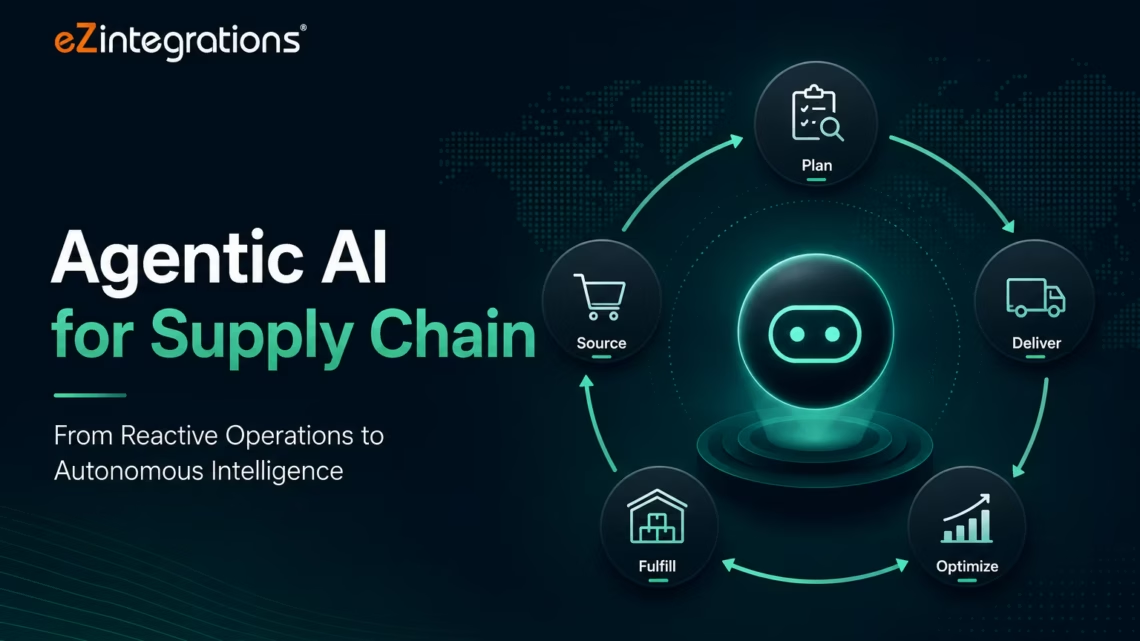
Agentic AI for Supply Chain: From Reactive Operations to Autonomous Intelligence
June 10, 2026Agentic AI for supply chain deploys coordinated networks of specialist AI agents aligned with Multi-agent system architecture that monitor logistics and supply chain operations continuously, detect anomalies and exceptions at population level, orchestrate autonomous responses across WMS, TMS, ERP, and carrier systems, and deliver synthesised intelligence to supply chain executives via natural language Chat UI. eZintegrations’ Goldfinch AI coordinates specialist worker agents through a Chat UI and Workflow Node: moving supply chain operations from reactive exception management (issues discovered after they become problems) to autonomous intelligence (issues identified, investigated, and routed before they become customer-visible).
TL;DR
- Reactive supply chain management means discovering problems after they occur: the carrier SLA breach you see in the monthly scorecard, the supplier lead time shift you notice when the stockout happens, the freight cost overrun you find when you close the quarter. The lag between event and discovery is where supply chain costs accumulate.
- Agentic AI closes that lag, consistent with McKinsey & Company research on agentic AI and autonomous supply chain operations. Not by making individual exception handling faster (that is Level 2 AI Workflows and Level 3 AI Agents) but by monitoring your entire supply chain continuously at population level: detecting patterns, correlating signals across domains, and routing intelligence to decision-makers before individual exceptions become systemic failures.
- Goldfinch AI is eZintegrations’ Level 4 multi-agent coordination platform. The Chat UI gives supply chain and logistics executives natural language access to live answers from across the operational stack in under 60 seconds. The Workflow Node runs autonomous intelligence programmes: coordinator agents dispatching parallel worker agents every night, delivering structured operational briefs every morning.
- Four agentic programmes in this guide: the Supply Chain Resilience Network (demand, supplier, carrier, inventory: monitored continuously), the Freight Intelligence Programme (cost, carrier performance, lane capacity), the Supplier Risk Network (compliance, financial health, performance), and the Fulfilment Operations Intelligence Centre.
- Deployment builds on an existing eZintegrations Level 1-3 foundation: Goldfinch AI coordination layers on top of an already-connected supply chain stack.
The Reactive Supply Chain: Where Costs Accumulate in the Lag
Consider four supply chain events that most organisations discover in the wrong order:
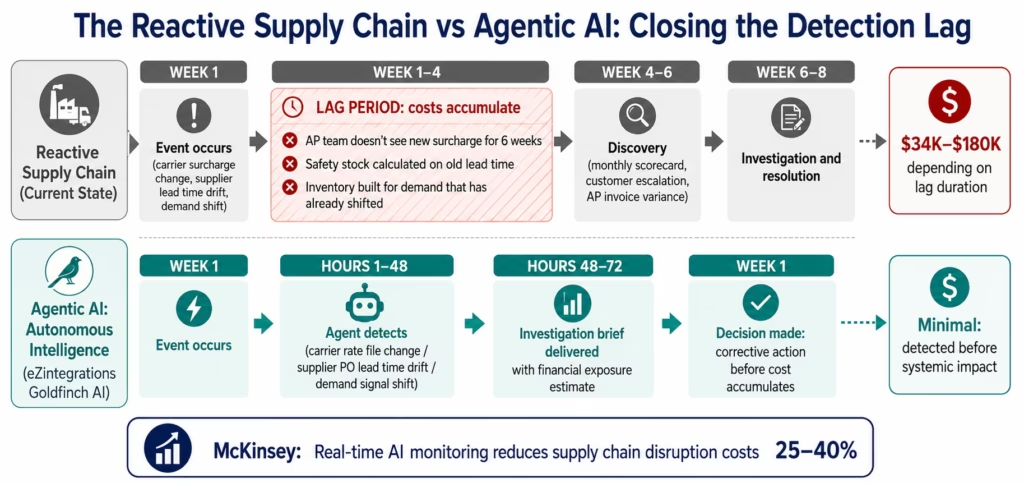
Event 1: A carrier changes its surcharge structure for residential deliveries in the Pacific Northwest, effective the first of next month. Your contracts team does not catch it in the carrier’s rate filing. The first invoice at the new rate arrives six weeks later. By then, 400 residential deliveries have been rated at the new surcharge, and the variance between what you planned to pay and what you owe is $34,000. The AP team flags it. The contracts team investigates. The resolution takes three weeks.
Event 2: Your primary packaging supplier in Vietnam begins running three-day lead time extensions on orders: not enough to trigger a formal delay notice, but consistent enough to shift your effective lead time from 18 days to 21 days. Your safety stock calculation was built on 18 days. You do not notice the lead time drift until a production line at your assembly facility runs short of packaging material. Emergency air freight costs $47,000.
Event 3: An unusually warm autumn reduces demand for your winter apparel line by 22% in weeks 6-8 of the season. Your demand planning system is on a monthly update cycle. The signal does not reach the replenishment system for three weeks. By then, inventory has been built at the distribution centre for a demand level that no longer exists. Markdowns cost $180,000 in margin.
Event 4: Your East Coast 3PL’s pick-pack on-time rate has been declining for six weeks: from 97% to 89%. You discover this when a Gold-tier retail customer escalates. Thirty-two orders to that customer were affected over the six weeks before the escalation. The relationship requires a formal remediation programme.
In each case, the event itself was not catastrophic. The lag between event and discovery is what made it expensive. And in each case, the data that would have enabled early detection existed: in the carrier rate database, in the purchase order lead time history, in the weekly demand feed, in the 3PL shipment confirmation timestamps. It just was not being monitored continuously, correlated across domains, and routed to the right decision-maker in time.
That is what agentic AI for supply chain does. Not faster exception handling: earlier exception detection. Not individual case investigation: population-level continuous monitoring. Not reports that arrive after the fact: intelligence that surfaces before the event becomes visible in a scorecard.
McKinsey estimates that supply chain operations with real-time AI monitoring reduce supply chain disruption costs by 25-40% versus operations relying on periodic reporting cycles. Gartner projects that by 2028, 60% of large enterprise supply chain organisations will operate with autonomous AI monitoring across at least three supply chain domains.
What Agentic AI Means for Supply Chain (and Why It Is Different from AI Agents)
The distinction between individual AI agents and agentic AI is the same distinction as between individual analysts and an operations intelligence function.
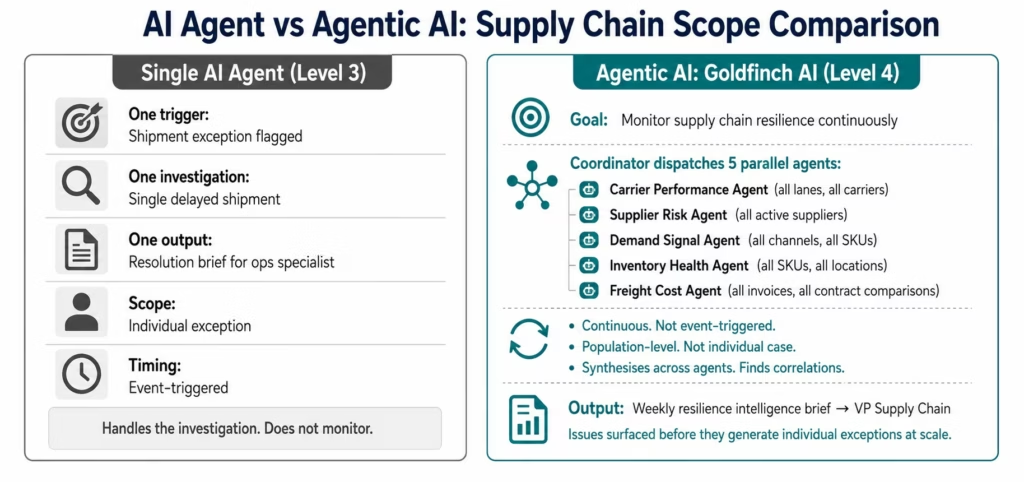
A single AI agent (Level 3) handles one exception at a time: one delayed shipment, one carrier claim, one inventory replenishment anomaly. The agent investigates well and fast, delivering a pre-researched brief to the operations specialist. This is covered in the AI agents for logistics guide.
Agentic AI (Level 4, Goldfinch AI) operates at the programme level. A coordinator agent receives a complex monitoring goal: not “investigate this shipment exception” but “monitor our supply chain resilience continuously and surface emerging risks before they become operational failures.” The coordinator decomposes this into parallel monitoring workstreams, dispatches specialist worker agents for each domain, receives their findings, correlates across domains, and synthesises a unified intelligence picture for executive decision-makers.
The practical supply chain differences:
Single AI agent: the Carrier Claims Agent assembles a damage claim package when an individual damage exception is flagged. One claim. One agent. Triggered by an individual event.
Agentic AI: the Freight Intelligence Programme coordinator monitors every carrier lane in your network simultaneously: on-time performance by carrier and lane, freight cost versus contracted rates, capacity utilisation trends, weather event correlations with delay patterns. The coordinator receives findings from five parallel carrier-monitoring agents and synthesises a weekly freight intelligence brief: identifying the $34,000 carrier surcharge discrepancy in week one, not week seven.
The difference is scope and timing. Individual agents handle individual exceptions. Agentic AI monitors the whole programme continuously and surfaces systemic patterns before they generate individual exceptions at scale.
Before vs After: The Agentic AI Transformation
| Supply Chain Domain | Before Agentic AI | After Agentic AI (Goldfinch AI) |
|---|---|---|
| Carrier SLA monitoring | Monthly scorecard: breach discovered 30 days after it started | Continuous lane-level monitoring: breach pattern identified within 48 hours |
| Carrier rate compliance | Invoice variances discovered when AP flags unusual amounts | Freight Intelligence Agent detects rate change at carrier filing, flags pre-submission |
| Supplier lead time drift | Stockout event reveals the drift has been compounding for weeks | Lead Time Agent detects consistent PO-to-delivery extension, alerts procurement in week two |
| Demand signal anomalies | Monthly plan update processes anomaly 3-4 weeks after event | Demand Signal Agent detects and classifies anomaly at ingestion, routes same-day |
| Inventory health overview | Weekly inventory report from BI team: 2-day lag | Inventory Health Agent monitors continuously, flags safety stock breaches as they occur |
| Supplier financial risk | Annual supplier risk review or reactive discovery from news | Supplier Risk Agent monitors financial signals, flags emerging risk within days |
| Cross-domain correlation | Siloed teams, no systematic correlation across domains | Coordinator correlates carrier performance decline with weather event affecting same region as supplier |
| Executive supply chain query | 2-4 hour analyst request to get current state data | Chat UI: natural language query answered from live data in under 60 seconds |
| Weekly operations briefing | Analyst spends 2-3 hours assembling from multiple system reports | Workflow Node coordinator runs Sunday night, Monday brief delivered automatically |
| Disruption early warning | Disruptions discovered from customer escalations or news | Multi-domain agent network identifies correlated risk signals 7-14 days before disruption |
The Goldfinch AI Architecture for Supply Chain
Goldfinch AI is eZintegrations’ Level 4 multi-agent coordination platform, aligned with autonomous supply chain technology trends tracked by ARC Advisory Group. In supply chain, it operates through two interfaces that together create continuous autonomous intelligence.
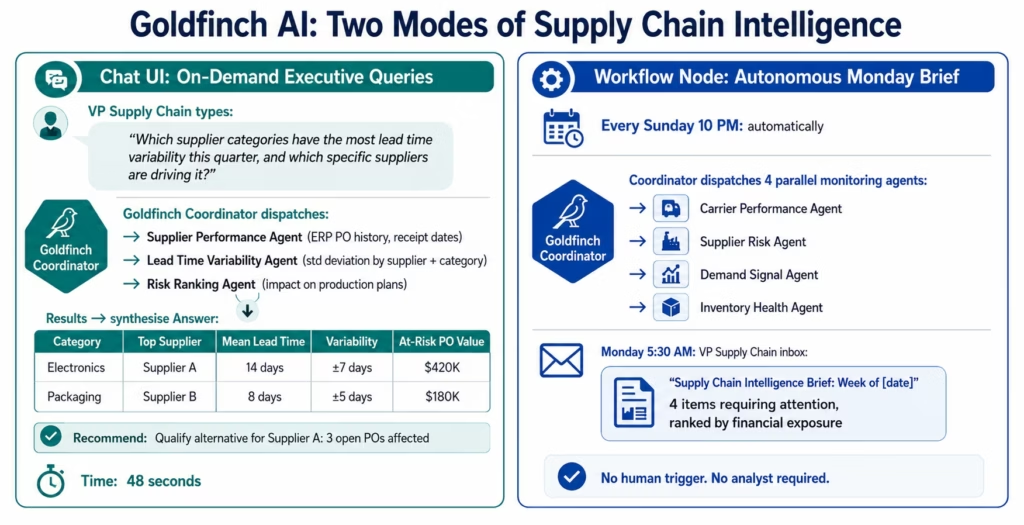
The Chat UI: natural language access to live supply chain data for executives. The VP of Supply Chain types a question. Goldfinch AI interprets the intent, identifies which systems and agent capabilities are needed, dispatches worker agents, receives results, synthesises across agents, and returns a structured answer: typically within 30-60 seconds.
The Chat UI is not a reporting tool that queries cached data. It dispatches agents that retrieve current data from live ERP, TMS, WMS, and supplier systems. The answer the VP receives reflects the state of those systems at the moment of the query, not the state as of the last batch cycle.
The Workflow Node: coordinator intelligence embedded in automated supply chain programmes. The Workflow Node is how agentic monitoring runs continuously: not just when an executive asks a question.
A Workflow Node deployed in the supply chain resilience programme runs every night: it dispatches the carrier performance agent, the supplier risk agent, the demand signal agent, and the inventory health agent across the full supply chain population. The coordinator receives findings from all four, correlates signals across domains, and produces the weekly intelligence brief: delivered to the supply chain leadership team every Monday morning without anyone requesting it.
Together, the Chat UI and Workflow Node represent two modes of the same agentic intelligence: on-demand natural language queries and scheduled autonomous monitoring programmes.
Agentic Programme 1: Supply Chain Resilience Network
The Supply Chain Resilience Network is the core agentic programme for supply chain operations. It monitors four critical supply chain domains continuously: demand signals, supplier performance, carrier operations, and inventory health: through four specialist worker agents coordinated by the Goldfinch AI resilience coordinator.
Worker Agent 1: Demand Signal Intelligence Agent
Monitors demand signals across all incoming channels (retailer POS feeds, distributor sell-through, direct eCommerce, B2B orders) continuously. For each signal batch:
Data Analysis detects statistical deviations from the forecast baseline: items where incoming demand is more than one standard deviation above or below the seasonal-adjusted forecast. LLM Classification categorises each deviation: known promotion, suspected promotion (no match in promotional calendar but consistent with promotional uplift pattern), competitive event, data feed error, or genuine demand shift.
At the population level, the coordinator tracks: which SKU categories are showing the most anomaly frequency, which retail channels are producing the most data quality issues, and whether anomaly patterns are concentrated in specific regions or account groups. The coordinator surfaces population-level demand health indicators alongside individual SKU exceptions.
Worker Agent 2: Supplier Performance and Risk Agent
Monitors supplier delivery performance, quality incident history, and external risk signals continuously across all active suppliers.
For delivery performance: the Watcher Tool monitors every PO against its confirmed delivery date. The agent calculates on-time delivery rate by supplier and flags suppliers where OTD rate has declined by more than the configured threshold over the trailing 4 weeks.
For external risk: the Web Crawling tool monitors news sources and financial data providers for signals about active suppliers: financial distress news, labour relations issues, facility disruptions, regulatory actions, or geopolitical events affecting suppliers in specific regions.
For compliance: Document Intelligence and the Watcher Tool monitor supplier certificate expiry dates, flagging compliance gaps 90/60/30 days before expiry.
The coordinator synthesises: a ranked list of supplier risk flags, the at-risk PO value for each flagged supplier, and the recommended action (expedite, qualify alternative, issue formal notice, or monitor).
Worker Agent 3: Carrier and Network Performance Agent
Monitors carrier performance across every lane in your network, freight cost compliance, and capacity signals.
On-time delivery monitoring: every shipment against contracted SLA by carrier and lane. Statistical deviation detection: when a carrier’s OTD rate for a specific lane declines meaningfully from baseline, the agent flags the pattern and retrieves the carrier’s service alerts (Web Crawling) for explanatory context.
Freight cost compliance: every ERA or invoice compared against contracted rates. Rate deviations flagged with the specific contract clause reference within 48 hours of invoice receipt.
Capacity signals: the agent monitors carrier capacity acceptance rates. When a carrier begins rejecting tenders at higher rates than baseline, the agent flags potential capacity constraints on that lane before they affect shipment planning.
Worker Agent 4: Inventory Health Agent
Monitors inventory positions, safety stock compliance, and replenishment health across all SKUs and all locations.
For safety stock compliance: the agent compares current inventory at each location against the safety stock requirement, flagging items where inventory has fallen below safety stock or is projected to breach safety stock within the replenishment lead time.
For parameter health: the agent runs the demand variability and supplier lead time calculation for all items, comparing the current safety stock settings against what the parameters would produce using current data. Items where the current safety stock setting is materially wrong (demand has shifted, lead time has drifted) are flagged for review: before the parameter error causes a stockout.
For inventory excess: the agent identifies items where current inventory plus outstanding POs exceeds the 90-day demand forecast by a configurable threshold: flagging excess build-up risk before it requires markdowns.
Coordinator synthesis:
The resilience coordinator receives findings from all four agents. It correlates across domains: does the demand decline for a specific SKU category correlate with the timing of a carrier capacity constraint on the lanes serving those customers? Does a supplier lead time extension for a specific component align with inventory health alerts for the items that use that component? Cross-domain correlation is what the coordinator provides that individual agents cannot.
The weekly resilience brief presents: a ranked risk register by financial exposure, the cross-domain correlations identified, and recommended actions for each risk item.
Agentic Programme 2: Freight Intelligence Programme
Freight is typically the largest discretionary cost line in a supply chain operation. The organisations that manage it best do so with continuous visibility: not monthly reports. The Freight Intelligence Programme deploys five specialist agents that monitor freight costs, carrier performance, and lane capacity in real time, coordinated by the Goldfinch AI freight coordinator.
Freight Cost Compliance Agent: Compares every carrier invoice against contracted rates automatically. For every rate variance beyond the tolerance threshold, the agent retrieves the applicable contract clause from the carrier contract knowledge base and classifies the variance: legitimate accessorial, carrier billing error, or ambiguous. The coordinator tracks variance patterns by carrier: is a specific carrier systematically billing above contracted rates for specific accessorial types? That is a contract renegotiation signal, not a one-off billing error.
Carrier Lane Performance Agent: Monitors on-time delivery performance by carrier and lane against contracted SLAs. Identifies lanes where performance has declined meaningfully over the trailing 4 weeks. Retrieves the financial exposure of SLA breaches for lanes where the contract includes performance guarantees. Triggers the SLA credit claim workflow for qualifying breaches.
Freight Mode Optimisation Agent: Monitors shipments where the mode selection may not be optimal given current conditions. Flags shipments that were rated as expedited when standard service would have met the delivery commitment, and shipments rated as LTL when FTL would have been more cost-effective given the load factor. At population level, identifies patterns in suboptimal mode selection and routes recommendations to the transportation planning team.
Carrier Capacity Signal Agent: Uses the Web Crawling tool to monitor carrier capacity signals: carrier earnings announcements mentioning capacity additions or reductions, industry capacity reports from FreightWaves or similar sources, and tender acceptance rate data from carrier portals. Flags emerging capacity constraints on key lanes 2-4 weeks before they materialise as service failures.
Fuel and Market Rate Agent: Monitors diesel fuel index changes, spot rate movements on key lanes, and contract rate adjustment triggers (many carrier contracts include fuel escalation clauses tied to the DOE weekly retail diesel index). When a fuel escalation clause trigger is approaching, the agent alerts the contracts team with the projected rate impact and the contractual trigger date.
Agentic Programme 3: Supplier Risk and Compliance Network
Supplier concentration risk is one of the most consistently underestimated supply chain risks. Most organisations know their strategic suppliers but do not have continuous visibility into which of those suppliers are showing early warning signals of operational, financial, or compliance risk.
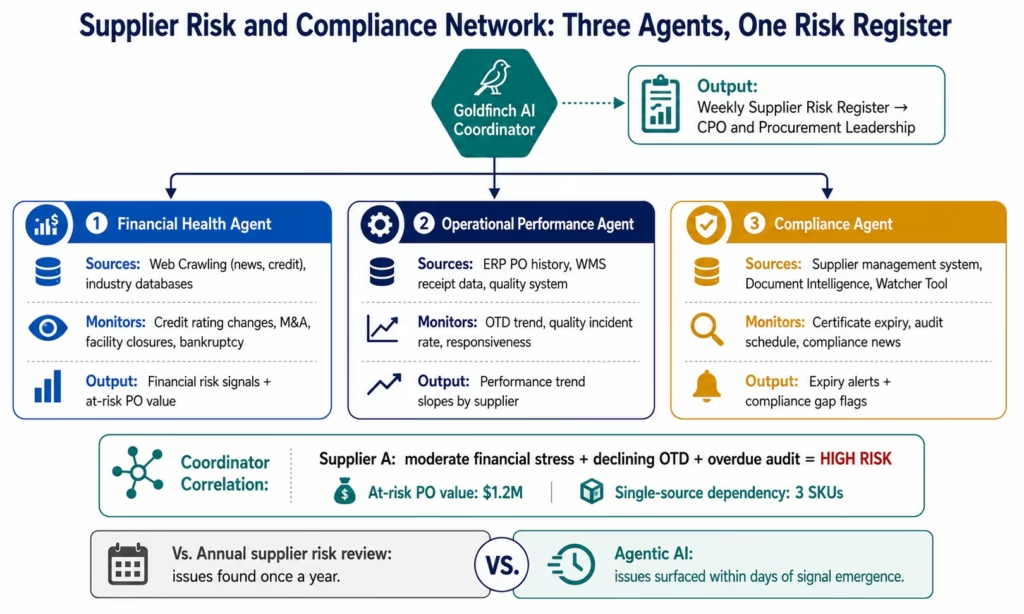
The Supplier Risk and Compliance Network deploys three specialist agents that monitor supplier health continuously across financial, operational, and compliance dimensions.
Supplier Financial Health Agent: Uses the Web Crawling tool to monitor financial news about active suppliers: credit rating changes, bankruptcy filings, major customer losses, facility closures, and M&A activity that could affect operational continuity. The agent also monitors trade credit information where available. When a financial risk signal is identified, Data Analysis retrieves the at-risk PO value and the dependency score (how many of your SKUs source exclusively from this supplier) to produce a financial exposure estimate alongside the risk signal.
Supplier Operational Performance Agent: Monitors on-time delivery, quality incident rate, and responsiveness metrics for all active suppliers. Identifies suppliers where performance has declined over the trailing 8 weeks, even where individual incidents have not triggered formal non-conformances. The coordinator tracks performance trend slopes: a supplier declining at 2% per month across multiple metrics is a different risk profile than one with isolated incidents.
Supplier Compliance Agent: Monitors certificate and audit report expiry dates, tracks compliance audit scheduling, and processes incoming compliance documents via Document Intelligence. Flags suppliers with expiring certifications before they lapse. For audits: tracks the schedule of planned audits and the gap between scheduled and completed audits. The Watcher Tool monitors for compliance-relevant news about suppliers (regulatory actions, public health incidents, labour practice violations).
Coordinator synthesis: The supplier risk coordinator correlates findings across all three agents. A supplier showing moderate financial stress signals, declining OTD performance, and an overdue compliance audit represents a different risk level than a supplier with any one of these signals in isolation. The coordinator ranks suppliers by composite risk score and routes a weekly supplier risk register to the procurement leadership team, with the specific signals that generated each supplier’s risk rating.
Agentic Programme 4: Fulfilment Operations Intelligence Centre
Fulfilment is where supply chain performance becomes customer experience. Orders fulfilled late, partially, or inaccurately are the visible tip of a systemic supply chain problem. The Fulfilment Operations Intelligence Centre monitors fulfilment performance continuously across all channels, warehouses, and 3PL partners.
Fulfilment Rate Monitoring Agent: Monitors order fill rates across all SKUs, all channels, and all fulfilment locations. Tracks: fill rate by SKU (percentage of ordered quantity fulfilled from available inventory), fill rate by channel (what percentage of orders are fulfilled in full, on time), and backorder depth (how many days of demand are represented by current backorders). The Watcher Tool triggers an investigation when fill rate for a specific SKU or category falls below the configured threshold.
3PL and Warehouse Network Agent: Monitors pick-pack SLA compliance across all warehouse locations and 3PL partners. Tracks SLA breach rates by location, shifts, and order type. Identifies systemic performance issues: a 3PL with an SLA breach rate that doubles on Fridays has a staffing pattern problem, not a random exception. The coordinator surfaces these patterns from aggregate data, which individual exception agents cannot detect because they see one shipment at a time.
Returns Intelligence Agent: Monitors return rates by SKU, channel, and reason code. Identifies SKUs with anomalous return rates (significantly above category baseline) and clusters return reasons for pattern identification. A SKU with a 35% return rate and a concentrated “product not as described” reason code is a product information problem, not a fulfilment problem. Routing this to the right team requires interpreting the aggregate pattern, not just handling individual returns.
Demand-Fulfilment Alignment Agent: Monitors the alignment between demand signals and fulfilment capacity across the network. Identifies situations where demand is accelerating in a region where fulfilment capacity is constrained, or where fulfilment capacity is idle in a region where demand has shifted. Routes reallocation recommendations to the operations team before the misalignment becomes a service level failure.
Coordinator synthesis: The fulfilment coordinator correlates findings across all four agents. Does the fill rate decline for a specific SKU correlate with an inventory health alert from the Supply Chain Resilience Network? Does the 3PL performance issue correspond to the same geographic area where the Carrier Network Agent has flagged capacity constraints? The coordinator synthesises across programmes as well as within them, identifying multi-domain causality chains.
Supply Chain Executive Intelligence via Chat UI
The Goldfinch AI Chat UI makes supply chain intelligence accessible to executives in natural language: without report requests, without analyst intermediaries, without waiting for the next scheduled meeting.
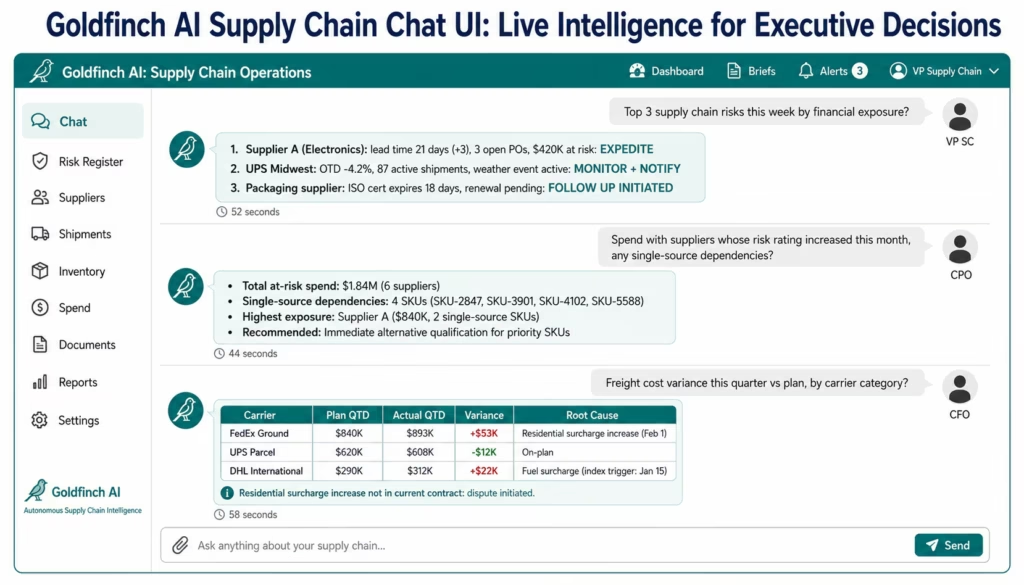
VP of Supply Chain: Monday 8 AM: “What are our top three supply chain risks this week by financial exposure?”
Goldfinch AI’s coordinator queries the active risk signals from the Supply Chain Resilience Network, the Freight Intelligence Programme, and the Supplier Risk Network simultaneously. It ranks by financial exposure and returns:
- Supplier A (Electronics): lead time drift extending to 21 days, 3 open POs, at-risk value $420K. Action: expedite or qualify alternative.
- UPS Midwest lane: OTD rate declined 4.2% this week, weather event active, 87 active shipments on affected lanes. Action: monitor, proactive customer notification prepared.
- Packaging supplier compliance: ISO certificate expires in 18 days, renewal not yet received. Action: immediate follow-up initiated by Compliance Agent.
Time: 52 seconds. Previously: a 2-hour analyst exercise to pull this from three separate systems.
CPO: Wednesday: “What is our total spend with suppliers whose risk rating has increased this month, and what single-source dependencies do we have in that group?”
Goldfinch AI queries the Supplier Risk Network for suppliers with increased composite risk scores this month, retrieves YTD spend from the ERP for each, identifies which items are single-sourced from those suppliers, and returns a financial exposure summary with the specific at-risk SKUs.
CFO: Thursday: “What is our freight cost trend this quarter versus plan, and which carrier categories are over budget?”
Goldfinch AI queries the Freight Intelligence Programme data and the ERP freight cost actuals versus the budget allocation, returns a variance analysis by carrier category, and flags the specific carrier contract provisions that may allow cost recovery for overbillings.
COO: Friday: “What is our fulfilment rate by channel this week versus last week, and where are we seeing the biggest changes?”
Goldfinch AI queries the Fulfilment Operations Intelligence Centre data and returns a channel-level fill rate comparison with trend flags and the specific SKU categories driving the changes.
Governance and Audit for Agentic Supply Chain AI
Agentic AI introduces governance considerations that scale with the number of agents operating simultaneously and the breadth of data they access. Four principles govern agentic supply chain AI in eZintegrations:
1. Data access scope per agent
Each worker agent is configured with the minimum data access required for its monitoring task. The Demand Signal Intelligence Agent accesses demand feeds and the demand planning system. It does not access financial data, HR data, or supplier contract terms. The Freight Cost Compliance Agent accesses invoice data and contract rates. It does not access supplier financial health data.
Data access scope is defined at configuration and enforced at the API Tool Call level: an agent cannot retrieve data sources outside its configured scope, regardless of what the coordinator requests.
2. Human-in-the-loop gates on consequential actions
The agentic monitoring programmes surface intelligence and route structured recommendations. They do not autonomously execute consequential actions without human approval:
- The Supplier Risk Network flags a high-risk supplier and recommends expediting or qualifying an alternative. The procurement team initiates the action.
- The Freight Intelligence Programme identifies a carrier billing error and recommends disputing. The AP team initiates the dispute.
- The Fulfilment Operations Centre flags a fill rate decline and recommends inventory reallocation. The operations team approves the reallocation.
The agents analyse and recommend. Humans authorise and execute.
3. Audit trail at agent, coordinator, and programme level
Every agent action generates an immutable log entry: the agent, the data sources accessed, the tool calls made, the data retrieved, the analysis performed, and the output produced. The coordinator’s synthesis decisions are also logged: which agents were dispatched, what findings each returned, how findings were correlated, and how the intelligence brief was constructed.
When the CFO asks the Chat UI a question and receives an answer, there is a complete audit trail from the query to every data source every worker agent accessed to produce the response.
4. SOC 2 Type II certification and GDPR compliance
eZintegrations is SOC 2 Type II certified, providing third-party validated assurance that the security controls governing agent data access are operating as documented. For supply chain organisations with EU operations, all supply chain data processed through Goldfinch AI complies with GDPR data processing requirements. For pharmaceutical and healthcare supply chain operations where logistics data touches patient or prescription information, HIPAA-compliant integration with a signed BAA is available.
Key Outcomes and Results
Supply chain organisations deploying agentic AI programmes across the Supply Chain Resilience Network, Freight Intelligence, Supplier Risk, and Fulfilment Operations report measurable improvements within 90-120 days:
Disruption Detection and Response:
- Supplier lead time drift detection: weeks (stockout reveals it) → days (agent detects trend)
- Carrier SLA breach pattern identification: 30 days (monthly scorecard) → 48 hours
- Demand signal anomaly to plan adjustment: 3-4 weeks → same-day routing
- Cross-domain risk correlation: not performed systematically → automated by coordinator
Freight Cost Management:
- Carrier invoice compliance monitoring: spot-check → 100% of invoices
- New carrier surcharge detection: weeks (invoice) → days (rate filing monitoring)
- Freight cost recovery from billing errors: 1-3% of total freight spend identified
- Carrier capacity constraint early warning: reactive (shipment rejected) → 2-4 week advance signal
Supplier Risk Management:
- Supplier financial risk detection: annual review → continuous signal monitoring
- Compliance gap identification: reactive (audit) → proactive (pre-expiry alert)
- At-risk spend visibility: quarterly report → real-time Chat UI query
- Single-source dependency risk: periodic assessment → continuous inventory
Fulfilment Performance:
- Fill rate monitoring: weekly report → continuous per-SKU monitoring
- 3PL SLA breach pattern detection: monthly scorecard → 48-hour statistical detection
- Return rate anomaly identification: manual quarterly review → continuous pattern monitoring
Executive Intelligence:
- Supply chain risk query: 2-4 hours (analyst) → 52 seconds (Chat UI)
- Weekly operations brief: 2-3 hours manual assembly → automated Monday delivery
- Cross-domain correlation: rarely performed → systematic coordinator output
How to Get Started
Step 1: Confirm your Level 1-3 foundation
Agentic AI monitoring builds on existing eZintegrations supply chain integration. The Supply Chain Resilience Network assumes your ERP, WMS, and key supplier and carrier connections are established. If not, start with the logistics integration platform and the AI agent templates first. Goldfinch AI coordination is most valuable on top of an already-connected supply chain stack.
Step 2: Choose your first agentic programme
The Supply Chain Resilience Network is the broadest starting point: it covers demand, supplier, carrier, and inventory simultaneously, giving the most comprehensive visibility. The Freight Intelligence Programme is typically the highest near-term ROI for organisations with complex carrier networks and high freight spend. The Supplier Risk Network is the highest value for procurement teams with strategic supplier concentration. Choose based on your organisation’s highest financial exposure domain.
Step 3: Configure the coordinator and worker agents
Import the Goldfinch AI programme template from the Automation Hub. Configure each worker agent with its data source connections and minimum necessary data access scope. Configure the coordinator’s synthesis rules: how to rank risk items, how to correlate across agent findings, and what format the intelligence brief should take.
Step 4: Set up the Chat UI for your executive team
Configure Goldfinch AI Chat UI access for each executive role: VP Supply Chain, CPO, CFO, COO. Set the data access scope for each role: aggregate intelligence by default, drill-down to specific supplier or shipment data with appropriate governance controls. Brief the executive team on query patterns and how to interpret structured responses.
Step 5: Activate the Workflow Node for automated intelligence briefs
Configure the Workflow Node for the weekly intelligence brief: the coordinator’s Sunday-night schedule, the worker agent dispatch configuration, and the output routing (who receives the brief, through which channel). Activate: the first automated intelligence brief runs on the configured schedule.
Book a free agentic AI supply chain demo and bring your current supply chain monitoring blind spots. We will map your demand, supplier, carrier, and inventory data to a Goldfinch AI programme and demonstrate the Chat UI with your actual executive use cases.
FAQs
Agentic AI coordinates multiple AI agents working in parallel toward complex monitoring and intelligence goals. Individual AI agents (Level 3) handle one exception at a time such as a delayed shipment or supplier non-conformance. Agentic AI (Level 4, Goldfinch AI) deploys a coordinator that dispatches specialist worker agents across the entire supply chain population simultaneously: monitoring demand signals from all channels, supplier performance from all active suppliers, carrier performance across all lanes, and inventory health across all SKUs, then synthesising their findings into unified intelligence for executive decision-makers. The distinction is individual exception handling versus continuous population-level monitoring with cross-domain correlation.
Goldfinch AI operates through two interfaces. The Chat UI answers natural language executive queries from live supply chain data in under 60 seconds, such as 'What are our top supply chain risks this week?' or 'What is our freight cost variance versus plan this quarter?' The Workflow Node runs autonomous scheduled monitoring programmes. Every Sunday night, the Supply Chain Resilience coordinator dispatches four parallel monitoring agents, correlates their findings, and delivers a structured Monday intelligence brief without requiring anyone to request it. Both interfaces use the same coordinator-worker architecture with full audit trails and configurable data access controls.
With the Level 1-3 integration foundation already in place, configuring the Goldfinch AI programme, worker agent data access scopes, Chat UI executive access, and Workflow Node intelligence briefs typically takes 4-6 weeks. A greenfield full-stack deployment starting from integration typically takes 12-18 weeks. The Automation Hub includes programme-level templates for the Supply Chain Resilience Network, Freight Intelligence Programme, Supplier Risk Network, and Fulfilment Operations Intelligence Centre.
Yes. eZintegrations is SOC 2 Type II certified and all Goldfinch AI processing runs within eZintegrations' infrastructure with no supply chain data sent to external AI providers. Every agent data access event generates an immutable audit log. Data access scope is configured per agent using minimum necessary access principles. GDPR compliance applies for EU operations. For healthcare or pharmaceutical supply chain operations involving patient or prescription data, HIPAA-compliant integration with a signed BAA is available.
The Supply Chain Resilience Network uses four specialist worker agents. Demand Signal Agent monitors retailer POS feeds, distributor sell-through, eCommerce order streams, and B2B ERP order data. Supplier Performance Agent monitors ERP PO history and receipt dates for on-time delivery, quality management systems for incident data, supplier management systems for compliance data, and Web Crawling for financial and operational news. Carrier Network Agent monitors TMS shipment data for OTD by lane and carrier, carrier invoice data for rate compliance, and carrier portals for capacity signals using Web Crawling. Inventory Health Agent monitors WMS inventory positions across all locations, ERP inventory data, safety stock parameter databases, and inbound pipeline status from open POs.
Both, with appropriate access controls. By default, Chat UI responses provide aggregate intelligence such as ranked risk lists, supplier performance summaries, and freight cost variance analysis. Drill-down access to individual supplier details including PO history, contract terms, and performance metrics, or to specific shipment details, is available through secondary queries governed by the executive's configured access role. For example, a Chief Procurement Officer asking about aggregate supplier risk receives the ranked summary first, while accessing the detailed performance history of a specific supplier requires a secondary authorised query with full audit trail logging.1. What is agentic AI for supply chain and how is it different from AI agents?
2. How does Goldfinch AI work for supply chain operations?
3. How long does it take to set up agentic AI for supply chain?
4. Is Goldfinch AI supply chain data secure and compliant?
5. What supply chain data sources does the Supply Chain Resilience Network monitor?
6. Can Goldfinch AI answer questions about individual suppliers and shipments or only aggregates?
Conclusion: From Reactive to Autonomous
The most costly characteristic of most supply chain operations is not the complexity of the network. It is the lag between event and discovery, reflecting McKinsey & Company research on supply chain resilience and autonomous operations.
A carrier surcharge change that costs $34,000 over six weeks could have cost $0 if detected at the rate filing. A supplier lead time drift that triggered $47,000 in emergency air freight could have been managed with a proactive safety stock adjustment if detected in week two instead of week eight. A demand shift that required $180,000 in markdowns could have been addressed with a replenishment hold if the signal had been acted on in week one.
Agentic AI for supply chain closes these lags. Not by making your team work faster: by making your supply chain continuously observable. The Goldfinch AI Supply Chain Resilience Network does not work business hours. The Freight Intelligence Programme does not wait for the monthly invoice cycle. The Supplier Risk Network does not wait for the annual risk review. They monitor continuously, correlate across domains, and surface intelligence before the lag accumulates cost.
Your executives stop asking “how did we not see this coming?” and start asking “what should we do about what the agents have identified?”
eZintegrations deploys Goldfinch AI on top of your existing supply chain integration stack: with the same governance model, the same audit trails, and the same SOC 2 certified infrastructure: adding coordinator intelligence and continuous monitoring to supply chain data flows that are already connected.
Book a free demo and bring your current supply chain monitoring blind spots. We will show you what continuous intelligence looks like for your specific carrier, supplier, and inventory stack.
Browse agentic AI supply chain templates in the Automation Hub to see the programme templates for the Supply Chain Resilience Network, Freight Intelligence Programme, and Supplier Risk Network.