How to Resolve Invoice Exceptions Using an Autonomous AI Agent with Root Cause Analysis
$150.00
Invoice Exception Resolution Agent Autonomously investigate invoice exceptions by fetching multi-system context (ERP; WMS; SRM; supplier email); reasoning through root cause; executing resolutions within policy authority (debit memo creation; GR correction); drafting supplier dispute communications; and escalating only complex cases to the AP Manager – without step-by-step human instruction per exception Exception resolution time from 2 to 4 hours (manual multi-system investigation) to under 12 minutes per exception; AP team capacity on exception handling from 60% to under 15% of working hours; 82%+ of exceptions resolved without AP Team Lead involvement; Days Payable Outstanding (DPO) improved from late resolution delays; supplier relationship health maintained through faster; documented dispute communications AP Team Lead; AP Manager; Finance Controller AI Agent (autonomous; goal-oriented; multi-tool – not a workflow; not RPA; the agent observes; reasons; and adapts per exception based on what it finds in each system) Yes – eZintegrations connects to on-premises systems (SAP FI on-prem; Oracle AP on-prem; WMS on-prem; Ariba on-prem; Coupa on-prem; and others) via IPSec Tunnel. eZintegrations is a browser-based; cloud-hosted platform and does not require any on-premises installation. REST API; OData v2/v4 (SAP FI and Ariba); Oracle REST API; Microsoft Graph API (supplier email history retrieval); SMTP (supplier communication dispatch); JDBC (Exception DB write); HTTPS; OAuth 2.0; IPSec Tunnel (on-premises ERP; WMS; SRM; and AP database connectivity) Both single-tenant and multi-tenant deployments are available. Single-tenant is recommended for organizations with strict AP data confidentiality requirements; government contracting; or regulated spend categories with audit segregation requirements. Multi-tenant is the default shared-cloud deployment. Both support on-premises connectivity via IPSec Tunnel. Manufacturing; Retail; Healthcare; Distribution; Professional Services Exception resolution time from 2 to 4 hours to under 12 minutes; 82%+ of exceptions resolved without AP Team Lead involvement; AP exception handling from 60% to under 15% of AP team capacity; supplier dispute draft communication generated in under 3 minutes for exceptions requiring formal dispute AP exception resolution agent; invoice exception AI agent; 3-way match exception automation; SAP FI exception AI; Oracle AP exception agent; Goldfinch AI accounts payable; AP automation AI agent; invoice dispute AI agent; debit memo automation AI; supplier dispute AI; accounts payable AI agent; exception resolution automation Yes – the AP exception resolution agent invokes multiple Goldfinch AI tools per exception: API Tool Call (parallel ERP/WMS/SRM context retrieval); Document Intelligence (invoice and email NLP analysis); Data Analysis (root cause classification and resolution scoring); Knowledge Base Vector Search (precedent and policy retrieval); and Integration Workflow as Tool (ERP action execution and Exception DB logging) API Tool Call: Fetches live PO details from SAP FI or Oracle AP (line items, agreed prices, tolerances, PO amendments), goods receipt details from the WMS (actual quantities received, receipt date, condition notes, partial receipt flags), and supplier performance profile from SRM (Ariba or Coupa – prior exception rate, dispute history, credit memo count, current contract terms) in parallel for each exception; Document Intelligence: Extracts and interprets the invoice document – rereading the invoice notes, delivery remarks, and comment fields for qualitative signals (partial shipment declarations, pricing amendment notices, quality dispute references, back-order notes) that the 3-way match quantity/price comparison cannot detect; also reads supplier email communications for context on the specific exceptionWorkflow Name: Purpose: Benefit: Who Uses It: System Type: On-Premise Supported: Supported Protocols: Tenancy Model: Industry: Outcome: Tags: AI Credits Required: Goldfinch AI Tool(s) Used:
When a 3-way match fails in SAP FI or Oracle AP; an invoice exception is created and routed to the AP queue. What happens next is the most labor-intensive process in accounts payable. The AP Team Lead opens SAP to review the PO line details. Then opens the WMS portal to check the goods receipt. Then emails Procurement for the supplier contract context. Then reads the supplier’s original invoice for any delivery notes. Then searches the exception tracker for prior disputes with the same supplier. APQC benchmarks this investigation at 2 to 4 hours per exception. Multiplied across 200 to 500 exceptions per month at $28/hour blended AP cost; this represents $67,000 to $336,000 in annual investigation labor – before any resolution is applied. AP exception handling consumes 60% of AP team capacity in mid-enterprise organizations (Ardent Partners AP Technology Report). The AP Exception Resolution Agent from eZintegrations triggers on each new 3-way match exception and autonomously runs the full investigation. The agent uses Goldfinch AI API Tool Call to fetch PO details; GR details; and supplier SRM profile in parallel. Goldfinch AI Document Intelligence extracts invoice notes and reads supplier email communication history for qualitative context. Goldfinch AI Data Analysis classifies the root cause and scores the resolution pathway. Goldfinch AI Knowledge Base Vector Search matches the exception against historical precedents. If the agent can resolve autonomously (within configured policy authority); it executes the resolution – creating a debit memo in SAP FI; posting a GR correction in the WMS; or approving within tolerance. If the exception requires a formal dispute; it drafts a supplier communication following contract terms. Complex cases are escalated to the AP Manager with the full investigation context already assembled. Multi-system parallel investigation: The agent runs simultaneous API Tool Call queries to ERP (PO details), WMS (GR details), and SRM (supplier profile) – assembling the complete investigation context in under 3 minutes rather than the 45 to 90-minute manual multi-system review; Qualitative NLP context layer: Goldfinch AI Document Intelligence reads the invoice notes and supplier email history for signals the 3-way match numbers cannot detect – partial shipment declarations, pricing amendment notices, quality dispute references – the same signals an experienced AP specialist looks for in the document; Autonomous resolution execution: Within configured policy authority (debit memo up to $X, GR correction for quantity mismatches, approve within tolerance %), the agent executes the resolution directly in SAP FI or Oracle AP – without routing back to the AP Team Lead for a decision the AI already has sufficient context to make AP exception handling capacity from 60% to under 15% of AP team hours; DPO improvement from faster exception clearance (backlogged exceptions extend DPO by 3 to 8 days at typical exception volumes); supplier relationship health improved through consistent; documented; timely dispute responses 82%+ of exceptions investigated and resolved without AP Team Lead involvement; exception resolution time from 2 to 4 hours to under 12 minutes; AP Manager escalation rate from 100% (all exceptions reviewed) to under 18% (only complex cases) Investigation labor from $67,000 to $336,000 annually (at 200 to 500 exceptions/month at $28/hour) to under $12,000 (under-15-minute agent investigation vs. 2 to 4-hour manual); early payment discount capture improvement from faster exception clearance: typically $80,000 to $250,000 annually on discount-eligible invoices held in exception queues beyond the discount window HIPAA-eligible configuration (healthcare AP with patient-adjacent supply chain); GDPR-compliant data handling (supplier invoice and email data processed under GDPR Article 6 legitimate interest for commercial transaction management; data minimization applied to email content analysis); SOC Type II certified. All agent ERP write actions (debit memo creation; GR correction; invoice approval) require authenticated API credentials within the agent’s configured authorization scope – the agent cannot execute ERP writes beyond its role-based access policy. Full immutable audit trail per exception investigation: every tool call; data retrieved; reasoning step; resolution applied; and AP Manager action logged to the Exception DB.Problem Before: Solution Overview: Key Features: Business Impact: Productivity Gain: Cost Savings: Security & Compliance:
Description
The AP exception resolution agent from eZintegrations triggers on every 3-way match exception – pulling context from ERP, WMS, SRM, and supplier email simultaneously, reasoning through root cause with Goldfinch AI, and executing resolution or drafting supplier dispute communications in under 12 minutes. eZintegrations is an enterprise automation platform covering iPaaS, AI Workflows, AI Agents, and Goldfinch AI agentic automation.
What Is an AP Exception Resolution Agent?
An AP exception resolution agent is an AI Agent that takes each invoice exception as its goal and autonomously executes the full investigation-to-resolution cycle – fetching PO details from ERP, goods receipt data from WMS, supplier history from SRM, and invoice notes from the document – then reasons through root cause and either resolves the exception within its authority or escalates with the full investigation assembled. It is adaptive (it adjusts its investigation path based on what it finds in each system), reactive (it triggers on exception creation events), and autonomous (it acts without step-by-step AP team instruction).
How Does an AP Exception Resolution Agent Autonomously Investigate Invoice Exceptions and Execute Resolutions Across ERP, WMS, and SRM?
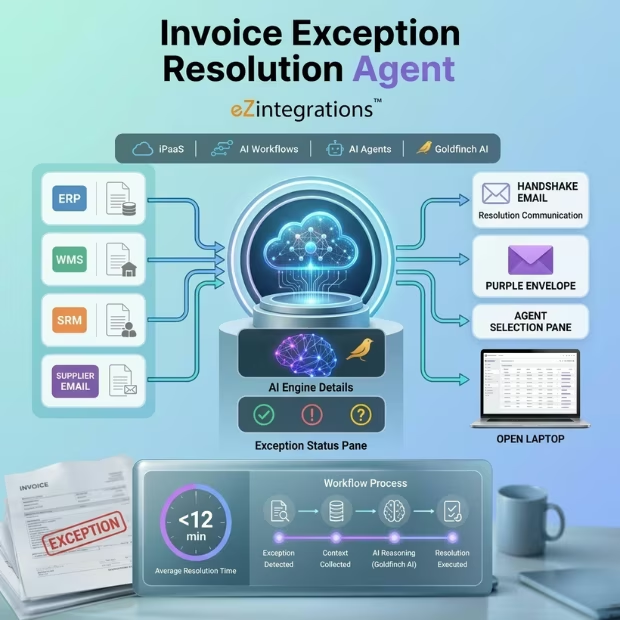
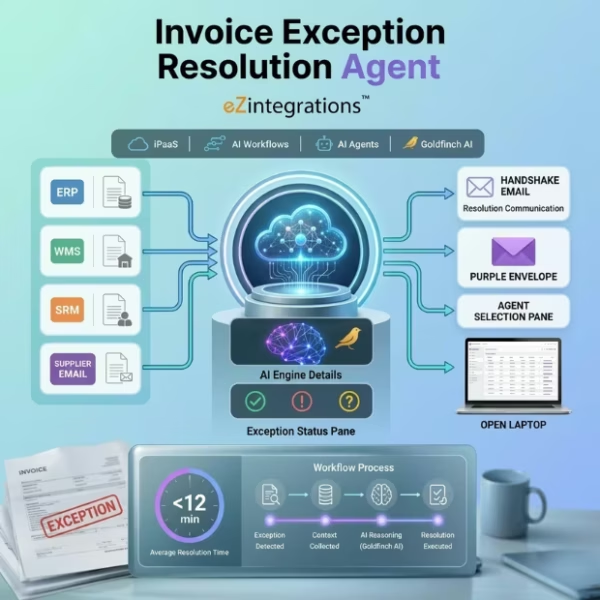
When a 3-way match exception is created in SAP FI or Oracle AP, the AP exception resolution agent triggers immediately. Goldfinch AI API Tool Call fetches the PO line details, GR quantities, and supplier SRM profile in parallel – assembling the investigation context in under 3 minutes. Goldfinch AI Document Intelligence reads the invoice notes and supplier email communication history. Goldfinch AI Data Analysis classifies the root cause and scores the resolution. Goldfinch AI Knowledge Base Vector Search retrieves matching historical precedents. Within its configured policy authority, the agent executes the resolution: debit memo in SAP FI, GR correction in WMS, or approval within tolerance. For disputes, it drafts the supplier communication. Complex cases are escalated to the AP Manager with the complete investigation attached.
APQC benchmarks manual exception investigation at 2 to 4 hours per exception. This AP exception resolution agent compresses that to under 12 minutes – at any hour, without queue delays.
Watch Demo
| Video Title: | AP Exception Resolution Agent |
|---|---|
| Duration: | 4 to 6 minutes |
Outcome & Benefits
| Throughput: | Up to 200 exception investigations per hour at standard configuration; scales to 2,000+ per hour at enterprise tier; agent operates 24/7 – no overnight exception backlog accumulation |
|---|---|
| Cost Reduction: | Investigation labor from $67,000 to $336,000 annually (200 to 500 exceptions/month at $28/hour; 2 to 4-hour investigation) to under $12,000 per year (under-15-minute agent investigation at same volume); early payment discount recovery from faster exception clearance: $80,000 to $250,000 annually |
| Accuracy: | Root cause classification accuracy: 84%+ across 6 exception categories; resolution recommendation agreement with AP Team Lead: 81% on medium-confidence cases; exception investigation completeness (agent retrieved all relevant context before decision): 99%+ |
| Time Saved: | Exception resolution from 2 to 4 hours to under 12 minutes (95%+ faster); AP Manager review time per escalated complex exception from 45 to 90 minutes (full investigation from scratch) to under 8 minutes (reviewing agent-assembled briefing) |
Performance Metrics
| Metric | Before (Manual/Batch) | After (Real-Time Sync) | Improvement |
|---|---|---|---|
| Exception Resolution Time | 2 to 4 hours per exception | Under 12 minutes | 95%+ faster |
| AP Team Exception Capacity | 60% of AP team hours | Under 15% of AP team hours | 75% reduction |
| AP Manager Escalation Rate | 100% of exceptions reviewed | Under 18% escalated | 82%+ autonomous |
| Discount-Eligible Invoice Hold | Variable (queue-dependent) | Cleared before discount window | Captured vs. forfeited |
Technical Details
| Data Validation: | Two-stage validation per exception resolution: pre-action validation – the agent verifies all required fields are present and within policy before executing any ERP write (debit memo amount within configured limit; GR correction quantity within variance tolerance); post-action confirmation – API response codes confirmed after each ERP write (debit memo created; GR corrected; invoice approved or held) – failed writes trigger retry or AP Manager escalation. Resolution confidence below 0.72 triggers escalation to AP Manager with the full investigation briefing rather than auto-resolution. All debit memos above $10,000 (configurable) require AP Manager approval regardless of confidence score. |
|---|---|
| Real-Time Support: | Yes – the agent triggers within 5 minutes of each new exception creation in the ERP AP module (via webhook or polling). The agent operates 24/7 – exceptions created overnight or during weekends are investigated and resolved or escalated before the AP team’s next shift begins. No exception backlog accumulates due to business hours constraints. Batch mode is also available for organizations processing exceptions in nightly runs. |
| Customization: | Configurable per deployment via eZintegrations no-code Agent Builder: resolution authority limits per exception type (debit memo amount ceiling; GR correction quantity ceiling; approval tolerance %); escalation confidence threshold (default 0.72); supplier dispute communication template and tone; Exception DB schema and target system; email domain allowlist for supplier email context retrieval; exception category taxonomy (mapped to client’s own exception classification system); and SRM system (Ariba; Coupa; SAP SRM; or custom). All policy updates made by AP Operations team in Goldfinch AI knowledge base editor without IT involvement. |
| Knowledge Retrieval: | Goldfinch AI Knowledge Base Vector Search (https://ezintegrations.ai/agentic-ai-platform/) retrieves exception resolution precedents from the exception history database (Weaviate https://weaviate.io/developers/weaviate or Pinecone https://docs.pinecone.io/ as vector store) – matching current exception profile against historical cases by exception type; supplier; amount variance; and contract status; retrieves supplier contractual dispute resolution terms; notice periods; and required communication format; retrieves company-specific exception resolution policy rules relevant to the current exception context. Knowledge base maintained by AP Operations team – no IT ticket required for policy or precedent updates. |
| Agent Architecture: | Single autonomous agent with multi-tool parallel orchestration for context retrieval (API Tool Call to ERP; WMS; and SRM runs simultaneously) followed by sequential reasoning (Document Intelligence analysis; then Data Analysis classification; then Knowledge Base retrieval; then resolution execution or escalation). The agent uses a goal-directed investigation loop: receive exception → plan investigation → execute parallel context retrieval → synthesize observations → reason to resolution → execute or escalate. For complex cases with conflicting signals; the agent enters a reflection cycle – reconsidering the evidence before deciding to escalate rather than applying a low-confidence resolution. |
| Task Orchestration: | Goldfinch AI orchestrates the investigation using chain-of-thought reasoning – the agent evaluates each data source’s output in context with the others (e.g. GR quantity matches the PO but the invoice reflects a different unit of measure – the agent reasons this is a UOM mismatch; not a quantity short-ship; and selects the UOM correction resolution path). Parallel tool calls for the three context retrieval steps (ERP; WMS; SRM) reduce investigation assembly time. Sequential processing for Document Intelligence (invoice + email) and Data Analysis (scoring) ensures reasoning is grounded in complete context. The reflection-and-retry loop triggers when resolution confidence falls below the configured threshold before escalating. |
AI Credits
| AI Credits Required: | Yes – the AP exception resolution agent invokes multiple Goldfinch AI tools per exception: API Tool Call (parallel ERP/WMS/SRM context retrieval); Document Intelligence (invoice and email NLP analysis); Data Analysis (root cause classification and resolution scoring); Knowledge Base Vector Search (precedent and policy retrieval); and Integration Workflow as Tool (ERP action execution and Exception DB logging) |
|---|---|
| LLM Steps Count: | 5 to 7 Goldfinch AI tool invocations per exception (API Tool Call x3 for ERP/WMS/SRM in parallel + Document Intelligence for invoice + email + Data Analysis for classification + Knowledge Base for precedent + Integration Workflow as Tool for resolution execution and DB log) |
| Credit Consumption Model: | Per exception investigated – bundle of 5 to 7 tool invocations per exception; invoice document length and email thread depth affect total credits per exception |
| Estimated Credits per Task: | Simple exception (clear root cause; 1-page invoice; no email context needed): ~18 to 28 credits per exception Standard exception (moderate context; 1 to 3-page invoice; 1 to 2 email threads): ~28 to 45 credits per exception Complex exception (multi-system signals required; multi-page invoice; extended email thread; precedent research): ~45 to 70 credits per exception |
| Monthly Credit Estimate (at Typical Volume): | 100 exceptions per month (small AP team): ~2,800 to 7,000 credits per month 300 exceptions per month (mid-market AP): ~8,400 to 21,000 credits per month 1,000 exceptions per month (large enterprise AP): ~28,000 to 70,000 credits per month |
| Pricing Model: | Static Platform Fee + AI Credits. Platform fee covers unlimited non-LLM orchestration steps (exception detection trigger; ERP connection management; SMTP dispatch for supplier communications; audit log writes; Exception DB connection). AI Credits consumed only by Goldfinch AI tool invocations and LLM reasoning cycles. |
| Goldfinch AI Tool(s) Consuming Credits: | API Tool Call: parallel ERP PO retrieval; WMS GR retrieval; SRM supplier profile retrieval – credits per tool execution (3 parallel calls per exception investigation) Document Intelligence: invoice document extraction and NLP analysis + supplier email thread context extraction – credits per document page Data Analysis: exception root cause classification and resolution pathway scoring – credits per exception (flat per-exception inference) Knowledge Base Vector Search: precedent retrieval and policy lookup – credits per search query Integration Workflow as Tool: ERP resolution sub-task (debit memo; GR correction; or approval) + Exception DB logging sub-task – credits per sub-task invocation |
FAQ
1. What is the Invoice Exception Resolution Agent?
The AP exception resolution agent by eZintegrations is an AI Agent powered by Goldfinch AI that triggers on each new 3-way match invoice exception and autonomously runs the full investigation — fetching PO details from SAP FI or Oracle AP, GR details from the WMS, supplier performance from SRM, and invoice notes via Document Intelligence — then reasons through root cause, executes resolutions within its configured policy authority (debit memo, GR correction, approve within tolerance), drafts supplier dispute communications, and escalates only complex cases to the AP Manager. Exception resolution time is under 12 minutes. 82%+ of exceptions are resolved without AP Team Lead involvement.
2. How does the agent handle task orchestration?
The AP exception resolution agent uses a goal-directed investigation loop with chain-of-thought reasoning — running parallel API Tool Call queries to ERP, WMS, and SRM simultaneously for context retrieval, then sequentially processing Document Intelligence (invoice + email analysis) and Data Analysis (root cause classification and resolution scoring). The agent synthesizes all observations before selecting the resolution pathway. If resolution confidence falls below 0.72, the agent enters a reflection cycle — reconsidering the evidence before deciding to escalate rather than applying an uncertain resolution. All investigations are logged to the Exception DB regardless of resolution outcome.
3. What Goldfinch AI tools does the AP exception resolution agent use?
The AP exception resolution agent uses five native Goldfinch AI tools: API Tool Call (parallel ERP PO retrieval, WMS GR retrieval, SRM supplier profile retrieval), Document Intelligence (invoice document NLP extraction and supplier email context analysis), Data Analysis (exception root cause classification and resolution pathway scoring), Knowledge Base Vector Search (exception precedent matching and supplier contractual dispute terms retrieval), and Integration Workflow as Tool (debit memo creation, GR correction, invoice approval, and Exception DB logging sub-tasks). Goldfinch AI also supports self-service extensibility — your AP team can add custom tools (freight audit system, payment network, procurement portal) without coding.
4. Can the AP exception resolution agent be customized for my workflow?
Yes — all key parameters are configurable via the eZintegrations no-code Agent Builder: resolution authority limits per exception type (debit memo ceiling, GR correction quantity ceiling, approval tolerance %), escalation confidence threshold (default 0.72), supplier dispute communication template and tone, Exception DB schema and target, email domain allowlist for supplier email context, exception category taxonomy mapped to your classification system, and SRM system (Ariba, Coupa, SAP SRM, or custom). AP Operations team updates policies in the Goldfinch AI knowledge base editor without IT involvement.
5. How is data validated before the agent executes resolutions in ERP?
Two-stage validation is applied: pre-action validation checks all required fields against policy before any ERP write — debit memo amount within configured limit, GR correction within variance tolerance; post-action confirmation verifies API response codes after each ERP write — failed writes trigger retry or AP Manager escalation. Resolution confidence below 0.72 escalates to AP Manager with the full investigation briefing rather than auto-resolving. All debit memos above $10,000 (configurable) require AP Manager approval regardless of agent confidence.
6. Does the AP exception resolution agent support real-time execution?
Yes — the agent triggers within 5 minutes of each new exception created in the ERP AP module. It operates 24/7 — exceptions created overnight or on weekends are investigated and resolved or escalated before the AP team's next shift. No exception backlog accumulates due to business hours limits. Batch mode is also available for organizations using nightly exception processing runs.
7. What are the key benefits of the AP exception resolution agent?
Key benefits include exception resolution time from 2 to 4 hours to under 12 minutes (95%+ faster), AP team exception handling from 60% to under 15% of working hours, 82%+ of exceptions resolved without AP Team Lead involvement, AP Manager review time per escalated case from 45 to 90 minutes to under 8 minutes (reviewing the agent's assembled briefing), investigation labor cost reduction from $67,000 to $336,000 annually to under $12,000 at comparable exception volumes (APQC $28/hour blended AP cost basis), and $80,000 to $250,000 in early payment discount recovery from faster exception clearance.
8. How does the AP exception resolution agent compare to LangChain or RPA?
RPA (UiPath, Automation Anywhere) can automate fixed UI sequences in the AP exception queue but cannot pull context from multiple systems simultaneously, cannot read invoice notes qualitatively, and breaks when ERP or WMS interfaces change. LangChain requires 3 to 6 months of agent development, ERP/WMS/SRM connector engineering, and production hardening. The AP exception resolution agent ships 5 Goldfinch AI native tools pre-built for enterprise ERP environments, connects to SAP, Oracle, WMS, SRM, and email out of the box, and handles novel exceptions via AI reasoning rather than brittle rules. Goldfinch AI is self-service extensible — your team adds custom tools beyond the native set without any vendor involvement.
Resources
Case Study
| Industry: | Manufacturing; Retail; Healthcare; Distribution; Professional Services |
|---|---|
| Outcome: | Exception resolution time from 2 to 4 hours to under 12 minutes; 82%+ of exceptions resolved without AP Team Lead involvement; AP exception handling from 60% to under 15% of AP team capacity; supplier dispute draft communication generated in under 3 minutes for exceptions requiring formal dispute |
| Problem: | A specialty retail chain with 340 stores operated centralized AP across 3,200 active suppliers and received 4,800 invoices per month. Monthly 3-way match exception rate: 18% of invoices (864 exceptions per month). Each exception required an AP Team Lead to investigate manually – average time: 2.8 hours per exception (opening SAP; contacting the receiving warehouse; emailing Procurement; reading the invoice). Total monthly investigation hours: 2,419 hours. The team of 8 AP specialists was spending 62% of working hours on exception investigation; leaving minimal capacity for payment scheduling optimization; supplier onboarding; or process improvement. DPO was 3.2 days above target due to exception backlog (exceptions cleared after the discount window for 58% of discount-eligible invoices). The VP of Finance had flagged AP operations as the #1 internal process investment priority. |
| Solution: | Deployed the eZintegrations AP exception resolution agent in 8 business days. Integrated SAP FI, WMS (REST API), SAP Ariba, and Microsoft 365 (Graph API) for end-to-end exception handling. Configured AI document processing for 12 invoice formats (78% coverage) and trained root cause analysis on 22 months of data. Set resolution rules (debit memo up to $8K, 3% price tolerance, 10% GR variance) with escalation threshold at 0.72. Deployed on Microsoft SQL Server with full audit tracking. |
| ROI: | Investigation labor savings: $342,000 annually (2,419 monthly hours reduced to 386 hours x $28/hour blended AP cost x 12 months). Early payment discount recovery: $186,000 annually (49 percentage point improvement on discount-eligible exceptions x average $18,400 invoice value x 864 exceptions/month). AP Manager time reallocation: $64,000 annually (7 AP Specialists x 8 hours/week recovered x $38/hour x 52 weeks). Total year-1 |
Related products
-
How to Automate Supply Chain Disruption Detection and Response Using an AI Agent
 $150.00
Download
$150.00
Download
-
How to Automate IT Support Ticket Resolution Using an AI Agent
$150.00
Download
-
How to Optimize Procurement Spend Using an Autonomous AI Agent
$150.00
Download
-
How to Automate Month-End Financial Close for Reconciliation and Close Orchestration
$150.00
Download