How to Automate Employee Onboarding Using an Autonomous AI Agent
$150.00
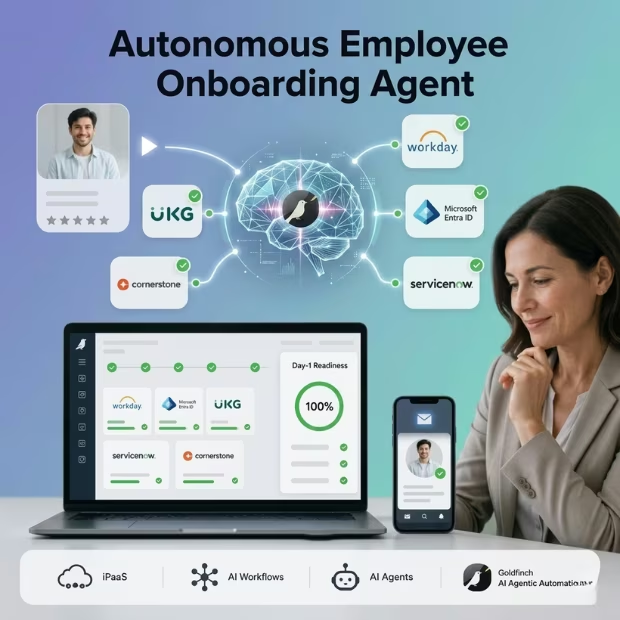
Autonomous Employee Onboarding Agent Autonomously coordinate all new hire onboarding tasks across HR; IT; Finance; Legal; and Facilities – from ATS hire confirmation through HRIS record creation; IT access provisioning; payroll setup; equipment ordering; training assignment; calendar scheduling; and Day-1 readiness reporting – without manual coordination between departments Onboarding coordination time from 40 hours of manual cross-department effort to under 2 hours of exception management; new hire Day-1 readiness from 68% (industry average) to 97%+; IT provisioning from 3 to 5-day lead time to same-day completion; HR Business Partner onboarding administration from 60% of weekly hours to under 10% HR Business Partner; IT Admin; Recruiter; HR Operations Manager AI Agent (autonomous; goal-oriented; multi-system orchestrator – not a workflow; not RPA; the agent monitors task completion; adapts to delays; and escalates based on what it observes across all connected systems) Yes – eZintegrations connects to on-premises systems (SAP HCM on-prem; Oracle HCM on-prem; Active Directory on-prem; ServiceNow on-prem; and others) via IPSec Tunnel. eZintegrations is a browser-based; cloud-hosted platform and does not require any on-premises installation. REST API; SCIM (Okta and Azure AD provisioning); Workday REST API; ADP API; ServiceNow REST API; Microsoft Graph API (M365 Calendar and email); HTTPS; OAuth 2.0; SMTP; LMS xAPI/SCORM REST; IPSec Tunnel (on-premises HCM; Active Directory; and payroll system connectivity) Both single-tenant and multi-tenant deployments are available. Single-tenant is recommended for organizations with strict HR data segregation requirements; regulated industries (healthcare; finance; government); or where employee PII management requires dedicated infrastructure. Multi-tenant is the default shared-cloud deployment. Both support on-premises connectivity via IPSec Tunnel. All Industries – Enterprise (highest coordination benefit in Financial Services; Healthcare; Technology; Manufacturing; Retail with high-volume hiring) Onboarding coordination from 40 hours of manual effort to under 2 hours of exception management; Day-1 readiness from 68% to 97%+; IT provisioning same-day vs. 3 to 5-day lead time; new hire satisfaction score improvement from reduced first-week friction employee onboarding agent; autonomous onboarding AI; HR onboarding automation agent; Workday onboarding AI; Okta provisioning agent; IT provisioning automation; Goldfinch AI HR agent; new hire onboarding automation; multi-system onboarding agent; ATS to HRIS automation; Day-1 readiness AI; onboarding orchestration AI Yes – the employee onboarding agent invokes multiple Goldfinch AI tools per new hire: API Tool Call (parallel HRIS; IAM; payroll; ServiceNow; LMS record creation); Watcher Tools (continuous task completion monitoring per active onboarding); Integration Workflow as Tool (calendar scheduling; welcome email; Day-1 readiness report sub-workflows); Data Analysis (Day-1 readiness scoring and critical path identification); and Knowledge Base Vector Search (onboarding task template retrieval) API Tool Call: Creates the employee record in Workday HRIS (profile, start date, department, role, manager, employment type), provisions access in Okta or Azure AD (user account, role-based group assignments, application access per job family), creates the payroll record in ADP or configured payroll system (pay rate, tax info, cost center, direct deposit setup trigger), creates the equipment order in ServiceNow (laptop, peripherals, access card per role template), and assigns training courses in the LMS (required compliance training, role-specific onboarding tracks), Data Analysis: Assesses Day-1 readiness score per new hire – calculating the percentage of required tasks completed across all systems, identifying the critical path blockers (which incomplete task prevents Day-1 operational readiness), and prioritizing escalation by business impact (IT access blocking is higher priority than orientation calendar acceptance), Integration Workflow as Tool: Calls pre-built eZintegrations integration sub-workflows for tasks that require multi-step sequences – including the M365 calendar scheduling workflow (creates orientation sessions, manager 1:1, and buddy introduction events), the welcome email dispatch workflow (sends personalized welcome email with onboarding checklist and Day-1 logistics), and the Day-1 readiness report workflow (compiles task completion status across all systems into a structured report for the HR Manager), Knowledge Base Vector Search: Retrieves the onboarding task template for the new hire’s role, department, location, and employment type – matching against the configured onboarding playbook to determine which tasks are required, which are optional, and which have role-specific variations (e.g. IT provisioning template for a software engineer vs. a finance analyst vs. a warehouse associate differs significantly), Watcher Tools: Continuously monitors task completion status across all provisioned systems – tracking IT account activation in Okta/Azure AD, equipment delivery status in ServiceNow, payroll record confirmation, LMS enrollment confirmation, and calendar event acceptance – triggering escalation alerts when tasks exceed their configured completion SLAWorkflow Name: Purpose: Benefit: Who Uses It: System Type: On-Premise Supported: Supported Protocols: Tenancy Model: Industry: Outcome: Tags: AI Credits Required: Goldfinch AI Tool(s) Used:
New hire onboarding involves 50 or more tasks across HR; IT; Finance; Legal; and Facilities. The HR Business Partner manually creates the HRIS record in Workday; emails IT to provision access; contacts Payroll to set up the payroll record; submits a ServiceNow ticket for equipment; adds the new hire to the LMS; schedules orientation on the M365 calendar; and sends the welcome email – then spends the next 1 to 3 weeks chasing down completion status across all these teams. According to SHRM; the average employee onboarding process requires 40 hours of HR coordination time per hire. Brandon Hall Group research shows that organizations with weak onboarding processes lose 30% of new hires within the first 90 days – and 68% of new hires are not fully operational on Day-1 due to incomplete provisioning. For high-volume hiring periods; the coordination overhead compounds and HR Business Partners spend 60% of their weekly hours on onboarding administration rather than talent development. The Autonomous Employee Onboarding Agent from eZintegrations triggers the moment a hire is confirmed in the ATS (Greenhouse or Workday Recruiting) and autonomously executes all onboarding tasks across connected systems. Goldfinch AI API Tool Call creates the HRIS record in Workday; provisions access in Okta or Azure AD; creates the payroll record in ADP; orders equipment in ServiceNow; and assigns LMS courses – all in parallel for same-day completion. Goldfinch AI Watcher Tools monitors task completion status across all systems and escalates when tasks exceed their SLA. Goldfinch AI Knowledge Base Vector Search retrieves the correct task template for the new hire’s specific role and location. Goldfinch AI Data Analysis scores Day-1 readiness and identifies critical path blockers. The HR Manager receives a Day-1 readiness report – not a 40-task coordination checklist. New hire Day-1 readiness from 68% (Brandon Hall Group benchmark) to 97%+; new hire 90-day retention improvement from reduced first-week friction; HR Business Partner onboarding capacity freed from administrative coordination for strategic talent initiatives Onboarding coordination from 40 hours of HR manual effort (SHRM benchmark) to under 2 hours of exception review; IT provisioning from 3 to 5-day lead time (waiting for HR-to-IT hand-off and ticket queue) to same-day execution; payroll and LMS setup from days-after-hire to same-day as HRIS creation SHRM estimates the average cost-per-hire at $4,700 – with onboarding failure adding $10,000 to $30,000 in re-recruitment cost when new hires leave within 90 days due to first-week friction. Organizations with 100 to 500 new hires per year and improving 90-day retention by 8 to 12 percentage points realize $800,000 to $3M in avoided re-recruitment cost. HR Business Partner labor savings: 38 hours per hire x average blended HR coordinator cost x annual hire volume = $190,000 to $950,000 annually at 100 to 500 hires per year. HIPAA-eligible configuration (healthcare workforce with clinical role onboarding requirements); GDPR-compliant data handling (new hire PII – name; address; compensation; tax ID – processed under GDPR Article 6 employment contract necessity; data minimization applied across system writes); SOC Type II certified; EEOC-aligned onboarding task execution (role-based provisioning templates configured independently of protected demographic attributes); I-9 and employment authorization data handled per US federal requirements where applicable. New hire PII transmitted only to systems with the specific need for that data field – payroll system receives compensation and tax data; LMS receives only name and employee ID; IAM receives only identity and role assignment fields. RBAC enforced on agent configuration; task template management; and onboarding record access. Parallel multi-system record creation: API Tool Call executes simultaneous record creation in HRIS, IAM, payroll, ServiceNow, and LMS – all in the same execution cycle rather than the sequential cross-department hand-offs that stretch manual onboarding to 1 to 3 weeks; Continuous task completion monitoring: Watcher Tools tracks completion status across all provisioned systems 24/7 – triggering escalation alerts with specific blocking context when any task exceeds its configured SLA, before the new hire arrives on Day-1; Role-specific task template intelligence: Knowledge Base Vector Search retrieves the correct onboarding task set for each new hire’s role, department, location, and employment type – ensuring a software engineer, a finance analyst, and a warehouse associate each receive their specific provisioning, compliance, and training requirements automaticallyProblem Before: Solution Overview: Business Impact: Productivity Gain: Cost Savings: Security & Compliance: Key Features:
Description
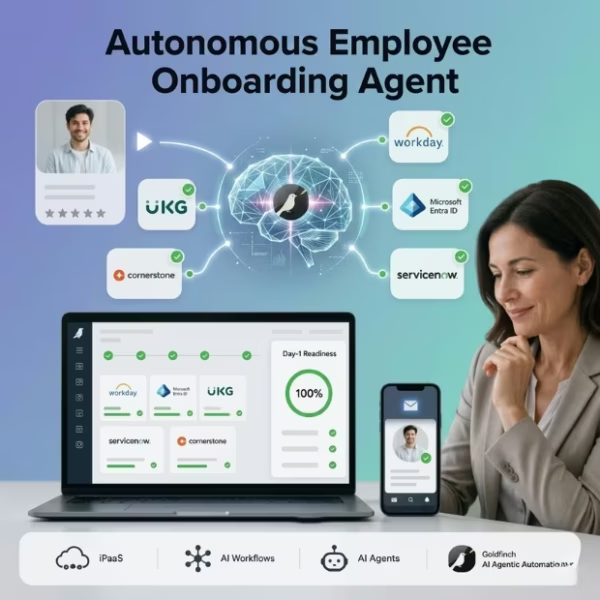
The employee onboarding agent from eZintegrations triggers when a hire is confirmed in the ATS and autonomously creates records in HRIS, IAM, payroll, ServiceNow, and LMS simultaneously — monitoring task completion, escalating blockers, and delivering a Day-1 readiness report to the HR Manager, all without cross-department coordination emails. eZintegrations is an enterprise automation platform covering iPaaS, AI Workflows, AI Agents, and Goldfinch AI agentic automation.
What Is an Employee Onboarding Agent?
An employee onboarding agent is an AI Agent that takes a new hire confirmation as its goal and autonomously orchestrates every downstream onboarding task — creating records across HRIS, IAM, payroll, facilities, and LMS systems, monitoring task completion status in real time, adapting to delays and blockers, and escalating with specific context when human intervention is required. Unlike a workflow automation that fires a fixed sequence of triggers, the agent observes what is and is not complete across all systems, reasons about which incomplete tasks are critical path, and escalates only the blockers that will prevent Day-1 operational readiness.
How Does an Employee Onboarding Agent Autonomously Coordinate HR, IT, Payroll, and Training Tasks Across Multiple Systems for New Hire Day-1 Readiness?
When a hire is confirmed in Greenhouse or Workday Recruiting, the employee onboarding agent triggers. Goldfinch AI Knowledge Base Vector Search retrieves the correct onboarding task template for the new hire’s role, location, and employment type. Goldfinch AI API Tool Call creates all required records in parallel: HRIS in Workday, user account in Okta or Azure AD, payroll record in ADP, equipment order in ServiceNow, and training assignments in the LMS. Goldfinch AI Integration Workflow as Tool schedules orientation calendar events, sends the welcome email, and compiles the Day-1 readiness report. Goldfinch AI Watcher Tools monitors completion status across all systems and escalates specific blockers to the responsible team before Day-1. Goldfinch AI Data Analysis scores readiness and identifies critical path.
SHRM benchmarks manual onboarding coordination at 40 hours per hire. This employee onboarding agent compresses that to under 2 hours — and the new hire doesn’t know the difference; the Day-1 experience is better.
Watch Demo
| Video Title: | Employee Onboarding Agent |
|---|---|
| Duration: | 5 to 7 minutes |
Outcome & Benefits
| Throughput: | Up to 500 new hire onboarding orchestrations per day at standard configuration; scales to 5,000+ per day at enterprise tier; supports high-volume hiring surges (campus recruiting season; seasonal workforce expansion) |
|---|---|
| Cost Reduction: | HR coordination labor from 40 hours per hire (SHRM) to under 2 hours; $190,000 to $950,000 annual HR labor savings at 100 to 500 hires per year; 90-day retention improvement saves $800,000 to $3M in avoided re-recruitment cost at 100 to 500 hires (Brandon Hall Group: 30% of new hires from poor onboarding leave within 90 days; SHRM $4,700 + $10,000 to $30,000 re-recruitment cost) |
| Accuracy: | Task completion across all systems: 97%+ Day-1 readiness rate (all required tasks completed before hire’s first day); role-specific task template match accuracy: 98%+ (correct task set assigned per role/location/employment type); Watcher Tools SLA breach detection: 100% (no missed escalations for overdue tasks) |
| Time Saved: | Onboarding coordination from 40 hours to under 2 hours per hire (95%+ reduction); IT provisioning from 3 to 5 days to same-day; payroll and LMS setup from 2 to 5 days after hire confirmation to same-day; Day-1 readiness report from manual weekly HR status meeting to automated morning-of report |
Performance Metrics
| Metric | Before (Manual/Batch) | After (Real-Time Sync) | Improvement |
|---|---|---|---|
| HR Coordination Per Hire | 40 hours (SHRM benchmark) | Under 2 hours | 95%+ reduction |
| Day-1 Readiness Rate | 68% (Brandon Hall Group) | 97%+ | 29+ percentage points |
| IT Provisioning Lead Time | 3 to 5 days | Same-day | 95%+ faster |
| 90-Day Retention (Onboarding-Related) | 70% (30% attrition) | 80 to 85%+ | $800K to $3M avoided |
Technical Details
| Data Validation: | Two-stage validation per system write: pre-write field validation – all required fields for each target system are present and within policy before the API call is executed (HRIS requires start date; department; role; and manager; IAM requires role group assignments from the role template; payroll requires compensation; tax status; and cost center); post-write confirmation – API response codes confirmed after each record creation – failed writes trigger retry (up to 3 attempts) before escalating to the HR Operations team with specific error context. Employee PII completeness: the agent validates that the ATS record contains all required fields before triggering onboarding; incomplete ATS records are flagged to the Recruiter for correction before system writes begin. |
|---|---|
| Real-Time Support: | Yes – the agent triggers within 15 minutes of hire confirmation in the ATS (via webhook or polling). Parallel record creation begins immediately – HRIS; IAM; payroll; ServiceNow; and LMS records are all created within the first hour of the trigger. Watcher Tools monitors completion 24/7. For same-day hires or rapid onboarding scenarios (acquisition; urgent contractor conversion); the agent supports expedited mode – prioritizing IT access provisioning and HRIS record creation ahead of other tasks. |
| Customization: | Configurable per deployment via eZintegrations no-code Agent Builder: onboarding task templates per role; department; location; and employment type (full-time; part-time; contractor; international hire); system-specific field mapping per target HRIS; IAM; payroll; and LMS; SLA windows per task type (IT provisioning SLA; equipment delivery SLA; payroll confirmation SLA); escalation routing per task type (IT blocker routes to IT Manager; payroll issue routes to Payroll Specialist); welcome email and Day-1 report template; expedited mode triggers; and Watcher Tools polling frequency per task type. All task templates managed by HR Operations in the Goldfinch AI knowledge base editor – no IT involvement required. |
| Knowledge Retrieval: | Goldfinch AI Knowledge Base Vector Search (https://ezintegrations.ai/agentic-ai-platform/) retrieves onboarding task templates from the HR playbook knowledge base (Weaviate https://weaviate.io/developers/weaviate or Pinecone https://docs.pinecone.io/ as vector store) – matching the new hire’s role title; department; location; and employment type against the configured onboarding playbook to return the exact task set; system provisioning template; LMS course assignments; and equipment order specifications for that hire profile. HR Operations team manages the playbook in the Goldfinch AI knowledge base editor without IT involvement – templates for new roles or locations added by HR without code changes. |
| Agent Architecture: | Single autonomous agent with multi-system parallel orchestration – API Tool Call to HRIS; IAM; payroll; ServiceNow; and LMS runs in parallel for maximum speed. Hierarchical multi-agent mode available for large enterprise with multiple business units (one orchestrator agent; department-specific sub-agents for IT provisioning; Finance setup; and Facilities management). The agent uses a goal-directed orchestration loop: receive hire confirmation → retrieve task template → execute parallel system writes → monitor completion → score readiness → escalate blockers → deliver Day-1 report. |
| Task Orchestration: | Goldfinch AI orchestrates the 11-step onboarding task sequence using an adaptive monitoring loop – after parallel record creation; the agent enters a continuous observation phase via Watcher Tools; evaluating task completion status across all systems against configured SLA windows per task type. When a task falls behind SLA; the agent identifies the specific blocker (license availability; manager approval pending; address verification required); routes the escalation to the responsible owner with specific context; and re-checks completion after the escalation SLA. The agent recomputes the Day-1 readiness score as tasks complete or fall behind. |
AI Credits
| AI Credits Required: | Yes – the employee onboarding agent invokes multiple Goldfinch AI tools per new hire: API Tool Call (parallel HRIS; IAM; payroll; ServiceNow; LMS record creation); Watcher Tools (continuous task completion monitoring per active onboarding); Integration Workflow as Tool (calendar scheduling; welcome email; Day-1 readiness report sub-workflows); Data Analysis (Day-1 readiness scoring and critical path identification); and Knowledge Base Vector Search (onboarding task template retrieval) |
|---|---|
| Credit Consumption Model: | Per new hire onboarding – bundle of tool invocations from trigger to Day-1 report delivery; Watcher Tools monitoring credits accumulate over the monitoring period (from hire confirmation to Day-1 start date) |
| Estimated Credits per Task: | Standard onboarding (single location; defined role template; 5 to 10 business days lead time): ~80 to 130 credits per new hire Complex onboarding (international hire; multi-system exceptions; expedited timeline; multiple escalation cycles): ~130 to 220 credits per new hire High-volume batch hire (same role; same location; 10 to 20 new hires in one batch): ~55 to 90 credits per hire (template cached; Watcher Tools batch monitoring efficiency) |
| Monthly Credit Estimate (at Typical Volume): | 20 hires per month (small enterprise): ~1,600 to 2,600 credits per month 100 hires per month (mid-market): ~8,000 to 13,000 credits per month 500 hires per month (large enterprise): ~40,000 to 65,000 credits per month |
| Pricing Model: | Static Platform Fee + AI Credits. Platform fee covers unlimited non-LLM orchestration steps (ATS webhook trigger; system connection management; retry logic; audit log writes; escalation SMTP dispatch). AI Credits consumed only by Goldfinch AI tool invocations and LLM reasoning cycles. |
| Credit Optimization Notes: | Cache the Knowledge Base task template per role/location combination for 7 days – avoids redundant template retrieval for the same role hired multiple times in the same week. Configure Watcher Tools to monitor at 4-hour intervals for tasks with 5+ day SLA windows (equipment delivery; compliance training completion) rather than hourly polling – reduces monitoring credits 70 to 80% for long-SLA tasks. For high-volume batch hiring of the same role (e.g. seasonal retail associate hiring; campus recruiting cohorts); use batch mode – the agent creates all records in a single batch API call to HRIS and IAM rather than individual calls per hire. Run Data Analysis readiness scoring twice (T-2 days and Day-1 morning) rather than continuously – avoids redundant scoring credits on tasks that complete in expected sequence. |
| LLM Steps Count: | 5 to 8 Goldfinch AI tool invocations per new hire onboarding (Knowledge Base template retrieval + API Tool Call x5 parallel system writes + Watcher Tools monitoring per task + Data Analysis readiness scoring + Integration Workflow as Tool x3 sub-tasks) |
| Goldfinch AI Tool(s) Consuming Credits: | API Tool Call: 5 parallel system write calls per new hire (HRIS, IAM, payroll, ServiceNow, LMS) – credits per tool execution per system; Watcher Tools: task completion monitoring across all 5 provisioned systems – credits per monitoring cycle per active onboarding (recurring until all tasks complete or Day-1 passes); Integration Workflow as Tool: calendar scheduling sub-workflow + welcome email sub-workflow + Day-1 report sub-workflow – credits per sub-task invocation; Data Analysis: Day-1 readiness score calculation and critical path identification – credits per readiness assessment (typically 2 to 3 assessments per hire: initial, T-2 days before start, Day-1 morning); Knowledge Base Vector Search: onboarding task template retrieval – credits per search query (one at hire trigger, one if role or location changes) |
FAQ
1. What is the Autonomous Employee Onboarding Agent?
The employee onboarding agent by eZintegrations is an AI Agent powered by Goldfinch AI that triggers when a hire is confirmed in the ATS and autonomously executes all onboarding tasks — creating the HRIS record in Workday, provisioning access in Okta or Azure AD, setting up payroll in ADP, ordering equipment in ServiceNow, assigning LMS courses, scheduling orientation calendar events, and sending the welcome email — all in parallel and on the same day. Goldfinch AI Watcher Tools monitors task completion across all systems 24/7, escalating blockers before Day-1. The HR Manager receives a Day-1 readiness report instead of a 40-task coordination checklist. Onboarding coordination time: from 40 hours to under 2 hours per hire.
2. How does the agent handle task orchestration?
The employee onboarding agent uses a goal-directed orchestration loop — Knowledge Base Vector Search retrieves the correct task template for the new hire's role and location, then API Tool Call executes parallel record creation across all 5 systems simultaneously. After creation, the agent enters a continuous monitoring phase via Watcher Tools, evaluating task completion against SLA windows per task type. When a task falls behind SLA, the agent identifies the specific blocker and routes the escalation to the responsible owner with context (e.g. 'IT provisioning blocked: Okta license pool exhausted — contact IT Admin to add licenses'). Data Analysis recomputes the Day-1 readiness score as tasks complete.
3. What Goldfinch AI tools does the employee onboarding agent use?
Five native Goldfinch AI tools: API Tool Call (parallel HRIS, IAM, payroll, ServiceNow, and LMS record creation), Watcher Tools (24/7 task completion monitoring with SLA-based escalation), Integration Workflow as Tool (calendar scheduling, welcome email, and Day-1 readiness report sub-workflows), Data Analysis (Day-1 readiness scoring and critical path blocker identification), and Knowledge Base Vector Search (role-specific onboarding task template retrieval). Goldfinch AI supports self-service extensibility — your HR Ops team can add custom tools (background check API, benefits enrollment portal, building access system) without coding.
4. Can the employee onboarding agent be customized for my specific onboarding process?
Yes — all parameters are configurable via the eZintegrations no-code Agent Builder: onboarding task templates per role, department, location, and employment type; system field mapping per target HRIS, IAM, payroll, and LMS; SLA windows per task type; escalation routing per task type; welcome email and Day-1 report templates; expedited mode for rapid onboarding; and Watcher Tools polling frequency per task type. HR Operations manages task templates in the Goldfinch AI knowledge base editor without IT involvement — new role templates or location-specific variations added by HR without code changes.
5. How is data validated before the agent creates records in downstream systems?
Two-stage validation: pre-write field validation checks all required fields are present before each API call — HRIS record requires start date, department, role, and manager; IAM requires role group assignments from the template; payroll requires compensation, tax status, and cost center; the agent validates ATS record completeness and flags Recruiter for correction if required fields are missing before any system writes begin; post-write confirmation verifies API response codes after each record creation — failed writes trigger up to 3 retry attempts before escalating to the HR Operations team with specific error context.
6. Does the employee onboarding agent support real-time execution?
Yes — the agent triggers within 15 minutes of hire confirmation in the ATS via webhook. Parallel record creation across all systems begins immediately and completes within the first hour of trigger. Goldfinch AI Watcher Tools monitors all system tasks 24/7 from trigger to Day-1. For same-day hires or expedited onboarding scenarios (acquisition integration, urgent contractor conversion), the agent supports expedited mode — prioritizing IT access provisioning and HRIS record creation before other tasks. The agent operates 24/7 without business hours constraints.
7. What are the key benefits of the employee onboarding agent?
Key benefits include onboarding coordination from 40 hours to under 2 hours per hire (SHRM benchmark), Day-1 readiness from 68% (Brandon Hall Group) to 97%+, IT provisioning from 3 to 5 days to same-day, HR Business Partner time on onboarding administration from 60% to under 10% of weekly hours, 90-day retention improvement worth $800,000 to $3M in avoided re-recruitment cost at 100 to 500 hires per year, and HR labor savings of $190,000 to $950,000 annually (38 hours per hire x annual volume x blended HR coordinator cost).
8. How does the employee onboarding agent compare to LangChain or ServiceNow workflows?
ServiceNow HR Service Delivery and Workday Journeys guide HR through onboarding tasks but require the HR Business Partner to manually trigger and monitor cross-system provisioning — they assist a human, not replace coordination. LangChain requires 3 to 6 months of development to build HRIS, IAM, payroll, and LMS connectors from scratch. The employee onboarding agent ships 5 Goldfinch AI tools pre-connected to Workday, Okta/Azure AD, ADP, ServiceNow, and LMS out of the box, adapts task templates per role via Knowledge Base, monitors completion autonomously via Watcher Tools, and deploys in under 2 weeks. Goldfinch AI is self-service extensible — your HR Ops team adds custom tools (background check API, benefits portal) without vendor involvement.
Resources
| Blog: | Automation Hub: 1000+ Enterprise Integration & AI Agent Templates |
|---|---|
| Platform Overview: | eZintegrations Platform – Enterprise iPaaS, AI Workflows & Agentic AI |
| Demo: | Book a Demo |
| Goldfinch AI Platform: | Agentic AI Platform — Goldfinch AI by eZintegrations |
Case Study
| Industry: | All Industries – Enterprise (highest coordination benefit in Financial Services; Healthcare; Technology; Manufacturing; Retail with high-volume hiring) |
|---|---|
| Outcome: | Onboarding coordination from 40 hours of manual effort to under 2 hours of exception management; Day-1 readiness from 68% to 97%+; IT provisioning same-day vs. 3 to 5-day lead time; new hire satisfaction score improvement from reduced first-week friction |
| ROI: | HR Business Partner labor savings: 6 HRBPs x (42 hours – 1.4 hours) per cohort x 4 months x 12 months annualized x $52/hour = $468,000 annually. 90-day retention improvement: 5.6 percentage point reduction x 180 hires/month x 12 months x $14,200 average re-recruitment cost (SHRM $4,700 cost-per-hire + 2x salary month cost for operations roles) = $2.2M avoided re-recruitment annually. IT Operations time savings on manual provisioning: estimated $84,000 annually. Total year-1 |
| Problem: | A regional bank with 2,800 employees hires about 180 people monthly. Onboarding is handled by 6 HR partners managing multiple tasks like HRIS setup, IT access, payroll, equipment, LMS, and orientation. This manual process takes significant time, with a Day-1 readiness rate of 63% and IT provisioning taking over 4 days. Some new hires even faced delays in access, impacting their experience and retention. |
| Solution: | Deployed eZintegrations onboarding agent in 11 days, integrating Greenhouse, Workday, Okta, ADP, ServiceNow, Cornerstone, and Microsoft 365. Automated HRIS setup, IT access, payroll, equipment, LMS, and scheduling with SLA-based tracking and escalation. Enabled readiness scoring before Day-1 for smoother onboarding. |
Related products
-
How to Automate Accounts Receivable Collections Using an Autonomous AI Agent to Reduce DSO
 $150.00
Download
$150.00
Download
-
How to Automate HR Policy Questions and Grievance Routing Using an Autonomous AI Agent
$150.00
Download
-
How to Resolve Invoice Exceptions Using an Autonomous AI Agent with Root Cause Analysis
$150.00
Download
-
How to Automate Month-End Financial Close for Reconciliation and Close Orchestration
$150.00
Download