Walmart Supplier EDI Integration for Beauty Brands: Avoid Chargebacks and Stay Compliant
April 19, 2026Walmart requires beauty brand suppliers to transmit four core EDI documents via AS2 protocol: EDI 850 (purchase order acknowledgment within 24 hours via EDI 855), EDI 856 (Advance Ship Notice within 30 minutes of shipment, before goods arrive), and EDI 810 (invoice within 24 hours of shipment). Missing or inaccurate ASNs are the single largest source of chargebacks, and Walmart’s OTIF program charges 3% of cost of goods sold on all non-compliant cases. eZintegrations automates all four EDI documents natively, runs pre-transmission validation against the 850 before generating the 856, and posts the confirmed PO data to your ERP, eliminating the manual touchpoints that cause chargeback-triggering errors.
TL;DR
- Walmart requires EDI 850 (PO), 855 (PO Acknowledgment), 856 (Advance Ship Notice), 810 (Invoice), and 997 (Functional Acknowledgment) transmitted via AS2 protocol in ANSI X12 format.
- The 856 (ASN) is the most chargeback-prone document. It must arrive at Walmart before the physical shipment. It must match the physical shipment exactly. Late, missing, or inaccurate ASNs trigger Walmart’s SQEP program and OTIF program charges 3% of cost of goods sold on non-compliant cases (see how Walmart OTIF fines are calculated).
- Walmart’s OTIF target is 98%. Falling below triggers quarterly chargebacks billed via HighRadius. For a beauty brand shipping 2MperyeartoWalmart,a53,000 in OTIF chargebacks per quarter.
- eZintegrations handles all four EDI document types natively, auto-generates SSCC-18 GS1-128 labels, runs pre-transmission validation of the 856 against the 850, and posts PO data to your ERP (NetSuite, SAP, Acumatica, or any supported ERP).
- Traditional Walmart EDI setup with legacy providers: 8-14 weeks. eZintegrations Automation Hub template: 2-4 weeks (limited by Walmart’s own certification testing timeline).
Why Walmart EDI Is the Highest-Stakes Integration a Beauty Brand Will Build
The buyer approved your lipstick line. You signed the Supplier Agreement. Your products are on the planogram. This is the moment your brand has been building toward. Walmart stores. Tens of millions of shoppers. Real shelf presence.
Then the first EDI 856 is late by 45 minutes. Walmart’s automated system logs the ASN as non-compliant. The SQEP fine posts to your HighRadius account. You do not find out for five weeks.
Walmart has required EDI from suppliers since 1988. Their compliance systems are automated, exacting, and not inclined toward leniency. The OTIF (On-Time In-Full) program charges 3% of cost of goods sold on non-compliant cases. The SQEP (Supplier Quality Excellence Program) separately penalises packaging, labelling, and ASN accuracy. Both run on automated scoring, both issue chargebacks quarterly, and both track your performance on a scorecard visible to your buyer.
For a beauty brand, the stakes are higher than for most categories. Walmart’s health and beauty category turns fast. Seasonal promotions (Valentine’s Day gift sets, holiday display-ready cases) have narrow ship windows and high PO volumes with many SKUs. A single compliance failure on a promotional PO can generate chargebacks across dozens of line items.
Getting the EDI integration right before the first PO arrives is not optional. It is the operational foundation of a profitable Walmart relationship.
The Four Core Walmart EDI Documents Every Beauty Supplier Needs
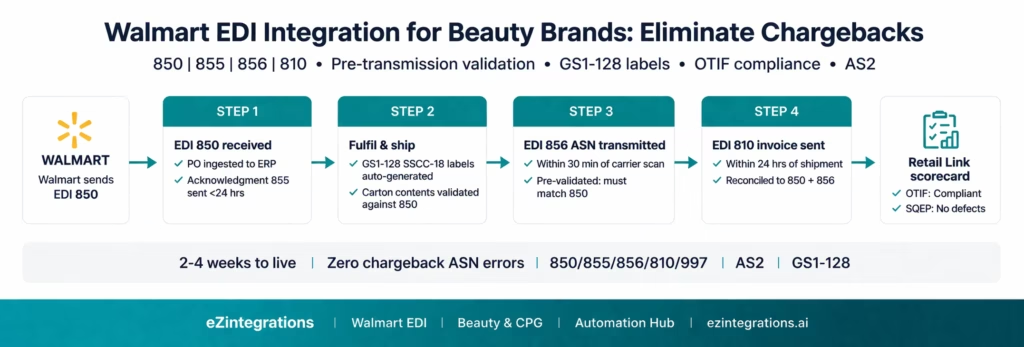
Walmart requires EDI exchange in ANSI X12 format over AS2, with detailed document requirements outlined in Walmart’s supplier documentation. The four documents your beauty brand must handle fluently are not optional add-ons. They are the price of doing business on Walmart shelves.
EDI 850: Purchase Order (Inbound from Walmart)
The 850 is the trigger for every Walmart order. When Walmart generates a purchase order for your lip gloss, eyeshadow palette, or setting spray, it arrives as an EDI 850 document.
This document contains:
PO number and date
Ship-to destination (DC number, address)
Required delivery date: the Must Arrive By Date (MABD)
Line items: each item identified by UPC/GTIN, with ordered quantity and agreed unit cost
Ship window: the earliest and latest acceptable ship dates
Your obligation: Ingest the 850 into your order management system or ERP, confirm the items and quantities against your inventory and production schedule, and send the 855 acknowledgment within 24 hours.
EDI 855: Purchase Order Acknowledgment (Outbound to Walmart)
The 855 tells Walmart you received the 850 and confirms whether you can fulfil it as submitted. You can acknowledge in three ways: accept as-is, accept with changes (quantity or price variance), or reject a line item. Failure to send the 855 within 24 hours of receiving the 850 triggers a compliance flag in Walmart’s system.
For beauty brands: if you cannot ship the full ordered quantity of a SKU (a shade is out of stock, production is delayed), the 855 is where you communicate the partial fill. Sending a full-quantity 855 and then short-shipping triggers an OTIF in-full violation, which is worse than acknowledging the shortage upfront.
EDI 856: Advance Ship Notice (ASN, Outbound to Walmart)
The 856 is the most critical and most chargeback-prone Walmart EDI document. It must be transmitted before the physical shipment arrives at the Walmart distribution centre. Walmart’s standard requirement: within 30 minutes of the carrier scanning the shipment.
The 856 must contain, at the shipment level, the order level, the carton level, and the item level:
Shipment level: BOL number, carrier SCAC code, ship date, tracking number
Order level: Walmart PO number, PO line references
Carton level: SSCC-18 barcode (GS1-128 label identifier for each carton)
Item level: UPC/GTIN per item, quantity per carton
The 856 must match the physical shipment exactly. If your shipment contains 240 units of SKU LGLOSS-04 spread across 10 cartons of 24, the 856 must reflect those exact 10 SSCC-18 labels, those exact 24 units per carton. Any discrepancy between the 856 and what Walmart physically receives triggers a SQEP chargeback.
EDI 810: Invoice (Outbound to Walmart)
The 810 is your invoice to Walmart for the shipped goods. It must be transmitted within 24 hours of shipment and must reconcile with both the 850 (agreed prices) and the 856 (shipped quantities). If the 810 shows a price that differs from the 850 or a quantity that differs from the 856, Walmart’s three-way matching generates a Code 10 (price discrepancy) or Code 22 (goods billed not shipped) deduction.
EDI 997: Functional Acknowledgment
The 997 is an automated receipt confirmation. Every time Walmart sends you an EDI document, their system expects a 997 within a short window confirming receipt. Every time you send Walmart an EDI document (855, 856, 810), their system sends you a 997. These are processed automatically by your EDI system and do not require manual action, but failures to generate or receive 997s indicate connectivity issues.
The Beauty Brand’s Chargeback Exposure: OTIF and SQEP
Understanding the two chargeback programs is the foundation for understanding why automation matters.
OTIF (On-Time In-Full)
Walmart’s OTIF program tracks two metrics per shipment: on-time arrival (within the MABD window) and in-full delivery (the quantity received matches the quantity ordered). Walmart’s target is 98% OTIF across all shipments.
When OTIF performance falls below threshold, Walmart charges 3% of cost of goods sold on non-compliant cases. The fine applies quarterly, billed via HighRadius approximately five weeks after quarter end.
The beauty brand math: a mid-size beauty brand shipping $500,000 per quarter to Walmart at a 5% OTIF non-compliance rate generates $15,000 per quarter in OTIF fines, $60,000 per year. At 10% non-compliance: $30,000 per quarter, $120,000 per year.
OTIF is not just a delivery problem. Most OTIF failures trace to upstream EDI errors. An 855 that acknowledged full quantity when the brand knew it could only ship 80% sets up an automatic in-full violation. An 856 that was transmitted late because it was generated manually after the carrier pickup means the MABD tracking is inaccurate. Automated, pre-validated EDI prevents these upstream errors before they become OTIF chargebacks.
SQEP (Supplier Quality Excellence Program)
SQEP covers packaging, labelling, and ASN accuracy defects. Common SQEP violations for beauty brands:
- ASN carton count does not match physical carton count received at DC
- SSCC-18 label not present on carton, unreadable, or does not match 856
- Product labelled incorrectly (wrong UPC, wrong shade description on carton)
- Mixed SKUs in a carton that was represented as single-SKU in the 856
- Display-ready case not configured per the planogram requirements
SQEP fines are assessed per-defect, with retail chargebacks typically ranging as a percentage of invoice value depending on violation severity (Weberlogistics). For beauty brands shipping display-ready promotional cases (holiday gift sets, endcap displays), SQEP compliance is particularly demanding because each display case has its own SSCC-18 label and specific pack configuration.
Where Beauty Brands Get Into EDI Trouble
Four specific failure modes cause the majority of beauty brand Walmart chargebacks.
Failure Mode 1: Manual ASN generation after the carrier picks up. The 856 must be transmitted within 30 minutes of carrier scan. In a manual EDI process, the operations team generates the ASN in a spreadsheet or the carrier’s portal after the truck leaves. If the operations team is busy, if the shipping manager is out, or if the carrier picked up outside normal hours, the 856 arrives late. Walmart’s system does not care why it was late.
Failure Mode 2: 856 data does not match the physical shipment. Beauty brands with many SKUs (foundation shades, lip colour variants, fragrance sizes) are especially vulnerable to carton-packing errors. If the warehouse packed 22 units into a carton instead of 24, and the 856 says 24, Walmart’s receiving system detects the discrepancy. SQEP chargeback. The only prevention is generating the 856 from the actual warehouse packing data, not from the planned PO quantities.
Failure Mode 3: 810 invoice price does not match the 850. Beauty brands frequently negotiate promotional pricing for seasonal Walmart placements: Valentine’s Day buy-one-get-one deals, Holiday gift set allowances, rollback pricing for endcap features. If the 850 reflects the promotional price and the 810 reflects the brand’s standard price, Walmart’s system generates a Code 10 price deduction automatically. Preventing this requires the 810 to reference the 850 pricing exactly.
Failure Mode 4: 855 acknowledged full quantity when inventory could not support it. A beauty brand receives a 850 for 2,400 units of a lip gloss shade. They send a 855 acknowledging 2,400. They ship 2,100 because the shade was partially out of stock. Walmart receives 2,100 and calculates an in-full violation: the brand committed to 2,400 and delivered 2,100. OTIF in-full chargeback at 3% of COGS on the 300-unit shortage. The correct approach: acknowledge 2,100 in the 855 and ship 2,100.
How eZintegrations Handles Walmart EDI for Beauty Suppliers
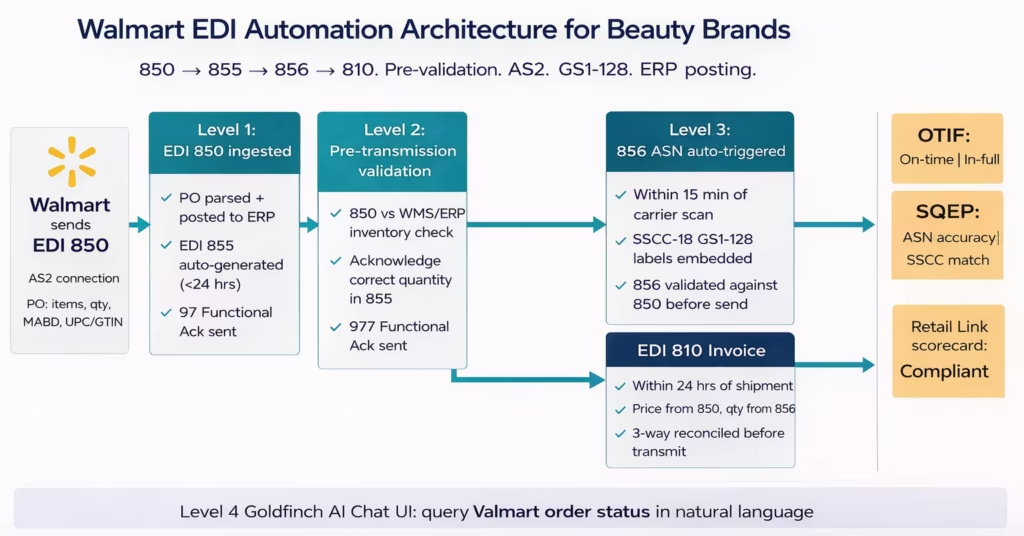
eZintegrations handles the full Walmart EDI document cycle without manual touchpoints at any step.
Level 1 (iPaaS Workflows): handles AS2 connectivity to Walmart’s EDI network, EDI 850 ingestion and parsing, EDI 855/856/810/997 generation and transmission, and ERP PO posting. All ANSI X12 document mapping is pre-built in the template.
Level 2 (AI Workflows, pre-transmission validation): validates each outbound EDI document before transmission. For the 856: cross-references carton contents against the 850 ordered items and quantities. Flags any discrepancy (wrong SSCC count, quantity mismatch, missing items) before the 856 leaves the system. Preventing a bad 856 from reaching Walmart is always better than receiving the SQEP chargeback.
Level 3 (AI Agents): monitors shipment confirmation from the carrier or WMS, auto-triggers the 856 within configurable time of carrier scan (default: 15 minutes), checks MABD against current ship date to flag at-risk shipments before they miss the delivery window, and routes exceptions to the operations team.
Level 4 (Goldfinch AI): orchestrates the full 850-to-payment cycle as a Workflow Node and provides Goldfinch AI Chat UI for operations managers to query Walmart order status: “What POs have ASNs not yet transmitted?” or “Which shipments are at risk for OTIF this week?”
GS1-128 SSCC-18 label generation: eZintegrations generates SSCC-18 barcodes for each carton based on the packing configuration in your WMS or ERP. The SSCC-18 numbers are embedded in the 856 carton-level records, ensuring the physical label and the EDI document reference the same identifier.
ERP PO posting: when the 850 is received and acknowledged, the PO is automatically created in your ERP (NetSuite, SAP S/4HANA, Acumatica, Oracle Fusion Cloud, or any supported system). Your inventory team works from the ERP PO, not a separate Walmart portal or spreadsheet.
The Beauty-Specific EDI Complications
Beauty brands face three Walmart EDI challenges that generic suppliers do not.
Challenge 1: High SKU Count Per PO and Shade-Level GTIN Tracking
A beauty brand’s Walmart PO might include 15 shades of a foundation, 8 shades of lip gloss, and 4 sizes of setting spray: 27 unique GTINs on a single 850. Each GTIN must map to the correct Walmart item number. Each GTIN must appear at the item level in the 856 carton records. For seasonal launches, new GTINs are added without much lead time. The EDI system must support rapid GTIN onboarding: new item numbers activated in the item master and available for 856 carton records within hours of the 850 arriving.
Challenge 2: Display-Ready Cases and Inner Pack Configurations
Walmart frequently orders beauty products in display-ready cases (endcap shippers, PDQ trays, counter displays) rather than bulk-packed master cartons. Each display case is a separate trade item with its own GTIN and its own SSCC-18 label. The 856 must represent the display case as a carton-level record with the display case GTIN, not the individual product GTIN. For holiday gift sets (a lipstick and lip liner paired in a gift-with-purchase case), the gift set GTIN is different from either individual item GTIN. The EDI system must handle GS1 hierarchy correctly: inner pack GTIN, display case GTIN, master carton GTIN, all mapped properly in the 856.
Challenge 3: Promotional Price Allowances in the 810
Walmart beauty promotions often involve negotiated price allowances: a 15% temporary price reduction for a rollback, a 10% promotional allowance for an endcap feature, a free-fill allowance for new item introduction. These allowances are specified in the 850 as price modifications. The 810 invoice must reference the promotional price from the 850, not the brand’s standard list price. For brands managing multiple simultaneous Walmart promotions across different item categories, keeping the 810 invoice prices aligned with each PO’s promotional terms is a source of recurring Code 10 deductions when done manually.
Before vs After: Manual Walmart EDI vs Automated
| EDI Process Step | Manual Walmart EDI | Automated with eZintegrations |
|---|---|---|
| 850 PO receipt | Retail Link manual download or SFTP poll | AS2 connection: 850 ingested automatically on arrival |
| 850 to ERP | Manual PO entry or spreadsheet import | Level 1: PO auto-posted to ERP (NetSuite/SAP/Acumatica) |
| 855 acknowledgment | Manual generation, sent same day if remembered | Auto-generated and transmitted within configurable window (<24 hrs) |
| Inventory qty check | Manual check before acknowledging 855 | Level 2: inventory query before 855 generation, correct qty acknowledged |
| 856 ASN timing | Generated manually after carrier pickup: risk of delay | Auto-triggered within 15 min of carrier scan from WMS/carrier API |
| SSCC-18 label generation | Manual spreadsheet or carrier portal: error-prone | Auto-generated from WMS packing data, embedded in 856 |
| 856 pre-validation | None: errors discovered at Walmart receiving | Level 2: 856 cross-checked against 850 before transmission |
| MABD monitoring | Manual check of Walmart calendar | Level 3: at-risk shipments flagged before MABD |
| 810 invoice pricing | Manual reference to 850 pricing terms | 810 auto-built from 850 confirmed prices, no manual lookup |
| 810 three-way reconciliation | Manual, often missed | Level 2: 810 reconciled to 850 and 856 before transmission |
| 997 acknowledgments | Manual monitoring | Automated send and receive, connectivity issues auto-flagged |
| OTIF monitoring | Monthly Retail Link check | Level 3 Watcher + Goldfinch AI Chat UI: real-time visibility |
| Chargeback detection | Quarterly HighRadius bill | Proactive: pre-transmission validation prevents the chargeback |
| New GTIN onboarding | Manual item master update before next order | Level 1 item master sync: new GTINs available within hours |
| Legacy EDI setup time | 8–14 weeks | 2–4 weeks (limited by Walmart certification testing) |
Step-by-Step: A Walmart 850 Through the Complete EDI Cycle
Here is the complete EDI cycle for a Valentine’s Day beauty promotion PO from Walmart.
The scenario: Walmart raises PO 4500881234 for Lumière Cosmetics, a mid-size beauty brand. The PO covers three items: 480 units of Rose Gloss (GTIN 00847654321001), 360 units of Velvet Lip Liner in Berry (GTIN 00847654321018), and 120 Valentine’s Day gift sets (GTIN 00847654321025). MABD: February 5. Ship window: January 29-31. Walmart DC: Kansas City.
Step 1: EDI 850 arrives via AS2. (January 22, 9:14 AM) Walmart transmits the 850 to eZintegrations’ AS2 endpoint. Level 1 parses the document: extracts PO number, ship-to DC, MABD (February 5), ship window (January 29-31), and all three line items with GTINs, quantities, and agreed promotional prices. EDI 997 Functional Acknowledgment auto-sent to Walmart: receipt confirmed within 2 minutes. Time: under 5 seconds.
Step 2: PO auto-posted to ERP. (January 22, 9:14 AM) The parsed 850 creates a sales order in the Lumière ERP (NetSuite). Order: SO-2026-WM-4882. All three line items with Walmart item numbers, GTINs, quantities, and prices. Inventory allocation check: Rose Gloss has 600 units available, Velvet Berry has 290 units available (below the 360 ordered), Valentine’s gift sets have 140 available. Time: 3-4 seconds.
Step 3: Inventory check flags Velvet Berry shortage. (January 22, 9:14 AM) Level 2 detects available: 290 < ordered: 360 for GTIN 00847654321018. Before generating the 855, the system alerts the Lumière ops team: “Velvet Berry short by 70 units. 855 will acknowledge 290 unless overridden by January 22 5 PM.” The ops team confirms 290. The 855 acknowledges line items as:
- Rose Gloss: 480 (as ordered)
- Velvet Berry: 290 (short acknowledged)
- Valentine’s gift sets: 120 (as ordered)
Step 4: 855 transmitted to Walmart. (January 22, 4:47 PM) EDI 855 transmitted via AS2 with correct acknowledged quantities. Walmart receives the partial acknowledgment on Velvet Berry: 290 instead of 360. This is within their accepted tolerance for partial fills. Walmart updates the PO for Velvet Berry to 290. No OTIF in-full violation on Velvet Berry because the shortage was acknowledged, not just short-shipped.
Step 5: Warehouse packs and ships. (January 30, confirmed ship day) Warehouse packs: 20 cartons of Rose Gloss (24 units each), 12 cartons of Velvet Berry (24 units each, with 2 cartons of 11 for remainder), and 6 cartons of Valentine’s gift sets (20 sets each). eZintegrations generates 38 SSCC-18 GS1-128 labels. Carrier (UPS freight) picks up at 2:14 PM. Carrier provides tracking number at 2:17 PM.
Step 6: EDI 856 ASN auto-triggered. (January 30, 2:29 PM) Twelve minutes after carrier scan confirmation. The 856 contains:
- Shipment level: BOL 887432, carrier SCAC UPSN, ship date January 30, tracking number 1Z…
- Order level: PO 4500881234 reference
- 20 carton records for Rose Gloss with SSCC-18 labels and UPC, 24 units per carton
- 12 carton records for Velvet Berry (10 at 24 units, 2 at 11 units)
- 6 carton records for Valentine’s gift sets with gift set GTIN 00847654321025
Before transmission: Level 2 validates the 856 carton totals against the 855 acknowledged quantities. Rose Gloss: 20 × 24 = 480. Confirmed. Velvet Berry: 10 × 24 + 2 × 11 = 262. Wait. Expected 290. 28 units missing in pack data. Level 2 flags the discrepancy and holds the 856. Ops team reviews: warehouse recount finds 28 units in a separate carton not captured in the WMS pick data. WMS corrected. 856 regenerated: 13 carton records for Velvet Berry. Level 2 re-validates: 10 × 24 + 2 × 11 + 1 × 6 = 262 + 28 = 290. Confirmed. 856 transmitted at 2:51 PM. Still within the 30-minute window.
What happened here: the pre-transmission validation caught a packing error that would have generated a SQEP chargeback for quantity mismatch. The 856 was corrected and transmitted accurately.
Step 7: EDI 810 invoice transmitted. (January 31, 8:00 AM) 810 auto-generated from the 855 acknowledged quantities and the 850 promotional prices. Level 2 reconciles: all three invoice line prices match the 850 promotional prices exactly. The Valentine’s gift set promotional allowance (10% off standard price) is applied as specified in the 850. 810 transmitted via AS2. Time: under 5 seconds.
Step 8: Shipment arrives at Kansas City DC. (February 4) One day before MABD. Walmart DC scans all 39 cartons against the 856 SSCC-18 labels. All carton quantities match. No SQEP defects. OTIF on-time: February 4, MABD February 5, compliant. OTIF in-full: Rose Gloss 480/480, Valentine’s sets 120/120, Velvet Berry 290/290 (acknowledged). All compliant.
Retail Link scorecard: 100% OTIF on this PO. Zero SQEP defects. Zero chargebacks.
Key Outcomes and Results
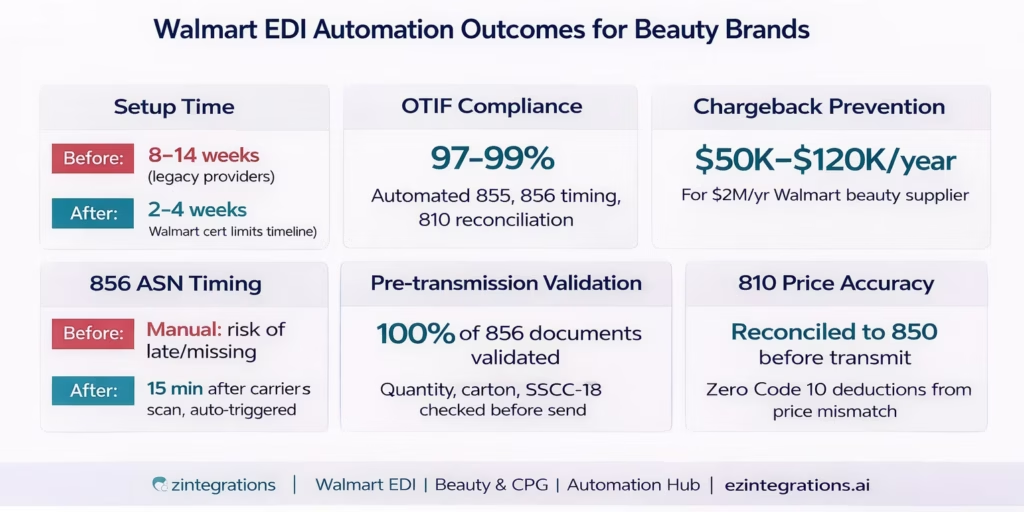
Chargeback prevention: pre-transmission 856 validation catches quantity and carton discrepancies before they reach Walmart. Late ASN chargebacks are eliminated by auto-triggering the 856 within 15 minutes of carrier scan. In-full OTIF violations from wrong 855 acknowledgments are prevented by the inventory check before the 855 is sent.
OTIF compliance: automated 855 acknowledgment with correct quantities, automated 856 timing, and automated 810 reconciliation against 850 pricing address all three primary OTIF and SQEP violation sources. Beauty brands typically reach 97-99% OTIF within the first full quarter of automated EDI operation.
Chargeback recovery value: for a beauty brand shipping $500,000 per quarter to Walmart, preventing a 5% OTIF non-compliance rate saves $15,000 per quarter in OTIF fines alone. SQEP chargeback prevention (ASN accuracy, SSCC match) adds to the saved amount. Total annual chargeback prevention for a $2M/year Walmart beauty supplier: $50,000-$120,000.
EDI setup time: legacy Walmart EDI providers quote 8-14 weeks from contract to go-live. eZintegrations targets 2-4 weeks, with the timeline driven primarily by Walmart’s own certification testing process (not the integration build). Walmart requires suppliers to pass a test document exchange before going live.
ERP integration: 850 POs auto-post to your ERP the moment they arrive. No separate order entry. No dual-keying between Walmart’s portal and your system. Inventory allocation begins from the ERP the moment the 850 is parsed.
New supplier grace period: Walmart waives OTIF fines for the first three months for new suppliers. This is the ideal window to validate that your EDI integration is running correctly before the fines start. eZintegrations targets go-live within the first month so you have two full months of live operation data before the grace period ends.
How to Get Started
Step 1: Get Your Walmart EDI Credentials and AS2 Configuration
Before building the integration, you need three things from Walmart: your Walmart Supplier ID (also called your ISA ID in the EDI context), the Walmart EDI AS2 endpoint details (URL, AS2 ID), and the specific 850 format version your Walmart category requires (typically ANSI X12 version 4010 or 5010, verify with your Walmart buyer). These are provided in the Supplier Agreement and through Retail Link. Your Walmart buyer or the Walmart Supplier Help Desk can confirm the details.
Step 2: Map Your GS1 Data: GTINs, SSCC Company Prefix, and GS1-128 Labels
Before the 856 can be built, your GS1 Company Prefix and product GTINs must be registered and correctly mapped to the Walmart item numbers in your catalog. If your brand has not yet obtained a GS1 Company Prefix (used to generate SSCC-18 numbers for your SSCC GS1-128 labels), register at GS1 US before beginning the integration build. Your Walmart item numbers are available in Retail Link under your item catalog. Map each Walmart item number to its corresponding GTIN and set the pack configuration (units per inner pack, inners per master carton) that matches your Walmart pack specs.
Step 3: Import the Walmart EDI Template and Configure
Go to the Automation Hub and import the Walmart EDI Supplier template. Configure your Supplier ID, AS2 credentials, and ERP connection (NetSuite, SAP, Acumatica, or Oracle). Upload your GTIN-to-Walmart item number mapping. Set the 856 auto-trigger timing (default: 15 minutes post-carrier scan). Configure the inventory check source for 855 acknowledgment (ERP inventory or WMS available quantity). Set the MABD risk alert threshold (default: flag any shipment where the MABD is within 3 business days and the order has not yet shipped).
Step 4: Run Walmart’s Certification Test Document Exchange
Walmart requires all new EDI suppliers to complete a certification test exchange before going live. This involves transmitting test versions of the 850, 855, 856, and 810 documents to Walmart’s test EDI environment and receiving confirmation that the documents pass Walmart’s format validation. This process takes 1-3 weeks depending on Walmart’s testing queue. eZintegrations supports the certification testing process: test documents can be generated and submitted directly from the platform.
Step 5: Go Live Before the Grace Period Ends
New Walmart suppliers receive a three-month OTIF grace period during which fines are waived but tracked. Target go-live at least 4-6 weeks before your first real PO, so you have time to resolve any edge cases (unusual pack configurations, promotional pricing flows) before the grace period ends. Monitor your OTIF scorecard in Retail Link weekly from go-live.
Total implementation timeline: 2-4 weeks from project start to go-live, with Walmart’s certification testing as the primary scheduling constraint.
FAQs
1. How does Walmart EDI integration work for beauty brands with eZintegrations
eZintegrations manages the full Walmart EDI cycle via AS2 including receiving EDI 850 purchase orders generating EDI 855 acknowledgments with inventory validation triggering EDI 856 ASNs within minutes of carrier scan and sending EDI 810 invoices reconciled to pricing. It also handles EDI 997 acknowledgments and supports beauty specific needs such as GS1 128 SSCC 18 labeling multi GTIN orders display ready packaging and promotional pricing with automatic ERP posting on PO receipt.
2. How long does it take to set up Walmart EDI with eZintegrations
Typical setup takes 2 to 4 weeks with the main dependency being Walmart certification testing which takes 1 to 3 weeks. The actual integration configuration including AS2 setup mapping and ERP connection is completed in 3 to 5 business days significantly faster than traditional EDI timelines.
3. Does eZintegrations handle the EDI 856 ASN timing requirement for Walmart
Yes, The platform automatically triggers the EDI 856 ASN shortly after carrier scan typically within 15 minutes and validates it against the original purchase order ensuring carton quantities label counts and GTINs are accurate preventing compliance errors and chargebacks.
4. What is Walmart OTIF and how does EDI automation prevent fines
OTIF or On Time In Full is Walmart’s compliance program that penalises late or incomplete shipments. eZintegrations prevents OTIF violations by validating inventory before PO acknowledgment ensuring timely ASN submission and monitoring delivery windows reducing the risk of penalties and improving compliance performance.
5. What EDI documents are required by Walmart for beauty brand suppliers
Required documents include EDI 850 purchase orders EDI 855 acknowledgments EDI 856 advance ship notices EDI 810 invoices and EDI 997 acknowledgments. All are transmitted via AS2 in ANSI X12 format and must align with GS1 128 SSCC 18 labeling requirements for shipment tracking and compliance.
Walmart’s Compliance System Is Automated. Your EDI Should Be Too.
Walmart’s chargeback system does not send warnings. It tracks OTIF performance automatically, issues chargebacks quarterly, and posts fines to your HighRadius account without manual review on their side. An 856 that was 45 minutes late generates the same SQEP chargeback whether you were short-staffed or shipping a record volume week. The system does not distinguish.
The defence is automation that is faster and more accurate than any manual process. Auto-triggered 856s within 15 minutes of carrier scan. Pre-transmission validation that catches carton discrepancies before they reach Walmart’s receiving dock. Inventory-validated 855 acknowledgments that prevent the over-commitment that causes in-full OTIF violations. 810 invoices that reference 850 promotional pricing automatically.
eZintegrations handles the full 850-to-810 Walmart EDI cycle for beauty brands, with the SSCC-18 label generation, multi-GTIN PO support, and promotional pricing logic that beauty category requirements demand.
Import the Walmart EDI Supplier Template from the Automation Hub and begin your Walmart certification test exchange. Or book a free demo with your Walmart Supplier ID, ERP type, and SKU count. We will walk through the GTIN mapping and certification test process in the session.
For multi-channel context, see the Amazon Seller Central integration guide for beauty brands. For supply chain document intelligence, see the AI document intelligence guide.