How to Automate 3-Way Invoice Verification Using AI
$0.00
| System Name: |
3-Way Verification |
|---|---|
| Architecture: |
Hierarchical multi-agent |
| Coordinator Agent: |
Verification Orchestrator |
| Worker Agents: |
PO Matcher; GR Validator; Invoice Checker |
| Safety Layer: |
Approval rules + thresholds |
Table of Contents
Description
| Planning: |
Match rules decomposition |
|---|---|
| Messaging: |
Event bus + audit events |
| Reflection: |
Variance & exception analysis |
| Knowledge: |
PO; GR; Invoice memory |
| Execution: |
Parallel document matching |
| Business Impact: |
99%+ matching accuracy |
3-Way Invoice Verification
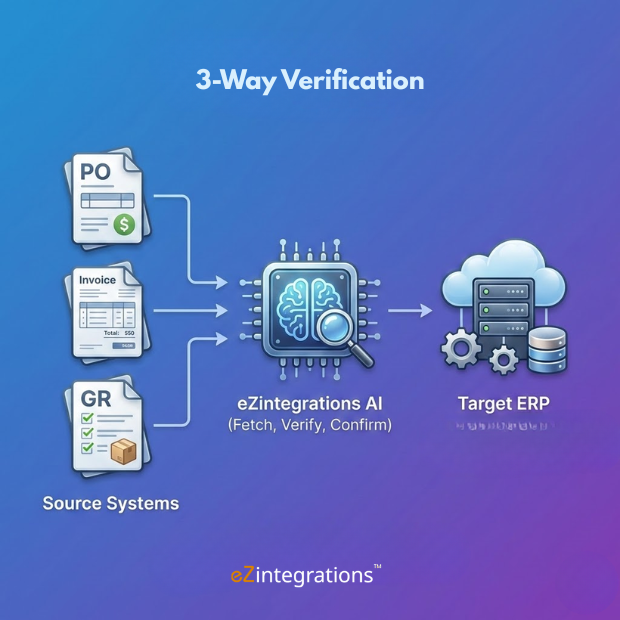
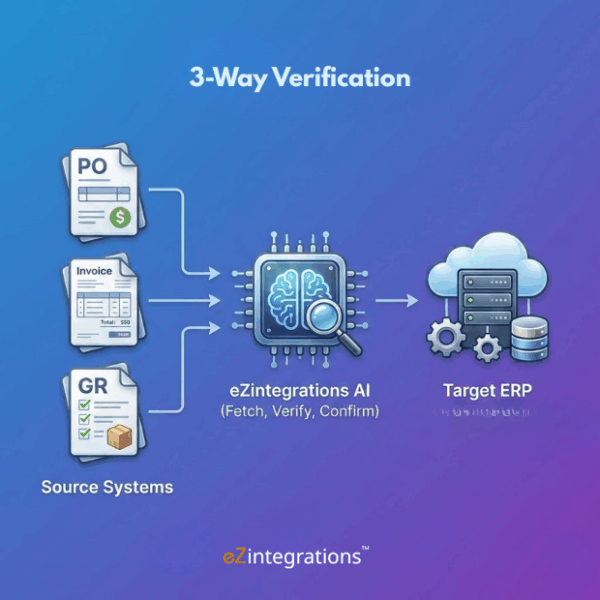
The 3-Way Invoice Verification system, built on eZintegrations – AI Workflows & AI Agents Automation Hub, a product of Bizdata, automates the reconciliation of purchase orders, goods receipts, and invoices using a hierarchical multi-agent architecture. The workflow processes procurement and financial data across systems to verify that supplier invoices match the approved purchase order and recorded goods receipt. By automating this process through eZintegrations, organizations can reduce manual verification work, improve financial accuracy, and maintain stronger compliance controls.
Automated Verification for Accurate Financial Processing
Within the eZintegrations automation platform, a Verification Orchestrator coordinates the workflow while worker agents perform purchase order matching, goods receipt validation, and invoice verification. Configurable approval rules and threshold checks provide an additional control layer for financial operations. This architecture enables finance, procurement, and IT teams to streamline invoice verification, reduce reconciliation errors, and maintain consistent financial records across enterprise systems.
Import this automation template into the eZintegrations platform to automate purchase order, goods receipt, and invoice matching.
Free to download. Requires an active eZintegrations account to configure and run the workflow.
Explore the 3-Way Invoice Verification template to automate purchase order, goods receipt, and invoice reconciliation.
Watch Demo
| Video Title: |
3-Way Verification Walkthrough |
|---|---|
| Duration: |
3:32 |
Outcome & Benefits
| Autonomy: |
95% automated processing |
|---|---|
| Time Saved: |
from 3–5 business days to under 10 minutes per invoice batch |
| Cost Reduction: |
-$60k/yr finance ops |
| Reliability: |
Consistent rule-based validation |
Technical Details
| Planner Type: |
Rule + AI hybrid |
|---|---|
| Agent Roles: |
Coordinator + domain workers |
| Scheduling: |
Event-driven + batch |
| Tool Router: |
Policy-based routing |
| Evaluation Metrics: |
Match accuracy % |
| Auditability: |
Every decision logged |
FAQ
1. What is the 3-Way Verification system?
The 3-Way Verification system automatically matches purchase orders (PO), goods receipts (GR), and invoices to ensure accurate financial and operational reconciliation.
2. How does this system save time and reduce errors?
It replaces manual verification with automated PO-GR-invoice matching, reducing processing time from days to minutes per invoice batch and improving match accuracy.
3. Who typically uses this system?
Finance, procurement, and operations teams use the system to reduce manual reconciliation effort, prevent errors, and maintain accurate financial records.
4. Who are the worker agents and what do they do?
Worker agents handle specific verification tasks: PO Matcher matches purchase orders, GR Validator validates goods receipts, and Invoice Checker verifies invoices to ensure accurate 3-way reconciliation.
5. What is the safety layer in this system?
The safety layer includes approval rules and thresholds, allowing human intervention when discrepancies or exceptions are detected.
6. What are the key benefits of the 3-Way Verification system?
It ensures accurate PO-GR-Invoice matching, reduces manual work, prevents financial discrepancies, and provides audit-ready verification records.
7. Can this system handle exceptions or mismatches?
Yes, mismatches are flagged for review according to pre-defined approval rules, ensuring exceptions are handled reliably.
8. How quickly can organizations implement this workflow?
Most teams can import the automation template and go live within a few hours using the eZintegrations platform.
Resources
Case Study
| Industry: |
Finance / Accounting |
|---|---|
| Problem: |
Manual 3-way matching delays |
| Solution: |
Agentic 3-way verification pipeline |
| Outcome: |
Faster close with zero leakage |
| ROI: |
$55,000 annual savings from automating 3-way invoice matching for a mid-sized company. |