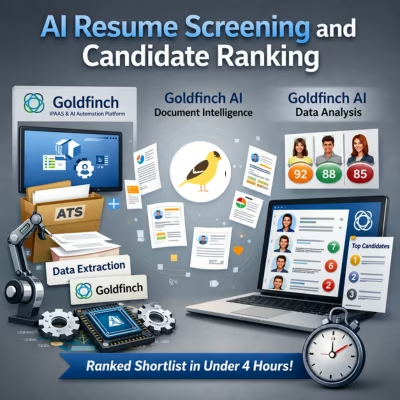
How to Automate Resume Screening and Candidate Ranking
$120.00
| Workflow Name: |
AI Resume Screening and Candidate Ranking |
|---|---|
| AI Model Type: |
NLP-based resume extraction with ML candidate scoring and ranking |
| Model Provider: |
Goldfinch AI of eZintegrations (Document Intelligence for resume NLP extraction + Data Analysis for ML candidate scoring and ranking against job requisition requirements) |
| Goldfinch AI Tool(s) Used: |
Document Intelligence: Extracts structured candidate data from resume documents (PDF; DOCX; or ATS-stored text) – skills inventory; years of experience per role; education level and field; certifications; job titles; employment gaps; and key achievement statements. Handles unstructured resume formats including creative layouts; international resume conventions; and multi-page CVs. Data Analysis: Scores each candidate against the job requisition requirements using a configurable ML ranking model – matching extracted skills to required and preferred skills; weighting experience depth against seniority level requirements; applying must-have qualifier gates (mandatory certifications; minimum years of experience; location constraints); and producing a numeric fit score (0 to 100) per candidate. Generates the ranked shortlist with score breakdown per dimension. |
| Task Type: |
Extraction + Scoring + Ranking (three-step AI pipeline – extraction feeds scoring; scoring feeds ranked shortlist creation) |
| Input Type: |
Resume documents in PDF or DOCX format from ATS (Workday or Greenhouse); job requisition record from ATS (required skills; preferred skills; must-have qualifiers; seniority level; education requirements; location constraints); configurable weighting rules per job family (e.g. technical skills weighted 60%; experience depth 30%; education 10% for engineering roles) |
| Output Format: |
Ranked candidate shortlist per job requisition in ATS – each candidate record updated with fit score (0 to 100); score breakdown by dimension (skills match; experience depth; education match; qualifier pass/fail); advancement recommendation (Advance to Interview/Hold/Disqualify); and AI screening notes summarizing fit rationale. Hiring Manager notification email with top shortlist and score summaries. Disqualification and advancement emails triggered to candidates. Recruiter-facing ATS dashboard with ranked list and filter by score dimension. |
| Who Uses It: |
Recruiter, Talent Acquisition Manager, Hiring Manager |
| On-Premise Supported: |
Yes – eZintegrations connects to on-premises ATS systems (SAP SuccessFactors on-prem; Oracle HCM on-prem; and others); on-premises HR databases; and MSSQL HR data stores via IPSec Tunnel. eZintegrations is a browser-based; cloud-hosted platform and does not require any on-premises software installation. |
| Industry: |
All Industries – Enterprise (highest volume benefit in Financial Services; Technology; Healthcare; Manufacturing; Retail) |
| Outcome: |
89%+ candidate fit score correlation with Hiring Manager acceptance rate, 60% reduction in time-to-shortlist, recruiters screen 5x the application volume in the same hours, 82% of disqualification decisions validated by Recruiter review |
Table of Contents
| Problem Before: |
Enterprise recruiting teams receive 200 to 1,000+ applications per open role. Recruiters manually read each resume to assess skills; experience depth; education match; and qualifications – taking 6 to 10 minutes per resume for an initial screen. A recruiter processing 200 applications per week spends 20 to 33 hours per week on initial screening alone; leaving limited time for candidate outreach; interview coordination; and hiring manager collaboration. SHRM research places the average cost-per-hire at $4,700; with a significant portion tied to recruiter screening time. High-volume roles (customer service; operations; technology) generate applicant backlogs that delay time-to-fill; causing top candidates to accept competing offers before the Hiring Manager ever reviews them. |
|---|---|
| AI Solution: |
The AI Resume Screening and Candidate Ranking workflow from eZintegrations processes each application the moment it is submitted to the ATS. Goldfinch AI Document Intelligence extracts structured candidate data from the resume – skills; years of experience per role; education; certifications; and achievement statements. Goldfinch AI Data Analysis scores each candidate against the job requisition requirements using a configurable fit model (skills match; experience depth; education; must-have qualifiers). A ranked shortlist is created in the ATS with fit score breakdown per dimension. Advancement and disqualification emails are triggered automatically. The Hiring Manager receives a notification with the top-ranked candidates and score summaries. |
| Validation (HITL): |
All advancement and disqualification decisions are classified as AI recommendations – not automated ATS actions. Candidates scoring above 75 (Advance recommendation) are presented to the Recruiter in a ranked shortlist. The Recruiter reviews the AI score breakdown; reads the highlighted fit rationale; and confirms advancement to interview or adjusts the recommendation before any interview scheduling or rejection email is sent. Candidates scoring below 40 (Disqualify recommendation) have their disqualification email held for 48 hours for Recruiter review; with a one-click override to hold the candidate for manual review. Candidates scoring 40 to 74 (Hold) are queued in the ATS for Recruiter review without an automated communication trigger. |
| Accuracy Metric: |
89%+ candidate fit score correlation with Hiring Manager interview acceptance rate (measured as Hiring Manager advancing the AI-recommended candidate to the next round). False negative rate (qualified candidates scored below 40): under 6% after model calibration per job family. Resume extraction accuracy (Goldfinch AI Document Intelligence): 93%+ on standard resume formats; 88%+ on non-standard layouts and international CVs. |
| Time Savings: |
Time-to-shortlist reduced from 3 to 7 days (manual screening queue) to under 4 hours per role for standard application volumes. Recruiter screening time per application reduced from 6 to 10 minutes (full manual read) to under 90 seconds (reviewing AI-scored record with highlights). Recruiters can effectively screen 5x the application volume in the same weekly hours. |
| Cost Impact: |
SHRM benchmarks average cost-per-hire at $4,700; with recruiter time representing approximately 25 to 35% of that cost. Organizations filling 100+ roles per year and processing 500+ applications per role typically realize $180,000 to $400,000 in annual recruiter labor savings from the screening time reduction. Faster time-to-shortlist also reduces offer-acceptance failure rate for top candidates engaged days rather than weeks after application. |
Description
The AI resume screening workflow from eZintegrations processes every application submitted to your ATS — extracting candidate data with Goldfinch AI Document Intelligence and scoring fit against job requirements with Goldfinch AI Data Analysis — producing a ranked shortlist in under 4 hours instead of days. eZintegrations is an enterprise automation platform covering iPaaS, AI Workflows, AI Agents, and Goldfinch AI agentic automation.
What Is an AI Resume Screening Workflow?
An AI resume screening workflow applies NLP extraction and ML fit scoring to automate the initial application review that currently consumes the largest share of recruiter time. Instead of a recruiter reading each resume to manually assess skills, experience depth, and qualifications against a job description, the AI extracts structured candidate data, scores each dimension against the requisition requirements, and produces a ranked list with a score breakdown — all before the Recruiter opens the first file.
How Does an AI Resume Screening Workflow Automatically Extract Candidate Data and Rank Applicants Against Job Requirements?
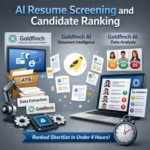
When a candidate submits an application to Workday or Greenhouse, the eZintegrations AI resume screening workflow sends the resume to Goldfinch AI Document Intelligence. Every relevant field is extracted: skills inventory, years of experience per role, education level and field, certifications, job titles, and key achievement statements. Goldfinch AI Data Analysis then scores the candidate against the job requisition on four dimensions — skills match, experience depth, education alignment, and must-have qualifier pass/fail — and produces a fit score (0 to 100). The ATS candidate record is updated with the score and recommendation. The Recruiter sees a ranked shortlist and reviews AI rationale before any candidate communication is triggered.
SHRM research places average cost-per-hire at $4,700. Recruiter screening time represents 25 to 35% of that cost. This AI resume screening workflow removes the manual scan from the process — leaving your Recruiters for outreach, interviews, and offer management.
Watch Demo
| Video Title: |
AI Resume Screening Workflow Demo: Workday Application to Ranked Shortlist with Goldfinch AI NLP Scoring in Under 4 Hours |
|---|---|
| Duration: |
4 to 6 minutes |
Outcome & Benefits
| Accuracy: |
89%+ fit score correlation with Hiring Manager interview acceptance; 93%+ resume extraction accuracy on standard formats; false negative rate under 6% after job family calibration |
|---|---|
| Touchless Rate: |
Candidates scoring below 40 have disqualification held 48 hours for Recruiter review – no fully automated disqualifications without Recruiter confirmation. Candidates above 75 enter the shortlist queue automatically. Effectively 0% fully touchless on final decisions; ~75% of scoring and ranking executed without Recruiter effort. |
| Time Saved: |
Time-to-shortlist from 3 to 7 days to under 4 hours per role; Recruiter review time per application from 6 to 10 minutes to under 90 seconds; Recruiters screen 5x the application volume in the same weekly hours |
| Cost Saved: |
$180,000 to $400,000 annual savings at 100+ roles per year with 500+ applications per role from recruiter screening labor reduction (SHRM $4,700 cost-per-hire basis; 25 to 35% recruiter time component) |
Performance Metrics
| Metric | Before (Manual/Batch) | After (Real-Time Sync) | Improvement |
|---|---|---|---|
| Time-to-Shortlist per Role | 3 to 7 days (manual queue) | Under 4 hours | 85%+ faster |
| Recruiter Time per Application | 6 to 10 minutes | Under 90 seconds (review AI record) | 85%+ reduction |
| Application Volume per Recruiter per Week | 200 to 250 (capacity-limited) | 1,000+ (AI-first screening) | 5x throughput |
| Top Candidate Drop-Off Rate | 15 to 25% (slow response) | Under 8% (same-day shortlist) | 50%+ reduction |
Functional Details
| Business Tasks: |
Automated resume data extraction per application (skills; experience; education; certifications; achievement statements); configurable multi-dimensional fit scoring against job requisition (skills match; experience depth; education; must-have qualifiers); ranked candidate shortlist creation in ATS with score breakdown per dimension; advancement recommendation classification (Advance/Hold/Disqualify); automated advancement and disqualification email triggers (with Recruiter review gate); Hiring Manager notification with top shortlist and score summaries; Recruiter dashboard in ATS with score filters and override capability; model accuracy reporting per job family per quarter |
|---|---|
| KPI Improved: |
Time-to-shortlist per role; time-to-fill per requisition; cost-per-hire (recruiter component); application-to-interview conversion rate; top candidate drop-off rate; offer acceptance rate; Recruiter capacity (applications screened per week); Hiring Manager satisfaction with shortlist quality |
| Scheduling: |
Real-time event-triggered per application submission to ATS (Workday or Greenhouse) – each application is scored within 15 minutes of submission. Batch re-scoring run available when job requisition requirements are updated (skills or qualifiers changed) – rescores all existing applications against the new criteria. Weekly model accuracy report generated comparing AI recommendations vs. Hiring Manager advancement decisions per job family. |
| Downstream Use: |
Fit scores and score breakdowns written to ATS candidate record (Workday Candidate Profile or Greenhouse Application) as custom fields; ranked shortlist visible to Recruiter in ATS shortlist view; advancement and disqualification emails sent via SMTP with Recruiter review gate enforced; Hiring Manager notification via ATS task or SMTP with shortlist summary; score data and Hiring Manager outcomes written to Snowflake or data warehouse for model retraining and TA analytics; weekly TA performance dashboard showing funnel metrics; score distribution by role; and AI recommendation acceptance rate |
Technical Details
| Model Name/Version: |
Goldfinch AI Document Intelligence (https://ezintegrations.ai/agentic-ai-platform/) with underlying LLM GPT-4o via Azure OpenAI (https://learn.microsoft.com/en-us/azure/ai-services/openai/) for resume NLP extraction and skills taxonomy mapping; Goldfinch AI Data Analysis for ML fit scoring using a gradient boosting classifier trained on historical hiring outcomes per job family; configurable skills taxonomy loaded from O*NET (https://www.onetcenter.org/) occupational framework for standardized skills classification across job families |
|---|---|
| Hosting Type: |
Cloud-hosted on Oracle OCI via eZintegrations; Goldfinch AI Document Intelligence and Data Analysis execute in customer-isolated tenant; ATS data accessed via Workday (https://developer.workday.com/) or Greenhouse (https://developers.greenhouse.io/) REST API; candidate data processed in compliance with employment law data handling requirements; on-premises ATS connectivity via IPSec Tunnel |
| Prompt Strategy: |
Document Intelligence uses a structured resume extraction prompt with ONET skills taxonomy as context: “Extract and structure the following resume data: skills inventory (map to ONET skill categories where applicable); years of experience per role (calculate from employment dates); highest education level and field; certifications and expiration dates; job titles held; employment gaps exceeding 6 months; and up to 3 key achievement statements with quantified outcomes where present. Return as structured JSON.” Data Analysis scoring: deterministic gradient boosting model – not LLM-based. No open-ended generation in the scoring step. |
| Guardrails: |
Fit score below 40: Disqualify recommendation; disqualification email held 48 hours for Recruiter override before send. Fit score 40 to 74: Hold recommendation; queued for Recruiter review; no automated communication. Fit score above 75: Advance recommendation; shortlisted for Recruiter confirmation before interview scheduling. Document Intelligence confidence below 0.72 on any must-have qualifier field (mandatory certification; required degree): candidate flagged as “Extraction Uncertain – manual review required” and not scored until Recruiter confirms the extracted value. Bias guardrail: model trained exclusively on skills; experience; education; and certification features – no demographic inference from name; address; photo reference; or graduation year fields; these fields are masked before scoring. |
| Latency: |
Under 15 minutes from ATS application submission to scored and ranked candidate record available to Recruiter (for standard 1 to 2-page resumes); under 30 minutes for multi-page CVs or resumes requiring extended extraction (international CVs; academic CVs with publication lists) |
| Data Governance: |
Candidate resume data processed in the customer-isolated eZintegrations tenant – not shared cross-tenant. Resume text processed by Goldfinch AI Document Intelligence via Azure OpenAI inference – no resume content retained by the model provider beyond the inference call. Candidate PII (name; contact details; address) used only for ATS record matching and communication routing – not included as model features. Demographic fields (graduation year; name origin inference) masked before scoring in compliance with EEOC guidelines and GDPR Article 9 (special category data). Full audit trail per application: extraction fields produced; score per dimension; recommendation classification; Recruiter action taken (confirmed/overridden); and final outcome. |
| Throughput: |
Up to 2,000 applications processed per day at standard configuration; scales to 20,000+ per day at enterprise tier with parallel Goldfinch AI inference threads; supports high-volume hiring events (campus recruiting days, seasonal hiring campaigns) |
Connectivity and Deployment
| Supported Protocols: |
REST API; Webhooks (Workday or Greenhouse application submission events); HTTPS; OAuth 2.0; API Key; SMTP (candidate advancement and disqualification emails; Hiring Manager notifications); IPSec Tunnel (on-premises ATS and HR database connectivity) |
|---|---|
| Security & Compliance: |
HIPAA-eligible configuration available (healthcare workforce including clinical role screening); GDPR-compliant data handling (candidate PII processed under Article 6 lawful basis; Article 9 special category data masked; data subject access request support for candidate data); SOC Type II certified; EEOC-aligned scoring design (demographic features excluded from model). TLS 1.3 encryption in transit; AES-256 at rest. Resume documents processed in isolated tenant via Azure OpenAI – no content retention beyond inference call. RBAC enforced on scoring model configuration; requisition weight settings; Recruiter communication triggers; and audit log access. |
| Tenancy Model: |
Both single-tenant and multi-tenant deployments are available. Single-tenant is recommended for organizations subject to strict HR data segregation requirements (financial services; healthcare; government contractors) or with EEOC audit obligations requiring isolated candidate data. Multi-tenant is the default shared-cloud deployment. Both support on-premises ATS connectivity via IPSec Tunnel. |
| On-Premise Supported: |
Yes – eZintegrations connects to on-premises ATS systems (SAP SuccessFactors on-prem; Oracle HCM on-prem; and others); on-premises HR databases; and MSSQL HR data stores via IPSec Tunnel. eZintegrations is a browser-based; cloud-hosted platform and does not require any on-premises software installation. |
FAQ
1. What is the AI Resume Screening and Candidate Ranking workflow?
The AI resume screening workflow by eZintegrations processes each application the moment it is submitted to Workday or Greenhouse ATS — extracting structured candidate data with Goldfinch AI Document Intelligence (skills, experience, education, certifications) and scoring fit against the job requisition with Goldfinch AI Data Analysis (0 to 100 fit score per dimension). A ranked shortlist is created in the ATS within 4 hours, advancement and disqualification emails are triggered after Recruiter review, and the Hiring Manager receives a shortlist notification — reducing time-to-shortlist from 3 to 7 days to under 4 hours.
2. What AI model types does the resume screening workflow use?
This workflow uses two Goldfinch AI tools: Document Intelligence (GPT-4o via Azure OpenAI) for resume NLP extraction and O*NET skills taxonomy mapping, and Data Analysis (gradient boosting classifier trained on historical hiring outcomes per job family) for multi-dimensional fit scoring. The combination achieves 89%+ fit score correlation with Hiring Manager acceptance rate and 93%+ extraction accuracy on standard resume formats.
3. What input data does the AI resume screening workflow require?
This workflow requires resume documents (PDF or DOCX) submitted via Workday or Greenhouse ATS, and a configured job requisition record with required skills, preferred skills, must-have qualifiers (mandatory certifications, minimum experience, location constraints), seniority level, and education requirements. Configurable weighting rules per job family (e.g. technical skills weighted 60% for engineering roles) are set once by the Talent Acquisition Manager and applied to all requisitions in that family.
4. What is the output format of the AI resume screening workflow?
The workflow produces a ranked candidate shortlist in the ATS — each candidate record updated with a fit score (0 to 100), score breakdown by dimension (skills match, experience depth, education, qualifier pass/fail), advancement recommendation (Advance/Hold/Disqualify), and AI screening notes summarizing fit rationale. The Hiring Manager receives an email notification with the top 5 to 10 candidates and score summaries. Advancement and disqualification emails are staged for Recruiter review before sending.
5. Who uses the AI resume screening workflow?
Recruiters use the ATS ranked shortlist as their daily review queue — confirming advancement recommendations and overriding holds or disqualifications when business context warrants. Talent Acquisition Managers configure the job family scoring weights and review model accuracy reports. Hiring Managers receive shortlist notifications and enter the process at the interview stage with ranked candidates and fit summaries already prepared.
6. What are the key benefits of the AI resume screening workflow?
Key benefits include 89%+ fit score accuracy, time-to-shortlist from 3 to 7 days to under 4 hours, Recruiter review time per application from 6 to 10 minutes to under 90 seconds, 5x application volume capacity for the same Recruiter headcount, 50%+ reduction in top candidate drop-off from slow response, and $180,000 to $400,000 annual savings at 100+ roles per year with 500+ applications per role (SHRM $4,700 cost-per-hire basis). The AI screening notes give Recruiters and Hiring Managers a consistent, documented rationale for every advancement decision.
7. What systems does the AI resume screening workflow integrate with?
This workflow integrates with Workday Recruiting or Greenhouse ATS for application ingestion and candidate record update, SMTP for candidate advancement and disqualification emails and Hiring Manager notifications, and Snowflake or a configured data warehouse for score logging and model retraining. On-premises ATS systems connect via IPSec Tunnel.
8. How often does the AI resume screening workflow run?
The workflow runs in real time — triggered within 15 minutes of each new application submission to the ATS. A batch re-scoring run is available when job requisition requirements are updated (new must-have skills, changed qualifiers) to rescore all existing applications against the new criteria. A weekly model accuracy report compares AI advancement recommendations vs. Hiring Manager decisions per job family, flagging job families where the false negative rate exceeds the 6% threshold for Talent Acquisition Manager review and recalibration.
AI Credits
| LLM Steps Count: |
2 (Document Intelligence extraction step + Data Analysis scoring step per application) |
|---|---|
| Credit Consumption Model: |
Per resume page for Document Intelligence (extraction scales with document length); per application record for Data Analysis (flat cost per scoring call) |
| Estimated Credits per Run: |
Standard 1 to 2-page resume: ~6 to 10 credits per application (4 to 6 extraction credits + 2 to 4 scoring credits) Extended 3 to 5-page CV (senior roles; academic CVs): ~12 to 20 credits per application High-volume role (500 applications at 1 to 2-page average): ~3,000 to 5,000 credits per role |
| Monthly Credit Estimate (at Typical Volume): |
500 applications per month (small enterprise; 2 to 5 open roles): ~3,000 to 5,000 credits per month 5,000 applications per month (mid-enterprise; 15 to 25 active roles): ~30,000 to 50,000 credits per month 20,000 applications per month (large enterprise; 50+ active roles): ~120,000 to 200,000 credits per month |
| Pricing Model: |
Static Platform Fee + AI Credits. Platform fee covers unlimited non-LLM integration steps (ATS webhook trigger detection; candidate record read; ATS field update; SMTP candidate email; Hiring Manager notification; Snowflake score logging). AI Credits consumed only by Goldfinch AI Document Intelligence (extraction) and Data Analysis (scoring). |
| Credit Optimization Notes: |
Configure Document Intelligence to extract from the body of the resume only – skip cover letters and references sections which do not contain scorable data. This reduces extraction credit consumption by 15 to 25% for multi-document applications. Apply a two-stage screening: run Document Intelligence extraction on all applications; but run Data Analysis scoring only for applications that pass a minimum keyword threshold (at least 2 of the top 5 required skills present in the extracted skills inventory) – this reduces scoring credits by 20 to 35% on high-volume roles with many clearly unqualified applicants. Cache job requisition scoring model parameters per requisition – avoids re-loading the model configuration for each application in a batch; reducing scoring latency and credits for high-velocity application periods. |
| Goldfinch AI Tool(s) Consuming Credits: |
Document Intelligence: extracts structured candidate data from resume documents using LLM NLP inference – credits scale with resume page count Data Analysis: scores candidate against job requisition requirements using ML ranking model – credits per candidate record (flat per-application cost regardless of job complexity) |
Resources
| Blog: |
AI Agent Templates Review 2026: 50+ Ready-to-Deploy Enterprise Workflows Tested |
|---|---|
| Goldfinch AI Overview: |
Agentic AI Platform — Goldfinch AI by eZintegrations |
| Platform Overview: |
eZintegrations Platform – Enterprise iPaaS, AI Workflows & Agentic AI |
| Demo: |
Book a Demo |
Case Study
| Problem: |
The Talent Acquisition team at a regional bank managed 180 open roles per year; receiving an average of 340 applications per role. Four Recruiters manually screened all applications – averaging 8 minutes per resume for initial screening. Total annual screening hours: approximately 16,320 FTE hours (180 roles x 340 apps x 8 min). Time-to-shortlist averaged 6.2 days from role posting. For branch manager and compliance roles (high compliance requirement; minimum certification mandates); time-to-shortlist averaged 9.4 days – causing top candidates to accept competing offers. Recruiter burnout was cited in two consecutive engagement surveys as the #1 HR operations pain point. |
|---|---|
| Solution: |
Deployed eZintegrations AI resume screening workflow in 6 business days. Greenhouse ATS as the application source via webhook. Goldfinch AI Document Intelligence configured for 12 financial services role families with O*NET financial services skills taxonomy. Data Analysis scoring model configured with must-have qualifier gates for compliance certifications (Series 7; FINRA SIE; CPA for relevant roles). Scoring weights configured by role family: branch manager (leadership experience 40%; regulatory knowledge 35%; customer service 25%); technology roles (technical skills 65%; experience depth 25%; education 10%). Recruiter review gate: 48-hour hold on all disqualification emails. Disqualification email content reviewed and approved by Legal and HR per EEOC guidelines. |
| ROI: |
Annual recruiter labor savings: $284,000 (13,872 hours saved x $20.45 blended TA hourly cost). Offer acceptance improvement value: estimated $420,000 (reduced re-hire cost from failed searches and improved fill rate on critical roles). Total year-1 ROI: $704,000 on a 6-business-day deployment. |
| Industry: |
All Industries – Enterprise (highest volume benefit in Financial Services; Technology; Healthcare; Manufacturing; Retail) |
| Outcome: |
89%+ candidate fit score correlation with Hiring Manager acceptance rate, 60% reduction in time-to-shortlist, recruiters screen 5x the application volume in the same hours, 82% of disqualification decisions validated by Recruiter review |