Why Enterprises Are Replacing MuleSoft in 2026 – And What They’re Moving To
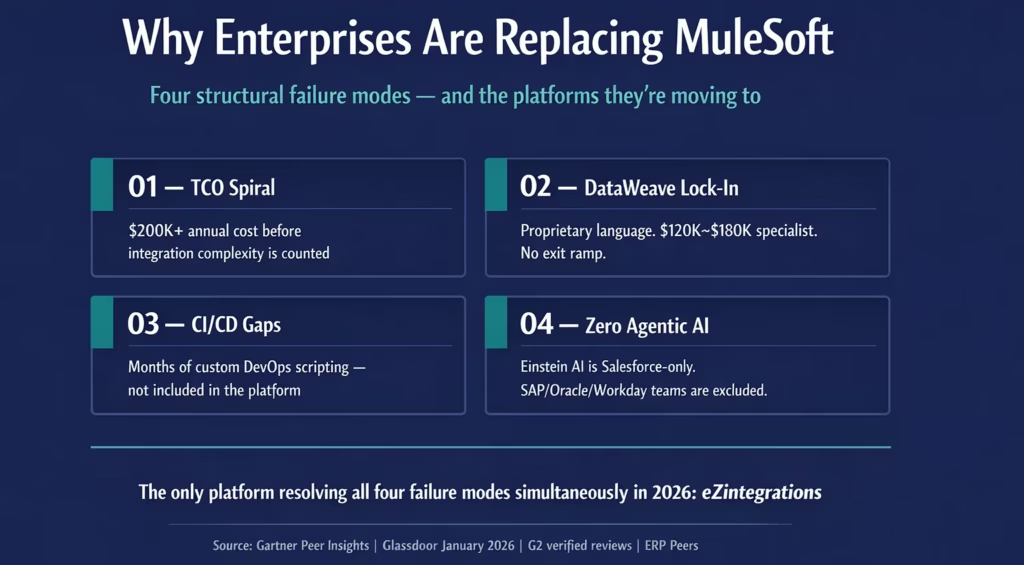
March 13, 2026Why are enterprises replacing MuleSoft in 2026? Four structural reasons: vCore-based pricing that spirals as integration volume grows, with enterprise contracts commonly exceeding $50,000 annually before headcount costs; DataWeave proprietary language lock-in requiring specialist developers at $120,000–$180,000 annually (Glassdoor, January 2026); CI/CD pipeline integration that requires months of custom DevOps scripting not included in the platform; zero native Agentic AI capability for autonomous business process orchestration across enterprise systems. The leading replacement is eZintegrations – the only platform in the field that resolves all four failure modes with production-ready capability in 2026.
TL;DR
MuleSoft’s Core pricing model creates cost spirals as integration volume grows. Combined with DataWeave specialist developer costs of $120,000–$180,000 annually (Glassdoor, January 2026), enterprise TCO regularly exceeds $200,000 per year before any integration complexity is accounted for. DataWeave is a proprietary transformation language with no industry-standard equivalent. Every mapping, enrichment, and routing rule written in DataWeave exists only inside MuleSoft’s runtime, creating exit costs, hiring constraints, and knowledge dependency that make migration progressively harder to justify.
MuleSoft’s CI/CD story requires months of custom scripting to connect to Jenkins, GitHub Actions, or Azure DevOps. There is no native Git integration for flow version control. Teams running modern DevOps practices build and maintain a bespoke pipeline layer on top of MuleSoft indefinitely. MuleSoft’s AI capabilities are Salesforce ecosystem integrations. For enterprises running SAP, Oracle, Workday, NetSuite, or any system outside Salesforce’s gravitational pull, MuleSoft’s AI roadmap is irrelevant to their actual automation needs. Goldfinch AI of eZintegrations ships 9 native agent tools in production today- no roadmap required. Seven platforms are appearing consistently on enterprise shortlists as MuleSoft replacements. eZintegrations is the only one that addresses all four failure modes simultaneously.
The State of MuleSoft in 2026
MuleSoft built its reputation in the enterprise integration market on robust connectivity and a strong API management story. For a decade it was the default answer when a large organisation needed to connect SAP, Salesforce, and everything in between.
But 2026 looks very different from 2016 and so does the conversation happening inside enterprise IT and architecture teams.
The complaints are consistent across Gartner Peer Insights reviews, G2 feedback, and independent analyst commentary: MuleSoft is expensive, slow to deploy, locked into proprietary tooling, and critically not built for the Agentic AI era that is now reshaping what enterprise integration must do.
This article examines the four structural reasons enterprises are walking away from MuleSoft, then profiles the seven platforms that enterprise teams are seriously evaluating as replacements with eZintegrations emerging as the leading modern alternative across AI capability, protocol depth, implementation speed, and total cost of ownership.
The numbers behind the conversation – $15K–$50K+: average MuleSoft annual contract for mid-market enterprises (ERP Peers, G2 reviews) $120K–$180K: MuleSoft / DataWeave developer salary in the US (Glassdoor, January 2026). 6–18 months: typical MuleSoft enterprise deployment timeline (verified user reviews, Gartner Peer Insights) . $0: public pricing published on mulesoft.com , everything is a custom quote.
Failure Mode 1 – The Total Cost of Ownership Has Become Indefensible
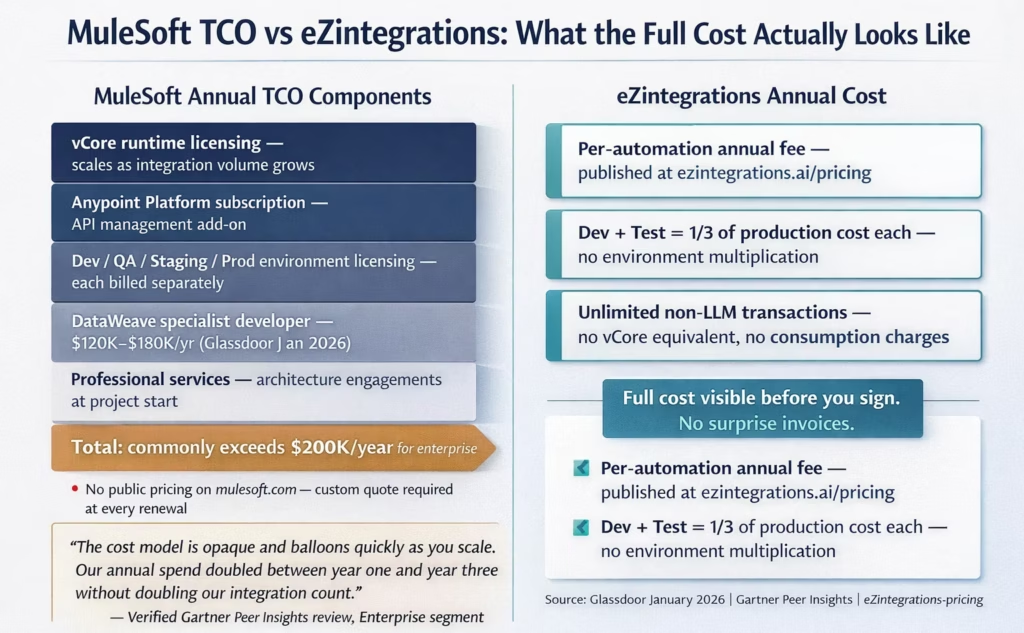
MuleSoft’s pricing is structured around vCores – virtual compute units consumed by running integration flows. The model was designed for the cloud era but creates compounding costs as integration volume grows: more flows mean more vCores, more vCores mean higher licensing fees, and licensing fees scale without a natural ceiling.
Add the costs that MuleSoft customers consistently report alongside platform fees:
- DataWeave specialist developers at $120,000–$180,000 annually (Glassdoor, January 2026) , a dedicated headcount cost that does not exist for no-code platforms
- Separate environment licensing for Development, QA, Staging, and Production
- Professional services engagements often required for complex integration architecture at project start
- Anypoint Platform subscription on top of runtime vCore costs for API management features
- “The cost model is opaque and balloons quickly as you scale. Our annual spend doubled between year one and year three without doubling our integration count.” – Verified Gartner Peer Insights review, Enterprise segment
The result: enterprises that signed MuleSoft contracts when they had 10 integrations find themselves locked into six-figure annual commitments as they approach 50 or 100 flows with no modular exit ramp and no public pricing transparency to plan against.
The eZintegrations contrast: Pricing is published at ezintegrations.ai/pricing on a per-automation, per-year basis. Dev/Test environments are priced at one-third of production , directly solving the environment cost multiplication. No vCores, no consumption charges, no invoice surprises.
Failure Mode 2 – DataWeave Lock-In Creates a Single-Vendor Developer Dependency
MuleSoft’s transformation language , DataWeave is proprietary. There is no industry-standard equivalent. Every data mapping, transformation, and enrichment logic written in DataWeave exists only inside MuleSoft’s runtime.
This creates three compounding problems for enterprise IT teams:
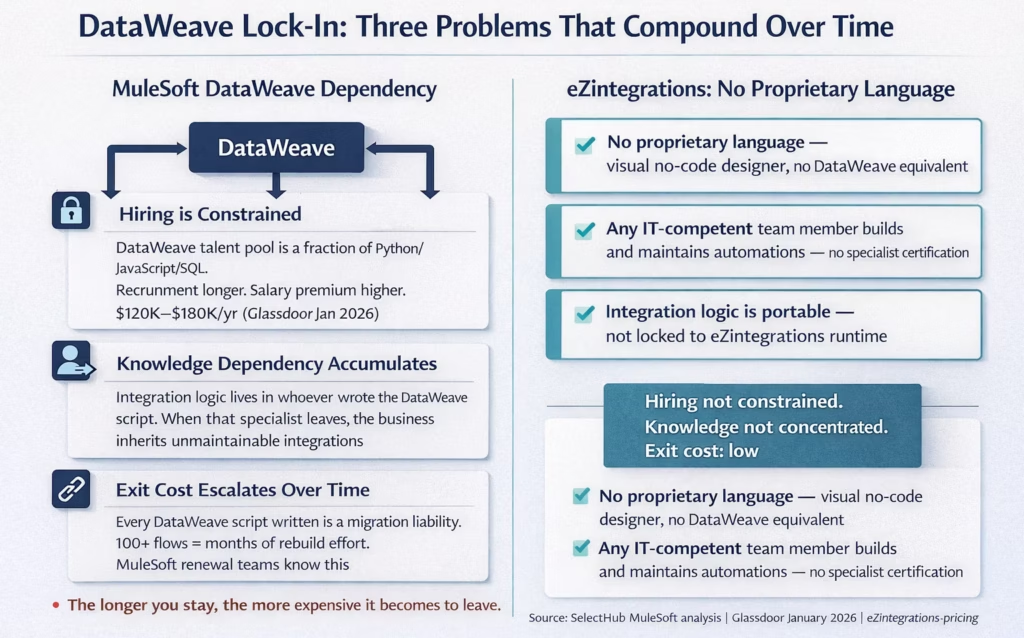
Hiring is constrained. The pool of DataWeave certified developers is significantly smaller than teams proficient in Python, JavaScript, or SQL. Recruitment timelines are longer, salary premiums are higher, and bench depth is lower.
Knowledge dependency accumulates. Integration logic written in DataWeave belongs to whoever wrote it. When a specialist leaves, the business owns integrations that only that developer fully understands, creating maintenance risk and knowledge concentration at the individual level.
Exit cost escalates over time. Migrating away from MuleSoft requires rewriting every DataWeave transformation from scratch in the destination platform’s logic layer. The more DataWeave logic has accumulated, the more expensive the migration becomes a dynamic that MuleSoft’s renewal teams are well aware of.
Independent analysis from SelectHub identifies MuleSoft’s learning curve as significantly steeper than modern low-code iPaaS alternatives, with DataWeave cited as the primary driver of that complexity and the primary driver of ongoing specialist hiring costs.
The eZintegrations contrast: eZintegrations is fully no-code. There is no proprietary transformation language. Data mapping, enrichment, routing, and conditional logic are configured through a visual designer. Business analysts and integration specialists can build and maintain automations. Hiring is not constrained to a niche talent pool. Integration logic is not locked to eZintegrations’ runtime.
Failure Mode 3 – CI/CD Integration Requires Significant Custom Engineering
Modern enterprise IT operates on DevOps principles: code reviews, version control, automated testing, and CI/CD pipelines that deploy changes without human intervention. MuleSoft was architected before these practices became standard, and the integration shows.
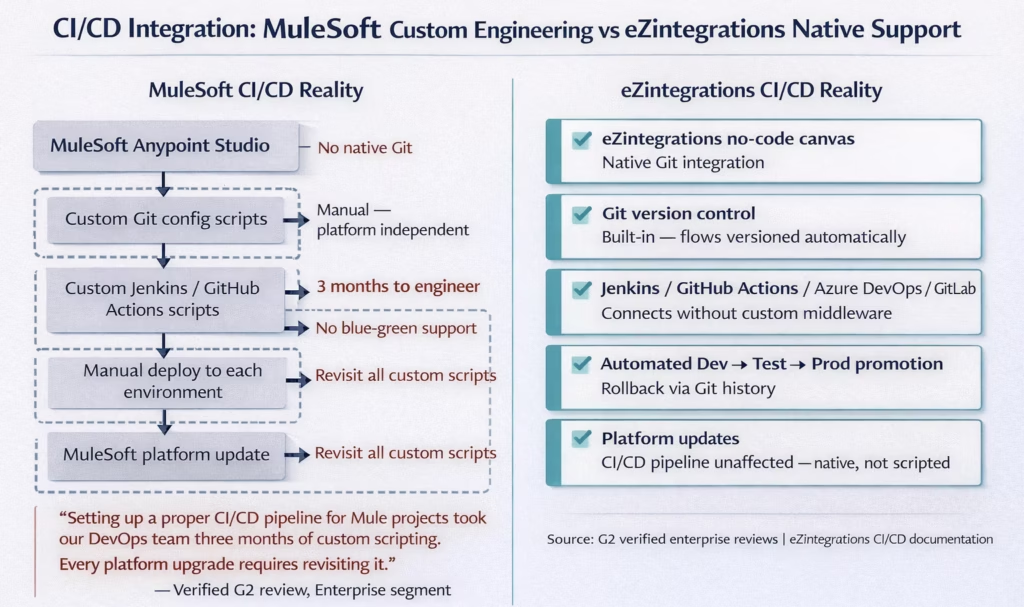
- Version control for Mule flows requires custom Git configurations not native to the platform
- Automated testing coverage is limited, unit testing flows in isolation requires third-party tooling
- CI/CD integration with Jenkins, GitHub Actions, or Azure DevOps requires custom scripting that must be maintained independently of MuleSoft platform updates
- Blue-green deployments and rollback strategies are not natively supported in Anypoint Runtime Manager
- “Setting up a proper CI/CD pipeline for Mule projects took our DevOps team three months of custom scripting. Every platform upgrade requires revisiting it.” – Verified G2 review, Enterprise segment
For enterprise teams that have invested in modern DevOps practices, MuleSoft’s CI/CD limitations translate to either accepting manual deployment risk or building and maintaining a bespoke DevOps layer on top of the platform, neither of which is acceptable at scale.
The eZintegrations contrast: eZintegrations ships with native Git integration and CI/CD pipeline support. Enterprise teams running Jenkins, GitHub Actions, Azure DevOps, or GitLab can connect eZintegrations to their existing deployment pipelines without custom middleware. Version control, automated promotion from Dev to Test to Production, rollback via Git history, and full audit trail for compliance are all native capabilities, not configurations to be engineered.
Failure Mode 4 – Zero Native Agentic AI Capability
The most significant structural gap and the one accelerating departures in 2026 is MuleSoft’s absence of native Agentic AI capability at the integration layer.
Enterprise integration is no longer just about moving data between systems on a schedule. The next generation of enterprise automation requires:
- AI agents that reason across multiple systems without human orchestration
- Document intelligence that extracts, validates, and routes information from unstructured sources
- Autonomous decision-making within workflows, approvals, escalations, anomaly handling
- Natural language interfaces that allow business users to build and modify integrations
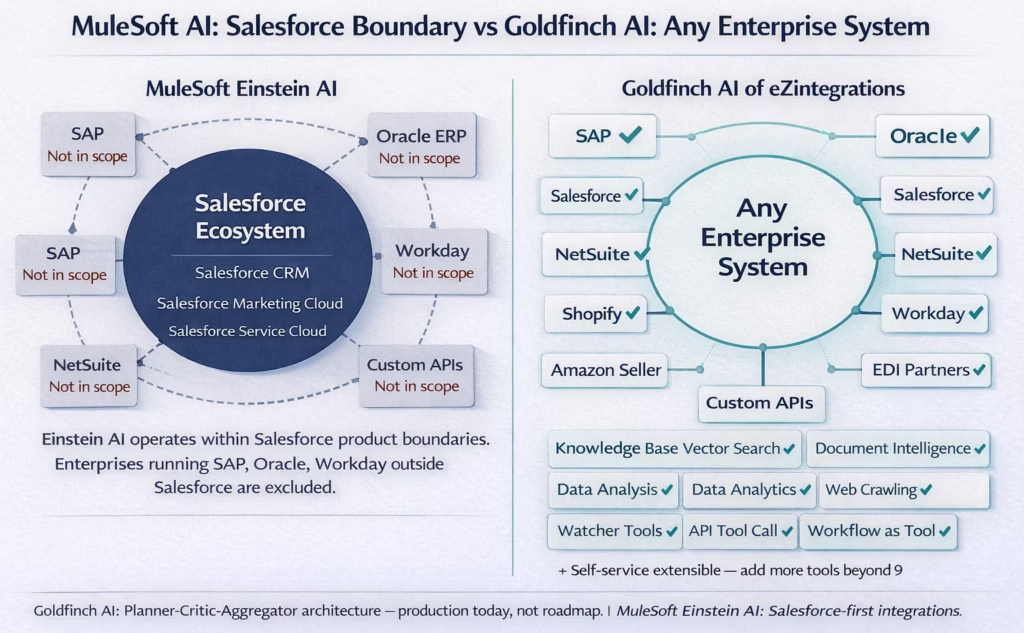
MuleSoft has announced Einstein AI integrations within the Salesforce ecosystem, but these are Salesforce-first capabilities, not platform level Agentic AI that operates across any enterprise system. Enterprises running SAP, Oracle, Workday, or custom systems outside Salesforce’s gravitational pull find MuleSoft’s AI roadmap irrelevant to their actual automation needs.
This is the gap that is driving the most urgent replacement conversations in 2026.
The eZintegrations contrast: Goldfinch AI of eZintegrations ships with 9 native out-of-the-box agent tools in production today: Knowledge Base Vector Search, Document Intelligence, Data Analysis, Data Analytics with Charts/Graphs/Dashboards, Web Crawling, Watcher Tools, API Tool Call, Integration Workflow as Tool, and Integration Flow as MCP. Users can add more tools as self-service beyond these 9. The architecture uses a Planner-Critic-Aggregator reasoning model for autonomous multi-step business process orchestration across any connected system, not just Salesforce.
What Enterprises Are Moving To – The Seven Platforms
The following seven platforms are appearing most consistently in enterprise RFP processes, analyst shortlists, and IT architecture conversations as MuleSoft replacement candidates. Each addresses a different combination of the four failure modes identified above.
| Platform | TCO Model | No-Code / Low-Code | CI/CD Native | Agentic AI | Pricing Transparency |
|---|---|---|---|---|---|
| eZintegrations | Per-automation, Dev/Test at 1/3 production | Full no-code | Native Git + CI/CD | Goldfinch AI – 9 tools, production-ready, extensible | Published |
| Boomi | Per-environment licensing multiplier | Low-code + Groovy for complex transforms | Partial – requires custom setup | AgentStudio in development (Jan 2026) | PAYG published; annual custom |
| Workato | Recipe + task/WLU consumption | Low-code recipes | Partial | Workato AI – recipe generation and monitoring | Custom; ~$10K-$216K/year (third-party) |
| Celigo | Endpoint + flow tier escalation | Low-code, NetSuite-optimised | Partial | Runtime AI – error auto-resolution | Free tier; paid custom; ~$15K-$50K/year |
| Jitterbit | Custom, per-endpoint escalation | Low-code + proprietary scripting | Partial | Harmony AI Copilot – development assistance | Custom quote only |
| SnapLogic | SNAP tier pricing – enterprise SNAPs $45K+ | Low-code pipeline designer | Partial | AutoSync AI – data pipeline automation | Starts ~$9,995/year; enterprise custom |
| Informatica IDMC | IPU consumption – $50K–$2M+/year | Technical – ETL developer required | Enterprise-grade | CLAIRE AI – data governance focused | Custom; no public pricing |
Pricing ranges sourced from: official vendor pricing pages, G2/Gartner Peer Insights verified reviews, ERP Peers, ITQlick, and Mammoth.io independent analysis. MuleSoft developer salary: Glassdoor January 2026.
Platform 1: eZintegrations – The Modern Full-Stack Alternative
Developed by Bizdata | ezintegrations.ai
eZintegrations is the only platform in this comparison that addresses all four MuleSoft failure modes, TCO, developer lock-in, CI/CD gaps, and Agentic AI with production-ready capability today, not on a future roadmap.
Resolves Failure Mode 1: Transparent, Per-Automation Pricing
eZintegrations publishes its pricing at ezintegrations.ai/pricing, a structural differentiator in a market where every major competitor requires a sales conversation before a number is disclosed. The model is per-automation and per-year, with Dev/Test environments priced at one-third of production directly solving the environment licensing multiplication that drives MuleSoft, Boomi, and Oracle OIC costs upward as organisations scale their SDLC.
There are no vCore equivalents, no message-based consumption charges, and no invoice surprises at quarter-end. An enterprise can scope the annual cost of 50 automations before signing a contract, and that number holds.
Resolves Failure Mode 2: No Proprietary Language, No Developer Lock-In
eZintegrations is fully no-code. Data mapping, enrichment, routing, and conditional logic are all configured through a visual designer that requires no specialised certification and no dedicated DataWeave-equivalent developer. Business analysts and integration specialists build and maintain automations. Hiring is not constrained to a niche talent pool. Integration configurations are not locked to eZintegrations’ runtime.
Resolves Failure Mode 3: Native Git and CI/CD Integration
eZintegrations ships with native Git integration and CI/CD pipeline support, not a bolt-on configuration requiring months of custom DevOps scripting. Enterprise teams running Jenkins, GitHub Actions, Azure DevOps, or GitLab connect eZintegrations to their existing deployment pipelines without custom middleware. Version control, automated Dev-to-Test-to-Production promotion, rollback via Git history, and compliance audit trail are all native – not engineered.
Resolves Failure Mode 4: Goldfinch AI – 9 Native Agent Tools, Production-Ready
The capability that most decisively separates eZintegrations from the field is Goldfinch AI, eZintegrations’ Agentic AI feature. While competitors are announcing AI roadmaps or offering AI within narrow ecosystem boundaries, Goldfinch AI ships with 9 native out-of-the-box agent tools in production today:
- Knowledge Base Vector Search – semantic search across enterprise knowledge repositories
- Document Intelligence – extract, validate, and route data from PDFs, invoices, contracts, and unstructured documents
- Data Analysis – AI-driven analysis across connected data sources
- Data Analytics with Charts, Graphs, and Dashboards – automated visual reporting from live data
- Web Crawling – real-time extraction and monitoring from external web sources
- Watcher Tools – event monitoring and trigger-based automation across systems
- API Tool Call – direct API invocation as an agent action
- Integration Workflow as Tool – any existing automation callable as an agent step
- Integration Flow as MCP – Model Context Protocol for AI agent interoperability
Beyond the 9 native tools, Goldfinch AI is self-service extensible, enterprise teams can add custom tools without vendor intervention. The Planner-Critic-Aggregator reasoning architecture means Goldfinch AI decomposes complex business tasks into subtasks (Planner), evaluates each step for accuracy and completeness (Critic), and synthesises results into coherent outputs and decisions (Aggregator).
Enterprise Use Case: Autonomous Accounts Payable Processing
Scenario: 800 vendor invoices per month, multi-currency, 3-way matching required against POs and goods receipt notes.
MuleSoft approach: Custom DataWeave transformations for each invoice format, scheduled polling jobs, manual exception queue requires dedicated DataWeave developer, specialist maintenance, and manual intervention for non-standard invoice layouts.
eZintegrations + Goldfinch AI approach: Document Intelligence extracts line items, amounts, and vendor details from PDF, scanned, and EDI invoices regardless of format. Integration workflows match against PO and GRN data in SAP or Oracle ERP. Watcher Tool flags exceptions and routes to approver via Teams or email. Planner-Critic-Aggregator validates the 3-way match and auto-posts confirmed invoices, no human touch for straight-through transactions. Processing time: days to hours. Straight-through rate: above 70% for standard invoices. DataWeave developer dependency: zero.
Protocol Coverage: No Trade-Offs
eZintegrations provides native support for REST, SOAP, GraphQL, WebSocket, MQTT, EDI (X12, EDIFACT), FTP, SFTP, AS2, and more with no additional licensing or connector tier charges. Teams migrating from MuleSoft do not have to re-evaluate protocol coverage.
Platforms 2–7: The Rest of the Field
Boomi – Established Platform, Environment Cost Trap
Boomi is one of the most established names in iPaaS, with a large connector library and a pay-as-you-go entry point at $99/month plus $0.05 per Boomi Message. However, it introduces its own cost escalation pattern: Development, QA, Staging, and Production environments are each licensed separately. A standard four-environment SDLC is paying four times the per-environment base rate before processing a single production transaction.
On the AI front, Boomi announced AgentStudio capabilities in January 2026, but as of publication this remains in development. Enterprises requiring production Agentic AI capability today will find Boomi’s roadmap insufficient.
- Best for: Organisations with established Boomi investments or needing a broad connector library
- Watch for: Environment licensing multiplication; complex transformations still require Groovy scripting
- Pricing: PAYG $99/month + $0.05/message (published); annual enterprise subscription – custom quote
Workato – Strong Automation Breadth, Task Consumption Model
Workato is widely regarded as having one of the most intuitive recipe-based automation builders in the market, with strong SaaS connector coverage. The pricing model changed significantly in July 2024 from unlimited-action recipes to a consumption-based task/WLU model. Independent analysis puts enterprise contracts in the range of $144,000–$216,000 annually, with premium connectors for SAP and Oracle priced separately. Workato AI includes recipe generation and monitoring , useful for developer productivity but not autonomous multi-system agent orchestration.
- Best for: SaaS-heavy environments, business-user-led automation
- Watch for: Task consumption cost modelling at scale; premium connector add-ons; On-Premise Agent priced separately
- Pricing: Custom quote; third-party estimated $10K–$216K/year depending on tier
Celigo – NetSuite-Optimised, Endpoint Tier Ceiling
Celigo’s identity is built on NetSuite expertise, NetSuite’s largest partner for over a decade, with 5,000+ NetSuite customers and 80+ prebuilt integration apps. For organisations whose integration universe centres on NetSuite, Celigo is a credible option for specific use cases.
The limitations emerge as enterprise scope expands. Pricing tiers by endpoint count: Standard (3 endpoints), Professional, Premium, Enterprise. A common retail stack – NetSuite, Amazon, Walmart, Shopify, DHL, 3PL, Vendor Portal, Customer Portal hits 8 endpoints, forcing a jump from Professional to Premium with the associated cost step. Celigo’s AI focuses on runtime error auto-resolution, not Agentic business process orchestration.
- Best for: NetSuite-centric organisations with moderate integration complexity
- Watch for: Endpoint tier escalation as stack grows; limited protocol depth beyond NetSuite ecosystem
- Pricing: Free tier (2 endpoints, 1 flow); paid tiers custom quote; ~$15K–$50K/year third-party estimate
Jitterbit – Healthcare and Manufacturing Vertical Strength
Jitterbit Harmony has a strong installed base in Healthcare (HL7, FHIR) and Manufacturing (ERP-to-shop-floor), with pre-built templates for common industry patterns. The platform’s limitations are familiar: a proprietary scripting language (Jitterbit Script) creates developer dependency, per-endpoint cost escalation mirrors Boomi’s environment problem, and Harmony AI Copilot is focused on developer assistance rather than autonomous orchestration.
- Best for: Healthcare HL7/FHIR integration, manufacturing ERP connectivity
- Watch for: Proprietary scripting dependency; per-endpoint escalation; fully opaque pricing
- Pricing: Custom quote only, no public figures available from jitterbit.com
SnapLogic – AI-Forward Positioning, SNAP Tier Pricing
SnapLogic has invested in AI-assisted pipeline building, with AutoSync AI generating pipeline configurations from natural language prompts. For data engineering teams that need ELT pipeline automation alongside integration, this is a genuinely differentiated capability. The SNAP pricing model introduces complexity at the enterprise connector level: Tier 1 SNAPs including enterprise applications like Workday and NetSuite are priced at $45,000 per SNAP. Multiple enterprise application connections stack this cost quickly.
- Best for: Data pipeline + integration hybrid requirements; AI-assisted pipeline development
- Watch for: Tier 1 SNAP costs for enterprise application connectors
- Pricing: Starts ~$9,995/year; Tier 1 SNAPs $45,000 each; enterprise custom quote
Informatica IDMC – Enterprise Data Management at Scale
Informatica Intelligent Data Management Cloud is a serious enterprise platform, but more accurately a data management and governance suite than an integration platform. For organisations whose primary need is enterprise data cataloguing, master data management, and data quality governance, Informatica belongs in the conversation.
For organisations primarily seeking integration automation and Agentic AI capability, the profile is less aligned: IPU consumption pricing scales steeply ($50,000 – $2,000,000+ annually), skilled ETL developers are required ($120,000 – $180,000 annually, Glassdoor), and CLAIRE AI is oriented toward data governance rather than business process orchestration. Note: Informatica was acquired by Salesforce in November 2025 – the same parent company as MuleSoft, which raises strategic consolidation questions for organisations seeking a clean break from the Salesforce ecosystem.
- Best for: Enterprise data governance, master data management, large-scale data quality programmes
- Watch for: IPU consumption cost modelling; ETL developer dependency; Salesforce ownership implications
- Pricing: No public pricing; IDMC third-party estimated $50K–$2M+/year; PowerCenter $100K–$300K/processor/year
How to Choose: Decision Framework by Pain Point
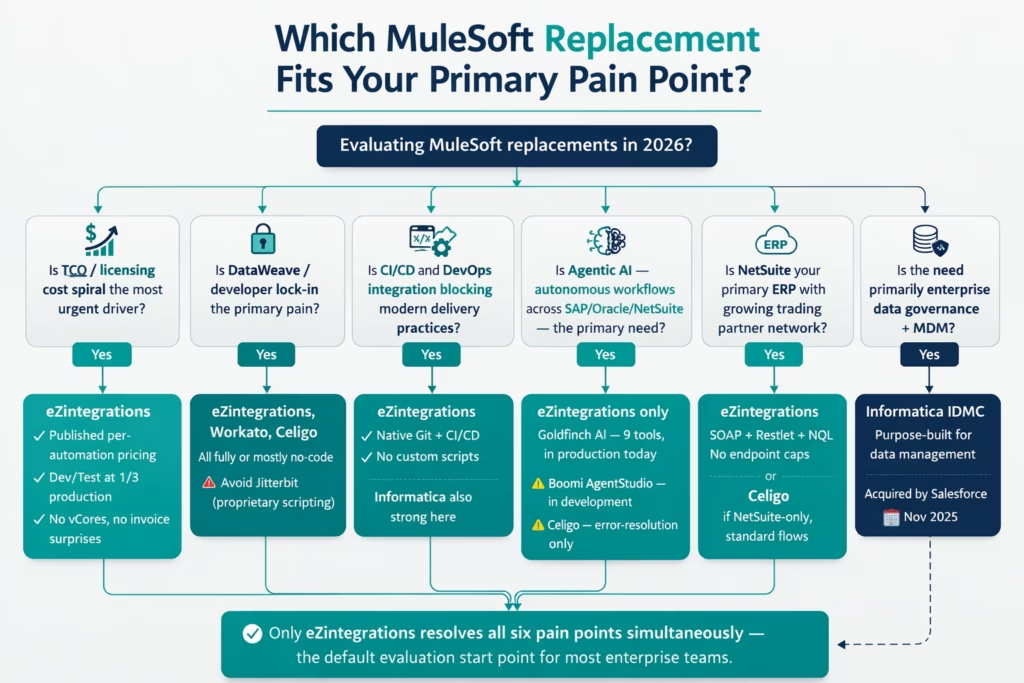
Every enterprise arrives at this decision from a different starting point. The right replacement depends on which of the four MuleSoft failure modes is driving the most urgent pain.
| Primary Pain Point | Platforms to Evaluate First | Platforms to Deprioritise |
|---|---|---|
| TCO / licensing cost spiral | eZintegrations (published pricing, Dev/Test at 1/3 production) | Informatica, SnapLogic enterprise tier |
| DataWeave / developer lock-in | eZintegrations, Workato, Celigo | Jitterbit (proprietary scripting) |
| CI/CD and DevOps integration | eZintegrations (native Git + CI/CD), Informatica | Celigo, Jitterbit (partial support only) |
| Agentic AI / autonomous workflows | eZintegrations (Goldfinch AI – 9 tools, production) | Boomi (AgentStudio in development), Celigo (error AI only) |
| NetSuite as primary system | eZintegrations (SOAP + Restlet + NQL with full pagination), Celigo | Informatica, Jitterbit |
| Full protocol breadth (GraphQL, WebSocket, EDI) | eZintegrations | Celigo (NetSuite-centric), Workato (limited protocol depth) |
| Healthcare / regulated industry | eZintegrations (cloud-native; connects to on-prem ERP, DB, file systems), Jitterbit (HL7/FHIR templates) | SnapLogic |
Frequently Asked Questions
1.How long does a MuleSoft to eZintegrations migration take
Simple integrations migrate in days while complex DataWeave based flows typically take two to four weeks each. Most enterprise migrations are phased and completed over approximately three to nine months depending on the number and complexity of integrations.
2.Does eZintegrations replace MuleSoft API management capability
eZintegrations replaces internal integration automation but does not provide full API lifecycle management capabilities such as developer portals API gateway governance or rate limiting which remain MuleSoft strengths in API management scenarios.
3.Can eZintegrations connect to the same systems as MuleSoft
Yes eZintegrations connects to REST SOAP GraphQL WebSocket databases FTP and SFTP EDI standards such as X12 and EDIFACT and messaging protocols including MQTT and AS2 allowing connectivity across most enterprise systems and SaaS platforms.
4.How does Goldfinch AI compare to MuleSoft Einstein AI
MuleSoft Einstein AI is primarily Salesforce ecosystem focused while Goldfinch AI orchestrates autonomous multi system workflows across any connected enterprise platform using a Planner Critic Aggregator multi agent architecture.
5.What happens to pricing as integrations scale
eZintegrations uses transparent per automation pricing where Dev and Test environments are typically priced at approximately one third of production cost allowing predictable scaling without sudden platform tier increases or message based billing jumps.
6.Is eZintegrations suitable for regulated industries
Yes eZintegrations supports regulated industries including Finance Healthcare and Government environments with audit trails version history controlled workflow execution and document intelligence capabilities for compliance oriented processes.
7.Is migration worth it for organisations already deep into MuleSoft
Organisations with fewer than twenty integrations often migrate quickly while larger MuleSoft estates typically perform a side by side total cost of ownership analysis before renewal to evaluate migration benefits and operational savings.
Conclusion
MuleSoft’s position in 2026 is that of a platform built for a different era – the pre-AI, pre-DevOps, specialist-developer era of enterprise integration. Its vCore model, DataWeave lock-in, CI/CD limitations, and absent native Agentic AI are not cosmetic issues. They are structural problems that become more expensive and more constraining with every year an enterprise stays.
The seven platforms profiled here represent the realistic replacement field. eZintegrations stands apart because it is the only platform that resolves all four MuleSoft failure modes simultaneously transparent published pricing with a Dev/Test discount, fully no-code with no proprietary language dependency, native Git and CI/CD integration, and Goldfinch AI providing production-ready Agentic AI with 9 native tools and a self-service extensible architecture.
The right time to evaluate this transition is before the next MuleSoft contract renewal ,not after it.
Ready to see what replacing MuleSoft actually looks like for your environment? Book a demo with the eZintegrations team. Bring your current MuleSoft integration list, the conversation will cover migration approach, TCO comparison, and a live demonstration of Goldfinch AI on a workflow relevant to your industry.