Agentic AI for Pharma: Autonomous Compliance, Clinical, and Supply Chain Workflows
June 16, 2026Agentic AI for pharma deploys coordinator-worker multi-agent architecture across compliance, clinical, and supply chain domains: with a coordinator agent that receives complex pharmaceutical goals (“monitor all ongoing clinical trials for protocol deviation signals and deliver a weekly risk brief”), dispatches specialist worker agents to Veeva Vault, SAP, LIMS, Medidata, and regulatory systems simultaneously, synthesises the findings, and delivers structured intelligence to quality, clinical, and supply chain teams. All processing runs under 21 CFR Part 11-compliant audit trails within eZintegrations’ GxP-validated infrastructure, no PHI or regulated data sent to external AI providers.
TL;DR
- Agentic AI in pharma is not a feature upgrade from AI workflows. It is a different operating model: instead of executing predefined steps with AI nodes, coordinator-worker multi-agent architecture receives complex pharmaceutical goals. “investigate why this trial site’s enrolment has dropped 40% in 30 days”: dispatches specialist worker agents to the relevant systems simultaneously, synthesises their findings, and delivers structured intelligence with the investigation complete.
- The compliance architecture required for pharma agentic AI is specific and achievable: 21 CFR Part 11-compliant audit trails for every coordinator and worker agent action, GxP validation documentation for the agent configuration, native AI inference within the compliance boundary (no PHI, study data, or GMP records sent to external AI providers), and human approval gates for any agent action that constitutes a regulated decision.
- Five agentic AI use cases where coordinator-worker architecture delivers capabilities that single agents and predefined workflows cannot: compliance risk intelligence programme, clinical operations intelligence agent, pharmacovigilance signal synthesis agent, CMC supply chain risk agent, and regulatory intelligence agent.
- Goldfinch AI of eZintegrations delivers this architecture natively: coordinator dispatching parallel worker agents to Veeva Vault, SAP S/4HANA, LIMS, Medidata, and regulatory systems: with 9 native enterprise tools, Chat UI for pharma intelligence queries, and Workflow Node for automated compliance programmes.
- CTA: Book a demo with your validation team, quality informatics lead, and clinical operations stakeholders to see the compliance architecture and the multi-agent investigation in your specific pharma system stack.
The Problem: Pharma’s Intelligence Deficit Across Three Domains
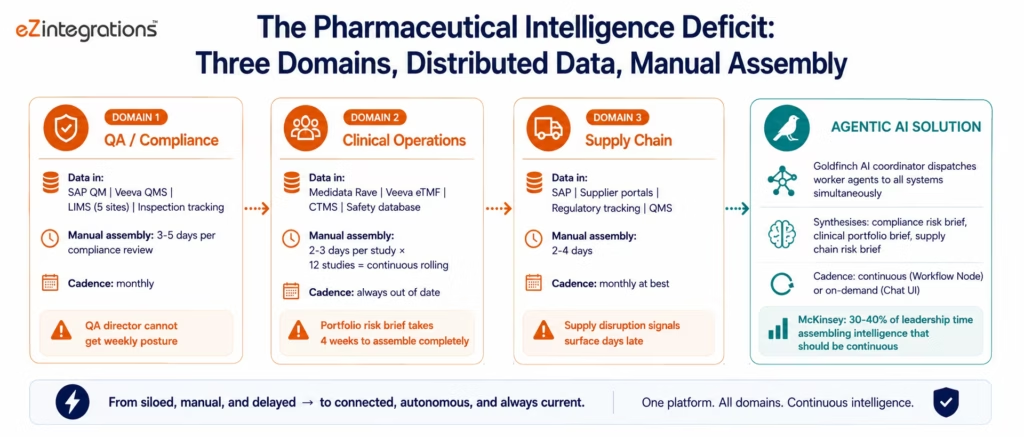
At a global pharmaceutical company, three intelligence gaps exist simultaneously on any given Thursday.
In quality and compliance: the QA director wants to know the current compliance risk posture across all five manufacturing sites, which sites have open CAPAs past their due dates, which have recent OOS trends that might signal a systemic quality issue, which have upcoming regulatory inspections with preparation status, and which have supplier qualification gaps that could affect the next batch release. This intelligence exists, distributed across SAP QM, Veeva Vault QMS, LIMS at each site, and a SharePoint-based inspection tracking tool. Assembling it manually takes a compliance analyst 3-5 days. It is done monthly, not weekly.
In clinical operations: the VP of Clinical Operations wants to know the current risk posture across all 12 active clinical trial, which sites are behind enrolment projections, which have protocol deviation trends that might indicate site capability issues, which have data query backlogs that could affect database lock timelines, and which have safety data patterns that warrant a medical monitor review. This intelligence lives in Medidata Rave, Veeva eTMF, the CTMS, and the safety database. Assembling it manually takes a CRA manager 2-3 days per study, making a 12-study portfolio review a continuous rolling effort that is always out of date.
In supply chain: the VP of Supply Chain wants to know the current risk posture across the active product portfolio, which APIs have single-source suppliers with capacity constraints, which have cold chain integrity alerts pending investigation, which have regulatory submission dependencies that could affect supply approval timelines, and which have DMF (Drug Master File) expiry dates approaching that require supplier action. This intelligence is distributed across SAP, supplier portals, the regulatory tracking system, and the quality management system.
According to McKinsey, pharmaceutical companies spend 30-40% of senior R&D and operations leadership time assembling and reviewing intelligence that should be continuously available from the connected data estate. Gartner estimates that the gap between the intelligence pharmaceutical organisations have the data to produce and the intelligence they actually receive on a regular cadence is the primary driver of delayed decision-making in clinical operations, quality management, and supply chain.
Agentic AI closes this gap. Not by improving existing reports. By replacing the report assembly cycle with continuous, coordinated multi-agent intelligence that synthesises findings from the connected pharma system estate, under the compliance architecture that pharmaceutical operations require. This shift also aligns with Forrester’s Top Emerging Technologies For Healthcare, 2025, which highlights AI acceleration as a major engine behind emerging healthcare innovation.
Agentic AI vs AI Agents vs AI Workflows: The Pharma Distinction
Understanding the three levels is essential for pharma organisations evaluating AI deployment: because each level addresses a different class of problem and requires a different governance framework.
AI Workflows (Level 2): a validation team defines a predefined processing sequence with AI nodes embedded. An AP invoice arrives, Document Intelligence extracts fields, the confidence-threshold routes to the LIMS for specification comparison, and the result posts to SAP. The sequence is fixed. The AI enriches specific steps. GxP validation covers the full sequence. This is the right tool for high-volume, defined processing with AI enrichment.
AI Agents (Level 3): a single agent receives a goal and determines its investigation sequence based on findings. The adverse event investigation agent reads the ICSR, queries Epic for patient history, retrieves the payer coverage criteria, and assembles the submission. The path is dynamic but the scope is bounded, one agent, one goal, one investigation. Validation covers the agent’s tool registry and autonomous action policy.
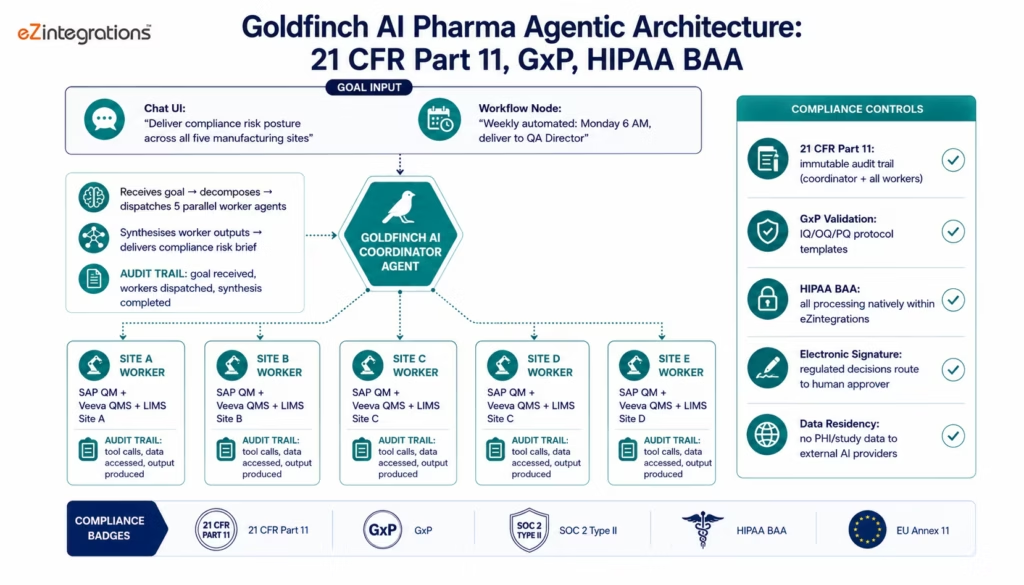
Agentic AI (Level 4: Goldfinch AI): a coordinator agent receives a complex goal and dispatches specialist worker agents in parallel. “Deliver the weekly compliance risk posture for all five manufacturing sites”. The coordinator dispatches five parallel worker agents (one per site), each querying SAP QM, Veeva QMS, LIMS, and the site-specific inspection records simultaneously. The coordinator synthesises the five worker outputs into a consolidated compliance risk brief. No single workflow or single agent can achieve this parallelism and synthesis at scale.
| Use Case | Right Level | Why |
|---|---|---|
| Batch release test result extraction | Level 2 AI Workflow | Predefined processing, high volume, Document Intelligence + SAP QM posting |
| Adverse event document investigation | Level 3 AI Agent | Single patient investigation, bounded scope, FHIR + payer portal |
| Weekly compliance risk posture (5 sites) | Level 4 Goldfinch AI | Parallel investigation across 5 sites, coordinator synthesis required |
| Clinical trial protocol deviation trace | Level 3 AI Agent | Single study, bounded investigation, Medidata + eTMF |
| 12-study portfolio risk brief | Level 4 Goldfinch AI | 12 parallel investigations, coordinator synthesis, Chat UI or Workflow Node |
| Regulatory submission data assembly | Level 3-4 | Single submission: Level 3; multi-product portfolio: Level 4 |
| Supply chain risk monitoring (20 APIs) | Level 4 Goldfinch AI | 20 parallel supplier investigations, coordinator risk synthesis |
The compliance governance implication: Level 4 Goldfinch AI requires validation of both the coordinator agent (goal interpretation, worker dispatch logic, synthesis logic) and each worker agent class (tool access, data scope, output format). This is additional validation scope compared to Level 3, but the capability it enables, parallel, synthesised, continuous intelligence across the full pharma data estate: is not achievable at lower levels.
The Compliance Architecture for Pharma Agentic AI
Pharma agentic AI must satisfy a more demanding compliance architecture than general enterprise agentic AI: because the systems being queried hold regulated data (PHI, IND/NDA study data, Good manufacturing practice manufacturing records) and because the intelligence produced may inform regulated decisions (batch release, safety signal escalation, regulatory submission).
21 CFR Part 11 Requirements for Agentic AI Systems
Coordinator agent audit trail: every goal received by the coordinator, every worker dispatch decision, every synthesis action, and every intelligence brief delivered must generate an immutable audit trail entry, Capturing the goal statement, the worker agents dispatched, the tool calls each worker made, the data accessed, and the synthesised output.
Worker agent audit trail: each worker agent’s actions generate their own audit trail every FHIR query, every SAP OData call, every Veeva REST quer with the data accessed, the output produced, and the timestamp. The combined coordinator + worker audit trail provides complete traceability for any intelligence brief from goal to output.
Electronic signature for regulated actions: where a Goldfinch AI intelligence brief informs a regulated decision (the QA director approving a CAPA closure based on an agent-assembled risk brief, the medical monitor escalating a safety signal based on an agent-synthesised PV analysis), the decision action must capture the reviewer’s identity, the timestamp, and the meaning of the action. The Goldfinch AI workflow routes the intelligence brief through the electronic signature workflow before the regulated action is executed.
Validated configuration: the Goldfinch AI coordinator configuration (goal templates, worker dispatch logic, synthesis prompts), the worker agent configurations (tool registry, data scope, output format), and the knowledge base content (GxP policies, regulatory guidance, clinical protocols) are treated as validated configurations subject to change control, version control, and re-validation when modified.
Data Residency for Pharma Agentic AI
This is the architectural gate for pharma agentic AI deployment. When Goldfinch AI worker agents query Veeva Vault for clinical study data, SAP for manufacturing batch records, or Medidata for patient-level trial data and when the coordinator synthesises this data into an intelligence brief the processing must occur within the validated, HIPAA-covered infrastructure.
eZintegrations’ Goldfinch AI processes all coordinator reasoning and worker agent tool calls natively within its own infrastructure. No clinical study data, no patient records, no GMP manufacturing data, no regulatory submission information is sent to external AI providers (OpenAI, Anthropic, Google) during agentic processing. The single HIPAA BAA and 21 CFR Part 11 compliance framework with eZintegrations covers the full Goldfinch AI processing stack.
GxP Validation Approach for Goldfinch AI
Validation scope for pharma agentic AI deployment:
- Coordinator agent validation: IQ confirming Goldfinch AI is configured as specified; OQ testing that coordinator correctly interprets goal templates, dispatches the correct worker agents for each goal type, and synthesises outputs according to the configured logic; PQ confirming consistent performance under production conditions with actual pharma system connections.
- Worker agent validation: per worker agent class (compliance worker, clinical worker, PV worker, supply chain worker), IQ/OQ/PQ covering tool access, data retrieval accuracy, output format, and confidence threshold routing.
- Knowledge base validation: content review and approval of all knowledge base entries (regulatory guidance, clinical protocols, GMP policies) by the appropriate subject matter expert, with version control and change control for updates.
- Audit trail validation: verification that every coordinator and worker action generates the specified audit trail content and that the audit trail is immutable and retrievable.
eZintegrations provides IQ/OQ/PQ protocol templates for standard Goldfinch AI configurations, reducing the validation timeline compared to custom agentic AI development.
Before vs After: Agentic AI for Pharma Operations
| Intelligence Need | Before Agentic AI | After Agentic AI (Goldfinch AI) | Impact |
|---|---|---|---|
| Multi-site compliance risk posture | Compliance analyst: 3-5 days manual assembly, monthly cadence | Goldfinch AI Workflow Node: weekly automated brief, 5 sites in parallel | Weekly vs monthly, 3-5 days → 90 minutes |
| 12-study clinical portfolio risk brief | CRA managers: rolling 4-week assembly, always partially stale | Coordinator dispatches 12 parallel workers, synthesises in hours | 4 weeks → hours, 100% coverage vs rolling partial |
| PV signal synthesis across case database | PV team: weekly manual case review, signal assessment meeting | Goldfinch AI synthesises signal patterns across full case database continuously | Real-time vs weekly, every case vs sampled |
| Supply chain risk across 20 API suppliers | Supply chain manager: 2-4 day manual supplier assessment | Coordinator dispatches 20 parallel workers, delivers ranked risk brief | 2-4 days → 3-4 hours, continuous vs monthly |
| Regulatory intelligence: recent guidance updates | Regulatory affairs: manual monitoring of FDA, EMA, ICH websites | Web Crawling agent monitors continuously, surfaces relevant updates with applicability assessment | Same-day vs weeks |
| Batch release intelligence (multi-product) | QA team: per-batch manual assembly from LIMS + SAP + CoAs | Coordinator assembles multi-product release status in single brief | Hours → minutes per product |
| Cross-study safety signal | Safety team: labour-intensive cross-study analysis | Goldfinch AI coordinator queries all study safety databases simultaneously | Days → hours |
| CMC supply chain for NDA submission | CMC team: 3-5 days data gathering from multiple systems | Coordinator dispatches parallel workers to all CMC data sources | 3-5 days → 4-6 hours |
| Inspection readiness brief | QA: 2-3 days preparing per-site readiness document | Goldfinch AI assembles inspection readiness brief on demand | On-demand vs 2-3 days |
| CAPA effectiveness review | Quality team: manual review of CAPA outcomes across all sites | Coordinator synthesises CAPA completion, effectiveness metrics, and overdue status across all sites | Continuous monitoring vs quarterly review |
How Goldfinch AI Connects the Pharma Enterprise
Goldfinch AI of eZintegrations deploys the coordinator-worker architecture across the pharmaceutical enterprise system estate using the same FHIR R4, Veeva REST, SAP OData V4, and LIMS connectors as the Level 1-3 platform, with the coordinator orchestrating parallel worker queries and synthesising the findings into intelligence appropriate for pharma leadership and operational teams.
System connections for pharma agentic AI:
Veeva Vault (all application families): eTMF (clinical trial master files, study documents, site records), QMS (CAPAs, deviations, change controls, SOPs), RegulatoryOne (submissions, health authority correspondence, dossier management), and Safety (ICSRs, aggregate reports). REST API with Veeva OAuth 2.0.
SAP S/4HANA: QM (quality management inspection lots, results recording, batch release), MM (materials management purchase orders, goods receipts, inventory), PP (production planning manufacturing orders, confirmations), PM (plant maintenance equipment records, work orders). OData V4 with automatic CSRF token management. SuiteQL-equivalent complex data queries for SAP supported through OData filter and expand operations, with multi-entity joins via OData navigation properties.
LIMS (LabVantage, LabWare, STARLIMS): analytical test results, stability data, method validation records, sample management. REST API and database connectors. IPSec Tunnel for on-premises LIMS deployments.
Medidata Rave / Veeva EDC: clinical trial data patient visit data, eCRF completions, query management, protocol deviation records. EDC data export API.
Clinical Trial Management System (CTMS): site performance data, enrolment projections, monitoring visit records, site qualification data.
Safety database (Argus, ARISg, Veeva Vault Safety): ICSR records, case classifications, aggregate report data, signal detection results.
Regulatory submission systems: eCTD dossier management, XEVMPD product database, EVDAS pharmacovigilance signal management.
Supplier portal connectivity: REST API connectivity to drug substance API suppliers, excipient suppliers, and packaging suppliers for capacity data, lead time updates, and quality event notifications.
9 native Goldfinch AI tools for pharma:
- Knowledge Base Vector Search: GxP policies, regulatory guidance (FDA, EMA, ICH), clinical protocols, DMF references, pharmacopoeial standards
- Document Intelligence: batch records, CoAs, inspection reports, clinical study reports, regulatory correspondence
- Data Analysis: OOS/OOT trend detection, enrolment projection modelling, safety signal pattern analysis, supply risk scoring
- Data Analytics with Charts/Graphs/Dashboards: site performance visualisations, quality metric dashboards, portfolio risk matrices
- Web Crawling: FDA regulatory guidance updates, EMA news, ICH guideline revisions, supplier news, competitor product filings
- Watcher Tools: CAPA due date monitoring, filing deadline alerts, batch release SLA tracking, clinical milestone monitoring
- API Tool Call: all system connections above
- Integration Workflow as Tool, call any Level 1-2 workflow (e.g., trigger the existing CAPA notification workflow from within the agent)
- Integration Flow as MCP: expose pharma integration capabilities via MCP for external AI tool consumption
Compliance: 21 CFR Part 11 audit trail for all coordinator and worker actions. GxP validation documentation support (IQ/OQ/PQ templates). HIPAA BAA for clinical data. GDPR for EU patient and employee data. EU Annex 11 for EU operations. All Goldfinch AI processing natively within eZintegrations’ compliant infrastructure. IPSec Tunnel for on-premises pharma systems.
Use Case 1: Compliance Risk Intelligence Programme (Workflow Node)
The capability gap: the QA director of a global pharma company has five manufacturing sites across three continents. Getting a current compliance risk posture for all five. CAPAs, OOS trends, inspection status, batch release performance. Requires a team of compliance analysts working for 3-5 days. It happens monthly. Decisions about resource allocation, site support, and inspection preparation are made on data that is up to 30 days old.
The Goldfinch AI solution: the Compliance Risk Intelligence Programme runs on the Workflow Node, an automated Goldfinch AI programme that executes on a configured schedule (weekly, Monday at 5 AM) without human request, delivering a consolidated compliance risk brief to the QA director’s inbox and the quality leadership Slack channel before the week begins.
The Coordinator-Worker Investigation
Coordinator receives goal (Workflow Node): “Generate weekly compliance risk posture for Manufacturing Sites A through E. Include: open CAPA status and overdue items, OOS/OOT trends from the past 30 days, upcoming inspection timelines, batch release performance, and any critical quality events.”
Five parallel worker agents dispatched simultaneously:
Each site worker queries (in parallel):
SAP QM query (API Tool Call):
- Open quality notifications (by category and age)
- Batch release data for the past 30 days (released vs rejected vs pending)
- Inspection lot status by material and process
- OOS results and investigation status
Veeva Vault QMS query (API Tool Call):
- Open CAPAs: by severity, due date, and overdue status
- Deviations opened in the past 30 days
- Change controls pending approval
- SOP review overdue items
LIMS query (API Tool Call):
- OOS results by method, material, and specification
- OOT trend data for critical quality attributes
- Stability data alerts
Knowledge Base query:
- Upcoming inspection timeline for this site (from the regulatory inspection tracker)
- Regulatory commitments with upcoming due dates
Worker outputs returned to coordinator (typically 8-12 minutes per worker, all running in parallel): structured site risk summary: open CAPAs with overdue count, OOS rate vs. 90-day baseline, inspection timeline, batch release rate, and any critical events.
Coordinator synthesis: the coordinator receives all five worker summaries and synthesises the consolidated brief;
- Executive summary: overall portfolio compliance posture (green/amber/red per site)
- Priority actions: sites with critical overdue CAPAs, elevated OOS rates, or imminent inspections requiring attention
- Trend analysis: sites where quality metrics are deteriorating vs improving
- Workload recommendations: which sites need QA leadership attention this week
Data Analytics with Charts: the coordinator generates a portfolio risk matrix (sites on one axis, risk categories on the other, colour-coded by status) and includes trend charts for each site’s OOS rate over the past 90 days.
Delivery: QA director receives the brief at 6 AM Monday, before the weekly quality leadership call, with the full investigation complete. Total coordinator + worker time: 25-35 minutes. Previous manual assembly: 3-5 days.
Use Case 2: Clinical Operations Intelligence Agent (Chat UI)
The capability gap: the VP of Clinical Operations at a mid-sized pharma company is preparing for a portfolio review meeting in 2 hours. They need the current risk status for all 12 active clinical trials, enrolment status vs projection, protocol deviation trends by site, data query backlog, and any safety patterns requiring medical monitor attention. There is no time for the CRA management team to assemble this manually.
The Goldfinch AI solution: the VP opens the Goldfinch AI Chat UI and asks, “Give me the current risk status for all 12 active clinical trials. Include enrolment vs projection, protocol deviation trends, query backlog, and any safety signals from the past 30 days.”
The Coordinator Dispatch and Response
Coordinator interpretation: the goal requires investigation across four dimensions for 12 studies. The coordinator dispatches 12 parallel enrolment worker agents, 12 parallel protocol deviation worker agents, and a single safety synthesis worker agent for the safety database.
Enrolment workers (12 parallel, CTMS queries):
Each enrolment worker queries the CTMS for the study:
- Actual enrolment vs projected enrolment as of current date
- Site-level enrolment distribution (identifying underperforming sites)
- Screen failure rate and trend
- Projected completion date based on current rate vs protocol planned date
Protocol deviation workers (12 parallel, Medidata + Veeva eTMF):
Each worker queries:
- Protocol deviations reported in the past 90 days: by category (eligibility, procedure, timing, consent)
- Deviation rate per 100 patient visits (normalised comparison across sites)
- Sites with deviation rates above the study-specific alert threshold
- Any deviations classified as important protocol deviations (IPDs) requiring regulatory reporting
Safety synthesis worker (Veeva Vault Safety + safety database):
The safety worker queries:
- SAEs reported in the past 30 days by study and by arm
- Dose-related AE patterns in the past 90 days
- Any safety signals flagged in the safety database for these studies
- Medical monitor review items pending
Coordinator synthesis: receives findings from all 25 parallel workers and synthesises the portfolio risk brief:
- Studies at highest risk: ranked by composite risk score (enrolment gap × deviation rate × safety flags)
- Enrolment alert: three studies are more than 15% behind projection, enrolment acceleration plan needed
- Protocol deviation alert: two sites across two studies have deviation rates above the alert threshold monitoring visit overdue at both sites
- Safety signal: one study has a dose-related AE pattern in the highest dose cohort that the medical monitor has not yet reviewed
Chat UI response delivered: 52 seconds from query submission. The VP of Clinical Operations enters the portfolio review meeting with a complete 12-study risk brief not the partial, manually assembled view that was the previous standard.
Use Case 3: Pharmacovigilance Signal Synthesis Agent
The capability gap: signal detection in pharmacovigilance requires reviewing the full case database for emerging patterns clusters of similar adverse events across different reporters, combinations of events that individually are not concerning but in combination suggest a safety signal, and changes in reporting rate for known events that might indicate a new risk population. This analysis requires time and expertise that the PV team applies selectively: to pre-identified signals or to aggregate report preparation periods. Continuous surveillance of the full case database is not feasible with human review alone.
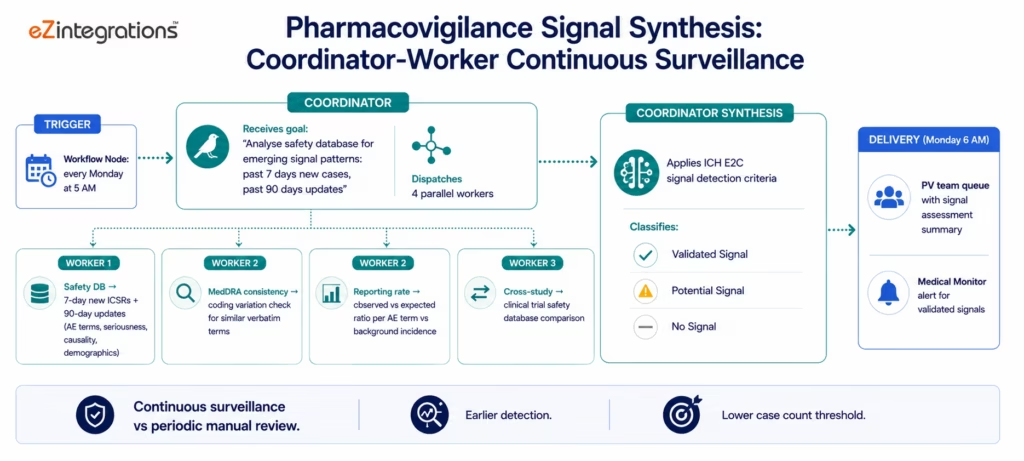
The Goldfinch AI solution: the PV Signal Synthesis Agent runs on the Workflow Node a continuous monitoring programme that analyses the safety database at a configured frequency, identifies emerging patterns, and delivers prioritised signal assessments to the PV team.
What the Agent Monitors and Synthesises
Case database monitoring (weekly Workflow Node):
The coordinator dispatches worker agents to:
Safety database worker: queries all ICSRs from the past 7 days (new cases) and the past 90 days (existing cases with updates). Extracts: adverse event terms, seriousness, causality, patient demographics, product doses, and concomitant medications.
MedDRA coding consistency worker: checks whether similar verbatim adverse event terms across cases have been coded consistently, flagging potential under-reporting of a specific preferred term due to coding variation.
Reporting rate worker: calculates the observed-to-expected ratio for each adverse event term in the case database against the background incidence rate for the indication (retrieved from the Knowledge Base) and the reporting rate from the Reference Safety Information.
Cross-study worker (if applicable): for products with ongoing clinical trials, the worker queries the study safety database to check whether cases from both spontaneous reporting and clinical trials show consistent or divergent patterns for the same adverse event terms.
Signal pattern classification: the coordinator applies the ICH E2C signal detection criteria to the patterns identified by the workers and classifies;
- Validated signal: consistent pattern across multiple independent sources with a disproportionate reporting rate; escalate to medical monitor for formal signal assessment
- Potential signal: pattern present but insufficient cases or inconsistent sourcing, add to monitoring list with alert if pattern strengthens
- No signal: normal variation within expected reporting distribution
Weekly delivery via Workflow Node: the PV Signal Synthesis report is delivered to the PV team’s queue every Monday morning with, new signals identified in the past week, updates on monitored potential signals (strengthening, weakening, or closed), and coding consistency alerts.
The result: the PV team’s attention is directed to the signals that emerge from continuous surveillance not constrained to the cases they have time to review manually. Signal detection lead time improves as patterns are identified at lower case counts (earlier in signal development) rather than when they accumulate to threshold-detectable levels through periodic aggregate analysis.
Use Case 4: CMC Supply Chain Risk Intelligence Agent
The capability gap: pharmaceutical supply chains are complex, multi-tier, and highly regulated. A single drug product may have an API from Supplier A in India, a key excipient from Supplier B in Germany, primary packaging from Supplier C in the US, and a contract manufacturing organisation in Ireland. Each supplier relationship has: a quality agreement, a supplier qualification status, ongoing supply performance data, a regulatory filings history (DMF or CEP), and capacity data. Maintaining current risk intelligence across 20 strategic suppliers requires data from five systems: SAP, Veeva QMS, the supplier portals, the regulatory tracking system, and the CMC dossier management system: and takes a supply chain risk manager 2-4 days to assemble quarterly.
The Goldfinch AI solution: the CMC Supply Chain Risk Intelligence Agent maintains a continuous, multi-tier view of supply chain risk: updated weekly via the Workflow Node and available on demand via the Chat UI.
The Coordinator-Worker Supply Chain Investigation
Weekly Workflow Node trigger: “Generate supply chain risk intelligence for the top 20 strategic suppliers. Include: supplier qualification status, recent quality events, supply performance vs SLA, capacity constraints, DMF/CEP expiry timeline, and regulatory filing dependencies.”
20 parallel supplier worker agents dispatched:
Each supplier worker queries (in parallel):
SAP MM/QM query: purchase order delivery performance (on-time, quantity), open quality notifications against this supplier, last goods receipt inspection result.
Veeva QMS query: supplier qualification status, any open supplier CAPAs, last audit date and outcome, quality agreement review status.
Regulatory tracking query: DMF/CEP expiry date, any regulatory action letters or observations against this supplier’s regulatory filings, product-specific regulatory approval dependencies.
Supplier portal query (if API accessible) or Knowledge Base: current capacity status, lead time commitments, any communicated constraints.
Coordinator synthesis: receives 20 supplier risk summaries and produces a ranked supply chain risk brief;
- Tier 1 risk: suppliers with a combination of qualification gaps, supply performance issues, and approaching regulatory filing expiry
- Tier 2 risk: suppliers with single-risk-factor concerns requiring monitoring
- Regulatory dependency alerts: products where the supply approval is contingent on a supplier DMF that has outstanding FDA queries
- Capacity constraint alerts: suppliers that have communicated capacity reductions affecting planned production schedules
Chat UI access: the VP of Supply Chain can query the connected estate at any time: “What is the current qualification status of all API suppliers for Product X, and are there any regulatory filing dependencies that could affect next year’s supply approval?”: answered by the Goldfinch AI coordinator in under 60 seconds from live data.
Use Case 5: Regulatory Submission Intelligence Agent
The capability gap: regulatory submissions require assembling data from multiple systems, Veeva eTMF (clinical study reports, investigator brochure), Veeva RegulatoryOne (prior submissions, health authority correspondence), SAP QM (CMC batch data), LIMS (stability data, method validation), and biostatistics outputs. For a complex NDA or BLA, tracking the completeness of the submission package across 150+ document requirements is itself a significant project management challenge: and identifying the gaps early enough to resolve them without delaying the submission target date requires continuous monitoring of the assembly status.
The Goldfinch AI solution: the Regulatory Submission Intelligence Agent monitors the assembly status of active submissions continuously, identifies gaps, and delivers a submission readiness brief to the regulatory affairs team on a configured schedule.
What the Agent Monitors
Document completeness per CTD module:
The coordinator dispatches worker agents to each relevant system:
- Veeva eTMF: checks for the presence and approval status of required clinical documents (CSRs, study protocols, IBs) per the submission document list
- Veeva RegulatoryOne: checks prior submission versions and health authority commitments relevant to the current submission
- SAP/LIMS: checks for the presence of required CMC data (batch analytical results, stability summary, method validation reports)
- Biostatistics output tracker: checks for the completion status of required ISS/ISE datasets and statistical analysis programmes
Gap analysis and risk assessment:
The coordinator synthesises the per-module status into a submission readiness assessment:
- Documents present and approved: green
- Documents present but pending approval amber (with due date for approval)
- Documents not yet generated: red (with estimated generation timeline and responsible team)
- Projected submission date vs. target submission date: based on current gap status
Cross-submission intelligence (for portfolio submissions):
For companies with multiple submissions in progress, the coordinator can query across all active submissions to identify shared document dependencies (the same updated Investigator Brochure needed for three active submissions), resource bottlenecks (the same CMC team responsible for multiple active dossiers), and common health authority correspondence that affects multiple products.
The result: regulatory affairs leadership has a current submission readiness brief available on demand not a weekly manual status update from each module owner. Submission delays attributable to late identification of document gaps reduce 40-60% as gaps are identified weeks earlier through continuous monitoring.
Key Outcomes and Results
Pharma organisations deploying Goldfinch AI agentic AI with eZintegrations report the following within 90-120 days of GxP-validated deployment:
Quality and Compliance:
- Compliance risk posture assembly: 3-5 days (manual, monthly) → 25-35 minutes (Goldfinch AI, weekly)
- QA leadership response time to emerging quality risks: reduces by 3-4 weeks as posture is available weekly vs monthly
- CAPA overdue visibility: from quarterly manual review to continuous Watcher Tool monitoring
- Inspection readiness brief: on-demand in 30-45 minutes vs 2-3 days manual preparation
Clinical Operations:
- Portfolio risk brief: 4 weeks (rolling manual assembly) → 52 seconds (Chat UI on demand) for 12-study portfolio
- Study risk identification lead time: improves 2-4 weeks as portfolio is assessed comprehensively rather than sequentially
- Protocol deviation escalation: same-day as deviations are analysed in weekly pattern review
Pharmacovigilance:
- Safety signal detection sensitivity: improves as all cases are analysed vs sampled review
- Signal emergence detection (time from first cases to formal assessment): reduces by estimated 20-40% compared to periodic manual review
- PV team capacity for complex signal assessment: increases as routine pattern screening is automated
Supply Chain:
- Supply chain risk brief: 2-4 days (quarterly manual) → 3-4 hours (weekly Goldfinch AI)
- Tier 1 risk supplier identification: weeks earlier than manual quarterly process
- Regulatory filing dependency alerts: detected in advance rather than at renewal deadline
Regulatory:
- Submission gap identification: continuous vs periodic manual status updates
- Submission delays from late gap identification: reduce 40-60%
How to Get Started
Pharma agentic AI deployment follows a validated approach: adding the coordinator and worker agent validation scope to the Level 2-3 validation work described in the AI workflow and AI agent deployment guides.
Step 1: Agentic AI architecture assessment and validation planning
Before any Goldfinch AI configuration: your validation team, quality informatics lead, and eZintegrations review the intended coordinator-worker architecture against 21 CFR Part 11, GxP, and data residency requirements. The output is an extended compliance architecture document covering, coordinator audit trail specification, worker agent audit trail specification, knowledge base content scope and approval process, and the validation protocol scope for coordinator + workers.
This takes 3-5 business days and is the prerequisite for all subsequent steps.
Step 2: Book a technical demo with your validation and quality informatics team
Goldfinch AI agentic compliance is best evaluated in a live demonstration: showing the coordinator dispatching parallel workers, the combined audit trail for a sample multi-site investigation, and the Chat UI querying your specific pharma system stack. Book a free demo and include your validation lead, quality informatics team, and the relevant clinical, PV, or supply chain stakeholders for the specific use cases being evaluated.
Step 3: Begin with one bounded use case
Start with the use case where the manual assembly burden is highest and the intelligence value is clearest. For most pharma organisations, this is either the Compliance Risk Intelligence Programme (Workflow Node) or the Clinical Operations Portfolio Brief (Chat UI) both of which have well-defined data sources, measurable time-savings, and bounded validation scope.
Configure the coordinator goal template, the worker agent tool assignments, and the knowledge base for the first use case before proceeding to additional use cases.
Step 4: Execute IQ/OQ/PQ for coordinator and worker agents
Using eZintegrations’ provided IQ/OQ/PQ protocol templates for standard Goldfinch AI configurations, execute validation for:
- The coordinator agent (goal interpretation, worker dispatch, synthesis)
- Each worker agent class used in the first use case
- The knowledge base content (subject matter expert review and approval)
- The audit trail completeness and retrievability
Step 5: Deploy with Workflow Node (automated) or Chat UI (interactive), supervised
For Workflow Node: deploy the first automated intelligence programme (weekly compliance risk posture) with the compliance analyst reviewing the coordinator-generated brief and comparing against a manually assembled brief for the first 4-6 delivery cycles before relying on the agentic output as the primary source.
For Chat UI: deploy with a defined scope of authorised query types and a supervised period where responses are validated against manual queries before expanding autonomous Chat UI use.
FAQs
AI agents (Level 3) conduct single, bounded investigations where one agent queries multiple systems in sequence to investigate a specific exception, such as an adverse event, an out-of-specification result, or a delivery delay. Agentic AI (Level 4, Goldfinch AI) uses a coordinator-worker multi-agent architecture in which a coordinator dispatches multiple specialist worker agents in parallel to different systems and then synthesises their findings into a consolidated intelligence brief. The key difference is parallelism and synthesis at scale. For example, a 12-study clinical portfolio risk assessment requires 12 simultaneous investigation threads. A coordinator-worker architecture enables the coordinator to manage all investigations concurrently and deliver a unified intelligence summary efficiently.
21 CFR Part 11 requires immutable audit trails for every action involving regulated electronic records. For Goldfinch AI, this means every goal received by the coordinator, every worker assignment decision, every tool call made by worker agents, including Veeva Vault queries, SAP OData requests, and LIMS data retrievals, as well as every synthesis action, generates a timestamped and immutable audit trail entry. eZintegrations provides complete coordinator and worker audit trail coverage natively. All Goldfinch AI processing occurs within eZintegrations' infrastructure, ensuring that study data, GMP records, and patient information are not transmitted to external AI providers. GxP validation support includes IQ/OQ/PQ protocol templates for both coordinator and worker agent configurations.
For a single bounded use case, such as a Compliance Risk Intelligence Programme, deployment begins with an agentic AI architecture assessment that typically requires 3-5 business days. Coordinator and worker agent configuration generally takes 1-2 weeks. IQ/OQ/PQ validation execution usually requires 4-6 weeks when using the provided protocol templates, compared to 8-12 weeks for fully custom development. Supervised deployment then runs for approximately 4-6 delivery cycles, during which agent-generated outputs are compared against manually assembled results. The overall timeline from assessment to validated deployment is typically 8-12 weeks, significantly faster than custom-built agentic AI solutions that often require 6-12 months of development and validation.
Yes, Goldfinch AI can dispatch worker agents to Veeva Vault and SAP S/4HANA simultaneously as part of a coordinated investigation. Veeva Vault connectivity supports all major application families including eTMF, QMS, RegulatoryOne, and Vault Safety through REST APIs. SAP S/4HANA connectivity uses OData V4 services with automated CSRF token management across modules such as QM, MM, and PP. Each worker agent operates using its own authenticated connection, performs investigations independently, and returns findings to the coordinator. The coordinator then synthesises the outputs into a consolidated intelligence brief. For on-premises SAP and LIMS deployments, connectivity is provided through the eZintegrations IPSec Tunnel. The audit trail records both worker activity and coordinator synthesis actions.
The Goldfinch AI Chat UI provides a natural language interface to the coordinator agent, allowing pharmaceutical leaders and operational teams to query connected systems using plain language. For example, a Vice President of Clinical Operations may ask, 'What is the current enrolment status for all Phase 3 studies versus projected targets, and which sites are most at risk?' The coordinator dispatches worker agents to relevant systems such as CTMS platforms and Medidata environments, gathers live data, synthesises the results, and returns a structured response in under 60 seconds. Access controls enforce minimum necessary access principles so users only see information they are authorised to view. Every Chat UI interaction generates an audit trail entry, replacing many of the manual data request processes that traditionally depend on analytics or data teams.1. What is agentic AI in pharma and how does it differ from AI agents?
2. How does Goldfinch AI satisfy 21 CFR Part 11 for pharma agentic AI?
3. How long does it take to deploy and validate pharma agentic AI?
4. Can Goldfinch AI query both Veeva Vault and SAP simultaneously for pharma intelligence?
5. What is the Goldfinch AI Chat UI and how does pharma use it?
Conclusion: Pharma Intelligence Should Not Be a Weekly Assembly Project
The pharmaceutical enterprise generates the data to support continuous, comprehensive compliance, clinical, and supply chain intelligence. What is missing is not data: it is the architecture to synthesise that data across distributed systems, at the cadence that pharmaceutical decision-making requires, under the compliance framework that pharmaceutical operations demand.
Goldfinch AI provides that architecture. Coordinator-worker multi-agent deployment means that the five-site compliance risk posture which takes a team 3-5 days to assemble becomes a 25-minute automated programme delivered every Monday morning. The 12-study clinical portfolio brief that requires a 4-week rolling manual process becomes a 52-second Chat UI query. The pharmacovigilance signal surveillance that could only be applied selectively becomes continuous monitoring of the full case database.
The compliance architecture is not a barrier. It is the design specification. 21 CFR Part 11 audit trails covering every coordinator and worker action, GxP validation support with IQ/OQ/PQ protocol templates, HIPAA BAA, EU Annex 11 compliance, and native processing within eZintegrations’ validated infrastructure the compliance requirements are met by the architecture, not worked around it.
Book a free demo and bring your validation lead, quality informatics team, and your most time-intensive intelligence assembly process. We will show you the coordinator-worker architecture, the 21 CFR Part 11 audit trail, and the Chat UI querying your specific pharma system stack in real time.