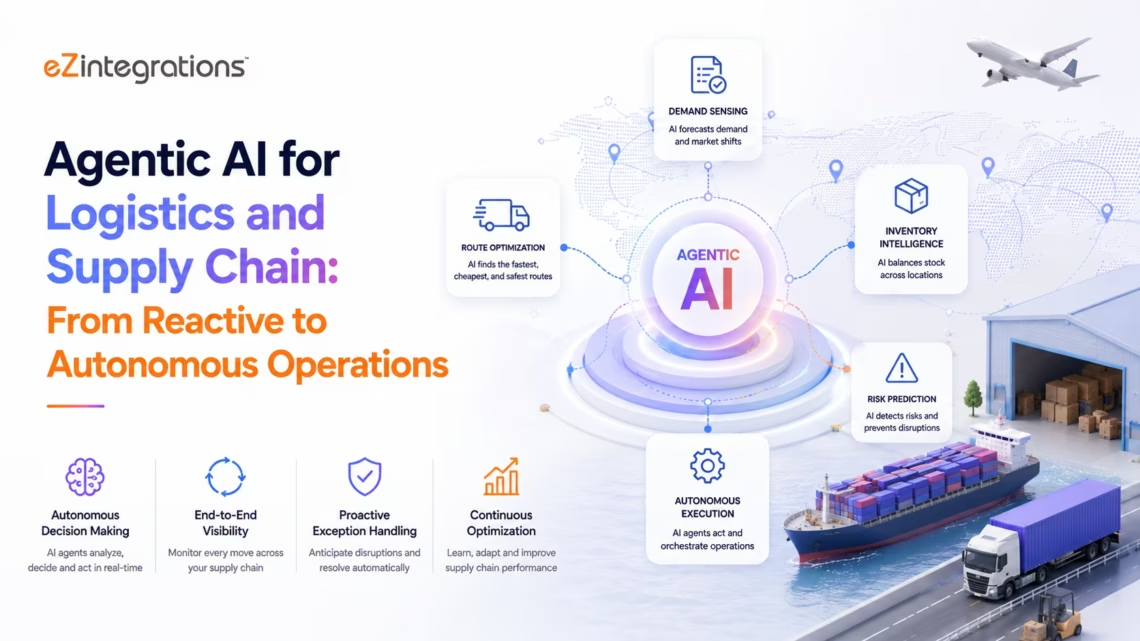
Agentic AI for Logistics & Supply Chain: From Reactive to Autonomous Operations
June 7, 2026Agentic AI for logistics deploys Goldfinch AI coFordinator-worker architecture to shift supply chain operations from reactive to autonomous: a coordinator agent monitors the full logistics network continuously, dispatches specialist worker agents to carrier APIs, TMS platforms, WMS systems, ERP, and supplier portals simultaneously when disruptions occur, synthesises the network-wide impact, and either executes pre-authorised recovery actions autonomously or delivers a recovery brief with options ranked by cost and service level impact, before the disruption reaches the customer.
TL;DR:
- Reactive logistics operations are defined by discovery lag: the shipment that failed is discovered when the customer calls, the supplier that is behind schedule is discovered when the production line stops, the 3PL network that is over-capacity in one region and under-utilised in another is discovered in the monthly operations review. The data to detect these conditions earlier exists in the connected supply chain system estate. The missing layer is the one that synthesises it continuously.
- Agentic AI (Level 4, Goldfinch AI) is that layer. Coordinator-worker architecture means one coordinator monitors the full logistics network, dispatches parallel worker agents to investigate simultaneously across all data sources when a signal fires, synthesises the network-wide picture, and acts or recommends, within minutes of a disruption’s origin, not hours or days after its consequences become visible.
- The distinction from Level 3 AI Agents: a single agent investigates one shipment exception. The Goldfinch AI coordinator responds to a port congestion event by simultaneously querying 47 in-transit shipments, all relevant carrier APIs, the WMS inventory position, and the ERP customer commitments, synthesising a ranked recovery plan that covers the entire affected shipment population, not just the one that was escalated.
- Five logistics agentic AI use cases where coordinator-worker architecture delivers capabilities single agents and workflows cannot: network-wide disruption response, dynamic multi-carrier optimisation, demand-supply synchronisation intelligence, multi-tier supplier risk synthesis, and autonomous freight audit and settlement.
- Goldfinch AI connects to TMS platforms (Blue Yonder, Oracle TMS), carrier APIs (FedEx, UPS, DHL), WMS (Manhattan Associates, Oracle WMS), ERP (SAP S/4HANA, NetSuite), EDI trading partners, and 3PL portals with Chat UI for logistics and supply chain leadership queries and Workflow Node for automated network intelligence programmes.
The Problem: Reactive Logistics Costs More Than the Disruption Itself
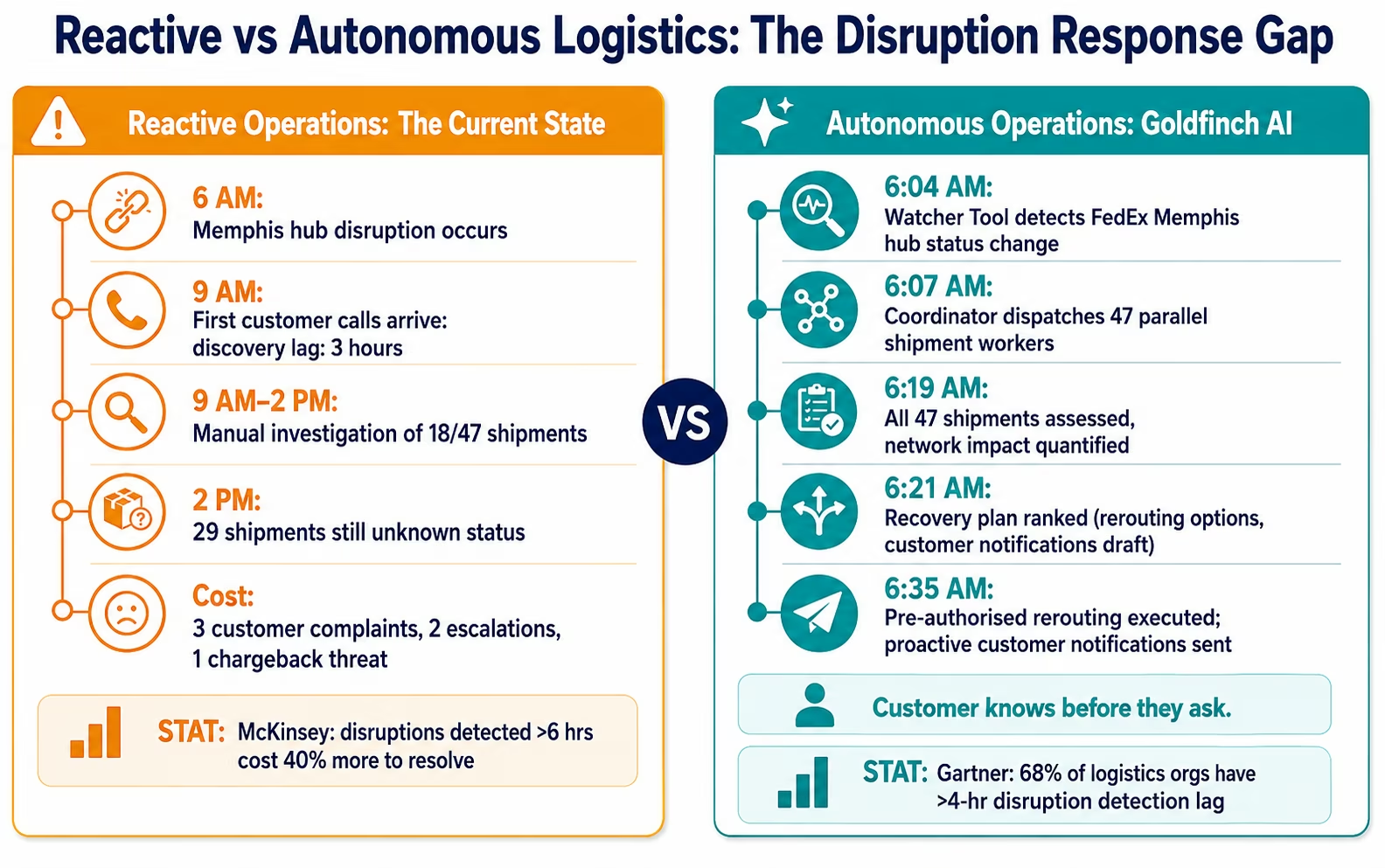
It is Tuesday at 6 AM. A severe weather event has disrupted a major logistics hub in Memphis. Forty-seven of your in-transit shipments were routed through that hub. Your logistics coordinator discovers this at 9 AM when three customer service calls arrive from customers whose deliveries were expected today.
What happens next is reactive logistics: the coordinator opens the TMS, searches for shipments routed through Memphis, finds 11 of the 47 (the search interface requires individual order lookups), begins calling FedEx for status updates on each, discovers that the carrier has an automated delay notification system that has already reclassified the estimated delivery dates but not informed your TMS, and begins the manual process of notifying customers and exploring alternative routing options.
By 2 PM, the coordinator has investigated 18 of the 47 shipments. The remaining 29 are still unknown in status. Three customers have already posted negative reviews. Two have escalated to the account management team. One has threatened chargeback.
The disruption itself: a weather event at a carrier hub: is uncontrollable. The response to it is not. The 3-hour discovery lag, the manual one-by-one investigation, the incomplete picture at 2 PM, the customer communications that arrive after the customer calls rather than before, these are consequences of a logistics operation that responds to disruptions rather than detecting and acting on them.
According to McKinsey, logistics disruptions that are detected and responded to within 2 hours of origin cost an average of 40% less in total resolution cost (expediting fees, customer credits, chargeback costs, CS team time) than disruptions detected after 6 hours. Gartner estimates that 68% of logistics organisations still operate with detection lags exceeding 4 hours for carrier network disruptions affecting more than 10 shipments.
The cost of reactive logistics is not just the disruption. It is the compounding cost of the response delay.
Agentic AI vs AI Agents vs Workflow Automation: The Logistics Distinction
All three levels of the eZintegrations architecture address different logistics problem classes. Deploying the wrong level for the problem class creates either under-capability (trying to handle a network-wide disruption with a single-shipment agent) or over-engineering (using coordinator-worker architecture for a simple order-to-WMS routing event).
Workflow Automation (Level 1-2): deterministic data flows for high-volume, predictable events. Order received on Shopify fires a webhook → WMS receives the pick order → inventory broadcast updates all sales channels → carrier label generated automatically. EDI 940 to 3PL fires when a production run completes. These are the 80-85% of logistics operations that follow known patterns. Level 1-2 handles them reliably, at scale, without human involvement.
AI Agents (Level 3): single-agent investigation of bounded exceptions. The shipment exception agent investigates why SHP-4421 has not moved in 48 hours: querying the carrier API, TMS, WMS, and customs in the sequence the findings indicate. The 3PL billing audit agent processes a 200-line billing statement against WMS records. One agent, one exception, bounded scope.
Agentic AI: Goldfinch AI (Level 4): coordinator-worker architecture for network-wide intelligence and response. When Memphis goes down, the coordinator does not investigate one shipment. It dispatches 47 parallel worker agents: one per affected shipment: simultaneously, synthesises the network-wide impact picture, and delivers (or executes) a recovery plan that addresses all 47. This is the capability class that transforms reactive logistics into autonomous logistics.
| Logistics Problem | Right Level | Why |
|---|---|---|
| Order → WMS pick order in 30 seconds | Level 2 Workflow | Deterministic event, predefined path |
| Inventory broadcast to all channels | Level 2 Workflow | Same update, all channels, WMS trigger |
| Why has THIS shipment not moved in 48 hrs? | Level 3 AI Agent | One shipment, bounded investigation |
| Memphis hub down: 47 shipments affected | Level 4 Goldfinch AI | 47 parallel investigations + synthesis + recovery |
| 3PL billing audit for THIS invoice | Level 3 AI Agent | One invoice, bounded reconciliation |
| Monthly freight cost optimisation across 12 carriers | Level 4 Goldfinch AI | 12 parallel carrier analyses + synthesis |
| Reorder when safety stock breached (one SKU) | Level 2 Workflow | Predefined trigger, predefined action |
| Demand-supply synchronisation across 50 supplier relationships | Level 4 Goldfinch AI | 50 parallel supplier assessments + synthesis |
| Single carrier performance audit | Level 3 AI Agent | One carrier, bounded analysis |
| Multi-carrier network optimisation | Level 4 Goldfinch AI | All carriers parallel, synthesis required |
The three levels are complementary and sequential within the same platform. Level 2 handles the routine. Level 3 handles the bounded exceptions that routines generate. Level 4 handles the network-wide intelligence that no single agent or workflow can produce.
Before vs After: Agentic AI for Logistics and Supply Chain
| Logistics Challenge | Before Agentic AI | After Goldfinch AI | Impact |
|---|---|---|---|
| Network disruption detection | Customer calls reveal disruption 3-6 hrs after origin | Watcher Tool detects within minutes; coordinator dispatches all affected shipment workers | Detection lag: hours → minutes |
| 47-shipment disruption response | Manual one-by-one investigation (18-29 hrs with current staffing) | 47 parallel workers, synthesised recovery plan in 25-35 minutes | 25-35 min vs 18-29 hrs |
| Multi-carrier freight optimisation | Monthly manual carrier performance review, rate shopping as needed | Coordinator assesses all carriers weekly, delivers ranked optimisation recommendations | Weekly vs monthly, continuous vs episodic |
| Demand-supply synchronisation (50 suppliers) | Weekly planning cycle, 2-3 day planning team assembly | Coordinator dispatches 50 parallel supplier workers, synthesises gap and surplus positions | Hours vs days |
| Multi-tier supplier risk | First-tier visibility only; sub-tier risk invisible until disruption surfaces | Coordinator synthesises first-, second-, and third-tier risk from all accessible data sources | Proactive risk vs reactive discovery |
| 3PL performance intelligence | Monthly operational review, data assembled 3-5 days after period close | Goldfinch AI Workflow Node delivers weekly 3PL performance brief automatically | Weekly automated vs monthly manual |
| Freight invoice settlement | Finance team reconciles freight invoices manually (4-6 hrs/carrier/month) | Coordinator dispatches parallel workers per carrier, synthesises freight audit in 45-60 min | 4-6 hrs/carrier → 45-60 min total fleet |
| Customer delivery risk assessment | CS team reacts to customer complaints | Goldfinch AI proactively identifies at-risk deliveries and drafts customer notifications | Proactive vs reactive |
| Cross-border compliance synthesis | Compliance team checks each shipment manually | Coordinator synthesises compliance risk across all active cross-border shipments | Continuous vs sampling |
| Supply chain leadership intelligence | Monthly supply chain report (3-5 days assembly) | Chat UI delivers live supply chain performance on demand; Workflow Node delivers weekly brief | On-demand vs monthly lagging |
How Goldfinch AI Connects the Logistics Network
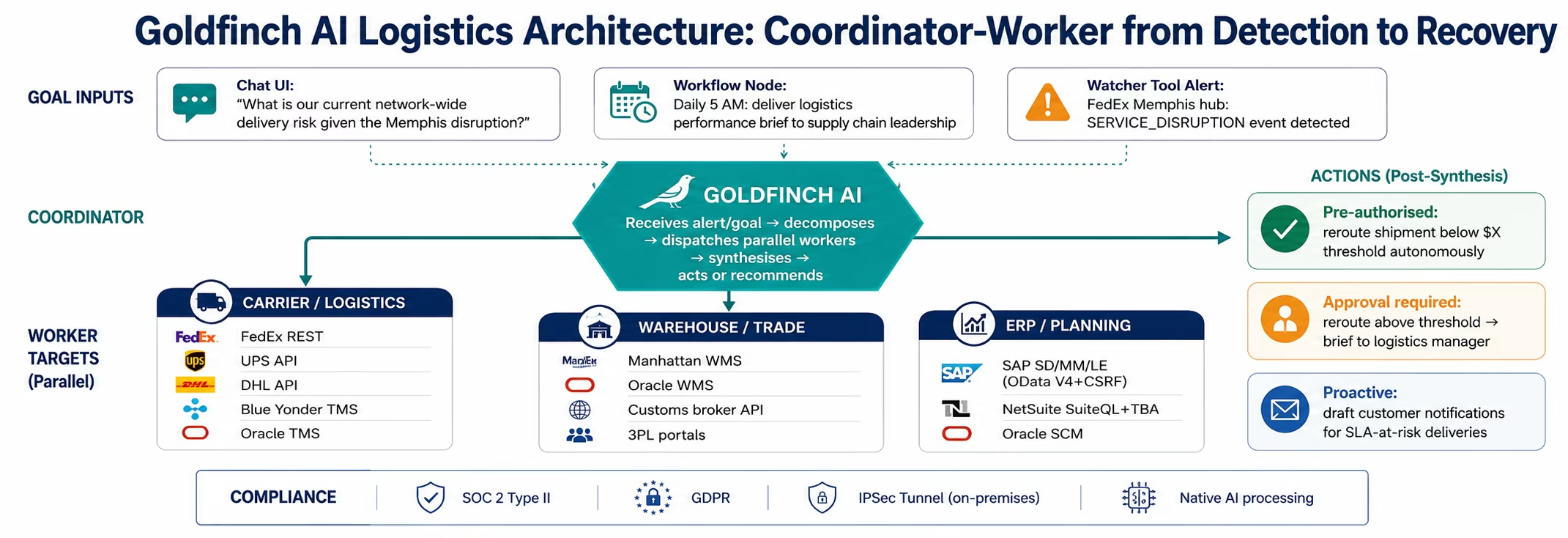
Goldfinch AI of eZintegrations uses 9 native enterprise tools to operate across the full logistics technology stack: connecting carrier APIs, TMS, WMS, ERP, EDI trading partners, and supplier portals in a coordinator-worker architecture that scales from single-shipment investigation to network-wide disruption response.
The coordinator-worker model for logistics:
The coordinator receives goals from the Chat UI (logistics leadership natural language queries) or the Workflow Node (automated network intelligence programmes). It decomposes each goal into parallel investigative tasks: one worker per shipment for disruption response, one worker per carrier for optimisation, one worker per supplier for risk synthesis: and dispatches all workers simultaneously. Workers execute their investigations using their assigned tools and return structured findings to the coordinator, which synthesises them into coherent logistics intelligence.
System connectors:
TMS platforms: Blue Yonder (JDA) TMS: REST API for shipment management, carrier performance, freight audit. Oracle TMS: REST API with assertion grant OAuth. MercuryGate: REST API. Shipment status, carrier commitments, freight cost data, and load planning information.
Carrier APIs: FedEx REST API (Ship, Track, Freight, Rate): real-time tracking, hub status, service disruption notifications. UPS Developer API (Tracking, Rating, Address Validation, Freight). DHL Express API (Track, Ship, Quote, Service Point Locator). USPS Web Tools API. Regional carrier REST APIs for the carrier mix relevant to each customer’s network.
WMS platforms: Manhattan Associates WMS: REST API for inventory queries, task management, outbound processing, inbound receiving. Oracle WMS: REST API. Blue Yonder WMS: REST API. Warehouse task status, inventory positions, capacity utilisation, and dock scheduling.
ERP systems: SAP S/4HANA (OData V4 with CSRF): SD (sales and distribution), MM (materials management), LE (logistics execution). NetSuite SuiteQL with Token-Based Authentication, item fulfilment, inventory, purchase orders. Oracle SCM Cloud: REST with assertion grant OAuth.
EDI connectivity: EDI 850 (Purchase Order), EDI 856 (Advance Ship Notice), EDI 940 (Warehouse Shipping Order), EDI 945 (Warehouse Shipping Advice), EDI 210 (Freight Invoice), EDI 214 (Transportation Carrier Shipment Status) for carrier status updates, EDI 997 (Functional Acknowledgement).
3PL portals: REST API connectivity to major 3PL partners and managed logistics platforms (ShipBob, ShipHero, XPO, Coyote, Echo Global) for capacity, rate, and performance data.
Customs and trade compliance: Customs broker API for import entry status, classification data, duty calculation, and compliance document retrieval.
9 native Goldfinch AI tools for logistics intelligence:
- Knowledge Base Vector Search: carrier service agreements, 3PL rate cards, trade compliance procedures, supplier SLA definitions, customer delivery commitment schedules, and disruption recovery playbooks
- Document Intelligence: carrier bills of lading, commercial invoices, packing lists, customs documentation, freight invoices, and supplier certificates of origin
- Data Analysis: carrier performance trend analysis, freight cost benchmarking, demand-supply gap calculations, supplier delivery performance scoring, and shipment risk probability modelling
- Data Analytics with Charts/Graphs/Dashboards: carrier performance dashboards, supply chain risk matrices, freight cost trend visualisations, and network utilisation heat maps embedded in intelligence briefs
- Web Crawling: port congestion reports, carrier network disruption alerts, weather event tracking, geopolitical risk signals, and commodity pricing affecting freight costs
- Watcher Tools: shipment SLA countdown monitoring, carrier hub status alerts, supplier acknowledgement deadlines, inventory threshold alerts, and network disruption signal detection
- API Tool Call: all logistics system connections above
- Integration Workflow as Tool: trigger existing Level 2 workflows (order dispatch, carrier label generation, EDI transmission) as part of agentic resolution actions
- Integration Flow as MCP: expose logistics integration capabilities via MCP for external AI tool consumption
Users extend the tool registry beyond these 9 as self-service.
Compliance: SOC 2 Type II certified. GDPR compliant for EU trade partner and customer data. All Goldfinch AI processing natively within eZintegrations, no shipment data, customer information, or trade compliance records sent to external AI providers. IPSec Tunnel for on-premises TMS, WMS, or ERP deployments behind corporate firewalls.
Use Case 1: Network-Wide Disruption Response Agent
The capability gap: when a carrier network disruption occurs: a hub delay, a port congestion event, a weather-related lane closure: the logistics team’s response speed is limited by their ability to identify all affected shipments simultaneously. Manual investigation is serial: one shipment at a time, one carrier portal at a time. The 47-shipment problem that takes 18-29 hours manually is the same problem the coordinator-worker architecture solves in 25-35 minutes.
The Goldfinch AI solution: the Network-Wide Disruption Response Agent combines continuous Watcher Tool monitoring of carrier network status with a coordinator-worker response capability that, when a disruption signal fires, immediately assesses the full affected shipment population, synthesises the network impact, and executes or recommends the recovery plan.
The Watcher Tool Detection Phase
The Watcher Tool continuously monitors:
- FedEx, UPS, and DHL service disruption notification feeds (REST API polling every 5-10 minutes)
- Port authority congestion status APIs for the company’s primary import/export ports
- Weather event feeds correlated with active carrier lane routing
- EDI 214 (Transportation Carrier Shipment Status) messages from carriers for in-transit shipment status anomalies
When a disruption signal is detected (FedEx Memphis hub status transitions to SERVICE_DISRUPTION), the Watcher Tool immediately triggers the coordinator.
The Coordinator-Worker Response
Coordinator receives trigger: “FedEx Memphis hub SERVICE_DISRUPTION event detected at 06:04. Assess all active shipments routed through this hub. Quantify customer impact. Develop recovery options.”
Step 1: Shipment identification (API Tool Call to TMS): the coordinator queries the TMS for all active in-transit shipments currently routed through Memphis hub. Result: 47 shipments identified.
Step 2: 47 parallel shipment worker agents dispatched:
Each shipment worker simultaneously:
Carrier API query: queries the FedEx tracking API for the current status of this shipment: last scan location, current ETA, any delay notification.
TMS query: retrieves the shipment’s routing plan, original committed delivery date, and the customer’s SLA tier.
ERP/customer commitment query: retrieves the customer’s order delivery commitment and any outstanding SLA penalty clauses for late delivery.
Alternative routing assessment (Knowledge Base): queries the routing alternatives for this shipment’s origin-destination pair: which carriers serve this lane, what are their current service disruption statuses, what is the incremental cost of each alternative.
Step 3: Coordinator synthesis (all 47 workers return findings in parallel, typically 10-14 minutes):
The coordinator categorises all 47 shipments:
- Category A: On-track despite Memphis disruption (12 shipments): already cleared Memphis before the disruption; ETA unchanged. No action required.
- Category B: Delayed, within SLA buffer (18 shipments): Memphis-held but current revised ETA is within the customer’s SLA tolerance. Monitor; prepare customer notification if ETA deteriorates further.
- Category C: At SLA risk, recoverable (11 shipments): Memphis-held, revised ETA exceeds committed delivery date by 1-2 days. Alternative routing available via UPS Chicago or DHL Cincinnati with 1-day transit premium. Recovery cost: $2,100-3,800 per shipment depending on weight/lane.
- Category D: Critical, Tier 1 customers at SLA breach (6 shipments): Tier 1 customers with committed SLA. Immediate recovery action required. Alternative routing available for 5 of 6; one requires expedited air freight.
Step 4: Recovery action recommendations (pre-staged for logistics manager approval or autonomous execution per policy):
- Category A: close: no action
- Category B: draft proactive delay notification for customer (ready for approval-and-send)
- Category C: reroute via UPS Chicago (if estimated recovery cost below pre-authorised threshold for this customer tier autonomous; above threshold: staged for approval)
- Category D: immediate reroute, executive escalation notification, proactive customer outreach by account management
Total time from Watcher Tool trigger to recovery recommendations: 25-35 minutes. The logistics coordinator receives a complete 47-shipment recovery brief before the first customer call arrives.
Use Case 2: Dynamic Multi-Carrier Optimisation Agent
The capability gap: most logistics organisations make carrier allocation decisions based on contracted rates and historical performance data reviewed monthly or quarterly. The actual optimisation opportunity: which carrier is currently performing best on which lane, which is currently over-capacity and likely to miss SLAs, which has reduced rates available due to capacity availability: changes weekly. Monthly reviews miss these signals entirely.
The Goldfinch AI solution: the Dynamic Multi-Carrier Optimisation Agent runs on the Workflow Node weekly, dispatching parallel worker agents to all active carriers simultaneously, synthesising current performance, capacity, and rate data into a ranked carrier allocation recommendation for the week ahead.
The Coordinator-Worker Carrier Assessment
Weekly Workflow Node (Friday at 4 PM: ready for Monday planning):
Coordinator dispatches one worker per carrier (12 carriers in this example, all running in parallel):
Each carrier worker queries:
TMS performance data: on-time delivery rate for this carrier for the past 30 days, by lane and service level.
Carrier API (REST): current service disruption status, capacity constraints by lane, any communicated rate changes or surcharges effective next week.
Freight invoice data (EDI 210 + Data Analysis): actual freight cost vs contracted rate for the past 30 days, identifying any systematic overbilling or unauthorised surcharges.
Knowledge Base: carrier contract: contracted rates per lane, volume commitment status, penalty clauses for service failures, and rate negotiation leverage points.
Coordinator synthesis: weekly carrier optimisation brief:
The coordinator synthesises all 12 carrier assessments into a ranked carrier allocation recommendation:
- Carriers ranked by composite score: on-time rate, capacity availability, current effective cost per lane, contract compliance
- Lane-specific recommendations: for each major lane in the shipping network, which carrier is currently the optimal choice for standard, expedited, and freight shipments
- Cost optimisation opportunities: carriers showing excess capacity on specific lanes this week (lower effective rates available) vs carriers showing capacity constraints (avoid for new bookings)
- Compliance flags: carriers with systematic invoice overbilling patterns flagged for immediate dispute
The result: carrier allocation decisions for the week are based on current data assembled in 45-60 minutes of automated Goldfinch AI processing, not on last month’s report. Freight cost optimisation improvements of 5-12% are typical within 90 days of continuous weekly carrier assessment as the organisation responds to weekly intelligence rather than monthly lagging data.
Use Case 3: Demand-Supply Synchronisation Intelligence
The capability gap: Demand-supply synchronisation across a 50-supplier network requires maintaining a current view of: what is on order from each supplier, what has been confirmed for delivery and when, what is in transit and at what stage, and how current inventory positions compare against the demand signal for each SKU. At 50 suppliers and hundreds of SKUs, maintaining this current view manually is a weekly planning team exercise that takes 2-3 days and is always at least partially out of date by the time the plan is executed.
The Goldfinch AI solution: the Demand-Supply Synchronisation Agent runs on the Workflow Node weekly (and is available via Chat UI on demand), dispatching 50 parallel supplier worker agents simultaneously to build a current supply-demand picture, and synthesising the network-wide gap and surplus positions into an actionable procurement intelligence brief.
The 50-Supplier Parallel Assessment
Weekly Workflow Node trigger: “Generate current demand-supply synchronisation intelligence for all 50 strategic suppliers. Include: open PO confirmation status, in-transit inventory by SKU, demand signal vs supply position gap analysis, and recommended procurement actions.”
50 parallel supplier workers dispatched simultaneously:
Each supplier worker queries:
ERP (SAP MM or NetSuite): open purchase orders for this supplier: quantities, confirmed delivery dates, unconfirmed PO lines, any recent revision requests.
TMS/carrier (API Tool Call): in-transit shipments from this supplier: current status, ETA, quantity.
Supplier portal (if API accessible) or EDI 856 (ASN): the supplier’s advance ship notice for any shipments not yet captured in TMS.
Demand signal (ERP + sales channel APIs): for each SKU supplied by this supplier, the current demand signal (actual orders + forecast for the next 12 weeks), the current inventory position (on-hand + in-transit), and the resulting days-of-supply coverage.
Coordinator synthesis: demand-supply gap brief:
The coordinator synthesises all 50 supplier assessments into a ranked demand-supply intelligence brief:
Supply shortfall alerts (suppliers where demand exceeds confirmed supply):
- Supplier X: API for Product A: demand signal shows 6,200 units required in weeks 3-4. Current confirmed supply: 4,800 units. Gap: 1,400 units. Days-of-supply risk: stockout projected at day 22. Recommended action: contact Supplier X for expedited delivery or alternative sourcing.
- Supplier Y: packaging material for Product B: 18% below confirmed delivery schedule. At current trajectory, production stop risk on day 17.
Recommended: dual-source emergency order from Supplier Z (secondary source, higher cost by 8%).
Supply surplus positions (suppliers where confirmed supply exceeds current demand):
- Supplier M: raw material batch confirmed for delivery week 2, but demand signal for this material has dropped 23% since the PO was placed. Excess delivery would require 12 weeks of additional storage.
Recommended: negotiate partial PO deferral.
Data Analytics output: demand-supply gap matrix (all 50 suppliers, colour-coded by risk status: green/amber/red), with trend charts for the top 10 highest-risk supply positions.
Chat UI availability: the VP of Supply Chain can query live “Which suppliers have the highest stockout risk in the next 30 days?”: answered by the coordinator in under 60 seconds from current data, dispatching parallel workers to the top-risk suppliers identified by the most recent Workflow Node run.
![50-supplier demand-supply synchronisation showing Goldfinch AI coordinator dispatching 50 parallel worker agents simultaneously to ERP, TMS, supplier portals, and sales channels: with the coordinator synthesising a demand-supply gap matrix showing supply shortfall alerts, surplus positions, and recommended procurement actions ranked by risk | Goldfinch AI demand-supply synchronisation: 50 suppliers, parallel assessment, risk-ranked brief]](https://ezintegrations.ai/wp-content/uploads/2026/05/12-2.avif "Agentic AI for Logistics & Supply Chain: From Reactive to Autonomous Operations")
Use Case 4: Multi-Tier Supplier Risk Synthesis Agent
The capability gap: most supply chain risk programmes have first-tier visibility: they know the direct suppliers, their performance, their qualification status. Sub-tier risk (the suppliers of your suppliers, and their suppliers) is largely invisible until a disruption in a second- or third-tier supplier surfaces as a supply shortage at your dock. By then, the disruption has already cascaded.
Second-tier supplier risk intelligence requires: knowing which second-tier suppliers your first-tier suppliers depend on, monitoring those second-tier suppliers for risk signals (financial distress, quality events, capacity constraints, geopolitical exposure), and synthesising the risk intelligence across the full multi-tier network.
The Goldfinch AI solution: the Multi-Tier Supplier Risk Synthesis Agent combines structured first-tier data (from ERP and supplier portals) with intelligence from Web Crawling and external risk databases to build a continuously updated multi-tier risk picture.
The Multi-Tier Risk Intelligence Programme
Weekly Workflow Node (Monday morning):
First-tier worker agents (one per strategic supplier: 50 workers):
Each queries:
- Supplier qualification status and performance from the ERP and quality management system
- Recent supply performance and any open quality notifications
- Any communicated constraints or capacity changes via supplier portal or EDI
Second-tier intelligence workers (Web Crawling + Knowledge Base):
For each first-tier supplier, the coordinator dispatches a sub-tier intelligence worker that:
- Queries the Knowledge Base for the documented sub-tier supply chain for this supplier (maintained as part of supplier qualification records or business continuity documentation)
- Uses Web Crawling to retrieve recent news about the identified second-tier suppliers: financial filings, production disruption news, regulatory actions, natural disaster exposure
- Queries any available external risk databases for second-tier supplier credit and operational risk scores
Coordinator synthesis: multi-tier risk brief:
The coordinator synthesises first-tier and second-tier findings into a risk brief ranked by supply impact:
- Tier 1 alert: First-Tier Supplier A is sole-sourced from Second-Tier Supplier X (documented in BCP records). Second-tier Web Crawl identified: Supplier X’s primary production facility is in a region under flood warning this week. First-tier Supplier A’s next confirmed delivery represents 60% of your production requirement for Product Z. Risk: high.
Recommended: contact Supplier A to confirm their continuity plan, assess alternative first-tier sourcing options. - Tier 2 monitor: First-Tier Supplier B sources API from Second-Tier Supplier Y. Recent news indicates Second-Tier Supplier Y has received an FDA warning letter for a GMP deficiency. First-tier Supplier B’s current stock of this API is 6 weeks of supply. Risk: emerging. Recommended: monitor Second-Tier Supplier Y’s remediation timeline, initiate qualification of alternative second-tier source.
The result: the supply chain risk team has a current, multi-tier risk brief delivered every Monday morning: without manually tracking second-tier suppliers through news feeds and procurement contacts. Disruptions that previously surfaced as dock-level supply shortages are identified at their origin, weeks before the cascade reaches production.
Use Case 5: Autonomous Freight Audit and Settlement Agent
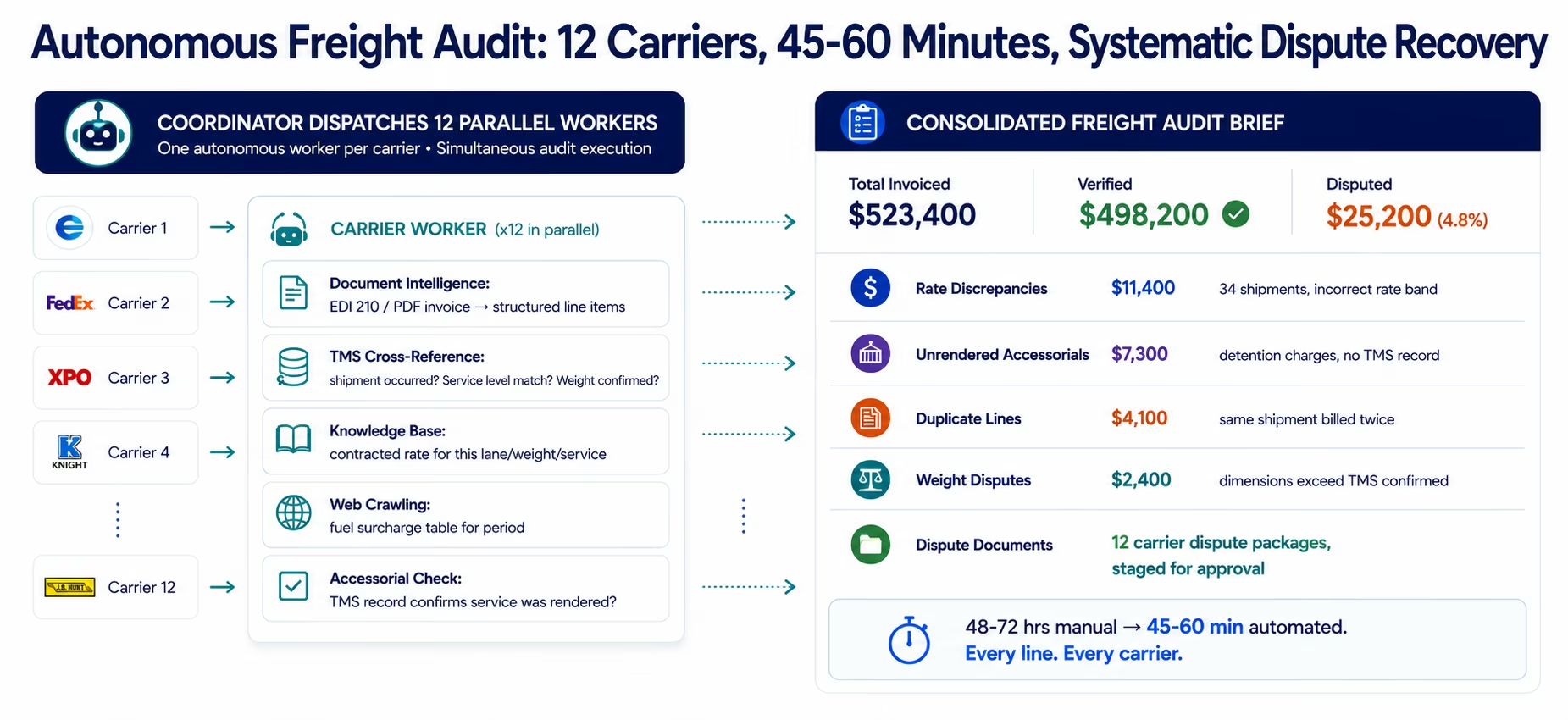
The capability gap: freight invoice reconciliation is one of the highest-volume, most systematic, and most error-prone financial processes in logistics operations. A company shipping 2,000 loads per month across 12 carriers receives 12 freight invoices containing thousands of line items. Reconciling each invoice against contracted rates, confirmed shipment records, and fuel surcharge schedules takes 4-6 hours per carrier per month, 48-72 hours of finance and operations team time per month.
Industry data consistently shows that 3-8% of freight invoice charges contain billing errors: typically from incorrect rate application, duplicate line items, or accessorial charges for services not rendered. At $500K/month in freight spend, that is $15,000-40,000 per month in potentially recoverable billing errors.
The Goldfinch AI solution: the Autonomous Freight Audit and Settlement Agent runs on the Workflow Node monthly (or triggered by invoice receipt), dispatching parallel worker agents per carrier, synthesising a comprehensive freight audit across all carriers in 45-60 minutes.
The Parallel Freight Audit
Monthly Workflow Node trigger (or invoice receipt webhook): “Audit all freight invoices received this month. Cross-reference against contracted rates, confirmed shipment records, and fuel surcharge schedules. Identify discrepancies and stage dispute documents.”
12 parallel carrier worker agents dispatched:
Each carrier worker executes:
Document Intelligence: the freight invoice (EDI 210 or PDF) is processed: every charge line extracted as structured data: shipment ID, origin, destination, service level, base rate, fuel surcharge, accessorial charges, and total.
TMS shipment record cross-reference: for each invoice line, the worker queries the TMS for the confirmed shipment record: verifying that the shipment occurred, the service level matches, and the weight/dimensions match the billed specifications.
Contract rate validation (Knowledge Base): the carrier’s contracted rate card (rates by lane, weight break, service level, and effective date) is retrieved from the Knowledge Base. The billed rate is compared against the contracted rate.
Fuel surcharge validation: the applicable fuel surcharge percentage for the invoice period is retrieved from the carrier’s published fuel surcharge schedule (Web Crawling of carrier fuel surcharge tables) and compared against the billed surcharge.
Accessorial charge validation: each accessorial charge (liftgate, residential delivery, detention, address correction) is cross-referenced against the TMS record for that shipment to confirm the accessorial service was actually required and performed.
Coordinator synthesis: freight audit brief:
The coordinator synthesises all 12 carrier audits into a consolidated freight audit report:
- Total freight invoiced: $523,400
- Verified charges: $498,200
- Disputed charges: $25,200 (4.8% of total invoiced)
- Rate discrepancies: $11,400 (incorrect rate applied on 34 shipments)
- Accessorial charges not rendered: $7,300 (detention charges with no TMS record)
- Duplicate line items: $4,100 (same shipment billed twice across the monthly invoice)
- Weight/dimension disputes: $2,400 (billed dimensions exceed TMS confirmed dimensions)
Dispute documents: for each disputed carrier, a structured dispute document is assembled: the specific invoice lines disputed, the TMS evidence supporting the dispute, the contracted rate that should have applied, and the amount to be credited.
Settlement routing: dispute documents staged for logistics finance team approval before submission to carriers. For carriers with pre-authorised automatic dispute submission (configured in the autonomous action policy), the dispute is submitted directly.
Total audit time across 12 carriers: 45-60 minutes. Previous manual audit: 48-72 hours across the finance and operations team. Monthly freight dispute recovery: typically $15,000-40,000 depending on freight spend volume.
Key Outcomes and Results
Logistics and supply chain organisations deploying Goldfinch AI agentic intelligence with eZintegrations report the following within 90-120 days:
Disruption Response:
- Network disruption detection lag: 3-6 hours (reactive) → under 10 minutes (Watcher Tool continuous monitoring)
- 47-shipment disruption response: 18-29 hours (manual, serial) → 25-35 minutes (47 parallel workers)
- Customer SLA breach incidents from carrier disruptions: reduce 35-50% as proactive recovery replaces reactive response
- Logistics coordinator time on disruption investigation: reduces 60-70%
Carrier Optimisation:
- Carrier allocation decision frequency: monthly → weekly (automated Workflow Node)
- Freight cost reduction from continuous carrier optimisation: 5-12% within 90 days
- Carrier invoice dispute recovery rate: increases significantly as systematic per-line audit replaces sampling
Supply Planning:
- Demand-supply synchronisation cycle: 2-3 day weekly planning exercise → 45-60 minutes automated
- Supply shortfall detection lead time: improves 1-2 weeks as weekly intelligence replaces manual assembly
- Procurement emergency expediting incidents: reduce 30-40% as shortfalls are identified before they become production stops
Supplier Risk:
- First-tier-only visibility → multi-tier visibility: second- and third-tier risk signals surfaced weeks before cascade
- Supplier disruption discovery lead time: improves by 2-4 weeks on average
Freight Finance:
- Monthly freight audit time: 48-72 hours → 45-60 minutes total across all carriers
- Freight invoice dispute recovery: 3-8% of freight spend (industry average applicable to systematic audit)
- Finance team time on freight reconciliation: reduces 85-90%
How to Get Started
Logistics agentic AI deployment builds on the same eZintegrations foundation as Level 2 workflow automation and Level 3 AI agents: the carrier connectors, TMS connections, and ERP integrations already configured for lower-level use cases are immediately available to the Goldfinch AI coordinator for worker agent dispatch.
Step 1: Book a logistics agentic AI demo with your supply chain and IT leadership
Goldfinch AI logistics intelligence is best evaluated against a real disruption scenario: showing the coordinator dispatching parallel shipment workers, the synthesised network recovery brief, and the Chat UI responding to a live supply chain query from your connected logistics stack. Book a Free demo logistics agentic AI and include your supply chain VP, logistics operations lead, and IT/integration architect.
Step 2: Connect your logistics stack
If eZintegrations is already deployed for Level 2 or Level 3 logistics automation, the Goldfinch AI coordinator inherits those connections. For new deployments, configure in priority order:
- TMS (Blue Yonder, Oracle TMS, or MercuryGate): REST API credentials: the coordinator’s primary source of shipment and carrier data (1-2 days)
- Carrier APIs (FedEx, UPS, DHL): API keys and account credentials: real-time tracking and status (4-8 hours each)
- ERP (SAP OData V4, NetSuite SuiteQL, Oracle REST): customer commitment and inventory data (2-4 hours)
- WMS (Manhattan Associates, Oracle WMS): inventory position and warehouse capacity (2-4 hours)
- EDI connections: trading partner IDs and interchange agreements for EDI 210, 214, 856, 940, 945 (1-3 days)
- Supplier portals: REST API credentials for priority suppliers with API access (varies)
Step 3: Configure coordinator goal templates and knowledge base
Load the knowledge base with the logistics intelligence that enables the coordinator to make carrier allocation and recovery decisions:
- Contracted carrier rates per lane, service level, and weight break (the freight rate card)
- Customer tier definitions and SLA commitments (which customers require what service level guarantees)
- Disruption recovery playbooks (for known disruption types: hub delay, port congestion, weather event: what the standard recovery options are and their cost parameters)
- Supplier sub-tier mapping (from business continuity plans or supplier qualification records: which second-tier suppliers each first-tier supplier depends on)
Takes 4-8 hours for initial deployment. Knowledge base quality directly determines the quality of recovery recommendations.
Step 4: Deploy the Network Disruption Response Watcher Tool
Configure the Watcher Tool to monitor the carrier disruption signals relevant to your network:
- FedEx, UPS, DHL service disruption API endpoints (configure polling interval: 5-10 minutes)
- Port authority congestion feeds for your primary import/export ports
- Weather event correlation with active carrier lanes
Test the detection and response by simulating a historical disruption event against live connected data.
Step 5: Deploy Workflow Node intelligence programmes
Configure the first automated Goldfinch AI intelligence programme. Recommended starting points by operational priority:
- Highest immediate ROI: Weekly freight audit (Workflow Node monthly: recovers 3-8% of freight spend)
- Highest operational value: Weekly demand-supply synchronisation (Workflow Node weekly: reduces procurement firefighting)
- Executive value: Weekly supply chain performance brief (Workflow Node weekly: Chat UI for leadership queries)
Frequently Asked Questions
AI agents (Level 3) handle bounded, single-scope investigations such as one shipment exception, one 3PL billing audit, or one supplier performance review. Agentic AI (Level 4, Goldfinch AI) operates at network scale, where value comes from coordinating and synthesising multiple parallel investigations. For example, if a carrier hub disruption affects dozens of shipments, a single AI agent processes them sequentially, taking significantly longer. In contrast, a coordinator-worker architecture dispatches parallel worker agents simultaneously, synthesises their findings, and produces a network recovery plan within minutes. The defining difference is parallelism at scale, which enables autonomous logistics operations.
Goldfinch AI connects to the full logistics technology stack via eZintegrations connectors. This includes TMS platforms such as Blue Yonder, Oracle TMS, and MercuryGate; carrier APIs including FedEx, UPS, DHL, and USPS; WMS platforms like Manhattan Associates and Oracle WMS; ERP systems including SAP S/4HANA, NetSuite, and Oracle SCM Cloud; EDI standards such as 210, 214, 850, 856, 940, and 945; and 3PL portals via REST APIs and SFTP. For on-premises deployments behind firewalls, connections are secured through the eZintegrations IPSec Tunnel.
The Chat UI serves as a natural language interface to the Goldfinch AI coordinator, enabling logistics leaders to query the live network without needing to know underlying systems. A user can ask complex questions about delivery risk or customer exposure, and the coordinator dispatches multiple worker agents across TMS, carrier APIs, and ERP systems simultaneously. The results are synthesised into a structured response within seconds using live data. Each query generates an audit trail, and access is controlled based on user permissions to ensure data governance.
The coordinator-worker architecture enables large-scale parallel processing. The coordinator dispatches individual worker agents for each supplier, allowing all suppliers to be analysed simultaneously. Each worker gathers data from ERP, TMS, supplier portals, and demand signals. The coordinator then aggregates and ranks the results by risk severity. This parallel approach reduces processing time from what would take 10–15 hours sequentially to under an hour, transforming a multi-day planning process into an automated intelligence workflow.
Autonomous freight audit typically delivers positive ROI within the first month. Industry benchmarks indicate that 3–8% of freight invoices contain billing errors. For a company with $500K monthly freight spend, this represents $15,000–40,000 in recoverable costs. Goldfinch AI processes freight audits in under an hour compared to multiple days of manual effort, recovering both financial leakage and operational capacity. The time savings alone can free up thousands of dollars per month in team capacity, and combined with dispute recovery, the total monthly ROI often exceeds the platform cost. At higher freight volumes, the recovery potential scales proportionally.1. What is agentic AI for logistics and how does it differ from AI agents?
2. What logistics systems does Goldfinch AI connect to?
3. How does the Goldfinch AI Chat UI work for logistics and supply chain leadership?
4. How does the demand-supply synchronisation agent handle 50 suppliers simultaneously?
5. What is the typical ROI on autonomous freight audit with Goldfinch AI?
Conclusion: Reactive Logistics Is a Choice, Not a Constraint
The difference between a logistics operation that discovers the Memphis disruption at 9 AM when customers call and one that detects it at 6 AM, assesses all 47 affected shipments by 6:30 AM, and executes the recovery plan before the first customer would even have noticed the delay: is not different data. Both operations have access to FedEx’s service disruption feed. Both have a TMS with all 47 shipments recorded. Both have carrier APIs with real-time tracking.
The difference is the architecture that synthesises those data sources at the speed the disruption demands: the Watcher Tool that detects the signal, the coordinator that immediately dispatches 47 parallel workers, the synthesis logic that categorises the 47 shipments by impact and recovery option, and the autonomous action policy that executes the pre-authorised rerouting while flagging the cases that need human decision.
Reactive logistics is not a constraint of the available technology. It is a consequence of operating at Level 2 (predefined workflows) and Level 3 (one-at-a-time agent investigation) when the disruption is a Level 4 problem, requiring parallel investigation across the full affected shipment population, synthesised into a coherent recovery plan, executed within the window where recovery is still possible.
Goldfinch AI closes this gap. The coordinator-worker architecture that handles 47 shipments in 25-35 minutes also handles 50 supplier demand-supply positions in 45-60 minutes, 12 carrier freight invoices in 45-60 minutes, and multi-tier supplier risk synthesis in a weekly automated programme. All on the same platform as the Level 2 workflows and Level 3 agents already running in production.
Book a Free demo logistics agentic AI and bring your supply chain VP, logistics operations lead, and your most complex network disruption scenario. We will show you the coordinator dispatching parallel workers across your connected logistics stack and delivering the recovery brief in real time.