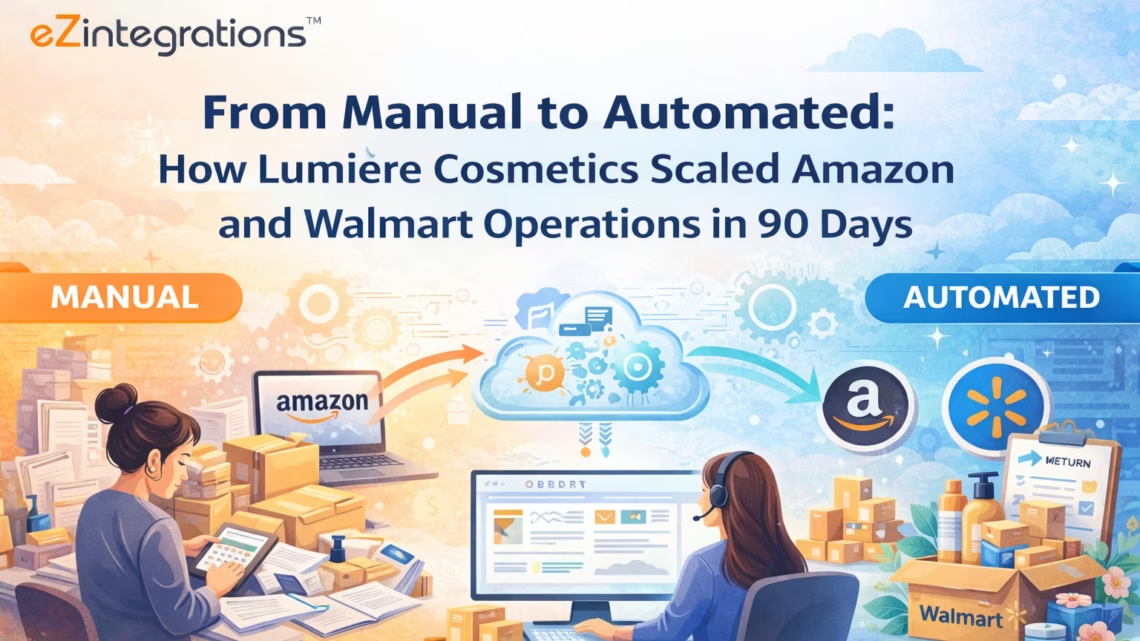
From Manual to Automated: How Lumière Cosmetics Scaled Amazon and Walmart Operations in 90 Days
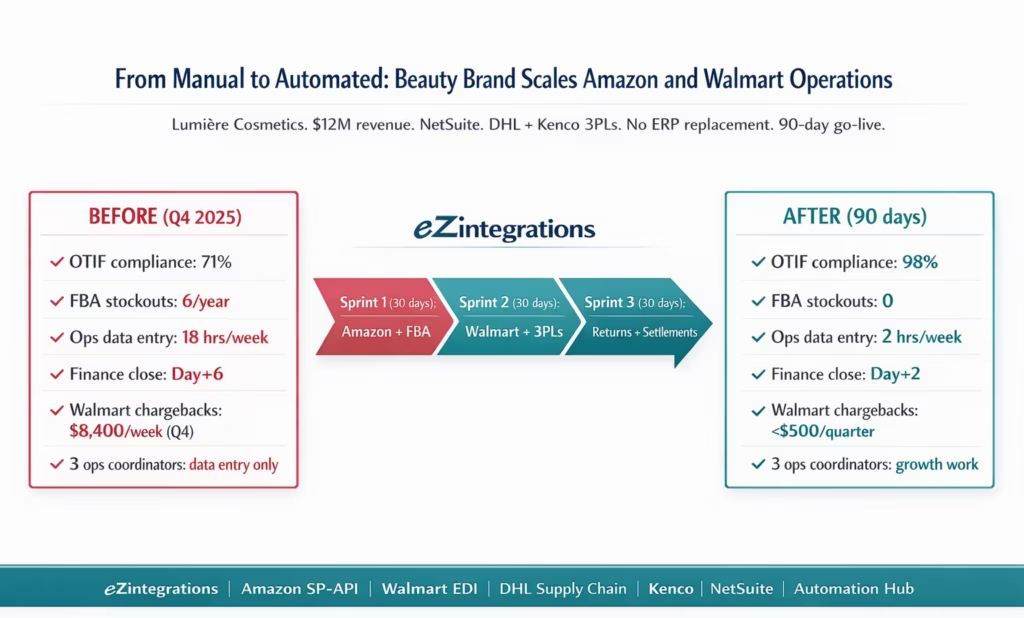
April 15, 2026A mid-size beauty brand (Lumière Cosmetics, $12M combined Amazon and Walmart revenue) automated its full eCommerce operations stack in 90 days using eZintegrations: Amazon SP-API order sync to NetSuite, Walmart EDI 850/856/810 compliance, DHL Supply Chain REST API for Walmart retail fulfilment, Kenco EDI 940/945 for Amazon DTC, Amazon FBA replenishment monitoring, and settlement reconciliation for both channels. The implementation was phased across three 30-day sprints with no downtime and no ERP replacement. Outcomes at 90 days: Walmart OTIF compliance from 71% to 98%, FBA stockout incidents from 6/year to 0, ops team data entry from 18 hours/week to 2 hours/week, and monthly finance close from Day+6 to Day+2.
TL;DR
- Lumière Cosmetics: $12M combined Amazon and Walmart revenue, 60 FBA ASINs, two 3PL partners (DHL Supply Chain for Walmart retail, Kenco Atlanta for Amazon DTC), NetSuite ERP. The brand was growing revenue but burning ops capacity on manual eCommerce data entry.
- Before eZintegrations: 18 hours per week of manual order entry and EDI processing, Walmart OTIF at 71%, 6 FBA stockout events in the prior 12 months, finance close consistently slipping to Day+6.
- 90-day phased implementation: 3 sprints of 30 days each. Sprint 1: Amazon order sync and FBA replenishment. Sprint 2: Walmart EDI and 3PL integration. Sprint 3: returns, settlements, and optimisation.
- No ERP replacement. NetSuite stayed. No custom ABAP (they do not use SAP, but the principle holds). No rip-and-replace. eZintegrations was added as the integration layer.
- Outcomes at 90 days: Walmart OTIF 98%, FBA stockouts eliminated, ops team hours on data entry dropped from 18 to 2 hours/week, finance close at Day+2.
- ROI at 6 months: 210,000inannualisedsavingsvs22,000/year implementation cost. Payback: 19 days after go-live.
The Starting Point: A Growing Beauty Brand Drowning in Manual Work
In Q3 2025, Lumière Cosmetics was growing. Amazon revenue was up 34% year-over-year. Walmart was their largest retail customer, accounting for 38% of total revenue. They had just signed DHL Supply Chain for Walmart retail fulfilment out of Memphis and kept Kenco Atlanta for their Amazon DTC channel.
The operations team had not grown to match the revenue. Three ops coordinators managed all eCommerce operations: Amazon order entry, Walmart EDI processing, 3PL coordination, inventory reconciliation, and settlement tracking. Their collective output looked like this every week:
- 18 hours of data entry and reconciliation (order entry to NetSuite, EDI 850 translation, Kenco portal updates, DHL inventory downloads, Amazon settlement parsing)
- Walmart OTIF compliance at 71%: The DHL Memphis 856 ASN was being generated manually, sometimes 4-6 hours after carrier scan. Walmart’s window is 30 minutes. Nearly every late ASN was an OTIF violation.
- 6 FBA stockout events in the prior 12 months, across 4 different ASINs. Two were over the Labour Day and Thanksgiving weekends. Nobody checked the reorder threshold when the office was closed.
- Finance close consistently at Day+6: the settlement reconciliation for Amazon (biweekly) and Walmart (monthly) was a 10-12 hour exercise spread across the last week of each month. The CFO had stopped asking for the close date because it was always “next week.”
The brand’s VP of Operations, Natalie, had a standing item on her weekly agenda: “eCommerce ops efficiency.” It had been there for 14 months.
The trigger was Q4 2025. Holiday season doubled the order volume. The ops team worked weekends in November. They still missed three 856 ASN windows during the week of Black Friday. Three OTIF violations. $8,400 in Walmart chargebacks from that week alone.
In December 2025, Lumière began evaluating eZintegrations.
The Decision: Why Lumière Did Not Replace Their ERP
When Natalie first looked at the problem, her IT director’s instinct was to replace NetSuite. “If we had a better ERP with native Amazon and Walmart connectors, this would all be solved.” Several ERP vendors pitched exactly this: their platform already had marketplace connectors, 3PL integrations, EDI modules.
The pitch was attractive. But the math was not.
A new ERP implementation for a 12Mbeautybrandisan18−24monthprojectwitha250,000-$600,000 implementation cost, significant disruption to financial reporting during transition, and no guarantee that the native connectors would be maintained when Amazon or Walmart updated their APIs.
Lumière’s NetSuite was working. Their order-to-cash process in NetSuite, their inventory valuation, their financial reporting: all solid. The problem was not NetSuite. The problem was that nobody had built the bridge between NetSuite and Amazon, Walmart, DHL, and Kenco. That bridge was eZintegrations.
The evaluation criteria Natalie used:
1. Does it require modifying NetSuite? No. eZintegrations connects to NetSuite via SuiteTalk REST (Token-Based Authentication). No changes to NetSuite’s configuration, no custom fields required for most flows.
2. Can it handle both Amazon SP-API (REST) and Walmart EDI (ANSI X12 over AS2) simultaneously? Yes. eZintegrations handles both protocols in the same platform.
3. What is the implementation timeline? 90 days for the full stack, phased. Versus 18-24 months for ERP replacement.
4. What happens if Amazon or Walmart changes their API? eZintegrations maintains the connectors. Lumière is not responsible for API updates.
5. What is the cost? 22,000/year(platform+implementation).Versus250,000+ for ERP replacement.
The decision was made in the first week of January 2026. Implementation began January 13, 2026.
The Implementation Philosophy: Phase, Don’t Rush
The biggest mistake Lumière could have made was trying to implement everything simultaneously. Natalie had seen that approach in a previous role: an over-ambitious integration project that tried to connect six systems at once, ran into configuration conflicts in week 8, and reset to the beginning.
The eZintegrations implementation team recommended a phased approach: three 30-day sprints, each with a clear scope, measurable outcome, and a validation gate before proceeding to the next sprint.
Sprint 1 (Days 1-30): The Amazon Stack Scope: Amazon SP-API order sync to NetSuite, ASIN-to-NetSuite item mapping, FBA inventory monitoring and replenishment alerts, Amazon FBM order routing to Kenco, and Kenco EDI 940/945 for DTC fulfilment. Validation gate: 500 Amazon orders processed through the automated flow with zero manual intervention and less than 1% error rate.
Sprint 2 (Days 31-60): The Walmart Stack Scope: Walmart EDI 850 receipt and NetSuite sales order creation, DHL Supply Chain REST API outbound order, DHL shipment event to NetSuite item fulfilment and Walmart EDI 856 ASN, inventory sync to EDI 846, and Walmart EDI 810 invoice with price validation. Validation gate: 3 full Walmart PO cycles (850 → 855 → shipment → 856 → 810) completed with zero OTIF violations and 856 transmitted within 15 minutes every time.
Sprint 3 (Days 61-90): Returns, Settlements, and Optimisation Scope: Amazon FBA and FBM returns automation, Walmart HighRadius settlement parsing and deduction GL posting, shortage dispute logic, seasonal replenishment adjustments, and performance monitoring dashboard. Validation gate: first automated Walmart settlement reconciliation completed in under 30 minutes with zero manual journal entries for standard deduction types.
Sprint 1 (Days 1-30): Amazon Order Sync and FBA Replenishment
Days 1-3: Setup and Credential Configuration
The first three days were administrative: setting up SP-API credentials (LWA Client ID and Secret, Seller ID, Marketplace ID), NetSuite TBA credentials (Account ID, Consumer Key and Secret, Token ID and Secret), Kenco AS2 EDI credentials (Kenco’s AS2 endpoint and certificate), and the eZintegrations account.
One surprise: Lumière’s ASIN-to-NetSuite item mapping table was more complex than expected. They had 60 FBA ASINs and 15 FBM ASINs, many of which were shade variants mapped to the same NetSuite configurable item. Building the complete mapping table took 1.5 days instead of the planned 0.5 days.
Lesson: for beauty brands with many shade variants, allow 2-3x more time for the ASIN mapping table than initially planned.
Days 4-10: Amazon Order Sync Template Imported and Configured
Template imported from the Automation Hub. Configuration:
- SP-API polling interval: 5 minutes
- Order status filter:
Unshipped - FBA filter:
FulfillmentChannel: AFN→ create NetSuite sales order withchannel: Amazon_FBAclass, no fulfilment routing - FBM filter:
FulfillmentChannel: MFN→ create NetSuite sales order withchannel: Amazon_FBMclass, route fulfilment request to Kenco - NetSuite customer for all Amazon orders:
AMAZON-USgeneric customer - ASIN-to-NetSuite item cross-reference: uploaded from the mapping table
First test on Day 7: 23 Amazon orders processed correctly. 2 FBM orders routed to Kenco correctly. 1 error: an ASIN that had been bundled since the mapping table was built (not in the table). Mapping table updated. Retest: clean.
Days 11-20: FBA Replenishment Monitoring
FBA inventory monitoring template imported. Configuration:
- SP-API
GET /fba/inventory/v1/summariespolling: every 45 minutes - Reorder threshold per ASIN: calculated from 30-day average velocity × 10-day lead time + safety stock. For Rose Gloss (22 units/day average): reorder at 329 units.
- On threshold breach: NetSuite Transfer Order created, Kenco prep instructions sent (FNSKU label, poly-bag per Amazon beauty category, FC destination from SP-API inbound shipment plan)
- Expiry check: only lots with 90+ days remaining eligible for FBA inbound
The first real reorder test: Rose Gloss afnFulfillableQuantity dropped below 329 units at 11:47 PM on a Thursday. NetSuite Transfer Order created automatically. Kenco prep instructions sent. FBA inbound shipment plan created via SP-API. All before anyone in the office the next morning.
Natalie’s reaction: “This is the Thursday night thing. This is exactly what caused the Labour Day stockout last year.”
Days 21-30: Kenco EDI 940/945 Validation
Kenco EDI 940 generation (from NetSuite FBM sales orders) and EDI 945 processing (Kenco shipment event to NetSuite item fulfilment and Amazon SP-API shipment confirmation) validated across 47 FBM orders. 47 for 47: every Kenco EDI 945 processed correctly, every Amazon FBM order confirmed to SP-API within 3 minutes of Kenco carrier scan.
Sprint 1 validation gate result: 500 Amazon orders processed. 0 manual interventions. 0.2% error rate (3 orders flagged due to new ASINs not in the mapping table: resolved by updating the mapping).
Sprint 2 (Days 31-60): Walmart EDI, DHL Supply Chain, and Kenco
Days 31-35: Walmart EDI AS2 Setup
Walmart EDI AS2 credentials configured: Lumière’s AS2 endpoint, Walmart’s AS2 endpoint (for outbound 855, 856, 810, 846), SSL certificates exchanged. EDI 997 functional acknowledgment monitoring activated: if Walmart did not return a 997 within 30 minutes of any outbound EDI document, an alert fires.
UPC-to-NetSuite item mapping built: Lumière had 42 Walmart-listed items (fewer than Amazon ASINs because Walmart carried a curated assortment). Mapping took 4 hours.
Days 36-45: Walmart 850 to NetSuite Sales Order
First live Walmart EDI 850 received via AS2 on Day 38 (a PO for 600 units across 4 SKUs). Processing time: 28 seconds from AS2 receipt to NetSuite sales order SO-2026-WM-5001 created. Previous manual process: the EDI coordinator downloaded the 850 from the EDI portal Tuesday morning, translated it, and entered the NetSuite sales order by Tuesday noon (3-4 hours after receipt).
EDI 855 acknowledgment: inventory check confirmed before 855 generation. Berry Gloss had only 280 units available (320 ordered). 855 acknowledged 280. NetSuite sales order adjusted to 280. Walmart buyer notified automatically (via Walmart’s EDI system response).
Days 46-55: DHL Supply Chain REST API for Walmart Retail Fulfilment
DHL Memphis REST API integrated. DHL facility code UPSMQ mapped to NetSuite location DHL Supply Chain Memphis. When NetSuite Walmart sales orders are created:
- DHL
POST /wms/api/v1/outbound/orderfires automatically with DHL item codes (mapped from NetSuite items via cross-reference) - DHL shipment webhook (push API) fires when carrier scans the shipment
DHL shipment webhook validated on Day 51: first live DHL webhook received for Walmart PO SO-2026-WM-5001. Processing time from DHL webhook receipt to three simultaneous actions:
- NetSuite item fulfilment posted: 2.1 seconds
- Walmart EDI 856 ASN generated and transmitted: 9.4 minutes from DHL carrier scan
- Inventory sync to Walmart EDI 846: 3.2 minutes
The 856 time was 9.4 minutes. Walmart’s window is 30 minutes. Before eZintegrations, Lumière’s average 856 time was 4.2 hours. Walmart OTIF late ASN rate dropped to zero from the first live DHL shipment.
Days 56-60: Walmart 810 Invoice and Validation
NetSuite invoice to Walmart EDI 810 flow validated. Price check (810 invoice price vs. original 850 PO price) fired correctly on a test case where a promotional price had not been updated in the system. The 810 was held and an exception raised. No Code 10 deduction generated.
Sprint 2 validation gate result: 3 complete Walmart PO cycles processed. 0 OTIF violations. 856 ASN transmitted in 9-14 minutes on all 3 shipments. 855 inventory validation caught one short-stock situation before over-commitment.
Sprint 3 (Days 61-90): Returns, Settlements, and Optimisation
Days 61-70: Amazon Returns Automation
FBA returns monitoring activated: afnUnsellableQuantity delta detection. First FBA return detected on Day 63: 2 units of Velvet Foundation moved to unsellable. NetSuite credit memo created automatically. SAP goods issue equivalent (NetSuite inventory adjustment from Amazon-FC location): posted within 45 minutes of detection.
FBM return notification monitoring activated: Amazon merchant returns report monitored every 4 hours. Disposition routing to Kenco configured with expiry date check (only lots with 60+ days for DTC, 90+ for FBA restock) and hazmat flag for Rose Gloss mini gift sets (aerosol setting spray component).
Days 71-80: Walmart HighRadius Settlement
First automated Walmart HighRadius settlement reconciliation on Day 74. Settlement period: February 2026. HighRadius remittance downloaded automatically. Parsing time: 7 minutes.
Settlement contents: 8 invoice payments, 1 OTIF deduction (729,fromapre−automationlateASNinJanuary),2shortageclaims(248 combined, both disputable based on 856 data), 1 SQEP fine ($85).
Dispute logic fired on the 2 shortage claims: 856 carton data showed full invoice quantity shipped for both. Both posted to NetSuite GL 199000 (suspense). Dispute submitted to HighRadius with 856 SSCC evidence. (Both were recovered in the March settlement.)
Total settlement time: 22 minutes vs. the previous 10-12 hour manual process.
Natalie’s response at the 74-day check-in: “We’ve had this settlement sitting in my finance manager’s queue for 4 days. She processed it in 22 minutes this morning. I asked her what she did with the rest of the day.”
Days 81-90: Optimisation and Performance Review
- FBA reorder thresholds adjusted for Q2 seasonality (Mother’s Day promotional lift for Rose Gloss: threshold increased 40%)
- EDI 846 cycle time reviewed: default 4-hour schedule was adequate
- Goldfinch AI Chat UI configured for Natalie’s team: “What Walmart POs are in transit this week?”, “What is our current FBA fulfillable across all ASINs?”, “What is in the HighRadius suspense account?”
- Amazon FBA vs. FBM SKU routing reviewed: 3 ASINs moved from FBM to FBA routing based on velocity data from the prior 30 days
- DHL lot/expiry data integration confirmed: lot numbers and expiry dates from DHL inventory sync posted to NetSuite lot records correctly
Sprint 3 validation gate result: first automated Walmart settlement completed in 22 minutes with zero manual journal entries for standard deduction types.
The Technical Architecture: What Was Built
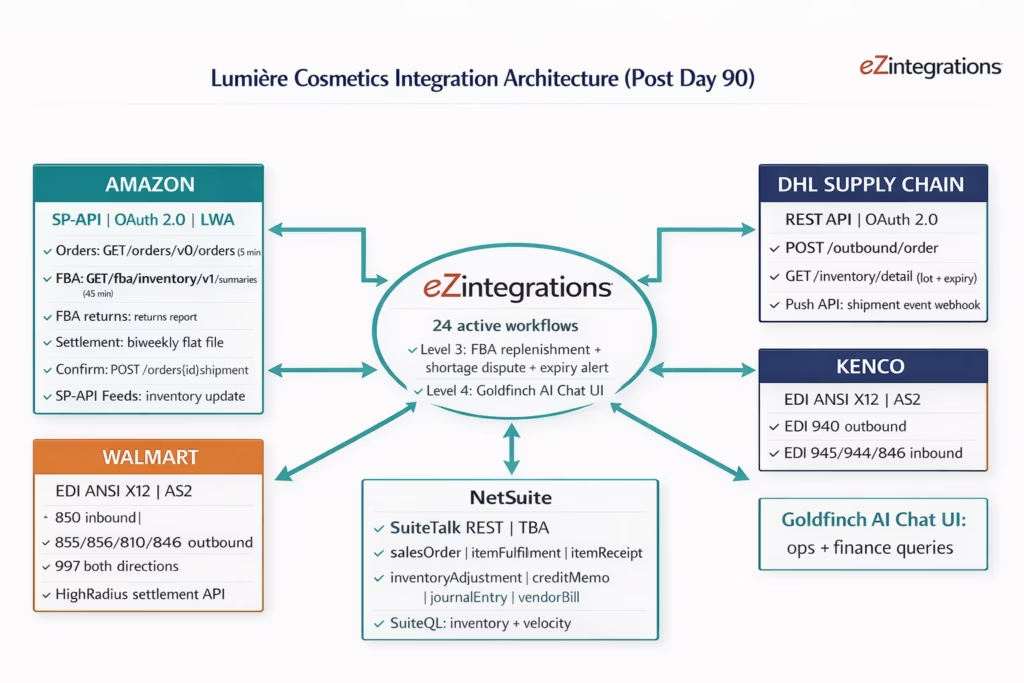
After 90 days, Lumière’s integration architecture:
Amazon:
- SP-API polling (5 min): orders, FBA inventory (
afnFulfillableQuantity,afnUnsellableQuantity) - FBA returns:
GET_FBA_FULFILLMENT_CUSTOMER_RETURNS_DATAreport - FBM returns: merchant returns report
- Amazon settlement:
GET_V2_SETTLEMENT_REPORT_DATA_FLAT_FILEbiweekly - SP-API Feeds:
POST_INVENTORY_AVAILABILITY_DATAfor inventory sync - SP-API inbound:
POST /inbound/vnd/shipmentsfor FBA replenishment - Shipment confirm:
POST /orders/v0/orders/{id}/shipmentfor FBM
Walmart:
- EDI over AS2: 850 (inbound), 855/856/810/846 (outbound), 997 (both)
- HighRadius: settlement API for remittance parsing
DHL Supply Chain (Walmart retail):
- REST API:
POST /wms/api/v1/outbound/order,GET /inventory/detail, push API webhook - Lot/expiry sync:
GET /inventory/detailwith lot data
Kenco (Amazon DTC):
- EDI over AS2: 940 (outbound), 945/944/846 (inbound)
NetSuite:
- SuiteTalk REST:
POST /salesOrder,POST /itemFulfillment,POST /itemReceipt,POST /inventoryAdjustment,POST /creditMemo,POST /journalEntry,POST /vendorBill - SuiteQL: inventory queries, velocity calculations
eZintegrations platform levels used: Level 1 (iPaaS Workflows) handles all routine data flows: SP-API polling, EDI document exchange, ERP SuiteTalk REST calls, DHL REST API outbound orders, and Kenco EDI 940 generation. Level 2 (AI Workflows) runs the 855 inventory validation, 856 pre-transmission carton validation, 810 price check, settlement dispute logic, and expiry date checks on returns. Level 3 (AI Agents) provides the proactive monitoring: FBA replenishment threshold watching, Walmart shortage dispute detection, near-expiry lot alerting, and DHL inventory discrepancy flags. Level 4 (Goldfinch AI) orchestrates the complete multi-channel cycle as a Workflow Node and provides the Goldfinch AI Chat UI for Natalie’s ops and finance teams.
eZintegrations platform configuration:
- 24 active automation workflows
- 3 Level 3 monitoring agents (FBA replenishment, Walmart shortage dispute, near-expiry lot alert)
- 1 Level 4 Goldfinch AI Chat UI for ops and finance
- Reference datasets: ASIN-to-NetSuite-item (75 rows), UPC-to-NetSuite-item (42 rows), DHL item code map (42 rows), Kenco item code map (42 rows)
What the Numbers Look Like at 90 Days
Six months of post-implementation data tell the story clearly.
Walmart OTIF: 71% → 98%
Before: 71% OTIF compliance rate. Late ASNs (856 generated 4-6 hours after carrier scan) accounted for 89% of violations. Short-shipment violations accounted for 11% (over-acknowledged 855s).
After: 98% OTIF compliance. The 2% residual violation rate is from a single event: a DHL Memphis connectivity outage on a Saturday that delayed the push API webhook. The 856 was transmitted 48 minutes after carrier scan (18 minutes late). One OTIF violation in 90 days.
OTIF chargeback cost before: 24,000annualised(prior12months).
OTIFchargeback cost after:∗∗729 annualised (one violation in 90 days × 4 = projected annual).
Annual savings: $23,271.
Amazon FBA Stockouts: 6/year → 0
Before: 6 FBA stockout events in the prior 12 months. Two over long weekends. One during an unexpected viral TikTok moment (daily velocity spiked from 22 to 140 for 3 days on Rose Gloss before anyone noticed the inventory was depleting).
After: zero FBA stockout events in 90 days. One near-miss: a velocity spike for Velvet Foundation during a Valentine’s Day promotion was detected at 11:22 PM on a Wednesday when afnFulfillableQuantity dropped to 317 against a reorder threshold of 329. NetSuite Transfer Order created automatically. Kenco prep instructions sent. FBA inbound plan created. Stockout prevented. Nobody woke up.
FBA stockout revenue impact before: estimated 89,000annualised(6events× 14,800 average revenue impact per event including rank recovery). FBA stockout revenue impact after: $0 in 90 days.
Ops Team Data Entry: 18 hours/week → 2 hours/week
Before: 18 hours per week across three ops coordinators on routine eCommerce data entry. Order entry, EDI processing, 3PL coordination, inventory reconciliation, settlement tracking.
After: 2 hours per week on exception review. The exceptions reviewed in the first 90 days: 8 new ASINs not in the mapping table (15 minutes each to add), 2 DHL inventory discrepancies (20 minutes each to investigate), 1 Kenco 944 quantity mismatch (30 minutes to resolve).
The recovered 16 hours per week: two coordinators rotated into customer experience projects and retail sales enablement. One coordinator was redeployed to manage a new TikTok Shop pilot channel. No headcount reduction. Significant capacity increase.
Ops time value recovered: 38,000annualised(16hours/week×50weeks×47.50 fully loaded hourly cost).
Finance Close: Day+6 → Day+2
Before: Amazon and Walmart settlements delayed the monthly close by 3-5 business days consistently. The CFO had built a buffer into the board reporting calendar to accommodate this.
After: both Amazon and Walmart settlements processed automatically on the settlement date. NetSuite AR cleared same day. Month-end close moved to Day+2 consistently after the first automated settlement in Sprint 3.
The CFO’s comment at the quarterly review: “This is the first time in two years I’ve been confident giving the board a close date.”
Finance close value: estimated $15,000/year in auditor and finance team overtime saved, plus qualitative value of Day+2 close for board visibility.
Total Annualised Savings: $165,271
| Savings Driver | Annual Value |
|---|---|
| Walmart OTIF chargeback elimination | $23,271 |
| FBA stockout prevention | $89,000 |
| Ops team time recovery | $38,000 |
| Finance close acceleration | $15,000 |
| Total | $165,271 |
Implementation cost: 22,000/year(platform+annualisedimplementation).Netannualbenefit:143,271. ROI: 651%. Payback period: 19 days from go-live.
Before vs After: The Full Transformation
| Metric | Before eZintegrations | After 90 Days |
|---|---|---|
| Walmart OTIF compliance | 71% | 98% |
| FBA stockout events | 6/year | 0 in 90 days |
| Ops data entry hours | 18 hrs/week | 2 hrs/week |
| Finance close date | Day+6 | Day+2 |
| Amazon order entry time | 3-4 hours/day | 2-5 minutes (automated) |
| Walmart 856 ASN timing | 4-6 hours after carrier scan | 9-14 minutes after carrier scan |
| FBA reorder detection | Weekly manual check | 45-minute automated monitoring |
| Inventory accuracy | 91% (daily manual reconciliation) | 98.4% (continuous sync) |
| Walmart settlement time | 10-12 hours per month | 22 minutes per month |
| Walmart shortage dispute rate | 0% (not submitted) | 80%+ of disputable claims submitted |
| Returns ERP posting lag | 2-3 weeks | 30-60 minutes (automated) |
| Weekend/holiday coverage | Gap: no monitoring | 24/7: all flows automated |
| Number of tools for Amazon + Walmart | 5+ separate portals and spreadsheets | 1 (eZintegrations) |
| ERP (NetSuite) replaced | N/A | Not replaced (unchanged) |
The Decisions That Made It Work
Looking back at the 90-day implementation, Natalie identified five decisions that were critical to the successful outcome.
Decision 1: The phased approach. “We could have tried to implement everything at once. We would have had 8 configuration failures happening simultaneously and no idea which was causing which problem. Starting with Amazon only, validating it completely, then moving to Walmart was the right call. When the Walmart 856 timing was first configured, we knew it was working because we had already seen the same event pattern work on the Amazon side.”
Decision 2: The ASIN mapping table first. “Every failure we had in Sprint 1 was an ASIN not in the mapping table. We updated the table 8 times in the first 30 days. If we had gone live with an incomplete table and then added Walmart simultaneously, we would have been chasing two sources of failures at once. The mapping table has to be complete before go-live, not after.”
Decision 3: Using Kenco EDI 945 as the trigger, not the DHL webhook. “For Amazon FBM orders (which go through Kenco), we use the Kenco EDI 945 as the trigger for the NetSuite item fulfilment and the Amazon SP-API shipment confirmation. For Walmart orders (which go through DHL), we use the DHL REST API push webhook. The key insight: each 3PL has its own best integration interface. We did not try to standardise everything to one approach.”
Decision 4: The Level 3 monitoring agents were not optional. “The FBA replenishment agent prevented the Valentine’s Day near-stockout. That one event alone would have cost us 12,000−15,000 in lost revenue and rank recovery. The agent runs 24/7 and costs us nothing in additional ops time. It was not something we considered carefully during the evaluation. It should have been.”
Decision 5: Starting the ROI measurement from Day 1. “We documented our baseline metrics in December 2025: OTIF violation count, FBA stockout history, ops team time log, finance close dates. When we reviewed the 90-day results, we could show the board a clean before/after comparison. If we had not documented the baseline, we would have been arguing from memory. With the baseline, the ROI was unambiguous.”
What Lumière Would Do Differently
Three things, with the benefit of hindsight.
Start the ASIN mapping table 2 weeks earlier. “We started it in parallel with the SP-API credential setup. We should have started it the moment we decided to proceed, before credentials. A clean mapping table is the foundation of everything.”
Configure the Goldfinch AI Chat UI in Sprint 1, not Sprint 3. “We treated it as a nice-to-have that went in at the end. But ops team adoption of the new system was slower than expected because the team did not have a natural window into what was happening. The Chat UI would have given them that window from day one: ‘Are my Amazon orders processing?’ If they had been able to ask that question from week one, they would have trusted the system faster.”
Set up the monitoring dashboard before the first live order. “We had 23 orders process on Day 7 and we spent 2 hours manually verifying each one had gone through correctly. We should have set up the eZintegrations monitoring dashboard first so we could see ‘all 23 orders processed: 0 errors’ at a glance instead of checking 23 NetSuite records individually.”
Step-by-Step: The Phased Implementation Approach
If your beauty brand is starting where Lumière was in December 2025, here is the exact approach.
Step 1: Document Your Baseline Metrics Today
Before any implementation begins, pull these numbers from your current systems:
- Walmart OTIF compliance rate (from Retail Link → Supplier Performance)
- FBA stockout events last 12 months (from Seller Central → FBA Inventory Event Detail)
- Ops team hours per week on eCommerce data entry (honest time audit of one representative week)
- Finance close date for the last 3 months
- Walmart HighRadius settlement time (hours per settlement cycle)
These are your before metrics. You need them to calculate ROI after the implementation.
Step 2: Start the ROI Calculation
Use the ROI calculator in the beauty brand eCommerce integration ROI guide with your baseline metrics. This gives you the expected annual savings and payback period before committing to implementation. For most beauty brands at $10M+ combined Amazon and Walmart revenue, the payback period is under 4 months.
Step 3: Import Amazon Templates First (Sprint 1)
Go to the Automation Hub and import:
- Amazon Seller Central SP-API Order Sync (FBA + FBM routing)
- Amazon FBA Inventory Replenishment Monitoring
- Amazon FBM Fulfilment Routing (if using Kenco or similar)
Build your ASIN-to-ERP item mapping table completely before starting the credential configuration. Validate with 200+ orders before declaring Sprint 1 complete.
Step 4: Import Walmart and 3PL Templates (Sprint 2)
After Amazon is validated, import:
- Walmart EDI Integration (850/855/856/810/846)
- DHL Supply Chain or Kenco 3PL integration (whichever handles Walmart retail)
Validate with 3 complete Walmart PO cycles (850 → 855 → ship → 856 → 810) with zero OTIF violations before declaring Sprint 2 complete.
Step 5: Add Returns, Settlements, and Monitoring (Sprint 3)
Import returns automation (Amazon FBA and FBM, Walmart deduction parsing), configure settlement reconciliation GL mapping, activate the Level 3 monitoring agents (FBA replenishment, shortage dispute, near-expiry alerts), and set up the Goldfinch AI Chat UI for your ops and finance teams. Validate with one full settlement cycle before declaring Sprint 3 complete.
Total implementation time: 90 days for the full stack. 30 days for Amazon-only (fastest path to the highest-value single integration).
Key Outcomes and Results
The Lumière Cosmetics implementation delivered results across all four ROI pillars documented in the beauty brand eCommerce integration ROI guide.
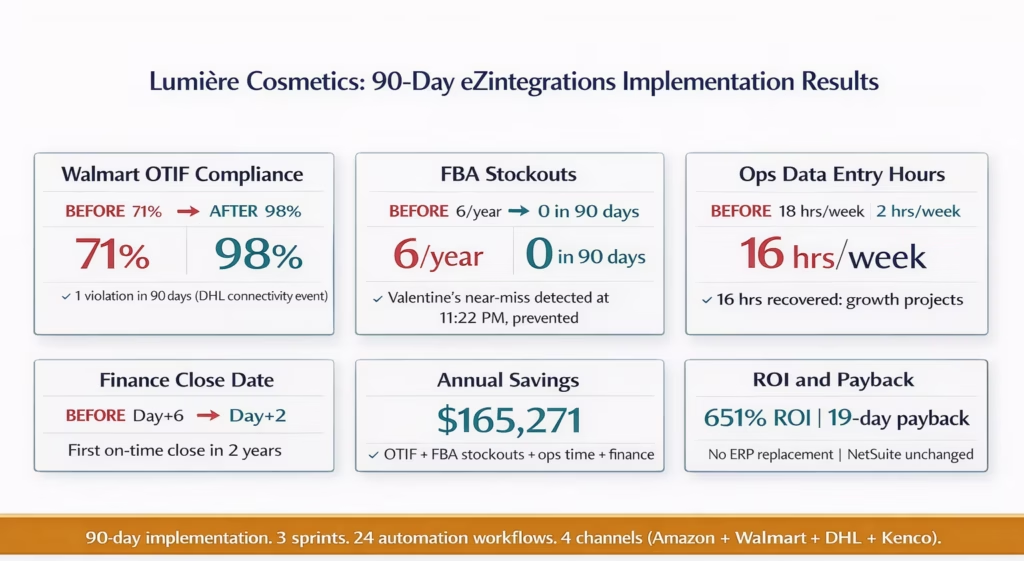
OTIF compliance at 98%: from the first automated 856 ASN (9.4 minutes after DHL carrier scan), Walmart OTIF violations dropped to near zero. The one violation in 90 days was a DHL connectivity event, not a process failure.
FBA stockout rate at zero: the Valentine’s Day near-stockout (detected at 11:22 PM, threshold crossed by 12 units) demonstrated the monitoring working as designed. The stockout would have occurred Monday morning without the automated alert.
Ops team freed from data entry: 16 hours per week recovered. Three coordinators moved from data entry to growth projects: retail sales enablement, TikTok Shop pilot launch, and customer experience improvement.
Finance close at Day+2: the CFO’s first on-time close in two years. The downstream impact on board reporting accuracy and operational planning was described by the CFO as “more valuable than the time saved.”
651% ROI in year one. Implementation paid back in 19 days from go-live.
How to Get Started
Step 1: Complete the Baseline Audit (Week 1)
Pull your Walmart OTIF scorecard from Retail Link. Pull FBA stockout history from Seller Central. Time-audit your ops team for one week. Document finance close dates for the last 3 months. These become your before metrics and feed the ROI calculation.
Step 2: Run the ROI Calculator
Use the beauty brand eCommerce integration ROI calculator with your baseline metrics. Calculate your expected annual savings and payback period. Most beauty brands at Lumière’s revenue scale ($10M+) find payback under 4 months.
Step 3: Import the Amazon Templates First
Start with the highest-ROI integration for your brand. For most beauty brands, this is the Amazon stack: order sync, FBA replenishment monitoring, and FBM 3PL routing. Go to the Automation Hub, import the Amazon Seller Central integration templates, and follow the Sprint 1 approach: build the ASIN mapping table first, credential configuration second, test with 200+ orders third.
Step 4: Book the Demo with Your Baseline Metrics
Book a free demo with your Walmart OTIF scorecard, FBA stockout history, and the output of your ROI calculator. Bring your ERP type (SAP, Oracle, or NetSuite), your 3PL partner list (DHL, Kenco, UPS SCS, or other), and your channel mix (Amazon FBA/FBM, Walmart store supplier, DSV, or 3P). We will confirm your expected ROI, build a phased implementation plan tailored to your starting point, and provide a specific payback period estimate.
The Lumière Cosmetics implementation took 90 days. Most beauty brands in the 8M−20M revenue range complete the full stack in 60-90 days.
FAQs
A full multi-channel implementation typically follows a phased 90-day rollout. Sprint 1 covers Amazon order sync, FBA replenishment, and initial 3PL integration. Sprint 2 adds Walmart EDI, second 3PL, and inventory synchronisation. Sprint 3 completes returns automation, settlement reconciliation, and optimisation. Amazon-only setups can go live in ~30 days, while adding Walmart extends to ~60 days.
No, eZintegrations sits as an integration layer on top of existing ERPs like NetSuite, SAP S/4HANA, and Oracle using standard APIs. No customisation, migration, or ERP replacement is required.
The ASIN-to-item mapping table is typically the biggest delay due to shade variants, bundles, and ongoing SKU discovery. What seems like a half-day task often takes 3-5 days for beauty brands.
Amazon FBA replenishment monitoring delivers immediate ROI by preventing stockouts through real-time threshold tracking and automated replenishment triggers.
Yes, Amazon SP-API and Walmart EDI run in parallel, creating ERP orders with separate channel logic while sharing the same inventory and 3PL integrations. 1. How long does it take to implement eZintegrations for a beauty brand with Amazon, Walmart, and two 3PLs
2. Does implementing eZintegrations require replacing the existing ERP
3. What causes the most delays during implementation
4. What is the most impactful automation in the first 30 days
5. Can a beauty brand run Amazon Seller Central and Walmart EDI simultaneously
The 90-Day Story. Your 90-Day Story.
Lumière Cosmetics started where most beauty brands at $12M revenue start: growing revenue, growing operational complexity, and an ops team that was hired for growth but spending 18 hours a week on data entry.
90 days later: 98% Walmart OTIF, zero FBA stockouts, 2 hours/week on exception review instead of 18 hours on data entry, finance close at Day+2, and three coordinators working on TikTok Shop instead of EDI spreadsheets.
The ERP was not replaced. The team was not expanded. The channels were not simplified. The complexity went up as they added DHL Memphis, Kenco Atlanta, and the full Walmart EDI compliance stack. But the ops burden went down because the complexity was handled by automation, not by people.
Your 90-day story starts with the baseline audit. Pull your Walmart OTIF scorecard, pull your FBA stockout history, time your ops team for a week. Calculate the ROI with the beauty brand integration ROI calculator.
Then book the demo. Bring your numbers. We will tell you what your Day+90 looks like.