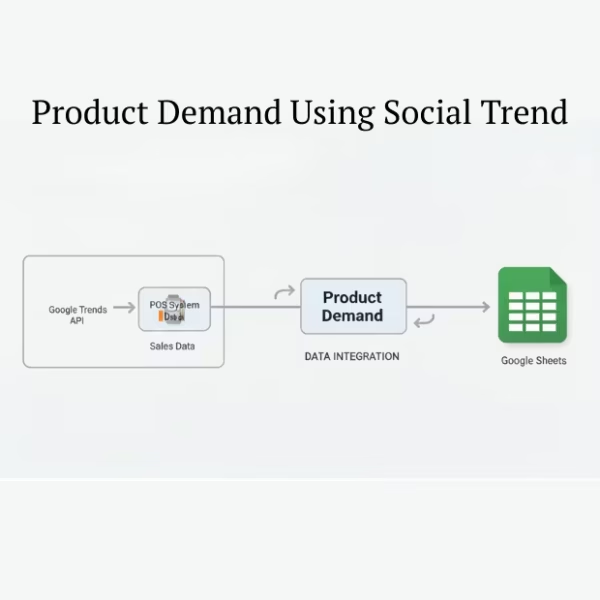
How to Automatically Identify Product Demand Using Social Trend
$0.00
| Workflow Name: |
Product Demand Using Social Trend |
|---|---|
| AI Model Type: |
Time Series / ML |
| Model Provider: |
Goldfinch AI |
| Task Type: |
Forecasting / Correlation Analysis |
| Input Type: |
Google Trends API / Sales Data |
| Output Format: |
Google Sheets |
| Who Uses It: |
Merchandising; Marketing Teams |
Table of Contents
Description
| Problem Before: |
Demand guessed from past sales only |
|---|---|
| AI Solution: |
Social trend + sales forecasting |
| Validation (HITL): |
Quarterly review |
| Accuracy Metric: |
MAPE |
| Time Savings: |
Faster demand planning |
| Cost Impact: |
Lower overstock risk |
Product Demand Using Social Trend Workflow
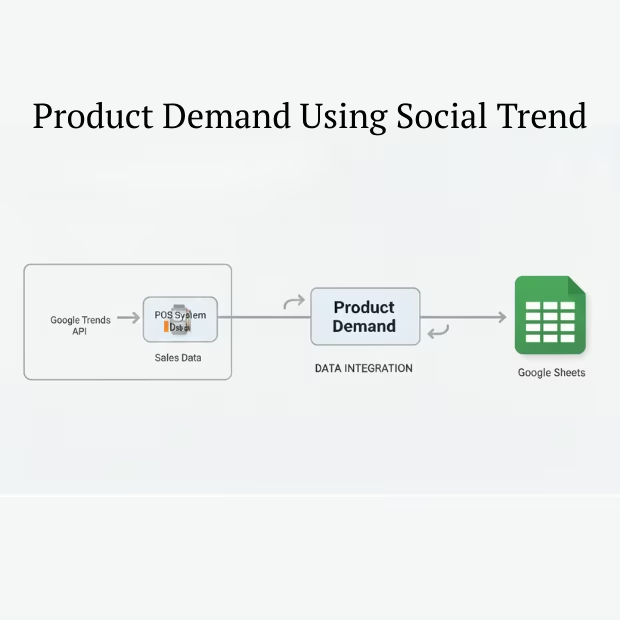
This workflow applies time series and machine learning models to analyze social trends and sales patterns for Product Demand Forecasting. Powered by Goldfinch AI, it correlates Google Trends data with historical sales to identify demand signals early.
Social Trend–Driven Demand Insights
By combining Google Trends APIs and sales data, the workflow delivers actionable forecasts directly into Google Sheets. Designed for merchandising and marketing teams, it supports better inventory planning, campaign timing, and data-driven product decisions.
Watch Demo
| Video Title: |
Amazon Seller Central Business Flow for Ecommerce Sellers |
|---|---|
| Duration: |
2:41 |
Outcome & Benefits
| Accuracy: |
90% forecast accuracy |
|---|---|
| Touchless Rate: |
80% |
| Time Saved: |
8 hrs/month |
| Cost Saved: |
Reduced dead stock |
Functional Details
| Business Tasks: |
Demand planning; forecasting |
|---|---|
| KPI Improved: |
Inventory turnover |
| Scheduling: |
daily |
| Downstream Use: |
Inventory reorder planning |
Technical Details
| Model Name/Version: |
SocialDemand v2 |
|---|---|
| Hosting Type: |
Cloud |
| Prompt Strategy: |
N/A |
| Guardrails: |
Trend spike smoothing |
| Throughput: |
Daily batch |
| Latency: |
2-3 minutes |
| Data Governance: |
Aggregated public data |
FAQ
1. What is the Product Demand Using Social Trend AI workflow?
It is an AI-driven workflow that predicts product demand by analyzing social media trends, online discussions, and engagement signals to identify rising or declining consumer interest.
2. How does this workflow predict product demand?
The workflow ingests social trend data, applies NLP and machine learning models to detect sentiment and popularity patterns, and correlates these insights with historical demand data to forecast future demand.
3. What types of data are used as inputs?
It uses data from social platforms such as posts, comments, hashtags, mentions, engagement metrics, and historical sales or product performance data when available.
4. What outputs does the workflow generate?
The workflow generates demand forecasts, trend scores, and product-level recommendations that can be delivered to dashboards, spreadsheets, or downstream planning systems.
5. How frequently are demand predictions updated?
Predictions can be refreshed in near real-time or on scheduled intervals depending on data availability and business requirements.
6. Who uses the Product Demand Using Social Trend workflow?
Product Managers, Marketing Teams, Merchandising Teams, and Supply Chain Planners use this workflow to anticipate demand shifts and align inventory and campaigns.
7. What are the benefits of using social trend–based demand prediction?
It enables early detection of demand changes, improves forecasting accuracy, reduces stockouts and overstocking, and supports proactive, data-driven product decisions.
Resources
Case Study
| Industry: |
Retail / eCommerce |
|---|---|
| Problem: |
Stockouts during trends |
| Solution: |
Social-aware forecasting |
| Outcome: |
Better availability |
| ROI: |
3-month payback |