Agentic AI for Humanoid Robots: The Integration Layer Powering Next-Gen Autonomous Systems
March 25, 2026Agentic AI for humanoid robots provides the autonomous integration layer that connects an entire robot fleet to enterprise systems at scale: a coordinated set of specialised agents that continuously read live SAP, WMS, MES, and CRM data, reason about fleet-wide conditions, and direct robot actions without requiring human instruction for each decision. Goldfinch AI from eZintegrations provides this platform layer, with multi-agent orchestration, 9 native tools, MCP endpoints for cross-system AI invocation, and a no-code canvas that scales from a single-robot pilot to a heterogeneous fleet of dozens of robots operating across multiple enterprise environments.
TL;DR
One robot, one exception, one AI agent resolving it: that is a proof of concept. Ten robots, three vendors, two warehouses, one manufacturing floor, and a shared enterprise stack running on agentic AI: that is a production deployment. The challenge of scaling humanoid robot deployments from pilot to fleet is not the hardware. UBS projects 2 million humanoids in the workplace by 2035 and a $30-50 billion total addressable market by that year. The hardware economics are improving every quarter (Goldman Sachs: manufacturing costs down 40% between 2023 and 2024).
The scaling challenge is the coordination layer. Deloitte’s 2026 Physical AI analysis identifies heterogeneous fleet orchestration as the critical next challenge: “organisations will increasingly deploy heterogeneous fleets of robots, autonomous vehicles, and AI agents from multiple vendors, each with proprietary protocols. This creates interoperability challenges that can lead to accidents, downtime, system congestion, and operational inefficiency.” Goldfinch AI from eZintegrations is the agentic AI platform that provides this coordination layer: specialised agents working in concert, each responsible for a defined domain, connected to enterprise systems via 5,000+ API endpoints, and orchestrated by a central planning layer that allocates work across the fleet based on live operational data.
The Problem: Scaling from One Robot to a Fleet Exposes the Coordination Gap
Your pilot was successful. One Agility Robotics Digit unit, running in a defined zone, handling tote transfers between the conveyor and the AMR network. The integration works. The exceptions are handled. The data writes back to SAP EWM within seconds. Your operations director calls it a win.
Six months later, the board approves a fleet expansion. Ten robots. Three vendors (Agility Robotics, Figure AI, and a Unitree logistics model for lighter payloads). Two warehouses. One manufacturing floor feeding the same SAP S/4HANA instance. The same MES. The same quality system. The same HR scheduling platform managing the human workers alongside the robots.
Now you have a fleet. And the architecture you built for one robot does not scale to ten.
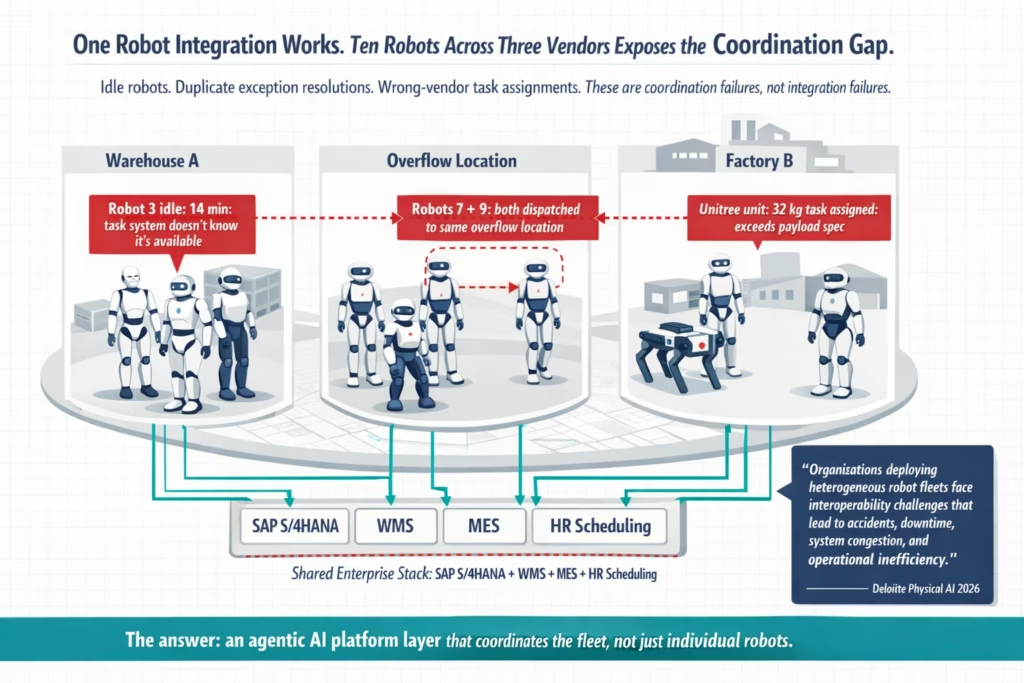
The integration layer still works. Each robot connects to SAP and WMS. The exception workflows still fire. But coordination has become the bottleneck. Robot Unit 3 in Zone B finishes early and sits idle for 14 minutes because the task assignment system does not know it is available. Robot Unit 7 and Robot Unit 9 are both dispatched to the same overflow location because two separate exception resolution agents each solved the same inventory problem independently, without knowing the other had already acted. The Unitree unit in the manufacturing cell has a lighter payload specification than the Agility units but the task assignment logic does not account for vendor-specific capability differences, and a 32 kg component gets assigned to the wrong robot.
These are not integration failures. They are coordination failures. And they only emerge at fleet scale.
Deloitte’s 2026 Physical AI analysis names this directly: “As physical AI systems mature, organisations will increasingly deploy heterogeneous fleets of robots, autonomous vehicles, and AI agents from multiple vendors, each with proprietary protocols. This creates interoperability challenges that can lead to accidents, downtime, system congestion, and operational inefficiency.”
The solution to coordination failures is not more workflows. More workflows create more competing agents acting without awareness of each other. The solution is an agentic AI platform: a coordinated architecture where specialised agents each own a defined domain, share a common view of fleet state and enterprise data, and are orchestrated by a planning layer that ensures their actions are coherent and non-conflicting.
That is the difference between deploying AI agents and deploying an agentic AI platform for humanoid robots.
The International Federation of Robotics identified Agentic AI as one of the five defining robotics trends for 2026. SAP announced at TechEd Berlin in November 2025 that SinoSwissHub is building “a regionally compliant, SAP-integrated orchestration platform for multi-robot fleets, with humanoids as the centrepiece.” The architectural direction is clear. The implementation question is which platform provides it at the enterprise level without requiring a custom multi-agent engineering project for every deployment.
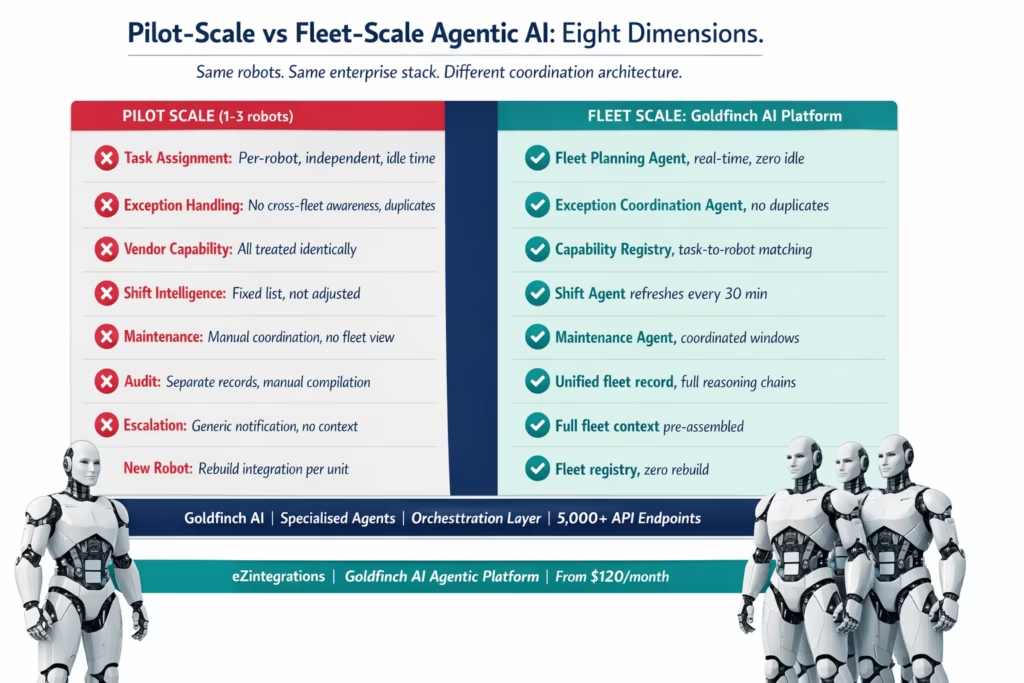
Before vs After: Pilot-Scale Operation vs Fleet-Scale Agentic AI
| Dimension | Pilot-scale (1–3 robots, single vendor) | Fleet-scale with Goldfinch AI agentic platform |
|---|---|---|
| Task assignment | Per-robot task dispatch from WMS. Each robot receives tasks independently. | Fleet Planning Agent reads live WMS task queue, robot availability, battery state, payload specs, and zone adjacency. Assigns tasks across the fleet to maximise throughput and eliminate idle time. |
| Exception handling | Each exception handled by its own workflow or single-robot agent. No cross-fleet awareness. | Exception Coordination Agent detects when multiple robots are responding to the same root cause. Prevents duplicate resolutions. Assigns single response. Logs fleet-level exception pattern. |
| Multi-vendor capability routing | All robots treated identically. Payload, dexterity, and speed differences across vendors not accounted for. | Vendor Capability Registry maintained by platform. Fleet Planning Agent matches tasks to robots based on payload, zone, current task, and vendor-specific capability profile. |
| Shift intelligence | Fixed task priority list at shift start. Not adjusted as conditions change across the fleet. | Shift Intelligence Agent reads ERP production orders, WMS queue depth, MES work orders, and live robot state every 30 minutes. Generates and refreshes fleet-wide task priority continuously. |
| Maintenance coordination | Faults logged per robot. Maintenance team coordinates manually. No fleet-level maintenance view. | Maintenance Agent monitors all robot telemetry feeds. Schedules maintenance windows to minimise concurrent robot downtime. Coordinates with Shift Intelligence Agent to ensure coverage during planned stops. |
| Compliance and audit | Decisions logged per robot in separate controller records. Cross-fleet audit requires manual compilation. | All agent decisions logged to a unified fleet audit record. Every task assignment, exception resolution, and escalation documented with reasoning chain, data sources, and timestamp. Single audit trail. |
| Escalation routing | Exceptions escalate to a generic supervisor notification. No cross-fleet context. | Escalation Agent assembles fleet-wide context before notifying: current fleet state, other active exceptions, relevant robot history, and recommended actions. Supervisor sees the full picture. |
| New robot onboarding | Each new robot requires a new integration configuration. Credentials re-entered. Workflows re-built. | New robot registered in fleet registry. Fleet Planning Agent incorporates it into assignment logic immediately. Existing credentials and workflows apply without rebuilding. |
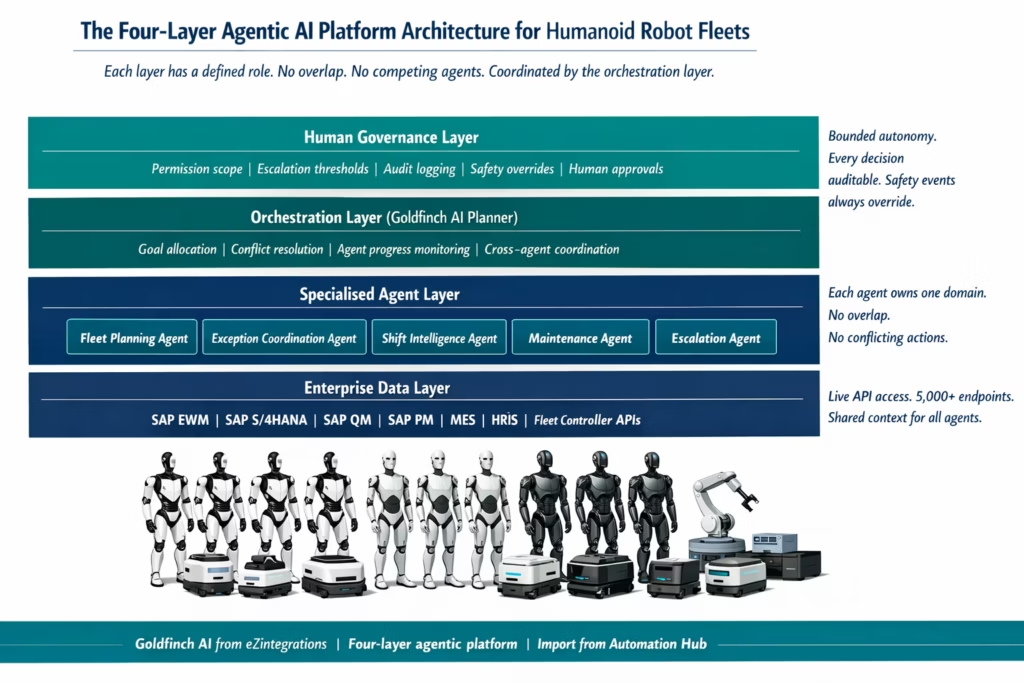
The Four-Layer Agentic AI Platform Architecture for Humanoid Robots
A fleet-scale agentic AI platform for humanoid robots is not a single agent. It is a structured architecture of specialised agents, each owning a specific domain, connected by an orchestration layer that keeps their actions coherent. Here is how the architecture divides across four functional layers.
Layer 1: Enterprise Data Layer (The Context Foundation)
Every agent in the platform reads from a common enterprise data layer. This is not a separate data warehouse. It is the live data from the enterprise systems your robots depend on, accessed via the eZintegrations API catalog: SAP EWM for warehouse tasks and inventory, SAP S/4HANA for production orders and materials, SAP QM for quality specifications, SAP PM for maintenance records, MES for work orders and assembly station status, HRIS for shift schedules and staffing, and fleet controller APIs for robot state, telemetry, and task status.
The enterprise data layer provides the shared context that prevents agents from making conflicting decisions. When the Fleet Planning Agent knows that Robot Unit 7 is currently handling an exception and is unavailable for new tasks, and the Exception Coordination Agent knows that Robot Unit 9 was already dispatched to the same overflow location, they do not make independent decisions based on incomplete context. They read from the same live data layer.
This is the data foundation that Reltio’s CTO identified as the critical gating factor for agentic AI in practice: “Simply put, if your data isn’t AI-ready, your AI can’t move beyond experimentation.” For robotics deployments, AI-ready data means real-time API access to all seven enterprise systems, not batch exports or stale dashboard data.
Layer 2: Specialised Agent Layer (The Domain Experts)
The specialised agents each own a defined functional domain. They do not overlap. They do not compete. Each one is responsible for a specific category of decisions and actions.
Fleet Planning Agent: Owns task assignment for the entire fleet. Reads WMS task queue, robot availability, battery state, current task status, vendor capability profiles, and zone adjacency. Assigns tasks to maximise fleet throughput and eliminate idle time. Refreshes continuously as conditions change.
Exception Coordination Agent: Monitors all active robot exceptions across the fleet. Classifies each exception. Identifies when multiple robots or multiple workflows are responding to the same root cause (the duplicate overflow dispatch problem). Assigns single responsibility. Prevents conflicting resolutions.
Shift Intelligence Agent: Owns fleet-level task prioritisation. Reads live ERP production orders, WMS priority flags, MES work order urgency, and current fleet state. Generates a dynamic fleet-wide priority queue that reflects actual business priorities, not static schedules. Refreshes every 30 minutes.
Maintenance Agent: Owns fleet-level maintenance coordination. Monitors all robot telemetry feeds simultaneously. Identifies degrading trends across the fleet. Schedules planned maintenance windows to avoid concurrent robot downtime. Coordinates with the Fleet Planning Agent to ensure zone coverage during planned stops.
Quality Coordination Agent: For fleets involved in quality inspection tasks. Monitors all robot quality events across the fleet. Identifies batch-level quality patterns (multiple robots flagging the same part number across different inspection stations). Escalates when a pattern indicates a systematic quality issue rather than an isolated reading.
Escalation Agent: Assembles fleet-wide context before any human notification is sent. When a Tier 3 exception requires supervisor involvement, the Escalation Agent does not send a single-robot alert. It compiles the current fleet state, any other active exceptions, the affected robot’s history, the enterprise data context (production order priority, WMS queue depth, MES work order status), and the recommended action. One notification. Complete picture.
Layer 3: Orchestration Layer (The Coordination Brain)
The orchestration layer is the Goldfinch AI Planner that coordinates the specialised agents. It does not execute actions itself. It allocates goals to the specialised agents, monitors their progress, resolves conflicts between agent decisions, and escalates to humans when the situation exceeds defined parameters.
When the Fleet Planning Agent proposes re-assigning tasks from Zone B to Zone A due to a queue imbalance, and the Maintenance Agent has scheduled Robot Unit 3 (the highest-capacity Zone A unit) for a planned maintenance window starting in 20 minutes, the orchestration layer identifies the conflict and resolves it: the Fleet Planning Agent’s rebalancing should avoid assigning multi-step tasks to Robot Unit 3 given its imminent maintenance window. The individual agents do not need to negotiate this with each other. The orchestration layer resolves it.
This is the multi-agent coordination pattern that eWeek described as the defining direction for enterprise agentic AI in 2026: “Expect multi-agent patterns to spread from labs to line-of-business apps, with teams composing small, specialised agents instead of one mega-agent.”
Layer 4: Human Governance Layer (Bounded Autonomy)
Enterprise agentic AI does not operate without boundaries. Every deployment of Goldfinch AI for humanoid robot fleets includes a Human Governance Layer: defined permission scopes for each agent (what it can do autonomously versus what requires authorisation), escalation thresholds, audit logging for every agent decision, and override capabilities for supervisors and safety officers.
The bounded autonomy model, which agentic AI analysts identified as the practical deployment pattern for 2026, means agents handle routine execution within defined limits, escalation paths are explicit and pre-configured, and human oversight remains intact for decisions that exceed configured thresholds.
For safety-critical scenarios (unexpected human entry into a robot zone, robot hardware alert during active operation, SAP PM fault classification of Critical severity), the governance layer overrides all agent decisions and escalates immediately. No agent reasoning cycle overrides a safety event.
How Goldfinch AI Operates as the Fleet Agentic AI Platform
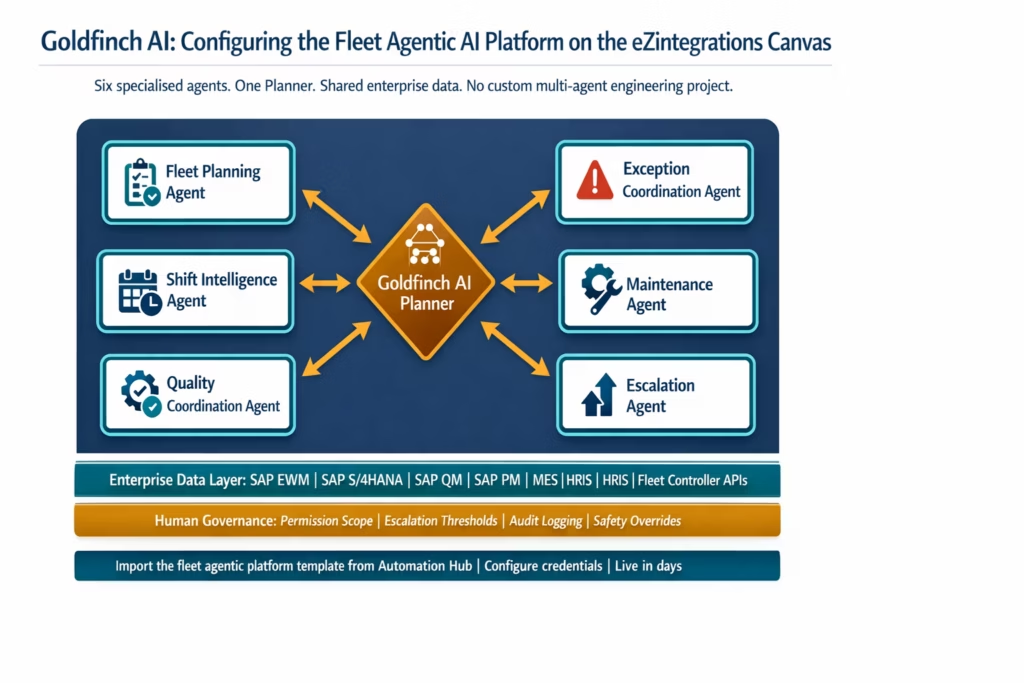
Goldfinch AI from eZintegrations is the agentic AI platform that implements the four-layer architecture described above. Here is how each layer is configured and operated within the eZintegrations platform.
Enterprise data layer: The API catalog
The enterprise data layer is not a separate infrastructure deployment. It is the eZintegrations API catalog: 5,000+ pre-built API endpoints covering SAP EWM, SAP S/4HANA, SAP QM, SAP PM, Oracle ERP, Siemens Opcenter, Workday, UKG, and every robot fleet controller that exposes a REST interface. Credentials are configured once per system and shared across all agents and workflows. Adding a new enterprise system to the data layer requires adding its API credentials to the credential vault, not building a new integration for each agent that needs it.
Specialised agents: Goldfinch AI configuration
Each specialised agent is configured in the Goldfinch AI canvas. The agent is defined by its goal, its tool access (which API Tool Calls, Integration Workflows as Tools, and Knowledge Base queries it can invoke), its permission scope (which actions it can execute autonomously), and its escalation threshold (which decision types route to the orchestration layer or to human governance). Six agents, six canvas configurations. Each one is independent. Each one reads from the shared enterprise data layer.
Orchestration layer: Goldfinch AI Planner
The Goldfinch AI Planner is the orchestration component of the agentic platform. It receives the fleet-level operational goal (run a productive shift across all 10 robots with zero unplanned stops and maximum throughput), breaks it into sub-goals allocated to each specialised agent, monitors agent execution, and resolves inter-agent conflicts. The Planner does not execute robot actions directly. It coordinates the agents that do.
Human governance: Permission scope and audit
Every Goldfinch AI agent in the fleet platform has a configured permission scope. The Fleet Planning Agent can re-assign tasks and update robot zone assignments autonomously. It cannot create or delete production orders. The Maintenance Agent can create scheduled SAP PM work orders. It cannot authorise emergency maintenance expenditure above a configured threshold. The Escalation Agent routes notifications. It cannot make safety decisions independently. Every action every agent takes is logged with the reasoning chain, data sources, and timestamp. The audit log is queryable across the full fleet.
MCP endpoints: Cross-platform AI invocation
Every Goldfinch AI agent workflow can be exposed as an MCP (Model Context Protocol) endpoint. This means your enterprise AI assistant (Claude, ChatGPT, or any MCP-compatible AI system) can invoke fleet-level queries and actions as native tool calls. Your operations AI assistant can ask “what is the current fleet state?” and the MCP endpoint queries live fleet controller and SAP data and returns a structured fleet summary. Your production AI agent can request a fleet rebalancing for Zone C and the Fleet Planning Agent executes it. Physical AI and digital AI on a unified infrastructure.
Automation Hub fleet templates
The Automation Hub includes fleet-scale agentic configuration templates: the six-agent fleet platform template (Fleet Planning, Exception Coordination, Shift Intelligence, Maintenance, Quality Coordination, Escalation), the Fleet Planning Agent standalone template, the heterogeneous vendor capability registry template, and the fleet audit logging workflow template. Import the full fleet platform template and configure your enterprise system credentials and fleet controller APIs. The architecture is pre-built. Configuration is the work, not engineering.
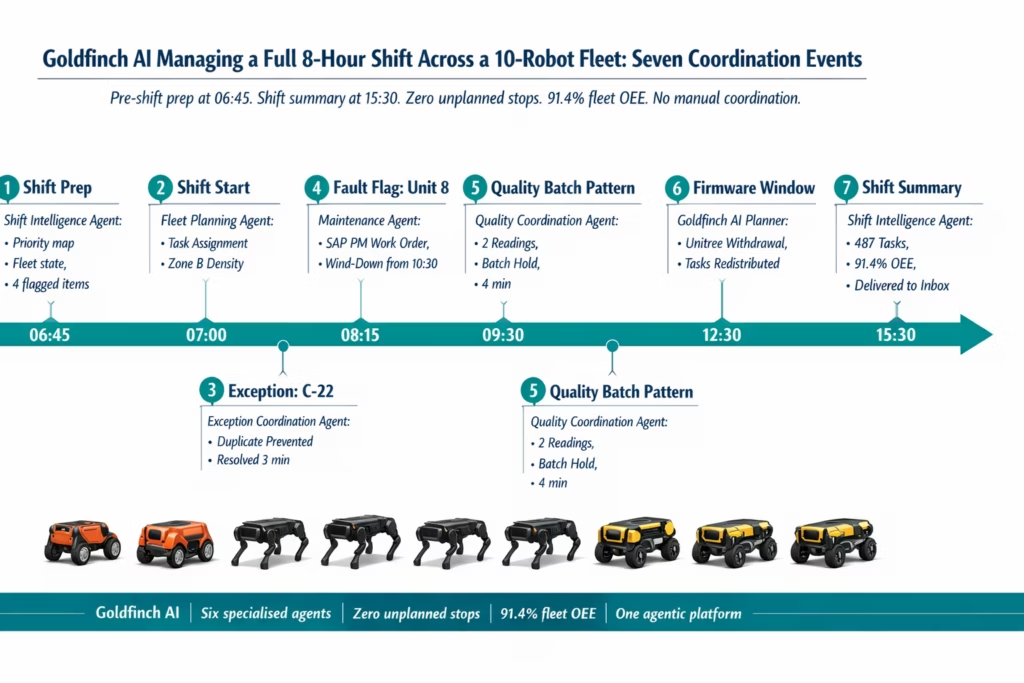
Step-by-Step: Goldfinch AI Managing a Shift Across a 10-Robot Heterogeneous Fleet
This example shows how the Goldfinch AI agentic platform coordinates a full 8-hour shift across a 10-robot fleet: 6 Agility Robotics Digit units, 3 Figure AI units, and 1 Unitree logistics model, operating across two warehouse zones and one kitting cell, connected to SAP EWM, SAP S/4HANA, SAP QM, and the Agility Arc, Figure AI, and Unitree fleet management APIs.
06:45: Shift Preparation (Shift Intelligence Agent)
Forty-five minutes before shift start, the Shift Intelligence Agent begins its pre-shift cycle:
- SAP S/4HANA API: retrieve the day’s production orders and their priority flags
- SAP EWM API: retrieve the current WMS task queue by zone and priority
- HRIS API: retrieve the human workforce schedule for the shift (zone assignments, team leads, break windows)
- All three fleet controller APIs: retrieve robot charge state, last maintenance record, and any pending fault flags
Output: a fleet-wide task priority map, a zone-to-robot assignment baseline, and a list of four flagged items (Robot Unit 8 showing motor temperature trend from the previous shift, Zone B has a 40% higher task queue than Zone A, one Unitree unit has a pending firmware update scheduled for mid-shift, and a production order for a heavy component requires a payload check against each robot type).
The Goldfinch AI Planner receives this pre-shift map and passes it to the Fleet Planning Agent.
07:00: Shift Start (Fleet Planning Agent)
The Fleet Planning Agent begins task assignment:
- Assigns the heavy component tasks exclusively to the 6 Agility Digit units (payload: 35 lbs) and the 3 Figure AI units (payload: 44 lbs). Excludes the Unitree unit (lighter payload, assigned to kitting cell tasks).
- Assigns Zone B (higher task queue) a higher initial robot density: 4 units.
- Flags Robot Unit 8 for monitoring: the motor temperature trend from the previous shift puts it at medium fault probability. Notifies the Maintenance Agent.
07:23: Exception Event (Exception Coordination Agent)
Robot Unit 4 fires SOURCE_BIN_EMPTY at Bin C-22. Simultaneously, Robot Unit 6 detects the same bin as its next assigned task. The Exception Coordination Agent detects the cross-robot conflict:
- Marks the exception as a shared inventory issue, not two independent robot exceptions.
- Assigns Robot Unit 4 as the exception handler. Robot Unit 6 is re-assigned to the next available task.
- Exception Coordination Agent queries SAP EWM for Bin C-22 and adjacent bins. Material found at C-24 (overflow staging). Robot Unit 4 re-dispatched to C-24. Exception resolved in 3 minutes.
- Fleet-level log: single exception record, one resolution action, no duplicate.
08:15: Maintenance Flag (Maintenance Agent)
Robot Unit 8’s motor temperature reading at 08:15 crosses the pre-configured trend threshold. The Maintenance Agent classifies fault probability as High.
- Creates a scheduled SAP PM work order: Robot Unit 8, end-of-shift maintenance inspection, motor temperature anomaly, Medium priority (not immediate failure, scheduled for shift end).
- Notifies the Fleet Planning Agent: Robot Unit 8 should complete its current task and not receive new assignments beyond 10:30 AM (2 hours before shift end) to allow controlled wind-down.
- The Fleet Planning Agent updates its assignment model to exclude Robot Unit 8 from new task allocation after 10:30 AM.
No maintenance technician was called. No shift supervisor was interrupted. The fleet absorbed the constraint automatically.
09:30: Quality Coordination Event (Quality Coordination Agent)
Robot Unit 2 flags an out-of-tolerance dimensional reading at Inspection Station 3 (Part 8842-A, height 22.7mm vs spec 22.0-22.5mm). Twenty minutes later, Robot Unit 5 flags the same part number at Inspection Station 7 with a similar height reading (22.6mm).
The Quality Coordination Agent detects the cross-robot pattern:
- Two robots, two stations, same part number, same characteristic, similar deviation. This is not an isolated reading. It indicates a batch or tooling issue.
- Quality Coordination Agent queries SAP QM for the current inspection lot for Part 8842-A. Batch 220, 48 parts in run.
- Creates a SAP QM batch hold for the entire Batch 220 inspection lot. Creates defect records for both readings. Notifies the Quality Manager with a batch-level quality alert: part number, batch, both deviation readings, both station IDs, and the pattern classification.
Response time from first reading to batch hold: 4 minutes. A quality manager reviewing two independent robot alerts would have needed 20-25 minutes to identify the batch pattern manually.
12:30: Unitree Firmware Update Window (Goldfinch AI Planner)
The scheduled Unitree firmware update window arrives. The Goldfinch AI Planner coordinates the temporary unit withdrawal:
- Fleet Planning Agent: redistributes the kitting cell tasks previously assigned to the Unitree unit to Robot Unit 3 (lightest Agility Digit unit, re-deployed from Zone A).
- Shift Intelligence Agent: updates the zone coverage model to reflect temporary kitting cell reduction.
- Fleet Planning Agent: notifies the kitting cell team lead of the temporary capacity adjustment via HRIS contact data.
Firmware update completes at 13:05. Unitree unit returns to kitting cell. Tasks redistributed back. No human coordination required.
15:30: End-of-Shift Summary (Shift Intelligence Agent + Goldfinch AI Planner)
Thirty minutes before shift end, the Shift Intelligence Agent generates the fleet shift summary:
- 10 robots, 8.5 active hours (Robot Unit 8 wound down from 10:30)
- Total tasks completed: 487 across all 10 units
- Exception rate: 0.6% (3 exceptions, all resolved autonomously)
- Quality events: 2 individual readings, 1 batch-level pattern detected and escalated to Quality Manager
- Maintenance event: 1 scheduled SAP PM work order (Robot Unit 8, end-of-shift)
- Zero unplanned stops
- Fleet OEE estimate: 91.4%
Summary delivered to Operations Manager inbox at 15:30. No manual compilation. No post-shift dashboard review. The shift report is ready before the shift ends.
Key Outcomes and Results
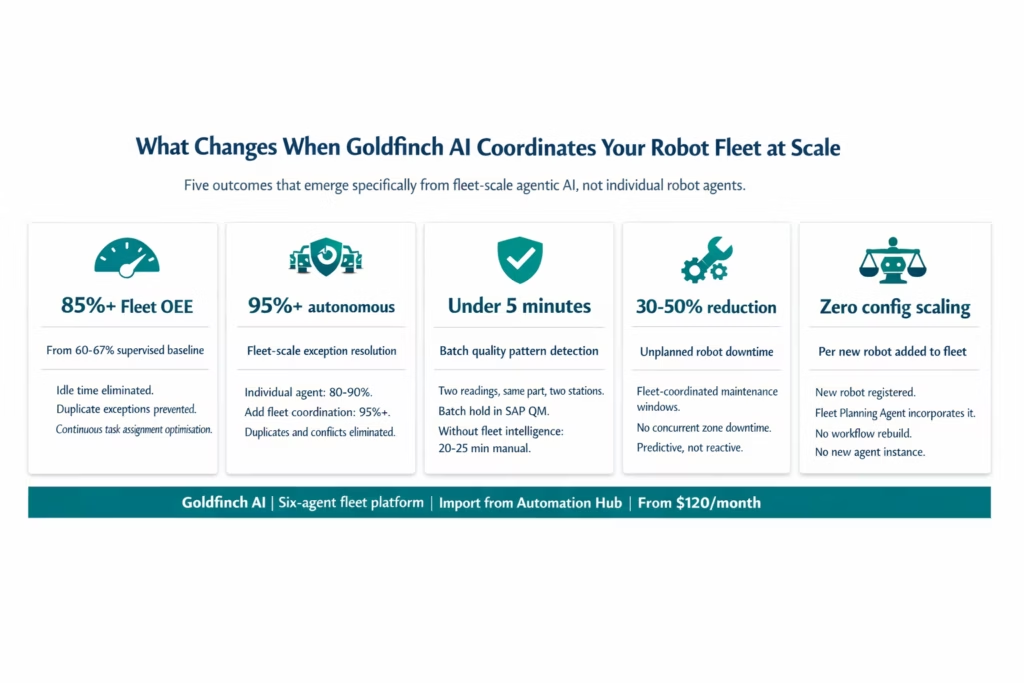
The outcomes of deploying Goldfinch AI as the fleet-scale agentic AI platform for humanoid robots divide into five categories that reflect the specific value of coordinated multi-agent operation versus individual robot agents.
Fleet OEE: From typical 60-67% to world-class 85%+
The primary driver of fleet OEE improvement from agentic AI coordination is the elimination of idle time and duplicate exception handling. A Fleet Planning Agent that continuously reassigns tasks based on live robot state, queue depth, and zone capacity eliminates the 8-14 minute idle gaps that occur when robots complete tasks faster than the WMS batch refresh catches up. A coordinated exception architecture that prevents duplicate resolutions eliminates the 20-30 minute recovery cycles from conflicting agent actions. Combined, these two improvements push fleet OEE from the typical 60-67% range for supervised humanoid deployments toward the 85%+ world-class threshold.
Exception resolution: 95%+ autonomy at fleet scale
Individual robot exception resolution covers 80-90% of single-robot exceptions autonomously. At fleet scale, the Exception Coordination Agent adds a further layer: it eliminates the duplicate and conflicting resolutions that occur when individual agents lack cross-fleet awareness. Fleet-scale autonomous exception resolution reaches 95%+ when the coordination layer is active, because the remaining 5% of unresolvable exceptions are genuinely novel situations rather than coordination failures that should have been autonomous.
Quality response: Batch-level pattern detection unavailable without fleet intelligence
A single robot flagging a quality reading generates an individual exception. Two robots at different stations flagging the same part number with the same characteristic deviation generates a batch signal. Without a Quality Coordination Agent monitoring all robots simultaneously, this pattern requires a human quality engineer to connect the dots manually. With fleet-scale agentic AI, the batch-level pattern is detected within minutes of the second reading, the batch hold is created in SAP QM immediately, and the quality manager receives a structured batch alert rather than two individual robot exceptions. The time from first reading to batch hold drops from 20-25 minutes to under 5 minutes.
Maintenance: Fleet-coordinated versus per-robot
Deploying maintenance coordination across the fleet with a Maintenance Agent that monitors all robot telemetry simultaneously eliminates the most expensive maintenance failure mode: multiple robots entering unplanned stops in the same zone during the same shift. The Maintenance Agent schedules planned maintenance windows to avoid concurrent downtime in the same zone, ensuring coverage continuity. Organisations deploying fleet-coordinated predictive maintenance for robotic fleets report 30-50% reductions in unplanned downtime versus per-robot reactive maintenance.
Scalability: Fleet size grows. Platform configuration does not.
Each new robot added to the fleet is registered in the vendor capability registry and connected to the fleet controller API. The Fleet Planning Agent incorporates it into its assignment model without configuration changes. The Exception Coordination Agent monitors it without a new exception workflow build. The Maintenance Agent adds it to its telemetry monitoring without a new agent instance. Platform configuration does not scale linearly with fleet size. A fleet of 10 robots uses the same six-agent platform configuration as a fleet of 30 robots.
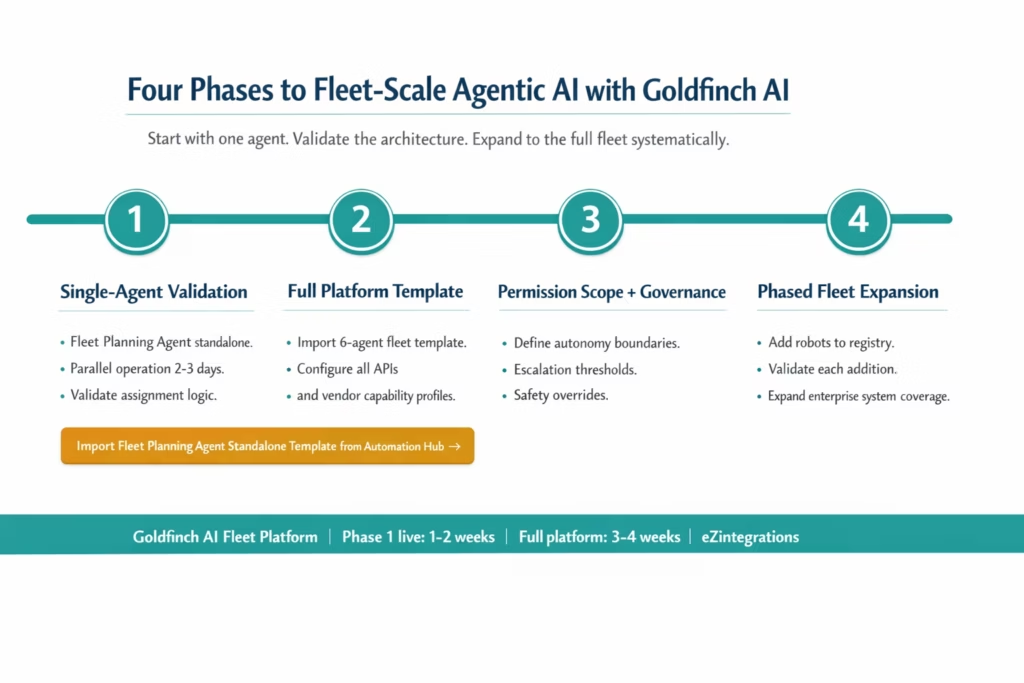
How to Get Started
Deploying the Goldfinch AI fleet agentic platform follows a four-phase approach designed to build confidence in the coordination architecture before expanding to the full fleet.
Phase 1: Single-agent validation (Week 1-2)
Before deploying the full six-agent fleet platform, deploy a single specialised agent on the current pilot-scale operation. The Fleet Planning Agent is the highest-value starting point for most deployments: configure it for your current robot fleet (even a single robot), connect it to your WMS and fleet controller APIs, and validate that its task assignment logic is correct and its escalation thresholds are appropriate. Import the Fleet Planning Agent standalone template from the Automation Hub and run 2-3 days of parallel operation (agent suggestions versus actual task assignments) before enabling autonomous assignment.
Phase 2: Import the full fleet platform template (Week 2-3)
Once the Fleet Planning Agent is validated, import the full six-agent fleet platform template from the Automation Hub. The template includes all six specialised agent configurations, the Planner orchestration setup, the human governance layer configuration, and the fleet audit logging workflow. Configure your enterprise system API credentials (SAP EWM, SAP S/4HANA, SAP QM, SAP PM, MES, HRIS) and all your fleet controller APIs. Define the vendor capability profiles for each robot vendor in your fleet.
Phase 3: Permission scope and governance configuration (Week 3)
Before enabling autonomous operation, configure the permission scope for each agent and the escalation thresholds for the governance layer. Review the boundary definitions: which actions can each agent execute without human approval? What SAP system actions require authorisation? What exception classifications route to human governance immediately? Define these boundaries with your operations manager, safety officer, and IT team before running the first autonomous shift.
Phase 4: Phased fleet expansion
Start the agentic platform with your current pilot fleet. Validate fleet OEE, exception resolution rates, and shift summary accuracy over 2-3 weeks. Add new robots to the fleet registry one or two at a time, validating that each addition is correctly incorporated into the Fleet Planning Agent’s assignment logic. Expand to additional enterprise systems (MES work order integration, SAP QM quality coordination, SAP PM maintenance dispatch) in order of operational priority.
Ready to configure the fleet agentic platform? Book a free demo with your current robot fleet documentation and enterprise system list. We will map your fleet architecture against the six-agent platform template and identify your Phase 1 starting point in the session.
Frequently Asked Questions
1. How do enterprises use agentic AI platforms for humanoid robot fleet operations
Enterprises deploy agentic AI platforms through a coordinated multi agent architecture where a Fleet Planning Agent manages real time task assignment using WMS ERP and robot state data an Exception Coordination Agent prevents duplicate or conflicting responses a Shift Intelligence Agent maintains dynamic prioritisation a Maintenance Agent schedules downtime efficiently a Quality Coordination Agent detects batch level quality patterns and an Escalation Agent prepares full context before human notification all orchestrated by a Planner layer and governed by a Human Governance Layer defining permissions escalation thresholds and audit logging.
2. How long does it take to set up the Goldfinch AI fleet agentic platform
Initial validation with a single Fleet Planning Agent takes 1 to 2 weeks a full six agent fleet platform can be configured within 2 to 3 weeks and fully autonomous operation with governance is typically achieved within 3 to 4 weeks. The main time investment is defining permission scopes and escalation thresholds with operations safety and IT teams.
3. Does Goldfinch AI work with mixed fleets of Agility Robotics Figure AI and Unitree robots simultaneously
Yes. Goldfinch AI connects to multiple robot fleet controllers through the eZintegrations API catalog including Agility Robotics Arc Figure AI and Unitree systems. Vendor specific capability profiles such as payload limits zone restrictions and task eligibility are maintained in a registry allowing the Fleet Planning Agent to assign tasks to the correct robot type automatically.
4. What happens if the Goldfinch AI Planner or an agent fails during an active shift
The platform uses a cloud native redundant architecture where failures trigger fallback modes. Affected decisions are routed to supervisors instead of autonomous execution while robots continue operating. Task assignment falls back to static priorities for impacted domains. All failures are logged and operations managers are notified ensuring graceful degradation rather than system stoppage.
5. How are safety critical events handled in the agentic AI platform
Safety critical events bypass all agent reasoning and are handled directly by the Human Governance Layer. Events such as human entry into robot zones critical hardware alerts or uncontrolled motion immediately trigger fleet stop safety notifications and full human oversight without any intermediate agent processing.
6. Can the Goldfinch AI fleet platform scale to large robot fleets
Yes. The architecture scales horizontally with each robot added to a central registry and connected via APIs. Core agents automatically incorporate new robots without reconfiguration and the cloud native infrastructure supports high volume concurrent event processing enabling deployments of 50 to 100 robots or more using the same six agent framework.
Conclusion
The humanoid robot hardware threshold has been crossed. The integration layer is understood (see our companion post on the humanoid robot integration platform). The AI agent reasoning capability for individual robot exceptions is proven (see our post on AI agents for humanoid robots).
What separates pilot-scale success from fleet-scale production is the coordination architecture. Ten robots from three vendors, operating across two warehouses and a manufacturing floor, require a system where agents share context, the orchestration layer resolves conflicts, and the governance layer ensures bounded autonomy at every decision point.
Deloitte named heterogeneous fleet orchestration as the defining next challenge for physical AI. SAP is building SAP-integrated orchestration platforms for multi-robot fleets with humanoids as the centrepiece. The IFR named Agentic AI as a top-five global robotics trend for 2026 specifically for its role in enabling fleet-scale autonomous operation. UBS projects 2 million humanoids in the workplace by 2035.
The platform layer that makes that fleet-scale reality operational is Goldfinch AI from eZintegrations: six specialised agents, one Planner, the four-layer architecture, and the Automation Hub templates that let your team configure it without a custom multi-agent engineering project.
Import the Fleet Planning Agent standalone template from the Automation Hub and begin Phase 1 validation this week. Or book a free demo and bring your current fleet composition and enterprise system list. We will map your fleet against the six-agent platform architecture in the session.