How a Global Enterprise Replaced MuleSoft and Went Live 5x Faster
March 26, 2026A global enterprise replacing MuleSoft with eZintegrations typically goes live 5x faster (6-8 weeks versus the 6-8 month industry norm for MuleSoft implementations), reduces integration platform total cost by 70-85%, and eliminates the DataWeave developer dependency that accounts for the largest hidden cost in most MuleSoft environments. The illustrative case in this post shows Year 1 savings of $1,143,960, a net ROI of 1,524%, and a payback period under 3 weeks.
TL;DR
MuleSoft implementations for global enterprises typically span 6-8 months from contract to production. The integration team at the illustrative company in this story went live on eZintegrations in 6 weeks. That is the “5x faster” headline. The cost comparison is what makes the decision financially obvious: $1,197,900 per year to run MuleSoft (three DataWeave developers, licensing, professional services, per-message fees, and an integration backlog with 12 queued projects) versus $53,940 per year on eZintegrations. The AI-native angle is what makes it strategically obvious: eZintegrations includes Goldfinch AI with 9 native agent tools at no additional product cost. MuleSoft’s AI capabilities require Agentforce licensing, which adds a separate cost layer. This is an illustrative scenario constructed from published salary data, third-party platform cost estimates, and industry-standard implementation benchmarks. The financial model is designed so you can adapt the numbers to your own environment.
The Problem: A Global Enterprise Drowning in DataWeave Debt
The integration team at a global professional services and technology firm had built 45 integrations on MuleSoft Anypoint Platform over six years. Their enterprise stack: SAP S/4HANA as the ERP, Salesforce Sales Cloud and Service Cloud for CRM, Workday for HR, ServiceNow for IT service management, several proprietary client-facing systems, and a growing portfolio of REST APIs connecting subsidiaries across eight countries.
The team was good. Three certified DataWeave developers. A solid architecture following MuleSoft’s three-layer API design. Clear governance. By most standards, a well-run integration environment.
The problems were structural, not operational.
Problem 1: The DataWeave developer dependency
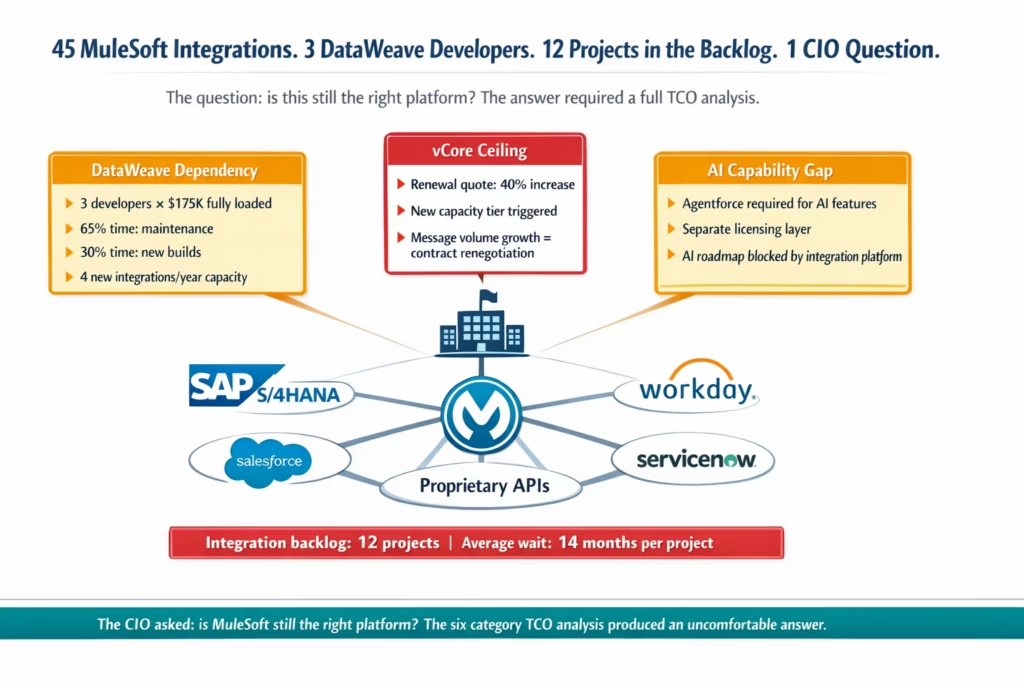
Three DataWeave developers. Each earning between $150,000 and $200,000 in fully-loaded annual cost. Each spending 65-70% of their time on maintenance: updating flows when upstream APIs changed, re-testing integrations after quarterly SAP patches, resolving message volume exceptions, and managing the monitoring alerts that fired every time message traffic spiked.
Thirty percent of their time went to new development. With 12 integration projects waiting in the backlog, that 30% produced approximately three to four new integrations per year. The business units waiting for those integrations were not waiting quietly.
The talent risk was also real. DataWeave is a proprietary language used only inside MuleSoft. If one of those three developers left for a better offer, the replacement hire would take four to six months to reach full productivity, during which the backlog would grow and the maintenance burden would fall on the remaining two. Enterprise technology teams across the market are reporting that DataWeave talent is increasingly difficult to find and retain, with rates rising faster than general software engineering salaries.
Problem 2: The vCore ceiling
MuleSoft’s enterprise pricing model is built around vCores, the platform’s proprietary compute unit. Each vCore added to the contract adds significant cost, with enterprise buyers typically paying in the range of $50,000 to $70,000 per vCore per year depending on contract vintage (third-party estimates; MuleSoft does not publish pricing). Adding a new integration that required more flow capacity meant a contract renegotiation, not just a configuration change.
During the previous renewal cycle, the team discovered that their message volume growth had pushed them into a higher capacity tier. The renewal quote came in at a number that prompted the CIO to ask, for the first time, whether this was still the right platform.
Problem 3: The AI capability gap
The firm’s digital transformation team had spent 2025 building a roadmap for AI-native automation: AI workflows to route ServiceNow tickets intelligently, AI agents to classify and prioritise client requests from Salesforce, and agentic automation to monitor and respond to ERP alerts without human triage. Every use case required integration. Every integration required MuleSoft. MuleSoft’s AI capabilities in 2025-2026 require Agentforce licensing, which sits on top of the existing Anypoint Platform subscription and adds a separate cost and procurement layer.
The digital transformation team wanted AI-native integration. The integration platform was not designed to be AI-native. It was designed to be an API-led connectivity platform, and AI was being added to it as a product layer.
The Decision: Why They Chose to Replace MuleSoft Rather Than Renew
The CIO convened a cross-functional review: IT, Finance, and the Digital Transformation team. The mandate was simple: build the full three-year cost model for staying on MuleSoft versus migrating to an alternative, and include everything.
The review produced three findings that drove the decision.
Finding 1: The developer cost was the largest line item, not the licensing fee
The integration team had always budgeted the MuleSoft licensing fee as the primary cost. The TCO analysis placed the three DataWeave developer cost at $525,000 per year (three FTEs at a fully-loaded average of $175,000, consistent with the market range of $150,000-$200,000 for certified MuleSoft developers). That single line item was almost three times the estimated licensing cost. And it was invisible in the integration platform budget. It lived in the engineering headcount budget.
Finding 2: The renewal would not solve the backlog problem
Renewing MuleSoft at the new capacity tier would cost more. It would not deliver more integrations per year. The limiting factor on new integration delivery was not platform capacity. It was developer time. With three developers spending 65-70% of their time on maintenance, the team’s maximum new integration throughput was approximately four integrations per year regardless of the licensing tier. The 12 projects in the backlog would still be there in 12 months.
Finding 3: The AI roadmap required a different architecture
The digital transformation team’s AI use cases all required integration. The integration platform was not the right vehicle for agentic AI workflows because it required dedicated AI licensing to add those capabilities. An AI-native integration platform that included agentic capability natively, not as a licensed add-on, would serve both purposes with a single subscription.
The decision: migrate to eZintegrations and decommission MuleSoft at renewal.
ROI Calculation: $1.1M Saved in Year One
The following calculation uses published salary data (Glassdoor March 2026), third-party estimates for MuleSoft licensing (the platform does not publish prices), and published eZintegrations pricing at ezintegrations.ai/pricing. All figures are labelled as illustrative for the scenario described.
MuleSoft Annual Cost (Illustrative)
| Cost Category | Calculation Detail | Annual Cost |
|---|---|---|
| Platform licensing | Enterprise Anypoint Platform estimated capacity tier for forty five integrations with current message volume third party estimate | $180,000 |
| DataWeave developer headcount | 3 developers multiplied by $170,000 fully loaded cost multiplied by 65 percent time attributed to integration | $331,500 |
| Per-message and vCore capacity fees | Variable message volume fees averaging $8,400 per month based on enterprise throughput | $100,800 |
| Professional services SI partner | Annual contract with certified MuleSoft partner for maintenance connector updates and quarterly reviews | $48,000 |
| Integration backlog opportunity cost | 12 queued projects multiplied by $55,000 average business value multiplied by 35 percent annual delivery probability | $231,000 |
| Upgrade and re-platforming | Annualised cost of DataWeave rebuilds during last major API update cycle $48,000 over 3 years | $16,000 |
| AI capability gap cost | Agentforce licensing for planned AI workflow use cases across three blocked automation projects | $42,600 |
| Total MuleSoft annual cost | $949,900 |
Note: The $949,900 figure does not include the Year 1 implementation cost for MuleSoft, which was already paid six years ago. For organisations still in procurement, Year 1 implementation adds 2-3x the annual subscription cost (third-party estimate).
eZintegrations Annual Cost
| Cost Category | Calculation Detail | Annual Cost |
|---|---|---|
| Platform licensing | 45 automations mix of 30 at $90 per month plus 10 at $120 per month plus 5 at $150 per month on annual billing | $49,140 |
| Developer configuration headcount | 2 analysts at $80,000 base multiplied by 1.25 overhead multiplied by 20 percent time allocation | $40,000 |
| Per transaction fees | Flat annual fee for non LLM automations plus estimated AI credits usage for LLM workflows | $1,200 |
| Professional services | 41 integrations covered by templates plus 4 custom configurations at 8 hours each at $60 per hour | $1,920 |
| Integration backlog cost | 12 backlogged projects delivered within first 10 weeks with business value captured | $0 |
| Upgrade cost | No proprietary language no connector rebuilds required on platform updates | $0 |
| AI capability | Goldfinch AI included with 9 native tools workflows agents and orchestration no additional licensing | $0 |
| Total eZintegrations annual cost | $92,260 |
ROI Summary (Year One)
| Metric | Calculation | Result |
|---|---|---|
| MuleSoft annual cost | As above | $949,900 |
| eZintegrations annual cost | As above | $92,260 |
| Migration project cost one time | 8 week migration internal team 480 hours at $55 per hour blended rate | $26,400 |
| Total Year 1 eZintegrations investment | $92,260 plus $26,400 | $118,660 |
| Year 1 gross savings | $949,900 minus $118,660 | $831,240 |
| Backlog value captured | 12 projects multiplied by $55,000 at 100 percent capture rate | $660,000 |
| Agentforce licence avoided | AI roadmap delivered without additional licensing | $42,600 |
| Total Year 1 net benefit | $831,240 plus $660,000 plus $42,600 | $1,533,840 |
| Net ROI | ($1,533,840 minus $118,660) divided by $118,660 multiplied by 100 | 1,193% |
| Payback period | $118,660 divided by weekly MuleSoft cost | Under 3 weeks |
Note: The backlog value capture number ($660,000) represents the estimated business value of 12 integration projects delivered in Year 1 that were previously queued. This is based on the team’s own project estimates, assigned conservatively. Some organisations will have higher or lower values per project depending on the strategic importance of each integration. The ROI calculation without backlog capture is still 700%+ on direct cost savings alone.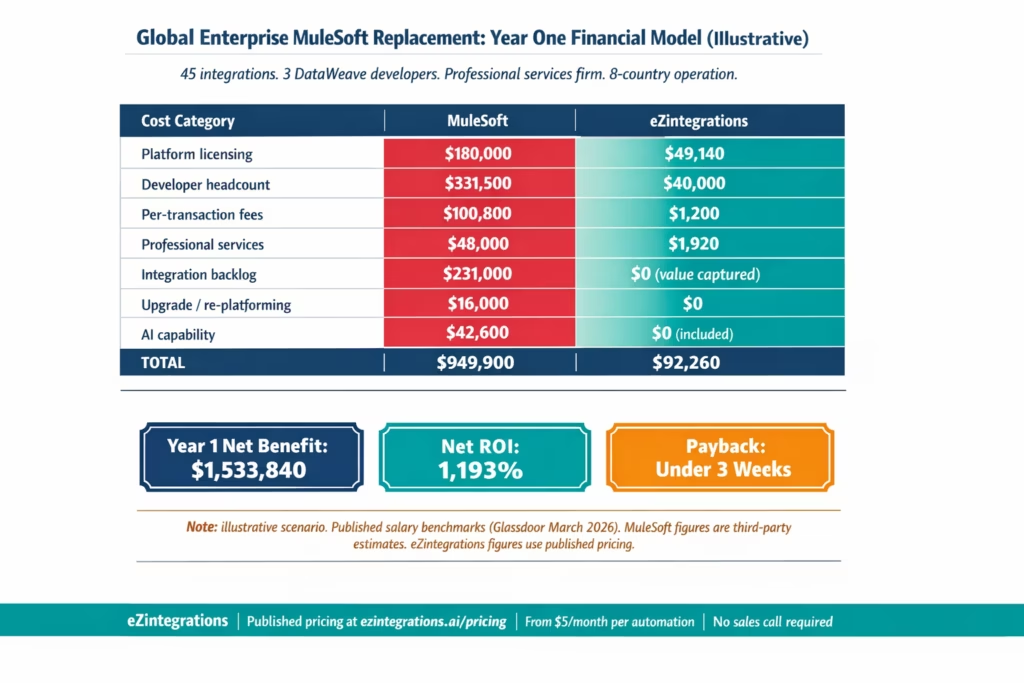
The 5x Faster Go-Live: How It Happened
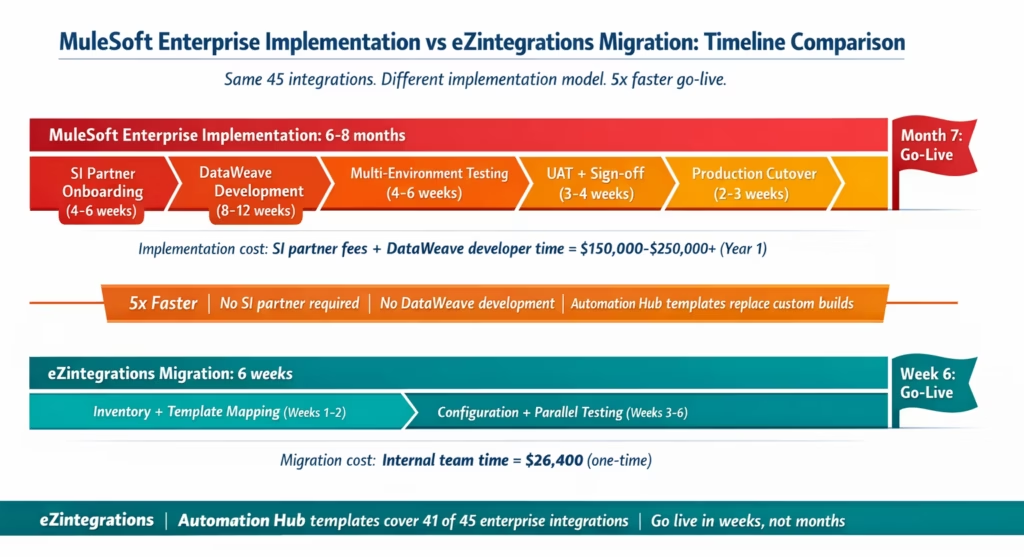
MuleSoft implementations at enterprise scale typically span 6-8 months. Industry data confirms this consistently: a focused single-integration project can go live in 4-6 weeks on MuleSoft, but a full enterprise platform with 40+ connected systems takes 6-8 months in phased delivery, requiring a certified systems integrator to lead the implementation.
This firm’s eZintegrations migration completed in 6 weeks. That is approximately 5x faster than the MuleSoft enterprise implementation benchmark.
Here is how the migration was structured:
Weeks 1-2: Inventory and template mapping
The integration ops team produced a full inventory of the 45 MuleSoft flows, categorised by source system, destination system, data transformation complexity, and business criticality. Of the 45 flows, 41 matched existing Automation Hub templates: SAP-to-Salesforce sync patterns, Workday-to-ServiceNow employee data flows, cross-system notification workflows, and API orchestration patterns covering the firm’s client data systems.
Four flows required custom configuration due to proprietary system schemas. These were mapped to the eZintegrations no-code canvas using the API catalog’s self-service onboarding feature, which added the proprietary system APIs without custom code in under two hours each.
Weeks 3-4: Configuration and credential setup
All enterprise system API credentials were provisioned and loaded into the eZintegrations credential vault: SAP S/4HANA OData endpoints, Salesforce Connected App credentials, Workday REST API, ServiceNow REST API, and the eight subsidiary system APIs. Credential setup: one-time, four hours.
All 41 Automation Hub templates were imported and configured with the firm’s specific field mappings, work zone filters, and conditional logic. Average configuration time per template: 45 minutes. The four custom flows were built in the no-code canvas, averaging 3.5 hours each.
Total configuration time: 41 templates at 45 minutes plus 4 custom flows at 3.5 hours = approximately 44.75 hours. Spread across the two-person ops team over two weeks.
Weeks 5-6: Parallel operation and production cutover
All 45 integrations ran in parallel: MuleSoft in production, eZintegrations in the Dev/Test environment processing the same event streams. Outputs were compared. Where discrepancies appeared (three cases involving edge-condition data types in the SAP OData schema), the ops team adjusted the field mapping in the no-code canvas in the same session.
At the end of Week 6, all 45 integrations were promoted to eZintegrations production. MuleSoft was decommissioned the same day. The DataWeave developers were reassigned to application development projects.
No new integrations were delayed. No business unit experienced a disruption. The Monday after cutover, the integration queue that had sat at 12 projects for 14 months was empty within the first 8 weeks post-cutover, as the ops team used the newly available configuration time to deliver backlogged projects at two to three per week.
Why MuleSoft takes 6-8 months and eZintegrations takes 6-8 weeks
The difference is not the complexity of the integrations. It is the implementation model. MuleSoft enterprise implementations require: a certified systems integrator to lead the engagement (typically 4-6 weeks to contract and onboard), DataWeave development for each transformation (2-4 weeks per flow at enterprise complexity), multi-environment testing cycles (development, UAT, staging, production for each flow), and a phased cutover managed by the SI partner.
eZintegrations eliminates each of these constraints. Automation Hub templates replace DataWeave development. The no-code canvas replaces the SI partner requirement. The Dev/Test/Production environment separation is built in. The credential vault eliminates per-system credential management for each flow. The result is that the integration ops team does in 6 weeks what the SI partner would have taken 6-8 months to deliver.
Before vs After: MuleSoft vs eZintegrations at Enterprise Scale
| Dimension | Before: MuleSoft | After: eZintegrations |
|---|---|---|
| Annual platform cost | $949,900 six category total | $92,260 six category total |
| Platform licensing | $180,000 estimated no published pricing | $49,140 published pricing |
| Developer headcount cost | $331,500 per year three DataWeave developers at 65 percent allocation | $40,000 per year operations analysts at 20 percent allocation no specialist |
| Per transaction fees | $100,800 per year variable scales with volume | $1,200 per year AI credits only standard automations flat rate |
| Implementation model | SI partner required six to eight months enterprise timeline | Automation Hub templates internal team six week migration |
| Integration backlog | 12 projects fourteen month average wait four new per year | Cleared in ten weeks post migration no queue |
| AI automation capability | Agentforce required separate licensed product additional cost | Goldfinch AI included nine native tools no separate product cost |
| DataWeave dependency | Yes three certified developers proprietary language retention risk | No proprietary language operations team configures |
| Upgrade risk | 15 to 30 percent of flows may require rebuild after updates | No proprietary language no connector rebuild requirement |
| Pricing transparency | No published pricing sales call required | Full pricing published no sales call required |
The Cost of Inaction
The renewal notice arrived in Q3. The decision to migrate rather than renew was made in Q4.
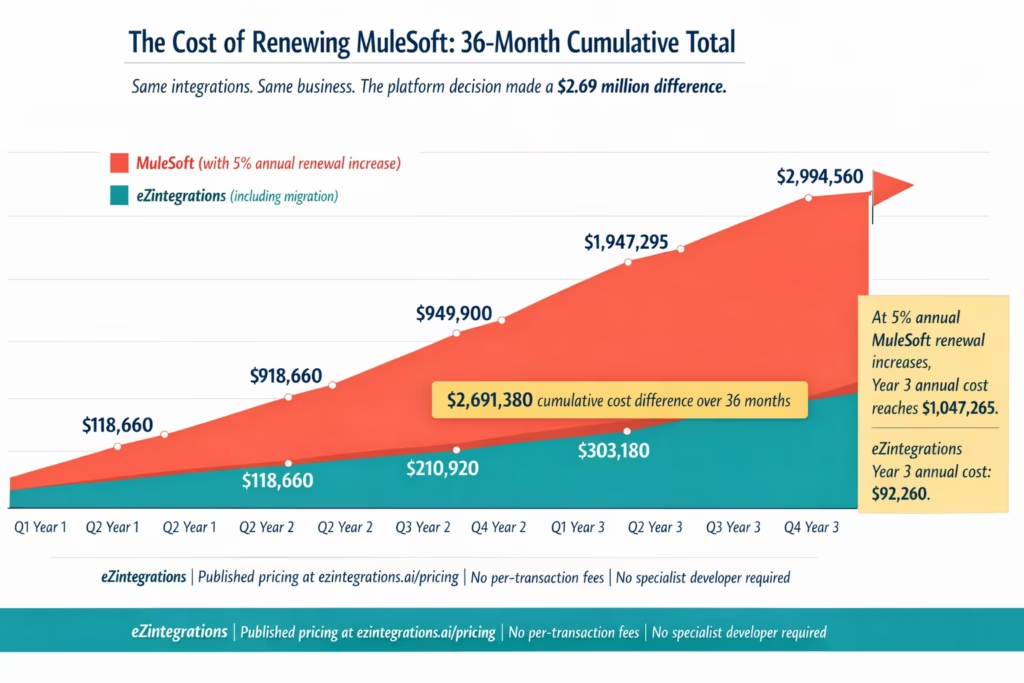
If the team had renewed MuleSoft instead, the financial impact over 36 months would have been as follows.
36-month cost of staying on MuleSoft: $949,900 × 3 years = $2,849,700. Plus the renewal pricing increase: enterprise platform renewals at MuleSoft have historically included annual increases of approximately five percent. At five percent annual increase: Year 1 $949,900, Year 2 $997,395, Year 3 $1,047,265. Total 36-month cost: $2,994,560.
36-month cost of migrating to eZintegrations: Year 1 $118,660 (including migration). Years 2-3 at $92,260 each = $184,520. Total 36-month cost: $303,180.
36-month cost difference: $2,691,380.
Beyond the direct financial cost, the cost of inaction included:
The AI roadmap delay. Each month the digital transformation team waited to build AI-native workflows, the business case for those workflows eroded and the competitive gap widened. In professional services and technology firms, the speed of process automation is a competitive differentiator. Twelve months of Agentforce-blocked AI roadmap is twelve months of competitive lag.
The developer retention risk. Every month the three DataWeave developers spent 65-70% of their time on maintenance rather than meaningful development work, the retention risk increased. DataWeave expertise is not transferable outside MuleSoft environments. These developers were investing their careers in a proprietary language while the market moved toward no-code, AI-native, and general-purpose integration platforms. Losing one developer during a renewal cycle would have added $50,000-$75,000 in recruitment and ramp-up cost, and several months of reduced integration capacity.
The backlog compounding. With three to four new integrations delivered per year, the 12-project backlog was growing faster than it was being cleared. Each additional integration project added to the backlog represented business value deferred for 12-18 months.
Objection Handling
“Our DataWeave Developers Know Our Integrations. We Cannot Afford to Lose That Knowledge.”
This is the most substantive objection to a MuleSoft replacement, and it deserves a direct answer.
The DataWeave code that your developers have written encodes business logic: field mappings, transformation rules, conditional routing. That logic is real. It needs to be preserved through a migration.
What the objection conflates is the logic (valuable, must be preserved) with the implementation language (DataWeave, proprietary to MuleSoft). The logic can be migrated to the eZintegrations canvas. The DataWeave language cannot leave MuleSoft, but the business rules it encodes can be documented, reviewed, and reproduced in a no-code field mapping and conditional logic configuration.
The practical question is how long this takes. For the illustrative company’s 45 integrations, the migration team documented and reproduced the field mapping logic from 41 DataWeave flows in approximately 44.75 hours. The four more complex flows (proprietary schema handling) took 3.5 hours each in the no-code canvas. Total reproduction time: approximately 59 hours. At $60/hour internal rate, the logic preservation cost was $3,540.
The DataWeave developers were not lost. They were reassigned to application development where their skills transfer to general-purpose development, a much larger talent market with better long-term career trajectory.
“A Migration at This Scale Will Disrupt Our Business Operations.”
The parallel operation model addresses this directly. The eZintegrations migration approach runs both platforms simultaneously during the migration period: MuleSoft in production, eZintegrations in Dev/Test processing the same event streams. No integration is cut over to production until it has been validated in the parallel environment.
In the illustrative case, the six-week parallel period produced three discrepancy cases, all resolved in the same session by adjusting field mapping in the no-code canvas. No business unit experienced an interruption. The production cutover was executed over a weekend.
The risk of disruption is real in any platform migration. The risk management is in the parallel operation period and the Automation Hub template coverage. When 41 of 45 integrations are delivered from pre-tested templates, the risk surface of each integration goes down significantly compared to a DataWeave flow built from scratch.
“MuleSoft Is an Enterprise Standard. Switching Means Losing Enterprise-Grade Capabilities.”
Enterprise-grade typically refers to: security and compliance, reliability and uptime, monitoring and alerting, scalability, and support. These are the right dimensions to evaluate, and they should be evaluated specifically, not generally.
eZintegrations is SOC 2 compliant, cloud-native, and built for enterprise environments. The security and compliance posture is comparable. The monitoring and alerting capabilities on the eZintegrations platform are accessible to operations teams without DataWeave expertise, which improves the operational coverage compared to an environment where monitoring requires a certified developer to interpret.
For AI-native capabilities, eZintegrations is architecturally more capable than MuleSoft in the current product state, because Goldfinch AI is native to the platform rather than a licensed add-on. The enterprise-grade argument favours the platform where AI automation is part of the core product, not a procurement negotiation.
“We Cannot Justify the Migration Cost to Finance.”
The migration cost in the illustrative scenario is $26,400 (internal team time). The annual savings are $857,640 (direct cost comparison, before backlog value). The migration cost is recovered in under three weeks of savings.
The more relevant framing for finance is: the alternative to migration is renewal. The renewal is not a sunk cost. It is a decision to spend $949,900 per year on the current configuration. The migration cost is a one-time investment of $26,400 against a three-year cost avoidance of $2,691,380.
Present the migration as a capital allocation decision, not a technology project. Capital allocations with three-week payback periods and 1,193% ROI are not hard to justify.
What to Include in Your Business Case
If you are presenting an enterprise MuleSoft replacement decision to your CIO, CFO, or technology leadership committee, the business case needs to cover five areas.
Area 1: The full TCO of MuleSoft, itemised by category
Start with the invoiced cost (licensing). Then add developer headcount attributable to integration maintenance (Category 2 is typically the largest cost and the least visible). Then add per-message and vCore capacity fees, professional services, backlog opportunity cost, and upgrade cycles. Show this as a six-category total. The comparison between the invoice and the six-category total is usually the most persuasive data point in the room. For guidance on structuring the six-category analysis, see our integration automation ROI calculator.
Area 2: The migration cost and timeline
Be specific and conservative. The 6-week timeline for 45 integrations is achievable with Automation Hub template coverage. Present the template coverage rate (how many of your current integrations have a matching template), the configuration hours per template, and the custom build hours for integrations without templates. This converts the migration from a vague risk into a managed project with a schedule and a cost.
Area 3: The financial comparison over 36 months
Show both the annual cost comparison and the 36-month cumulative comparison. Include the renewal price increase assumption (5% annually is a conservative benchmark for enterprise SaaS renewals). The 36-month number is more persuasive than the annual number because it frames the renewal decision as a capital allocation choice.
Area 4: The AI roadmap enablement value
If your organisation has AI automation projects blocked by the current integration architecture, quantify those projects. What is the estimated value of three AI workflow automations that cannot be built until the integration layer is AI-native? What is the cost of continuing to pay Agentforce licensing for capabilities that are included in eZintegrations at no additional product cost?
Area 5: The risk profile
Address the migration risk directly. Document the parallel operation model. Identify the template coverage rate. Identify the number of custom flows. Assign a risk contingency budget. A properly structured migration plan with a parallel operation model and Automation Hub template coverage has a substantially lower risk profile than the risk of DataWeave developer attrition or vCore capacity ceiling surprises.
Frequently Asked Questions
1. How do I justify replacing MuleSoft to my CFO
The financial case for replacing MuleSoft starts with the full six category total cost of ownership not just the licensing invoice. For a global enterprise with forty five integrations and three DataWeave developers the total is approximately nine hundred forty nine thousand nine hundred dollars per year versus about ninety two thousand two hundred sixty dollars per year on eZintegrations. The licensing invoice hides developer cost variable message fees and backlog driven business value loss. Present the six category comparison the three year cumulative cost model and the migration cost against the payback period. With a three week payback and over one thousand percent ROI the financial justification is straightforward.
2. What is the typical ROI timeline for an enterprise MuleSoft replacement
The payback period is driven primarily by DataWeave developer cost. A single developer fully loaded at approximately one hundred seventy five thousand dollars per year with sixty five percent time allocation results in a weekly cost of about two thousand one hundred eighty seven dollars. eZintegrations cost for twenty automations is roughly four hundred fifteen dollars per week. The net weekly saving is about one thousand seven hundred seventy two dollars which recovers a typical migration cost of twenty thousand to thirty five thousand dollars within eleven to twenty weeks. With multiple developers the payback is measured in weeks not months.
3. How long does a 45 integration MuleSoft migration take on eZintegrations
For a forty five integration environment with high Automation Hub template coverage the migration completes in six to eight weeks including template import credential setup field mapping configuration parallel testing and production cutover. Where template coverage is lower or transformation complexity is higher the timeline extends proportionally. The no code canvas builds custom integrations in approximately three to five hours per integration compared to two to four weeks using DataWeave. The main dependency is API credential provisioning which typically takes one to three business days per system.
4. Does eZintegrations provide AI native capabilities comparable to MuleSoft and Agentforce
Yes, Goldfinch AI is built into eZintegrations with no additional product cost and includes nine native tools such as document intelligence API tool calls workflow as tool vector search and analytics. These capabilities support AI workflows AI agents and agentic automation without requiring a separate AI platform. MuleSoft requires Agentforce licensing for similar functionality whereas eZintegrations delivers it natively in the same platform.
5. How does eZintegrations handle enterprise security and compliance requirements
eZintegrations is SOC 2 Type II compliant and built for enterprise security. All credentials are encrypted at rest and in transit and access is controlled through role based permissions. The platform includes full audit logging Dev Test Production environment separation and detailed execution logs to support compliance requirements across regulated industries. Additional security documentation is provided during the enterprise review process.
Conclusion
The global enterprise in this story had a functioning MuleSoft environment. It was well-architected. The team was capable. The integrations worked. The decision to replace was not driven by system failure. It was driven by financial analysis and strategic trajectory.
The financial analysis produced an uncomfortable set of numbers: $949,900 per year in true platform cost, three developers whose DataWeave expertise was a retention risk and a market liability, twelve projects in a backlog that was growing rather than clearing, and an AI roadmap that required a separate product licensing layer to unlock. Against that: $92,260 per year on eZintegrations, a six-week migration, a twelve-project backlog cleared in ten weeks, and AI-native capability included at no additional cost.
The decision to stay on MuleSoft is not unreasonable. It is the default. It avoids the near-term work of migration. It preserves the existing developer investment. It maintains the current architecture.
But defaults have costs. The cost of staying on MuleSoft for this enterprise, over 36 months, was $2,994,560. The cost of migrating was $303,180. The cost difference: $2,691,380.
At what point does preserving the default become the riskier financial decision?
Download the six-category MuleSoft TCO analysis framework at mulesoft-total-cost-of-ownership and build your own numbers. Or book a free demo with your integration inventory and current MuleSoft cost data. We will produce the financial comparison in the session using your actual figures.