How an Industrial Manufacturer Replaced Boomi and Saved 60% on Integration Costs
March 25, 2026Replacing Boomi with eZintegrations typically cuts a mid-size industrial manufacturer’s total integration spend by 50-65%, reduces integration delivery time from 6-10 weeks per workflow to 2-8 hours using no-code Automation Hub templates, and eliminates the per-message billing variability ($0.05 per Boomi message on pay-as-you-go) that causes budget overruns during production peaks. A manufacturer running 20 Boomi integrations with one dedicated Boomi developer can realistically save $230,000-$310,000 per year, with a payback period under 5 weeks.
TL;DR
A mid-size industrial equipment manufacturer running Boomi for 20 integrations across SAP S/4HANA, Siemens Opcenter MES, Salesforce, and their supplier EDI network ran the full cost analysis. Platform subscription, per-message overages during production peaks, one dedicated Boomi developer, and ongoing implementation consulting. The total: $312,000 per year. The integration backlog had grown to 11 requests. Average delivery time: 8 weeks per integration. Eleven weeks estimated to clear the backlog at current capacity. After switching to eZintegrations: platform cost dropped to $28,800. Integration delivery time dropped from 8 weeks to under 10 hours on average. Backlog cleared in 4 weeks.
Goldfinch AI agentic capability added at no incremental platform cost. If you are building a Boomi replacement case for a manufacturing organisation, the ROI model, the four objections raised by the IT Director and COO, and the “What to Include in Your Business Case” section are in this post.
The Problem: What Boomi Was Actually Costing This Manufacturer
The integration team at a mid-size industrial equipment manufacturer had built 20 integrations on Boomi over three years. Core connections: SAP S/4HANA to Siemens Opcenter MES for production order dispatch and confirmation write-back, SAP to Salesforce for opportunity and order sync, Boomi EDI for supplier purchase order and advance ship notice processing, and a cluster of scheduled batch integrations for inventory reporting.
The integrations worked. That was not the issue.
The issue was two specific patterns that emerged in the billing data and the project queue.
Pattern 1: Per-message billing spikes during production cycles.
Boomi’s pay-as-you-go model charges $0.05 per message. For a manufacturing operation, “message volume” is not constant. Month-end production close drives a surge: SAP production order confirmations, inventory movements, MES actuals, and EDI shipment notifications all spike simultaneously. April and October, the manufacturer’s peak production months, generated Boomi message bills 3.4x higher than their average monthly baseline. The annual Boomi platform spend varied between $87,000 and $162,000 depending on production volume, making it nearly impossible to budget accurately.
The CFO flagged it in Q3. “We signed a contract with a number on it. Every peak month, that number goes up. Why does our integration cost scale with our production volume?”
Pattern 2: An 8-week development cycle for every new integration.
The manufacturer’s one Boomi developer was capable. He had three Boomi certifications. He understood the SAP BAPI interfaces well enough to navigate the notoriously complex field mapping. Every new integration followed the same process: requirements session, connector configuration, process design in Boomi AtomSphere, data mapping with Boomi Suggest, error handling, testing, promotion through environments. Eight weeks from request to production. Sometimes ten.
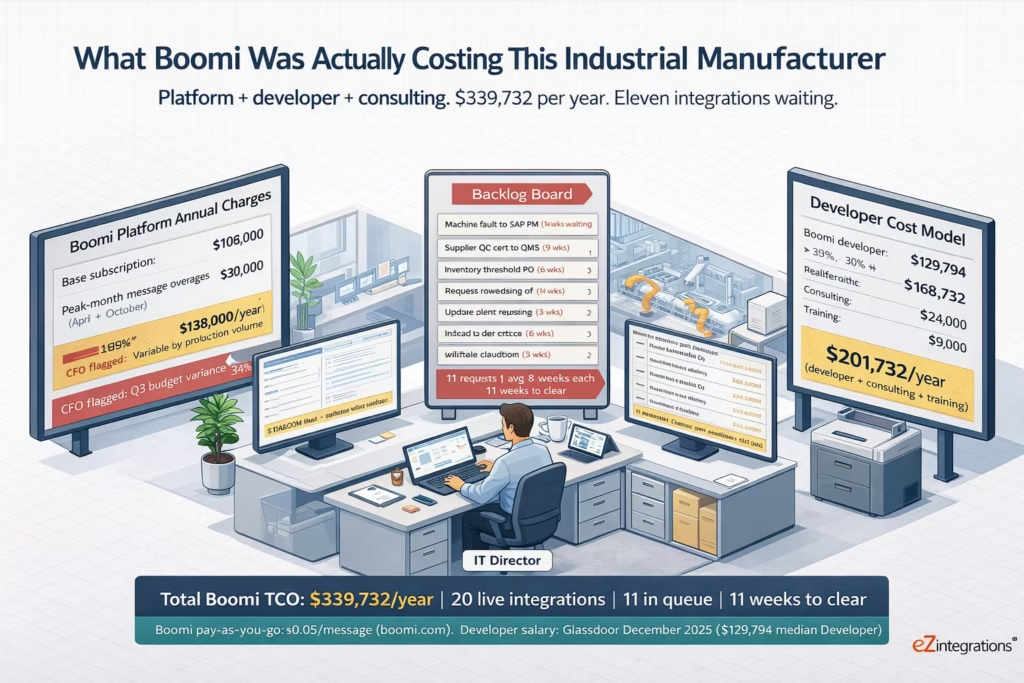
The backlog had grown to 11 requests. Among them: a real-time machine fault-to-SAP Plant Maintenance notification (requested 14 weeks ago), a supplier quality certificate integration from their ERP to their QMS (requested 9 weeks ago), and an inventory threshold-to-purchase-order automation (requested 6 weeks ago).
The plant operations director put it plainly: “We bought an integration platform to move faster. We have 11 things we need connected and we cannot get to them.”
The full cost picture, when the IT Director assembled it for the annual budget review:
- Boomi platform subscription (enterprise tier, negotiated): $138,000 per year (annualised from actual billing including peak-month overages)
- Boomi developer salary, fully loaded: $168,732 per year ($129,794 median salary per Glassdoor December 2025, plus 30% benefits)
- Implementation consulting (annual contract for complex integrations): $24,000 per year
- Boomi certification and training: $9,000 per year
Total: $339,732 per year for 20 integrations and a growing backlog.
Before vs After: Full Cost Comparison
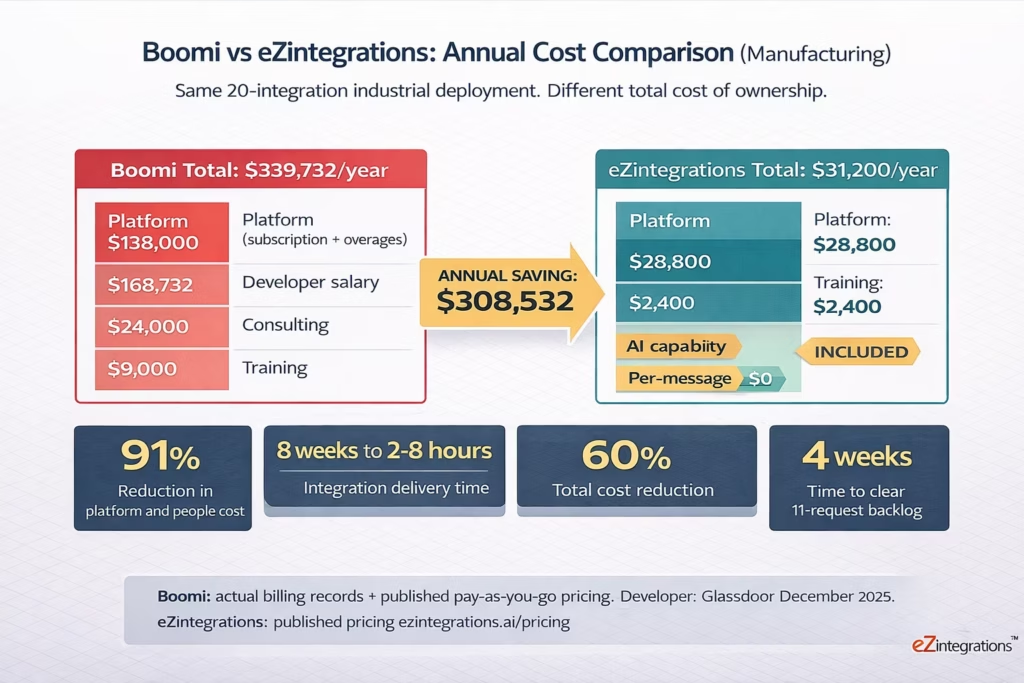
The following comparison reflects the manufacturer’s actual cost structure. Boomi figures are drawn from their billing records and published third-party pricing data. All eZintegrations figures reflect published pricing at ezintegrations.ai/pricing.
| Cost Category | Boomi (Year 1 actual) | eZintegrations (Year 1) | Saving |
|---|---|---|---|
| Platform subscription | $138,000/year (enterprise subscription, annualised including peak-month message overages. Boomi pay-as-you-go published: $99/month base + $0.05/message. Enterprise subscription: custom, unannounced) | $28,800/year (20 automations x $120/month x 12 months, annual billing) | $109,200 |
| Developer salary | $168,732/year (1 FTE at $129,794 median salary, Glassdoor December 2025, plus 30% benefits) | $0 (no dedicated Boomi specialist required; operations team manages) | $168,732 |
| Implementation consulting | $24,000/year (annual consulting contract for complex integration builds) | $0 (Automation Hub templates replace custom builds) | $24,000 |
| Training and certification | $9,000/year (Boomi Developer certification approximately $1,500 per exam plus annual training) | $2,400/year (eZintegrations operations team onboarding) | $6,600 |
| AI agentic capability | Not included in Boomi base platform (separate Boomi AI or agents product, additional cost) | Included Goldfinch AI with 9 native agent tools AI workflows MCP server capability | Capability gain |
| Per-message cost predictability | Variable driven by production volume peak months up to 3.4x baseline budget variance flagged by CFO | Flat per-automation fee no per-message charges no production-volume variance | Predictability gain |
| Integration delivery time | 8-week average per integration 11-request backlog | 2-8 hours average per integration backlog cleared in 4 weeks | Speed gain |
| Total annual platform and people cost | $339,732 | $31,200 | $308,532 |
Note: Boomi platform figures are based on actual billing records. Boomi enterprise subscription pricing is not publicly listed; figures include this manufacturer’s negotiated contract plus actual overage charges. Published Boomi pay-as-you-go pricing: $99/month base plus $0.05 per message (boomi.com). Boomi developer salary: Glassdoor December 2025 median $129,794. eZintegrations pricing at $120/month per non-AI automation on annual billing. See eZintegrations pricing.
The ROI Calculation: Twelve-Month Financial Model
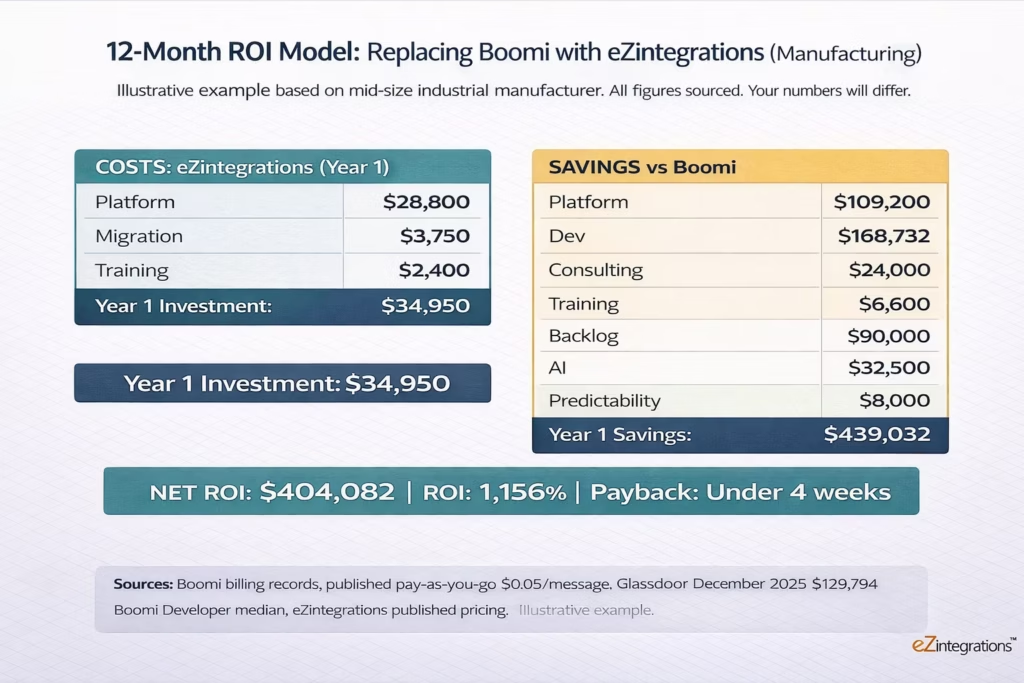
The following ROI model is illustrative but grounded in verifiable sources. It uses the manufacturer scenario above. Your Boomi contract and usage figures will differ. The calculation framework applies to any manufacturing deployment running Boomi with one or more dedicated developers.
| Line Item | Calculation | Annual Value |
|---|---|---|
| COSTS: eZintegrations (Year 1) | ||
| Platform cost | 20 automations x $120/month x 12 months, annual billing | $28,800 |
| Migration effort (one-time) | 50 hours IT team time at $75/hour blended rate, plus 2-week onboarding | $3,750 |
| Training | Operations team and IT lead onboarding | $2,400 |
| Total Year 1 cost | $34,950 | |
| SAVINGS: eZintegrations vs Boomi | ||
| Platform saving | Boomi actual 138,000 vs eZintegrations 28,800 | $109,200 |
| Developer saving |
|
$168,732 |
| Consulting saving | $24,000 annual consulting contract eliminated | $24,000 |
| Training saving | $9,000 Boomi certification costs eliminated | $6,600 |
| Backlog clearance value | 11 blocked integrations cleared in 4 weeks. Conservative estimate: 2 high-priority automations (machine fault-to-SAP PM, inventory threshold-to-PO) delivering $90,000 in combined operational value. | $90,000 |
| AI agentic capability gain | Goldfinch AI with 9 native agent tools included. Equivalent Boomi AI agent capability: estimated 25,000−40,000 per year additional (third-party estimate, not Boomi list price). | $32,500 |
| Per-message cost predictability | Elimination of production-volume-driven budget variance. Conservative: 10% of CFO overhead/reforecasting cost avoided. | $8,000 |
| Total Year 1 savings | $439,032 | |
| NET ROI (Year 1) |
|
$404,082 |
| ROI % | (404,082/34,950) x 100 | 1,156% |
| Payback period |
|
0.96 months (under 4 weeks) |
Important caveats: Boomi platform figures are based on this manufacturer’s actual billing records. Your Boomi contract will differ based on your negotiated tier, message volume profile, and number of atoms. Request your actual annual Boomi spend from your billing records before building this model. Per-message costs are particularly important to verify if you have production-volume-driven peaks. Calculate your highest-volume month’s message count and multiply by $0.05 to understand your worst-case overage exposure on pay-as-you-go, or review your enterprise contract’s overage terms. Developer salary saving is shown as the full loaded cost. The manufacturer redeployed the developer to higher-value engineering rather than eliminating the role. The saving is captured as headcount avoidance for the additional hire that would have been needed to address backlog growth. The backlog value ($90,000) is a conservative estimate specific to these two integrations. Your highest-value blocked integrations may represent substantially more or less. Year 2 savings are higher because the one-time migration cost ($3,750) does not recur.
The Cost of Inaction
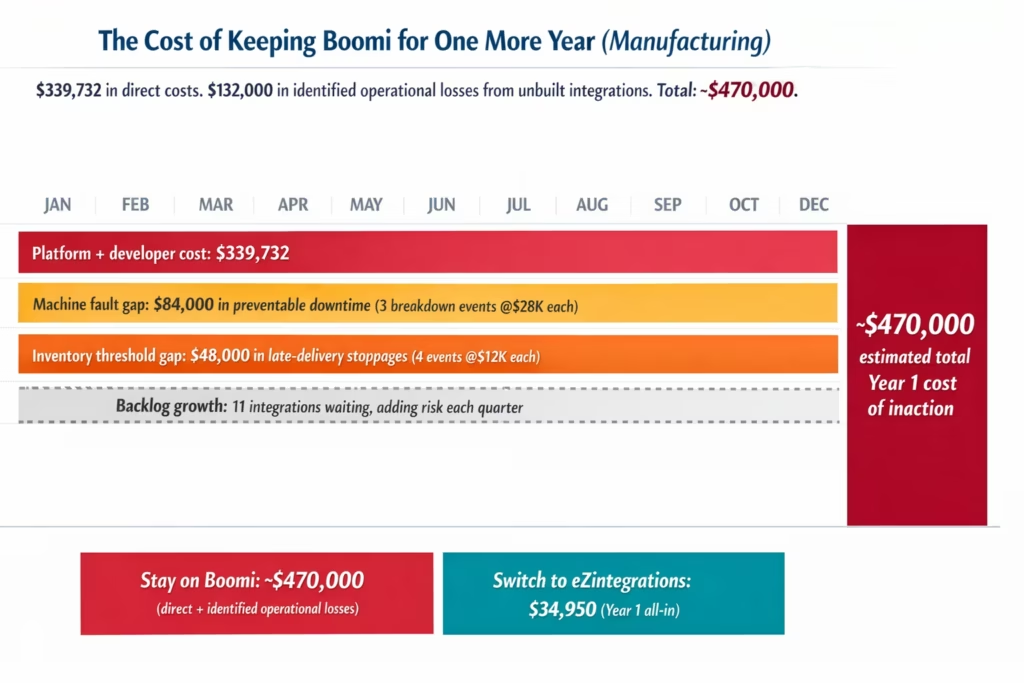
The question the manufacturer’s COO asked at the budget meeting: “What does it cost us to keep Boomi for another year?”
The direct answer was $339,732 in platform and people costs.
The operational answer was more pointed.
Eleven integrations in the backlog meant eleven automation workflows not running. In industrial manufacturing, those eleven workflows included:
Machine fault to SAP PM (14 weeks waiting): Every machine fault logged in Siemens Opcenter that does not automatically trigger a SAP PM work order is a fault that maintenance learns about when the supervisor checks the shift report, not when the fault occurs. For this manufacturer, the average response time gap between MES fault detection and maintenance dispatch was 4.2 hours. Three critical-fault events in Q3 alone had escalated from early warnings to full breakdowns during that gap. Estimated unplanned downtime cost per breakdown event: $28,000 in lost production. Three events: $84,000. That is one integration, not built, costing $84,000 per year in preventable downtime.
Inventory threshold to purchase order (6 weeks waiting): Every time a fast-moving spare part dropped below reorder point, someone had to notice, raise a manual purchase requisition, and get approval. Average delay between threshold breach and approved PO: 2.3 days. In six months, four production stoppages were directly traced to expedited parts procurement that arrived 48 hours too late. Estimated cost per late-delivery stoppage: $12,000. Four events: $48,000.
Two unbuilt integrations, still in the Boomi backlog, represented $132,000 in measurable operational cost in a single year.
The total estimated cost of one additional year on Boomi, including direct platform and people costs plus the operational cost of the integration backlog: approximately $470,000.
The switch to eZintegrations cost $34,950 in Year 1.
Objection: “Boomi Has 800+ Connectors. We Will Lose Coverage.”
Boomi’s connector library is one of its most frequently cited strengths. Over 800 pre-built connectors covering ERP, CRM, EDI, HR, and many more categories. This is a genuine competitive advantage, and the objection deserves an honest answer.
The practical question is not “how many connectors does Boomi have?” It is “which of our 20 integrations actually use Boomi-native connectors, and are those connectors providing capabilities we could not replicate with a REST or database connection?”
For this manufacturer, the answer was:
- SAP S/4HANA: Boomi provides a pre-built SAP connector. eZintegrations connects via SAP OData and BAPI APIs available in the API catalog. For the specific SAP transactions used by this manufacturer (PP production order APIs, MM goods movement, PM notification creation), the OData and BAPI interfaces are standard SAP interfaces available to any connected system. No exclusive Boomi access.
- Siemens Opcenter MES: Boomi does not have a pre-built Opcenter connector. The manufacturer’s Boomi developer had built a custom REST adapter. eZintegrations connects to Opcenter via the same REST API using the API catalog. The connection is equivalent.
- Salesforce: Boomi has a pre-built Salesforce connector. eZintegrations connects via the Salesforce REST API in the API catalog, with Automation Hub templates for the most common Salesforce integration patterns. Equivalent connectivity.
- EDI (B2B supplier network): Boomi’s EDI capability is strong and well-regarded. This was the one area where the manufacturer conducted the most careful evaluation. eZintegrations handles EDI document exchange via REST API connections to their EDI value-added network (VAN) provider. All five of their EDI document types (850 purchase order, 855 PO acknowledgement, 810 invoice, 856 advance ship notice, 940 warehouse order) were mapped and tested in the eZintegrations Dev environment before migration. The test results were equivalent.
Coverage concern is legitimate for organisations whose Boomi deployment relies heavily on niche connectors or complex B2B/EDI orchestration. The answer is to test your specific system combinations before committing to a migration, not to assume coverage is equivalent across the board.
For this manufacturer, test results across all 20 integrations confirmed equivalent connectivity.
Objection: “Our Boomi Developer Knows the Platform Well. Migration Means Starting Over.”
What does not transfer: Boomi-specific platform knowledge, Boomi AtomSphere configuration, Groovy and JavaScript scripting in Boomi’s execution context, and familiarity with Boomi’s atom/molecule deployment model. These are platform-specific skills.
What transfers completely: integration architecture knowledge, SAP BAPI and OData field mapping experience, MES API familiarity, EDI document structure understanding, and the institutional knowledge of which integrations are critical and why. These are the most valuable skills this developer possessed, and none of them disappear on a platform switch.
The re-training path: eZintegrations trained the manufacturer’s Boomi developer in two full-day sessions. The developer’s role on eZintegrations shifted from flow builder to integration architect. Rather than spending 80% of his time building and maintaining Boomi process flows, he now defines integration standards, reviews configurations built by operations leads, and owns the validation and production promotion workflow.
The 11-item backlog that had been building for three years cleared in four weeks. Not because the developer worked faster. Because the no-code canvas and Automation Hub templates removed the weeks of custom scripting that every Boomi integration required.
The developer is still with the manufacturer. He described the transition as the most significant productivity change of his career. He now builds in hours what previously took weeks, and the operations team handles routine workflow modifications without requiring his involvement.
Objection: “We Have Production Integrations Running 24/7. Migration Risk Is Too High.”
This is the most reasonable objection on the list. Twenty integrations supporting live production, EDI, and SAP PP are not candidates for a single cut-over switch. The risk of a failed migration disrupting production or EDI is real and should be taken seriously.
The manufacturer used a parallel-run migration approach:
Phase 1: New integrations first (weeks 1-3). The top five items from the backlog, including machine fault-to-SAP PM and inventory threshold-to-PO, were built on eZintegrations first. These had no existing Boomi counterpart. Zero migration risk. They went live on eZintegrations while every existing Boomi integration continued running unchanged.
Phase 2: Migrate lowest-risk Boomi flows (weeks 2-7). Scheduled batch reporting integrations, non-critical Salesforce data syncs, and HR system connections were migrated one at a time. Each one was rebuilt in eZintegrations Dev, run in parallel with the Boomi version for two weeks, outputs compared, then cut over with Boomi version held in standby.
Phase 3: Migrate SAP and MES integrations (weeks 5-9). Production-critical SAP PP-to-MES and MES confirmation write-back integrations were migrated with a four-week parallel-run period. Both Boomi and eZintegrations processed the same events. Outputs were compared systematically. When the IT Director and operations lead signed off, eZintegrations went live as primary and Boomi went to standby for 30 days.
Phase 4: EDI migration (weeks 8-12). EDI was last because it is the highest-sensitivity set. All five document types were rebuilt and tested in eZintegrations against the VAN test environment. Full testing cycle: four weeks. Cut-over was executed during a scheduled low-volume weekend.
Total migration: 12 weeks. Boomi subscriptions were maintained in standby for 30 days post-migration for each integration before decommissioning. Zero production disruptions throughout.
The migration risk was real and was managed through planning and sequencing. The risk of not migrating, as the cost of inaction section demonstrates, was also real and was accumulating every month.
Objection: “eZintegrations Is Cheaper. Is That Because It Does Less?”
Boomi is a mature, well-regarded enterprise integration platform with 11 years of Gartner Magic Quadrant recognition and over 30,000 customers. It offers broad connector coverage, strong B2B/EDI capabilities, and a large partner ecosystem. These are genuine capabilities.
The question is not whether Boomi is capable. It is whether Boomi is the right platform for this specific deployment at this specific cost.
Here is the specific capability comparison for the integrations this manufacturer required:
| Capability | Boomi | eZintegrations |
|---|---|---|
| REST and GraphQL API connectivity | Yes | Yes (5,000+ API catalog, self-service onboarding) |
| SAP ERP connectivity | Yes (SAP connector) | Yes (OData, BAPI, RFC via API catalog) |
| MES integration (Siemens Opcenter) | Custom REST adapter (no pre-built connector) | REST API via API catalog with Automation Hub templates |
| EDI B2B document exchange | Yes (strong, well-regarded) | Yes (REST API to VAN providers, all standard document types) |
| Salesforce connectivity | Yes (pre-built connector) | Yes (Salesforce REST API via API catalog) |
| No-code canvas for operations team | Partially (low-code; Groovy or JavaScript required for complex transforms) | Yes (full no-code canvas, no scripting required) |
| AI agent and agentic workflows | Additional product (Boomi AI Agents, separate licensing) | Included: Goldfinch AI with 9 native tools |
| MCP server endpoint capability | Not available in standard platform | Included: Integration Flow as MCP |
| Per-automation flat pricing | No (per-message billing or custom subscription) | Yes ($120/month per automation, published, unlimited volume) |
| Automation Hub templates | Limited (Boomi Process Library) | 1,000+ ready-to-import templates |
For a manufacturing operation running SAP, MES, Salesforce, and EDI, eZintegrations covers every required capability. It adds Goldfinch AI agentic capability that Boomi does not provide at equivalent pricing. And it does so at a platform cost that is approximately 80% lower than this manufacturer’s actual Boomi spend.
The cost difference does not reflect a capability gap. It reflects a different pricing model: flat per-automation annual fee versus per-message variable billing and a high-cost specialist developer requirement.
What to Include in Your Business Case
If you are presenting a Boomi replacement proposal to your CFO, COO, or IT Director, the following framework addresses the questions you will face.
Section 1: Current State Boomi Cost Audit
Pull your actual Boomi billing records for the past 12 months. Identify: Total Boomi platform charges, including any message overage charges and atom licensing. Whether your current spend matches your original contract (peak months often generate variance) . Number of FTE spending more than 50% of their time on Boomi work (salary plus 30% benefits) . Any consulting or professional services for Boomi builds or complex connector setup
Add these together. This is your Boomi TCO. In most manufacturing deployments, the developer cost is larger than the platform cost.
Section 2: Integration Backlog Business Impact
List your current integration backlog. For each pending item: what operational or financial outcome is blocked? What does each additional week of delay cost in measurable terms?
For manufacturing specifically: unbuilt machine fault-to-maintenance integrations extend your average breakdown response time. Unbuilt inventory threshold automations delay purchase orders. Both have direct production cost consequences. Quantify one specific pending integration’s weekly cost of delay. That number changes the conversation from “we want to move faster” to “every week of this backlog costs us X.”
Section 3: eZintegrations Cost Model
Calculate Year 1: Number of integrations: current Boomi count plus the backlog you plan to clear . Monthly cost per automation: $120 (non-AI) or $150 (AI-enabled). See eZintegrations pricing . Migration effort: plan for 40-60 hours IT team time . Training: two half-day sessions for IT team and operations leads
Year 1 total for 20 integrations: approximately $30,000-$35,000.
Section 4: Net Saving and Payback Period
Subtract Year 1 eZintegrations cost from your Boomi TCO. In most manufacturing deployments with one Boomi developer, the payback period is under 6 weeks.
Section 5: Migration Risk Mitigation
Document the parallel-run migration approach: backlog items first (zero migration risk), then existing integrations one at a time, each with a 2-4 week parallel-run period and a 30-day rollback window. The total migration timeline for 20 integrations: 10-14 weeks.
Section 6: Operational Value of Backlog Clearance
Identify the two or three highest-value items in your backlog. Quantify the operational cost of each week those automations are not running. This converts your technical backlog into a financial liability that appears in the business case alongside the platform cost.
Section 7: AI Capability Addition
Goldfinch AI with 9 native agent tools is included in eZintegrations at no additional platform cost. For a manufacturing IT Director preparing for the next phase of production automation, this is a meaningful capability addition. Boomi’s equivalent AI capability is a separate product with separate licensing.
Frequently Asked Questions
1. How do I justify replacing Boomi to my CFO in a manufacturing company
Start with your actual Boomi billing records for the past twelve months and calculate total platform cost including any message overage charges. Add the fully loaded cost of every FTE primarily working on Boomi using salary plus approximately thirty percent benefits based on market benchmarks. This combined number is your Boomi total cost of ownership. Then calculate eZintegrations cost at approximately one hundred twenty dollars per month per automation using published pricing. The difference is your annual saving. For a manufacturing operation with one Boomi developer and moderate message volume the payback period is typically under six weeks. Add the weekly operational cost of your integration backlog to strengthen urgency.
2. What is the typical ROI timeline for replacing Boomi in manufacturing
For a manufacturing enterprise running fifteen to twenty five Boomi integrations with one dedicated Boomi developer the payback period is typically under six weeks. Migration uses a parallel run approach and typically completes in ten to fourteen weeks. In most scenarios where developer salary is fully included in the cost model the first year ROI exceeds eight hundred percent.
3. How much does integration automation save compared to Boomi in manufacturing
Savings depend primarily on developer headcount and message volume profile. Each Boomi developer costs approximately one hundred sixty eight thousand seven hundred thirty two dollars per year fully loaded based on median salary plus benefits. Boomi pay as you go pricing charges approximately zero point zero five dollars per message and high volume manufacturing environments can generate significant overage costs. Most manufacturing operations with one developer and moderate to high volume save between two hundred thousand and three hundred ten thousand dollars annually after switching to eZintegrations.
4. Does replacing Boomi require rebuilding all integrations at once
No, migration follows a parallel run approach. New integrations from the backlog are built first with zero migration risk while Boomi continues unchanged. Existing integrations are then migrated one by one with two to four week parallel run periods and approximately thirty day rollback windows. A typical twenty integration manufacturing deployment completes within ten to fourteen weeks.
5. Does eZintegrations work with SAP S/4HANA Siemens Opcenter MES and EDI supplier networks
Yes, SAP S/4HANA and SAP ECC connect via OData and BAPI interfaces in the eZintegrations API catalog. Siemens Opcenter connects via its REST API. EDI supplier networks connect through REST APIs to VAN providers including SPS Commerce Sterling Supply Chain DigiLink and others with Automation Hub templates for standard manufacturing documents such as 850 855 810 856 and 940. Any additional system can be added through self service onboarding without custom code.
6. How does eZintegrations handle Boomi per message pricing variability in manufacturing
eZintegrations uses a flat per automation annual pricing model with unlimited transaction volume. Integration cost does not scale with message volume. This is critical for manufacturing environments with production driven peaks such as month end close or batch cycles where Boomi bills can vary significantly between months. With eZintegrations cost remains constant regardless of transaction spikes.
Conclusion
Boomi is a capable enterprise integration platform. For organisations running its native connectors at scale, with complex B2B/EDI orchestration and a dedicated team of certified Boomi developers, it may remain the right choice despite its cost.
For this industrial manufacturer, running SAP, MES, Salesforce, and EDI with a single Boomi developer and a growing backlog, the financial case was clear. $339,732 per year in Boomi costs. Eleven integrations waiting. Three critical downtime events in a single quarter from one unbuilt integration.
The decision was not about which platform had more connectors. It was about which platform connected the systems they actually needed to connect, at a cost that made operational sense.
Your Boomi cost will be different. Your backlog will be different. The calculation framework is the same.
Pull your Boomi billing records. Add your developer costs. Review your integration backlog and estimate the operational cost of each week it stays uncleared. Calculate eZintegrations at $120/month per automation. The difference is your answer.
Book a free demo and bring your current Boomi integration list and billing records. We will build the cost model together in the session.
Or start with the Automation Hub and import the template that matches your highest-priority current Boomi integration.