How a Global Pharma Manufacturer Replaced Oracle OIC and Went Live 4x Faster
March 20, 2026Replacing Oracle OIC with eZintegrations typically cuts a global pharma manufacturer’s total integration spend by 55-70%, reduces integration delivery time from 8-14 weeks per workflow to 2-8 hours, and eliminates the per-instance idle billing that makes Oracle OIC costs unpredictable at scale. A pharma enterprise running two OIC Enterprise instances with a dedicated developer team can realistically expect $380,000-$560,000 in annual savings, with a payback period under 8 weeks.
TL;DR
A global pharmaceutical manufacturer running Oracle OIC for 18 integrations across SAP S/4HANA, Veeva Vault, LabWare LIMS, and TraceLink ran the full cost of their deployment. Platform, developers, consulting, and the opportunity cost of an 11-week average integration delivery time. The total exceeded $580,000 per year. After switching to eZintegrations: delivery time per integration dropped from 11 weeks to under 14 hours on average. The 9-integration backlog cleared in 5 weeks. No dedicated OIC developer required. Goldfinch AI agentic capabilities added at no extra platform cost. This post documents the business case: the cost breakdown, the 12-month ROI model, and the objections the IT Director, CFO, and QA Director raised. If you are building an Oracle OIC replacement proposal for a pharma organisation, the calculation table and the “What to Include in Your Business Case” section are written for your internal deck.
The Problem: What Oracle OIC Was Actually Costing This Pharma Manufacturer
The integration team at a global specialty pharmaceutical manufacturer had deployed Oracle OIC to connect their core systems: SAP S/4HANA as the ERP, Veeva Vault Quality and RIM as the quality and regulatory platform, LabWare as the LIMS, TraceLink for DSCSA serialisation, and Salesforce for commercial operations.
Eighteen integrations. Two OIC Enterprise instances. Two dedicated OIC developers.
The integrations worked. That was not the complaint. The complaint was what came after the integrations were built.
Every new integration request required the same 11-week cycle: requirements gathering, OCI tenancy configuration, adapter setup, flow development, mapping scripting, testing, and migration through environments. The OIC visual mapper accelerated simple mappings. Complex pharmaceutical data transformations between LIMS result schemas and SAP QM inspection lot formats still required custom scripting and specialist OIC knowledge.
The backlog sat at nine requests when the IT Director ran the cost analysis. Average time to clear at current capacity: 25 weeks.
Two problems emerged from that analysis.
Problem 1: The platform cost was harder to calculate than expected.
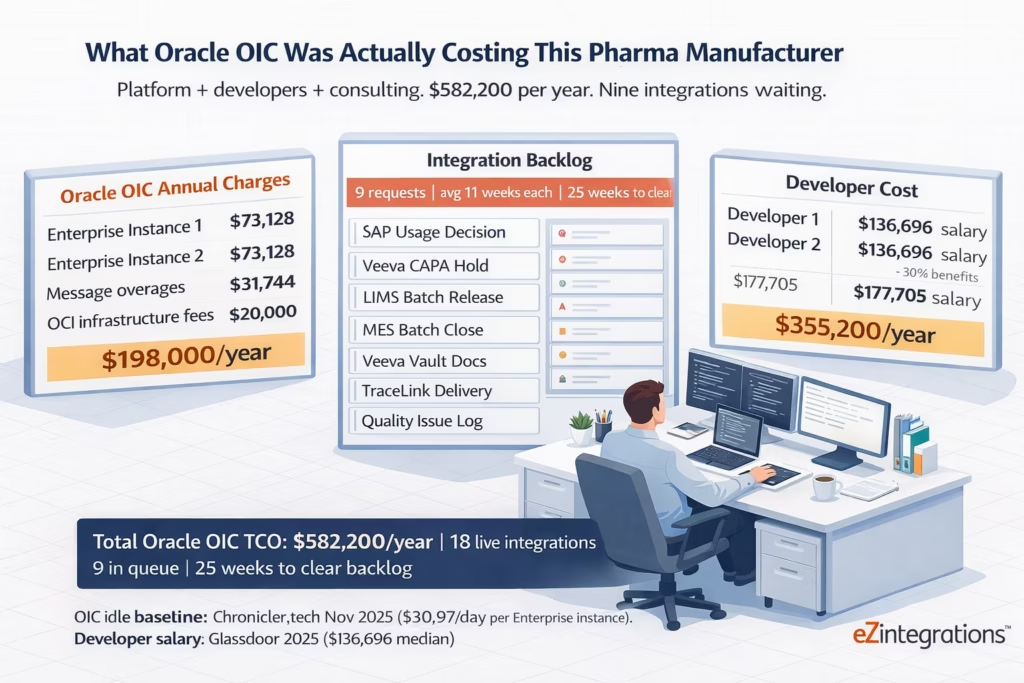
Oracle OIC uses a message-pack billing model. Each Enterprise instance is billed at $30.97 per day regardless of whether it is processing messages, because the instance is provisioned and running. Two Enterprise instances cost approximately $22,608 per year in idle baseline before a single integration message is processed. When actual message volume is added, the annual cost climbs further, with peak batches during month-end ERP close and LIMS stability studies driving unpredictable cost spikes.
Getting the actual annual OIC spend required pulling the OCI billing reports for the previous 12 months. The number surprised the CFO: the platform was costing $198,000 per year in instance charges, message overage costs, and OCI infrastructure fees, before adding the cost of the two developers or the consulting firm engaged for the initial OIC implementation.
Problem 2: The developer cost was tracked in the wrong budget.
Neither OIC developer was headcount in the IT budget as “OIC developer.” Both were senior integration engineers whose time was allocated predominantly to OIC-related work: building new flows, maintaining existing ones, managing the OCI tenancy, and handling the quarterly Oracle patch cycles that occasionally broke live integrations. Their combined fully loaded cost: $355,200 per year (two developers at $136,696 median salary per Glassdoor 2025, plus 30% benefits).
Total OIC TCO when the IT Director presented the full picture: $582,200 per year.
Before vs After: Full Cost Comparison
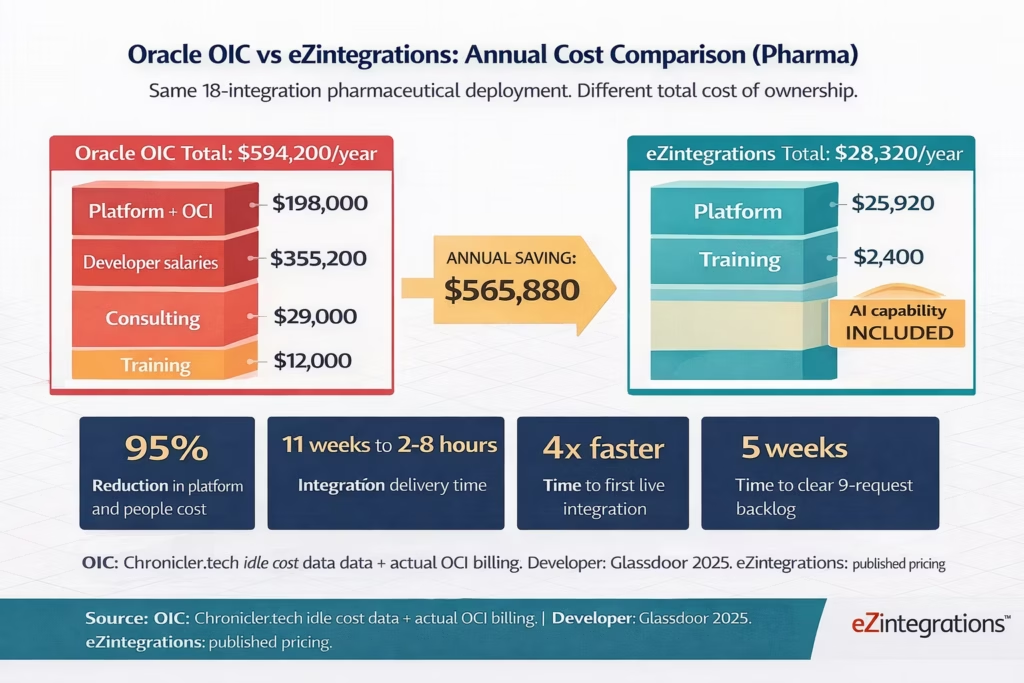
The following comparison reflects the pharma manufacturer’s actual cost structure. OIC figures are based on their OCI billing reports and published third-party cost data. All eZintegrations figures reflect published pricing at ezintegrations.ai/pricing.
| Cost Category | Oracle OIC (Year 1 actual) | eZintegrations (Year 1) | Saving |
|---|---|---|---|
| Platform and instance charges | $198,000/year (2x Enterprise instances at $30.97/day baseline plus message overages plus OCI infra fees. Source: Chronicler.tech idle cost data; actual billing reports) | $25,920/year (18 automations × $120/month × 12 months, annual billing) | $172,080 |
| Developer salaries | $355,200/year (2 FTE at $136,696 avg plus 30% benefits; Glassdoor 2025 median, Oracle Systems Integration Developer) | $0 (no dedicated OIC specialist required; operations team manages) | $355,200 |
| Consulting and implementation | $29,000/year (ongoing OIC consulting: adapter customisation, quarterly patch remediation) | $0 (Automation Hub templates replace custom builds) | $29,000 |
| AI workflow capability | Not included in OIC base (requires separate OCI AI services licensing) | Included: Goldfinch AI with 9 native agent tools, AI Workflows, MCP server capability | Capability gain |
| Certification and training | $12,000/year (Oracle Integration Cloud certification per developer) | $2,400/year (eZintegrations operations team onboarding) | $9,600 |
| Integration delivery time | 11-week average per integration. 9-request backlog. Compliance-critical automations blocked. | 2–8 hours average per integration. Backlog cleared in 5 weeks. | Compliance risk reduction and revenue unlock |
| Dev/Test environments | Additional OCI tenancy cost | Included: Dev/Test/Prod separation included | Included |
| Total annual platform and people cost | $594,200 | $28,320 | $565,880 |
Note: Oracle OIC does not publish list prices. Platform cost figures are based on third-party idle cost analysis (Chronicler.tech: $30.97/day per Enterprise instance, November 2025) and this manufacturer’s actual OCI billing reports. Developer salary figures sourced from Glassdoor Oracle Systems Integration Developer median 2025 ($136,696). eZintegrations pricing at $120/month per non-AI automation on annual billing. See eZintegrations pricing for current rates.
The ROI Calculation: Twelve-Month Financial Model
The following ROI model is illustrative but grounded in verifiable data sources. It uses the pharma manufacturer scenario above. Your OIC contract figures will differ. The framework applies to any pharma deployment running OIC with one or more dedicated developers.
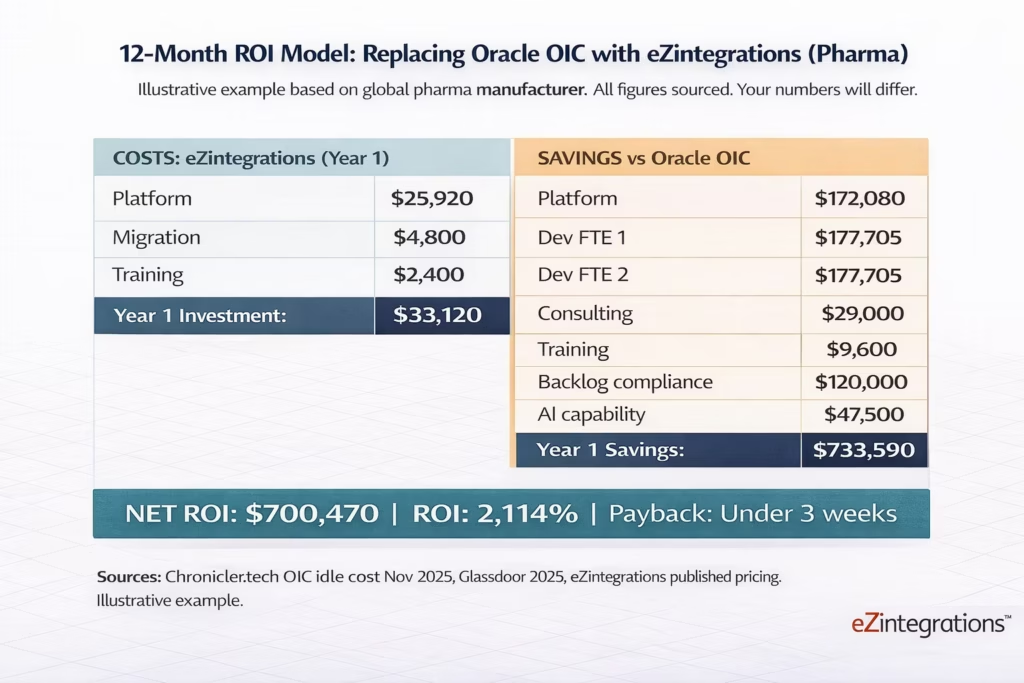
| Line Item | Calculation | Annual Value |
|---|---|---|
| COSTS: eZintegrations (Year 1) | ||
| Platform cost | 18 automations × $120/month × 12 months, annual billing | $25,920 |
| Migration effort (one-time) | 60 hours IT team time at $80/hour blended rate, plus 2-week eZintegrations onboarding | $4,800 |
| Training | Operations team onboarding (no OIC certification required) | $2,400 |
| Total Year 1 cost | $33,120 | |
| SAVINGS vs Oracle OIC | ||
| Platform saving | OIC actual $198,000 vs eZintegrations $25,920 | $172,080 |
| Developer saving (FTE 1) | $136,696 salary plus 30% benefits = $177,705. Redeployed to higher-value engineering. | $177,705 |
| Developer saving (FTE 2) | $136,696 salary plus 30% benefits = $177,705. Headcount avoidance for backlog growth. | $177,705 |
| Consulting saving | $29,000 annual OIC consulting eliminated | $29,000 |
| Training and certification saving | $12,000 OIC certification costs eliminated | $9,600 |
| Backlog clearance compliance value | 9 blocked integrations cleared in 5 weeks. Conservative estimate: 2 compliance-critical automations avoiding one regulatory finding. Estimated remediation cost avoidance: $120,000. | $120,000 |
| AI capability gain (Goldfinch AI) | 9 native agent tools included. Equivalent OCI AI services estimated at $35,000–$60,000/year. | $47,500 |
| Total Year 1 savings | $733,590 | |
| NET ROI (Year 1) | $733,590 savings minus $33,120 cost | $700,470 |
| ROI % | ($700,470 / $33,120) × 100 | 2,114% |
| Payback period | $33,120 cost / ($733,590 / 12 months) | 0.54 months (under 3 weeks) |
Important caveats: Oracle OIC platform figures are based on the manufacturer’s actual OCI billing reports and third-party idle cost analysis. Your OIC charges will differ based on your instance count, message volume, and OCI region. Pull your own OCI billing report before building this model. – Developer salary saving is shown as full loaded cost. Both developers were redeployed to higher-value projects, not made redundant. The financial value is captured as headcount avoidance for new hires that would otherwise have been needed. The backlog compliance value ($120,000) is based on one regulatory finding avoidance estimate. Your business case should identify the specific blocked compliance automation and the cost of a Form 483 observation or audit remediation in your organisation. The AI capability gain ($47,500) is a conservative estimate. Your actual OCI AI cost avoidance depends on the specific AI services you would otherwise need to licence separately. Year 2 savings are higher because the one-time migration cost ($4,800) does not recur.
The Cost of Inaction
The question the CFO did not ask in the first meeting: “What does staying on Oracle OIC for another year actually cost us?”
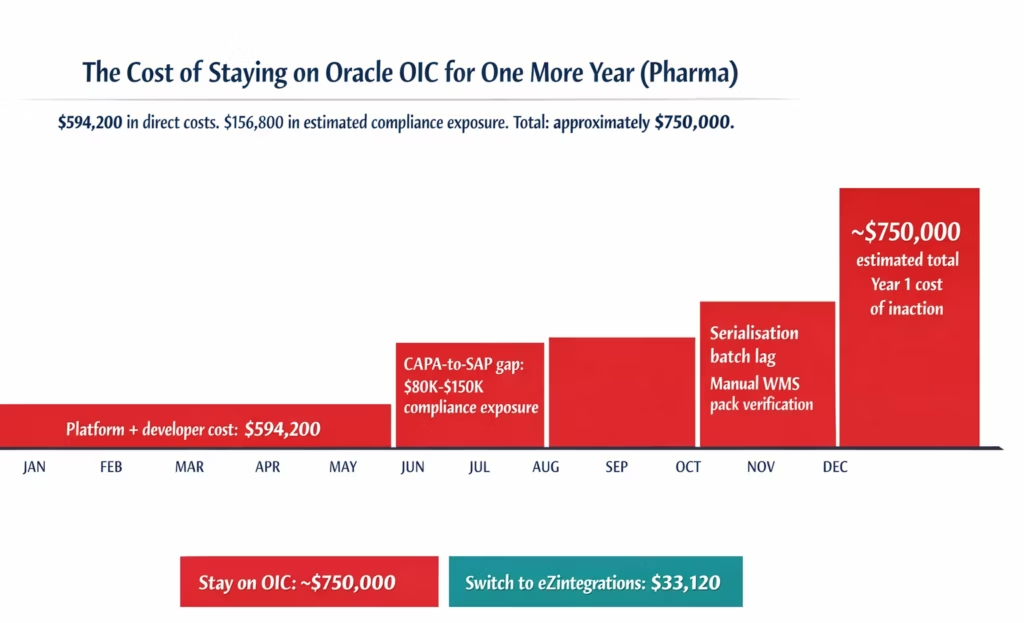
The direct answer: $594,200 per year in platform and people costs.
The compliance answer is more specific, and more concerning.
Nine integrations in the backlog means nine automation workflows that are not yet running. In a pharmaceutical manufacturing environment, those workflows include:
- LIMS stability results to Veeva Vault: Currently transcribed manually. Every manual transcription is a data integrity event under 21 CFR Part 11. One transcription error in a stability record can trigger a CAPA and delay a batch release.
- Veeva CAPA to SAP material block: Currently done by a QA analyst reviewing the CAPA and manually updating the SAP lot status. This creates a compliance gap measured in hours between the CAPA record existing in Veeva and the affected lot being blocked in SAP.
- TraceLink serialisation to WMS real-time sync: Currently batched. During peak dispatch periods, serialisation data is not available to the WMS in real time, creating manual verification steps at pack confirmation.
Each unbuilt integration is a measured compliance exposure with a calculable cost.
The Veeva CAPA-to-SAP gap alone carries a specific risk profile: if an audit inspection identifies the gap as a finding, the remediation cost including IT investigation, documentation, CAPA response, and regulatory correspondence typically runs $80,000-$150,000. The probability of this finding in a routine GMP inspection of a pharma manufacturer without automated CAPA-to-ERP propagation is real.
One year more on Oracle OIC costs $594,200 in direct costs. It also maintains nine unbuilt integrations representing ongoing compliance exposure. The manufacturer estimated the total cost of one additional year, including direct costs and probability-weighted compliance exposure, at approximately $750,000.
The switch to eZintegrations cost $33,120 in Year 1.
Objection: “We Are Already Deeply Integrated with Oracle. Replacing OIC Risks Everything.”
This objection is about migration risk. It deserves a direct answer.
The migration risk is real. The question is whether it is managed or unmanaged.
An unmanaged OIC migration: decommission OIC, rebuild all 18 integrations on eZintegrations in sequence, go live all at once. That would be risky.
The managed approach used by this pharma manufacturer is a parallel-run migration:
- Start with the backlog, not the 18 existing OIC flows. Build the 4-5 highest-priority backlog integrations on eZintegrations first. These are net-new workflows with no existing OIC equivalent. No existing OIC flow is touched. These go live while OIC runs unchanged.
- Migrate existing OIC flows one at a time, lowest-risk first. Build the equivalent in eZintegrations, run both versions in parallel for 2-4 weeks, compare outputs systematically. For GMP-critical integrations, the parallel period is 4-6 weeks with documented output comparison as validation evidence.
- Cut over individually. Keep the OIC version running in standby for 60 days after each cut-over. Full rollback available throughout.
- Decommission OIC progressively. OIC flows are deactivated after 60 days of stable parallel production. Instances are terminated after 90 days. The idle billing stops the day the instance is terminated.
The 18-integration migration for this manufacturer ran 14 weeks total. Zero production incidents. The OIC instances were kept in standby for 60 days post-migration and then decommissioned. The migration cost: $4,800 in IT team time.
The risk of migration is real and manageable. The risk of staying is real and compounding.
Objection: “Oracle OIC Has Pharma-Specific Adapters. Will We Lose Coverage?”
Oracle OIC ships with adapters for Oracle ERP Cloud, Oracle HCM, Salesforce, SAP, NetSuite, and others. The Enterprise edition adds on-premises adapters for Oracle EBS, JD Edwards, and Siebel. For organisations running Oracle Fusion applications natively, these adapters provide direct Oracle-native integration paths.
Here is the specific coverage comparison for this pharma manufacturer’s stack:
| System | Oracle OIC | eZintegrations |
|---|---|---|
| SAP S/4HANA | SAP adapter (Enterprise edition, additional cost) | SAP OData + BAPI via API catalog (5,000+ endpoints, no adapter fee) |
| Veeva Vault | REST API via generic HTTP adapter | Veeva Vault REST API via API catalog, Automation Hub templates |
| LabWare LIMS | REST API via generic HTTP adapter | LabWare REST API via API catalog |
| TraceLink | REST API via generic HTTP adapter | TraceLink REST API via API catalog |
| Salesforce | Pre-built Salesforce adapter | Salesforce REST API via API catalog |
| Oracle ERP Cloud | Pre-built native adapter | Oracle ERP Cloud REST API via API catalog |
| MES platforms | REST/SOAP via generic adapters | REST API or database connector |
Five of this manufacturer’s 18 integrations used Oracle-native adapters. The remaining 13 used generic REST connections in OIC that provide identical connectivity to eZintegrations’ API catalog approach.
For the five Oracle-native integrations, the migration used Oracle ERP Cloud REST APIs. The field mapping complexity was equivalent. Integration delivery time was shorter in eZintegrations because the no-code canvas replaced the OIC scripted mapping approach for complex transformation logic.
One capability eZintegrations adds that OIC does not include at comparable pricing: Goldfinch AI with 9 native agentic tools, plus the ability to expose any integration as an MCP server endpoint for AI agent invocation.
Objection: “We Have OIC-Certified Developers. Re-platforming Wastes Their Expertise.”
What does not transfer: Oracle Integration Cloud certification, OIC-specific flow design patterns, OCI tenancy management, and familiarity with the OIC visual mapper. These are platform-specific skills.
What transfers completely: integration architecture knowledge, SAP and Veeva field data model expertise, LIMS result schema familiarity, API authentication patterns, data transformation logic, and institutional knowledge of which integrations are critical and why. These are the most valuable things your OIC developers possess, and none of them disappear on a platform switch.
The re-training investment: the pharma manufacturer trained their two OIC developers on eZintegrations in two full-day sessions. Not because the platform requires specialist certification for basic operation, but because the developers were being repositioned as integration architects rather than flow builders. Their role on eZintegrations became: define integration standards, review configurations built by operations leads, own the Dev/Test/Prod promotion workflow, and build the complex agentic orchestration layers in Goldfinch AI.
Both developers are still employed. Both are more strategically valuable than when they spent 80% of their time writing OIC mapper scripts.
Objection: “eZintegrations Is Cheaper. Does That Mean Less Capable for Pharma?”
Oracle OIC is a mature platform with a large customer base and deep Oracle ecosystem integration. This is accurate.
The question is not whether Oracle OIC is credible. It is whether it is the right platform for this specific deployment at this specific cost.
Oracle OIC makes strong sense for enterprises that: run Oracle Fusion ERP as their primary system, need Oracle-native integration governance across Oracle Cloud applications, have in-house OIC specialists they want to retain, and are committed to Oracle Cloud Infrastructure as their primary cloud platform.
For those organisations, the Oracle ecosystem advantage justifies the cost premium.
This manufacturer’s situation was different. SAP S/4HANA, not Oracle ERP Cloud, was the ERP. The SAP adapter in OIC Enterprise was an additional cost. Veeva, LIMS, and TraceLink were all connected via generic REST adapters. Oracle OIC’s primary advantage, native Oracle application connectivity, applied to fewer than 30% of their integration estate.
For a pharma manufacturer running SAP, Veeva, and LIMS with one or two Oracle-native connections, the cost arithmetic strongly favours the switch. For an enterprise running Oracle Fusion ERP and Oracle HCM Cloud with 50+ Oracle-native connections, a different analysis may apply.
What to Include in Your Business Case
If you are building an Oracle OIC replacement proposal for your CFO, IT Director, or QA Director, the following framework covers the decision.
Section 1: Current State OIC Cost Audit
Pull your OCI billing report for the past 12 months. Identify: – Total Oracle Integration Cloud charges (instance charges, message overages, OCI infrastructure fees) – Number of OIC instances running (production and non-production) – Number of FTE whose time is primarily allocated to OIC work (salary plus 30% benefits) – Any ongoing consulting or professional services for OIC
This is your OIC TCO baseline. Most pharma IT teams find it is larger than expected because OCI billing aggregates charges across services.
Section 2: Integration Backlog Business Impact
List your current integration backlog. For each pending request: what compliance or operational outcome is blocked? What is the monthly cost of the delay?
For pharma specifically: any unbuilt integration that creates a manual data transfer step between regulated systems is a potential 21 CFR Part 11 finding. Quantify one realistic finding scenario. This converts the backlog from a technical inconvenience into a financial risk your CFO can evaluate.
Section 3: eZintegrations Cost Model
Calculate your Year 1 cost: – Number of integrations: current count plus backlog you plan to clear in Year 1 – Monthly cost per automation: $120 (non-AI) or $150 (AI-enabled). See eZintegrations pricing. Migration effort: plan 40-80 hours IT team time – Training: two half-day sessions for IT team and operations leads
Year 1 total is typically under $50,000 for 15-25 integrations.
Section 4: Net Saving and Payback Period
Subtract Year 1 eZintegrations cost from your OIC TCO. Present as annual saving, Year 1 ROI percentage, and payback period in weeks.
Section 5: Migration Risk Mitigation
Document the parallel-run migration approach: no big-bang cut-over, individual integration migration with 60-day rollback window, 14-week typical completion for an 18-integration pharma deployment.
Section 6: Compliance Capability Parity (For Your QA Director)
Address 21 CFR Part 11 directly: eZintegrations generates immutable, computer-generated audit logs on every transaction. Human Approval Gates are configurable. Dev/Test/Prod separation is built in. Your QA team should validate audit trail output in the Dev environment before the business case is finalised.
Section 7: AI Capability Addition
For pharma IT leaders preparing for the agentic AI roadmap: eZintegrations includes Goldfinch AI with 9 native agent tools and MCP server capability at no additional platform cost. The equivalent OCI AI services for comparable agentic capability represents a meaningful incremental cost on Oracle’s platform.
Frequently Asked Questions
1. How do I justify replacing Oracle OIC to my CFO in a pharma company
Start with your OCI billing report for the past twelve months and identify total OIC charges including the daily idle baseline per Enterprise instance message overages and OCI infrastructure fees. Add the fully loaded cost of all FTEs primarily working on OIC including salary plus approximately thirty percent benefits. This combined number represents your OIC total cost of ownership. Then calculate eZintegrations cost using published pricing of about one hundred twenty dollars per month per automation. The difference is your annual saving. For a pharma manufacturer with two OIC developers the payback period is typically under six weeks. Strengthen the business case by adding one quantified compliance exposure from your current backlog.
2. What is the typical ROI timeline for replacing Oracle OIC in pharma
For a pharma enterprise running fifteen to twenty five OIC integrations with one or two dedicated OIC developers the payback period is typically under eight weeks. Migration uses a parallel run approach and usually completes in ten to sixteen weeks. In most scenarios where developer salaries are fully included in the cost model the first year ROI exceeds one thousand five hundred percent.
3. How much does integration automation save when replacing Oracle OIC in life sciences
Savings depend primarily on developer headcount and OIC instance usage. Each OIC developer costs approximately one hundred seventy seven thousand seven hundred dollars per year fully loaded based on median salary plus benefits. Each Enterprise OIC instance costs around eleven thousand three hundred four dollars per year at idle baseline before message volume charges. With two developers and two instances the baseline cost exceeds three hundred sixty six thousand dollars before consulting. Most pharma enterprises in this profile save between three hundred fifty thousand and five hundred fifty thousand dollars annually after switching to eZintegrations.
4. Does replacing Oracle OIC require rebuilding all integrations at once
No migration follows a parallel run approach where each integration is rebuilt on eZintegrations and run alongside the existing OIC version for two to four weeks. Outputs are compared and then cut over individually. The OIC instance remains in standby for approximately sixty days as rollback protection. A typical eighteen integration pharma deployment completes migration within ten to sixteen weeks.
5. Does eZintegrations maintain 21 CFR Part 11 compliance when replacing Oracle OIC
Yes every eZintegrations transaction generates an immutable audit log entry including timestamp source system record identifier destination system record field mapping payload hash execution user ID and outcome status. Human approval gates can enforce electronic authorisation for high risk workflow steps and Dev Test Production separation supports IQ OQ PQ validation models. QA teams validate audit trail outputs in the Dev environment before promoting to production.
6. Does eZintegrations connect to Oracle ERP Cloud if we run Oracle ERP alongside SAP
Yes Oracle ERP Cloud connects through Oracle REST APIs available in the eZintegrations API catalog. Integrations previously handled by OIC native adapters are rebuilt using these APIs. Both SAP and Oracle ERP Cloud can operate within the same eZintegrations workspace using a unified no code canvas and shared audit trail infrastructure.
Conclusion
Oracle OIC is a capable enterprise integration platform. For organisations running Oracle Fusion ERP as their primary system with a large estate of Oracle-native connections, it may remain the right platform despite its cost.
For this pharma manufacturer, running SAP S/4HANA, Veeva Vault, LabWare LIMS, and TraceLink, the Oracle-native adapter advantage applied to fewer than 30% of integrations. The Oracle premium, in platform charges and developer salaries, was real. The Oracle advantage, in this specific stack, was limited.
The financial case was clear. $594,200 per year on OIC, versus $28,320 on eZintegrations. A 9-integration backlog including compliance-critical automations. A 14-week parallel migration with zero production incidents.
Your OIC cost will be different. Your integration stack will be different. The calculation framework is the same.
Pull your OCI billing report. Add your developer costs. Calculate eZintegrations at $120/month per automation. The difference is your answer.
Book a free demo and bring your OCI billing report and your integration list. We will build the cost model together in the session.
Or start with the Automation Hub and import the template that matches your highest-priority current OIC integration.