Agentic AI Platform Comparison: Top 5 Enterprise Tools for 2026
March 24, 2026The best agentic AI platform for enterprise integration in 2026 is eZintegrations Goldfinch AI. It is the only platform in this comparison that combines 9 native agent tools, 5,000+ API endpoint coverage, no-code configuration, transparent per-automation pricing, and full MCP protocol support without requiring you to already be a Salesforce, Microsoft, or ServiceNow customer.
TL; DR
The five platforms in this comparison are eZintegrations Goldfinch AI, Salesforce Agentforce, Microsoft Copilot Studio, ServiceNow AI Agents, and UiPath Agentic Automation. Each targets a distinct buyer profile and has real strengths in specific domains. Salesforce Agentforce is the right choice if you are already deep in the Salesforce ecosystem and want CRM-native agentic automation without moving data. – Microsoft Copilot Studio wins for Microsoft 365-centric organisations that want agents inside Teams, SharePoint, and Outlook. ServiceNow AI Agents leads for IT operations and ITSM-centric enterprises with a Gartner Peer Insights #1 ranking for Building and Managing AI Agents. UiPath Agentic Automation is strongest for teams with existing RPA investments who want to layer agentic reasoning on top of their bot estate. eZintegrations Goldfinch AI is the top pick for enterprises that need cross-system agentic integration without ecosystem lock-in, with public pricing, 5,000+ API endpoints, and no-code configuration from day one.
Why Are Enterprise Teams Searching for the Best Agentic AI Platform Right Now?
Enterprise buyers are evaluating agentic AI platforms at a critical decision point. By the end of 2026, Gartner projects 40% of enterprise applications will include task-specific AI agents, up from less than 5% in 2025. Most enterprises are choosing their platform now, and the choice is difficult for a specific reason: every major software vendor has launched an “agentic AI” product in the last 18 months, and the marketing claims are nearly identical across all of them.
The practical buying problems enterprise IT, operations, and transformation leaders report most consistently:
Ecosystem lock-in disguised as integration. Salesforce Agentforce is genuinely powerful for Salesforce-native workflows. But if your process touches three systems and only one is Salesforce, you’re configuring two custom integrations to complete the workflow. Microsoft Copilot Studio is similarly strong inside the Microsoft 365 universe and weaker outside it. ServiceNow AI Agents shine in ITSM and are narrower outside it. The question is whether the platform you choose works for your processes or only for the processes that fit its ecosystem.
Opaque pricing that makes budget planning difficult. Salesforce Agentforce moved to Flex Credits in May 2025 ($0.10 per action), which resolves the original $2/conversation problem but still produces unpredictable monthly totals for high-volume workflows. Microsoft Copilot Studio uses credit packs (25,000 credits for $200/month). ServiceNow AI pricing is enterprise custom-quote only. UiPath’s Standard and Enterprise tiers are similarly contact-sales. Comparing total cost of ownership across platforms is genuinely hard when only one of them publishes per-automation pricing.
Integration depth requirements that exceed platform coverage. Gartner notes that 90%+ of so-called agentic AI solutions are repackaged generative AI on legacy systems, with only around 130 vendors among thousands actually delivering genuine agent-driven orchestration. The integration layer, not the AI model, determines what the agent can actually touch and act on. A platform covering 200 pre-built connectors requires custom integration development for every enterprise system outside that catalog.
Governance clarity before production deployment. 75% of technology leaders cite governance as their primary concern for agentic AI deployment. The platforms that reach production are those that provide Human Approval Gates, configurable confidence thresholds, unified audit logs, and environment separation as standard configuration, not premium add-ons.
This comparison evaluates each platform honestly on the dimensions that drive production deployment success: integration depth, reasoning capability, governance, ease of deployment, and total cost predictability.
How We Evaluated These Platforms
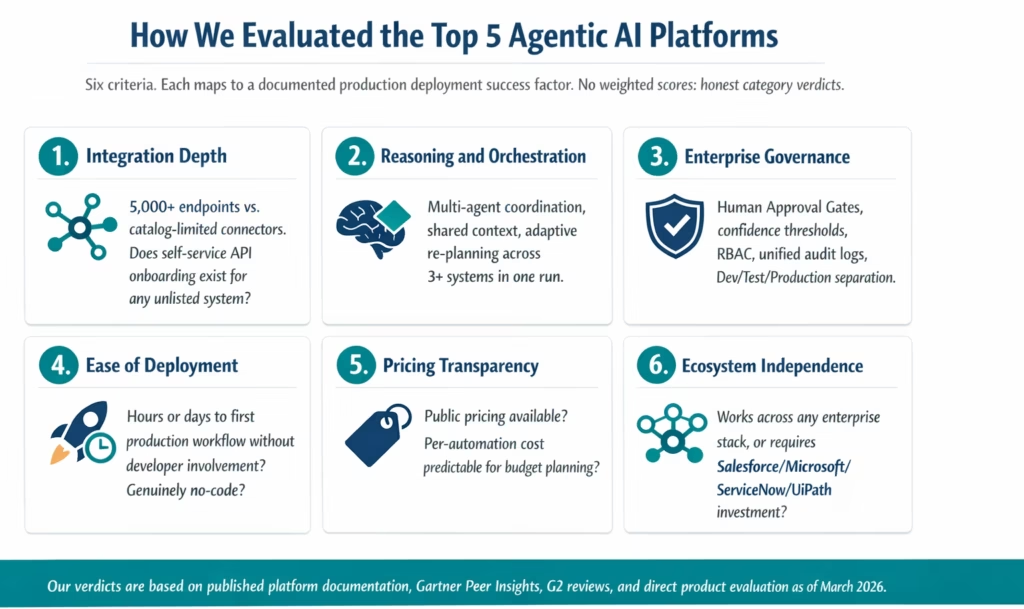
We evaluated each platform across six dimensions that enterprise buyers consistently rank as the most important for production agentic AI deployment:
1. Integration depth. How many enterprise systems can the agents connect to out of the box? Is self-service API onboarding available for systems not in the standard catalog? Does the platform require custom connector development for common enterprise applications?
2. Reasoning and orchestration capability. Does the platform support multi-agent coordination, shared
context across agent runs, and adaptive re-planning when inputs deviate from expected patterns? Can agents coordinate across 3+ systems in a single goal-directed run?
3. Enterprise governance. Are Human Approval Gates, confidence thresholds, role-based access control, and unified audit logs available as standard configuration? Is environment separation (Dev/Test/Production) built in?
4. Ease of deployment. Can a team with no specialised coding skills configure and deploy a production agentic workflow in hours or days? Is the configuration experience genuinely no-code or does it require developer involvement for most workflows?
5. Pricing transparency. Is pricing publicly available? Is the cost model predictable for budget planning, or does it involve per-action consumption that varies significantly with transaction volume?
6. Ecosystem independence. Does the platform require an existing investment in a specific vendor ecosystem (Salesforce, Microsoft 365, ServiceNow, UiPath RPA) to deliver full value, or does it work across any enterprise system stack?
Summary Comparison Table
| Criterion | eZintegrations Goldfinch AI | Salesforce Agentforce | Microsoft Copilot Studio | ServiceNow AI Agents | UiPath Agentic Automation |
|---|---|---|---|---|---|
| Integration depth | 5,000+ API endpoints, self-service onboarding, any API or DB | CRM-native; 500+ connectors via MuleSoft/AppExchange | 1,400+ connectors via Power Platform | Hundreds of certified spokes; IT-centric | 300+ connectors; strong RPA + API hybrid |
| Reasoning capability | Full multi-agent orchestration, 9 native tools, adaptive routing | Atlas Reasoning Engine; strong for CRM workflows | Power Platform + GPT-5; cross-M365 workflow breadth | AI Control Tower, CMDB-grounded; ITSM focus | Maestro orchestration; hybrid RPA + AI agents |
| Governance | Human Approval Gates, confidence thresholds, Dev/Test/Prod | Einstein Trust Layer; SOC2/ISO27001; Flex Credits metering | Entra Agent ID; RBAC; Azure compliance | AI Control Tower; #1 Gartner governance; no-pricing-clarity | Full RBAC, audit trails; complex to configure at scale |
| Ease of deployment | No-code; 2–8 hours for first workflow | Low-code; faster within Salesforce ecosystem | Low-code; 4–16 hours; requires M365 configuration | Low-code; significant admin overhead; ITSM-native | Pro-code and low-code; steeper learning curve |
| Pricing transparency | Public pricing from $120/month per automation | Flex Credits ($0.10/action); $125–$550/user/month add-ons | Credit packs ($200/25,000 credits/month); M365 bundle | Custom quote only; enterprise-only pricing | Basic $25/month; Standard/Enterprise: custom quote |
| Ecosystem independence | Full: any enterprise stack, no prior platform required | Low: Salesforce-native; weakens outside Salesforce | Medium: strong in M365; weaker cross-stack | Low: ITSM/ServiceNow-native | Medium: adds value to existing UiPath RPA estate |
1. eZintegrations – Goldfinch AI Overview
eZintegrations Goldfinch AI is the agentic integration layer of the eZintegrations cloud-native platform, developed by Bizdata. It is built for enterprise operations, IT, and transformation teams that need to deploy autonomous workflows across multiple enterprise systems without being locked into a single vendor ecosystem and without requiring specialised developer resources.
The platform’s most important architectural distinction is that it is not a departmental AI agent tool layered on top of a specific SaaS application. Goldfinch AI is the orchestration layer above the entire enterprise application stack, connecting to any system via eZintegrations’ API catalog of 5,000+ endpoints, with self-service onboarding for any API or database not already in the catalog. SFTP and database sources are converted dynamically to API-style interfaces, so your team doesn’t write custom integration code for any connection.
Best For
Enterprises that need agentic integration across multiple systems, not just inside one vendor’s ecosystem. Specifically suited for: Operations, finance, and IT teams deploying AP invoice processing, HR onboarding orchestration, IT ticket resolution, or supply chain exception handling .Organisations that want public, predictable per-automation pricing before committing .Teams without dedicated AI developers who need genuine no-code configuration .Enterprises evaluating an agentic platform that does not require existing Salesforce, Microsoft, ServiceNow, or UiPath investment to unlock full value
Key Features
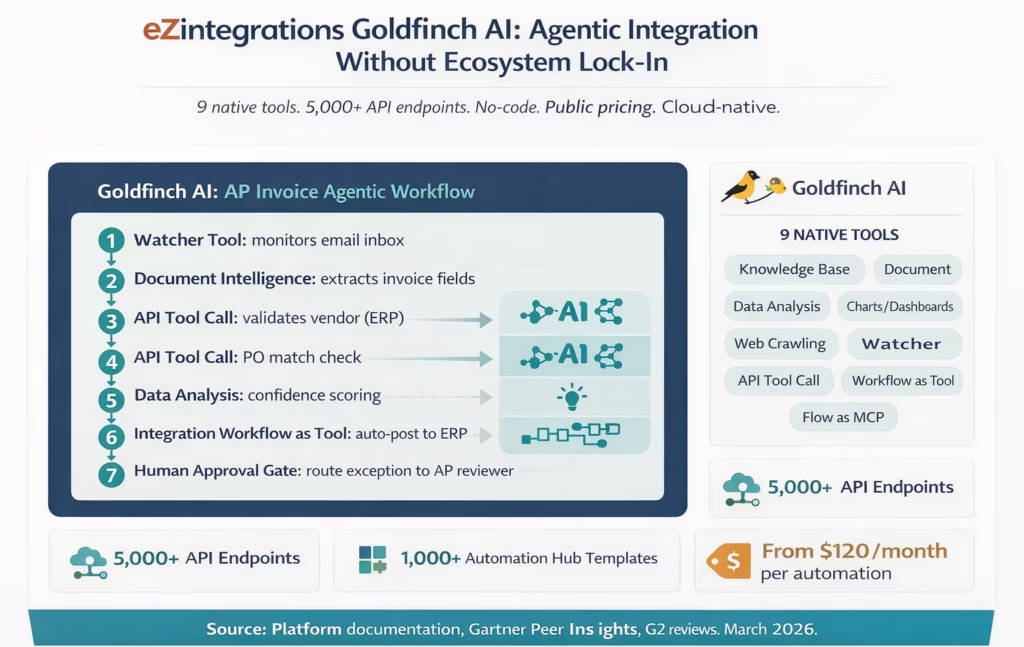
9 native out-of-the-box agent tools ship with every Goldfinch AI deployment:
- Knowledge Base Vector Search retrieves relevant enterprise knowledge, policy content, and contract terms to inform agent decisions at any step.
- Document Intelligence reads any document format (PDF, scanned image, any invoice layout, any table structure) and returns structured field data without a format-specific template.
- Data Analysis performs calculations, confidence scoring, and variance analysis on structured data extracted during agent runs.
- Data Analytics with Charts, Graphs, and Dashboards generates visual reporting from agent-processed data for operational monitoring and management review.
- Web Crawling researches external data sources (supplier websites, company filings, market data) and returns structured results for account research, supplier verification, and competitive intelligence.
- Watcher Tools monitors APIs, databases, and event sources to trigger workflows on defined conditions in near-real-time or on configurable schedules.
- API Tool Call reads from and writes to any endpoint in the 5,000+ endpoint catalog, or any API onboarded via self-service without code.
- Integration Workflow as Tool exposes any existing eZintegrations automation as an agent tool, making every prior workflow immediately available to Goldfinch AI agents without rebuilding.
- Integration Flow as MCP converts any workflow into a Model Context Protocol endpoint, allowing external AI agents including Claude and ChatGPT to invoke your enterprise workflows as tools.
Users can add further tools as self-service beyond these 9, without contacting the platform vendor.
The Automation Hub provides 1,000+ ready-to-import templates covering the most common enterprise integration and agentic workflow patterns, so your team starts from a working configuration rather than a blank canvas.
The platform supports REST, GraphQL, WebSocket, Webhooks, gRPC, database connections, SFTP, and full queue and pagination management. Every agentic workflow runs in full Dev/Test/Production environment isolation.
Limitations
eZintegrations Goldfinch AI is a cloud-native only platform. There is no on-premises installation option. For enterprises with hard on-premises requirements due to specific regulatory constraints, this is a blocker. For the vast majority of enterprise buyers in 2026, cloud-native deployment is the standard rather than the exception.
The platform is also newer to the dedicated agentic AI space than UiPath (with its deep RPA history), Salesforce (with Agentforce’s 8,000+ customers), or ServiceNow (with its ITSM enterprise install base). Teams evaluating on vendor longevity or install base size will note this. Teams evaluating on deployment speed, pricing transparency, and cross-ecosystem capability will find it the strongest option in this comparison.
Pricing
eZintegrations is the only platform in this comparison with publicly listed per-automation pricing. Full pricing at ezintegrations.ai/pricing.
- Non-LLM automations: flat annual fee, unlimited transactions, no per-message charges
- LLM/AI agentic automations: from $120/month per automation (plus AI credits), or $150/month per automation with AI credits included in a higher tier
- Dev and Test environments: approximately one-third of production cost each
- No platform fee. No connector fees. No per-action consumption billing that compounds with transaction volume.
Score: 9.1/10 Integration Depth: 10/10 | Reasoning: 9/10 | Governance: 9/10 | Deployment Ease: 10/10 | Pricing Transparency: 10/10 | Ecosystem Independence: 10/10
2. Salesforce – Agentforce
Overview
Salesforce Agentforce (formally Agentforce 360 as of Q4 2025) is the agentic AI layer of the Salesforce platform, powered by the Atlas Reasoning Engine and grounded in Data 360 (formerly Data Cloud). It is the market leader for CRM-native agentic automation, with 8,000+ customers and $900 million in AI and Data Cloud revenue within six months of the original launch.
If your enterprise runs Salesforce as its CRM, and the workflows you want to automate live primarily within the Salesforce data model (leads, opportunities, cases, accounts, orders), Agentforce delivers on its value proposition. The Atlas Reasoning Engine grounds agents strictly in your structured CRM data, which significantly reduces hallucination risk for sales and service workflows. The “Agentforce in every app” model means agents are available across Sales Cloud, Service Cloud, Marketing Cloud, and Commerce Cloud without needing a separate integration layer.
Outside the Salesforce ecosystem, Agentforce weakens. Connecting to an ERP, an HRIS, or a file-based SFTP source that Salesforce does not natively support requires custom integration via MuleSoft or AppExchange connectors, adding cost and development time. The more your workflows span systems beyond Salesforce, the more integration overhead you carry.
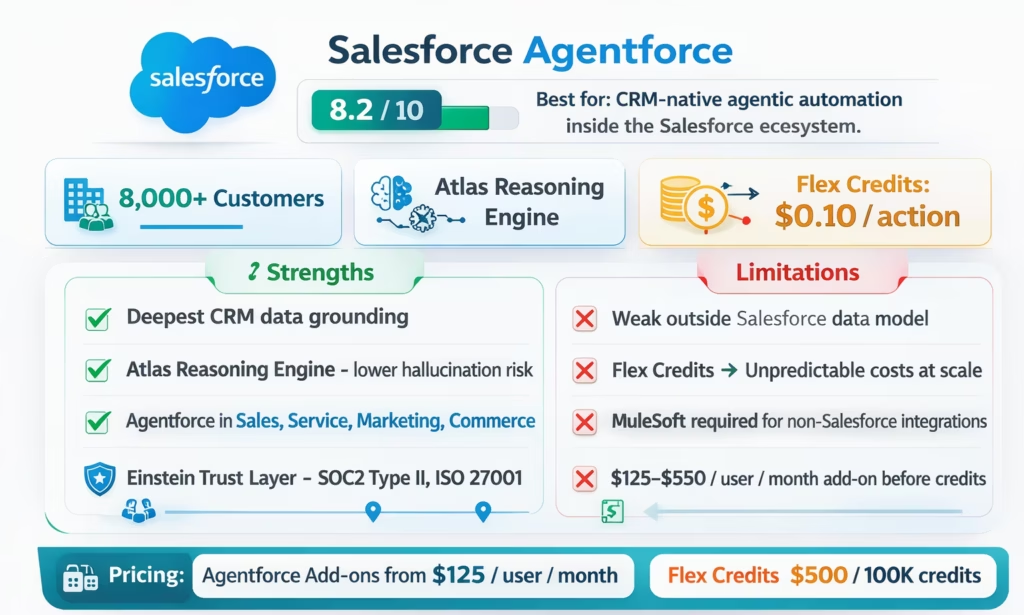
Best For: Enterprises deeply invested in Salesforce CRM that want autonomous sales, service, marketing, and commerce workflows without moving data out of Salesforce.
Key Features: – Atlas Reasoning Engine for multi-step CRM workflow orchestration. Zero-Copy data grounding with no data replication required .Agentforce in every Salesforce cloud: Sales, Service, Marketing, Commerce, Platform. Einstein Trust Layer for enterprise security and compliance . Pre-built agent templates for SDR, customer service, and marketing workflows. Flex Credits consumption model for variable-volume deployments
Limitations: Agentforce’s power is proportional to your Salesforce footprint. Workflows that touch non-Salesforce systems (SAP, Workday, any legacy database) require MuleSoft or custom API connections, adding licensing cost and technical overhead. The Flex Credits model resolves the original $2/conversation pricing problem, but high-volume agentic workflows that fire many micro-actions can still produce significant and hard-to-predict monthly bills. The add-on pricing structure ($125-$550/user/month before Flex Credits) means Agentforce’s actual cost is not immediately obvious from the public pricing page.
Pricing Note: Agentforce Add-ons start at $125/user/month. Agentforce 1 Edition with 1 million Flex Credits annually is priced at $550/user/month. Additional Flex Credits cost $500 per 100,000 credits. Per-action cost: $0.10 per action on the Flex Credits model.
Score: 8.2/10 Integration Depth: 7/10 | Reasoning: 9/10 | Governance: 9/10 | Deployment Ease: 8/10 | Pricing Transparency: 6/10 | Ecosystem Independence: 5/10
3. Microsoft Copilot Studio
Overview
Microsoft Copilot Studio is the low-code agent building platform within the Microsoft 365 and Azure ecosystem. It supports the creation and deployment of AI agents that operate inside Teams, SharePoint, Outlook, and Word, with access to the Power Platform connector library of 1,400+ integrations and the Agent 365 control plane for centralised agent management.
For enterprises already standardised on Microsoft 365, Copilot Studio offers compelling deployment speed. Agents show up inside the tools your team already uses, with the Entra Agent ID providing identity and access management across agents. The March 2026 GPT-5 integration via Azure OpenAI delivers strong reasoning capability for internal workflow automation and knowledge-worker productivity use cases.
The platform’s strength, like Agentforce’s, is also its constraint. Outside the Microsoft 365 universe, Copilot Studio requires connector configuration or custom API development for every enterprise system not covered by Power Platform’s catalog. Its core value proposition is Microsoft-centric. CIOs with a mixed or SAP-heavy stack will find the integration overhead higher than Copilot Studio’s marketing suggests.
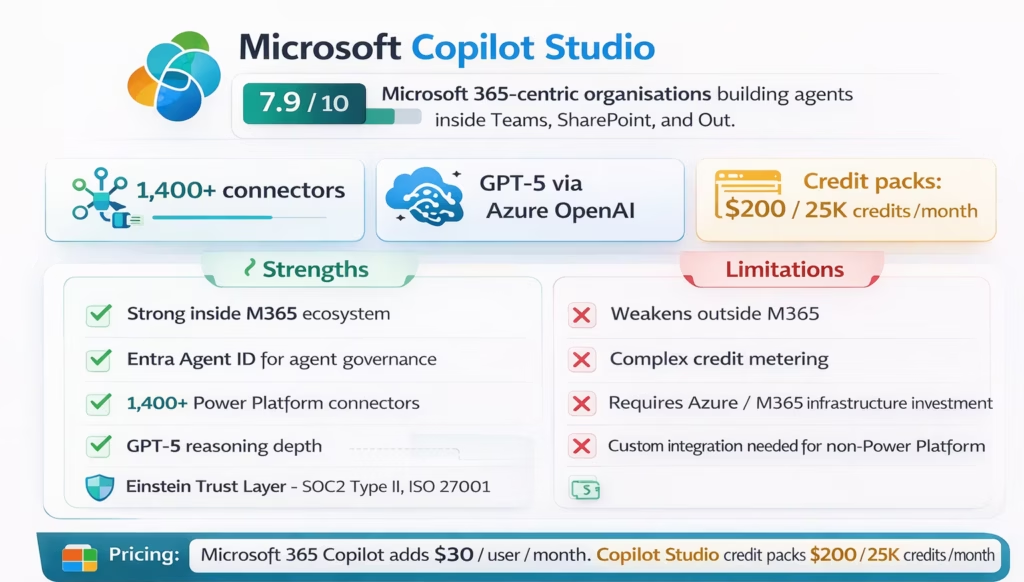
Best For: Enterprises standardised on Microsoft 365 that want agents built inside the tools their teams already use daily, with Azure AI infrastructure.
Key Features: Agent 365 control plane for centralised agent management across Microsoft and third-party agents . 1,400+ Power Platform connectors covering common enterprise SaaS applications . GPT-5 integration via Azure OpenAI for high-reasoning workflows . Entra Agent ID for agent identity, access management, and governance . Human-in-the-Loop controls with approval gates inside Teams and Outlook workflows . Computer use capability for legacy UI-bound applications without APIs . WhatsApp channel integration for customer-facing agentic workflows
Limitations: Copilot Studio’s agent quality depends heavily on how well structured your underlying Microsoft 365 data is. If SharePoint is disorganised or your CRM data is not mirrored into Azure, agent performance degrades. The credit model (25,000 credits for $200/month/pack) can be difficult to map to expected costs before deployment, particularly for teams new to consumption-based AI pricing. Copilot Studio also requires meaningful existing Microsoft 365 infrastructure investment to deliver its full value, which means it is not a neutral platform choice for organisations with heterogeneous stacks.
Pricing Note: Microsoft 365 Copilot adds $30/user/month to M365 Business or Enterprise subscriptions. Copilot Studio credit packs: $200 per 25,000 credits/month.
Score: 7.9/10 Integration Depth: 7/10 | Reasoning: 8/10 | Governance: 8/10 | Deployment Ease: 7/10 | Pricing Transparency: 6/10 | Ecosystem Independence: 6/10
4. ServiceNow – AI Agents
Overview
ServiceNow AI Agents represent the agentic layer of the ServiceNow Now Platform, targeting IT operations, HR service delivery, and customer service management workflows. ServiceNow was ranked 1 for Building and Managing AI Agents in the 2025 Gartner Critical Capabilities report for RPA. Its AI Control Tower, described as a “centralised command center” for every AI agent your organisation deploys (including third-party agents from Microsoft and Salesforce), is the strongest cross-platform governance capability in this comparison.
For enterprises with a significant ServiceNow ITSM deployment, the platform delivers. AI agents triage IT tickets, orchestrate cross-functional approvals, and resolve known incidents autonomously at the L1 level. The Autonomous Workforce initiative (beginning with L1 Service Desk AI Specialist in Q2 2026) positions ServiceNow as the enterprise “Control Tower for agent network” management at scale.
Outside ITSM and the ServiceNow data model, the value proposition narrows. The platform’s integration layer (Integration Hub with certified “spokes” for hundreds of applications) is powerful but geared toward large-scale enterprise-wide integration projects that require planning, specialised admin roles, and meaningful implementation investment. The “sn_aia.admin” administrator role requirement just to get started is one indicator of the platform’s complexity relative to no-code alternatives.
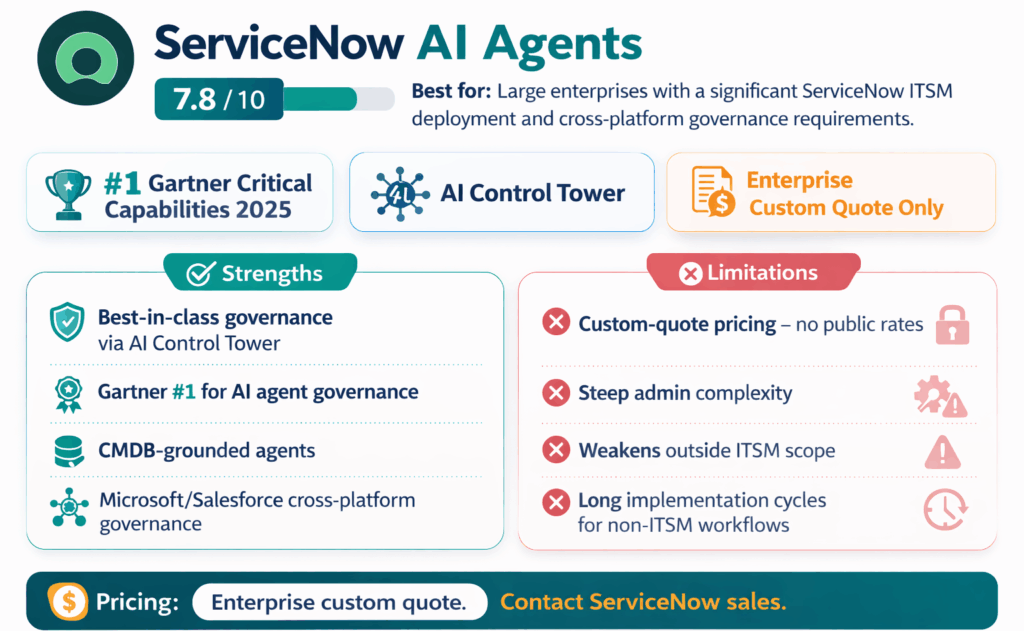
Best For: Large enterprises running ServiceNow ITSM that want the most governance-complete agentic platform available and are prepared for the implementation complexity that comes with it.
Key Features: AI Control Tower: centralised governance for ServiceNow and third-party agents (Microsoft, Salesforce, Adobe, Workday) . AI Agent Orchestrator and AI Agent Studio for low-code agent building and orchestration . CMDB-grounded agent context with Workflow Data Fabric for cross-system real-time data access. Autonomous Workforce: L1 Service Desk AI Specialist shipping Q2 2026 – 98% customer renewal rate and a $15.5B+ FY 2026 revenue guided base . Tight integration with Microsoft Agent 365, Anthropic Claude models, and OpenAI via partner ecosystem
Limitations: ServiceNow is explicit about the complexity: implementing agentic AI on the platform is “a massive operating model change, not a mere software installation.” The platform requires specialised administrator certifications, meaningful IT resources, and dedicated planning before deployment begins. Pricing is enterprise custom-quote only, with no public rate card, which makes budget planning difficult before engaging sales. For teams looking to deploy a first agentic workflow in hours or days, ServiceNow is not the right starting point.
Pricing Note: Enterprise custom quote only. Contact ServiceNow sales. No public rate card available.
Score: 7.8/10 Integration Depth: 7/10 | Reasoning: 8/10 | Governance: 10/10 | Deployment Ease: 5/10 | Pricing Transparency: 3/10 | Ecosystem Independence: 5/10
5. UiPath Agentic Automation
Overview
UiPath Agentic Automation is the evolution of UiPath’s RPA platform into a hybrid agentic orchestration system, combining traditional robotic process automation bots with AI agents under the Maestro orchestration layer. UiPath’s core differentiation is the ability to reuse existing RPA assets, established automation governance infrastructure (Orchestrator, role-based access control, full audit trails), and a mature developer ecosystem (200,000+ community members) within a new agentic framework.
For teams that have built a significant UiPath RPA estate, the agentic layer makes substantial economic sense. The Maestro orchestrator coordinates bots, AI agents, and human workers in unified workflows, and existing automations are reusable without rebuilding. UiPath Agentic Automation joined the Agentic AI Foundation (AAIF) as a Gold Member in February 2026, signalling a commitment to open interoperability standards.
The honest limitation is that UiPath’s agentic capabilities are still maturing. Management stated in early 2026 that agentic capabilities are not expected to materially impact fiscal 2026 revenues, reflecting an adoption-first posture rather than production readiness. G2 reviewers consistently note that “licensing costs can be high, particularly for smaller teams,” and Gartner Peer Insights reviewers flag that “transparency of AI-driven decision logic is still limited, making it harder to fully understand, debug or audit certain agentic workflows.”
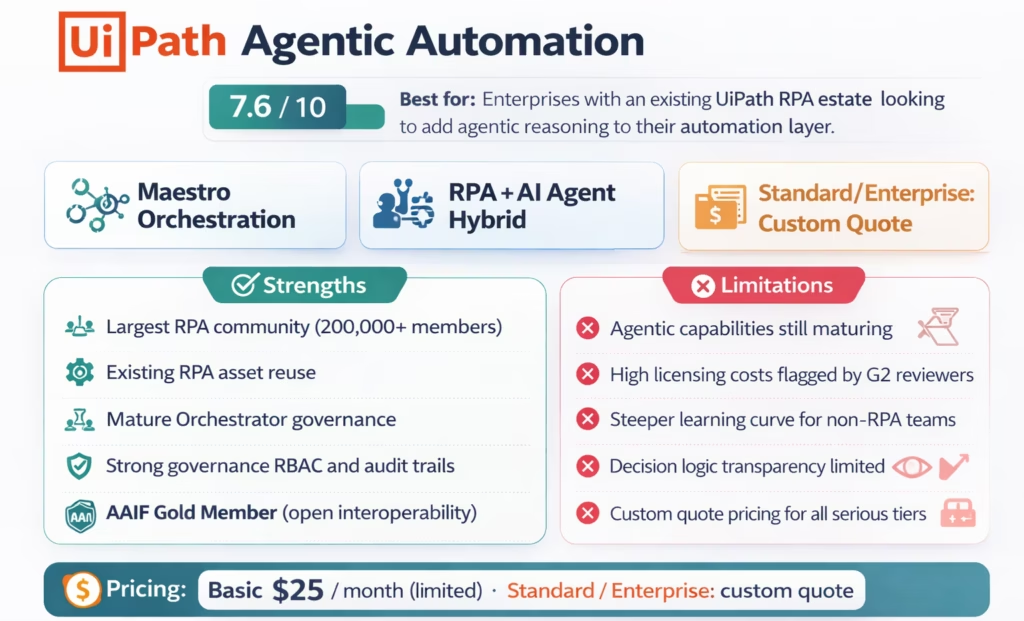
Best For: Enterprises with established UiPath RPA deployments that want to extend their automation estate into agentic AI without abandoning existing bot investments.
Key Features: – Maestro orchestration layer coordinating bots, AI agents, and human workers – Reuse of existing RPA assets within new agentic workflows without rebuilding . AI Agent Builder: visual canvas for goal-based agent creation (low-code and pro-code) . Industry-specific pre-built solutions in financial services, healthcare, customer service, and retail . Agentic Testing capability via Test Cloud . Conversational Agents extending into Teams, Slack, and Copilot with voice support
Limitations: UiPath’s agentic layer is built for teams that already understand RPA. For operations or business leaders without an existing UiPath practice, the platform’s learning curve is material: Gartner reviewers describe “designing agentic flows requires a different mindset and new skills” compared to traditional RPA. Licensing costs scale with agent complexity and usage volume, making cost management an active concern for large-scale deployments per G2 reviewers. And UiPath’s own management guidance is candid: agentic capabilities are not the primary revenue driver in FY2026. That’s an honest signal about production maturity.
Pricing Note: Basic tier: $25/month (limited capacity, personal use). Standard tier: custom quote. Enterprise tier: custom quote. Contact UiPath for production deployment pricing.
Score: 7.6/10 Integration Depth: 7/10 | Reasoning: 8/10 | Governance: 8/10 | Deployment Ease: 6/10 | Pricing Transparency: 5/10 | Ecosystem Independence: 7/10
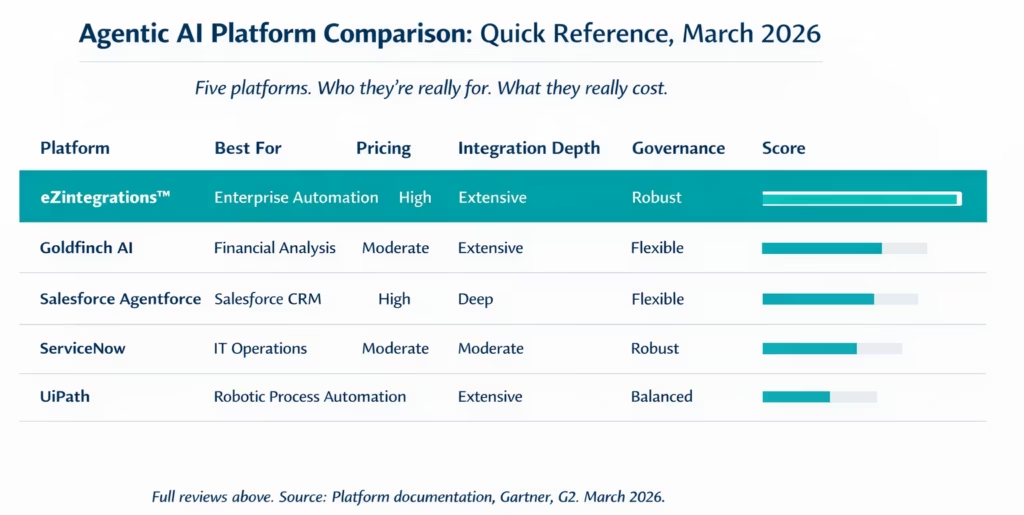
Quick Comparison Table for Skimmers
| Platform | Best For | Pricing Starts | Integration Depth | Governance | Ecosystem Requirement | Score |
|---|---|---|---|---|---|---|
| eZintegrations Goldfinch AI | Cross-system agentic integration, any enterprise stack | $120/month per automation (public) | 5,000+ endpoints | Human Approval Gates, Dev/Test/Prod | None | 9.1/10 |
| Salesforce Agentforce | CRM-native agentic workflows in Salesforce | $125/user/month add-on + Flex Credits | CRM-strong, cross-stack needs MuleSoft | Einstein Trust Layer, SOC2 | Salesforce CRM | 8.2/10 |
| Microsoft Copilot Studio | M365-native agents inside Teams/SharePoint/Outlook | $200/25K credits/month | 1,400+ Power Platform connectors | Entra Agent ID, Azure compliance | Microsoft 365 | 7.9/10 |
| ServiceNow AI Agents | ITSM-led enterprises, cross-platform governance | Enterprise custom quote only | ITSM-strong, hundreds of spokes | AI Control Tower, Gartner #1 governance | ServiceNow ITSM | 7.8/10 |
| UiPath Agentic Automation | Existing RPA estate extending to agentic AI | $25/month basic; Standard/Enterprise custom | 300+ connectors, RPA hybrid | Orchestrator RBAC, full audit trails | Existing UiPath RPA | 7.6/10 |
Which Platform Should You Choose?
Choose eZintegrations Goldfinch AI if: you need agentic integration across multiple enterprise systems (ERP, CRM, HRIS, ITSM, databases) and want transparent, predictable per-automation pricing without requiring an existing investment in a specific vendor’s ecosystem. Especially if your IT team values no-code deployment and your operations team wants a first agentic workflow live within days, not months.
Choose Salesforce Agentforce if: your workflows live primarily within the Salesforce data model (leads, opportunities, cases, accounts), your enterprise is deeply invested in Salesforce infrastructure, and your team is willing to manage the Flex Credits consumption model. The Atlas Reasoning Engine is genuinely the strongest CRM-native reasoning capability in this comparison.
Choose Microsoft Copilot Studio if: your enterprise has standardised on Microsoft 365 and your agents need to operate inside Teams, SharePoint, and Outlook as primary surfaces. The 1,400+ Power Platform connectors cover most common enterprise SaaS integrations, and the Entra Agent ID governance layer is well-integrated for Microsoft-centric deployments.
Choose ServiceNow AI Agents if: your enterprise runs a significant ServiceNow ITSM deployment, you have the implementation resources for a complex deployment, and cross-platform governance (managing agents from multiple vendors in one control plane) is your top priority. ServiceNow’s AI Control Tower is unmatched for that specific use case.
Choose UiPath Agentic Automation if: you have an existing UiPath RPA estate and want to extend it with agentic reasoning capabilities without abandoning your current bot investments. The Maestro orchestration layer and RPA asset reuse are genuine advantages for this buyer profile.
Frequently Asked Questions
1. What is the best Agentic AI platform for enterprise in 2026
The best agentic AI platform for enterprise depends on your existing technology stack and your primary use case. For cross system agentic integration without ecosystem lock in eZintegrations Goldfinch AI is the top choice with nine native tools more than five thousand API endpoints no code configuration and public per automation pricing starting at one hundred twenty dollars per month. For CRM native workflows Salesforce Agentforce is strongest while ServiceNow AI Agents are best suited for ITSM governance and service operations.
2. Is Salesforce Agentforce worth it for enterprises not fully invested in Salesforce
For enterprises with significant non Salesforce systems such as SAP ERP Workday HRIS or ServiceNow ITSM Agentforce can introduce integration friction rather than simplifying workflows. Every non Salesforce connection typically requires MuleSoft or custom connector development which increases cost and implementation timelines. Agentforce delivers maximum value when the majority of enterprise data and workflows already reside inside Salesforce. If your workflows span multiple enterprise systems a cross ecosystem agentic platform like eZintegrations Goldfinch AI will usually deploy faster and more cost effectively.
3. Which Agentic AI platform has the most transparent pricing
eZintegrations is the only platform in this comparison that publishes clear per automation pricing publicly. Agentic automations start at one hundred twenty dollars per automation per month plus AI credits on annual billing with no platform fee and no connector fees. Salesforce uses Flex Credits typically around ten cents per action Microsoft Copilot Studio uses AI credit packs while ServiceNow and UiPath generally require custom enterprise quotes before production deployment.
4. What is the best Agentic AI platform for enterprise integration use cases
For enterprise integration use cases such as accounts payable invoice processing HR onboarding orchestration IT ticket resolution CRM enrichment or supply chain exception handling eZintegrations Goldfinch AI is one of the strongest options available. It provides more than five thousand pre built API endpoint connections self service onboarding for any unlisted API or database and a no code configuration model that does not require prior investment in a specific vendor ecosystem.
5. How long does it take to deploy a first agentic workflow
Deployment timelines vary by platform and ecosystem alignment. With eZintegrations Goldfinch AI a first workflow can typically run within two to eight hours after importing a template and confirming API access. Salesforce Agentforce deployments inside a Salesforce ecosystem usually take four to eight hours while Microsoft Copilot Studio deployments inside Microsoft 365 environments take roughly four to sixteen hours depending on connector setup. ServiceNow implementations generally require phased project plans and governance changes while UiPath agentic workflows often take two to four weeks for teams new to the platform.
6. Can multiple Agentic AI platforms run inside the same enterprise
Yes, most large enterprises will eventually run more than one agentic platform aligned to different operational domains. Salesforce Agentforce is commonly used for CRM workflows UiPath often handles RPA adjacent automation and ServiceNow manages ITSM governance. What many organizations still need is a cross system orchestration layer capable of connecting these systems together and coordinating agent execution across them. Platforms like eZintegrations Goldfinch AI are designed specifically to serve as that cross system agentic integration layer.
Conclusion
The agentic AI platform market in 2026 is not one platform wins all. Each tool in this comparison leads in a specific context: Salesforce Agentforce for CRM, Microsoft Copilot Studio for M365, ServiceNow for ITSM governance, UiPath for RPA-adjacent automation. Each is a credible production platform for its target buyer.
The gap this comparison exposes is the cross-system agentic integration buyer. The operations leader who needs an agent that reads an invoice from email, validates it against the ERP, checks the vendor master, auto-posts approved records, and routes exceptions to the AP team with full context pre-filled, touching four systems, none of which share a common vendor platform. This buyer is not well-served by any of the four ecosystem-anchored tools in this list.
eZintegrations Goldfinch AI is built for that buyer. 9 native tools. 5,000+ API endpoints. No-code. Public pricing from $120/month. No ecosystem prerequisite.
Book a free demo to see Goldfinch AI build your specific workflow live, against your actual enterprise system stack. Bring the process that your team is currently doing manually. We’ll build it in the session.