What is Agentic AI? Enterprise Guide for Technology and Innovation Leaders 2026
March 24, 2026Agentic AI is an AI system that perceives its environment, reasons about a goal, plans a sequence of actions, calls tools and APIs, and executes tasks autonomously with minimal human intervention. Unlike generative AI, which responds to prompts, agentic AI pursues outcomes. In enterprises, it automates multi-step workflows across systems, makes decisions, handles exceptions, and escalates only when human judgment is truly required.
TL;DR
Agentic AI is AI that acts. It perceives, reasons, plans, and executes multi-step tasks autonomously across systems, not just generates text in response to a prompt. Gartner predicts 40% of enterprise applications will include task-specific AI agents by end of 2026, up from less than 5% in 2025. By 2028, at least 15% of day-to-day work decisions will be made autonomously by agentic AI. The critical failure point is not strategy or budget. Gartner warns that 40%+ of agentic AI projects will be cancelled by 2027 due to unclear business value and inadequate risk controls. The technology leaders who succeed in 2026 will be those who build agentic AI on a governed, integration-complete platform, not on isolated LLM experiments disconnected from enterprise systems. eZintegrations Goldfinch AI ships with 9 native agent tools, connects to 5,000+ API endpoints, and converts every integration workflow into an agent tool, all without writing code.
What is Agentic AI? The 40-Word Definition
Agentic AI is an artificial intelligence system that perceives its environment, reasons about a defined goal, plans a sequence of steps, calls external tools and APIs, and executes tasks autonomously with minimal or no human intervention until the goal is complete.
That definition matters in practice. Most enterprise AI deployed before 2025 was assistive: you gave it a prompt, it returned an output, and a human decided what to do next. Agentic AI breaks that loop. The human defines the goal. The agent handles everything else.
According to Gartner, by end of 2026 up to 40% of enterprise applications will include integrated task-specific AI agents, up from less than 5% in 2025. By 2035, agentic AI is projected to drive approximately $450 billion in enterprise application software revenue, 30% of the total market. This is the fastest adoption curve in enterprise technology since the public cloud.
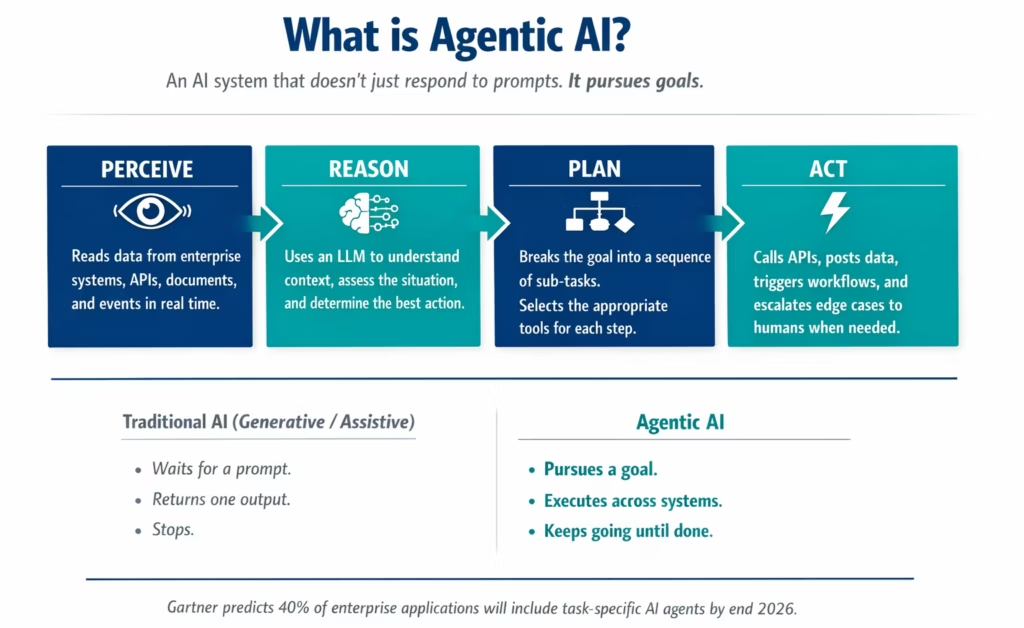
The origin of the word matters. “Agentic” comes from “agency”: the capacity to act independently. Agentic AI is AI with agency. It doesn’t wait for you to tell it the next step. It determines the next step itself, takes it, evaluates the result, and decides what to do from there.
MIT Sloan defines autonomous software agents as systems that “perceive, reason, and act in digital environments to achieve goals on behalf of human principals, with capabilities for tool use, economic transactions, and strategic interaction.” That is precisely what separates this technology from every previous wave of enterprise AI investment.
How Does Agentic AI Work? The Four-Phase Architecture
Agentic AI operates through a repeating four-phase cycle: collect, reason, act, and learn. Understanding this cycle is what separates technology leaders who deploy agentic AI successfully from those whose projects get cancelled.
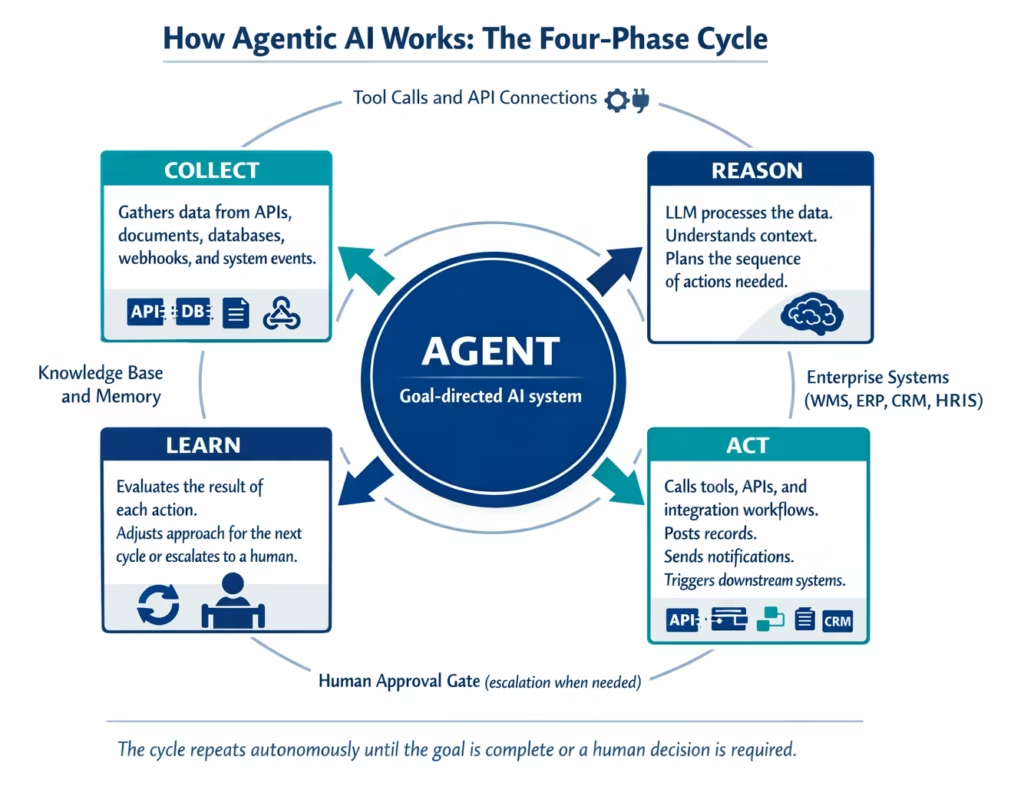
Phase 1: Collect. The agent gathers information from its environment. This might mean reading a new invoice that arrived in an email inbox, polling a WMS task queue, checking a CRM pipeline for at-risk deals, or receiving a webhook trigger from a monitoring system. The agent doesn’t wait to be asked. It watches.
Phase 2: Reason. The agent uses an LLM as its cognitive engine to understand what the collected data means, determine whether an action is warranted, and plan the sequence of steps required. The LLM produces a structured action plan, not a chat response. According to TechTarget, LLMs provide agentic systems with “natural language processing to capture complex language patterns, glean context, and understand intent.” This is the reasoning layer.
Phase 3: Act. The agent executes. It calls APIs, writes to enterprise systems, invokes integration workflows, sends notifications, and moves data between systems. This is where the work happens. No human clicks a button. No one copies a value from one screen and pastes it into another. The agent does it.
Phase 4: Learn. The agent evaluates the outcome of each action. Did the API call succeed? Did the data post correctly? Was the confidence threshold met? If the action succeeded, the agent proceeds to the next step. If it encounters an ambiguous outcome or an exception outside its configured decision range, it escalates to a human approval gate. The human resolves the exception. The agent continues.
This cycle repeats autonomously until the defined goal is complete or a human decision is genuinely required. For well-designed enterprise agentic AI, most cycles complete without any human touchpoint.
Agentic AI vs. Generative AI: The Distinction That Changes Your Investment Decision
Generative AI creates content; agentic AI creates outcomes. That one sentence is the most important distinction for any technology leader allocating AI budget in 2026.
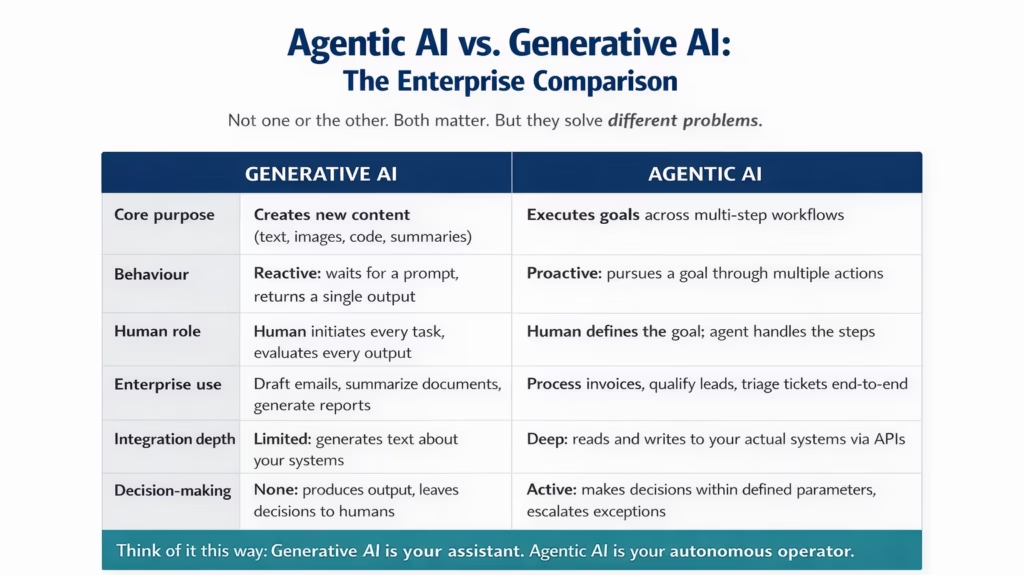
89% of enterprises report some level of generative AI implementation. Yet most executives find that efficiency gains plateau quickly. The reason is the execution gap: generative AI cannot cross system boundaries, close loops, or make decisions on your behalf. A human still has to take every AI output and do something with it.
Agentic AI eliminates that gap. Consider the same task: approving a supplier invoice.
With generative AI, the system might summarise the invoice. A human reads the summary and then manually validates it against the PO, enters the data into the ERP, and approves payment.
With agentic AI, the agent reads the invoice, validates it against the PO and vendor master via API, posts the approved record to the ERP automatically, and routes the 8% of invoices that fall below the confidence threshold to the AP team for a 30-second review. The human touched 8% of the work.
That is not a productivity improvement. That is a process transformation.
According to IBM, agentic AI “uses a digital ecosystem of LLMs, machine learning, and NLP to perform autonomous tasks on behalf of the user or another system” and “doesn’t solely rely on human prompts nor require human oversight.” The practical difference for a technology leader: generative AI needs a driver for every mile. Agentic AI navigates on its own and only asks for directions when the GPS fails.
Agentic AI vs. AI Agents: A Precise Taxonomy
“Agentic AI” and “AI agents” are related but not identical. Understanding the difference protects you from vendor “agent washing,” which Gartner identifies as the rebranding of existing automation tools, chatbots, or RPA systems as agents without genuine agentic capability.
| Term | Definition | Key Characteristic |
|---|---|---|
| AI Agent | A software component that can perceive inputs and take actions toward a goal | Individual unit; can be narrow or broad in scope |
| Agentic AI | A system or platform that deploys, orchestrates, and governs multiple AI agents working together | Multi-agent coordination; system-level capability |
| Multi-Agent System | A network of specialised agents that collaborate, hand off work, and share context to complete complex goals | Distributed; specialised agents with shared orchestration |
| Generative AI | AI that creates content (text, images, code) in response to prompts | Reactive; single-output; no autonomous action |
| RPA / Traditional Automation | Rules-based bots that execute predefined, structured scripts | No reasoning; brittle when inputs change; no LLM |
The practical implication: a single chatbot that routes support tickets is an AI agent. An agentic AI system is the platform that deploys, orchestrates, and governs multiple specialised agents across your enterprise, with shared memory, governance controls, and the ability to coordinate toward complex goals.
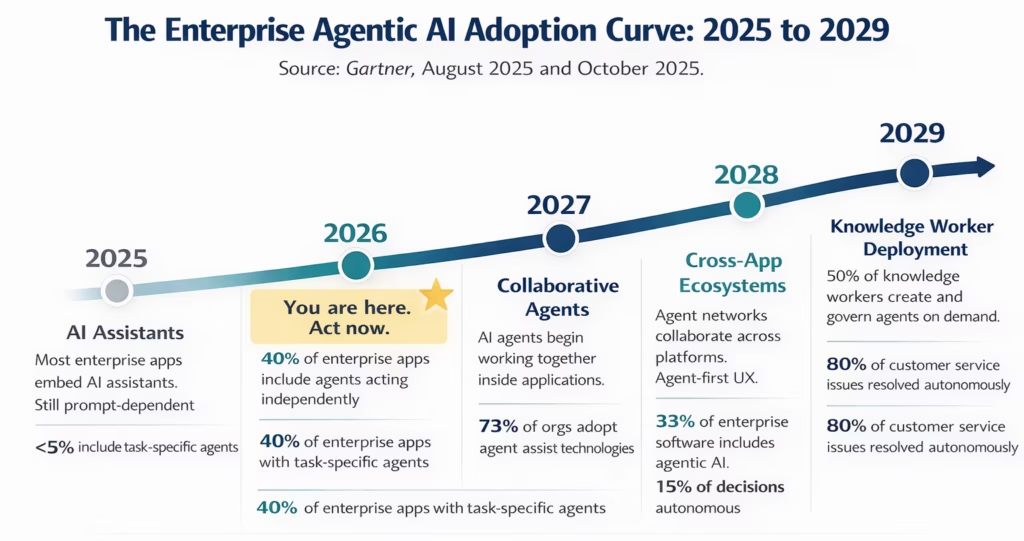
Gartner’s staged progression makes this clear:
2025: Most enterprise apps embed AI assistants. Still prompt-dependent.
2026: 40% of enterprise apps include task-specific agents acting independently.
2027: AI agents begin working together inside applications.
2028: Multi-agent ecosystems collaborate across platforms.
2029: At least 50% of knowledge workers create, govern, and deploy agents on demand.
Your organisation is moving through this progression right now, whether you’ve planned for it or not.
Why 2026 is the Defining Year for Enterprise Agentic AI
The window to set your agentic AI strategy is 3 to 6 months. That’s not a marketing claim. Gartner’s August 2025 analysis explicitly stated that C-level leaders at software organisations have 3 to 6 months to define their AI agent strategies or risk being outpaced by competitors.
Three data points explain why the urgency is real, not just analyst hype:
96% of enterprise IT leaders plan to expand AI agent use in the next 12 months. 41% expect more than 50% of all AI deployments to be autonomous within two years. The competitive pressure is structural.
Gartner predicts 15% of day-to-day work decisions will be made autonomously by agentic AI by 2028, up from 0% in 2024. By 2029, 80% of common customer service issues will be resolved autonomously, reducing operational costs by 30%. The productivity gaps between organisations that deploy effectively and those that don’t will compound over time.
Enterprise AI spend reached $37 billion in 2025, up from $2.3 billion in 2023. The investment pace is not slowing. Organisations deploying now are building institutional knowledge, governance frameworks, and template libraries that later entrants will take years to replicate.
The counterweight is also real. Gartner warns that 40%+ of agentic AI projects will be cancelled by end of 2027, primarily due to “escalating costs, unclear business value, and inadequate risk controls.” The risk is not in moving too fast. The risk is in moving without a governed platform.
Six High-Value Enterprise Agentic AI Use Cases
The highest-ROI agentic AI deployments in 2026 concentrate in six functional areas. Each one has documented results, clear integration points, and well-defined exception logic. These are the places to start.
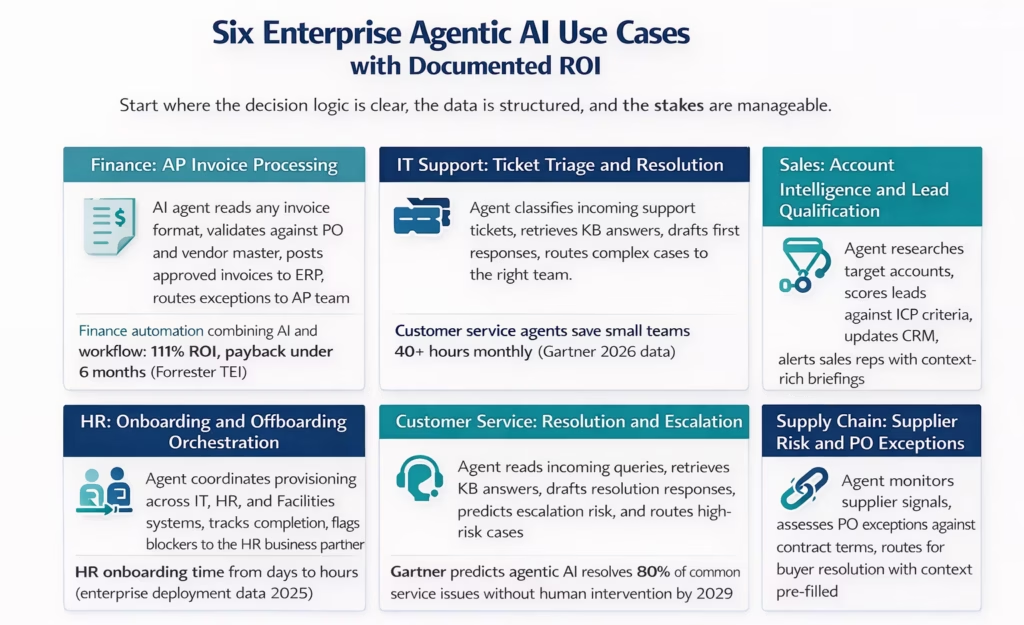
Finance and AP automation is the most deployment-ready category. Document Intelligence reads any invoice format. Agent validation checks against vendor master and PO records. ERP posting is automatic. Finance automation combining AI and workflow automation delivers 111% ROI with payback under six months, according to Forrester TEI data.
IT support has the lowest configuration complexity of any agentic AI use case, because IT support data is structured (ticket systems), decision criteria are clear (priority rules, routing logic), and APIs are standardised. Teams report saving 40+ hours per month per small team from ticket triage automation alone.
Sales intelligence agents produce 2 to 3 times improvement in pipeline velocity by automating account research, lead qualification scoring, and CRM enrichment. The sales team gets better information, faster, without spending time on research tasks.
HR operations coordination, covering onboarding provisioning and offboarding access revocation, is complex to configure but high-value once deployed. The bottleneck is multi-system API access (directory, HRIS, SaaS tools), not the agent logic itself.
Customer service is where Gartner sees the longest-range impact: 80% of common service issues resolved autonomously by 2029, driving 30% operational cost reduction. The 2026 starting point is resolution draft assistance and escalation prediction, not full autonomous resolution.
Supply chain has the highest per-deployment configuration complexity due to variable ERP and procurement system APIs. The ROI is clear when deployed: automated invoicing and exception handling accelerate financial close processes by 30 to 50%.
The Real Failure Risks: What Gartner Says Goes Wrong
More than 40% of agentic AI projects will be cancelled by end of 2027. That statistic from Gartner is the most important thing a technology leader can know before starting an agentic AI programme. The failures are predictable. So are the solutions.
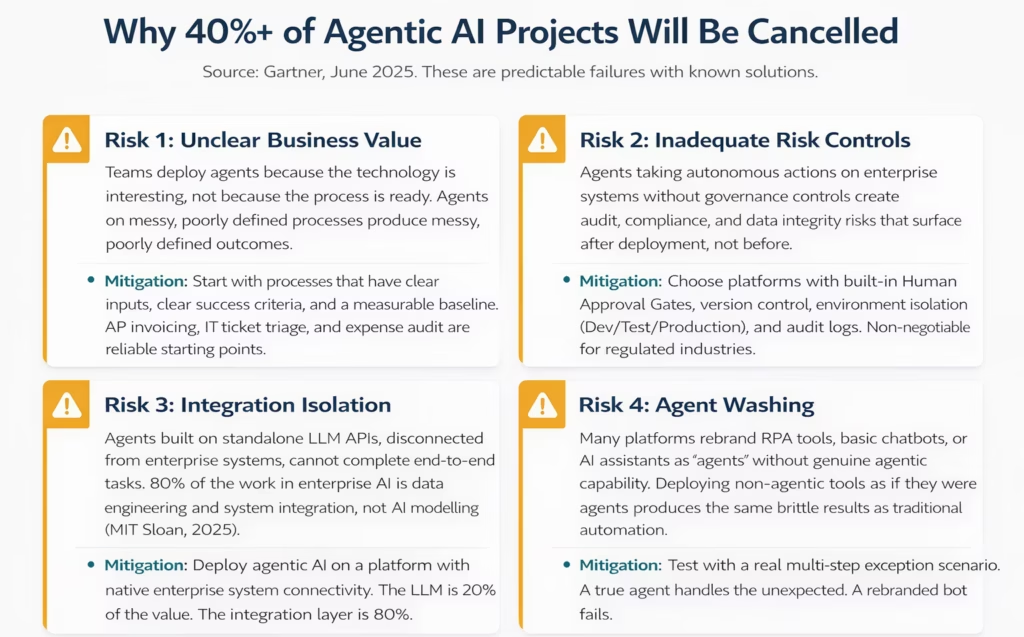
The four primary failure causes, per Gartner’s analysis:
Unclear business value. “Most agentic AI projects right now are early-stage experiments driven by hype and often misapplied,” said Anushree Verma, Senior Director Analyst at Gartner. The solution is process selection discipline: start with processes that have a measurable baseline, clear decision logic, and structured inputs.
Inadequate risk controls. Agents that can act on enterprise systems without governance create audit and compliance exposure. Every production agentic AI deployment needs human approval gates, confidence thresholds, audit logs, and environment isolation.
Integration failure. MIT Sloan’s 2025 research found that 80% of the work in enterprise AI is data engineering, stakeholder alignment, and workflow integration. The LLM is the smallest part of the engineering effort. Agents built on LLM APIs alone, without enterprise system connectivity, cannot complete end-to-end tasks.
Agent washing. Gartner identified “agentwashing” as a widespread problem: rebranding chatbots, RPA tools, and AI assistants as AI agents without substantive agentic capability. The test is simple: ask the vendor to demonstrate the agent handling an exception it has never seen before. An agent adapts. A rebranded bot fails.
What to Look For in an Enterprise Agentic AI Platform
The right enterprise agentic AI platform delivers five non-negotiable capabilities. Platforms that lack any one of these five will create the failure modes Gartner describes.
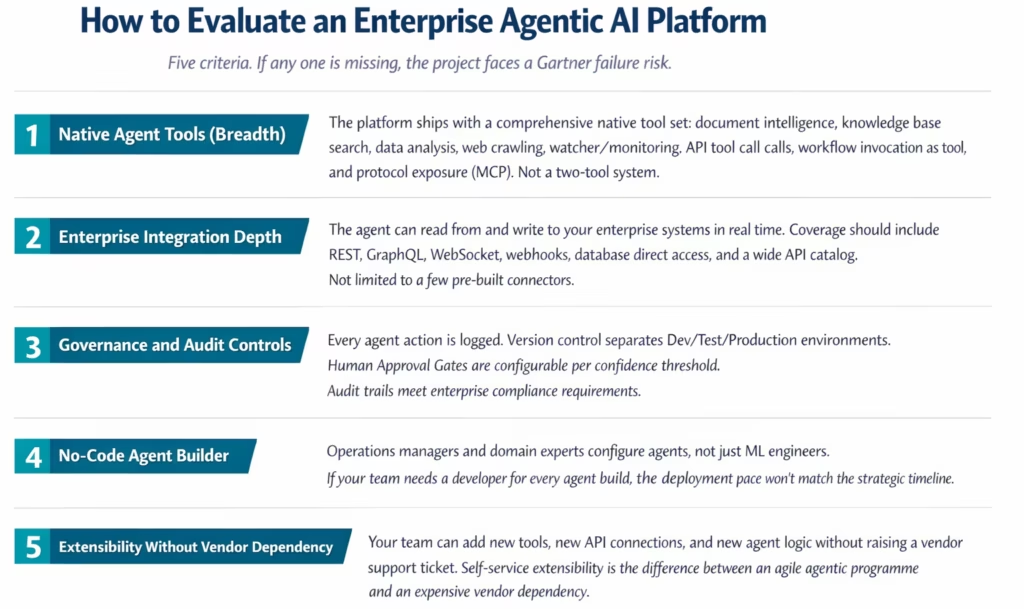
The five criteria map directly to the Gartner failure modes. Poor integration depth causes integration failure. Absent governance causes risk control failure. No-code accessibility prevents the deployment pace needed to demonstrate business value quickly. Narrow tool sets limit what the agent can actually do and where. Vendor dependency on extensibility creates cost overruns and delays.
How eZintegrations Goldfinch AI Delivers Agentic Capability Today
eZintegrations Goldfinch AI is a cloud-native agentic AI platform built on 9 native agent tools, connecting to 5,000+ enterprise API endpoints, with no-code configuration for operations teams and built-in governance for IT.
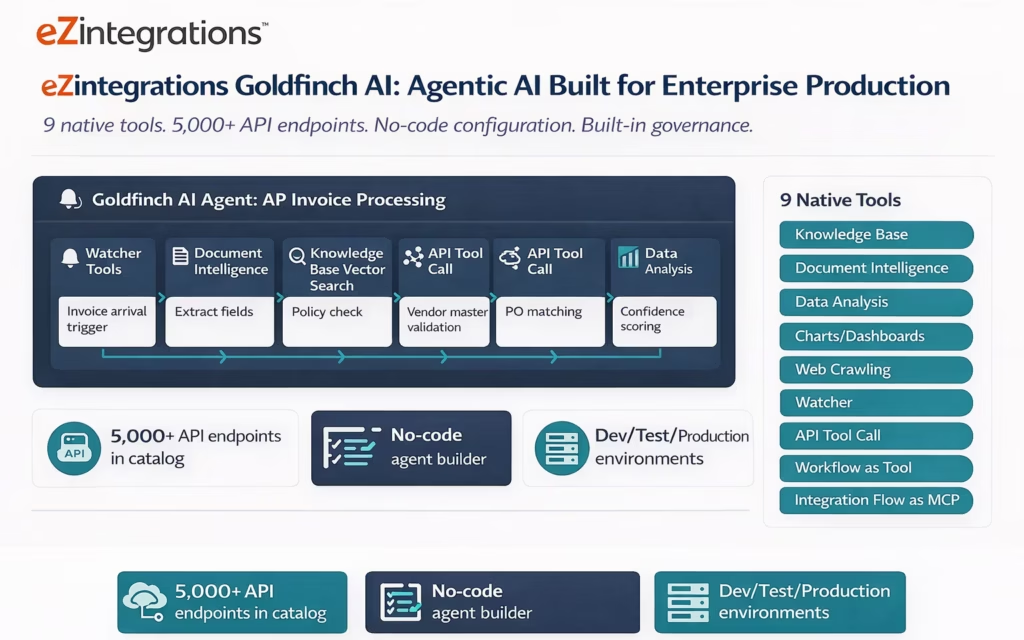
Goldfinch AI ships with 9 native out-of-the-box agent tools:
- Knowledge Base Vector Search retrieves relevant content from your documented policies, playbooks, and reference data.
- Document Intelligence reads any document format (PDF, image, scanned file) and extracts structured field data without a format-specific template.
- Data Analysis runs calculations, validations, and variance analysis on structured data sets.
- Data Analytics with Charts, Graphs, and Dashboards generates visual output from agent-processed data.
- Web Crawling researches external sources (competitor sites, news, company data) and returns structured results.
- Watcher Tools monitors APIs, databases, and event sources on a defined schedule or in near-real-time.
- API Tool Call reads from and writes to any API endpoint in the 5,000+ endpoint catalog or any self-service onboarded API.
- Integration Workflow as Tool exposes any existing eZintegrations workflow as an agent tool, making every prior automation investment immediately available to Goldfinch AI agents.
- Integration Flow as MCP converts any workflow into a Model Context Protocol endpoint, allowing external AI agents (ChatGPT, Claude) to invoke your enterprise workflows as tools.
Beyond these 9, your team can add further tools as self-service without vendor involvement.
Every Goldfinch AI agent includes configurable confidence thresholds and Human Approval Gates. Every deployment uses separate Dev, Test, and Production environments. Every agent action is logged in a full audit trail. The eZintegrations platform is cloud-native, requires no on-premises installation, and connects to on-premises systems via their API or database interfaces.
For context on the AI Workflows layer that sits below Goldfinch AI, and the 1,000+ templates in the Automation Hub that provide starting configurations for every use case, those resources are linked.
How to Get Started with Agentic AI in Your Organisation
Start with one process, one team, and one clear outcome metric. That is the common structure of every successful enterprise agentic AI deployment in 2026.
The five-step path from zero to first production agent:
Step 1: Select a high-clarity process. Choose a process with structured inputs (digital documents, API data, form submissions), clear decision logic (if X then Y, with known exception types), and a measurable baseline (current processing time, error rate, headcount hours). AP invoice processing, IT ticket triage, and expense audit are reliable starting points for exactly these reasons.
Step 2: Document the decision logic and exceptions. An agent is only as good as the rules it works from. Before configuring anything in the platform, write down: what inputs the agent receives, what the agent should decide in each scenario, what confidence threshold triggers automatic action versus human review, and who receives the exception notification. This documentation becomes your Knowledge Base content.
Step 3: Confirm API access. Every enterprise agentic AI deployment requires API access to both the source system (where the agent reads data from) and the target system (where the agent writes results to). Confirm IT API access approval before starting configuration. This is the most common deployment bottleneck and it has nothing to do with the AI.
Step 4: Build, test, and calibrate in Dev. Import the relevant template from the Automation Hub, configure your API connections and Knowledge Base content, set your initial confidence threshold (85-90% is a standard starting point), and run 20 to 30 representative test cases. Observe where the agent routes correctly versus incorrectly. Calibrate the threshold and refine the Knowledge Base content. Repeat until the Dev results are consistent.
Step 5: Promote to Production and expand. Once Dev results are consistent, promote to Production and monitor the first two weeks of live runs closely. Keep the Dev environment active for testing changes. Once the first agent is stable, repeat the process for the second use case. The second deployment is always faster than the first.
Book a free demo to see a live Goldfinch AI build session for your specific use case and enterprise system combination. Or explore eZintegrations pricing for plan details.
Frequently Asked Questions
1. What is Agentic AI for enterprise?
Agentic AI for enterprise, delivered through eZintegrations Goldfinch AI, is a multi-agent system where a Planner Agent creates a structured execution plan, specialist sub-agents execute tasks in parallel or serial using defined dependencies, a Critic Agent monitors progress and triggers human review when needed, and an Aggregator Agent synthesizes and validates the final outcome with enterprise guardrails applied across ERP, SCM, PLM, and CX systems.
2. What is the difference between AI agents and Agentic AI?
A single AI agent makes a decision at one workflow step using its tools. Agentic AI coordinates multiple specialist agents working together on a shared objective, with task dependencies managed between them, progress monitored by a Critic Agent, and a finished outcome synthesized by an Aggregator Agent. One is a decision. The other is an autonomous business outcome.
3. How does Human in the Loop work in eZintegrations Agentic AI?
Human in the Loop is built into the Critic Agent architecture. The Critic Agent monitors execution continuously and triggers human notifications automatically when it detects a decision point that exceeds defined autonomous authority thresholds. The right person receives full context, execution pauses at the relevant step, and resumes automatically when the human input is received.
4. Can eZintegrations Agentic AI connect to SAP, Oracle, and Infor natively?
Yes. eZintegrations connects natively to SAP ERP, Oracle ERP and SCM, Infor, Veeva, Salesforce, and other major enterprise platforms through pre-built integration templates. The Aggregator Agent applies guardrails across all connected enterprise datasets while respecting the roles and privileges defined in each system.
5. What is the difference between Chat Interface mode and Workflow Component mode?
Chat Interface mode lets business users interact with the Master Agent conversationally using natural language. The full multi-agent system executes behind the conversation and delivers results directly in chat. Workflow Component mode embeds the entire Master Agent system as a callable step inside an automated integration pipeline, enabling Agentic AI to run as part of fully automated business processes with no human initiation.
6. What are FF, FS, SS, and SF dependencies in Agentic AI?
These are task dependency types from project management applied to multi-agent coordination. Finish-to-Start (FS) means Agent B starts after Agent A finishes. Finish-to-Finish (FF) means both agents must finish together. Start-to-Start (SS) means both agents start simultaneously. Start-to-Finish (SF) means Agent B keeps running until Agent A starts. eZintegrations uses all four to manage sub-agent execution timing with project plan precision.
7. How is eZintegrations Agentic AI different from Microsoft Copilot Studio or Salesforce Agentforce?
Copilot Studio is Microsoft-ecosystem-first with no structured Planner architecture and no native SAP or Oracle connectivity. Agentforce is Salesforce-CRM-first with no multi-agent project plan coordination. Neither platform includes a Critic Agent monitoring execution quality, project-plan task dependencies between agents, or an Aggregator Agent applying enterprise guardrails. eZintegrations delivers all these capabilities natively through Goldfinch AI on a fully managed platform with a 99.9% uptime SLA.
Conclusion
Agentic AI is not the next generation of chatbots. It is the end of the productivity plateau that every enterprise reached after deploying generative AI. Generative AI made individuals faster. Agentic AI makes operations autonomous.
The data is unambiguous. Gartner projects 40% of enterprise applications will include task-specific AI agents by end of 2026, 15% of day-to-day decisions will be made autonomously by 2028, and agentic AI will resolve 80% of common customer service issues without human intervention by 2029. The window to set your strategy is 3 to 6 months, per Gartner’s own analysis.
The organisations that succeed will be those that start with governed, integration-complete platforms, select high-clarity processes, document their decision logic, and expand from a stable first deployment. The ones that fail will be those that deploy agents on isolated LLM experiments disconnected from enterprise systems, without confidence thresholds, without audit logs, and without a clear process baseline to measure against.
eZintegrations Goldfinch AI is built for the organisations that want to succeed. 9 native tools. 5,000+ API endpoints. No-code configuration. Built-in governance. Cloud-native. Available today.
Book a free demo to see Goldfinch AI in action for your specific use case and enterprise system stack.