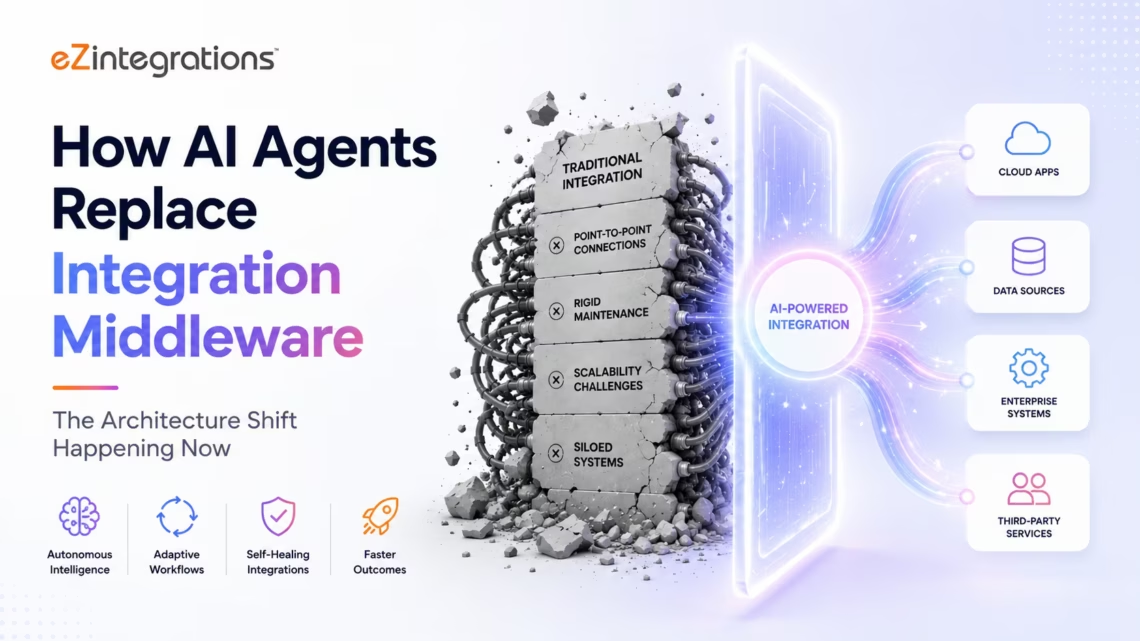
How AI Agents Replace Integration Middleware: The Architecture Shift Happening Now
June 7, 2026AI agents replace traditional integration middleware by operating goal-directed rather than rule-directed: instead of executing predefined transformation sequences, agents investigate systems autonomously, determine what data is needed and where it lives, retrieve it across multiple APIs, and deliver structured intelligence without human-defined workflows. The architectural shift: from pipelines that move data to agents that answer questions and complete tasks across enterprise systems.
TL;DR:
- Traditional middleware (ESBs, iPaaS, ETL pipelines) connects systems by executing predefined sequences: receive data from System A, transform it, deliver it to System B. The human defines every step of every sequence in advance.
- AI agents operate differently: they receive a goal (“get me a complete account health brief for customer Acme Corp”) and determine autonomously what to investigate, which systems to query, what data to retrieve, and how to assemble the result.
- This is not an incremental improvement to middleware. It is a different architectural model: from pipelines that move data to agents that complete tasks. The distinction matters because agents handle the cases that pipelines cannot: novel information needs, multi-system investigations where the next query depends on the result of the previous one, and business questions that do not map to predefined data flows.
- Middleware is not going away. It is being supplemented by a layer above it: AI agents that orchestrate across middleware pipelines to answer questions and complete tasks that no single pipeline was built to handle.
- eZintegrations delivers this through Goldfinch AI (Level 4): a coordinator-worker agent architecture with 9 native enterprise tools, Chat UI for natural language system queries, and Workflow Node for autonomous business intelligence programmes: operating on top of the same Level 1-3 integration infrastructure.
What Traditional Integration Middleware Actually Does
Traditional integration middleware: Enterprise Service Buses, iPaaS platforms, ETL pipelines: executes sequences of operations that a human defined in advance.
This is its fundamental design principle: predictable, deterministic execution of predetermined logic. It is excellent at this.
Wikipedia defines middleware as software that lies between an operating system and the applications running on it: in enterprise integration specifically, it is the software layer between source and destination systems that handles data movement, transformation, and routing.
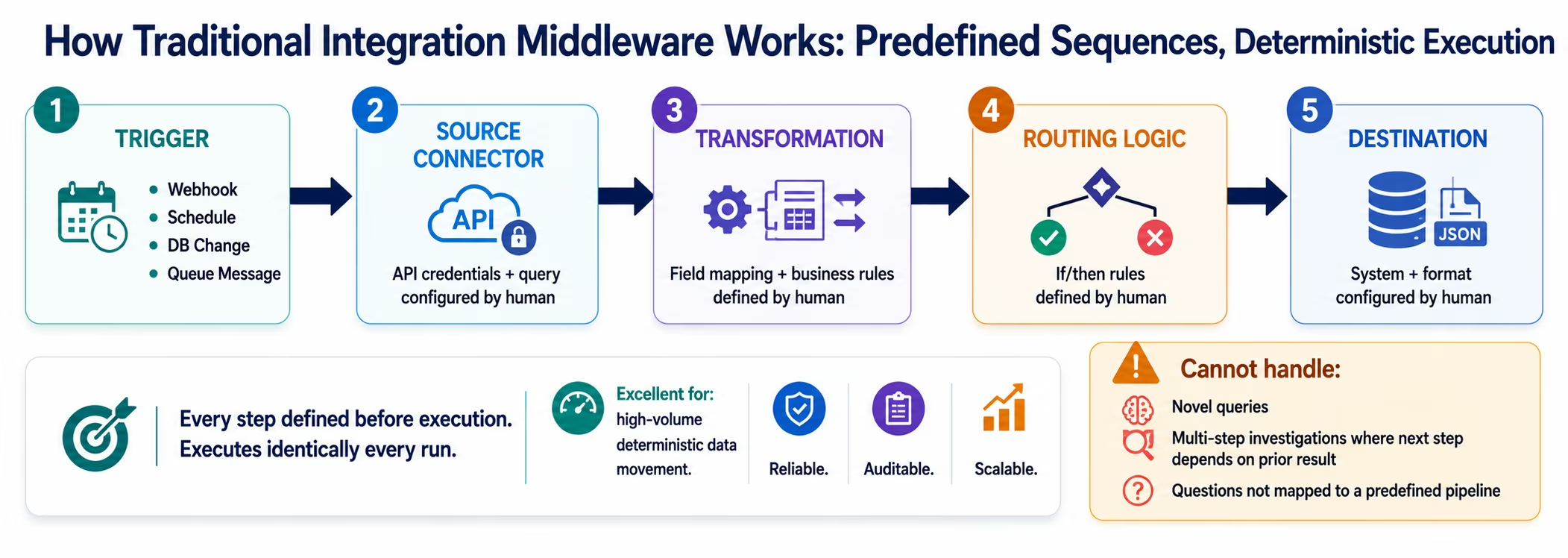
The canonical middleware execution model:
- A trigger fires (webhook received, schedule elapsed, database change detected)
- The middleware reads from the source system using the configured connector and authentication
- The middleware applies the configured transformation rules to the data
- The middleware routes the transformed data to the configured destination
- The middleware logs the execution and handles errors according to configured retry rules
Every step of this sequence is defined by a human before the workflow runs. The middleware executes exactly what was configured: no more, no less. This is the correct design for the majority of enterprise integration use cases, deterministic data movement at volume, reliably, with full audit trails.
Gartner estimates the enterprise middleware market at $13.2 billion in 2025 and growing: which tells you that middleware is not going away. It also does not tell you the full picture of what is changing in enterprise integration architecture.
Where Middleware Reaches Its Architectural Limits
Middleware’s limitations are not defects: they are architectural consequences of its design principle. A system designed to execute predefined sequences cannot, by design, handle situations that were not predefined.
Three categories of enterprise information needs expose these limits consistently:
Limitation 1: The Novel Query
A VP of Sales asks: “What is the current pipeline health for the northeast region, including deals at risk based on engagement data from the last 30 days?”
This question touches Salesforce (pipeline data), Outreach or Salesloft (engagement data), Gong (call recording and conversation intelligence), and possibly the marketing platform (lead source attribution). There is no predefined middleware pipeline for this specific combination of data sources, time windows, and analytical framing. Building a pipeline that answers this specific question takes days: by which time the sales forecast meeting has already happened.
Middleware requires the question to exist before the pipeline is built. Most business questions arrive faster than pipelines can be built for them.
Limitation 2: The Conditional Investigation
A CS manager asks: “Why did the Acme Corp account’s health score drop by 23 points this week?”
The answer requires: pulling the health score history from the CS platform, identifying which component scores changed, querying the product analytics system for usage data during the relevant period (to understand which features stopped being used), querying the CRM for any support tickets or interactions during the period, and querying the billing system to check whether a payment failed. Then: assembling these findings into a coherent account brief that explains the health score change.
Each step of this investigation depends on the result of the previous step. You cannot know which product features to investigate until you see the health score breakdown. You cannot know which time period to query in the CRM until you know the health score change date. Middleware pipelines execute predetermined steps, they cannot dynamically determine the next step based on what they found in the previous one.
Limitation 3: The Cross-System Task
A procurement manager needs: “Create a vendor performance report for Q1 2026 combining PO data from SAP, delivery performance data from the 3PL portal, invoice data from the AP system, and quality metrics from the ERP: formatted for the quarterly supplier review.”
This is a task, not a data movement. It requires accessing four systems, correlating data across them, applying analytical logic (performance scoring, trend identification), and producing a formatted output. No single middleware pipeline handles this: it requires multi-system orchestration with intelligence applied at the assembly step.
What AI Agents Do That Middleware Cannot
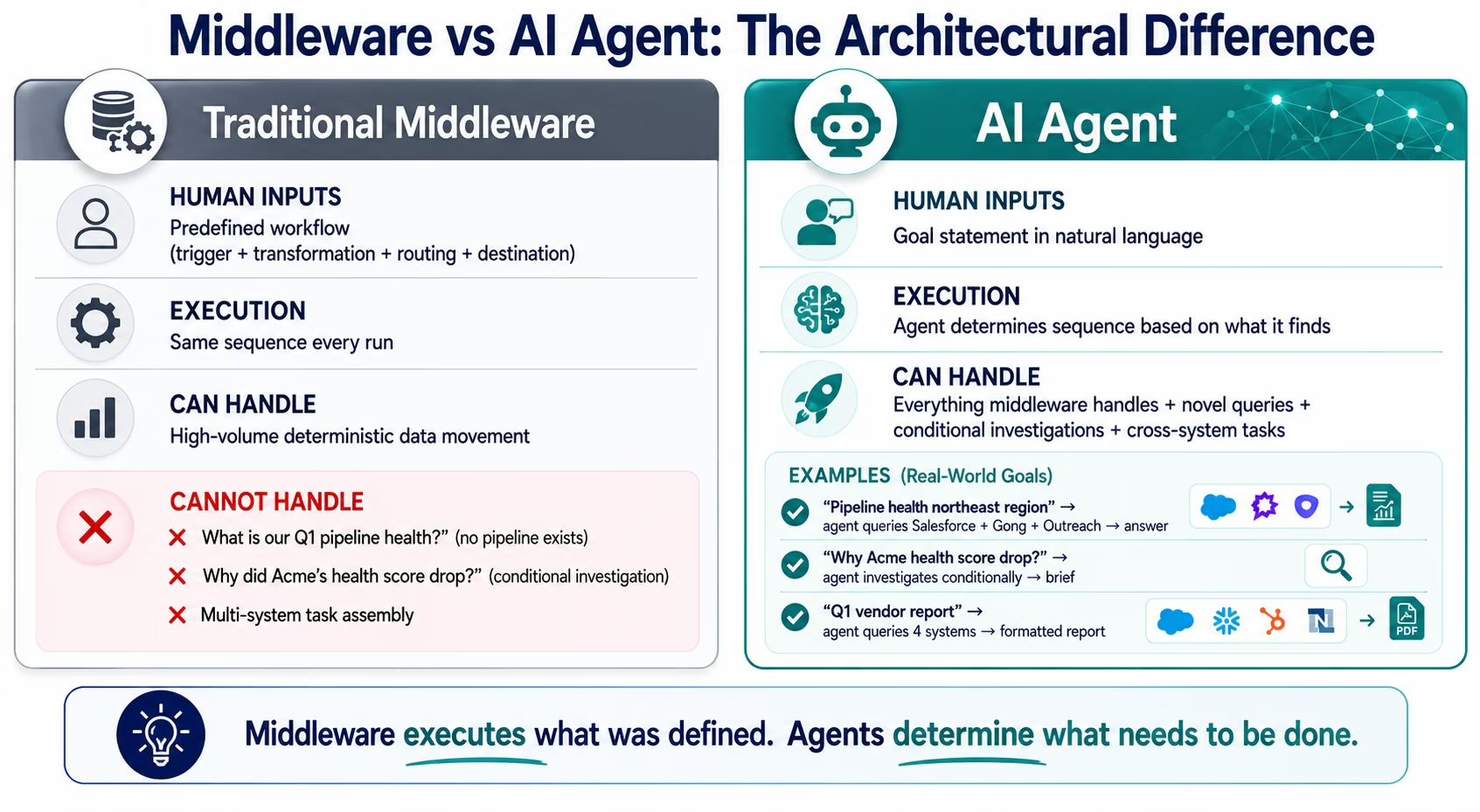
AI agents receive goals and determine how to achieve them: autonomously deciding which systems to query, in what sequence, and how to assemble the results. This is the architectural difference.
Wikipedia’s definition of autonomous agents describes them as systems that perceive their environment and take actions to achieve goals. In enterprise integration, the “environment” is the connected system estate, the “perception” is reading API responses and data outputs, and the “actions” are API calls, database queries, document retrievals, and analytical computations.
The same three limitations that expose middleware’s boundaries are handled natively by AI agents:
Novel queries: the agent receives the question in natural language (“what is the current pipeline health for the northeast region?”), determines from its tool registry which systems to query, constructs the appropriate API calls, retrieves the data, and assembles the answer. No pipeline needs to be built in advance. The agent uses the tools available to it: whatever APIs and data sources have been connected: to answer any question expressible within the scope of those connections.
Conditional investigations: the agent executes the investigation dynamically. It pulls the health score history, reads the component scores, identifies the declining component, then decides which system to query next based on what it found. The next step depends on the prior result. This is not possible with predefined pipelines: it is native to goal-directed agents.
Cross-system tasks: the agent decomposes the task into steps, executes each step using the appropriate tool, and assembles the output. The four-system vendor performance report becomes a multi-tool agent task: query SAP, query the 3PL portal, query AP, query the ERP quality module, correlate and score, format. The agent handles the orchestration; the human receives the report.
The Three Architectural Differences That Matter
The shift from middleware to AI agents involves three specific architectural changes: each with implications for how enterprise integration is designed, maintained, and governed.
Difference 1: Instruction Model (Imperative → Declarative)
Traditional middleware is imperative: “do this, then this, then this.” Every step is explicitly specified. If the sequence is wrong, the output is wrong: and the human who configured the workflow is responsible for specifying the correct sequence.
AI agents are declarative: “achieve this goal.” The agent determines the sequence of steps needed to achieve the goal, based on the available tools, the information retrieved at each step, and the goal statement. The human specifies the desired outcome; the agent determines the path.
This is the same distinction that separates SQL from imperative programming: SQL says “return customers where revenue > $100K” without specifying how to retrieve them (the query planner determines the execution path). AI agents receive a goal statement and determine the execution path.
The practical implication: agents can handle goals that cannot be expressed as fixed sequences, because the correct sequence depends on what is discovered along the way. Middleware cannot handle this. Agents can.
Difference 2: Scope of Operation (Single Pipeline → Multi-System Orchestration)
A middleware pipeline connects System A to System B via a defined data flow. Its scope is the specific source-transformation-destination sequence for which it was configured.
An AI agent’s scope is the full set of tools available to it: all connected APIs, databases, knowledge bases, and other agents in its tool registry. A single agent goal can involve querying 8 different systems, applying multiple analytical frameworks, and assembling a composite result: tasks that would require multiple coordinated middleware pipelines to approach, and even then could not handle the conditional branching inherent in a real investigation.
Multi-system orchestration is native to agent architecture. For middleware, it requires an orchestration layer on top of the pipelines: which is effectively what AI agent architecture provides.
Difference 3: Adaptability (Static → Dynamic)
A middleware pipeline executes the same sequence every time it runs. If the source API changes its field names, the pipeline breaks. If the business question changes, a new pipeline must be built.
An AI agent adapts. If one tool call fails, the agent can try an alternative approach: using a different API endpoint, querying a different data source, or adjusting the query parameters based on the error response. If the goal is expressed differently, the agent re-plans. If a new data source is added to the tool registry, the agent can immediately use it: no reconfiguration required.
This adaptability is not unlimited: agents fail on goals outside their tool scope, misinterpret ambiguous instructions, and occasionally choose inefficient investigation paths. But the adaptability ceiling of agents is significantly higher than the adaptability ceiling of static middleware pipelines.
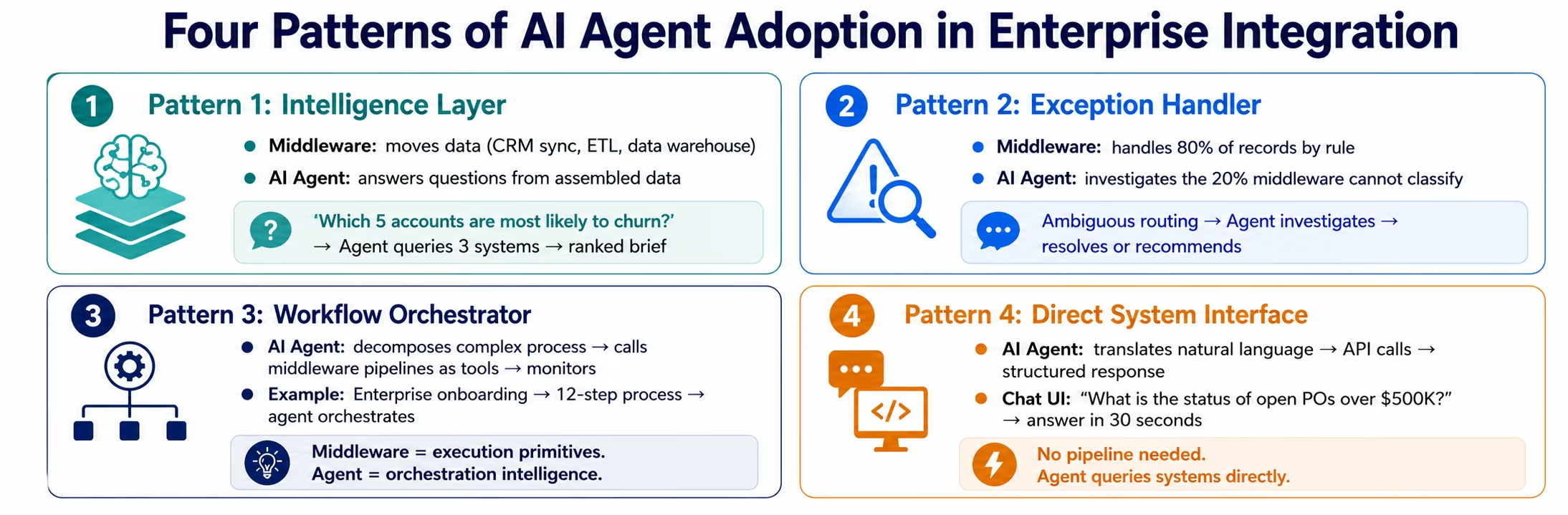
How the Shift is Happening: The Four Adoption Patterns
AI agents are not replacing middleware in a single dramatic architectural transition. They are supplementing it in four patterns that enterprise organisations are adopting incrementally.
Pattern 1: The Intelligence Layer
The most common adoption pattern: AI agents operate as an intelligence layer above existing middleware. The middleware pipelines continue to run unchanged: they move data reliably between systems. The AI agent layer sits above, using the data that middleware has assembled and answering questions about it.
The CRM-to-ERP sync still runs via iPaaS. The data warehouse still receives nightly loads via ETL. The AI agent queries these systems (using their APIs or direct database connections) to answer questions that no single pipeline was built to answer, “what are the five accounts most likely to churn this quarter, and what are the specific signals for each?”
Middleware maintains the data estate. AI agents interrogate it.
Pattern 2: The Exception Handler
AI agents handle the exception cases that middleware routes to human review queues. When a middleware pipeline encounters a record it cannot process according to its rules: an ambiguous classification, a validation failure with an unclear cause, a routing decision with multiple plausible outcomes: the record is handed to an AI agent for investigation and resolution.
The agent investigates: queries related systems, applies classification logic, determines the correct handling, and either resolves autonomously or presents a structured recommendation to a human approver. The middleware handles the 80% of straightforward cases; the AI agent handles the 20% that require judgment.
Pattern 3: The Workflow Orchestrator
For complex multi-step business processes: onboarding a new enterprise customer, executing a vendor qualification workflow, managing a complex procurement even, AI agents orchestrate the sequence of tasks across multiple systems, calling middleware pipelines as tools within the orchestration.
The agent decomposes the business process into steps, determines which system or middleware pipeline handles each step, monitors completion, and adapts if a step fails or produces unexpected results. The middleware pipelines remain as reliable execution primitives; the AI agent provides the orchestration intelligence above them.
Pattern 4: The Direct System Interface
For use cases where a natural language interface to enterprise systems is the goal: a C-suite executive querying live business data in conversation, an operations manager asking “what is the current status of open purchase orders over $500K?“: AI agents provide the interface directly. The agent translates the natural language query into system calls, executes them across the relevant APIs, and assembles the response.
This is where the Chat UI of platforms like Goldfinch AI operates: not replacing middleware, but providing a conversational intelligence layer that uses connected systems as data sources.
What Middleware AI Agents Use (They Don’t Replace Pipelines)
A critical clarification that prevents architectural misunderstanding: AI agents orchestrate across middleware, they do not replace it. The data movement layer, the pipelines that synchronise Salesforce with NetSuite, that load the data warehouse nightly, that broadcast inventory levels to connected channels: continues to run as built. AI agents operate above this layer.
In eZintegrations’ architecture, this is explicit in the four-level design:
Level 1 (iPaaS / Workflow Automation): deterministic data pipelines. REST API connectors, GraphQL queries, webhook handlers, database integrations, message queue consumers. High-volume, reliable, predefined. These are the data movement foundations that the rest of the architecture depends on.
Level 2 (AI Workflows): intelligence added to Level 1 pipelines, Document Intelligence, LLM Classification, Data Analysis nodes embedded within workflow steps. The pipeline is still predefined; AI enriches specific steps within it.
Level 3 (AI Agents): autonomous investigation agents that use Level 1 and Level 2 capabilities as tools. When a Level 3 agent needs to query Salesforce, it calls the Salesforce API tool, which under the hood uses the same Salesforce connector as Level 1. The agent does not bypass the middleware layer; it calls it as a tool.
Level 4 (Goldfinch AI): coordinator-worker multi-agent orchestration. A coordinator agent dispatches worker agents (each at Level 3) and synthesises their results. The Goldfinch AI Chat UI and Workflow Node are the interfaces through which goals are expressed.
The middleware layers (1 and 2) continue to exist and run. They are the execution layer on which agents (3 and 4) operate. The architectural shift is the addition of layers 3 and 4 on top of the existing middleware foundation: not the removal of layers 1 and 2.
The 9 native tools Goldfinch AI agents use:
- Knowledge Base Vector Search (semantic search across connected knowledge bases)
- Document Intelligence (read and extract from any document)
- Data Analysis (statistical computation and anomaly detection)
- Data Analytics with Charts/Graphs/Dashboards (visual output generation)
- Web Crawling (real-time information from external sources)
- Watcher Tools (continuous monitoring and threshold alerting)
- API Tool Call (direct REST/GraphQL API calls to any connected system)
- Integration Workflow as Tool (calling a Level 1/2 workflow as a tool within the agent)
- Integration Flow as MCP (exposing integration capabilities via Model Context Protocol)
Each of these tools is a capability the agent can call autonomously. Users can add further tools beyond these 9 as self-service.
Real Enterprise Use Cases: Before Middleware, After AI Agents
To make the architectural shift concrete, here are three enterprise use cases: showing what the same business need looks like with middleware alone versus with AI agents above the middleware layer.
Use Case 1: Account Health Investigation
Before (middleware only):
The CS manager notices that Acme Corp’s health score dropped. They open four browser tabs: the CS platform (health score history), the product analytics dashboard (usage data), the CRM (recent interactions), and the billing system (payment status). They manually correlate the data across tabs, forming a hypothesis about the cause of the health score decline. Time: 45-90 minutes.
Alternatively, they submit a request to the data team for a custom report. Turnaround: 3-5 business days. By which time the account situation may have escalated further.
After (AI agent on top of middleware):
The CS manager types in the Goldfinch AI Chat UI: “Why did Acme Corp’s health score drop 23 points this week? What are the most likely causes and what should I do first?”
The Goldfinch AI coordinator dispatches worker agents: one to the CS platform for health score component history, one to the product analytics system for usage data, one to the CRM for interaction history, one to the billing system for payment status. The agents query their respective systems, the coordinator synthesises the results, and the Chat UI returns a structured brief in 47 seconds: “Health score decline driven primarily by 68% drop in daily active users over the past 7 days (feature: [feature name]). One support ticket open for 9 days with no resolution. Payment status: current. Recommended first action: engineering escalation on open ticket + CSM outreach today.”
Time: 47 seconds versus 45-90 minutes. Decision quality: same. Engineer involvement: zero.
Use Case 2: Integration Backlog Triage
Before (middleware only):
The engineering manager has 40 items in the integration backlog.
Prioritising them requires: researching each item’s business impact (conversations with stakeholders), estimating technical complexity (reviewing API documentation for each system), identifying dependencies (checking which items are blocked by prior items), and checking template availability (searching the Automation Hub manually). Time to produce a prioritised backlog: 2-3 weeks.
After (Integration Triage Agent):The Goldfinch AI Triage Agent runs against the Jira backlog. For each item: it retrieves the original request and stakeholder context, queries the API documentation for the target systems, checks the Automation Hub for matching templates, and calculates a priority score across four dimensions (business impact, technical complexity, dependencies, template availability). The engineering manager receives a prioritised backlog with a written rationale for each item’s ranking. Time: 3-4 hours. Human review: 30 minutes.
Use Case 3: Vendor Performance Report
Before (middleware only):
The procurement team needs a quarterly vendor performance report. Data sits in SAP (PO data), the 3PL portal (delivery data), the AP system (invoice data), and the ERP quality module (defect data). Building a middleware pipeline to aggregate this data would take 3-4 weeks. Running it manually (exporting from four systems, reconciling in Excel) takes 2-3 days per quarter.
After (multi-agent report generation):
The procurement manager submits the report request to Goldfinch AI: “Generate Q1 2026 vendor performance report for the top 20 vendors by spend, covering delivery SLA, invoice accuracy, and quality metrics.”
The coordinator dispatches four worker agents to the respective systems, a fifth to correlate and score vendor performance, and a sixth to format the output for the supplier review. The report is ready in 23 minutes. The procurement manager reviews and approves in 15 minutes.
What This Means for Your Integration Architecture
The practical implication for enterprise architects is not “replace your middleware” but “design your integration architecture for the world where agents operate above it.” This means four things concretely.
Make your middleware agent-queryable. AI agents call middleware systems through their APIs. Middleware that exposes rich, well-documented REST or GraphQL APIs is immediately usable by agents. Middleware that only exposes data through scheduled batch exports is not. As you extend or modernise your integration estate, prioritise API-first design that enables agents to query your data in real time.
Build a tool registry. AI agents are only as useful as the tools they have access to. A tool registry: the catalogue of APIs, databases, knowledge bases, and workflows that agents can call, determines the scope of questions agents can answer and tasks they can complete. Building this registry is an integration architecture decision: which systems should be agent-accessible, at what granularity, and with what authentication model?
Define agent governance before you need it. AI agents make decisions autonomously within their configured scope. Before deploying agents that interact with production systems, define: which actions agents can take without human approval, which require human review, and which are always escalated. The autonomous action policy at Level 3 is the governance mechanism: define it explicitly, not retroactively.
Plan the four-level architecture. The platforms that will serve enterprise integration needs in 2026 and beyond are those that support all four levels, deterministic pipelines (Level 1), AI-enriched pipelines (Level 2), autonomous investigation agents (Level 3), and multi-agent coordination (Level 4). Single-level platforms force migration when requirements evolve. Four-level platforms grow with your needs.
How eZintegrations Implements AI Agent Integration
eZintegrations is designed as a four-level architecture from the ground up: not middleware with agents bolted on, and not agents operating without a reliable middleware foundation.
Level 1 and Level 2 as the data foundation: all standard iPaaS workflow automation (REST, GraphQL, WebSocket, Database, Message Queue, File connectors) plus native AI Workflow nodes (Document Intelligence, LLM Classification, Data Analysis, Semantic Matching). This is the reliable data movement and enrichment layer on which everything above depends.
Level 3 AI Agents: autonomous investigation agents with 9 native enterprise tools. Each agent receives a goal, determines its investigation sequence, calls the appropriate tools, and delivers a structured result. Human approval gates are configurable per agent and per action type.
Level 4 Goldfinch AI: the coordinator-worker multi-agent orchestration layer. A coordinator agent receives goals: from the Chat UI (natural language queries from business users and executives) or the Workflow Node (automated intelligence programmes on configured schedules): and dispatches specialist worker agents in parallel. The coordinator synthesises worker outputs and delivers a unified result.
Chat UI for real-time intelligence: business users and executives query the connected system estate in natural language. “What is the current health of our top 20 accounts by revenue?“: answered in under 60 seconds by the coordinator dispatching agents to the CS platform, CRM, product analytics, and billing systems. No custom report. No data team request. No waiting.
Workflow Node for automated intelligence: AI agent programmes that run on configured schedules or trigger conditions: the Integration Backlog Triage Agent that runs every Monday morning and delivers a prioritised backlog view, the Account Health Monitor that runs nightly and surfaces accounts whose health signals have deteriorated, the Pipeline Health Intelligence that delivers the morning’s integration estate summary before the engineering team starts work.
SOC 2 Type II, GDPR, HIPAA BAA: all agent processing runs natively within eZintegrations’ compliant infrastructure. No agent tool calls send enterprise data to external AI providers. PHI, PII, and financial data processed by agents stays within the compliance boundary.
IPSec Tunnel for on-premises systems: agents can query on-premises systems (SAP on-premises, Oracle on-premises, on-premises databases) through the IPSec Tunnel: the same connection used for Level 1 pipeline connectivity.
Book a free demo AI agent integration and bring your most complex cross-system question or task. We will show you the agent configuration, the tool registry setup, and the Chat UI or Workflow Node implementation for your specific use case.
Frequently Asked Questions
Integration debt is the accumulated cost of deferred, improvised, and undocumented integration architecture decisions: including point-to-point connections, unmonitored developer scripts, shadow iPaaS tools, and ungoverned data flows that compound over time. It became a crisis in 2026 for two reasons. First, the maintenance burden consumes 40–50% of engineering capacity, preventing delivery of new capabilities. Second, the fragmented foundation blocks AI workflows, AI agents, and agentic AI adoption: the capabilities enterprise leadership is under pressure to deploy.
Integration debt cost has three components. Direct maintenance cost: engineering hours spent on monitoring, debugging, patching, and updating existing integrations, typically 40–50% of engineering capacity. Opportunity cost: the business value of backlogged integrations not yet delivered, often estimated at $8–12M per year for mid-sized enterprises. Risk premium: the probability-weighted cost of compliance failures, security incidents, and data quality issues caused by unreliable integrations. The direct maintenance component alone can reach several million dollars annually in large estates.
No, Full rebuilds consistently fail or recreate new debt. Integration requirements continue evolving during the rebuild, institutional knowledge is lost as team members leave, and dependent systems change over time. The correct approach is incremental migration, prioritised by (business criticality × health risk ÷ modernisation complexity), with parallel-run validation before retiring legacy integrations. The goal is not a perfect end state, but a continuously improving, less indebted integration estate.
Integration debt directly determines the ceiling for AI adoption. AI workflow nodes require managed, monitored, and documented pipelines. AI agents require clean API connections with managed authentication and schema definitions. Agentic AI coordination requires a fully observable, connected system estate. Point-to-point integrations, undocumented flows, and shadow tools cannot support these requirements without modernisation. Therefore, the integration roadmap is a prerequisite to the AI adoption roadmap.
Shadow IT integrations are data flows built outside the official integration platform: such as Zapier workflows created by business users, developer scripts running on unmonitored servers, and direct system-to-system webhooks. These often represent 20–40% of enterprise data flows and are the highest-risk component of integration debt because they are ungoverned, unmonitored, and undocumented, frequently handling sensitive data. Resolving integration debt without addressing the shadow estate leaves significant compliance and reliability risks unresolved.
Integration debt resolution follows a phased timeline. Phase 1: stabilise high-risk integrations within approximately 8 weeks. Phase 2: inventory and classify the full estate over 6–16 weeks, overlapping with Phase 1. Phase 3: migrate integrations by priority over 4–24 months depending on estate size and resources. Phase 4: enable AI capabilities on modernised integrations as early as month 6. Overall, enterprises typically reach a substantially AI-ready integration foundation within 12–24 months, with incremental value delivered throughout the process.1. What is integration debt and why is it a crisis in 2026?
2. How do you calculate the cost of integration debt?
3. Should enterprises rebuild their integration stack from scratch?
4. What is the connection between integration debt and AI adoption?
5. What is shadow IT integration and why does it matter for debt resolution?
6. How long does integration debt resolution take?
Conclusion: Middleware Is the Foundation. Agents Are the Intelligence Above It.
The framing of “AI agents replacing middleware” is partially right and significantly misleading. The deterministic data movement layer: the pipelines that synchronise systems, maintain data quality, and execute business process automation: is not being replaced. It is being given a more powerful interface.
What changes is what sits above the middleware layer. Traditional middleware has no natural language interface, no ability to answer novel questions, no capacity to conduct conditional investigations across multiple systems, and no mechanism for orchestrating complex multi-system tasks that require intelligence at the assembly step. These are not features that can be added to middleware by extending it. They require an architectural layer above it.
AI agents provide that layer. They receive goals, access the connected system estate through their tool registry, conduct investigations that no predefined pipeline could conduct, and deliver intelligence that no single middleware pipeline was built to produce.
The enterprises that will be most effective at this transition are the ones that design their middleware layer to be agent-queryable (API-first, real-time accessible), build their tool registry explicitly (which systems should agents be able to query, at what granularity), define agent governance before deployment (autonomous action policy, human approval gates), and choose a four-level platform that supports both reliable data movement and intelligent orchestration.
eZintegrations delivers this four-level architecture: Level 1 iPaaS for reliable data movement, Level 2 AI Workflows for intelligent pipelines, Level 3 AI Agents for autonomous investigation, and Level 4 Goldfinch AI for multi-agent coordination and natural language enterprise intelligence.
Book a free demo AI agent integration and bring your most complex cross-system question. We will show you what Goldfinch AI can answer in under 60 seconds from your connected system estate.