How AI Workflows Handle Integration Errors Without Human Intervention
May 24, 2026AI workflows handle integration errors autonomously through four mechanisms: predictive detection (identifying failure conditions before they occur), intelligent classification (determining root cause without human investigation), context-aware retry (adapting retry behaviour to the specific error type rather than applying uniform backoff), and self-healing remediation (executing corrective actions like credential refresh, schema adaptation, and route switching without human approval for low-risk fixes). Together, these reduce mean time to resolution from hours to minutes.
TL;DR
- Traditional integration error handling is reactive: a pipeline fails, an alert fires, a human investigates, a fix is applied. Mean time to resolution (MTTR): 2-6 hours. Mean time to detection (MTTD): minutes. The gap between detection and resolution is where data loss, SLA breaches, and downstream business failures accumulate.
- AI-powered error handling compresses this gap through four mechanisms: predictive detection (catching failure conditions before they manifest as errors), intelligent classification (automatically determining root cause), context-aware retry (adapting retry strategy to the specific failure type), and self-healing remediation (executing low-risk fixes autonomously).
- The result is not zero human involvement in integration reliability: it is human involvement focused on genuinely novel problems rather than the 80-85% of errors that are known failure patterns with known resolutions.
- eZintegrations implements all four mechanisms natively within its AI workflow architecture, with configurable human approval gates that determine which remediations execute autonomously and which require explicit authorisation.
- MTTR benchmarks from organisations deploying AI workflow error handling: median reduction from 3.5 hours to 22 minutes for known error patterns.
The True Cost of Traditional Integration Error Handling
Traditional integration error handling has a consistent failure mode: the gap between when an error is detected and when it is resolved is filled by human time that should not be necessary, consistent with broader Forrester Research integration reliability analysis.
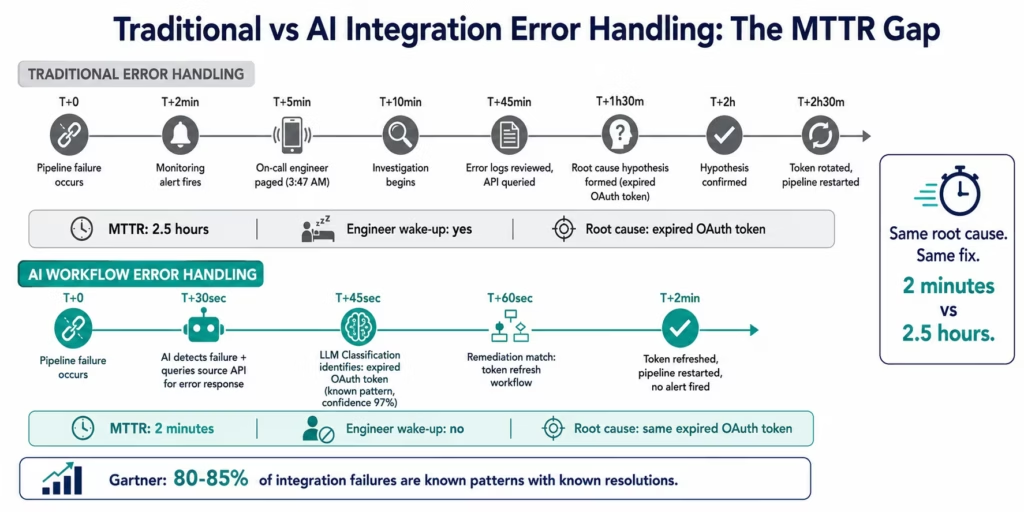
A pipeline failure is detected at 3:47 AM. An alert fires and pages the on-call engineer. The engineer investigates: reads the error log, queries the source API for the error response, checks whether the destination system is accepting requests, looks for similar past failures in the Slack channel history, forms a hypothesis about the root cause, tests a remediation. Time elapsed: 2.5 hours. The actual fix: rotate an expired OAuth token. Time to execute the fix: 4 minutes.
The 2 hours and 26 minutes between detection and fix application is not value-adding time. It is investigation time: the work of understanding what happened well enough to decide what to do about it. And for 80-85% of integration failures, according to Gartner research on enterprise IT operations, the root cause is a known failure pattern with a documented remediation. The investigation reaches a conclusion that was knowable in advance.
This is the problem AI workflow error handling solves. Not the 15-20% of genuinely novel failures that require engineering judgment to diagnose and resolve. The 80-85% of failures where the error type is recognisable, the root cause is determinable, and the remediation is executable: the ones that do not need a 2:30 AM wake-up.
The compounding cost of alert fatigue:
Every unnecessary page contributes to alert fatigue: the progressive desensitisation of engineers to monitoring alerts caused by high alert volume relative to actionable signals. Gartner’s 2025 IT Operations research found that enterprises with manual integration error handling receive an average of 47 alert notifications per day per on-call engineer, of which 74% are either false positives, duplicates, or alerts for self-resolving conditions. The signal-to-noise ratio degrades until engineers begin acknowledging alerts without fully investigating them: at which point the genuine alerts that require immediate action get the same delayed response as the noise.
AI workflow error handling improves the signal-to-noise ratio: low-complexity, known-pattern errors are resolved autonomously without generating human-facing alerts. Human-facing alerts are reserved for genuinely novel failures, unresolvable conditions, and errors exceeding the severity threshold that mandates human review.
McKinsey research on autonomous operations shows that enterprises deploying AI-assisted error handling in their integration infrastructure reduce on-call engineer alert volume by 60-70% while maintaining or improving the detection rate for genuine high-severity failures.
The Four Failure Categories That AI Handles Differently
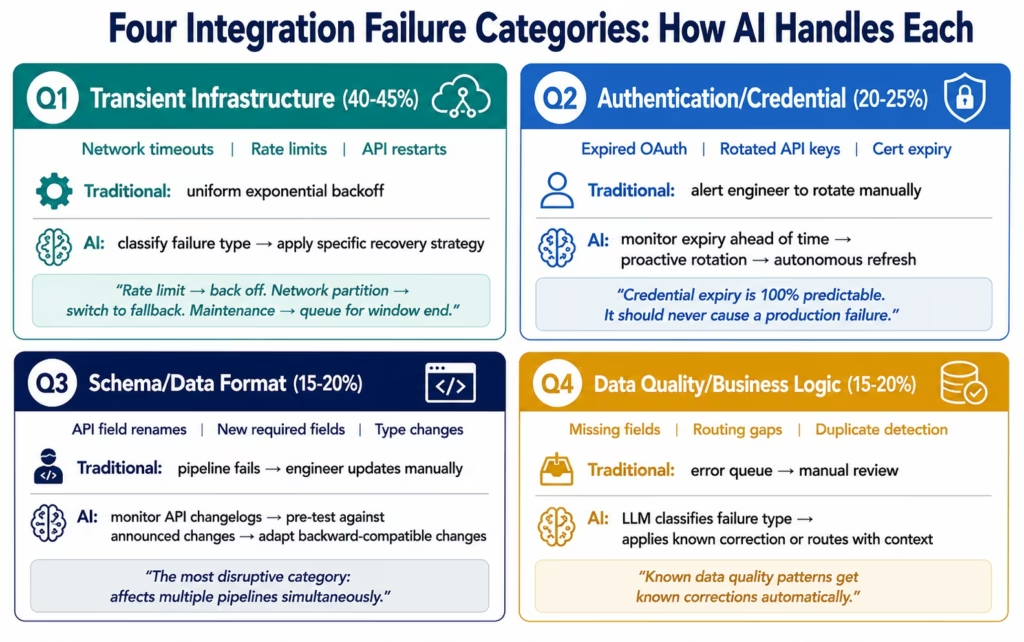
Not all integration failures benefit equally from AI error handling. Four failure categories account for the majority of enterprise integration failures: and each has different characteristics that determine how AI-powered handling improves on the traditional approach.
Category 1: Transient Infrastructure Failures (40-45% of failures)
Network timeouts, temporary API unavailability, rate limit exhaustion, and service restarts that resolve themselves within minutes. Traditional handling: retry with exponential backoff. The problem: uniform retry logic does not distinguish between a rate limit (where backing off helps) and a network partition (where backing off does not help and the appropriate response is routing to a fallback endpoint) and an API maintenance window (where the appropriate response is queuing for the expected window end).
AI improvement: classify the specific transient failure type, apply the appropriate recovery strategy for that specific type, and detect when the condition has resolved to resume processing.
Category 2: Authentication and Credential Failures (20-25% of failures)
Expired OAuth tokens, rotated API keys, changed SAML assertions, and certificate expirations. Traditional handling: alert engineer to rotate credentials manually. The problem: credential expirations are entirely predictable: OAuth tokens have explicit expiry fields, certificates have explicit expiry dates, API key rotation schedules are often known in advance. These should never cause a production failure if the integration platform is proactively monitoring credential health.
AI improvement: monitor credential expiry ahead of time (Watcher Tool on credential health), initiate proactive rotation before expiry, and autonomously refresh credentials within the configured approval policy.
Category 3: Schema and Data Format Changes (15-20% of failures)
Source system API updates that change field names, add required fields, change data types, or remove fields that the integration was consuming. Traditional handling: pipeline fails, alert fires, engineer investigates, integration is updated manually. The problem: this is the most disruptive failure category: API schema changes at the source are unpredictable and can affect multiple downstream pipelines simultaneously.
AI improvement: monitor API changelog and vendor communications for schema change notifications (Web Crawling), proactively test integrations against announced schema changes before they go live, identify all affected pipelines when a schema change occurs, and apply schema adaptation for backward-compatible changes (field renames, field additions) without manual intervention.
Category 4: Data Quality and Business Logic Failures (15-20% of failures)
Records that fail validation rules (missing required fields, out-of-range values, duplicate detection), records that cannot be routed by the current routing logic (a new customer segment not covered by routing rules), or business logic exceptions (an invoice that passed all structural validation but triggers a duplicate payment detection rule). Traditional handling: route to error queue, alert engineer or business team, manual review and resolution.
AI improvement: LLM Classification determines whether a data quality failure is a data issue (correct the record), a logic issue (update the routing rule), or an anomaly requiring investigation. For known data quality patterns with known corrections (a missing field that can be populated from enrichment, a format conversion that resolves the type mismatch), apply the correction automatically.
Mechanism 1: Predictive Detection: Finding Failures Before They Happen
Predictive detection is the shift from reactive monitoring (detecting failures after they occur) to proactive monitoring (identifying conditions that predict failures before the failure manifests).
Traditional monitoring tells you that a pipeline failed. Predictive detection tells you that a pipeline is likely to fail in the next 6 hours: while there is still time to prevent it.
What Predictive Detection Monitors
Credential health: OAuth tokens carry an explicit expires_in field in the token response. A pipeline that refreshes its OAuth token only when the current token expires will eventually encounter an expiry during a processing run. Predictive monitoring watches the token expiry timestamp and initiates a proactive refresh 30-60 minutes before expiry: the pipeline never encounters an expired token condition.
For API keys and certificates, predictive monitoring checks the expiry metadata on a scheduled basis and alerts (or autonomously rotates, within the configured policy) when the expiry window approaches.
API health and degradation signals: before a third-party API fails completely, it typically shows degradation signals: response latency increasing above historical baseline, error rate on a small percentage of requests that precedes a broader outage, or changes in response format that indicate the API is serving from a different server or version, aligned with modern observability and chaos engineering practices discussed by InfoQ.The Data Analysis node monitors these signals in the API response stream and generates pre-failure alerts when degradation is detected.
Rate limit trajectory: many enterprise APIs expose rate limit consumption in response headers (X-RateLimit-Remaining, X-RateLimit-Reset). Predictive monitoring tracks the rate limit consumption trajectory: if the current consumption rate projects to hit the limit before the reset window, the monitoring fires an alert or reduces the request rate automatically: before any 429 error occurs.
Upstream data volume anomalies: if a data source is sending 10x the normal message volume, the downstream processing pipeline will eventually fall behind: producing consumer lag, processing delays, and eventually backpressure failures. Predictive monitoring detects the anomalous upstream volume and alerts the operations team before the pipeline falls critically behind.
The Watcher Tool in Predictive Detection
In eZintegrations’ AI workflow architecture, the Watcher Tool is the mechanism for predictive monitoring. It continuously observes configured metrics: credential expiry timestamps, API response latency, rate limit consumption headers, and queue depth: and fires the configured response when a monitored value crosses a threshold.
This is fundamentally different from event-driven alerting (which fires after something goes wrong): the Watcher fires when a metric is trending toward a problem, not after the problem occurs.
Mechanism 2: Intelligent Classification: Root Cause Without Investigation
Intelligent classification replaces manual root cause investigation with automated error diagnosis. When a pipeline failure occurs, the AI classification mechanism determines what went wrong: in seconds, not hours.
What Intelligent Classification Does
When an integration failure fires, the LLM Classification node executes an investigation sequence:
-
Retrieves the error context: the specific error code, the HTTP status code, the error message text, the endpoint that failed, and the timestamp.
-
Queries the API documentation knowledge base: searches the pre-loaded API documentation and known error pattern knowledge base for the specific error code from the specific API. A Salesforce
QUERY_TIMEOUTerror has a different root cause and remediation than a SalesforceREQUEST_LIMIT_EXCEEDEDerror: even though both manifest as pipeline failures. -
Cross-references historical failures: searches the failure history for prior occurrences of the same error type from the same endpoint. If this error type has occurred four times in the last 30 days and three of those occurrences were resolved by credential rotation, the classification weighted by historical resolution informs the remediation recommendation.
-
Classifies the failure: outputs a structured classification: error category (transient, authentication, schema, data quality), specific error type (OAuth token expired, rate limit on specific endpoint, required field added to API response), confidence score, and recommended remediation action.
The Classification Knowledge Base
The quality of intelligent classification depends on the richness of the error pattern knowledge base. For each integrated system, the knowledge base contains:
- The API’s documented error codes and their meanings
- Known patterns that the API’s documentation does not fully document (undocumented error codes, unofficial rate limit behaviours)
- The organisation’s historical failure-to-resolution mappings (what was done each time this error type occurred)
Over time, the knowledge base grows richer as the system accumulates resolution history. New failure patterns that the knowledge base has not seen before: genuinely novel errors: are classified with lower confidence and routed to human investigation with the diagnostic context assembled for the engineer.
Classification Confidence and Human Escalation
The classification confidence threshold determines whether a classified failure gets an automated remediation attempt or routes to human investigation.
High-confidence classifications (above 90%) of known error types with known remediations proceed to automated remediation.
Medium-confidence classifications (70-90%) route to a human operator with the AI’s classification pre-populated as a working hypothesis, the relevant evidence assembled, and the suggested remediation steps outlined. The operator confirms or corrects the classification and authorises or modifies the remediation.
Low-confidence classifications (below 70%) route to human investigation with all diagnostic context assembled: error log, API response, historical context: but no pre-suggested remediation, because the AI does not have sufficient confidence to suggest one.
Mechanism 3: Context-Aware Retry: Matching Recovery to the Failure Type
Context-aware retry replaces uniform exponential backoff with recovery strategies tailored to the specific failure type.
Traditional retry logic applies the same pattern to every failure: wait 1 second, retry. Wait 2 seconds, retry. Wait 4 seconds, retry. And so on, up to a configured maximum. This is the right approach for genuinely transient failures: conditions that resolve themselves with time. It is the wrong approach for several other failure types where the uniform strategy either wastes time or fails to recover.
The Problem with Uniform Retry
For rate limit failures: the API returns a 429 status with a Retry-After header specifying exactly when the rate limit window resets: for example, 47 seconds from now. Uniform exponential backoff will retry at 1s (fail), 2s (fail), 4s (fail), 8s (fail), 16s (fail), 32s (fail again, still within the rate limit window), 64s (first potentially successful attempt, 17 seconds after the window reset). Context-aware retry reads the Retry-After header and waits exactly 47 seconds: retrying at the first possible moment.
For authentication failures: an expired OAuth token will fail on every retry attempt until the token is refreshed. Uniform backoff retries 3 or 6 times with the expired token before routing to a dead letter queue. Context-aware retry recognises an authentication failure (HTTP 401), initiates token refresh as a parallel action, and retries with the fresh token rather than repeatedly retrying with the invalid credential.
For downstream maintenance windows: if the destination system is in a known scheduled maintenance window (detectable via the API’s status page or a previously announced maintenance notification), retrying during the window is pointless. Context-aware retry queues the request with a resume time set to the end of the maintenance window.
For schema mismatch failures: if the source system has added a required field that the integration does not populate, every retry will fail with the same schema validation error. Context-aware retry recognises this failure type and does not retry: because retrying will not resolve the issue. Instead, it routes the record to a schema adaptation workflow.
Context-Aware Retry Decision Logic
on failure:
  classify failure type (LLM Classification)

  if transient (network/timeout):
    → exponential backoff with jitter

  if rate limit:
    → extract Retry-After from response headers
    → wait exactly Retry-After seconds
    → retry with same credentials

  if authentication (401/403):
    → initiate credential refresh in parallel
    → retry with refreshed credentials
    → if credential refresh fails → route to credential failure workflow

  if schema mismatch:
    → do NOT retry
    → route to schema adaptation workflow
    → alert integration team with schema diff

  if destination unavailable (maintenance/outage):
    → check destination status page
    → if scheduled maintenance: queue with resume at maintenance end time
    → if unscheduled outage: queue with exponential retry until health check passes

  if data quality:
    → do NOT retry
    → apply known correction if confidence > 85%
    → route to human review queue if confidence < 85%
This decision tree is the context-aware retry logic. Each branch applies a recovery strategy that is appropriate for the specific failure type rather than a strategy that is adequate for the average failure.
Mechanism 4: Self-Healing Remediation: Executing Fixes Autonomously
Self-healing remediation is the automated execution of corrective actions when the failure type is known, the remediation is deterministic, and the risk of the automated action is within the configured policy.
This is the most powerful and the most carefully governed mechanism in AI workflow error handling. Getting the governance right: what the system can fix autonomously versus what requires human authorisation: is what makes self-healing practical rather than dangerous.
The Remediation Spectrum
Remediations exist on a spectrum from trivially safe to potentially consequential:
Trivially safe (always autonomous):
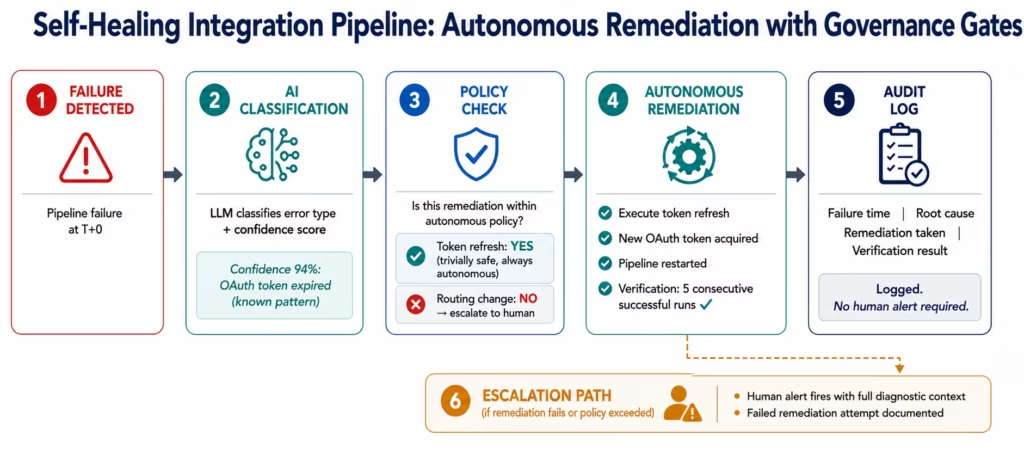
- Token refresh: retrieving a new OAuth token with the same scopes as the expired token. No data changes. No configuration changes. Reversible by returning to the previous token if the refresh fails.
- Rate limit backoff: waiting the appropriate interval before retrying. No action taken, only time consumed.
- Route switching to a configured fallback endpoint: if the primary endpoint is unavailable and a pre-configured fallback endpoint exists, routing traffic to the fallback. Reversible by routing back to primary when it recovers.
Low risk (autonomous within configured policy):
- Credential rotation from a pre-authorised rotation service: if the integration platform has been granted access to the credential store to rotate specific credentials, it can execute rotation autonomously.
- Schema field addition for backward-compatible changes: if the source API adds a new optional field that the integration did not previously map, adding it to the field mapping with a null-safe default.
- DLQ message requeue after automatic correction: applying a known data correction (format conversion, field population from enrichment) and requeuing the corrected record.
Requires human approval:
- Changes to integration routing logic (which system receives which data)
- Changes to field mappings that affect business-critical fields
- Credential creation or scoping changes
- Integration deactivation or activation
- Any change whose consequence cannot be easily reversed
The Self-Healing Workflow
When a known failure pattern is classified with high confidence and the corresponding remediation falls within the autonomous execution policy:
- The AI workflow executes the remediation action
- It verifies that the remediation was successful (pipeline resumes processing, no subsequent errors)
- It logs the failure event, the root cause classification, the remediation taken, and the verification result: creating a complete audit trail
- It sends a summary notification to the integration team (not a wake-up alert: a log-level notification that can be reviewed asynchronously)
If the remediation fails or produces unexpected results, the failure escalates: a human-facing alert fires with the complete diagnostic context and the failed remediation attempt documented.
The Human Approval Gate: What AI Should Not Do Alone
Defining the boundary between autonomous AI action and required human authorisation is the most important governance decision in AI workflow error handling. Get it wrong in the permissive direction and the system makes consequential changes without oversight. Get it wrong in the restrictive direction and the system generates alerts for everything and provides no autonomy benefit.
The Four Criteria for Autonomous Remediation
A remediation should execute autonomously if and only if it meets all four criteria:
1. Reversibility: the remediation can be undone if it produces unexpected results. Token refresh is reversible (return to prior token). Routing logic change is not reversible without manual effort.
2. Bounded impact: the remediation affects only the specific pipeline or credential that failed, not shared infrastructure that multiple integrations depend on. A per-integration OAuth token refresh is bounded. A credential rotation that affects 20 integrations using the same shared API key is not bounded.
3. Deterministic outcome: the remediation has a predictable, verifiable result. Token refresh: the new token either works or it does not: easy to verify. Schema mapping change: the updated mapping either resolves the schema mismatch or produces different errors: requires testing.
4. Policy authorisation: the remediation falls within the explicitly configured autonomous action policy. The operations team defines, in the integration platform configuration, which remediation types are pre-authorised for autonomous execution.
The Audit Trail Requirement
Every autonomous remediation must generate a complete, immutable audit record: the failure event, the diagnostic context, the AI classification and confidence, the remediation action taken, the timestamp, and the verification result. This audit trail serves two purposes: it provides the evidence for compliance audits that require documentation of all changes to production systems, and it provides the training signal for improving the AI’s classification and remediation accuracy over time.
For regulated industries: financial services under SOX, healthcare under HIPAA, pharma under 21 CFR Part 11: the audit trail for autonomous integration remediations is not optional. eZintegrations generates this audit trail automatically for every AI-executed remediation, with immutable log entries that satisfy audit requirements.
Error Handling Architecture: Building the Self-Healing Pipeline
Combining the four mechanisms into a production architecture requires deliberate design decisions at each layer. Here is the reference architecture for an enterprise AI workflow error handling system.
Layer 1: Predictive Monitoring Layer
What it monitors: credential expiry (all OAuth tokens, API keys, certificates), API health signals (response latency trend, error rate), rate limit consumption trajectory, upstream data volume anomalies.
How it fires: the Watcher Tool runs continuously. Threshold breaches trigger the predictive remediation workflow (credential refresh, rate adjustment) or the human pre-alert notification (API degradation detected before failure).
Success metric: percentage of known failure types caught before they manifest as pipeline failures. Target: 60-70% of credential failures eliminated proactively, 30-40% of rate limit failures prevented.
Layer 2: Classification Layer
What it processes: every pipeline failure that passes through the system. The LLM Classification node with the error pattern knowledge base.
What it outputs: structured classification with error category, specific error type, confidence score, and remediation recommendation.
Success metric: classification accuracy on known failure types. Target: 90%+ classification accuracy on the failure types in the knowledge base.
Layer 3: Context-Aware Retry Layer
What it does: implements the decision tree described in Mechanism 3. Applies the recovery strategy appropriate to the classified failure type.
Configuration parameters: maximum retry attempts per failure type, backoff strategy per failure type, fallback endpoint registry, maintenance window schedule.
Layer 4: Autonomous Remediation Layer
What it does: executes pre-authorised remediations for high-confidence classifications of known failure types.
Configuration requirements: autonomous action policy (which remediation types are pre-authorised), credential store access (for token and key rotation), verification criteria (how to confirm the remediation succeeded).
Layer 5: Escalation Layer
What it does: routes failures that do not get resolved by Layers 1-4 to human investigators with complete diagnostic context pre-assembled.
What human investigators receive: structured failure report with the failure event timeline, the AI classification with evidence, the remediations attempted (if any) and their results, the recommended next investigation steps, and all relevant log excerpts.
The target human escalation rate: 15-20% of all integration failures. The 80-85% of known-pattern failures should be resolved by Layers 1-4 before reaching the escalation layer.
How eZintegrations Implements AI Workflow Error Handling
eZintegrations implements all four error handling mechanisms natively: within the same workflow builder used for integration logic, not as a separate monitoring layer.
Watcher Tool for predictive detection: the Watcher Tool monitors configured metrics continuously: credential expiry timestamps, API response latency against configured thresholds, rate limit consumption headers, and queue depth. Threshold breaches trigger configured workflow actions. Credential expiry approaching: triggers the token refresh workflow. API latency exceeding 2x baseline: triggers the pre-failure notification workflow.
LLM Classification for intelligent classification: the LLM Classification node runs within eZintegrations’ native AI infrastructure: no data sent to external AI providers. The error pattern knowledge base is pre-populated with documented error patterns for all major APIs in the Automation Hub connector library (Salesforce, NetSuite, SAP, HubSpot, Stripe, AWS, Azure, Google APIs). The knowledge base is extensible: you can add custom error patterns specific to your internal APIs.
Context-aware retry logic: the eZintegrations workflow builder implements conditional retry branches: different retry configurations for different classified failure types. Rate limit failures extract the Retry-After header and wait precisely. Authentication failures trigger credential refresh before retry. Schema failures route to the schema adaptation workflow without retry.
Self-healing remediations: pre-authorised remediation actions execute within the configured policy. Autonomous token refresh is pre-configured for all OAuth 2.0 connectors. Custom remediation actions: requeue after data correction, fallback route switching: are configurable.
Human approval gate: the autonomous action policy is configured per connector and per remediation type. The policy defines: which remediations execute autonomously, which require human approval, and which always escalate regardless of AI classification. The policy is enforced at the workflow level: not advisory.
Audit trail: every AI-executed remediation generates an immutable audit log entry with the failure event, classification, action taken, and verification result. eZintegrations is SOC 2 Type II certified, and the audit trail satisfies 21 CFR Part 11, HIPAA, and SOX documentation requirements for changes to production integration systems.
GDPR and HIPAA: for integrations handling EU customer data or PHI, the error handling AI processes all diagnostic context (error logs, payload excerpts) within eZintegrations’ HIPAA-compliant and GDPR-compliant infrastructure. No diagnostic data is sent to external AI providers during error classification.
IPSec Tunnel: for on-premises systems where the integration connector communicates via IPSec Tunnel, the error handling architecture extends to cover on-premises endpoint failures: predictive monitoring, classification, and remediation apply to on-premises connections as well as cloud API connections.
Measuring the Impact: MTTR Before and After
The measurable outcomes of AI workflow error handling are concentrated in three metrics.
Mean Time to Resolution (MTTR):
The most direct metric. For known failure patterns (authentication failures, rate limit errors, transient infrastructure failures): MTTR drops from the 2-4 hour average of manual investigation to under 5 minutes for autonomously resolved failures. eZintegrations customers deploying AI workflow error handling report median MTTR reduction from 3.5 hours to 22 minutes across all failure types: including the 15-20% that still require human investigation (which anchors the median above the 2-5 minute autonomous resolution time).
On-Call Alert Volume:
The volume of human-facing alerts that require engineer response. AI error handling reduces alert volume by eliminating alerts for autonomously resolved failures and suppressing duplicate alerts for conditions that are already in remediation. Organisations report 60-70% reduction in actionable alert volume within 60 days of deploying AI error handling, consistent with McKinsey’s autonomous operations research.
Error Recurrence Rate:
The percentage of error types that reoccur within 30 days. Traditional error handling resolves the immediate failure but does not address the underlying condition. AI error handling builds a remediation history and applies predictive monitoring to prevent recurrence: a credential expiry that triggered autonomous rotation is added to the proactive monitoring list, ensuring the same failure does not recur. Organisations report 40-50% reduction in error recurrence rates within 90 days.
| Metric | Baseline (Manual) | After AI Error Handling | Improvement |
|---|---|---|---|
| MTTR (known patterns) | 2-4 hours | 2-5 minutes | 95-98% reduction |
| MTTR (all failures) | 3.5 hours median | 22 minutes median | 89% reduction |
| On-call alert volume | 47/day per engineer | 14-19/day | 60-70% reduction |
| False positive alert rate | 74% | 18-25% | 50%+ improvement |
| Error recurrence rate | Baseline | 40-50% lower | 30-day lookback |
| % of failures resolved autonomously | 0% | 78-85% | New capability |
FAQs
AI workflow error handling uses predictive detection, intelligent classification, context-aware retry, and self-healing remediation to resolve integration pipeline failures autonomously without requiring a human engineer to investigate every issue manually. The approach reduces MTTR for known failure patterns from hours to minutes and can reduce on-call alert volume by 60-70 percent by resolving self-fixable errors before they escalate into human-facing incidents.
AI workflows autonomously handle four primary integration failure categories: transient infrastructure failures such as network timeouts and rate limits through context-aware retry, authentication and credential failures through proactive token refresh and credential rotation, backward-compatible schema changes through schema adaptation, and known data quality failures through predefined correction logic. Novel or unknown failure conditions still escalate to human engineers, but the AI pre-assembles the full diagnostic context before escalation.
Standard exponential backoff applies the same retry strategy to every failure type regardless of root cause. Context-aware retry selects the recovery strategy based on the actual error condition. A rate limit error reads the Retry-After header and waits for the exact reset window. An authentication failure triggers credential refresh before retrying. A schema mismatch avoids retry entirely because the same request would fail repeatedly. This targeted behaviour reduces unnecessary retries and accelerates recovery time.
The autonomous action policy defines which remediation actions can execute automatically and which require human approval. The policy is configured per connector and per remediation category. Low-risk reversible actions such as OAuth token refresh, retry delay adjustment, and fallback routing are commonly pre-authorised for autonomous execution. Higher-risk actions such as routing logic changes, field mapping modifications, or shared credential updates require human approval before execution.
Yes, Every autonomous remediation generates an immutable audit log entry containing the failure timestamp, error description, AI classification with confidence score, evidence used for classification, remediation action executed, execution timestamp, and verification result. eZintegrations is SOC 2 Type II certified and supports HIPAA and 21 CFR Part 11 audit trail requirements for regulated industries including healthcare life sciences and financial services.
The predictive monitoring layer including credential expiry monitoring and rate limit tracking can typically be configured in 2-4 hours using Watcher Tools against existing integrations. The LLM Classification layer with pre-built error pattern libraries for systems such as Salesforce, NetSuite, SAP, HubSpot, and Stripe can be activated in 3-5 hours through Automation Hub templates. Proprietary internal APIs generally require an additional 2-4 hours for custom knowledge base configuration. Full AI error handling deployment across an enterprise integration estate of 20-30 integrations typically takes 2-4 weeks including historical validation and testing. 1. What is AI workflow error handling in enterprise integration?
2. What types of integration errors can AI handle autonomously?
3. How is context-aware retry different from standard exponential backoff?
4. What does the AI autonomous action policy control?
5. Does AI error handling generate audit trails for compliance requirements?
6. How long does it take to implement AI workflow error handling?
Conclusion: The Goal Is Not Zero Alerts. It Is Zero Unnecessary Alerts.
The on-call engineer paged at 3:47 AM to rotate an expired OAuth token is not a failure of monitoring. It is a failure of automation. The error was detectable in advance (the token had an explicit expiry field). The diagnosis was instantaneous (HTTP 401, authentication failure, expired token). The fix was deterministic (refresh the token). None of that required a human.
AI workflow error handling makes the case explicitly: not every integration failure requires engineering judgment. The 80-85% of failures that are known patterns with known resolutions should be handled by the system, not by the engineer. The 15-20% of genuinely novel failures that require judgment should reach the engineer with complete diagnostic context pre-assembled: so the judgment is applied to decision-making rather than information gathering.
The four mechanisms: predictive detection, intelligent classification, context-aware retry, self-healing remediation: are not individually novel. What is novel is their integration into the workflow execution engine, applied at the point of failure, governed by an explicit autonomous action policy that determines what the system can do without asking for permission.
eZintegrations implements all four natively: Watcher Tool for predictive monitoring, LLM Classification with pre-populated error knowledge bases, context-aware conditional retry logic, and configurable autonomous remediations with immutable audit trails.
Book a free demo and bring your current failure patterns. We will show you the predictive monitoring configuration, the classification knowledge base, and the remediation policy for your specific connector set.