eZintegrations vs Make (Integromat) 2026: Which Platform Scales for Enterprise Workflows?
May 1, 2026eZintegrations beats Make (Integromat) on native AI automation (Level 2 AI Workflows, Level 3 AI Agents, Level 4 Goldfinch AI are built in, not assembled from third-party modules), enterprise governance (RBAC, audit logs, change management at all tiers), ERP connectivity (native SAP, Oracle, NetSuite), and predictable per-automation pricing with no operations caps. Make excels at visual scenario building for technical-but-non-developer users and has a large module library. For enterprises that have outgrown Make’s operations limits, need AI agents, or require enterprise compliance certifications, eZintegrations is the appropriate next platform.
TL;DR:
- Make (formerly Integromat) is a powerful visual automation platform that sits between consumer tools like Zapier and full enterprise iPaaS platforms, as reflected in G2 Make vs eZintegrations reviews. Its visual scenario builder and module-based architecture are genuinely impressive for technical users who want no-code power without developer involvement.
- Make scales better than Zapier but hits its own ceiling at enterprise scale: operations-based pricing that penalises complexity, limited ERP connectivity, governance gaps that enterprise procurement teams reject, and no native AI agent capability.
- eZintegrations delivers native Level 1-4 automation: rule-based iPaaS, AI Workflows, AI Agents with 9 built-in enterprise tools, and Goldfinch AI multi-agent orchestration. Make’s AI capability requires assembling third-party modules (OpenAI, Anthropic HTTP modules) rather than running native AI inference.
- The audience for this comparison: IT leaders at mid-market enterprises who started with Make and are evaluating whether to scale it or move to an enterprise platform, or who are shortlisting platforms and want to understand where Make’s boundaries are.
- Verdict: Make for technically sophisticated small-to-mid teams that need visual scenario power without enterprise requirements. eZintegrations for enterprise automation that needs native AI, ERP connectivity, governance, and predictable pricing at scale.
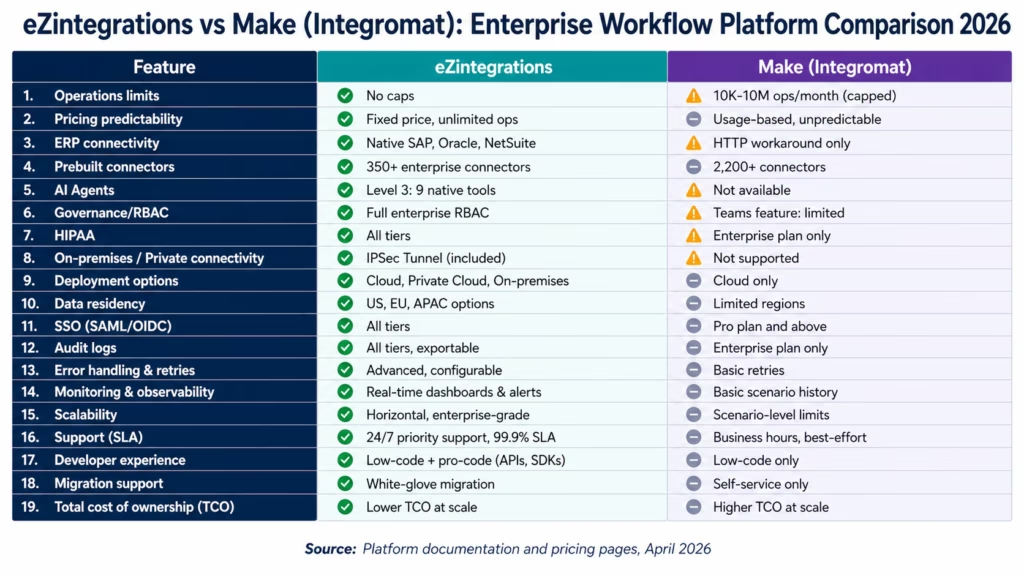
Summary Comparison Table (eZintegrations vs Make)
| Feature | eZintegrations | Make (Integromat) |
|---|---|---|
| Designed for | Enterprise automation + AI agents | Technical teams, mid-market SaaS automation |
| Pricing model | Per-automation ($90-$150/mo per workflow) | Per-operation (capped by plan) |
| Operations / volume limits | No execution caps | Capped (10,000-10M ops/month by tier) |
| Native AI Workflows (Level 2) | Yes: Document Intelligence, LLM classification | Assembled via HTTP + OpenAI module |
| AI Agents (Level 3) | Yes: 9 native tools, HITL, confidence thresholds | Not available |
| Multi-agent orchestration (Level 4) | Yes: Goldfinch AI, Chat UI, Workflow Node | Not available |
| ERP connectivity (SAP, Oracle, NetSuite) | Native connectors: OData V4, SuiteQL, OAuth | Not supported natively: HTTP workaround |
| On-premises systems | IPSec Tunnel (included) | Not supported |
| Webhook handling | HMAC verification, fan-out, dead letter queue | Webhooks supported, limited verification |
| Error handling | Dead letter queue, retry with backoff, row-level logging | Error routes in scenarios, limited recovery |
| Governance and RBAC | Full enterprise RBAC: Admin, Editor, Viewer | Teams feature: limited permissions |
| Audit logs | All tiers | Not available (enterprise feature) |
| HIPAA, SOC 2 Type II | All tiers | Enterprise plan only |
| Database connectivity | Native SQL, NoSQL, cloud DW | Basic: limited native DB connectors |
| GraphQL support | Native | HTTP module workaround |
| Automation Hub templates | 1,000+ production-ready | 500+ scenario templates |
| On-premises connectivity | IPSec Tunnel | Not supported |
| Visual builder | Yes: workflow canvas | Yes: scenario canvas (strength) |
| Target user | IT teams, operations, AI teams | Technical users, developers |
Introduction
Make is the platform that technical users who outgrew Zapier usually discover next. Its visual scenario builder with routers, iterators, aggregators, and error handlers is genuinely more powerful than Zapier’s approach. Its per-operation pricing model is more flexible than Zapier’s per-task caps. Its module library covers thousands of SaaS applications.
Make positions itself as a platform for teams, not just individuals. And it delivers on that positioning: for technical teams working with SaaS-centric workflows.
The enterprise ceiling is different from Zapier’s ceiling but exists at the same strategic inflection point. Make was not designed for enterprises running SAP, Oracle, or NetSuite as their ERP. It was not designed for autonomous AI agents. It was not designed for the governance and compliance requirements that enterprise procurement teams impose. And its operations-based pricing, like Zapier’s task-based pricing, escalates with workflow complexity in ways that enterprise-scale automation makes painful.
This comparison is for the IT leader who knows Make well and wants to understand specifically where it breaks down at enterprise scale, and what eZintegrations provides at each gap, aligned with Gartner enterprise iPaaS research.
Make’s Visual Scenario Builder: Genuine Strength
Before addressing the gaps, it is worth acknowledging what Make does well. Make’s scenario canvas is one of the best visual automation builders available. Its support for iterators, aggregators, routers, and custom error routes within a single scenario gives technical users significantly more power than Zapier’s linear Zap model.
If you can see your automation as a visual graph: data flowing through parallel paths, branching on conditions, looping over arrays, collecting results: Make’s canvas represents it more faithfully than most no-code platforms. For developers-turned-no-coders or technically proficient operations managers, this is a genuine productivity advantage.
Make also handles webhooks well for a mid-market tool, supports multiple data types within scenarios, and has a large module library that covers most major SaaS applications.
These strengths are real. The comparison below is about where Make’s strengths end and enterprise requirements begin.
The Operations Limit: Where Make’s Pricing Breaks Down
The verdict: Make’s operations-based pricing model penalises enterprise complexity. eZintegrations has no execution caps.
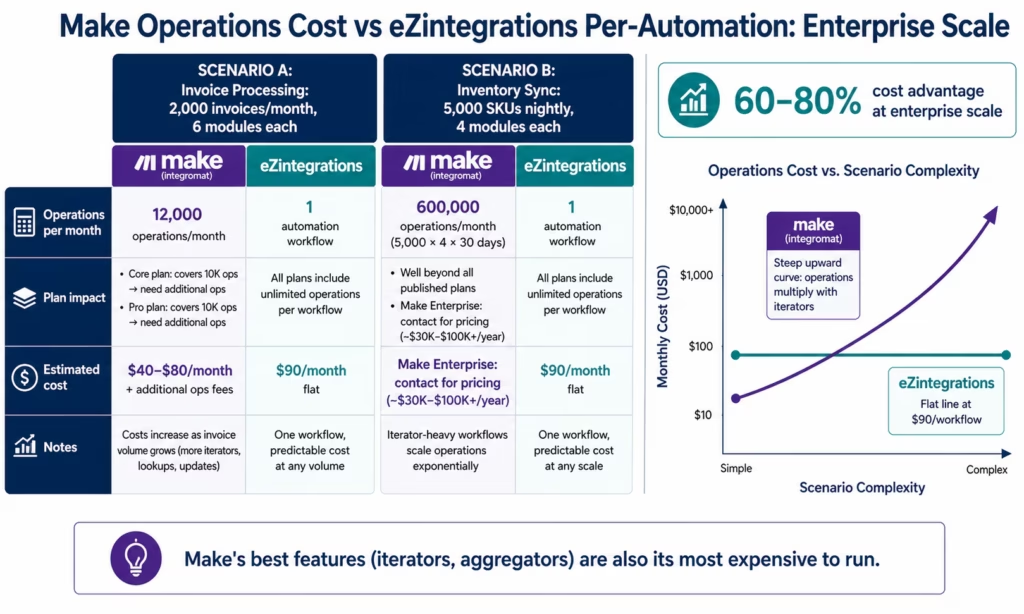
Make charges by operations: each module execution in a scenario counts as one operation. A scenario with 6 modules that processes 1,000 records per month uses 6,000 operations. A scenario with an iterator that loops over 50 records per execution uses 50× the operations of a non-looping scenario.
Make’s plans (see Make pricing tiers):
| Plan | Monthly Operations | Price |
|---|---|---|
| Free | 1,000 | $0 |
| Core | 10,000 | $9/month |
| Pro | 10,000 | $16/month |
| Teams | 10,000+ (additional ops purchasable) | $29/month |
| Enterprise | Custom | Contact for pricing |
The “additional operations” model means that as you build more complex scenarios (more modules, more iterators, more aggregators: the features that make Make powerful), your operation consumption grows and your monthly cost grows with it, consistent with Forrester Total Economic Impact of integration platforms. The features that make Make better than Zapier also make it more expensive at scale.
The iterator problem in enterprise scenarios:
Enterprise data processing typically involves iterating over collections: process each line item in an invoice, each record in a batch pull, each employee in a Workday export. In Make, each iterator loop consumes operations per iteration. A scenario that iterates over 100 invoice line items uses 100× the operations of a single-record scenario. A nightly inventory sync that processes 5,000 SKUs with 4 modules per SKU uses 20,000 operations per run: exceeding Make’s Core plan daily.
For enterprise deployments with high data volume and complex multi-module scenarios, Make’s operation consumption creates a cost structure that approaches Make Enterprise pricing quickly. Make Enterprise’s pricing is not publicly listed; enterprise contracts typically run $30,000-$100,000+/year based on available community reports.
eZintegrations: $90/month per automation workflow. A workflow that iterates over 5,000 records with 4 steps per record costs $90/month regardless of whether it runs daily or hourly, and regardless of record count growth.
AI Automation: Native vs Assembled from Modules
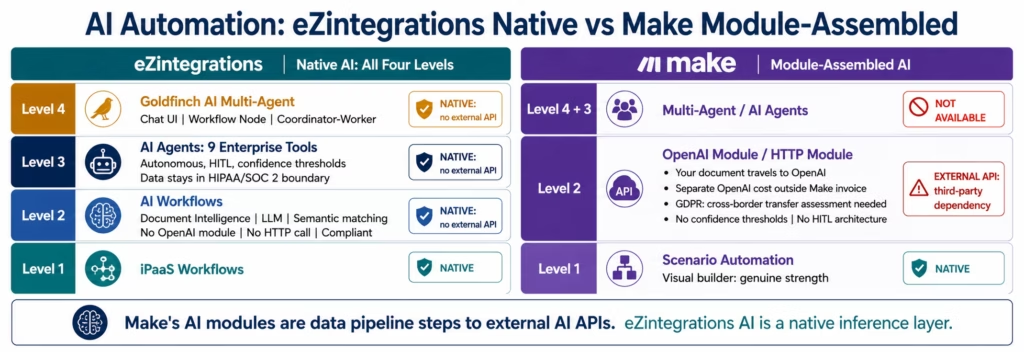
The verdict: eZintegrations delivers production-grade native AI at all four levels. Make’s AI is assembled from third-party HTTP modules and has no enterprise agent architecture.
What Make offers for AI:
Make has an OpenAI module and support for HTTP modules that can call Anthropic, Google AI, and other AI APIs. You can build scenarios that call OpenAI’s API from within a Make scenario: summarise this document, classify this text, generate a response.
Make also has an AI scenario builder feature that uses AI to help construct scenarios from natural language descriptions. Like Zapier’s AI builder and SnapLogic’s SnapGPT, this is a development-time tool, not production AI automation.
The structural limitation of module-assembled AI, particularly in the context of enterprise automation ROI highlighted by McKinsey & Company:
When a Make scenario calls the OpenAI module to process a document, several enterprise concerns arise:
First, data residency: your document content travels from Make’s infrastructure to OpenAI’s infrastructure. If your Make instance is in the EU and OpenAI processes in the US, you have a cross-border data transfer that requires assessment under GDPR.
Second, cost transparency: every OpenAI module call generates an OpenAI API cost that sits outside your Make subscription invoice. Enterprise finance teams typically require consolidated cost visibility, not split billing across multiple AI providers.
Third, no agent architecture: assembling an AI workflow from Make HTTP modules + OpenAI module does not give you confidence thresholds, reflection loops, human-in-the-loop gates, or multi-tool orchestration. You get a pipeline that calls an AI API. You do not get an autonomous agent.
What eZintegrations provides:
Level 1 (iPaaS Workflows): rule-based automation comparable to Make’s core scenario capability.
Level 2 (AI Workflows): Document Intelligence, LLM classification, semantic duplicate detection, and 3-way match with AI tolerance all run as native workflow nodes within eZintegrations. No OpenAI module. No HTTP module. No data leaving eZintegrations’ compliance boundary.
Level 3 (AI Agents): 9 native enterprise tools. The AP Exception Agent retrieves the PO from SAP via API Tool Call, checks the GR, searches the vendor contract via Knowledge Base Vector Search, compares amounts via Data Analysis, and routes a packaged exception to the AP manager: autonomously, within eZintegrations’ HIPAA and SOC 2 boundary, with a confidence threshold gate before any autonomous action.
Level 4 (Goldfinch AI): coordinator-worker multi-agent orchestration with Chat UI for natural language enterprise queries and Workflow Node for embedding coordinator intelligence inside Level 1 workflows.
Make has no production equivalent to Level 3 AI Agents or Level 4 Goldfinch AI. Its AI features help users build scenarios faster or add simple text processing steps. They do not provide enterprise autonomous process automation.
ERP and Enterprise System Connectivity
The verdict: Make does not natively connect to enterprise ERP systems. eZintegrations provides native SAP, Oracle, NetSuite, and 1,000+ enterprise system connectors.
Make’s module library is extensive for SaaS applications: Salesforce, HubSpot, Slack, Google Workspace, Shopify, Stripe, and thousands more. For organisations whose entire stack is SaaS, Make’s module library covers most needs.
The boundary is enterprise ERP. Make does not have native modules for SAP S/4HANA, SAP ECC, Oracle ERP Cloud, NetSuite, Infor CloudSuite, or EPICOR. The workaround is Make’s HTTP module, which can call any REST API: but using it to connect to SAP requires your team to:
- Configure SAP OData endpoints manually
- Write CSRF token fetch logic for SAP write operations
- Handle SAP-specific error codes in the scenario error routes
- Update the HTTP configuration when SAP releases quarterly API updates
- Manage authentication token refresh
This is not a connector. It is custom integration development using a low-code HTTP client. The maintenance burden is yours entirely.
eZintegrations provides native enterprise connectors:
- SAP S/4HANA: native OData V4 with automatic CSRF token management
- SAP ECC: BAPI and RFC connectivity
- Oracle ERP Cloud: REST APIs with OAuth assertion flow
- NetSuite: SuiteQL with full Token-Based Authentication (TBA) handled internally
- Infor CloudSuite, EPICOR, Dynamics 365, JDE: native REST API connectors
- 1,000+ enterprise and SaaS systems: pre-configured in the API Catalog with correct authentication and pagination
The API Catalog difference: not just having a connector, but having the connector pre-configured with the authentication method, pagination pattern, and error handling specific to that system. SAP quarterly updates are handled by the platform team. NetSuite biannual updates are handled by the platform team. Your team configures business logic, not API handshakes.
Make’s competitive strength is SaaS module breadth. eZintegrations’ competitive strength is enterprise system depth: particularly for ERP systems that require native authentication management.
Enterprise Governance and Compliance
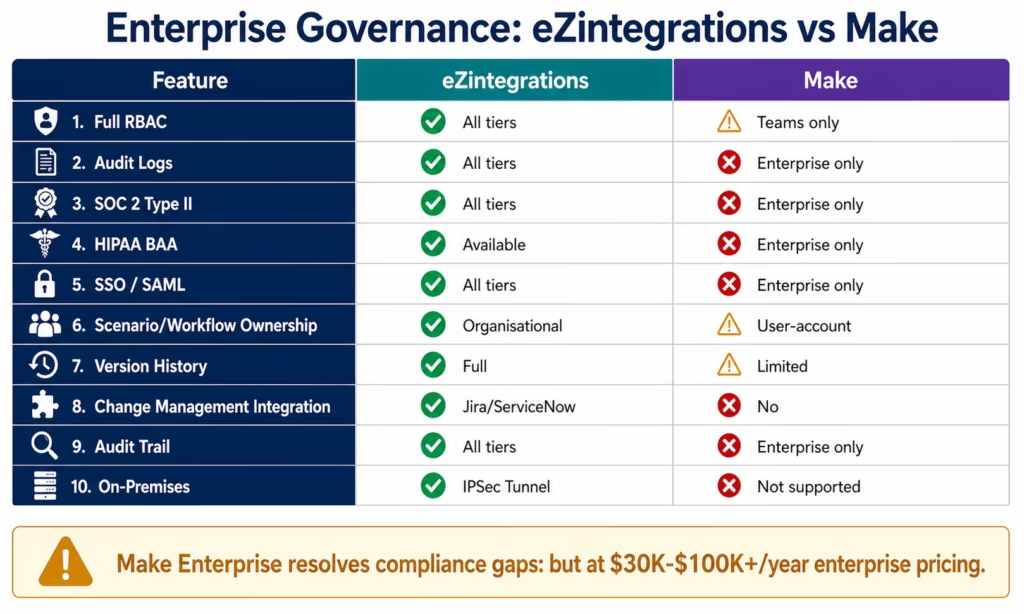
The verdict: eZintegrations includes enterprise governance at all tiers. Make restricts critical governance features to its Enterprise plan.
This is the dimension that most consistently fails enterprise procurement review for Make.
| Governance Feature | eZintegrations | Make |
|---|---|---|
| Role-based access control | Full RBAC: Admin, Editor, Viewer | Teams feature: limited per-scenario permissions |
| Audit logs | All tiers | Not available in non-enterprise plans |
| SOC 2 Type II | All tiers | Enterprise plan |
| HIPAA BAA | Available | Enterprise plan |
| GDPR compliance | All tiers | All tiers |
| SSO / SAML | All tiers | Enterprise plan |
| Workflow version history | Yes | Limited |
| Change management integration | Yes (Jira, ServiceNow) | No |
| Scenario ownership model | Organisational: team-managed | User-account-based |
| Data residency options | Available | Available (EU data centre) |
The scenario ownership model is a governance risk that surfaces most visibly during staff transitions. In Make, scenarios belong to the user account that created them. When that user leaves the organisation or their account is deactivated, scenario management becomes complicated. Enterprise automation assets should belong to the organisation, not to individuals.
eZintegrations’ workflow ownership is organisational by design. Every workflow is a team resource with documented ownership, version history, and access control: independent of which individual configured it.
For enterprises in healthcare, financial services, or any regulated sector, Make’s restriction of HIPAA and SOC 2 to the Enterprise plan creates a procurement problem. Regulated enterprises cannot put sensitive data through an integration platform that does not have applicable compliance certifications on their specific plan tier. Make Enterprise’s pricing resolves this but adds significantly to the cost comparison.
Error Handling and Reliability
The verdict: eZintegrations has enterprise-grade error recovery. Make has scenario error routes: more advanced than Zapier, but without a dead letter queue or row-level record logging.
Make’s error handling is genuinely more advanced than Zapier’s. Make allows you to define error-handling routes within a scenario: a “Resume,” “Rollback,” or “Ignore” instruction when a module fails. You can add dedicated error-handling modules that run when failures occur. This is a real capability that Zapier lacks.
The enterprise gap is in recovery:
Make’s error handling:
- Error routes within scenarios (Resume, Rollback, Ignore)
- Error handler modules can be added to scenarios
- No dead letter queue for failed data records
- No automatic retry with configurable exponential backoff
- No row-level logging (which specific record failed, what the input data was, what the system returned)
- Incomplete execution tracking (Make logs scenario execution history but not individual record outcomes)
- No one-click reprocessing of specific failed records
eZintegrations’ error handling:
- Dead letter queue: failed records held with full record data and error message
- Automatic retry: 3 attempts with exponential backoff (configurable)
- Row-level error logging: which specific record failed, the input data, the destination system response
- One-click reprocessing: correct the issue and reprocess without re-running the full workflow
- Execution log: every run with status, duration, records processed, records failed
- Fan-out error routing: simultaneous Slack alert + ServiceNow ticket + database log
Make’s error routes are appropriate for controlling scenario flow logic. They are not the same as enterprise-grade record recovery. When a scenario processes 500 records and 12 fail due to a validation error in the destination system, Make’s error route catches the module failure. The 12 failed records are not automatically queued for reprocessing with their input data preserved. In eZintegrations, those 12 records are in the dead letter queue with full context, ready for one-click reprocessing.
Pricing: Per-Operation vs Per-Automation
The verdict: Make’s per-operation model is better than Zapier’s per-task model but still creates enterprise cost escalation. eZintegrations’ per-automation pricing is the most predictable at enterprise scale.
Make pricing (as of April 2026):
| Plan | Monthly Operations | Monthly Price |
|---|---|---|
| Free | 1,000 | $0 |
| Core | 10,000 | $9 |
| Pro | 10,000 | $16 |
| Teams | 10,000 (+ purchasable) | $29+ |
| Enterprise | Custom | Contact |
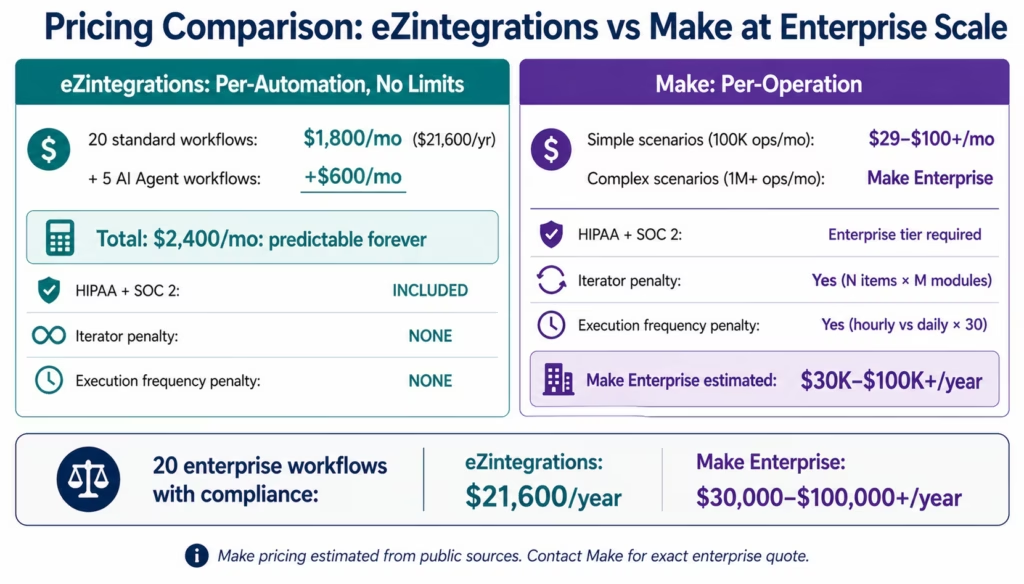
Additional operations can be purchased in blocks. Make Enterprise, required for HIPAA and SOC 2 compliance, is not publicly priced but typically runs $30,000-$100,000+/year for enterprise deployments.
The operation complexity penalty:
Make’s operation count grows with scenario complexity:
- Each module execution = 1 operation
- An iterator over N items × M modules = N × M operations per scenario run
- Webhooks, routers, and error handlers all consume operations
A complex enterprise scenario with an iterator over 500 records and 5 modules per record = 2,500 operations per execution. Run it daily: 75,000 operations per month. Run it hourly: 1,800,000 operations per month. Both well outside published Make plans.
eZintegrations pricing:
- $90/month per standard automation
- $120/month per Level 3 AI Agent automation
- $150/month per Level 4 Goldfinch AI automation
- No operations counting. No iterator penalty. No execution frequency penalty.
A workflow that runs hourly over 500 records with 5 steps each costs $90/month on eZintegrations. Always.
3-year cost comparison (illustrative, 20 complex enterprise scenarios):
| Scenario | eZintegrations | Make (estimated) |
|---|---|---|
| 20 complex workflows, standard | $21,600/year | Make Enterprise: $30K-$100K+/year |
| With HIPAA and SOC 2 required | $21,600/year | Make Enterprise required |
| With high-frequency execution | $21,600/year | Operations overages escalate |
| With AI agent workflows | $28,800/year (mix of $90-$120) | Not available |
Make pricing is estimated from published tiers and community-reported enterprise contract figures. Contact Make directly for your specific quote.
Who Should Choose Each Platform
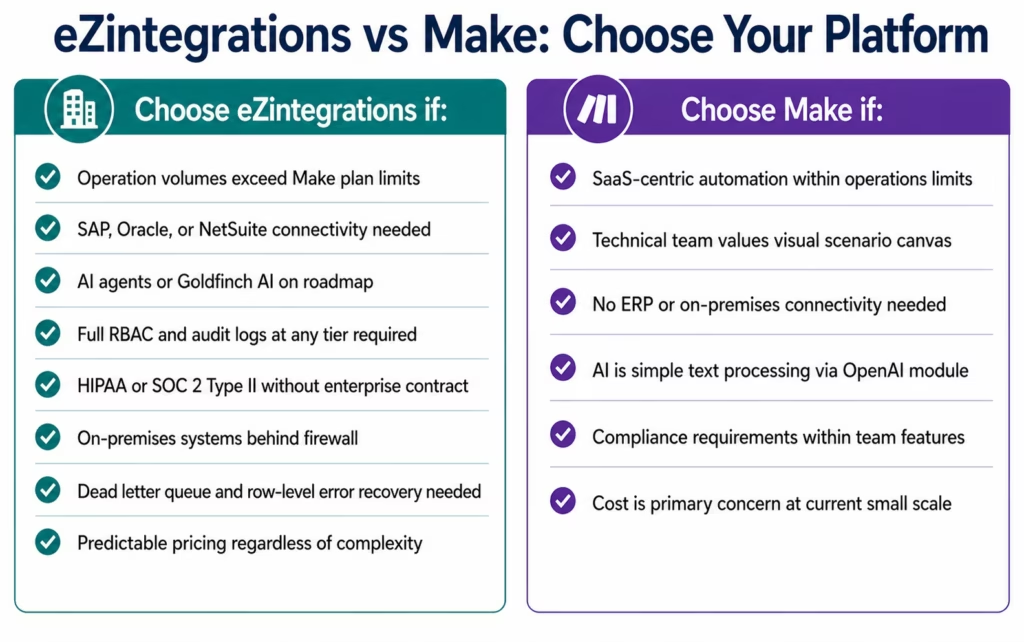
Choose eZintegrations if:
- Your organisation processes high volumes where Make’s operations limit creates cost escalation
- You need native ERP connectivity: SAP, Oracle, NetSuite, Infor, EPICOR: Make does not support these natively
- AI automation is on your roadmap: Document Intelligence, AI agents, or Goldfinch AI multi-agent orchestration
- You need enterprise governance at any tier: full RBAC, audit logs, workflow version history, organisational scenario ownership
- HIPAA or SOC 2 Type II compliance is required without a dedicated enterprise contract
- You need on-premises system connectivity (on-premises ERP, legacy databases)
- Dead letter queue, row-level error logging, and automatic retry are requirements for your high-criticality workflows
- You want predictable per-automation pricing that does not escalate with scenario complexity or execution frequency
Choose Make if:
- Your automation estate is primarily SaaS-to-SaaS and stays within Make’s operation limits
- Your team is technically proficient and values Make’s visual scenario canvas for complex conditional logic
- You do not need ERP or on-premises connectivity
- AI automation is limited to simple text processing via OpenAI module and you accept the external API approach
- Compliance requirements are either not applicable or covered by Make’s team features
- Cost at your current scale is more important than enterprise governance and reliability
Detailed Feature Comparison
| Capability | eZintegrations | Make | Winner |
|---|---|---|---|
| Visual workflow builder | Yes: workflow canvas | Yes: scenario canvas (strength) | Make (UX depth) |
| Operations / execution limits | None: unlimited | Capped by plan (10K-custom) | eZintegrations |
| ERP connectivity (SAP, Oracle, NetSuite) | Native connectors | HTTP module workaround | eZintegrations |
| On-premises systems | IPSec Tunnel (included) | Not supported | eZintegrations |
| Level 2: AI Workflow steps | Native: Document Intelligence, LLM | OpenAI HTTP module (external) | eZintegrations |
| Level 3: AI Agents | 9 native tools, autonomous, HITL | Not available | eZintegrations |
| Level 4: Multi-agent (Goldfinch AI) | Chat UI + Workflow Node | Not available | eZintegrations |
| Iterator / loop handling | Native looping | Iterator module (ops-intensive) | Tie (Make UX, eZintegrations cost) |
| Error recovery (dead letter queue) | Yes: full DLQ + retry + row logging | Error routes (no DLQ) | eZintegrations |
| Automatic retry with backoff | Yes: configurable | Limited | eZintegrations |
| Row-level error logging | Yes: specific record data | No | eZintegrations |
| Webhook HMAC verification | Full: Shopify, Stripe, GitHub | Webhooks supported, limited | eZintegrations |
| GraphQL support | Native | HTTP module | eZintegrations |
| Database (SQL/NoSQL) | Native connectors | Limited native | eZintegrations |
| Full RBAC | All tiers | Limited (Teams) | eZintegrations |
| Audit logs | All tiers | Enterprise only | eZintegrations |
| HIPAA at all tiers | Yes | Enterprise only | eZintegrations |
| SOC 2 Type II at all tiers | Yes | Enterprise only | eZintegrations |
| Pricing predictability | Flat per-automation | Per-op escalates with complexity | eZintegrations |
| Template library | 1,000+ production-ready | 500+ templates | eZintegrations (enterprise depth) |
| SaaS module breadth | 1,000+ in catalog | 1,500+ modules | Make (consumer breadth) |
| Scenario/workflow complexity | Full: branches, loops, conditions | Full: router, iterator, aggregator | Tie |
Bottom Line Verdict
Make sits at an interesting position in the automation market: meaningfully more powerful than Zapier for technical users, but meaningfully less capable than enterprise iPaaS for organisations with real enterprise requirements.
For the evaluation question this blog addresses: which platform scales for enterprise workflows: the answer depends on which enterprise requirements you have:
If your enterprise requirements are primarily about SaaS complexity (sophisticated conditional logic, data transformation, multi-path routing between SaaS apps), Make handles it well within its operation limits. Its visual canvas is genuinely better than many enterprise iPaaS platforms for expressing complex SaaS workflow logic.
If your enterprise requirements include ERP connectivity, AI agents, governance, or compliance certification at non-Enterprise plan cost, Make does not scale to those requirements. eZintegrations was designed for exactly this set of needs: native SAP/Oracle/NetSuite connectivity, Level 3 AI Agents with 9 enterprise tools, full RBAC and audit logs at all tiers, and per-automation pricing that does not penalise complexity or execution frequency.
On AI automation: Make’s module-assembled AI (OpenAI HTTP call + error handling) is functional for simple tasks. It is not an enterprise AI agent. The comparison to eZintegrations’ Level 3 autonomous agents and Level 4 Goldfinch AI is not a feature difference: it is an architecture difference.
On pricing at scale: Make’s operations model is more expensive than it appears once you account for iterator-heavy enterprise scenarios and compliance requirements that push you to Make Enterprise pricing. eZintegrations’ flat per-automation pricing is the most predictable model for enterprise deployment.
The decision: if you are a technical team doing sophisticated SaaS automation within Make’s operation limits and without enterprise governance requirements, Make is a solid tool. If you are an enterprise evaluating which platform to build your next two years of automation on, eZintegrations handles the full stack: from basic SaaS integration to AI agents to multi-agent Goldfinch AI, with enterprise governance, compliance, and predictable pricing throughout.
FAQs
For enterprise workflows with ERP connectivity, AI agents, governance requirements, or high-volume execution, yes. eZintegrations provides native SAP, Oracle, and NetSuite connectivity (Make uses HTTP module workarounds), Level 3 AI Agents with 9 enterprise tools (Make has no equivalent), full RBAC and audit logs at all tiers (Make restricts these to Enterprise), and flat per-automation pricing with no operations caps (Make's operations-based pricing escalates with scenario complexity). For technical teams doing sophisticated SaaS automation within Make's operation limits without governance requirements, Make remains a capable platform.
Make's AI capability comes from its OpenAI module and HTTP modules that call external AI APIs. This approach sends data to third-party AI providers outside Make's compliance boundary, incurs separate API costs, and does not provide enterprise agent architecture (confidence thresholds, reflection loops, human-in-the-loop gates). eZintegrations provides native Level 2 AI Workflows (Document Intelligence, LLM classification, semantic matching: all running within eZintegrations' HIPAA/SOC 2 boundary) and Level 3 AI Agents with 9 built-in enterprise tools. Make has no native equivalent to eZintegrations' Level 4 Goldfinch AI multi-agent orchestration or Chat UI.
Five primary limitations: operations-based pricing escalates with scenario complexity: iterator-heavy enterprise scenarios consume operations rapidly; no native ERP connectivity: SAP, Oracle, NetSuite, and on-premises systems require HTTP module workarounds; governance restrictions: audit logs, HIPAA, SOC 2, and SSO require Make Enterprise plan; no enterprise AI agents: Make's AI is assembled from third-party HTTP modules with external data exposure; no dead letter queue or row-level error logging for enterprise-grade record recovery.
Make charges per operation: each module execution in a scenario. Complex scenarios with iterators consume operations rapidly: 500 records × 5 modules = 2,500 operations per run. For high-frequency, high-volume enterprise workflows, operation consumption reaches Make Enterprise pricing territory quickly. Make Enterprise (required for HIPAA and SOC 2) typically runs $30,000-$100,000+/year. eZintegrations charges $90/month per automation workflow with no operations cap. A complex daily sync workflow costs $90/month whether it processes 500 or 50,000 records.
Yes, eZintegrations has native Salesforce REST and all major SaaS connectors with full support for complex conditional routing, data transformation, and field-level mapping. The Automation Hub contains templates for common Salesforce patterns. Beyond Make's capability: Level 2 AI Workflow steps for lead scoring and enrichment, Level 3 AI Agents for autonomous CRM exception handling, and native ERP connectivity so Salesforce-to-SAP runs in the same platform as Salesforce-to-HubSpot. The transition from Make's visual scenario model to eZintegrations' workflow canvas is straightforward for teams already comfortable with visual automation tools.
Standard SaaS-to-SaaS Make scenarios (Salesforce, HubSpot, Slack, Google Workspace): Automation Hub templates cover most patterns and deploy in 2-5 days each. Complex custom Make scenarios with significant transformation logic: 1-3 weeks per scenario depending on complexity. The migration from Make to eZintegrations is typically faster than from SnapLogic or MuleSoft because Make users are already accustomed to visual workflow building: the conceptual model transfers. eZintegrations provides a Make migration assessment during the demo: scenario inventory review, Automation Hub template coverage mapping, and migration timeline.1. Is eZintegrations better than Make for enterprise workflows?
2. How does Make compare to eZintegrations for AI workflow automation?
3. What are Make's main limitations for enterprise use?
4. How does Make's pricing compare to eZintegrations at scale?
5. Can eZintegrations replace Make for Salesforce and complex SaaS automation?
6. How long does it take to migrate from Make to eZintegrations?
Conclusion
Make is a platform that grew up from Integromat into something genuinely powerful for technical teams. Its scenario canvas, iterator support, and SaaS module breadth give it capabilities that justify its reputation as the step up from Zapier.
The enterprise ceiling it hits is structural, not incidental: operations-based pricing that escalates with complexity, no ERP connectivity, governance features restricted to enterprise contracts, no native AI agents, and no on-premises support.
eZintegrations is designed for the scale that follows Make: enterprise teams where automation connects ERP systems alongside SaaS, where AI agents handle exception queues, where governance and compliance are procurement requirements, and where pricing needs to be predictable regardless of execution volume.
If your organisation is at the Make ceiling: hitting operations limits, needing SAP connectivity, requiring HIPAA certification at a reasonable price point, or putting AI agents on the roadmap: the transition to eZintegrations is the right next move.
Book a free demo and bring your Make scenario inventory. We will show you the Automation Hub template coverage for your scenarios, demonstrate the Level 3 AI Agent capability for your highest-exception workflow, and produce a cost comparison that accounts for Make Enterprise pricing versus eZintegrations’ flat per-automation model.
Browse the Automation Hub to identify the production-ready templates that cover your most critical Make scenarios.
If you are experiencing Make’s limits today: operations overages, ERP connectivity gaps, governance gaps in procurement review: the 5 signs your integration platform is holding you back likely describes your situation.