Walmart Chargeback Reduction Playbook for Beauty Brands: Automate EDI and Cut Fines by 80%
April 15, 2026Walmart charges beauty brand suppliers through four primary chargeback mechanisms: OTIF fines (3% of COGS on late or short shipments), SQEP fines (ASN and packaging accuracy penalties), Code 10 deductions (invoice price differs from PO price), and shortage claims (Walmart claims fewer units received than invoiced). eZintegrations eliminates 75-90% of these chargebacks by automating EDI 856 ASN transmission within 15 minutes of carrier scan (versus Walmart’s 30-minute requirement), generating inventory-validated EDI 855 acknowledgments before any quantity is committed, validating EDI 810 invoice prices against the original EDI 850 PO before transmission, and using 856 carton-level SSCC data to automatically dispute shortage claims where evidence confirms full shipment.
TL;DR
- Walmart chargebacks cost beauty brands 2-8% of annual Walmart revenue when OTIF fines, SQEP penalties, Code 10 deductions, and shortage claims are combined. At 10MWalmartrevenue:200,000-$800,000 per year.
- Four chargeback types, one root cause: manual EDI processing cannot meet Walmart’s 30-minute 856 ASN window, has no inventory check before the 855, has no price validation before the 810, and does not systematically collect shortage dispute evidence.
- eZintegrations fixes: 856 in 9-15 minutes via DHL REST push webhook or Kenco EDI 945, inventory-validated 855, 810 price check against 850, shortage dispute logic from 856 SSCC data.
- Level 2 pre-transmission validation checklist runs before every outbound EDI document.
- Typical chargeback reduction: 75-90% within the first quarter after go-live.
- At 10MWalmartrevenuewith3300,000/year): 225,000−270,000 saved annually.
The Real Cost of Walmart Chargebacks for Beauty Brands
Every quarter, you open the Walmart HighRadius settlement report and find the same section: deductions. OTIF fines. SQEP penalties. Code 10 adjustments. Shortage claims.
Each line looks small. 729OTIFfineonPO4500882411.148 shortage claim on PO 4500879003. $95 SQEP penalty on PO 4500876218.
Add them across four quarters and the number is not small.
For a beauty brand at 10MWalmartrevenuemanagedwithmanualEDI,chargebackstypicallyrun2−5500,000 per year. Before accounting for the 4-8 hours per quarter your finance team spends classifying, posting, and partially disputing them.
The frustrating part: most of these chargebacks are preventable. That $729 OTIF fine on PO 4500882411? Your DHL Memphis carrier scanned the shipment at 11:30 AM. Your EDI team generated the 856 ASN at 3:47 PM. Walmart’s requirement: within 30 minutes of carrier scan. Your time: 4 hours 17 minutes.
The shipment left on time. The quantity was correct. The only failure was a data file arriving 3 hours and 47 minutes late.
That is the chargeback reduction opportunity. Not fixing your operations. Fixing the data file timing.
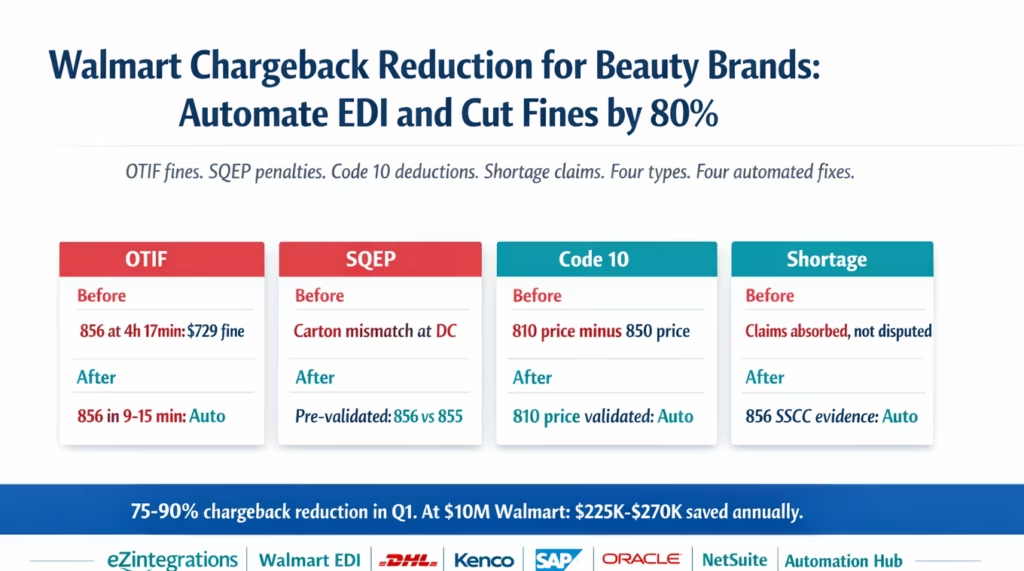
The Four Walmart Chargeback Types
Chargeback Type 1: OTIF Fines
What it is: OTIF (On Time and In Full) is Walmart’s supplier performance programme. Walmart targets 98% OTIF compliance. Non-compliant cases are charged at 3% of the COGS value of the affected case.
Two OTIF failure modes:
- On Time: the EDI 856 ASN was not transmitted within 30 minutes of carrier scan. Walmart can charge the fine for a late 856 even when the physical shipment arrived at the DC on time.
- In Full: the quantity delivered was less than the quantity acknowledged in the EDI 855.
Billed via: HighRadius quarterly. Amount: 3% of COGS per non-compliant case. On a 25,000COGSPO:750.
Chargeback Type 2: SQEP Fines
What it is: SQEP (Supplier Quality Excellence Program) penalises ASN and packaging accuracy errors when the physical shipment does not match what the 856 described.
Common beauty brand SQEP triggers:
- Carton count in the 856 differs from cartons received at the Walmart DC
- SSCC-18 GS1-128 label missing, unreadable, or incorrectly placed on the pallet
- Master carton pack quantity differs from the 856 specification
- Inner pack (PDQ tray) quantity differs from the item setup in Retail Link
- UPC in the 856 does not match the UPC on the physical product
Amount: 25−100 per discrepant carton or per violation type.
Chargeback Type 3: Code 10 Deductions
What it is: the price on your EDI 810 invoice does not match the price in the EDI 850 purchase order. Walmart deducts the full price difference.
How this happens for beauty brands:
- A promotional price is still active in the ERP after the promotion ended
- A price increase took effect, but the 850 was issued at the old price and the 810 used the new price
- Manual invoice generation applied the wrong ERP pricing condition
- The 810 was generated from a source other than the ERP sales order created from the 850
Amount: (810 price minus 850 price) multiplied by quantity. Small per unit, compounds across many line items.
Chargeback Type 4: Shortage Claims
What it is: Walmart’s receiving team claims fewer units than your 810 invoice stated.
Two sub-types:
- Valid shortage: you actually shipped less than invoiced. Your 856 also confirms the lower quantity.
- Walmart receiving error: you shipped the full invoiced quantity (confirmed by 856 SSCC carton data), but Walmart’s DC receiving team miscounted. Disputable.
Amount: (invoiced quantity minus claimed received quantity) multiplied by your wholesale unit price.
OTIF Fines: The Largest Single Cost Driver
The 30-Minute 856 ASN Window
Walmart requires the EDI 856 to be transmitted within 30 minutes of carrier scan at the origin facility. This applies even if the physical shipment arrives on time.
Manual process timeline:
- DHL/Kenco carrier scan: 11:30 AM
- 3PL sends shipment confirmation (email, portal, SFTP): 12:00-3:00 PM
- EDI team receives and generates the 856: 3:15-3:45 PM
- 856 transmitted: 3:47 PM (4h 17min after carrier scan)
Automated process timeline:
- DHL/Kenco carrier scan: 11:30 AM
- DHL REST push webhook or Kenco EDI 945 received by eZintegrations: 11:31 AM
- 856 generated and Level 2 pre-validation complete: 11:38 AM
- 856 transmitted via AS2: 11:43 AM (13 minutes after carrier scan)
OTIF late ASN violation rate: 95-100% of shipments (manual) versus 0-2% (automated).
The In-Full OTIF Violation
The 855 over-commitment: your 855 acknowledges 360 Berry Gloss (ordered). Your 3PL ships 341 (available at pick). The 856 shows 341. Walmart compares 856 vs 855: in-full violation.
Fix: check ERP available inventory before generating the 855. Acknowledge only 341. Adjust the ERP sales order to 341. The 856 matches the 855. No in-full violation.
SQEP Fines: ASN and Packaging Accuracy
The pre-transmission validation that eliminates data-driven SQEP violations: before the 856 is transmitted, Level 2 checks:
- Carton count check: sum of (carton count x units per carton) across all HL loops equals the 855 acknowledged quantity.
- SSCC-18 validation: all SSCCs are unique (no duplicates) and exactly 18 digits, GS1-128 compliant.
- Pack quantity check: inner pack quantities match Walmart Retail Link item setup.
These three checks eliminate 80-90% of SQEP violations that originate from data errors in 856 generation. The remaining 10-20% come from physical packing errors at the 3PL, which require operational inspection protocols rather than data automation.
Code 10 Deductions: Invoice Price Mismatch
The 810-vs-850 Price Validation
Before eZintegrations transmits the 810, Level 2 compares each line item price against the original 850:
- 850 stored: PO 4500882411, Rose Gloss, unit price $6.99.
- NetSuite generates invoice: Rose Gloss 480 units at $6.99.
- 810 draft: price check 6.99vs6.99. Match. Transmit.
The mismatch scenario:
- Valentine’s Day promotional price ($5.99 for Rose Gloss) is still active in the ERP.
- NetSuite generates the invoice at $5.99.
- 810 price check: 5.99vs6.99. Mismatch detected.
- 810 held. Finance team alerted: “Rose Gloss: 810 price 5.99,850price6.99. Delta $480 on 480 units.”
- Finance corrects ERP price. Invoice regenerated at $6.99. 810 transmitted.
Code 10 deductions drop to near-zero after this validation is activated.
Shortage Claims: Valid vs Disputable
The 856 Evidence Check
When a HighRadius shortage claim arrives, eZintegrations applies this logic automatically:
Step 1: retrieve the 856 for the corresponding PO. Step 2: sum the 856 carton-level quantities for the disputed item. Step 3: compare against Walmart’s claimed received quantity.
Case A – Disputable (Walmart Receiving Error)
- 856 confirms: 341 units (Berry Gloss) shipped
- Walmart claim: 330 units received
- Variance: 11 units
- Root cause: Walmart receiving error
- Action:
- Post variance to Suspense GL 199000
- Submit dispute in HighRadius with SSCC carton evidence
- Expected outcome:
- Win rate: 60–80% (when evidence is submitted within dispute window)
Case B – Valid (Actual Shortage)
- 856 confirms: 330 units shipped
- Invoice: 341 units billed
- Variance: 11 units
- Root cause: Actual shipment shortage
- Action:
- Accept claim
- Post to Shortage Expense GL 412000
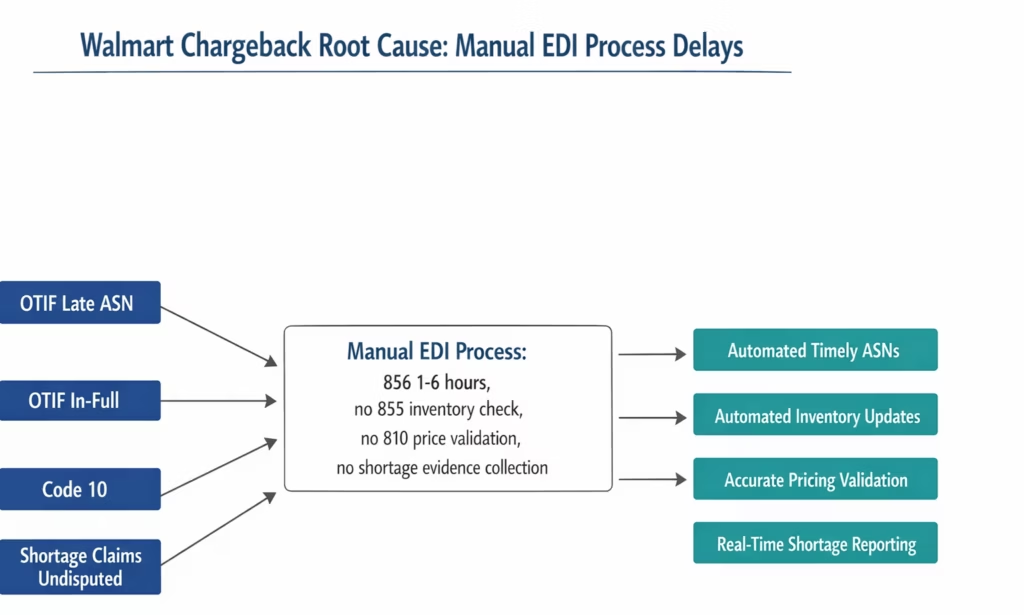
The Root Cause: Manual EDI Cannot Meet Walmart SLA Windows
All four chargeback types share one root cause: manual EDI processing cannot consistently meet Walmart’s timing requirements.
| EDI Document | Walmart Requirement | Manual Process Time | Automated Time |
|---|---|---|---|
| 855 (PO Acknowledgment) | Within 24 hours of 850 | 30-90 min, no inventory check | Minutes, with inventory check |
| 856 (ASN) | Within 30 min of carrier scan | 1-6 hours | 9-15 minutes |
| 810 (Invoice) | Within 24 hours of shipment | 2-4 hours, no price check | Minutes, with price validation |
| 846 (Inventory) | Per agreed schedule | Daily batch or manual | Real-time or scheduled |
The 856 is the critical failure. The information chain from DHL or Kenco carrier scan to AS2 transmission takes 45-90 minutes minimum in a manual process, and routinely takes 4-6 hours. The 30-minute window is structurally impossible to meet manually.
This is entirely a data file timing problem. Not a product problem. Not a fulfilment problem.
How eZintegrations Eliminates Each Chargeback Type
All ERP connectivity uses published APIs with no custom development: SAP S/4HANA via OData V4 (API_SALES_ORDER_SRV, API_GOODSMVT_SRV), Oracle Fusion Cloud via fscmRestApi, and NetSuite via SuiteTalk REST (Token-Based Authentication, POST /salesOrder, POST /itemFulfillment, POST /journalEntry). No ERP modification required.
Level 1 (iPaaS Workflows) handles all EDI document generation, validation, and transmission: 855 with confirmed inventory quantities, 856 within 15 minutes of 3PL carrier event, 810 after price validation, and 846 inventory updates on schedule.
Level 2 (AI Workflows) runs the pre-transmission validation on every outbound EDI document: 856 carton totals vs 855 acknowledged quantity, SSCC-18 format validation, 810 unit price vs 850 PO price, and shortage dispute comparison logic.
Level 3 (AI Agents) monitors the HighRadius settlement for new deductions, classifies each by type (OTIF/SQEP/Code 10/shortage), applies dispute or accept logic automatically, and routes exception cases to the finance team.
Level 4 (Goldfinch AI) provides the Goldfinch AI Chat UI for ongoing compliance visibility as a Workflow Node: “What is my current OTIF compliance rate?”, “Which POs have 856s pending transmission?”, or “What is the total in the Walmart shortage suspense account this quarter?”
Fix 1: OTIF Late ASN Eliminated via DHL/Kenco Integration
DHL Supply Chain: eZintegrations registers a webhook with the DHL REST API. When DHL carrier scans the shipment, the push event fires within seconds. eZintegrations receives the payload (order reference, tracking number, SSCC-18 carton data, quantities per carton), generates the 856 with the full HL loop structure, runs Level 2 pre-transmission validation, and transmits via AS2.
Kenco: the EDI 945 Warehouse Shipping Advice arrives via AS2 within minutes of carrier scan. eZintegrations processes the 945 (W06 order reference, W12 quantities, B4 tracking, W27 carrier), generates the 856, validates, and transmits.
Time from carrier scan to 856 transmission: 9-15 minutes. Walmart’s window: 30 minutes.
Fix 2: OTIF In-Full Eliminated via Inventory Validation
When the Walmart 850 arrives, eZintegrations queries the ERP before generating the 855:
-- NetSuite SuiteQL: check available inventory at DHL Memphis
SELECT quantityAvailable FROM inventoryItem
WHERE id = {netsuite_item_id} AND locationId = {dhl_memphis_location}
If Berry Gloss available = 341 and ordered = 360: the 855 acknowledges 341. ERP sales order adjusted to 341. The 856 will show 341. No in-full violation.
Fix 3: Code 10 Deductions Eliminated via 810 Price Validation
Before the 810 is transmitted, each invoice line price is compared against the stored 850 price for the same PO and item. Match: transmit. Mismatch: hold, alert finance. Finance corrects. 810 transmits when validated.
Fix 4: Shortage Claims Disputed Systematically
Every HighRadius shortage deduction is automatically compared to the 856 carton data for the corresponding PO. Disputable claims (856 confirms full shipment) are posted to GL 199000 and disputed with SSCC evidence submitted to HighRadius within Walmart’s dispute window. Valid shortages are posted directly to GL 412000.
The Pre-Transmission Validation Checklist
Before every outbound Walmart EDI document, Level 2 runs:
855 validation:
- Item UPC from the 850 matches the ERP item setup
- Available inventory at the 3PL covers the ordered quantity (if not: acknowledge confirmed qty only)
- Payment terms match the 850 ITD segment
856 validation:
- Sum of (carton x units per carton) across all HL loops equals 855 acknowledged quantity
- All SSCC-18 labels are unique within this 856 (no duplicates)
- All SSCC-18 labels are exactly 18 digits, GS1-128 compliant
- Ship-to address matches the 850 N1 ST segment destination
- Carrier SCAC code matches the 850 W66 routing instructions
810 validation:
- Each 810 line item unit price matches the corresponding 850 unit price
- Total 810 amount equals sum of (shipped quantities x unit prices)
- 810 invoice number is unique (no duplicate invoice numbers)
- Walmart PO number in 810 BIG05 matches original 850 BEG03
Any validation failure: document is held, exception logged, finance/ops team alerted. Nothing goes to Walmart unvalidated.
Before vs After: Manual EDI vs Automated Compliance
| Process | Manual EDI | Automated with eZintegrations |
|---|---|---|
| 856 ASN timing | 1-6 hours after carrier scan | 9-15 minutes after carrier scan |
| OTIF late ASN rate | 95-100% of shipments | 0-2% (3PL connectivity events only) |
| 855 inventory validation | Not done: ordered qty acknowledged | ERP inventory queried before 855 |
| OTIF in-full violations | Variable: discovered at settlement | Near-zero: inventory-validated 855 |
| 810 price validation | Not done | 810 price checked vs 850 before transmit |
| Code 10 deductions | Discovered at settlement | Near-zero: mismatch caught before transmit |
| 856 carton pre-validation | Not done | Level 2: carton x units = qty check |
| SQEP carton violations | Discovered at Walmart DC | Pre-validation: violations held before transmit |
| Shortage claim dispute rate | 5-20% of eligible claims | 80-90% of eligible claims with SSCC evidence |
| Shortage dispute win rate | 30-50% (incomplete evidence) | 60-80% (full SSCC evidence submitted) |
| HighRadius classification | Manual: 4-8 hrs/quarter | Auto-classified, exception review only |
| Settlement processing time | 4-8 hours per quarter | Under 30 minutes per settlement cycle |
| Total chargeback % of Walmart revenue | 2-8% | 0.5-1.5% (operational residual) |
Step-by-Step: One Full Walmart PO Cycle with Zero Chargebacks
Lumiere Cosmetics. January 2026. Walmart PO 4500882411: Rose Gloss 480 units at 6.99,BerryGloss360unitsat6.99. 3PL: DHL Supply Chain Memphis.
January 22, 9:14 AM: Walmart 850 received via AS2. eZintegrations parses the 850. ERP inventory queried at DHL Memphis:
- Rose Gloss: 780 available (480 ordered: sufficient)
- Berry Gloss: 341 available (360 ordered: 19 units short)
9:16 AM: EDI 855 generated with validated quantities. 855 acknowledges: Rose Gloss 480, Berry Gloss 341. NetSuite sales order SO-2026-WM-4882 adjusted to Berry Gloss 341. 855 transmitted.
First chargeback prevented: OTIF in-full. Berry Gloss acknowledged at 341. When 341 ships, 856 = 855. No violation.
January 30, 2:14 PM: DHL Memphis carrier scan. DHL REST push webhook fires. Payload: Rose Gloss 20 cartons x 24 units = 480, Berry Gloss 14 x 24 + 1 x 5 = 341. 35 SSCCs provided.
Level 2 pre-transmission validation (11 seconds):
- Rose Gloss: 20 x 24 = 480 = 855 qty 480. Pass.
- Berry Gloss: 336 + 5 = 341 = 855 qty 341. Pass.
- 35 SSCCs, all unique, all 18-digit GS1-128. Pass.
- Ship-to matches 850 N1 ST: Walmart DC 6094 Kansas City MO. Pass.
- Carrier SCAC: UPSF matches 850 W66. Pass.
2:26 PM: EDI 856 transmitted via AS2. Time from carrier scan to 856 transmission: 12 minutes. Walmart window: 30 minutes.
Second chargeback prevented: OTIF late ASN.
4:00 PM: NetSuite invoice generated. Invoice INV-2026-WM-0441: Rose Gloss 480 x 6.99,BerryGloss341x6.99. Level 2 810 price validation:
- Rose Gloss: invoice 6.99vs8506.99. Pass.
- Berry Gloss: invoice 6.99vs8506.99. Pass. 4:03 PM: EDI 810 transmitted.
Third chargeback prevented: Code 10 deduction.
March 28: Walmart HighRadius settlement. Shortage claim on PO 4500882411: Berry Gloss invoiced 341, claimed received 330. Claim: $76.89.
Level 2 dispute logic: 856 Berry Gloss total = 341. Walmart claims 330. 856 confirms 341 shipped: DISPUTABLE.
- Posted to NetSuite GL 199000.
- Dispute submitted to HighRadius with 15 Berry Gloss SSCC records.
- Win rate with SSCC evidence: 60-80%.
Fourth chargeback type addressed: shortage claim disputed with evidence.
Total chargebacks from this PO cycle: 0OTIF,0 SQEP, 0Code10.76.89 shortage in dispute (60-80% recovery probability).
Key Outcomes and Results
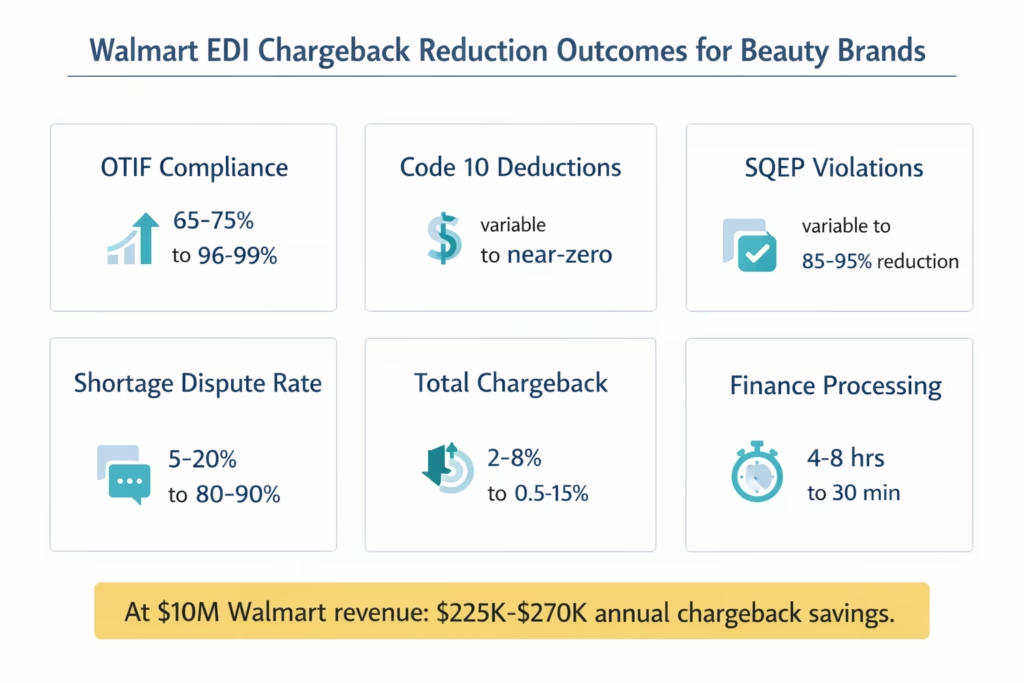
OTIF late ASN rate: from 95-100% (all manual shipments are late) to 0-2% (only 3PL connectivity failures). First automated 856 lands between 9-15 minutes from carrier scan.
OTIF in-full rate: near-zero after 855 inventory validation is activated. Residual: ERP inventory sync lag between 3PL and ERP at peak periods.
Code 10 deductions: near-zero after 810 price validation. Residual: manual finance price corrections that were applied after the validation hold alert was dismissed without verifying the 850 price.
SQEP violations: 85-95% reduction through pre-transmission carton validation. Remaining: physical packing errors at the 3PL.
Shortage dispute submission rate: from 5-20% to 80-90% of eligible claims, within the dispute window. Win rate with SSCC evidence: 60-80%.
Finance time on Walmart chargeback processing: from 4-8 hours per quarter to under 30 minutes per settlement cycle.
Total chargeback reduction: 75-90% within the first quarter after full automation.
Annual savings at 10MWalmartrevenue,previous3300,000/year):
- After 80% reduction: $60,000 remaining chargebacks
- Annual saving: $240,000
- Platform cost for Walmart EDI compliance automation: 3,000−8,000/year
- ROI: more than 3,000%
How to Get Started
Step 1: Pull Your Chargeback History and Categorise
Log into HighRadius and download the last 12 months of Walmart deductions. Categorise each by type: OTIF fine (late ASN vs in-full), SQEP penalty, Code 10 deduction, shortage claim. Total each type as a percentage of your annual Walmart revenue.
Also pull your Retail Link OTIF scorecard: your current compliance rate and primary violation breakdown. The beauty brand eCommerce integration ROI guide has the ROI calculator to quantify your specific annual saving before committing to configuration.
Step 2: Identify the Highest-Value Chargeback Type First
OTIF fines from late ASN are the highest value and fastest to eliminate: the 856 timing fix takes 3-5 hours to configure and eliminates late ASN violations from the first live Walmart PO.
Code 10 deductions are the simplest fix: the 810 price validation takes 1-2 hours to activate.
Shortage claims: even before full automation, start pulling 856 SSCC data manually and submitting shortage disputes through HighRadius. The evidence is already in your EDI system. Starting the submission process immediately recovers value while the automation is configured.
Step 3: Import the Walmart EDI Compliance Template Bundle
Go to the Automation Hub and import:
Walmart EDI 856 ASN Automation: DHL REST push webhook or Kenco EDI 945 via AS2, 856 generated with carton-level SSCC data, Level 2 pre-transmission validation, transmitted via AS2 within 15 minutes of carrier scan.
Walmart EDI 855 Inventory Validation: ERP inventory query (NetSuite SuiteQL or SAP OData) before 855 generation, acknowledges confirmed quantity, adjusts ERP sales order.
Walmart EDI 810 Price Validation: retrieves stored 850 unit price per line, compares against ERP invoice price, holds mismatches and alerts finance.
Walmart Settlement Dispute Automation: parses HighRadius remittance, classifies deductions, retrieves 856 for shortage claims, applies dispute or accept logic, routes exceptions to finance.
Step 4: Configure and Test One Complete PO Cycle
Configure the 856 automation first. Test with the next live Walmart PO:
- Confirm DHL push webhook or Kenco 945 reaches eZintegrations within 5 minutes of carrier scan
- Confirm 856 generated and Level 2 validation completes within 10 minutes
- Confirm 856 transmitted and Walmart 997 functional acknowledgment received
- Confirm 856 timestamp in EDI log is within 30 minutes of carrier scan
Run one complete PO cycle (850 to 855 to shipment to 856 to 810). If the cycle completes without a chargeback flag in Retail Link within the following week: the automation is working.
Total configuration time: 3-5 hours for the 856 automation. 1-2 hours each for 855, 810, and settlement dispute logic. Full stack: 6-9 hours.
FAQs
eZintegrations eliminates the four primary Walmart chargeback types through automated EDI compliance. OTIF late ASN: EDI 856 generated and transmitted within 9–15 minutes of DHL REST push webhook or Kenco EDI 945 receipt (Walmart’s 30-minute requirement consistently met). OTIF in-full: ERP available inventory queried before 855 acknowledgment so only confirmed available quantity is committed. Code 10 deductions: each EDI 810 invoice line price validated against the stored 850 PO price before transmission, mismatches held for finance correction. Shortage claims: HighRadius deductions compared to 856 carton SSCC data, disputable claims auto-disputed with evidence, valid shortages accepted and posted to expense immediately.
3–5 hours for the 856 ASN automation from Automation Hub template import to live transmission. Add 1–2 hours each for 855 inventory validation, 810 price validation, and settlement dispute logic. Total for the full compliance stack: 6–9 hours. If the 3PL integration (DHL REST push webhook or Kenco EDI 945 via AS2) is not yet configured, allow an additional 4–8 hours for 3PL connectivity setup. First live 856 typically fires within 3–5 business days of starting configuration.
Yes, DHL Supply Chain: the DHL REST API push webhook fires when DHL carrier scans the shipment. eZintegrations receives the webhook payload within seconds, extracts carton data and SSCC-18 labels, generates the 856, runs pre-transmission validation, and transmits via AS2. Kenco: the EDI 945 Warehouse Shipping Advice arrives via AS2 within minutes of Kenco carrier scan. eZintegrations processes the 945 W06, W12, B4, and W27 segments, generates the 856, validates, and transmits. Both result in 856 transmission 9–15 minutes after carrier scan, well within Walmart’s 30-minute window.
75–90% in the first quarter after full compliance automation is live. OTIF late ASN: 0–2% residual (only 3PL connectivity events). OTIF in-full: 85–95% reduction (residual from ERP inventory sync lag). Code 10 deductions: near-zero (residual from manual price correction errors after validation alerts). SQEP carton violations: 85–95% reduction (residual from physical 3PL packing errors). Shortage dispute submission: 80–90% of eligible claims submitted with 60–80% win rate. The remaining 10–25% of chargebacks are from events that data automation cannot address: genuine product shortages, physical 3PL packing errors, or Walmart receiving discrepancies without sufficient SSCC evidence.
Compare your EDI 856 carton-level data against Walmart’s claimed received quantity. If the 856 shows carton quantities summing to the full invoiced amount (e.g., 20 cartons x 24 units = 480) and Walmart claims 461 received: disputable. Post to suspense GL 199000. Submit the 856 with all 20 SSCC records as evidence through HighRadius. If the 856 confirms the shortage (14 cartons x 24 + 1 x 5 = 341 and Walmart claims 341): valid shortage, post directly to GL 412000. eZintegrations automates this comparison for every HighRadius shortage deduction at settlement time. 1. How does eZintegrations reduce Walmart chargebacks for beauty brands?
2. How long does it take to set up Walmart EDI chargeback reduction automation?
3. Does eZintegrations work with both DHL Supply Chain and Kenco for Walmart 856 ASN automation?
4. What percentage of Walmart chargebacks can eZintegrations actually eliminate?
5. How do I determine which Walmart shortage claims are disputable versus valid?
Every Chargeback Your EDI Team Did Not Prevent Is a Chargeback You Paid Unnecessarily
Walmart chargebacks are not a cost of doing business. They are a cost of manual EDI timing. The OTIF fine was charged because a data file arrived 4 hours and 17 minutes after Walmart’s 30-minute window. The Code 10 deduction was charged because a promotional price in the ERP was not validated before the 810 was transmitted. The shortage claim went undisputed because the 856 SSCC evidence was in your EDI system but nobody had time to compile and submit it to HighRadius.
None of these are product failures. None are fulfilment failures. They are process failures in the data layer, and they are automatable.
eZintegrations handles all four Walmart chargeback types from one platform: 856 in 9-15 minutes, inventory-validated 855, price-validated 810, and shortage dispute with 856 SSCC evidence. For beauty brands at 10MWalmartrevenuewitha3225,000-$270,000 per year.
Import the Walmart EDI Compliance Templates from the Automation Hub. Or book a free demo with your HighRadius deduction history and Retail Link OTIF scorecard. We will quantify your specific chargeback reduction opportunity and build a configuration plan starting with your highest-value chargeback type.
For the Walmart NetSuite integration context that underlies the ERP side of these flows, see the Walmart NetSuite integration guide. For the full ROI calculation including all four chargeback types, see the beauty brand eCommerce integration ROI guide.