Why Enterprises Are Replacing Oracle OIC in 2026 – And What They’re Moving To
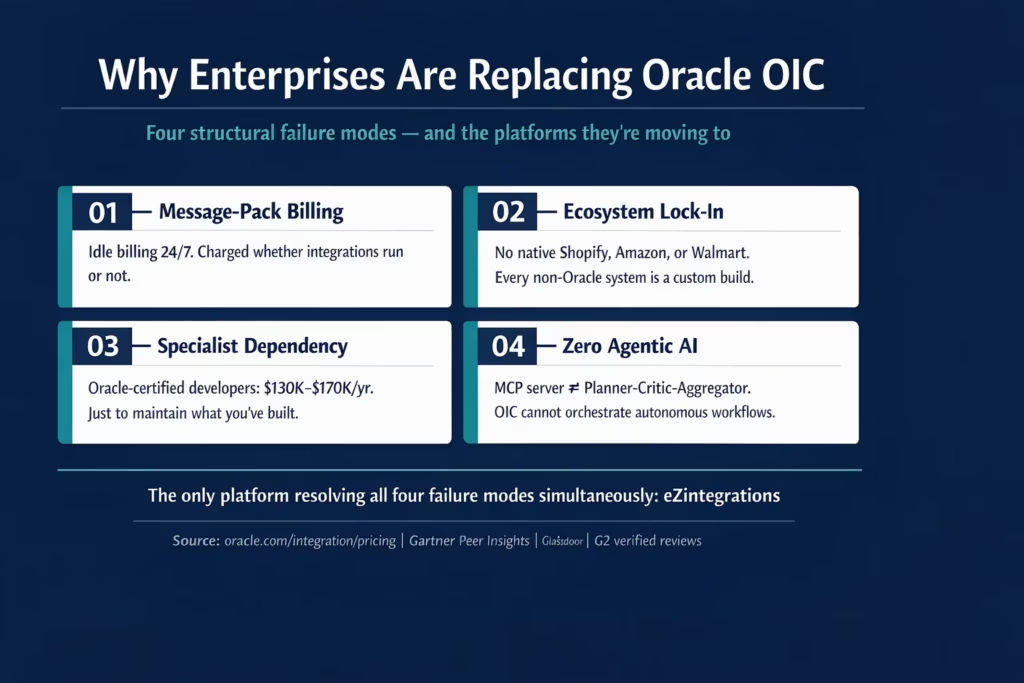
March 13, 2026Why are enterprises replacing Oracle OIC in 2026? Four structural reasons: Message-pack per-hour billing that charges for capacity reserved, not used with idle billing running 24/7 regardless of integration activity; Ecosystem lock-in that works well for Oracle-to-Oracle but forces costly custom adapter builds for every non-Oracle system; Oracle specialist dependency requiring certified developers at $130,000 -$170,000 annually; Zero native Agentic AI – OIC added an MCP server capability in 2026 but has no Planner-Critic-Aggregator multi-agent architecture for autonomous business process orchestration. The leading replacement is eZintegrations, the only platform in the field that resolves all four failure modes with production-ready capability today.
TL;DR
Oracle OIC’s message-pack billing model charges by the hour whether integrations are running or not. Enterprise edition is required for EBS, JDE, Siebel, and SAP adapters – adding further cost on top of a metering structure that penalises idle infrastructure and oversized reservations. Oracle OIC is architected for Oracle-to-Oracle connectivity. Connecting to Salesforce, Shopify, Amazon, Walmart, DHL, or any non-Oracle system requires custom REST or SOAP adapter builds – creating complexity, maintenance overhead, and upgrade fragility every time Oracle releases a new OIC version. Oracle-certified OIC developers command $130,000-$170,000 annually (Glassdoor, 2026). Unlike no-code platforms where business analysts drive automation, OIC’s complexity concentrates knowledge in a small, expensive specialist pool. Oracle added MCP server capability to OIC in 2026. What it does not have is a production-ready multi-agent orchestration architecture. There is no Planner Agent, no Critic Agent, no Aggregator Agent, and no equivalent to Goldfinch AI of eZintegrations for autonomous cross-system workflow orchestration. Seven platforms are appearing consistently on enterprise shortlists as Oracle OIC replacements. eZintegrations is the only one that addresses all four failure modes simultaneously.
The State of Oracle OIC in 2026
Oracle Integration Cloud has been a fixture in enterprise integration since 2017. For organisations running Oracle Fusion Cloud, Oracle EBS, JDE EnterpriseOne, or NetSuite, it offered an obvious answer: native connectivity to Oracle’s own application estate, managed on Oracle Cloud Infrastructure, with Oracle’s support model behind it.
That story still holds – within its boundaries.
Outside those boundaries, a different story is emerging in 2026. Enterprise IT leaders, integration architects, and Heads of Digital Transformation are raising consistent objections across Gartner Peer Insights, G2, and Forrester research: Oracle OIC is expensive to run, expensive to staff, structurally limited to Oracle-centric architectures, and completely unprepared for the Agentic AI era that is now defining what enterprise integration platforms must deliver.
This article examines the four structural reasons enterprises are walking away from Oracle OIC, then profiles the seven platforms appearing consistently on enterprise shortlists as replacements with eZintegrations emerging as the leading modern alternative across AI capability, mixed-stack connectivity, implementation speed, and total cost of ownership.
The numbers behind the conversation – 1 message pack/hour minimum: Oracle OIC idle billing rate charged whether integrations are active or not (oracle.com/integration/pricing). Enterprise edition required: for EBS, JDE, Siebel, and SAP adapters. Standard edition cannot connect Oracle’s own on-premises ERP stack – $130K–$170K: Oracle OIC specialist developer annual salary (Glassdoor, 2026) – $0: public dollar pricing published on oracle.com/integration/pricing, structure is documented, amounts require an Oracle sales conversation.
Failure Mode 1 — Message-Pack Billing Makes Cost Impossible to Predict or Control
Oracle OIC uses a message-pack per-hour billing model. One message pack covers 5,000 messages per hour under a new cloud license, or 20,000 messages per hour under a Bring Your Own License (BYOL) arrangement.
The billing mechanics are straightforward to explain. The consequences are not straightforward to manage at enterprise scale.
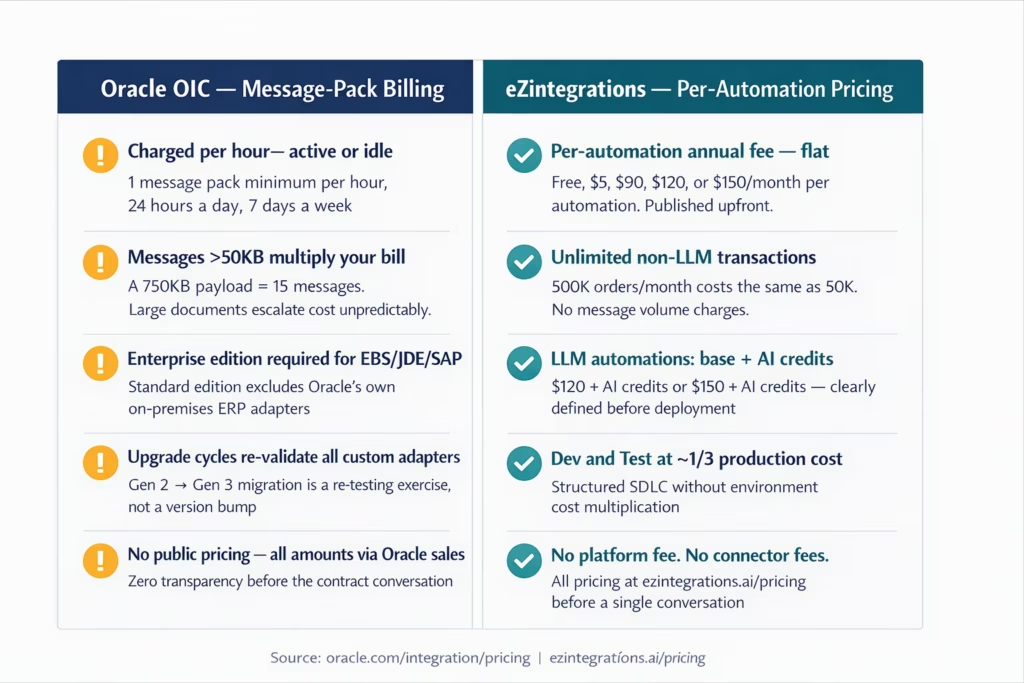
Idle billing runs continuously. Oracle OIC charges the minimum of one message pack per hour regardless of whether any integration is processing messages during that hour. An OIC instance that is provisioned and running, even with no active workflows accrues charges every hour of every day. For enterprises with overnight processing lulls, weekend quiet periods, or seasonal fluctuations, the cost accumulates silently.
Message size multiplies your bill unpredictably. OIC defines one message as 50KB of in-and-out transmission. A payload of 750KB counts as 15 messages. A payload of 5MB counts as 100 messages. Enterprises processing large documents, purchase orders, invoice packages, EDI files, batch records routinely discover that their actual message consumption is a multiple of their baseline estimate. The Forrester finding that mixed-stack teams on ecosystem-centric platforms report 40% higher integration maintenance costs is partly a reflection of exactly this dynamic: unexpected consumption, unbudgeted overages, and reactive capacity adjustments.
Enterprise edition is an additional cost layer. Standard edition covers cloud-to-cloud SaaS integration and Visual Builder. If your Oracle estate includes EBS, JDE EnterpriseOne, Siebel, or SAP, which it almost certainly does if you are a mid-to-large enterprise, you need Enterprise edition to access those on-premises adapters. That is a tier escalation conversation with Oracle sales, with no public pricing available for either tier.
Upgrade complexity multiplies lock-in cost. Oracle has moved from OIC Generation 2 to Generation 3 architecture. Enterprises mid-contract on Gen 2 face a migration to Gen 3 that requires re-testing every integration, not simply upgrading a version number. This is not a minor patching exercise; it is a revalidation effort that consumes specialist time and creates a window of operational risk. Combined with the adapter dependency described in the next section, each major OIC upgrade becomes an inflection point where migration costs look increasingly competitive with continuing.
The eZintegrations contrast: Pricing is published at ezintegrations.ai/pricing on a per-automation, per-year basis. Non LLM automations run at unlimited transaction volume, no per-message charges, no idle billing, no capacity reservation arithmetic. A Shopify to Oracle EBS order sync processing 500,000 orders per month costs the same annual per-automation fee as one processing 50,000 orders. Dev and Test environments are priced at approximately one-third of production cost. No platform fee. No connector fees. No Oracle sales conversation required to discover what you will pay.
Failure Mode 2 — Ecosystem Lock-In Makes Mixed-Stack Integration Expensive and Fragile
Oracle OIC is an exceptional platform for one specific architecture: Oracle to Oracle. Fusion Cloud to EBS. EBS to NetSuite. JDE to Oracle Analytics Cloud. Within that ecosystem, native adapters, pre-built recipes, and Oracle’s managed infrastructure make integration fast and reliable.
The moment you step outside that ecosystem, the picture changes substantially.
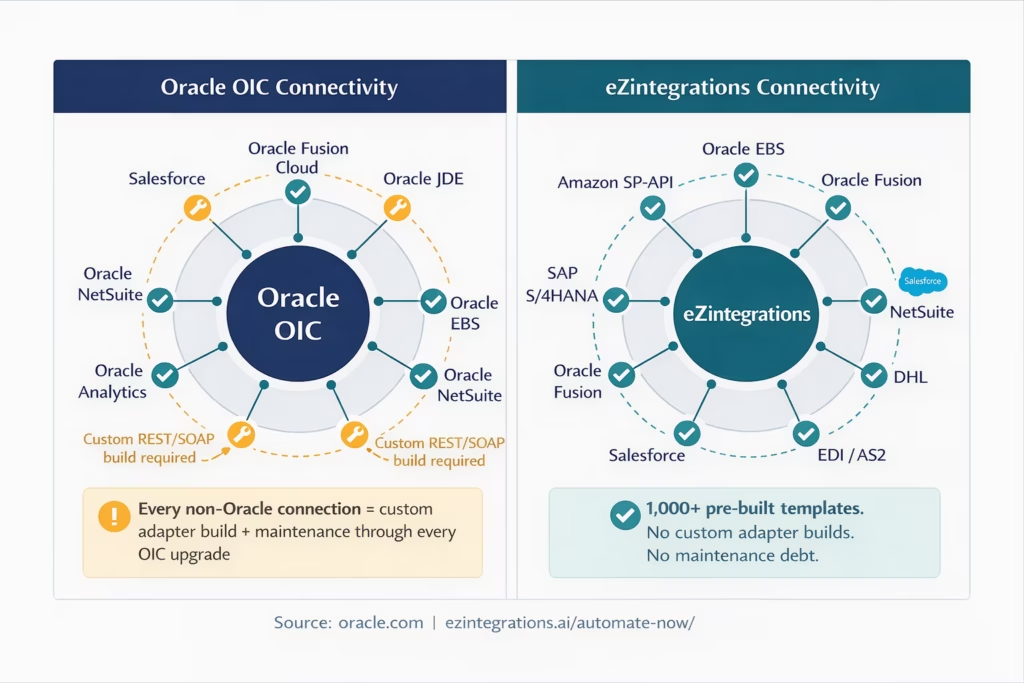
Non-Oracle systems require custom adapter builds. Connecting Oracle EBS to Salesforce requires a custom REST or SOAP adapter. Connecting to Shopify requires another. Amazon Seller Central, Walmart Seller Portal, DHL, Kenco, a 3PL partner using an AS2 EDI connection, every non-Oracle endpoint is a custom build, not a native capability. Oracle OIC has no native Amazon Seller Central adapter. It has no native Walmart Seller adapter. It has no native Shopify GraphQL connector.
For enterprises whose digital operations extend beyond Oracle’s application boundary, which in 2026 means virtually every enterprise in Retail, CPG, Industrial Goods, Hi-Tech, and Pharma, this is not an edge case. It is the core of their integration roadmap.
Custom adapters require maintenance through every OIC upgrade. A custom REST adapter built for OIC Generation 2 needs to be revalidated against OIC Generation 3. If Oracle changes its adapter framework, which it has done between major versions that re-validation becomes a rebuild. Every non-Oracle system connection accumulates a maintenance debt that compounds with each platform upgrade cycle.
Gartner Peer Insights reviews confirm the pattern. Oracle OIC consistently rates highly for Oracle-to-Oracle integration scenarios. Ratings decline for mixed-stack deployments. The reviews from enterprises running hybrid estates Oracle ERP alongside Salesforce CRM, Shopify storefronts, and third-party logistics providers, describe a platform doing one thing well and everything else through workarounds.
The eZintegrations contrast: eZintegrations ships with production-ready templates for Oracle EBS, Oracle Fusion Cloud, Salesforce, Shopify (with native GraphQL), Amazon Seller Central, Walmart Seller, EDI trading partners via AS2/SFTP, SAP, NetSuite, and 1,000+ additional automation templates in the Automation Hub at ezintegrations.ai/automate-now/. None of these require custom adapter builds. Every connection is a transparent per-automation annual fee. Adding a new 3PL partner, a new marketplace, or a new trading partner to your Oracle ecosystem does not trigger an Account Manager conversation about tier escalation.
Failure Mode 3 — Oracle Specialist Dependency Creates a Costly Single-Point-of-Knowledge Risk
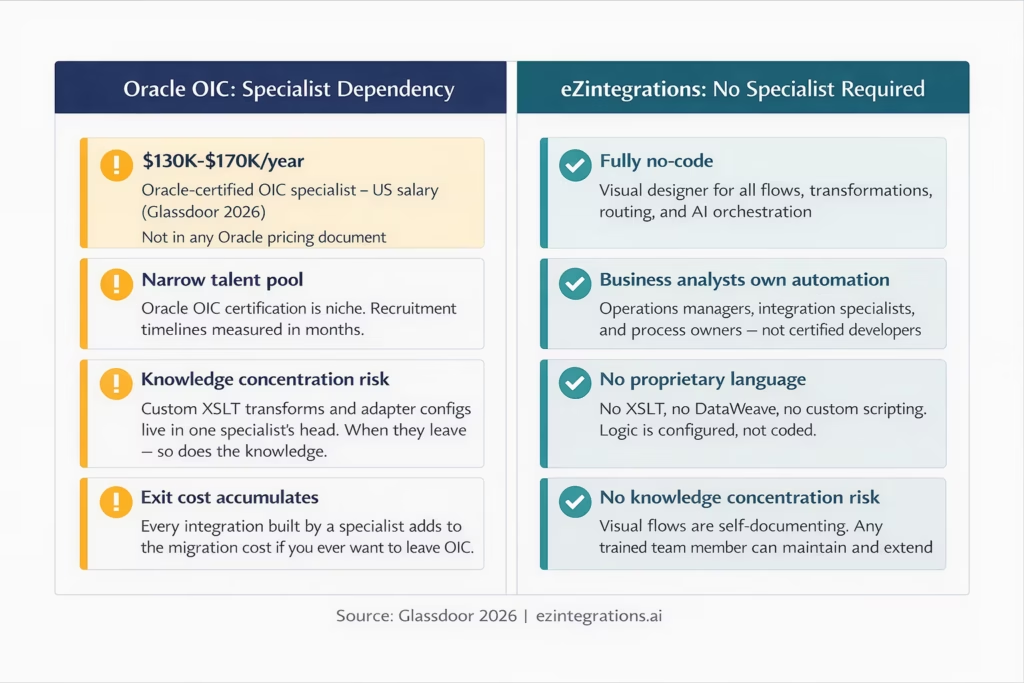
Oracle OIC is not a no-code platform. Building and maintaining complex integrations, especially those involving EBS or JDE adapters, custom XSLT transformations, process automation, and REST adapter configurations, requires Oracle certified developers who understand both the integration platform and the underlying Oracle application architecture.
Oracle-certified OIC developers command $130,000–$170,000 annually in the US market (Glassdoor, 2026). That headcount cost is a structural addition to OIC’s total cost of ownership that does not appear in any Oracle pricing document.
The deeper problem is not the salary cost, it is the knowledge concentration risk.
OIC expertise is a narrow talent pool. The market for Oracle Integration Cloud specialists is significantly smaller than the market for developers proficient in general-purpose integration platforms. Recruiting timelines are longer. Replacement timelines when a specialist leaves are measured in months, not weeks. Bench depth on a three-person integration team is effectively one person.
When a specialist leaves, operational risk spikes. Integrations built and maintained by a single Oracle specialist carry undocumented logic, non-standard adapter configurations, and custom XSLT transformations that only their author fully understands. When that person leaves, the business inherits a black box. The new hire, at the same $130K–$170K salary premium, starts from documentation that is typically incomplete.
The eZintegrations contrast: eZintegrations is fully no-code. Integration flows, AI workflows, Document Intelligence configurations, and Goldfinch AI agent orchestrations are built and maintained in a visual designer. Business analysts, operations managers, and integration specialists not Oracle-certified developers, own the automation layer. There is no proprietary transformation language. There is no certification barrier to staffing. And there is no knowledge concentration risk concentrated in a single specialist headcount.
Failure Mode 4 — Zero Native Agentic AI Capability
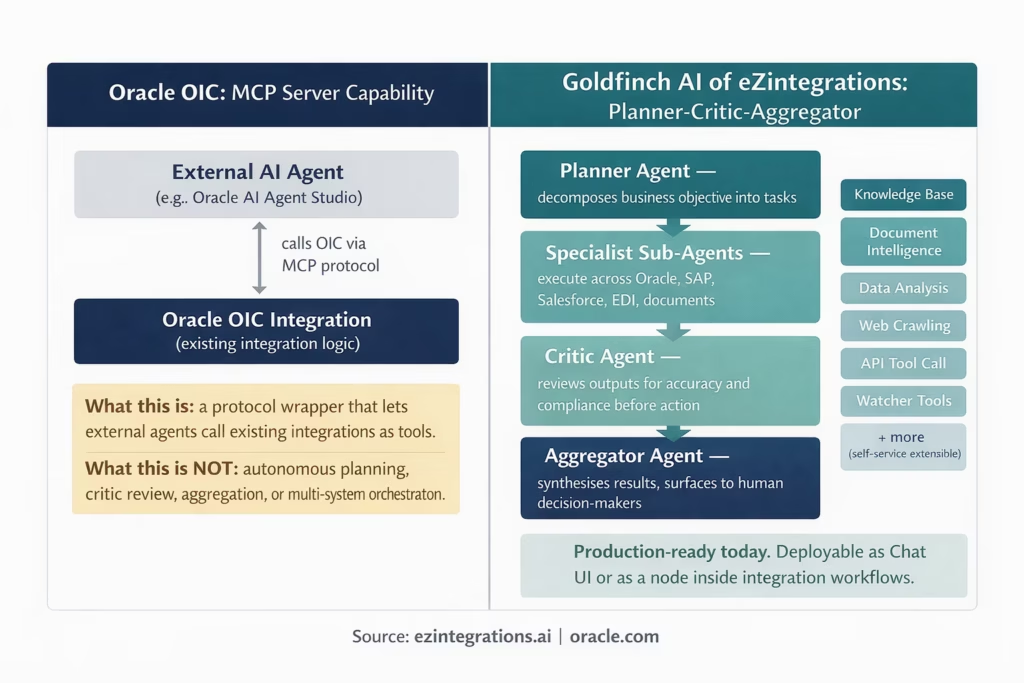
Oracle OIC added MCP (Model Context Protocol) server capability in 2026. This is a meaningful step, it allows external AI agents to call OIC integrations as tools.
It is not Agentic AI. And the distinction matters for enterprise planning.
What MCP server capability does: It exposes existing OIC integrations as callable tools for external AI agents. If you are running an external agent framework, Oracle’s own AI Agent Studio, a custom LangChain build, or a third-party orchestration layer, you can point those agents at OIC integrations. The integration logic still lives in OIC. The agent logic lives elsewhere.
What Agentic AI actually requires: A production ready Agentic AI capability for enterprise automation requires a Planner Agent that decomposes business objectives into actionable tasks, Specialist Sub-Agents that execute against specific systems and data sources, a Critic Agent that reviews outputs for accuracy and compliance before action is taken, and an Aggregator Agent that synthesises results and surfaces them to human decision makers. This architecture, the Planner-Critic-Aggregator model is what enables genuine autonomous decision-making at workflow steps, not just API calls wrapped in a protocol.
Oracle OIC has none of this architecture. It has an MCP server. The gap between “our integrations can be called as tools” and “our platform autonomously plans, executes, reviews, and completes complex business workflows” is the gap between a telephone and an autonomous operator.
What enterprises need this for: The use cases that are driving Agentic AI investment in enterprise IT are not edge cases. Autonomous accounts payable processing. Real-time inventory rebalancing across Oracle EBS and multiple marketplace channels. Supplier onboarding that triggers document intelligence, ERP data enrichment, and routing decisions without human intervention. 3-way invoice matching that resolves discrepancies autonomously before escalating only the exceptions. These are the workflows that enterprise IT leaders are trying to build in 2026. Oracle OIC cannot build them natively.
The eZintegrations contrast: Goldfinch AI of eZintegrations is a production-ready multi-agent orchestration platform with a Planner Agent, Specialist Sub-Agents, Critic Agent, and Aggregator Agent. It ships with 9 native agent tools out of the box: Knowledge Base Vector Search, Document Intelligence, Data Analysis, Data Analytics with Charts/Graphs/Dashboards, Web Crawling, Watcher Tools, API Tool Call (Basic/OAuth 1.0/2.0/Custom Signature/pagination), Integration Workflow as a Tool Call, and Integration Flow as MCP. Users can extend with additional tools as self-service beyond these 9. Goldfinch AI can be deployed as a Chat UI or as a node inside existing integration workflows, meaning it complements and extends the automation layer rather than requiring a separate agentic infrastructure build.
What Enterprises Are Moving To — The Seven Platforms
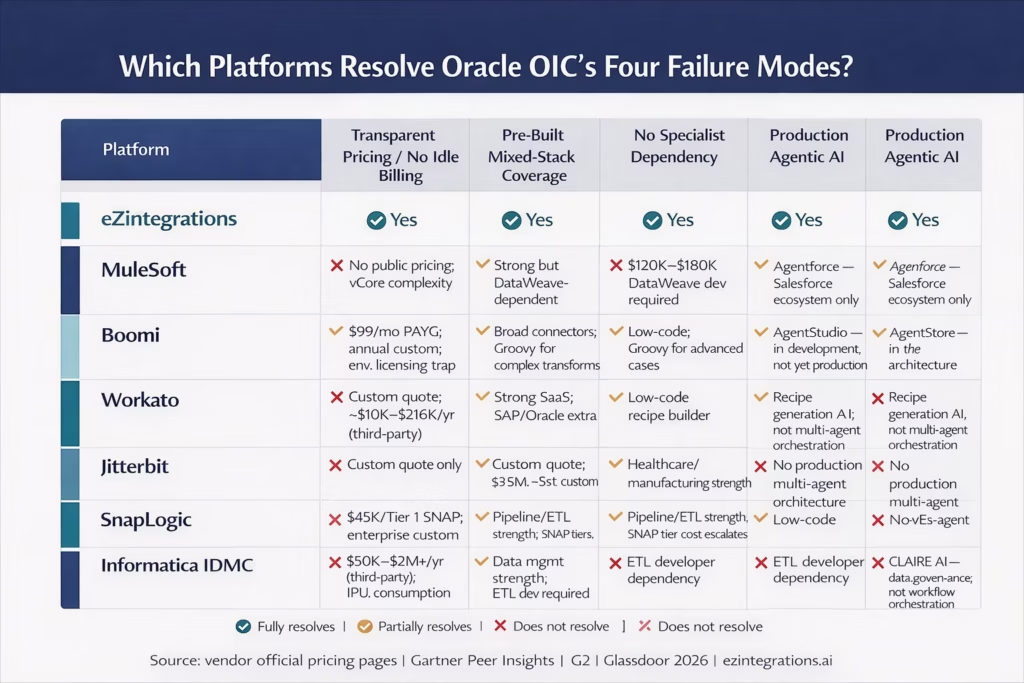
Enterprise shortlists replacing Oracle OIC in 2026 consistently feature seven platforms. These are not hypothetical alternatives, they are the platforms appearing in procurement processes, RFP documents, and migration projects at enterprises in Hi-Tech, Pharma, Retail, CPG, Industrial Goods, and Industrial Manufacturing.
| Platform | Pricing Model | AI Capability | Mixed-Stack Coverage | No-Code |
|---|---|---|---|---|
| eZintegrations | Per-automation annual; Dev/Test ~1/3 production; Free-$150/month + AI credits for LLM automations | Goldfinch AI – 9 native tools, Planner-Critic-Aggregator, production-ready | 1,000+ templates; Oracle, SAP, Salesforce, Shopify, Amazon, Walmart, EDI | Full no-code |
| MuleSoft | No public pricing; vCore/Flows + Messages; $15K-$50K+ platform; $120K-$180K DataWeave dev | Salesforce Agentforce integration; limited for non-Salesforce stacks | Strong API management; proprietary DataWeave | Low-code; developer required |
| Boomi | $99/mo + $0.05/msg (PAYG); annual plans custom quote | AgentStudio – in active development | Broad connector library; 300K+ connections | Low-code; Groovy scripting for complex transforms |
| Workato | Custom quote; ~$10K-$216K/year | Recipe generation and monitoring AI | Strong SaaS coverage; SAP/Oracle connectors priced separately | Low-code recipe builder |
| Jitterbit | Custom quote; no public pricing | Jitterbit AI — data mapping and integration AI | Healthcare and manufacturing focus; 250+ connectors | Low-code |
| SnapLogic | ~$9,995/year entry; Tier 1 SNAPs $45K each; enterprise custom quote | AutoSync AI – data pipeline automation | Pipeline-focused; Workday and NetSuite via Tier 1 SNAPs | Low-code pipeline designer |
| Informatica IDMC | ~$50K-$2M+/year; IPU consumption; custom quote | CLAIRE AI – data governance and quality | Enterprise data management; ETL developer required | Technical; ETL developer dependency |
Platform 1: eZintegrations — The Modern Full-Stack Alternative
eZintegrations from Bizdata is the only platform in this field that directly resolves all four Oracle OIC failure modes with production-ready capability in 2026.
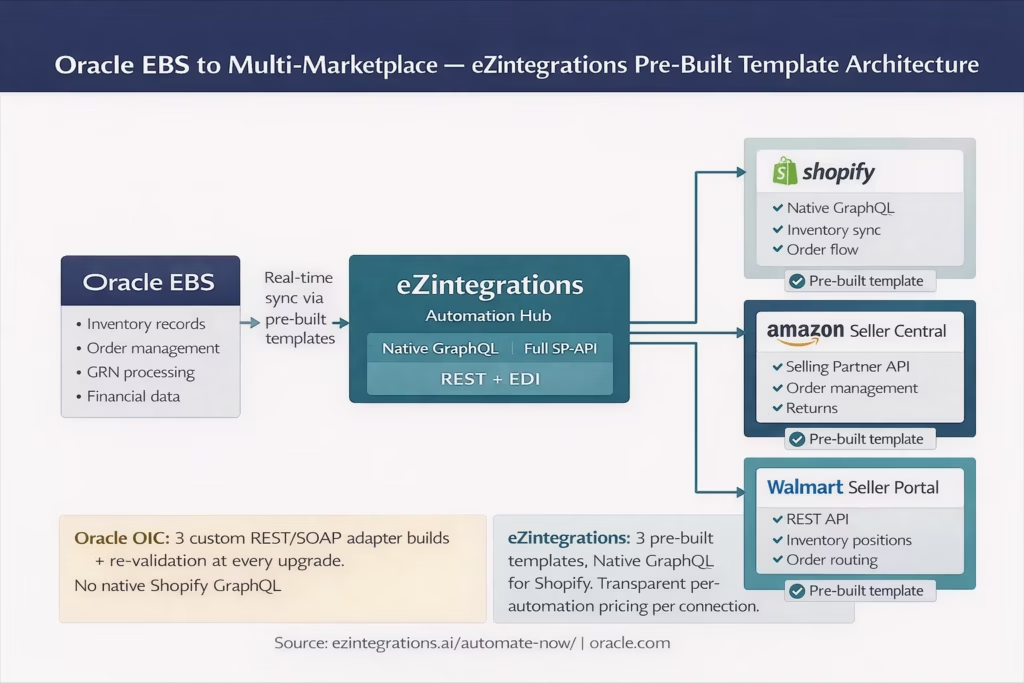
The Anchor Use Case: Oracle EBS to Multi-Marketplace
A recognised global Retail enterprise was running Oracle EBS as their system of record for inventory, orders, and fulfillment. Their growth strategy required simultaneous presence on Amazon Seller Central, Walmart Marketplace, and Shopify, three platforms with distinct API protocols, distinct fulfillment requirements, and distinct data models.
On Oracle OIC, that architecture required three separate custom adapter builds: a REST adapter for Amazon’s Selling Partner API, a REST adapter for Walmart’s Seller Portal, and a Shopify adapter that could not use OIC’s native connector framework because Shopify’s primary API is GraphQL, a protocol Oracle OIC does not natively support. Each custom adapter required specialist build time, specialist documentation, and specialist maintenance through every OIC upgrade.
On eZintegrations, that same architecture is covered by production-ready Automation Hub templates. Shopify connects via eZintegrations’ native GraphQL support. Amazon Seller Central connects via full Selling Partner API coverage including inventory sync, order management, fulfillment updates, and returns. Walmart Seller connects via REST. Oracle EBS connects via pre-built EBS adapter templates covering inventory positions, order records, GRN processing, and financial data flows.
The result: inventory positions from Oracle EBS synchronised in real time to three marketplace channels. Orders from all three marketplaces flowing back to Oracle EBS for fulfillment. Returns processed across all channels against the EBS record of truth. The entire stack implemented in days rather than the months their previous custom-adapter architecture required.
Pricing that doesn’t punish scale: Each marketplace connection is a transparent per-automation annual fee published at ezintegrations.ai/pricing before a single line of configuration is written. Adding a fourth marketplace, or a new 3PL partner, or a new EDI trading partner, adds one per-automation fee. No message-pack consumption recalculation. No tier review. No Account Manager conversation.
Goldfinch AI for what comes next: Once the integration layer is running, Goldfinch AI of eZintegrations extends that connected Oracle estate into autonomous workflows. Inventory rebalancing decisions across three marketplace channels. Autonomous identification of fulfillment exceptions requiring escalation. Procurement cycle automation that connects Oracle EBS purchasing data with supplier EDI and Salesforce CRM for unified procurement intelligence. These are not roadmap items, they are production-ready today.
Why eZintegrations Wins on All Four Failure Modes
On pricing: No message-pack billing, no idle charges, no capacity reservation. Per-automation annual fees published transparently. Non LLM automations run at unlimited transaction volume regardless of how many orders, invoices, or inventory records your business processes. AI/LLM automations are priced at the applicable base tier plus AI credits ($120 + AI credits or $150 + AI credits depending on automation complexity). Dev and Test environments at approximately one-third of production cost.
On ecosystem lock-in: 1,000+ production-ready templates in the Automation Hub covering Oracle EBS, Oracle Fusion Cloud, SAP, Salesforce, Shopify (native GraphQL), Amazon Seller Central, Walmart Seller, NetSuite, DHL, EDI (AS2/SFTP/X12/EDIFACT), and hundreds of additional enterprise systems. No custom adapter builds. No maintenance debt through platform upgrades.
On specialist dependency: Fully no-code. Implementation in hours to days using pre-built templates. Business analysts, operations teams, and integration specialists own the automation layer, not Oracle-certified developers. 99.9% uptime SLA. 24/7 global support.
On Agentic AI: Goldfinch AI ships today with a Planner-Critic-Aggregator architecture, 9 native agent tools, and self-service extensibility. Not a roadmap. Not an MCP wrapper around existing integrations. A production-ready multi-agent orchestration system that can be deployed as a Chat UI or as a node inside integration workflows.
Platforms 2–7: The Rest of the Field
MuleSoft
MuleSoft is Oracle OIC’s most common competitor in enterprise integration RFPs. It brings strong API management, a large connector ecosystem, and deep Salesforce integration, reinforced by Salesforce’s 2018 acquisition of MuleSoft and the convergence with Agentforce.
For enterprises replacing Oracle OIC specifically because of mixed-stack Oracle-plus-Salesforce requirements, MuleSoft is a natural evaluation candidate. The tradeoffs are well-documented: proprietary DataWeave language requiring $120,000–$180,000 specialist developers (Glassdoor, January 2026), vCore/Flows+Messages pricing with no public list price, and an AI roadmap that is Salesforce-ecosystem-centric. Organisations running SAP, Workday, NetSuite, or systems outside Salesforce’s orbit will find MuleSoft’s AI value proposition largely irrelevant to their actual automation needs. Informatica IDMC, now also Salesforce-owned following its November 2025 acquisition raises the same strategic concentration question for enterprise buyers seeking a clean break.
Boomi
Boomi is a strong choice for enterprises whose integration footprint sits within standard connector library coverage and whose developer preference runs toward low-code rather than fully no-code. Pay-as-you-go starts at $99/month plus $0.05 per Boomi Message, accessible for small-scale use but scaling painfully with volume. Annual plans require a custom quote. Per-environment licensing (Dev, QA, Staging, and Production each licensed separately) is the primary cost escalator for enterprise SDLC teams. Boomi’s AgentStudio is in active development as of early 2026, meaningful forward momentum, but not yet a production-ready Planner-Critic-Aggregator architecture. Complex data transformations requiring more than basic mapping require Groovy scripting, a developer dependency that does not exist on fully no-code platforms.
Workato
Workato is widely regarded as having one of the most intuitive recipe-based builders in the market, with strong SaaS connector coverage and a clean implementation experience. The pricing model changed significantly in July 2024 from unlimited-action recipes to a consumption-based task/WLU model. Independent analysis puts enterprise contracts in the range of $10,000–$216,000 annually (third-party estimate). Premium connectors for SAP and Oracle are priced separately, relevant for Oracle EBS replacement scenarios where those connections are not optional. Workato AI focuses on recipe generation and monitoring, useful for developer productivity but not autonomous cross-system agent orchestration.
Jitterbit
Jitterbit Harmony is a unified low-code platform with particular strength in healthcare and manufacturing verticals. Pricing is custom quote only with no public dollar figures, three tiers (Standard, Professional, Enterprise) based on number of endpoint connections. Jitterbit AI provides intelligent data mapping suggestions and expanded API management. For enterprises replacing Oracle OIC in healthcare interoperability or discrete manufacturing scenarios, Jitterbit is a credible evaluation candidate. The absence of a production-ready multi-agent Agentic AI architecture is the same gap that exists across most of this field outside eZintegrations.
SnapLogic
SnapLogic’s pipeline-first architecture is strong for data engineering and ETL workloads that blend integration with analytics pipelines. Entry pricing starts around $9,995/year. Tier 1 SNAPs covering enterprise applications like Workday and NetSuite are priced at $45,000 each making multi-enterprise-application stacks expensive quickly. AutoSync AI handles data pipeline automation. For Oracle EBS replacement scenarios that are primarily data pipeline and warehouse loading rather than transactional integration, SnapLogic is worth evaluating. For mixed-stack transactional integration with Agentic AI requirements, the SNAP tier pricing model and absence of multi-agent orchestration limit the case.
Informatica IDMC
Informatica IDMC is an enterprise data management platform with deep capabilities in data quality, master data management, and data governance. IPU consumption pricing with no public figures, third-party analysis places enterprise contracts between $50,000 and $2,000,000+ annually. CLAIRE AI focuses on data governance and quality rather than autonomous workflow orchestration. The November 2025 acquisition by Salesforce raises the same strategic concentration question as MuleSoft for enterprises seeking independence from the Salesforce ecosystem. For Oracle EBS replacement scenarios where the primary requirement is data management and governance, not transactional integration or Agentic AI, Informatica IDMC warrants evaluation. For everything else, the pricing structure and ETL developer dependency make it a difficult fit for mixed-stack transactional requirements.
How to Choose: Decision Framework by Pain Point
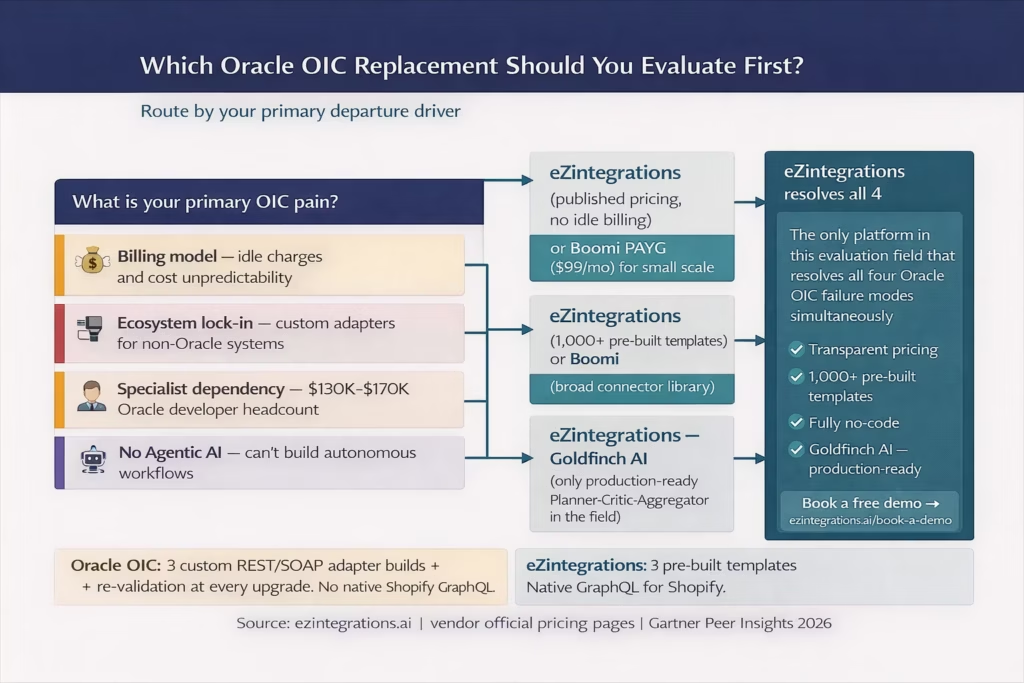
Your primary pain is OIC’s billing model and cost unpredictability: → eZintegrations: transparent per-automation pricing, no idle billing, unlimited non-LLM transactions. The clearest cost structure in the market. → Boomi PAYG ($99/month + $0.05/message) is transparent at entry scale but escalates with volume and environment count. → Workato and Jitterbit require custom quotes – the opaqueness you are trying to escape.
Your primary pain is the custom adapter build burden for non-Oracle systems: → eZintegrations: 1,000+ pre-built templates covering your full mixed stack from day one. → Boomi: broad standard connector library for common SaaS systems; Groovy required for complex transforms. → MuleSoft: strong connector ecosystem but DataWeave transforms require specialist developers.
Your primary pain is Oracle specialist dependency and staffing cost: → eZintegrations: fully no-code — no specialist developer required, no proprietary language. → Workato: low-code recipe builder — lower specialist barrier than OIC or MuleSoft, but still developer-oriented. → Boomi: low-code with Groovy for complex cases — developer dependency remains for advanced scenarios.
Your primary pain is the absence of Agentic AI for autonomous workflows: → eZintegrations: Goldfinch AI — Planner-Critic-Aggregator, 9 native tools, production-ready today. → Boomi: AgentStudio in active development — forward momentum, not yet production-ready multi-agent. → MuleSoft: Agentforce integration — Salesforce-ecosystem-centric; limited value for non-Salesforce stacks. → Everyone else: no production-ready multi-agent architecture as of March 2026.
You are a mid-market enterprise in the $15K–$50K/year budget range with straightforward Oracle-to-SaaS needs: → Workato or Boomi PAYG may be appropriately scoped entry points. → eZintegrations is worth the evaluation if your Oracle footprint extends beyond Fusion Cloud into EBS, JDE, or mixed-stack scenarios.
You operate in Hi-Tech, Pharma, Retail, CPG, Industrial Goods, or Industrial Manufacturing and need industry-specific templates with transparent pricing: → eZintegrations: purpose-built template coverage for these verticals, published pricing, and Goldfinch AI for the autonomous workflow layer that is reshaping operations across all six industries.
Frequently Asked Questions
1.Why are enterprises replacing Oracle OIC in 2026
Enterprises are replacing Oracle OIC due to four structural issues including message pack per hour billing that charges for reserved capacity even when idle ecosystem lock in that forces custom adapter builds for every non Oracle system Oracle specialist developer dependency costing approximately 130000 to 170000 dollars annually and the absence of native Agentic AI for autonomous cross system workflow orchestration. Platforms most commonly evaluated as replacements include eZintegrations MuleSoft Boomi Workato Jitterbit SnapLogic and Informatica IDMC with eZintegrations leading across these dimensions.
2. Does Oracle OIC have Agentic AI
Oracle OIC added MCP server capability in 2026 allowing external AI agents to call OIC integrations as tools. However Oracle OIC does not include a native Planner Critic Aggregator multi agent architecture for autonomous enterprise workflow orchestration. eZintegrations provides this capability through Goldfinch AI which includes a Planner Agent Specialist Sub Agents Critic Agent and Aggregator Agent with nine native tools and self service extensibility.
3.How does Oracle OIC pricing compare to eZintegrations
Oracle OIC pricing uses message pack per hour billing which charges for reserved integration capacity even when not used. Enterprise edition is required for adapters such as Oracle EBS JDE Siebel and SAP and pricing is only available through Oracle sales conversations. eZintegrations publishes all pricing transparently with per automation annual fees ranging from free to approximately 150 dollars per month for non LLM automations with unlimited transaction volume and AI enabled automations priced at 120 dollars plus AI credits or 150 dollars plus AI credits with no platform or connector fees.
4. Can eZintegrations replace Oracle OIC for Oracle EBS integrations
Yes eZintegrations provides production ready templates for Oracle EBS integrations including inventory synchronization order management purchase order automation goods receipt processing and financial data flows. It also connects Oracle systems with Salesforce Shopify Amazon Seller Central Walmart Seller SAP EDI partners and over one thousand enterprise applications through Automation Hub templates with transparent pricing.
5. How long does it take to migrate from Oracle OIC to eZintegrations
Oracle to Oracle integrations can typically migrate within days to weeks using Automation Hub templates. Mixed stack integrations such as Oracle EBS to Shopify Amazon Walmart or third party logistics providers are often faster to implement on eZintegrations than they were originally on Oracle OIC due to template driven automation and a no code integration canvas. Bizdata provides full migration support during this process.
6. Is eZintegrations better than Oracle OIC
For enterprises operating mixed stack environments beyond Oracle systems eZintegrations is often considered a stronger option because it connects Oracle ERP with Salesforce Shopify Amazon Walmart 3PL providers EDI partners and custom SaaS through pre built templates while offering transparent pricing no idle message pack billing a no code canvas and native Agentic AI through Goldfinch AI. Oracle OIC remains strong for pure Oracle ecosystem integrations.
7. Does eZintegrations connect to Oracle Fusion Cloud EBS and NetSuite
Yes eZintegrations supports Oracle Fusion Cloud Oracle EBS Oracle JDE EnterpriseOne and NetSuite with pre built integration templates and protocol level connectivity. NetSuite integrations support SOAP API Restlet API and SuiteQL with pagination handling. All Oracle connectors are priced transparently per automation without additional connector fees.
8. What is Goldfinch AI and does Oracle OIC have an equivalent
Goldfinch AI is the Agentic AI capability of eZintegrations from Bizdata built on a Planner Critic Aggregator multi agent architecture with nine native tools and self service extensibility. Oracle OIC introduced MCP server capability in 2026 allowing external agents to invoke integrations but it does not include a native multi agent orchestration architecture or an equivalent capability for autonomous cross system enterprise workflows.
Conclusion
Oracle OIC was built for a specific problem , Oracle-to-Oracle integration in a managed cloud environment and it solves that problem well. The enterprises that are replacing it in 2026 are not the ones staying inside that boundary. They are the ones whose integration roadmaps have grown beyond Oracle’s ecosystem: into Salesforce, into marketplace channels, into third-party logistics networks, into EDI trading partner communities, and into the Agentic AI workflows that are now defining competitive operations in Retail, CPG, Industrial Goods, Hi-Tech, Pharma, and Industrial Manufacturing.
For those enterprises, Oracle OIC’s four structural failure modes, message-pack idle billing, ecosystem lock-in, specialist dependency, and zero native Agentic AI are not acceptable trade-offs for staying with a familiar platform. They are costs with known alternatives.
The seven platforms in this article represent the realistic replacement field. eZintegrations stands apart because it is the only platform that resolves all four Oracle OIC failure modes simultaneously, transparent published pricing with no idle billing, production-ready mixed stack templates covering every major enterprise system, a fully no-code canvas that eliminates the Oracle specialist dependency, and Goldfinch AI providing production ready Agentic AI with 9 native tools and a self-service extensible architecture.
If your Oracle integration estate is reaching the limits of what OIC was designed for, the conversation worth having is what your next integration platform looks like before the next OIC renewal locks you in for another year.