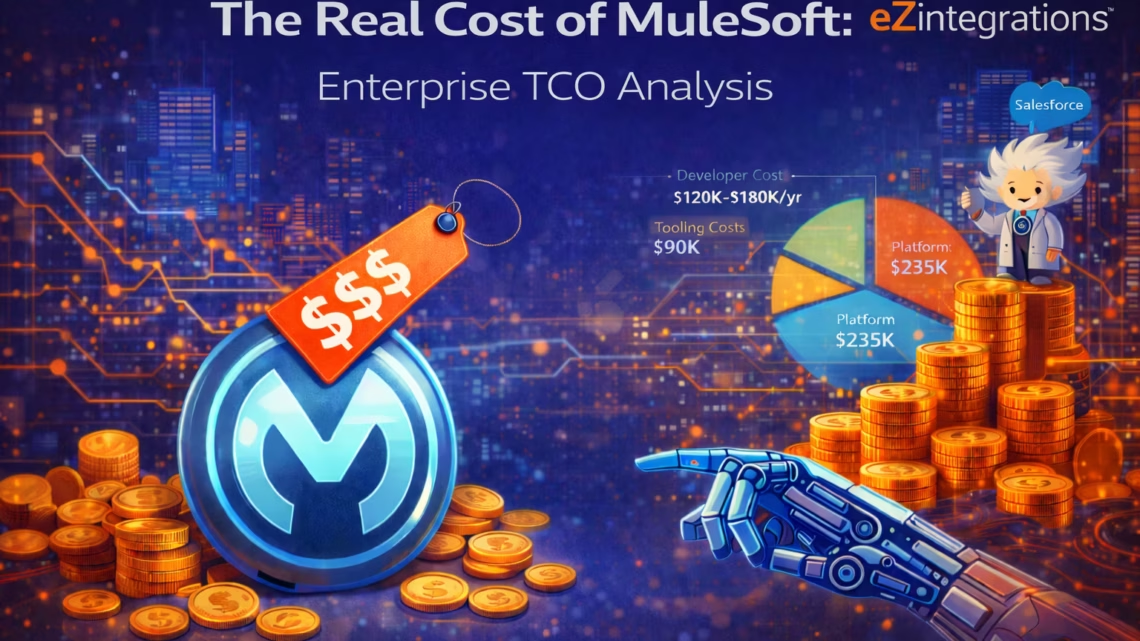
The Real Cost of MuleSoft: Enterprise TCO Analysis 2026
March 16, 2026MuleSoft Anypoint Platform publishes no list prices. All contracts require a custom quote from the MuleSoft sales team. Third-party analysis and buyer community data indicate that for a typical mid-market enterprise, the first-year total cost of ownership (platform subscription plus implementation, professional services, and one DataWeave developer) sits between $350,000 and $600,000+. The platform subscription alone is estimated at $15,000 to $50,000+ for smaller deployments, rising to six figures for enterprise scale, with first-year costs consistently running 2-3x the base subscription before a single integration is in production. eZintegrations, the alternative evaluated throughout this analysis, publishes all pricing at ezintegrations.ai/pricing, starting from free and scaling to $150/month per automation, with no platform fee, no connector fees, and no specialist developer required.
TL;DR
MuleSoft Anypoint Platform does not publish list prices. Every contract requires a direct negotiation with the MuleSoft sales team, and no two buyers pay the same amount. The platform subscription is only the first cost layer. First-year TCO adds implementation (6-8 months typical, often requiring a certified systems integrator), DataWeave developer headcount at $113,000–$175,000/year (Glassdoor, January 2026), professional services, training, and ongoing maintenance. Third-party analysis consistently places first-year TCO for mid-market deployments at 2-3x the base subscription. For enterprises running 20-50 integrations, that means total Year 1 costs in the $350,000–$600,000+ range before productivity gains materialize. eZintegrations publishes all pricing at ezintegrations.ai/pricing, starts at free, scales to $150/month per automation, requires zero specialist developers, and has templates live in hours to days rather than months.
Why MuleSoft’s Published Price Is Not Your Price
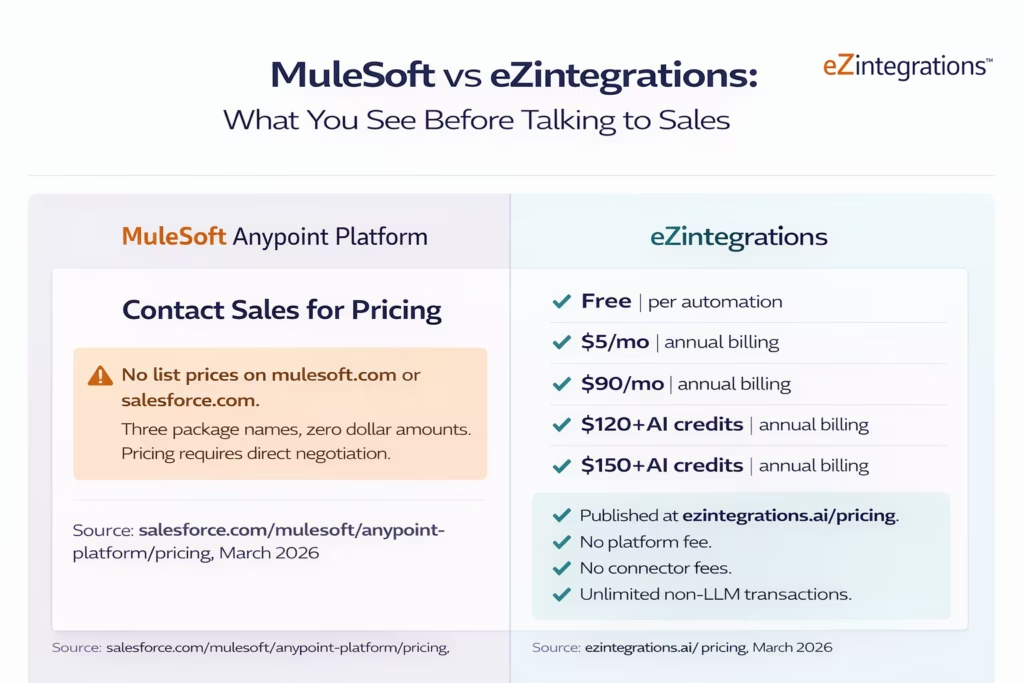
Go to salesforce.com/mulesoft/anypoint-platform/pricing. You will find three package names: Integration Starter, Integration Advanced, and API Management Solution. You will not find a single dollar figure.
Every Anypoint Platform contract requires a conversation with a MuleSoft account executive. The price you pay depends on your Mule Flow capacity requirements, your Mule Message volume, your deployment model (CloudHub, CloudHub 2.0, or hybrid), your support tier selection, and your negotiating use.
This opacity is a structural feature, not an oversight. By requiring sales contact before any pricing discussion, MuleSoft optimises contract value per customer rather than competing on published price transparency. The result for buyers: no competitive anchoring, no internal budget modelling before the first sales call, and no way to compare costs with alternatives without committing to the pipeline.
MuleSoft’s pricing structure operates on multiple variables that make cost prediction complex. Unlike straightforward per-seat or flat-fee models, MuleSoft uses capacity-based subscription pricing without publishing public list prices, requiring direct negotiation with their sales team.
This matters because MuleSoft is often evaluated by procurement teams who need a budget number for internal approval before engaging a vendor. That number does not exist on the vendor’s website. The budget number in this analysis is built from Glassdoor salary data, buyer community reports, and third-party cost research. It is consistently higher than the subscription line item alone.
MuleSoft Pricing: The Four Cost Layers
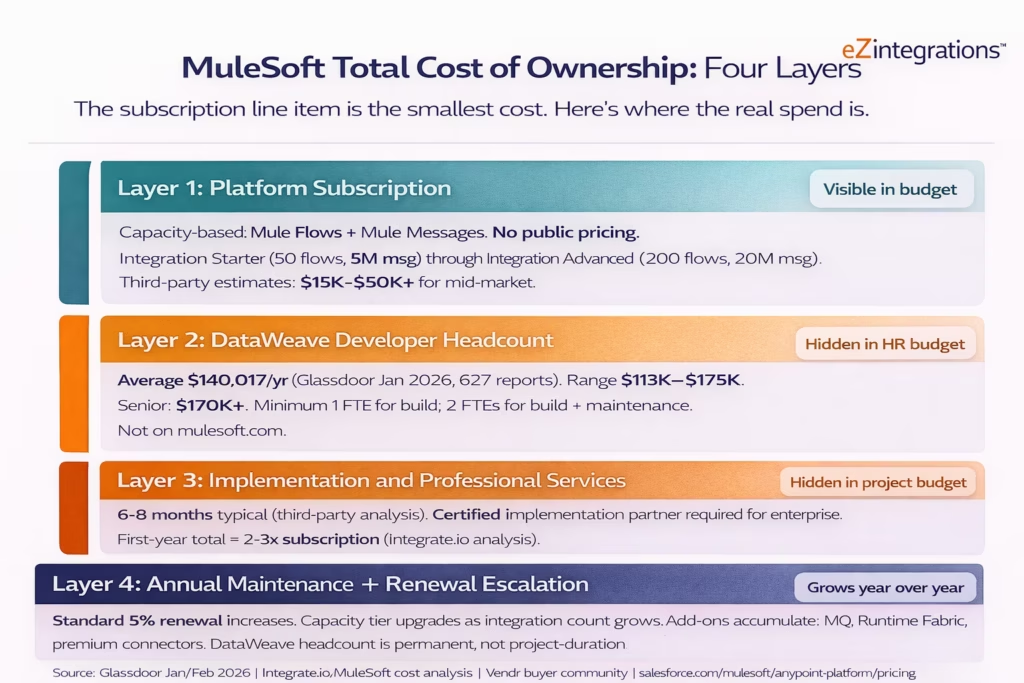
MuleSoft’s total cost of ownership has four distinct layers. The subscription is the one that appears in budget approvals. The other three are what make the renewal conversation uncomfortable.
Layer 1: Platform Subscription
The Anypoint Platform subscription is capacity-based, measured in Mule Flows (breadth of integrations deployed) and Mule Messages (volume of transactions through those integrations).
MuleSoft offers three main packages: Integration Starter, Integration Advanced, and API Management Solution. Integration Starter includes 50 flows, 5 million messages, and 10,000 GB of data throughput annually. Integration Advanced includes 200 flows, 20 million messages, and 40,000 GB of data throughput annually.
What this means in practice: as your integration count grows and transaction volumes increase, your subscription cost increases. An enterprise that starts with 20 integrations and grows to 60 does not pay the same renewal price. This capacity-based model means your annual subscription is determined by how much Flow capacity and Message capacity your organization requires.
Third-party buyers cite entry-level platform costs in the $15,000–$50,000+ range for mid-market deployments. Enterprise-scale contracts covering 50+ flows with significant message volumes and Advanced package requirements sit materially higher.
Layer 1 is the number in your budget line. It is typically the smallest number in your actual Year 1 spend.
Layer 2: DataWeave Developer Headcount
DataWeave is MuleSoft’s proprietary transformation language. It is the syntax used to map, transform, and route data between systems in Anypoint Platform flows. There is no alternative for complex integration logic on MuleSoft: if your integration does meaningful data transformation, someone on your team writes DataWeave.
That person carries a market salary of $113,570–$174,633 per year in the United States, with a Glassdoor-reported average of $140,017 (Glassdoor, January 2026, 627 salary submissions). Senior MuleSoft developers average $170,433/year (Glassdoor, February 2026). MuleSoft specialists command $150,000–$200,000 annually in salary and benefits. Unlike low-code platforms that empower non-technical users, MuleSoft requires dedicated technical staff.
This headcount cost does not appear in MuleSoft’s pricing documentation. It appears in your HR budget, your engineering team’s headcount plan, and eventually in your retention risk register when that developer gets a better offer.
For enterprises running 20+ integrations, a single DataWeave developer is not adequate for both build and ongoing maintenance. Two developers is the practical minimum for uninterrupted operations.
Layer 3: Implementation and Professional Services
MuleSoft implementation timelines typically span 6-8 months, affecting time-to-value compared to alternatives.
A 6-8 month implementation has two cost components. The first is the professional services fee, whether from MuleSoft directly or from a certified implementation partner. MuleSoft maintains a large ecosystem of certified partners precisely because enterprise implementations require specialist-led delivery. The second is the opportunity cost: the integrations you planned to go live in Q1 are not generating value until Q3 at the earliest.
Additional costs including implementation, training, and developer resources can multiply subscription costs by 2-3x. First-year total costs often run 2-3x the base subscription for typical mid-market deployments.
Training for internal teams is a separate line item. MuleSoft certification programs exist at the Developer, Integration Architect, and Platform Architect levels. Enterprise teams targeting self-sufficiency budget $5,000–$15,000+ per team member for formal training.
Layer 4: Annual Maintenance and Renewal Escalation
Once MuleSoft is in production, maintenance has three recurring costs.
The DataWeave developer headcount from Layer 2 does not become part-time after implementation. Every new integration requires DataWeave logic. Every API change in a connected system may require flow modifications. Every MuleSoft platform upgrade requires validation and potential DataWeave refactoring.
Renewal escalation is documented in buyer communities. Buyers report standard 5% increases assessed at renewal, with some negotiating price protection for 2-5 year lock-in. Enterprises that grew their integration count during Year 1 face capacity tier upgrades on top of the base escalation.
Add-ons accumulate. Anypoint MQ for message queuing, Runtime Fabric for container deployments, Anypoint API Experience Hub, premium connectors, and Flex Gateway capacity add-ons are each purchased separately at renewal.
What’s Included at Each Cost Level: Three Buyer Profiles
The ranges are wide because MuleSoft’s actual cost depends heavily on the complexity of your integration environment, your team’s existing DataWeave expertise, and your negotiating use at contract time. These three scenarios are built from buyer community data, third-party analysis, and Glassdoor salary reports. They are illustrative ranges, not contractual figures.
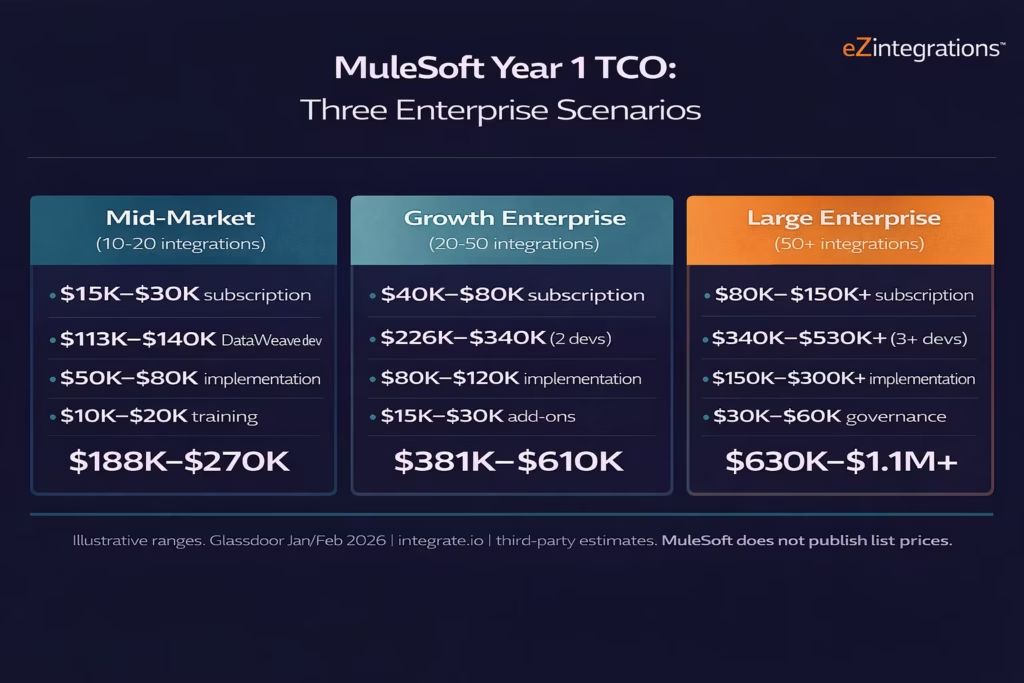
Mid-Market Enterprise (10-20 integrations, Starter package)
A company connecting its ERP, CRM, e-commerce platform, and a handful of SaaS applications falls in this profile. One DataWeave developer is the minimum viable headcount for build and maintenance. Implementation through a certified SI partner over 6 months is standard.
Estimated Year 1 TCO: $188,000 to $270,000
This range places the DataWeave developer as the largest single cost line, at roughly 50-60% of total Year 1 spend.
Growth Enterprise (20-50 integrations, Advanced package)
An enterprise adding supply chain, third-party logistics, marketplace, and EDI connections alongside core ERP-CRM integration. Two DataWeave developers are required: one for build, one for maintenance and incident support. The Advanced package is the minimum for the monitoring and multi-environment deployment requirements at this scale.
Estimated Year 1 TCO: $381,000 to $610,000
At this profile, total Year 1 spend on DataWeave headcount ($226,000–$340,000) is typically 2x the platform subscription cost.
Large Enterprise (50+ integrations)
A global enterprise running Oracle EBS or SAP S/4HANA alongside Salesforce, multiple marketplace channels, EDI trading partners, and real-time event-driven flows. Three or more DataWeave developers, Runtime Fabric for containerised deployment, Anypoint MQ for message queuing, and advanced monitoring are all required rather than optional.
Estimated Year 1 TCO: $630,000 to $1,100,000+
Renewal costs for this profile increase each year as integration count grows, add-ons accumulate, and developer headcount expands to cover the growing maintenance surface.
True Cost of Ownership: MuleSoft vs eZintegrations
This comparison uses the Growth Enterprise profile (20-50 integrations) as the baseline, because it is the most common enterprise evaluation scenario where both MuleSoft and eZintegrations appear on the shortlist simultaneously.
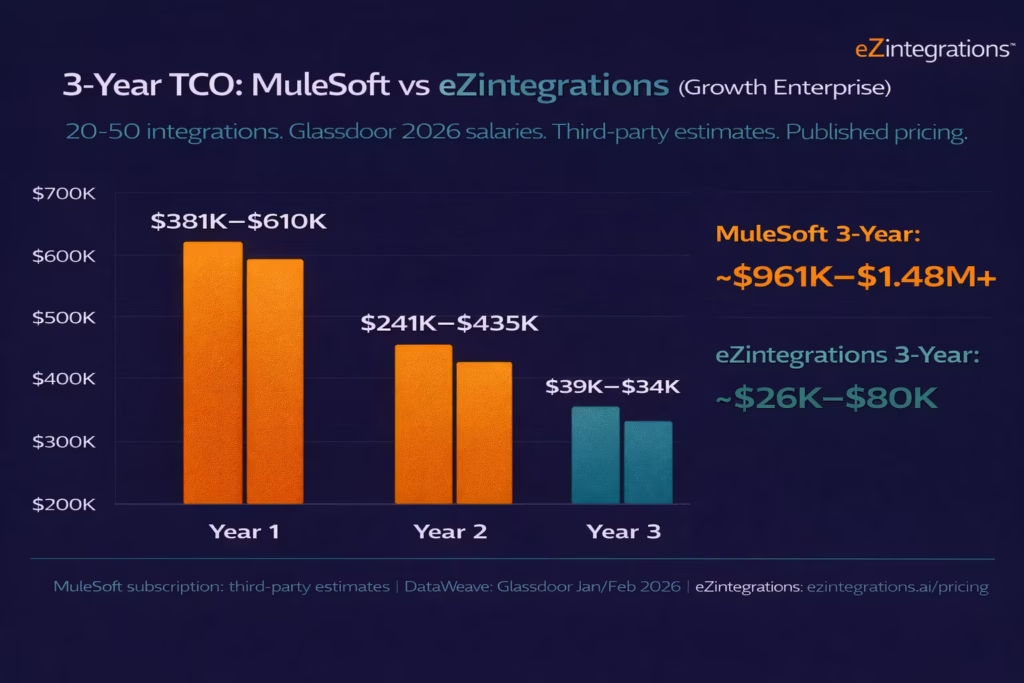
| Cost Component | MuleSoft (Year 1, Growth Enterprise) | eZintegrations (Year 1, Growth Enterprise) |
|---|---|---|
| Platform subscription | $40,000–$80,000 (est., third-party) | Published: ~$1,080–$21,600/yr (20 automations × $90–$150/mo × 12) |
| Specialist developer headcount | $226,000–$340,000 (2 DataWeave devs, Glassdoor 2026) | $0 (fully no-code, no specialist required) |
| Implementation and SI | $80,000–$120,000 (6–8 months, certified SI) | $0–$5,000 (template-based; days to weeks not months) |
| Training and certification | $20,000–$40,000 per team member | $0 (platform training included; no proprietary language) |
| Add-ons (MQ, connectors, monitoring) | $15,000–$30,000 | $0 (no connector fees; monitoring included) |
| Year 1 Total | $381,000–$610,000 | $1,080–$26,600 |
| Year 2 (renewal + maintenance) | $280,000–$420,000 | $1,080–$21,600 |
| Year 3 (renewal escalation) | $300,000–$450,000+ | $1,080–$21,600 |
| 3-Year Total | $961,000–$1,480,000+ | $3,240–$69,800 |
eZintegrations Year 1 figures based on 20 automations at $90/month per automation, annual billing, published at ezintegrations.ai/pricing. LLM/AI automations are priced as a base tier plus AI credits. MuleSoft figures are illustrative estimates from third-party analysis, Glassdoor January/February 2026, and buyer community reports. MuleSoft does not publish list prices.
The gap between these two TCO profiles is driven entirely by the DataWeave developer cost. That cost does not appear on the MuleSoft invoice. It appears in your engineering headcount budget, every year, for as long as you run MuleSoft integrations.
What You Get For Your Money, and What You Don’t
Five cost categories consistently appear in buyer experience reviews and post-implementation assessments that do not show up in any MuleSoft pricing document.
DataWeave training and certification
MuleSoft certification exists at three levels: MuleSoft Certified Developer, MuleSoft Certified Integration Architect, and MuleSoft Certified Platform Architect. Enterprise teams pursuing self-sufficiency need developers at the Developer level minimum, architects at the Integration Architect level for governance and design authority. Each certification requires formal training investment on top of the developer’s base salary.
Capacity forecasting errors
The Flows + Messages model means your subscription cost is tied to how accurately you forecast integration growth and transaction volume at contract time. Enterprises that underestimate integration growth mid-contract face in-period capacity tier upgrades: paying more than the contracted rate for capacity they need now but did not project when signing. Monitor your consumption closely: if you consistently hit the upper limits of your flow or message pack, you may need to scale up your package, or evaluate if a core-based model would be more economical for heavy, constant loads.
DataWeave lock-in exit cost
Every complex transformation written in DataWeave is tied to the MuleSoft runtime. If your organisation evaluates alternatives at renewal, the re-engineering cost for migrating DataWeave transformations to a new platform is a real exit barrier. This cost is invisible until it becomes the reason you accept a 15% renewal increase rather than re-platform.
Salesforce ecosystem bundling pressure
Since Salesforce acquired MuleSoft in 2018, enterprise accounts are often presented with bundled pricing across Salesforce CRM, MuleSoft, and other Salesforce products. The bundling creates apparent savings that can obscure the true MuleSoft component cost within the overall Salesforce contract. IT Architects evaluating MuleSoft in isolation may be looking at a different price than what their organisation’s Salesforce account team is discussing.
Agentforce AI consumption costs
MuleSoft confirmed that while Agentforce connectors and MuleSoft AI connectors are available for free via Anypoint Exchange, using them in production consumes Mule Flows and Mule Messages capacity. Like any other Anypoint Connector, customers will be charged for the flows and messages capacity utilised when using the MuleSoft Agentforce Connector. Using these connectors drives consumption, potentially accelerating when you will need to expand your subscription.
This means AI automation on MuleSoft is not an incremental add-on. It is additional Flows and Messages consumption against your existing subscription capacity, driving earlier tier upgrades and higher renewal costs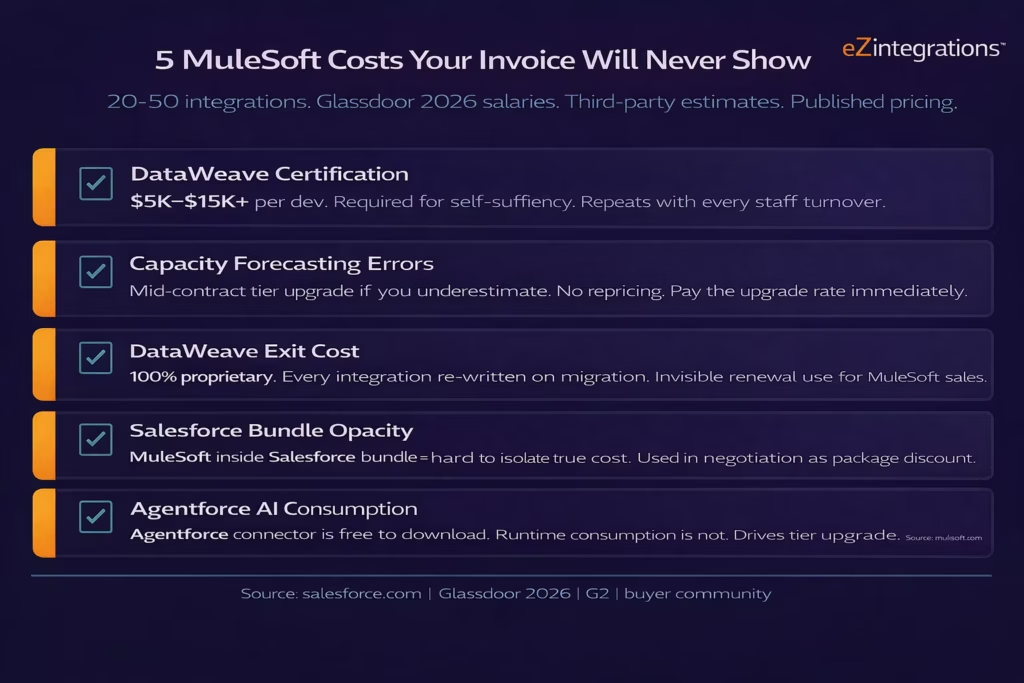
Is MuleSoft Worth It? An Honest Assessment
This is the question your IT Director will ask after seeing the TCO figures. The answer is genuinely conditional.
MuleSoft is worth the cost if:
Your integration architecture is primarily Oracle-plus-Salesforce or SAP-plus-Salesforce, and API management is a strategic capability alongside integration. If your organisation uses Salesforce as its core CRM and needs Anypoint API Manager as an enterprise API gateway alongside the integration platform, MuleSoft delivers genuine concentrated value within that architectural boundary. The Anypoint Exchange connector library is broad, the API-led connectivity model is architecturally sound, and the Salesforce alignment for Agentforce-driven workflows is genuine where Salesforce is the primary system of record.
You also have or can hire the DataWeave expertise required, budget for 6-8 months of implementation, and have enough Salesforce ecosystem investment that the bundled contract economics make sense over a 3-year horizon.
MuleSoft is not worth the cost if:
Your integration stack extends materially beyond Oracle and Salesforce. The moment your architecture includes Shopify (GraphQL), Amazon Seller Central, EDI trading partners, or SAP S/4HANA alongside non-Oracle ERP, MuleSoft’s Salesforce-centric AI and DataWeave-based transformation creates specialist dependencies that don’t scale without proportional headcount growth.
Enterprise buyers report that the platform is becoming quite expensive, making every renewal difficult to manage with Finance.
You should also evaluate alternatives to MuleSoft if your 2026 roadmap requires production Agentic AI. Agentforce integration is Salesforce-ecosystem-centric. It does not provide a Planner-Critic-Aggregator multi-agent orchestration system capable of autonomous execution across Oracle, SAP, Shopify, Amazon, and third-party logistics simultaneously. For enterprises whose AI roadmap extends beyond Salesforce, MuleSoft’s AI capability does not cover the requirement.
eZintegrations Pricing Explained
eZintegrations from Bizdata is the direct alternative evaluated throughout this TCO analysis. Unlike MuleSoft, eZintegrations publishes all pricing at ezintegrations.ai/pricing.
Pricing model: Per automation, annual billing. No platform fee. No connector fees. Non-LLM automations run at unlimited transaction volume, meaning 500,000 transactions/month costs the same annual fee as 50,000.
Tiers:
| Tier | Monthly per Automation | Best For |
|---|---|---|
| Free | $0 | Single automation, evaluation |
| Starter | $5/month | Simple SaaS-to-SaaS, single connection |
| Professional | $90/month | Standard ERP, CRM, e-commerce, database integrations |
| AI Workflow Base | $120/month + AI credits | Document intelligence, invoice processing, classification |
| AI Workflow Advanced | $150/month + AI credits | Complex ERP integrations: Oracle FBDI, FHIR/EHR, SAP |
| Dev/Test environments | ~1/3 of production cost | All tiers |
What this means for budget modelling: An enterprise running 20 standard integrations pays approximately $21,600/year (20 x $90 x 12). That is the complete platform cost. There is no DataWeave equivalent, no specialist headcount requirement, no certified implementation partner requirement, no add-on connector fees, and no renewal escalation tied to transaction volume.
Goldfinch AI: eZintegrations’ Agentic AI capability, Goldfinch AI, ships as a core platform feature. It operates as a Planner-Critic-Aggregator multi-agent system with 9 native out-of-the-box tools: Knowledge Base Vector Search, Document Intelligence, Data Analysis, Data Analytics with Charts and Dashboards, Web Crawling, Watcher Tools, API Tool Call, Integration Workflow as Tool, and Integration Flow as MCP. Unlike MuleSoft’s Agentforce integration, Goldfinch AI operates across Oracle, SAP, Salesforce, Amazon, Shopify, and any connected system simultaneously. It is not Salesforce-ecosystem-limited.
Automation Hub: 1,000+ production-ready templates at ezintegrations.ai/automate-now/ cover Oracle EBS, SAP S/4HANA, Salesforce, Shopify (native GraphQL), Amazon Seller Central, Walmart, DHL, Kenco 3PL, and EDI trading partner onboarding. Implementation through templates is measured in days, not months.
CI/CD: Native Git integration, branch-based development, automated integration testing, and environment promotion from Dev through QA to Staging to Production are built-in platform features, not additional tooling.
Frequently Asked Questions
1. How much does MuleSoft cost
MuleSoft Anypoint Platform does not publish list prices and all pricing requires a direct sales conversation. Third party estimates for mid market deployments place the platform subscription at 15000 to 50000 dollars or more per year for starter tier capacity while enterprise advanced tier deployments run significantly higher. When DataWeave developer salaries of 113000 to 175000 dollars per year per developer Glassdoor January 2026 implementation costs typically two to three times the base subscription in year one and professional services are included a typical mid market enterprise spends around 188000 to 270000 dollars in year one. Growth enterprises with 20 to 50 integrations often reach 381000 to 610000 dollars in total year one cost based on buyer reports and salary data.
2. Does MuleSoft have a free trial
Yes MuleSoft offers a 30 day free trial of the Anypoint Platform available through salesforce.com or mulesoft.com with no credit card required and no installation needed. The trial includes access to Anypoint Studio the Design Center and CloudHub deployment. However it does not include the full message or flow capacity of a paid subscription and any DataWeave transformations created during the trial still require the same specialist expertise needed in production deployments.
3. How does MuleSoft pricing compare to eZintegrations
A direct comparison is typically made using the year one total cost of ownership for a growth enterprise running 20 to 50 integrations. MuleSoft year one cost is commonly estimated between 381000 and 610000 dollars when subscription cost two DataWeave developers implementation training and add ons are included. For the same integration count eZintegrations costs approximately 1080 to 21600 dollars in year one based on per automation annual pricing. The difference is primarily driven by DataWeave developer headcount which represents the largest single cost component in MuleSoft deployments and is not required on eZintegrations.
4. What are MuleSoft hidden fees
Several cost categories frequently reported by buyers do not appear directly on MuleSoft invoices. These include DataWeave developer salaries of 113000 to 175000 dollars per year per developer according to Glassdoor 2026 DataWeave training and certification costs of roughly 5000 to 15000 dollars per team member implementation through a certified system integrator partner which often adds two to three times the base subscription cost in year one capacity tier upgrades when integration volume exceeds the contracted Mule Flows or Mule Messages allowance and Agentforce connector consumption which draws against existing platform capacity. Buyers also report typical renewal price increases of around five percent annually.
5. Does MuleSoft require certified developers
Yes for deployments that include complex data transformation logic. MuleSoft relies on DataWeave which is its proprietary transformation language. Integrations that involve data mapping format conversion routing logic or enrichment normally require a developer skilled in DataWeave. Organizations without a DataWeave certified developer often depend on external implementation partners for ongoing maintenance which creates a recurring professional services dependency.
6. Is there an alternative to MuleSoft with transparent pricing
Yes eZintegrations publishes all pricing publicly at ezintegrations.ai pricing. Automations are priced per unit annually with tiers including Free five dollars per month ninety dollars per month one hundred twenty dollars per month plus AI credits and one hundred fifty dollars per month plus AI credits depending on automation complexity. There is no platform fee no connector fee and no per transaction charge for non LLM automations. The platform uses a fully no code canvas so no DataWeave equivalent developer expertise is required.
7. How long does MuleSoft take to implement
Independent analysis suggests that enterprise MuleSoft implementations typically take six to eight months from contract signing to the first production integrations. This timeline assumes a certified implementation partner a DataWeave developer on the client team and a defined integration architecture. Complex implementations involving Oracle EBS SAP and multiple EDI trading partners often extend beyond eight months. By contrast template based integrations on eZintegrations using the Automation Hub can go live in hours to days depending on configuration requirements.
Conclusion
MuleSoft Anypoint Platform is a technically capable enterprise integration platform. For the narrow architectural profile where it is genuinely the right tool, primarily Oracle-plus-Salesforce environments with strategic API management requirements, the cost can be justified by the concentrated value delivered within that boundary.
For the majority of enterprise IT Architects evaluating an integration platform in 2026, that profile does not describe their actual stack.
A mixed-stack environment connecting Oracle or SAP alongside Salesforce, Shopify, Amazon Seller Central, EDI trading partners, and third-party logistics does not fit the Salesforce-centric model that justifies MuleSoft’s cost structure. The DataWeave specialist you need to run MuleSoft effectively costs $113,000–$175,000/year (Glassdoor January 2026), does not appear in any MuleSoft pricing document, and stays on payroll as long as MuleSoft is in production.
If your 2026 roadmap includes Agentic AI, that cost structure compounds further, because Agentforce works within the Salesforce ecosystem and adding AI automation on MuleSoft accelerates capacity consumption and tier upgrades rather than solving it.
eZintegrations is the alternative designed for that majority use case: the mixed-stack enterprise that needs full protocol coverage, no specialist headcount requirement, published transparent pricing, and production-ready Agentic AI through Goldfinch AI that works across Oracle, SAP, Salesforce, Amazon, and any connected system simultaneously.
Before your next MuleSoft renewal conversation, run the numbers from Section 4 with your actual integration count and headcount costs. The TCO gap compounds every year.
Book a free demo with the eZintegrations team.
Bring your current integration architecture, your MuleSoft renewal timeline, and your 2026 roadmap. We will show you your specific stack modelled on eZintegrations pricing before you commit to anything.