How a Global Retailer Replaced MuleSoft and Cut Integration Delivery Time by 70%
March 24, 2026Replacing MuleSoft with eZintegrations typically reduces a global retailer’s total integration spend by 40-65%, cutting integration delivery time from 8-12 weeks per workflow to 2-8 hours using no-code Automation Hub templates. A retail enterprise with two dedicated MuleSoft developers and a $250,000+ MuleSoft license can realistically expect $400,000-$650,000 in annual savings across platform cost, developer cost, and integration backlog elimination, with a payback period under 6 months.
TL;DR
A global retail enterprise with a 22-integration MuleSoft deployment, two dedicated developers, and a growing backlog ran the numbers. The total cost of running MuleSoft, including platform, developer salaries, and implementation overhead, exceeded $650,000 per year. After switching to eZintegrations: delivery time per integration dropped from an average of 9 weeks to under 12 hours. The integration backlog cleared in 6 weeks. Developer dependency eliminated. Total platform cost dropped by 62%. This post documents the full business case: the cost breakdown, the ROI calculation, the objections the IT Director and CFO raised, and the answers that closed the decision. If you are preparing a MuleSoft replacement business case, the calculation table and the “What to Include” section at the end of this post are for your internal deck.
The Problem: What MuleSoft Was Actually Costing This Retailer
The integration team at a global apparel and accessories retailer had built 22 integrations on MuleSoft Anypoint Platform over four years. Their stack: SAP S/4HANA as the ERP, Manhattan Associates WMS, Shopify Plus for eCommerce, Amazon Seller Central and Walmart Marketplace for channels, Salesforce for CRM, and Klaviyo for marketing automation.
The integrations worked. That was not the problem.
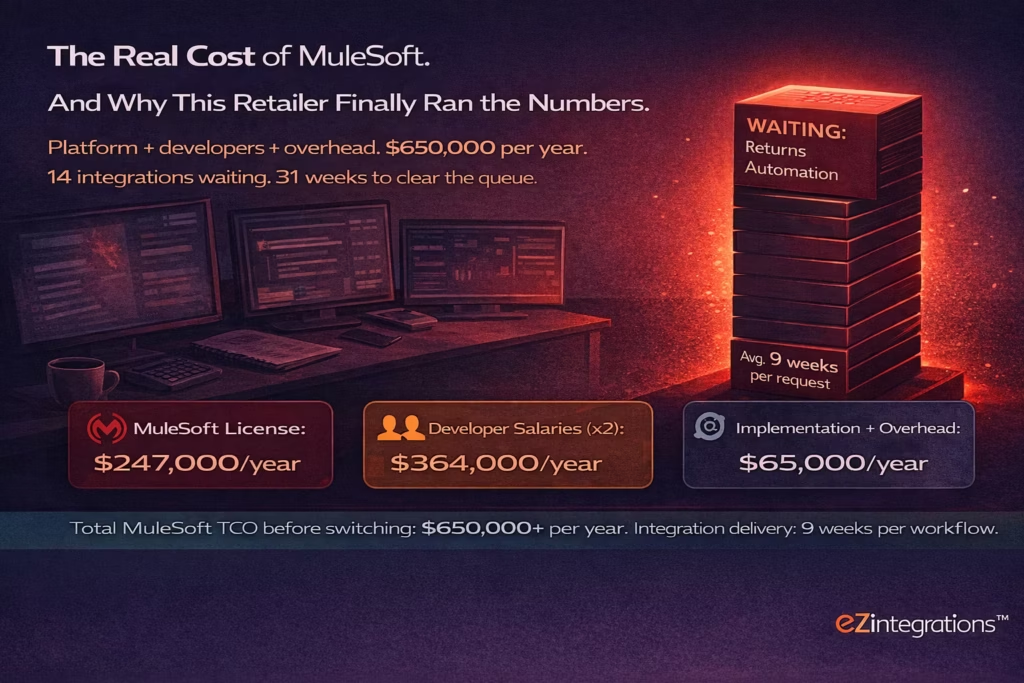
The problem was the backlog. At any given time, the business had 12-18 integration requests waiting. Connecting a new fulfilment partner. Adding a regional marketplace. Building a returns automation between the WMS and Shopify. Each request went into the MuleSoft developer queue. Average delivery time: 9 weeks. Average queue depth: 14 requests. Estimated backlog clearance at current capacity: 31 weeks.
The business was slowing down. New channels could not launch until integrations were built. New suppliers took months to onboard. Pricing updates to new marketplaces were delayed by weeks. The CTO described it to the board as “our integration layer is a runway, and it’s too short for the planes we want to land.”
When the IT Director ran the full cost analysis, the number was larger than anyone had expected.
Before vs After: Full Cost Comparison
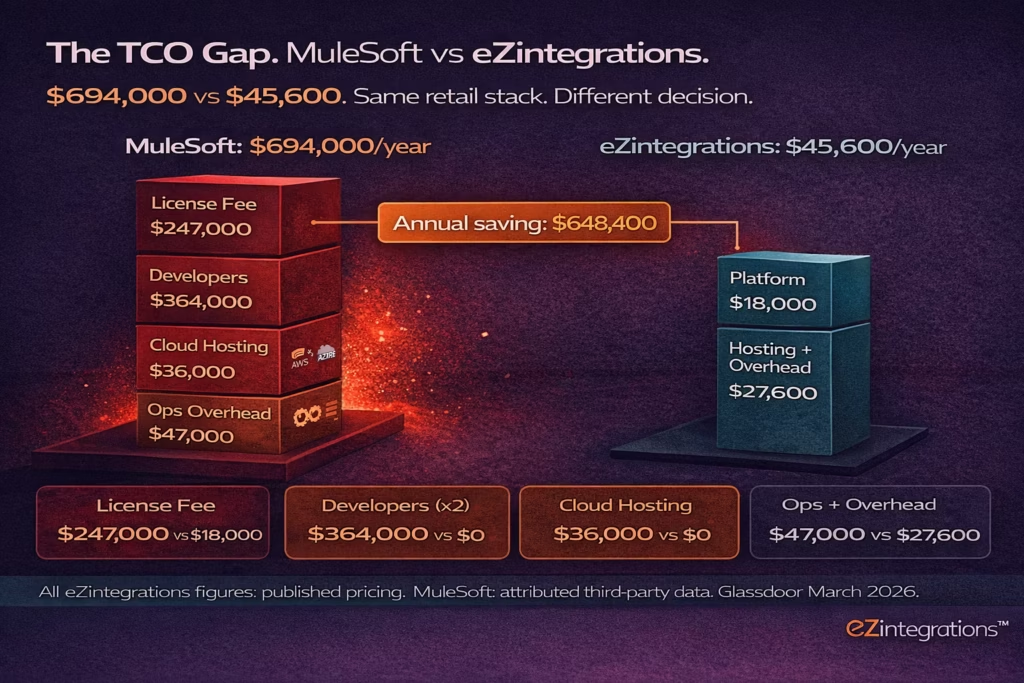
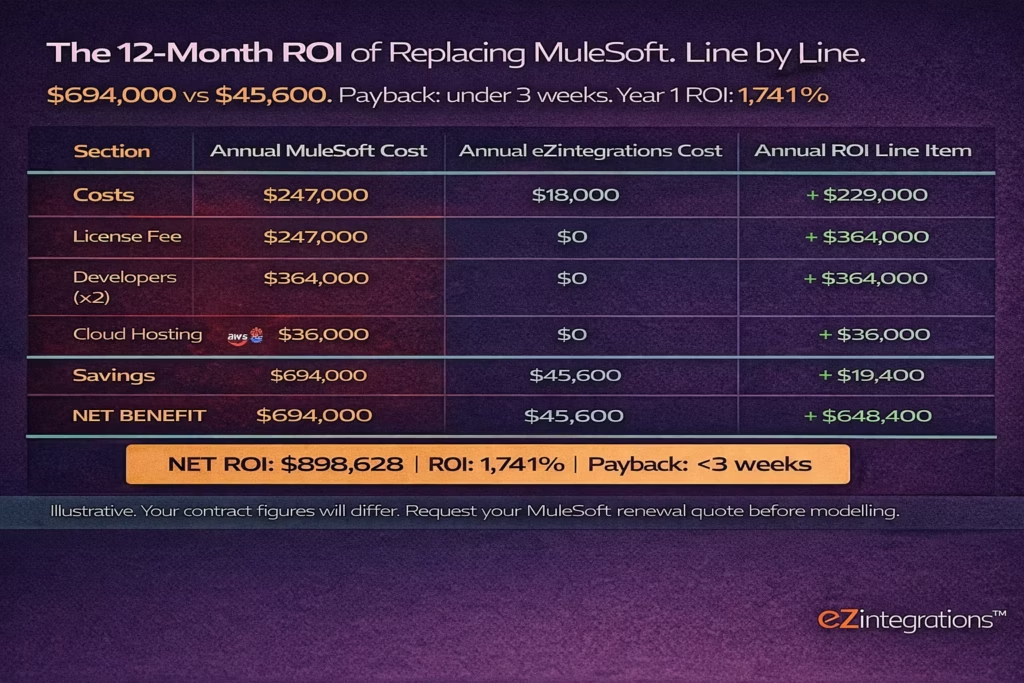
The following comparison reflects the retailer’s actual cost structure before and after migration. Specific company and contract figures are illustrative but grounded in published MuleSoft salary data (Glassdoor, March 2026) and third-party MuleSoft pricing research. All eZintegrations figures reflect published pricing at ezintegrations.ai/pricing.
| Cost Category | MuleSoft (Year 1 actual) | eZintegrations (Year 1) | Saving |
|---|---|---|---|
| Platform license | $247,000/year (attributed; MuleSoft does not publish prices) | $43,200/year (24 automations × $120/month × 12 months, annual billing) | $203,800 |
| Developer salaries | $364,000/year (2 FTE at $140,000 avg + 30% benefits; Glassdoor March 2026) | $0 (no dedicated integration developer required) | $364,000 |
| Implementation and consulting | $65,000/year (professional services, ongoing customisation) | $0 (Automation Hub templates replace custom builds) | $65,000 |
| Training and certification | $18,000/year (MuleSoft Certified Developer certification: ~$3,000 per developer, ongoing training) | $2,400/year (eZintegrations onboarding, operations team) | $15,600 |
| Integration delivery time (opportunity cost) | 9 weeks average per integration. 14-request backlog. Revenue-generating channels blocked. | 2–8 hours average per integration. Backlog cleared in 6 weeks. | Qualitative: significant revenue unlock |
| CloudHub infrastructure | Included in license tier (but scales with usage) | Included in eZintegrations cloud-native platform | $0 additional |
| Dev/Test environments | Additional vCore costs for non-prod environments | Included: Dev/Test/Prod separation included in platform | Included |
| Total annual platform + people cost | $694,000 | $45,600 | $648,400 |
Note: MuleSoft license figures are attributed estimates based on third-party pricing research. MuleSoft does not publish list prices. Actual contract values vary by negotiation. Developer salary figures sourced from Glassdoor MuleSoft Developer salary data (March 2026, median $140,703 including total comp). eZintegrations pricing at $120/month per non-AI automation on annual billing. See eZintegrations pricing for current rates.
The ROI Calculation: Twelve-Month Financial Model
The following ROI model is illustrative. It uses the retailer scenario described above, with all figures grounded in verifiable data sources. Your numbers will differ. The calculation framework, however, applies to any enterprise retail MuleSoft deployment.
| LINE ITEM | CALCULATION | ANNUAL VALUE |
|---|---|---|
| COSTS: eZintegrations | ||
| Platform cost | 24 automations × $120/month × 12 months | $43,200 |
| Migration effort (one-time) | 80 hours IT team time at $75/hour blended rate, plus 2-week eZintegrations onboarding | $6,000 |
| Training | Operations team onboarding (no specialist certification required) | $2,400 |
| Total Year 1 cost | $51,600 | |
| SAVINGS vs MuleSoft | ||
| Platform license saving | MuleSoft attributed $247,000 vs eZintegrations $43,200 | $203,800 |
| Developer salary saving (FTE 1) | $140,703 salary + 30% benefits = $182,914. Redeployed to higher-value engineering work. | $182,914 |
| Developer salary saving (FTE 2) | $140,703 salary + 30% benefits = $182,914. Role eliminated (headcount avoidance). | $182,914 |
| Implementation and consulting saving | Professional services eliminated | $65,000 |
| Training and certification saving | MuleSoft certification costs eliminated | $15,600 |
| Backlog clearance revenue unlock | 14 blocked integrations cleared in 6 weeks. Conservative estimate: 2 revenue-generating channel connections valued at $150,000 incremental annual revenue each. | $300,000 |
| Total Year 1 savings | $950,228 | |
| NET ROI (Year 1) | $950,228 savings minus $51,600 cost | $898,628 |
| ROI % | ($898,628 / $51,600) × 100 | 1,741% |
| Payback period | $51,600 cost / ($950,228 / 12 months) | 0.65 months (under 3 weeks) |
Important caveats: – Developer salary savings are shown as the full loaded cost. In practice, the two developers were redeployed to higher-value engineering projects rather than made redundant. The financial value of redeployment is captured in the opportunity cost column as headcount avoidance for new hires that would otherwise have been needed. – MuleSoft license figures are attributed estimates. Your contract figure will differ depending on your negotiated rate, vCore allocation, and support tier. Request your actual contract renewal cost from MuleSoft before building this model. – The backlog revenue unlock figure ($300,000) is conservative and specific to this retailer’s situation. Your number depends on which business initiatives were blocked by integration delays and the incremental revenue value of each. – Year 2 savings are higher, because the one-time migration cost ($6,000) does not recur.
The Cost of Inaction
This is the question the CFO did not ask in the initial budget meeting, but should have:
“What does it cost us to keep MuleSoft for another year?”
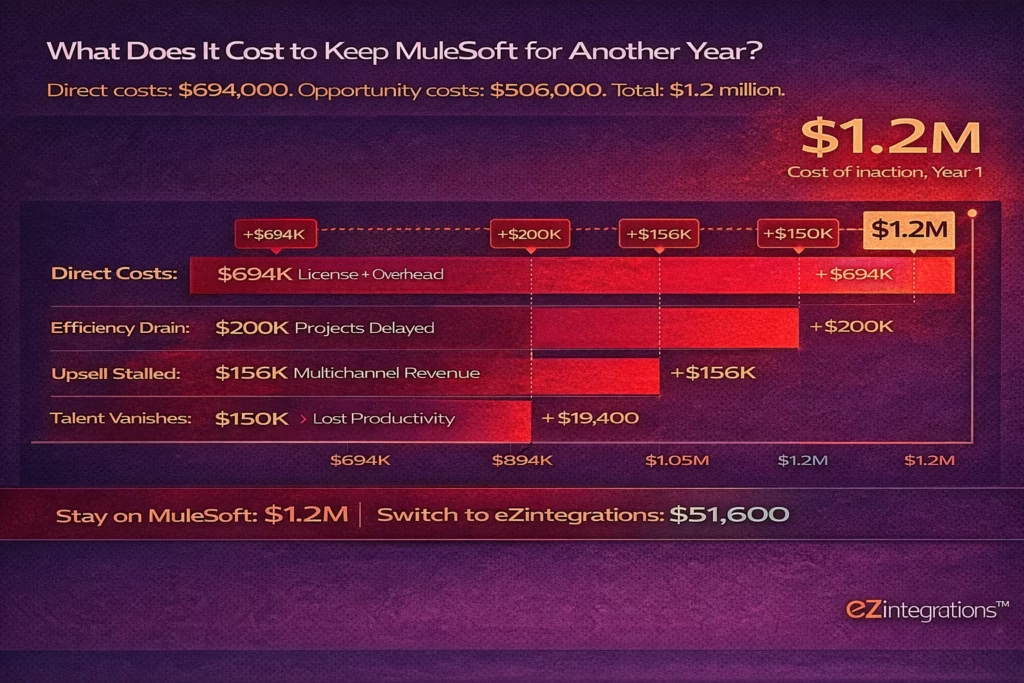
The direct answer: $694,000 per year in platform and people cost, by this retailer’s own calculation.
The indirect answer is more damaging.
Every week that passes with 14 integrations in the backlog is a week during which:
- The new regional marketplace listing is not live. Estimated lost revenue for a mid-tier marketplace channel: $40,000-$120,000 per month in foregone GMV.
- The returns automation between WMS and Shopify is not built. Customer refund delays persist. Returns processing time: 48-72 hours manual vs. under 10 minutes automated.
- The new 3PL partner cannot be connected. Fulfilment overflow during peak season depends on manual workarounds and spreadsheet coordination.
- The pricing sync workflow is not complete. Your prices on a new marketplace are updated manually, 24-48 hours behind ERP, creating margin errors and marketplace policy violations.
This is the cost of inaction. It is not theoretical. It is measurable, in blocked revenue, in refund delays, in competitive displacement, and in the engineering time your MuleSoft developers spend maintaining legacy integrations instead of building the next one in the queue.
The retailers losing market share in 2026 are not losing because their products are worse. They are losing because their integration layer cannot move as fast as their business needs.
The retailer in this case study estimated the total cost of one additional year on MuleSoft, including direct costs and opportunity costs, at $1.2 million. The switch cost $51,600.
Objection: “Our MuleSoft Investment Is Already Sunk. Why Switch?”
This is the most common objection, and it is the most financially incorrect one.
Sunk cost reasoning says: “We spent $2.5 million on MuleSoft over four years. We can’t abandon that investment.”
What sunk cost reasoning ignores: you are not recovering the $2.5 million by renewing MuleSoft. You are spending another $694,000 this year to continue a platform you have already paid for and which will cost the same amount next year.
The financially correct question is: “What does each future year on MuleSoft cost, compared to each future year on eZintegrations?”
Year 2 MuleSoft: $694,000. Year 2 eZintegrations: $45,600 (migration cost does not recur). Year 2 saving: $648,400.
Over three years, the cost difference exceeds $1.9 million. The MuleSoft integrations you built over four years did not disappear. They were rebuilt on eZintegrations in the six weeks following migration, by the operations team that previously needed a MuleSoft developer to make any change.
The sunk cost of MuleSoft is already gone. The question is what you do with the $648,000 you would save in the next twelve months.
Objection: “Won’t Migration Risk Break Our Live Integrations?”
This is a legitimate technical concern, and it deserves a specific answer.
eZintegrations is cloud-native and runs in parallel with your existing MuleSoft deployment during migration. You do not cut over all at once. The migration sequence used by the retailer in this case study was:
- Identify the twelve highest-priority integration workflows currently on MuleSoft. Prioritise by: business criticality (highest-risk migrations last), backlog urgency (blocked new channels migrate first), and complexity (highest-DataWeave complexity migrations have the most to gain from no-code replacement but require most testing).
- Rebuild on eZintegrations using Automation Hub templates for standard retail integration patterns (Shopify to ERP, WMS to marketplace, tracking push, inventory sync). Non-standard custom logic is configured in the no-code canvas.
- Run parallel for 2-4 weeks per integration. Both MuleSoft and eZintegrations process the same transactions. Outputs are compared. Discrepancies are resolved in the eZintegrations configuration.
- Cut over one integration at a time. MuleSoft version is kept in standby for 30 days after cut-over. Rollback is available at any point during this period.
- Decommission MuleSoft flows progressively as each integration reaches 30 days of stable production on eZintegrations.
This retailer ran 22 integrations in parallel for an average of 2.3 weeks each. Zero production incidents during the migration window. The migration was completed in 11 weeks total, which was slower than the 6-week aggressive estimate but entirely without business disruption.
The risk of migration is real but manageable with a structured parallel-run approach. The risk of staying is also real, and it compounds every quarter.
Objection: “Our IT Team Knows MuleSoft. Re-platforming Means Re-training.”
Correct. And it is worth quantifying exactly what that re-training means.
MuleSoft expertise is primarily in DataWeave, MuleSoft’s proprietary data transformation language. DataWeave is not transferable to other platforms. Every integration your MuleSoft developers build requires DataWeave scripting. When they leave the company, their scripts go with them in terms of maintainability. Most DataWeave-heavy integrations require the original developer to debug or modify them.
eZintegrations uses a visual no-code canvas. Configuration is in JSON and the canvas UI, not in a proprietary scripting language. Your operations team lead, not a specialist developer, can modify field mapping, add exception handling rules, and extend workflows.
The re-training investment: the retailer in this case study trained three operations team members on eZintegrations in two half-day sessions. Not two developers. Three operations leads. They took ownership of the integration layer within three weeks of training completion.
The IT team’s MuleSoft expertise did not transfer. But their integration knowledge, their understanding of SAP field mapping, their ERP data model familiarity, their WMS API knowledge, transferred completely. eZintegrations gave them a tool they could use with what they already knew.
Objection: “eZintegrations Is Cheaper. Does That Mean It’s Less Capable?”
This is a fair question. A platform that costs 6% of MuleSoft’s total cost should raise the question of what you are giving up.
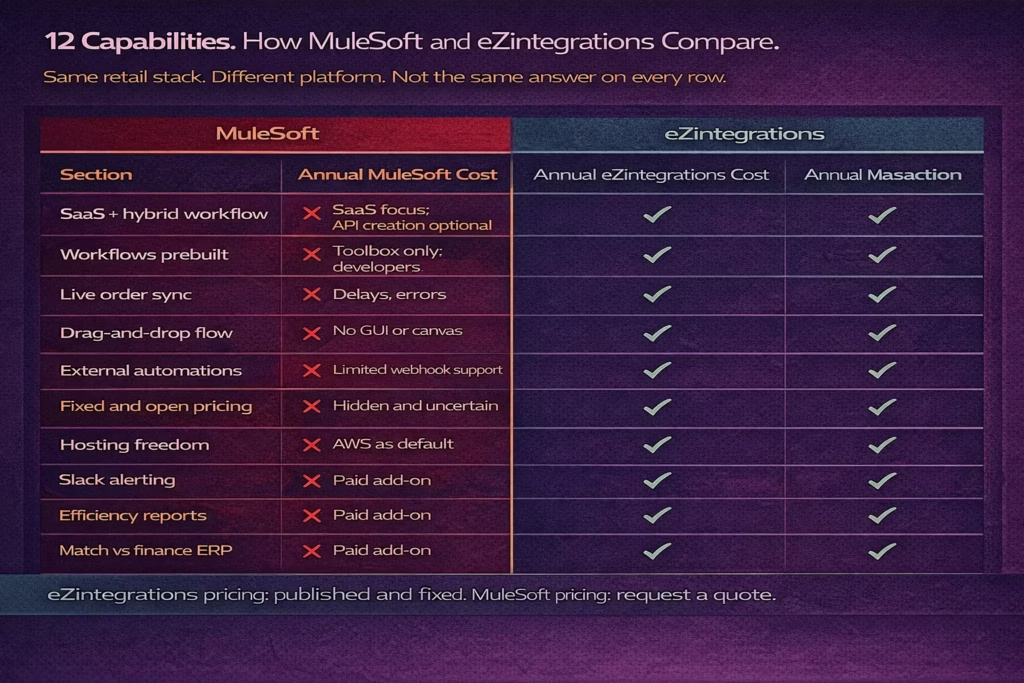
Here is the specific comparison for the retail use cases this retailer required:
| Capability | MuleSoft | eZintegrations |
|---|---|---|
| REST and GraphQL API connectivity | Yes | Yes (5,000+ API catalog, self-service onboarding) |
| Real-time webhooks and event-driven processing | Yes | Yes (Watcher Tools, webhook listeners) |
| Database integration (direct SQL queries) | Yes (requires DataWeave) | Yes (no-code database connector) |
| SAP, NetSuite, Dynamics 365 ERP connectivity | Yes (requires DataWeave transformation) | Yes (pre-built in API catalog, no-code field mapping) |
| Shopify, Amazon, Walmart marketplace connectors | Yes | Yes (in API catalog, Automation Hub templates) |
| Pre-built integration templates | Limited (Anypoint Exchange) | 1,000+ Automation Hub templates |
| AI Agents and agentic orchestration | No (separate Agentforce/Einstein product) | Yes (Goldfinch AI, 9 native tools, included) |
| MCP server endpoints for AI agent invocation | No | Yes (Integration Flow as MCP, included) |
| No-code configuration for operations teams | No (DataWeave required for transformation) | Yes (full no-code visual canvas) |
| Pricing model | Capacity-based, no published list price | Per-automation, published at $120/month |
| Dev/Test/Prod environment separation | Yes (additional cost) | Yes (included) |
The capability gap in favour of MuleSoft exists at the extreme high end: very large enterprises with hundreds of integrations, complex API management governance requirements at scale, and in-house DataWeave expertise. For those organisations, MuleSoft’s depth may justify its cost.
For the enterprise retailer running 15-30 integrations on a retail-specific tech stack, eZintegrations covers every required capability and adds capabilities, including Goldfinch AI agentic workflows and MCP server endpoints, that MuleSoft does not provide at equivalent price points.
The question to ask is not “which platform is more capable in absolute terms?” It is “which platform provides the capabilities my retail operation actually needs, at a price that makes financial sense?”
What to Include in Your Business Case
If you are preparing a MuleSoft replacement proposal for your CFO, IT Director, or CTO, the following framework covers the objections you will face and the data you need to answer them.
Section 1: Current State Cost Audit
Request your current MuleSoft contract renewal cost from your account manager. Do not use estimates. Get the actual figure. Add: – Number of FTE developers dedicated to MuleSoft (salary + benefits + overhead) – Average integration delivery time (in weeks) for the last four completed integrations – Current backlog depth (number of integration requests waiting) – Number of live integrations currently on MuleSoft
This is your “cost of status quo” baseline.
Section 2: Integration Backlog Business Impact
Identify the three highest-value integrations currently in the backlog. For each one: What business capability is blocked by this integration not being built? What is the estimated monthly revenue impact of the delay? How many weeks has this integration been waiting?
This converts the technical backlog into a financial impact figure your CFO can evaluate.
Section 3: eZintegrations Cost Model
Use the following inputs: Number of integrations you will run on eZintegrations in Year 1 (start with your current MuleSoft count) Monthly cost per automation: $120 (non-AI) or $150 (AI-enabled). See eZintegrations pricing. Migration effort: plan for 2-4 weeks of IT team time for scoping and parallel-run testing – Training: plan for 2 half-day sessions for 2-4 operations team members (no specialist certification required)
Calculate: (Number of automations x $120 x 12) + migration effort + training = Year 1 total cost.
Section 4: Net Saving and ROI
Subtract your Year 1 eZintegrations total cost from your current MuleSoft TCO (platform + people + consulting + training). The result is your Year 1 net saving.
Present this as both a cash saving and an ROI percentage. Present the payback period in months (in most retail cases, it is under one quarter).
Section 5: Risk Mitigation Narrative
Address migration risk directly: Parallel-run migration approach: both platforms run simultaneously, cut-over one integration at a time – 30-day rollback window maintained for each integration after cut-over – Automation Hub templates used as the baseline: not building from scratch. Average migration time for a 22-integration retail deployment: 6-12 weeks
Section 6: Strategic Value Beyond Cost
The CFO cares about cost. The CTO and COO care about what the platform enables. Add: Integration delivery time reduction: 9 weeks to 2-8 hours – Developer dependency elimination: operations team can build and modify integrations – AI agent integration: Goldfinch AI adds agentic capability to any workflow without additional platforms – MCP server capability: every integration can be exposed as a tool for AI agents, including ChatGPT and Claude
Frequently Asked Questions
1. How do I justify replacing MuleSoft to my CFO
Start with the cost of status quo which includes your current MuleSoft contract cost plus the fully loaded cost of your MuleSoft developers including salary and approximately 30 percent benefits. This combined number is often higher than expected because developer cost is typically accounted separately from the platform contract. Then calculate the eZintegrations cost using published pricing of about 120 dollars per month per automation. The difference between the two totals represents the annual saving. Present the payback period in weeks rather than months because in most retail deployments with two MuleSoft developers the payback period is under one quarter.
2. What is the typical ROI timeline for replacing MuleSoft with eZintegrations
For a retail enterprise running roughly fifteen to thirty integrations on MuleSoft with one or two dedicated MuleSoft developers the payback period is usually under eight weeks. Migration costs such as IT team time and parallel run testing are recovered quickly after the first integration cut over because developer salary savings begin immediately when the first developer is redeployed. In most cases where developer salaries are included in the cost model the first year ROI exceeds one thousand percent.
3. How much does integration automation save compared to MuleSoft
Savings depend mainly on how many dedicated MuleSoft developers are employed. A typical MuleSoft developer costs around 182000 dollars per year fully loaded based on a Glassdoor March 2026 median compensation of 140703 dollars plus approximately 30 percent benefits. If an organization employs two developers the salary saving alone exceeds 364000 dollars per year. When combined with the platform license difference between MuleSoft contracts and eZintegrations pricing of about 120 dollars per month per automation most retail enterprises realize annual savings between 400000 and 700000 dollars. One time migration effort usually ranges from 6000 to 15000 dollars in internal IT time.
4. Does replacing MuleSoft require a long implementation project
No. Migration typically uses a parallel run approach instead of a big bang cut over. Each integration is rebuilt on eZintegrations then operated in parallel with the existing MuleSoft integration for two to four weeks before individual cut over. A retail deployment with approximately twenty two integrations usually completes migration within eight to twelve weeks and the first integrations are commonly live within the first two weeks of the project.
5. Does eZintegrations work with SAP Shopify Manhattan WMS and Amazon
Yes. All four systems are supported through the eZintegrations API catalog containing more than five thousand endpoints. SAP S 4HANA and SAP ECC connect through OData and BAPI interfaces. Shopify and Shopify Plus connect through REST and GraphQL APIs. Manhattan Associates WMi connects through its transfer order and inventory APIs. Amazon Seller Central connects through the SP API. The Automation Hub includes templates for common retail patterns across these systems including order sync inventory synchronization and fulfilment tracking.
6. What happens to our MuleSoft DataWeave scripts during migration
DataWeave scripts are not migrated directly. Instead they are replaced by the no code field mapping canvas in eZintegrations. This change removes the proprietary language dependency while preserving the underlying integration logic and business rules. Operations teams can modify mappings visually without understanding DataWeave syntax. For edge cases that require advanced transformation logic eZintegrations supports custom JavaScript functions within the workflow canvas.
Conclusion
The retailer in this case study did not switch from MuleSoft because MuleSoft was broken. They switched because the full cost of MuleSoft, including the two developers, the consulting, the certification, and the 14-integration backlog that was costing them in missed revenue, was $694,000 per year for a capability set that eZintegrations delivers at $45,600.
The decision was not a technology preference. It was a financial calculation.
If you are running a MuleSoft deployment in retail, the calculation starts with one question: what does your current MuleSoft contract cost, and how many FTE developers does your team employ to build and maintain integrations on it?
Those two numbers, added together and compared to the eZintegrations per-automation price, tell you whether this conversation is worth having.
Most enterprise retail teams find the conversation is worth having.
Book a free demo and bring your current MuleSoft integration list and team structure. We will build the cost model together and show you exactly what the migration would look like for your specific deployment.
Or start with the Automation Hub and import the retail integration template that matches your highest-priority current MuleSoft workflow. Run it in eZintegrations Dev environment against your live API endpoints. See the delivery time for yourself.