Order Data Sync: Unlock 50% Faster No-Auth Datalake Updates
$0.00
| Workflow Name: |
Order Data Sync to Datalake Using No Auth |
|---|---|
| Purpose: |
Template to Automatically sync order data from source APIs to the Datalake without authentication. |
| Benefit: |
Simple; fast ingestion of order data from open APIs or internal sources without needing OAuth tokens. |
| Who Uses It: |
Data Engineers; Analytics Teams; BI Teams |
| System Type: |
Order Data Integration Workflow |
| On-Premise Supported: |
Yes (via secure gateway) |
| Supported Protocols: |
HTTPS; REST API |
| Industry: |
E-commerce / Enterprise Data Operations |
| Outcome: |
Fresh; accurate; and incremental order data in Datalake |
Table of Contents
Description
| Problem Before: |
Manual data extraction and batch uploads were slow and error-prone. |
|---|---|
| Solution Overview: |
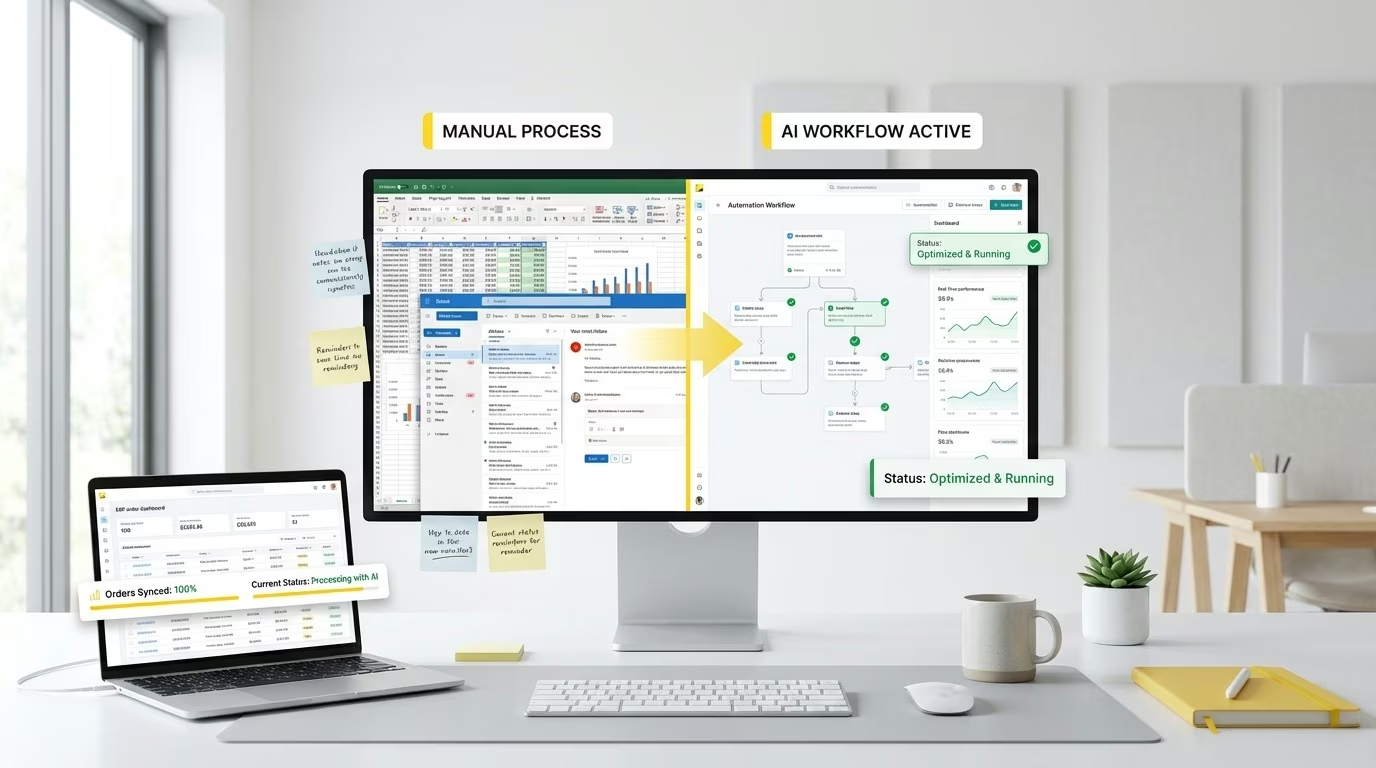
Automated API fetch; data transformation; and Datalake insertion with no authentication required. |
| Key Features: |
No-auth API access; incremental sync; data mapping; batch logging; error handling. |
| Business Impact: |
Reduces manual handling; ensures timely order updates; and improves downstream reporting. |
| Productivity Gain: |
Eliminates manual API calls and CSV handling for order ingestion. |
| Cost Savings: |
Reduces operational overhead by up to 50%. |
| Security & Compliance: |
Encrypted transport (HTTPS); internal access control |
Order Data Sync – Datalake Using No Auth
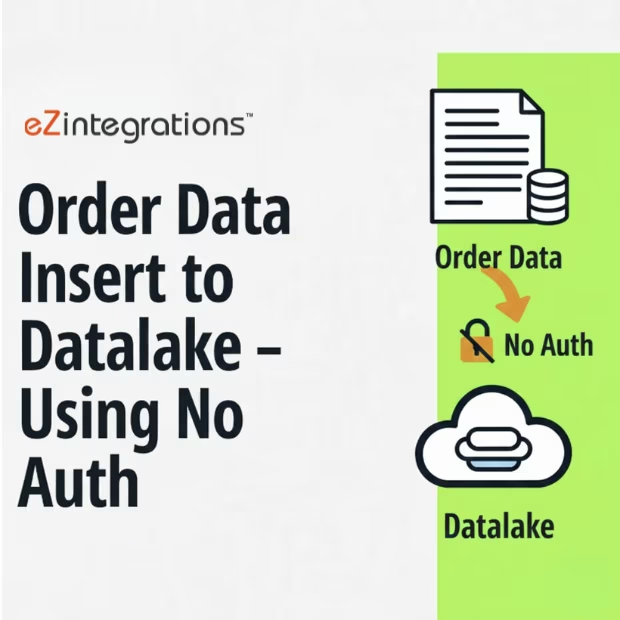
Order Data Sync automates the ingestion of order data from source APIs to the Datalake without requiring authentication. This workflow enables fast, reliable data transfer from open APIs or internal sources.
Simple and Efficient Order Data Ingestion
By eliminating authentication steps, the workflow ensures quick data syncing while maintaining accuracy. Teams benefit from streamlined access to order data for analytics, reporting, and BI operations with minimal manual effort.
Watch Demo
| Video Title: |
Integrate NetSuite data to any Datalake |
|---|---|
| Duration: |
5:31 |
Outcome & Benefits
| Time Savings: |
Manual sync reduced from hours/day to minutes |
|---|---|
| Cost Reduction: |
Eliminates manual API monitoring and CSV processing |
| Accuracy: |
High consistency despite no-auth access |
| Productivity: |
Faster updates to analytics tables; fewer errors |
Industry & Function
| Function: |
Data Extraction; Sync; ETL Automation |
|---|---|
| System Type: |
Order Data Integration Workflow |
| Industry: |
E-commerce / Enterprise Data Operations |
Functional Details
| Use Case Type: |
Order Data Synchronization |
|---|---|
| Source Object: |
Order dataset from API |
| Target Object: |
Datalake order tables for analytics and reporting |
| Scheduling: |
Hourly or real-time |
| Primary Users: |
Data Engineers; Analytics Teams; BI Teams |
| KPI Improved: |
Data freshness; reduced manual intervention; reporting accuracy |
| AI/ML Step: |
Optional anomaly detection or data validation |
| Scalability Tier: |
Mid-to-Enterprise; supports large order volumes |
Technical Details
| Source Type: |
REST API (No Auth) |
|---|---|
| Source Name: |
Order API |
| API Endpoint URL: |
https://api.example.com/orders/noauth |
| HTTP Method: |
GET |
| Auth Type: |
None |
| Rate Limit: |
Dependent on source API limits |
| Pagination: |
Offset-based or batch-based pagination |
| Schema/Objects: |
Orders; Order Lines; Customer IDs; Timestamps |
| Transformation Ops: |
Data mapping; type conversion; deduplication; timestamp normalization |
| Error Handling: |
Retry logic; error logging; alert notifications |
| Orchestration Trigger: |
Hourly or on-demand |
| Batch Size: |
500 – 5000 records per batch |
| Parallelism: |
Multi-threaded API calls for faster ingestion |
| Target Type: |
Cloud Datalake |
| Target Name: |
Order_Datalake_Zone |
| Target Method: |
API push / cloud storage write |
| Ack Handling: |
Success/failure logs stored in monitoring sheet |
| Throughput: |
Up to 20K records/hour |
| Latency: |
<30 seconds per batch |
| Logging/Monitoring: |
Execution logs; response logs; retry and alert logs |
Connectivity & Deployment
| On-Premise Supported: |
Yes (via secure gateway) |
|---|---|
| Supported Protocols: |
HTTPS; REST API |
| Security & Compliance: |
Encrypted transport (HTTPS); internal access control |
FAQ
1. What is the Order Data Sync to Datalake workflow?
It is an automated workflow that syncs order data from source APIs to the Datalake without requiring authentication, enabling fast and simple data ingestion.
2. How does the workflow sync order data without authentication?
The workflow connects directly to source APIs or internal endpoints that do not require OAuth tokens or API keys, retrieves order data, and inserts it into the Datalake automatically.
3. What types of order data are handled?
It handles order IDs, customer details, product information, quantities, prices, timestamps, and any relevant metadata provided by the source system.
4. How frequently can the workflow run?
The workflow can be scheduled to run hourly, daily, or near real-time, depending on business needs and data volume.
5. What happens if no new order data is available?
If no new or updated records are found, the workflow completes successfully, logs the run, and ensures no errors are generated.
6. Who uses this workflow?
Data Engineers, Analytics Teams, and BI Teams use this workflow to maintain up-to-date order data in the Datalake without authentication complexities.
7. What are the benefits of automating order data sync without auth?
Automation enables simple, fast ingestion of order data, reduces manual effort, avoids authentication overhead, and ensures accurate, real-time data availability for analytics and operations.
Case Study
| Customer Name: |
Internal Analytics / Data Engineering Team |
|---|---|
| Problem: |
Manual syncing of order data from open APIs was slow and error-prone |
| Solution: |
Automated no-auth pipeline to sync order data to Datalake |
| ROI: |
Order data ingestion 2-3× faster with minimal manual effort |
| Industry: |
E-commerce / Enterprise Data Operations |
| Outcome: |
Fresh; accurate; and incremental order data in Datalake |