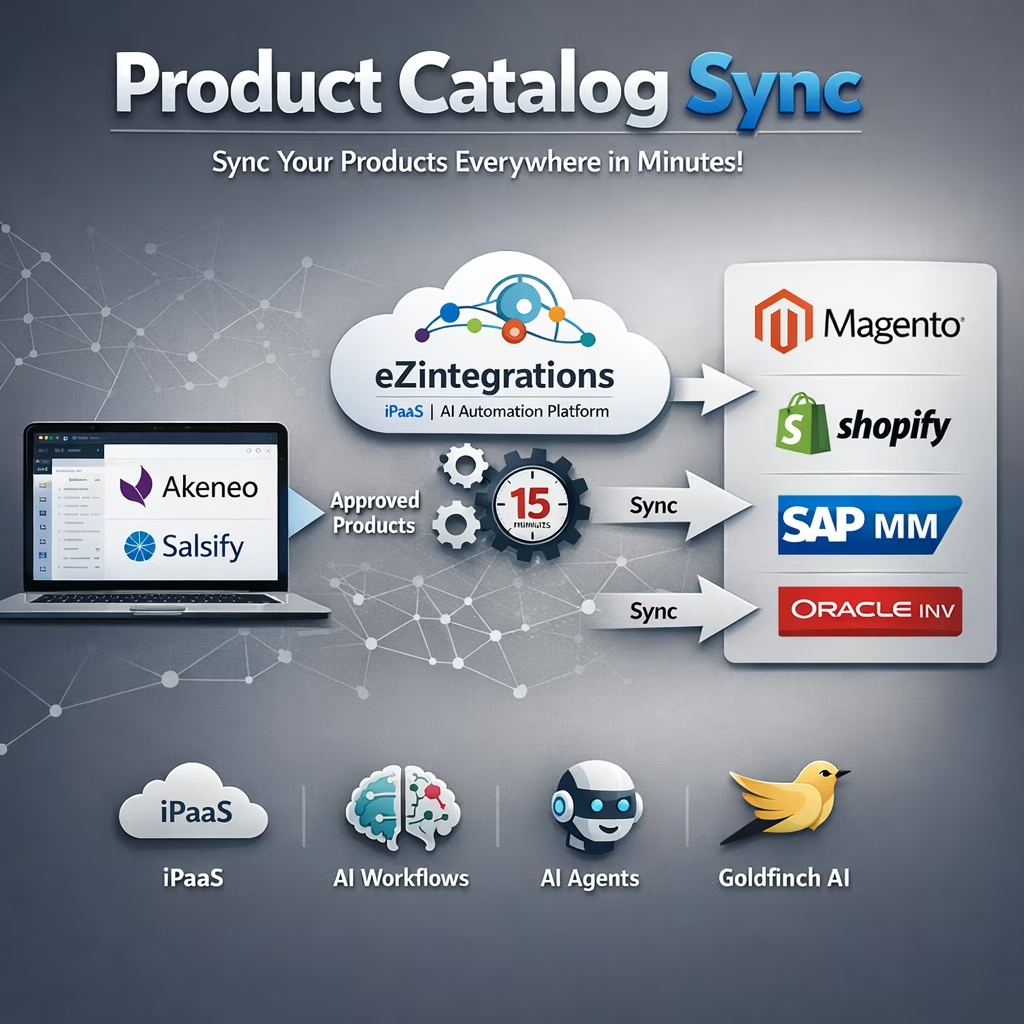
How to Automate Product Data Sync Across PIM, eCommerce & ERP
$90.00
| Workflow Name: |
Product Catalog Sync: PIM to eCommerce + ERP |
|---|---|
| Purpose: |
Automatically push approved product catalog records from Akeneo or Salsify PIM to Magento or Shopify eCommerce and to SAP MM or Oracle INV ERP item master – the moment a product is approved in PIM – with no manual re-entry in either downstream system |
| Benefit: |
Eliminates product launch delays from manual data re-entry; removes price and attribute discrepancies between PIM; eCommerce; and ERP; and makes every approved product live on the storefront and purchasable in ERP within minutes of PIM approval |
| Who Uses It: |
Product Data Manager; eCommerce Merchandiser; Product Operations Manager |
| System Type: |
Multi-Target Data Syndication, Event-Triggered iPaaS Workflow |
| On-Premise Supported: |
Yes – eZintegrations connects to on-premises SAP MM; Oracle EBS INV; and other ERP systems via IPSec Tunnel. eZintegrations is a browser-based; cloud-hosted platform and does not require any on-premises software installation. |
| Industry: |
Consumer Goods / Retail |
| Outcome: |
All 2,400 active SKUs are now kept in sync across Akeneo; Magento; and SAP MM automatically. New products go live on the Magento storefront within 12 minutes of Akeneo approval. The Product Data Manager team reallocated 60% of their time from manual re-entry to product content quality and taxonomy improvement. The next seasonal collection launched on the day the PIM team completed product records – 17 days earlier than the prior year. |
| Tags: |
PIM to eCommerce ERP sync; product catalog automation; Akeneo Magento integration; Salsify Shopify sync; SAP MM product sync; Oracle INV item master automation; product data syndication; PIM eCommerce integration; product launch automation; eCommerce ERP product sync; item master automation; product information management |
| AI Credits Required: |
No – all six workflow steps are standard iPaaS operations (PIM API event capture; schema mapping; eCommerce REST API product push; ERP item master REST API write). Covered fully under the Unlimited plan. No Goldfinch AI tools are invoked. |
Table of Contents
| Problem Before: |
Product teams maintain the master product catalog in Akeneo or Salsify PIM. When a new product is approved or updated; a Product Data Manager manually re-enters attributes – product name; description; images; pricing; dimensions; weight; tax class; categories – into Magento or Shopify for the storefront; and separately into SAP MM or Oracle INV for procurement and inventory. At 50 to 200 product updates per month; this process consumes 20 to 80 FTE hours monthly. Version mismatches occur on 8 to 15% of products (different prices or attributes in PIM vs. storefront vs. ERP); causing customer-facing price discrepancies and ERP procurement errors. Product launches are delayed an average of 3 to 7 days from PIM approval to storefront live; costing revenue on time-sensitive launches such as seasonal collections and new SKU introductions. |
|---|---|
| Solution Overview: |
The Product Catalog Sync workflow from eZintegrations monitors Akeneo or Salsify PIM for approved product records via webhook or REST API polling. When a product is approved or updated; the workflow maps product attributes to the eCommerce schema and pushes the product to Magento or Shopify via REST API; then maps the same record to the ERP item master schema and creates or updates the item in SAP MM or Oracle INV – both targets updated from a single PIM approval event. |
| Key Features: |
Real-time product approval event capture from Akeneo or Salsify via webhook or configurable REST polling Dual-target syndication: a single PIM approval pushes to both eCommerce (Magento or Shopify) and ERP item master (SAP MM or Oracle INV) in the same workflow execution Configurable attribute mapping from PIM schema to eCommerce product fields (title; description; images; price; inventory; categories; SEO fields) and ERP item master fields (material number; description; material group; unit of measure; weight; tax class; valuation class) Price enforcement: price changes in PIM propagate to both eCommerce and ERP simultaneously – eliminates the price discrepancy that occurs when one system is updated manually without the other Exception queue with field-level validation errors and Product Data Manager alert for unmapped attributes; missing required ERP fields; or API failures |
| Business Impact: |
Eliminates product launch delays by making every approved product live on the storefront and purchasable in ERP within 15 minutes of PIM approval – and enforces price and attribute consistency across all three systems from a single PIM record as the source of truth. |
| Productivity Gain: |
Product Data Managers and eCommerce Merchandisers processing 50 to 200 product updates per month reclaim 20 to 80 FTE hours monthly previously spent on manual cross-system re-entry; freeing capacity for product content quality improvement; taxonomy management; and launch readiness. |
| Cost Savings: |
Retail and consumer goods organizations managing 500+ active SKUs across PIM; eCommerce; and ERP typically realize $40,000 to $100,000 in annual savings from labor reduction; eliminated product launch delays; and avoided revenue loss from storefront price discrepancies. |
Description
PIM to eCommerce ERP sync from eZintegrations automatically pushes approved product records from Akeneo or Salsify to your Magento or Shopify storefront and SAP MM or Oracle INV item master — in under 15 minutes, from a single PIM approval event. eZintegrations is an enterprise automation platform covering iPaaS, AI Workflows, AI Agents, and Goldfinch AI agentic automation.
How Does PIM to eCommerce ERP Sync Work to Automatically Push Approved Product Data from a PIM to an eCommerce Platform and ERP Item Master?
When a product record is approved or updated in Akeneo or Salsify, the eZintegrations PIM to eCommerce ERP sync workflow triggers. Product attributes are mapped to the eCommerce schema and pushed to Magento or Shopify via REST API. In the same workflow execution, the same PIM record is mapped to the ERP item master schema and the item is created or updated in SAP MM or Oracle INV. Both downstream systems are updated from a single PIM event — no second step, no separate data entry.
Version mismatches between PIM, storefront, and ERP average 8 to 15% of active SKUs in organizations managing these three systems manually. A customer-facing price discrepancy between PIM and Shopify costs the average retail transaction plus remediation effort. PIM to eCommerce ERP sync enforces PIM as the single source of truth by propagating every attribute change simultaneously.
Deploy PIM to eCommerce ERP sync in under 1 business day. No professional services required.
Watch Demo
| Video Title: |
PIM to eCommerce ERP Sync Demo: Akeneo Product Approval to Shopify and SAP MM in Under 15 Minutes |
|---|---|
| Duration: |
3 to 5 minutes |
Outcome & Benefits
| Time Savings: |
Product launch time from PIM approval to storefront live reduced from 3 to 7 days (manual queue) to under 15 minutes; Product Data Manager monthly hours on cross-system re-entry reduced from 20 to 80 hours to under 2 hours of exception review |
|---|---|
| Cost Reduction: |
$40,000 to $100,000 annual savings from labor reduction; eliminated product launch revenue delays; and avoided price discrepancy remediation at 500+ active SKUs |
| Accuracy: |
99%+ product data consistency across PIM; eCommerce; and ERP; 8 to 15% version mismatch rate eliminated; price and attribute discrepancies between storefront and ERP reduced to zero for synced products |
| Productivity: |
50 to 200 product updates per month handled automatically; Product Data Manager focus shifted from manual re-entry to taxonomy governance and content quality; new product launches reach customers on the day of PIM approval |
Performance Metrics
| Metric | Before (Manual/Batch) | After (Real-Time Sync) | Improvement |
|---|---|---|---|
| Time from PIM Approval to Storefront Live | 3 to 7 days (manual queue) | Under 15 minutes | 99%+ faster |
| Version Mismatch Rate (PIM vs. eCommerce vs. ERP) | 8 to 15% of active SKUs | Under 0.5% | 95%+ reduction |
| Monthly FTE Hours on Cross-System Re-Entry | 20 to 80 hours/month | Under 2 hours (exceptions) | 90%+ reduction |
| Price Discrepancy Incidents | Frequent (multi-system manual) | Zero (single-source propagation) | 100% eliminated |
Industry & Function
| Function: |
Product Information Management; eCommerce Operations; Product Management; ERP Item Master Management; Marketing Operations |
|---|---|
| System Type: |
Multi-Target Data Syndication, Event-Triggered iPaaS Workflow |
| Industry: |
Consumer Goods / Retail |
Functional Details
| Use Case Type: |
Multi-Target Data Syndication; Event-Triggered iPaaS Workflow; Master Data Distribution |
|---|---|
| Source Object: |
Approved product record from PIM – includes product ID; product name; short description; long description; images (URLs or binary); SKU; GTIN/EAN/UPC; price (list price; sale price; cost); categories; attributes (color; size; material; weight; dimensions); unit of measure; tax class; status (active/inactive); and locale-specific variants where applicable Target Object 1 (eCommerce): Product listing in Magento or Shopify – product title; body HTML description; images; variants (size/color); price; compare-at price; inventory quantity; SKU; barcode; weight; metafields; product type; vendor; tags; SEO title/description Target Object 2 (ERP Item Master): SAP MM Material Master (MRP views; Sales views; General Plant Data; Basic Data) or Oracle INV Item Master record (item number; description; category; UOM; weight; dimensions; tax classification; cost; valuation class) |
| Scheduling: |
Real-time event-driven via webhook on PIM product approval or status change to “Active” (Akeneo or Salsify); REST polling at 15-minute intervals as fallback; update sync triggered by any PIM attribute change on approved products (price changes; description updates; image replacements) |
| Primary Users: |
Product Data Manager; eCommerce Merchandiser; Product Operations Manager |
| KPI Improved: |
Time from PIM approval to storefront live; version mismatch rate across systems; product launch revenue delay; Product Data Manager FTE hours per product update; price discrepancy incidents |
| AI/ML Step: |
N/A – standard iPaaS workflow with no AI steps; covered under Unlimited plan |
| Scalability Tier: |
Enterprise – supports 1,000+ product sync events per month at standard configuration; scales to 50,000+ SKU catalogs at enterprise tier with parallel processing threads |
Technical Details
| Source Type: |
Cloud PIM (Product Information Management) Source Name (PIM 1): Akeneo PIM (https://api.akeneo.com/) – REST API for product record retrieval; webhook on product workflow status change to “Approved” or product status = enabled Source Name (PIM 2): Salsify (https://developers.salsify.com/) – REST API for product record retrieval; webhook on channel readiness or workflow step completion |
|---|---|
| API Endpoint URL: |
Akeneo: /api/rest/v1/products/{code} and /api/rest/v1/products?search=… | Salsify: /api/v1/orgs/{org_id}/products/{product_id} |
| HTTP Method: |
GET (product record retrieval on webhook trigger or polling); webhook POST (outbound event from Akeneo or Salsify on product status change) |
| Auth Type: |
OAuth 2.0 with Client Credentials (Akeneo); API Key Bearer Token (Salsify) |
| Rate Limit: |
Akeneo: 100 requests per minute per API token; Salsify: 5 requests per second per API key |
| Pagination: |
Akeneo: cursor-based pagination using search_after parameter for bulk product polling; Salsify: page-based pagination with per_page and page parameters |
| Schema/Objects: |
PIM product fields: product ID/SKU; name; short description; long description; attribute set (color; size; weight; dimensions; material); price list (retail price; sale price; cost); images (URL array); categories (hierarchical); GTIN/EAN/UPC; unit of measure; tax class; locale variants. eCommerce target fields: title; body_html; vendor; product_type; tags; variants (price; compare_at_price; sku; barcode; weight); images; metafields; SEO title/description; inventory_management. ERP item master fields: material number; material description; material group; base unit of measure; weight/dimensions; tax classification; valuation class; price control; standard cost; sales views (item category group; general item category); MRP type and lot size. |
| Transformation Ops: |
PIM attribute set to eCommerce product type mapping (configurable per category); long description HTML sanitization for Shopify/Magento body_html; image URL resolution and optional image binary transfer; price format conversion (PIM decimal to eCommerce currency string); category hierarchy flattening to eCommerce product type and tags; PIM UOM to ERP base unit of measure mapping; material group assignment from PIM product category; ERP valuation class assignment from PIM product type; locale/language field mapping for multilingual catalogs; GTIN/EAN normalization; inactive/discontinued product handling (sets eCommerce product to draft/archived and ERP item to blocked/inactive status) |
| Error Handling: |
Missing required eCommerce fields (title; price; at least one image) routes to exception queue with product ID and missing field list. Missing required ERP item master fields (material group; base UOM; valuation class) routes to exception with product ID and field detail. eCommerce API write failures (Magento 422 validation error; Shopify rate limit exceeded) retry up to 3 times with exponential backoff. ERP API write failures retry up to 3 times. Persistent failures alert Product Data Manager via email within 15 minutes. No approved product event is silently dropped. |
| Orchestration Trigger: |
Akeneo webhook on product workflow step completion or product status = enabled; Salsify webhook on channel readiness or workflow step; REST polling at 15-minute intervals for products changed since last sync timestamp |
| Batch Size: |
1 product per webhook event; up to 200 products per REST polling batch at 15-minute interval; bulk catalog sync supports up to 5,000 products per batch job |
| Parallelism: |
Up to 50 concurrent workflow threads per tenant; supports simultaneous eCommerce and ERP writes in parallel within the same workflow execution Target Type 1: Cloud eCommerce Platform Target Name 1: Shopify (https://shopify.dev/docs/api/admin-rest) or Magento 2 / Adobe Commerce (https://developer.adobe.com/commerce/webapi/rest/) Target Type 2: Cloud ERP or On-Premises ERP (connected via IPSec Tunnel) Target Name 2: SAP S/4HANA Materials Management (https://help.sap.com/docs/SAP_S4HANA_ON-PREMISE) or Oracle Fusion Cloud Inventory Management (https://docs.oracle.com/en/cloud/saas/supply-chain-management/inventory-management.html) |
| Target Method: |
Shopify: REST API POST/PUT – /admin/api/2024-01/products.json (create) or /admin/api/2024-01/products/{product_id}.json (update); Magento: REST API POST/PUT – /rest/V1/products; SAP MM: OData REST API POST/PATCH – /API_PRODUCT_SRV/A_Product (Basic Data) + sales and MRP views; Oracle INV: REST API POST – /fscmRestApi/resources/latest/inventoryItems |
| Ack Handling: |
Shopify returns product ID on creation/update; Magento returns product SKU and entity ID; SAP MM returns material number; Oracle INV returns item ID. All reference IDs logged to workflow audit trail. Product Data Manager receives a daily summary email of synced products with eCommerce URL and ERP material number per product where configured. |
| Throughput: |
1,000+ product sync events per month at standard configuration; scales to 50,000+ SKU bulk catalog syncs at enterprise tier |
| Latency: |
Under 15 minutes from PIM approval event to live on eCommerce and created in ERP item master (webhook mode); under 30 minutes for polling fallback |
| Logging/Monitoring: |
Full execution log per product event (timestamp; PIM product ID; eCommerce product ID; ERP material number; attribute mapping results; eCommerce write status; ERP write status; validation outcomes); real-time monitoring dashboard in eZintegrations console; configurable launch delay alerts if product not live on storefront within 30 minutes of PIM approval |
Connectivity & Deployment
| Supported Protocols: |
REST API; OData v2/v4; Webhooks; HTTPS; OAuth 2.0; API Key / Bearer Token; SFTP (bulk image file transfer where applicable); IPSec Tunnel (on-premises ERP connectivity) |
|---|---|
| Security & Compliance: |
HIPAA-eligible configuration available; GDPR-compliant data handling (product records do not typically contain PII; configuration includes data minimization controls); SOC Type II certified. TLS 1.3 encryption in transit; AES-256 at rest. RBAC enforced on attribute mapping configuration; exception queue access; and bulk sync job management. Full immutable product sync audit trail per event. |
| Tenancy Model: |
Both single-tenant and multi-tenant deployments are available. Single-tenant provides dedicated infrastructure recommended for large retail catalogs (50,000+ SKUs) with high-frequency update volumes. Multi-tenant is the default shared-cloud deployment. Both support on-premises ERP connectivity via IPSec Tunnel. |
| On-Premise Supported: |
Yes – eZintegrations connects to on-premises SAP MM; Oracle EBS INV; and other ERP systems via IPSec Tunnel. eZintegrations is a browser-based; cloud-hosted platform and does not require any on-premises software installation. |
FAQ
1. What is the Product Catalog Sync: PIM to eCommerce + ERP workflow?
PIM to eCommerce ERP sync by eZintegrations automatically pushes approved product records from Akeneo or Salsify PIM to Magento or Shopify eCommerce and to SAP MM or Oracle INV ERP item master — from a single PIM approval event, in under 15 minutes, with no manual re-entry in either downstream system. The workflow eliminates the version mismatches, price discrepancies, and product launch delays that occur when product data is manually re-entered across three separate systems.
2. What data does this workflow process?
This workflow processes approved product records from PIM containing product name, descriptions, SKU, GTIN/EAN/UPC, images, price (list, sale, cost), categories, attributes (color, size, material, weight, dimensions), unit of measure, and tax class. Each record is mapped to both the eCommerce product schema (Shopify/Magento) and the ERP item master schema (SAP MM material master or Oracle INV item) with configurable field mapping per product type and category.
3. How does PIM to eCommerce ERP sync improve product operations?
PIM to eCommerce ERP sync reduces product launch time from 3 to 7 days (manual re-entry queue) to under 15 minutes, and enforces price and attribute consistency across PIM, storefront, and ERP simultaneously. Version mismatches between systems average 8 to 15% of active SKUs without automation — a price discrepancy between PIM and Shopify costs a customer transaction and requires manual audit and correction. This workflow makes PIM the single source of truth by propagating every attribute change to both downstream systems at approval time.
4. Who typically uses this workflow?
Product Data Managers and eCommerce Merchandisers in retail, consumer goods, and B2B manufacturing organizations configure and monitor this workflow. Product Operations Managers use the sync audit trail to verify product launch readiness and cross-system consistency. The exception queue is the primary daily touchpoint — your team reviews only products that failed attribute validation, missing required ERP fields, or API write errors, not the full product volume.
5. Can eZintegrations connect to on-premises systems like SAP MM on-prem or Oracle EBS?
Yes. eZintegrations connects to on-premises SAP MM, Oracle EBS INV, and other ERP systems via IPSec Tunnel — no on-premises software installation is required. eZintegrations is a browser-based, cloud-hosted platform, so your on-premises ERP item master participates in the PIM to eCommerce ERP sync securely through the encrypted tunnel without any agent deployed on your servers.
6. What systems does this workflow connect?
This workflow connects Akeneo or Salsify PIM (source) to Shopify or Magento 2 eCommerce (first target) and to SAP S/4HANA Materials Management or Oracle Fusion Cloud Inventory Management (second target ERP) via REST API. Both targets are updated in a single workflow execution from one PIM approval event. On-premises ERP deployments connect via IPSec Tunnel.
7. What are the key benefits of PIM to eCommerce ERP sync?
Key benefits include under 15 minutes from PIM approval to live on eCommerce and purchasable in ERP (vs. 3 to 7 days manually), 99%+ product data consistency across all three systems, 8 to 15% version mismatch rate eliminated, price discrepancy incidents reduced to zero for synced products, and $40,000 to $100,000 in annual savings at 500+ active SKUs from labor reduction and launch delay elimination. Deploys in under 1 business day.
8. How does this workflow handle exceptions or errors?
When a product record is missing required eCommerce fields (title, price, image) or required ERP item master fields (material group, base UOM, valuation class), eZintegrations routes the product to a monitored exception queue with field-level detail. The Product Data Manager receives an alert email within 15 minutes with the product ID and missing field list. eCommerce and ERP API write failures retry automatically up to 3 times. No approved PIM product event is silently dropped.
Resources
Case Study
| Customer Name: |
Mid-market consumer goods brand (name withheld – reference available on request) |
|---|---|
| Problem: |
The product team maintained 2,400 active SKUs in Akeneo PIM. When a product was approved or updated in PIM; a Product Data Manager manually re-entered all attributes into Magento and separately into SAP MM for procurement. Average time per product update: 22 minutes across both systems. Version mismatch rate between PIM and Magento: 11.3% of active SKUs at any given time; discovered during quarterly audits and causing customer-facing price discrepancies on 40 to 60 SKUs per quarter. New seasonal collection launches (averaging 80 to 120 new SKUs) required 2 to 3 weeks of manual data entry before the collection went live – after the PIM team had already completed the product records. |
| Solution: |
Deployed eZintegrations PIM to eCommerce ERP sync in 4 business days; connecting Akeneo as the PIM source via webhook on product status change to “Complete” and both Magento 2 and SAP S/4HANA MM as targets. Attribute mapping configured for 6 product categories with distinct Magento and SAP attribute requirements. Image URL transfer configured. Price propagation from Akeneo price books to Magento variant pricing and SAP standard cost. Exception queue configured to alert the Product Data Manager for products with missing required SAP material group or missing Magento images. |
| ROI: |
Annual labor savings: $67,000 (2,400 SKUs x average 1.2 updates/year x 22 min per update x $28.50/hr blended product ops cost). Seasonal collection launch time reduced from 2 to 3 weeks to under 2 hours for 80 to 120-SKU collections. Version mismatch rate reduced from 11.3% to 0.2%. Price discrepancy incidents reduced from 40 to 60 per quarter to zero. |
| Industry: |
Consumer Goods / Retail |
| Outcome: |
All 2,400 active SKUs are now kept in sync across Akeneo; Magento; and SAP MM automatically. New products go live on the Magento storefront within 12 minutes of Akeneo approval. The Product Data Manager team reallocated 60% of their time from manual re-entry to product content quality and taxonomy improvement. The next seasonal collection launched on the day the PIM team completed product records – 17 days earlier than the prior year. |
Related products
-
Sync Oracle Fusion Products to Shopify – 3X Faster
 $0.00
Download
$0.00
Download
-
Acumatica stock item automation to Google Sheet-90% Faster
 $0.00
Download
$0.00
Download
-
Transform Your Shopify Customer Data to Acumatica Integration – No Coding Needed
 $0.00
Download
$0.00
Download
-
SAP to Amazon Ship Confirmation Automation- 16x Faster
 $0.00
Download
$0.00
Download