How to Automatically Build a Patient 360 View from OpenEHR to Database
$0.00
| Workflow Name: |
EHR Integration: OpenEHR → Database Patient 360 Sync |
|---|---|
| Purpose: |
Build patient 360 in database |
| Benefit: |
Unified patient view |
| Who Uses It: |
Clinicians; Analytics Teams |
| System Type: |
EHR Integration Workflow |
| On-Premise Supported: |
Yes |
| Industry: |
Healthcare |
| Outcome: |
Unified patient view |
Table of Contents
Description
| Problem Before: |
Patient data spread across systems |
|---|---|
| Solution Overview: |
Consolidate patient data from OpenEHR |
| Key Features: |
Data aggregation; mapping |
| Business Impact: |
Better clinical decisions |
| Productivity Gain: |
Faster insights |
| Cost Savings: |
Less manual analysis |
| Security & Compliance: |
HIPAA compliant |
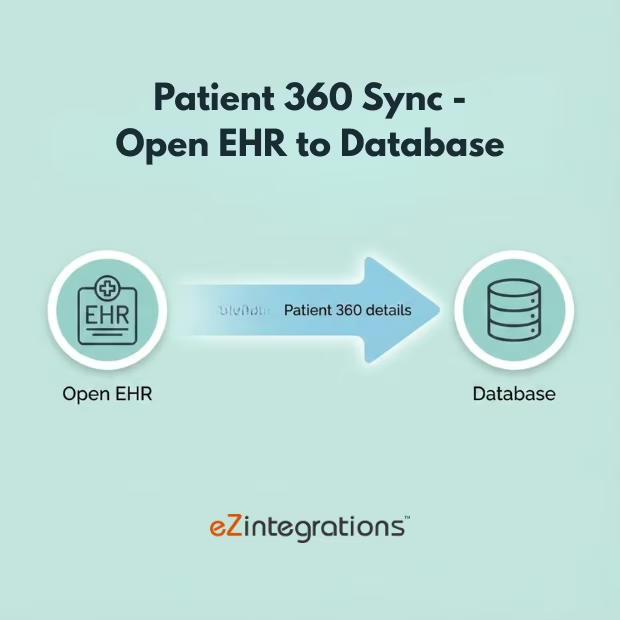
EHR Integration – OpenEHR to Database (Patient 360)
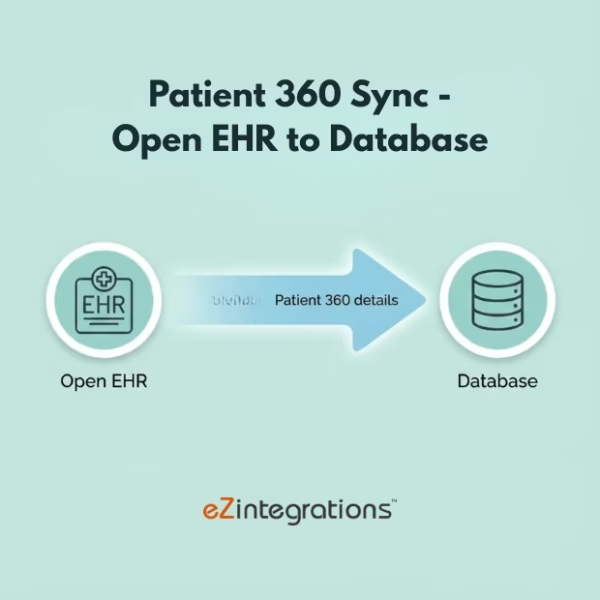
This workflow enables OpenEHR Patient 360 by consolidating patient data from OpenEHR to database. It creates a unified and comprehensive patient view that supports clinical insights and data-driven decision-making.
Automated Patient 360 Data Sync for Unified Care Visibility
The system retrieves patient demographics, clinical records, and related data from OpenEHR, validates them, and builds a complete patient profile in the database. This workflow helps clinicians and analytics teams gain a holistic view of patients, reduce data silos, and improve care coordination.
Watch Demo
| Video Title: |
Integrating eMDs EHR Patient Immunization details to Database |
|---|---|
| Duration: |
07:16 |
Outcome & Benefits
| Time Savings: |
Faster reporting |
|---|---|
| Cost Reduction: |
Lower analysis effort |
| Accuracy: |
High |
| Productivity: |
Improved insights |
Industry & Function
| Function: |
Data Consolidation |
|---|---|
| System Type: |
EHR Integration Workflow |
| Industry: |
Healthcare |
Functional Details
| Use Case Type: |
EHR Integration |
|---|---|
| Source Object: |
Patient 360 Data |
| Target Object: |
Patient 360 Tables |
| Scheduling: |
Batch |
| Primary Users: |
Analytics Teams |
| KPI Improved: |
Data completeness |
| AI/ML Step: |
Optional analytics |
| Scalability Tier: |
Enterprise |
Technical Details
| Source Type: |
EHR |
|---|---|
| Source Name: |
OpenEHR |
| API Endpoint URL: |
OpenEHR REST API |
| HTTP Method: |
GET |
| Auth Type: |
OAuth 2.0 |
| Rate Limit: |
Configured |
| Pagination: |
Supported |
| Schema/Objects: |
Patient; visits; insurance |
| Transformation Ops: |
Normalization and mapping |
| Error Handling: |
Log and retry |
| Orchestration Trigger: |
Scheduled sync |
| Batch Size: |
Configurable |
| Parallelism: |
Supported |
| Target Type: |
Database |
| Target Name: |
Patient 360 Database |
| Target Method: |
DB insert/update |
| Ack Handling: |
DB response logged |
| Throughput: |
High volume |
| Latency: |
Seconds |
| Logging/Monitoring: |
Audit logs |
Connectivity & Deployment
| On-Premise Supported: |
Yes |
|---|---|
| Supported Protocols: |
HTTPS |
| Cloud Support: |
Hybrid |
| Security & Compliance: |
HIPAA compliant |
FAQ
1. What is the OpenEHR to Database Patient 360 integration workflow?
It is an automated EHR integration workflow that consolidates patient data from OpenEHR into a database to build a comprehensive Patient 360 view.
2. What does Patient 360 mean in this workflow?
Patient 360 provides a unified view of patient information by combining demographics, clinical data, encounters, observations, and related records into a single database.
3. What types of data are included in the Patient 360 build?
The workflow includes patient demographics, clinical observations, encounters, diagnoses, care plans, and other relevant EHR data available in OpenEHR.
4. How does the Patient 360 data sync work?
The workflow extracts patient-related data from OpenEHR, applies data mapping and transformation, and loads it into a database to maintain a unified patient profile.
5. How often is Patient 360 data updated?
Patient 360 data can be updated in real time, near real time, or on a scheduled basis depending on analytics and clinical requirements.
6. Who uses the Patient 360 data?
Clinicians use it for better care context, while analytics teams use it for reporting, population health insights, and advanced analytics.
7. What are the benefits of building Patient 360 in a database?
It enables a unified patient view, improves data accessibility, supports analytics and reporting, and enhances clinical and operational decision-making.
8. What system type does this workflow belong to?
This workflow is part of an EHR integration workflow designed to centralize OpenEHR patient data into a database.
Case Study
| Customer Name: |
Healthcare Provider |
|---|---|
| Problem: |
Fragmented patient data |
| Solution: |
Patient 360 automation |
| ROI: |
Better care outcomes |
| Industry: |
Healthcare |
| Outcome: |
Unified patient view |