How to Automatically Sync Care Plans from openEHR to Database
$0.00
| Workflow Name: |
EHR Integration: OpenEHR → Database Care Plan Sync |
|---|---|
| Purpose: |
Sync care plans to database |
| Benefit: |
Centralized care plans |
| Who Uses It: |
Clinicians; IT Teams |
| System Type: |
EHR Integration Workflow |
| On-Premise Supported: |
Yes |
| Industry: |
Healthcare |
| Outcome: |
Care plans stored in database |
Table of Contents
Description
| Problem Before: |
Care plans stored only in EHR |
|---|---|
| Solution Overview: |
Extract care plans from OpenEHR |
| Key Features: |
Data extraction; mapping |
| Business Impact: |
Better care coordination |
| Productivity Gain: |
Reduces manual exports |
| Cost Savings: |
Less admin effort |
| Security & Compliance: |
HIPAA compliant |
EHR Integration – OpenEHR to Database (Care Plan)
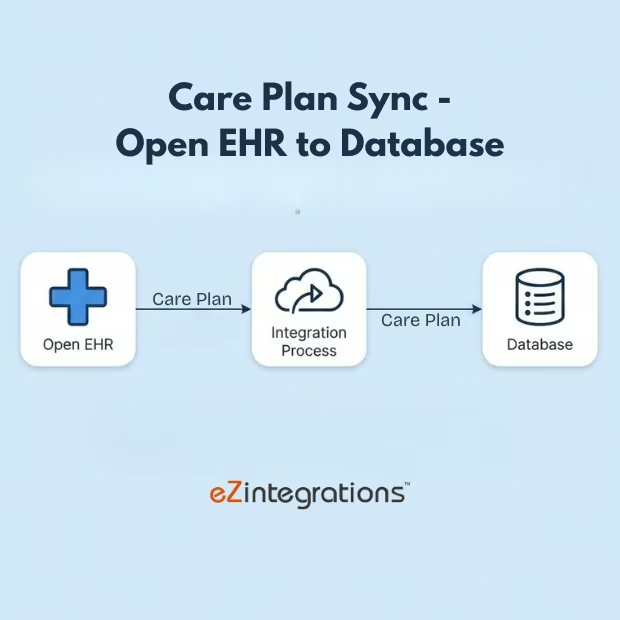
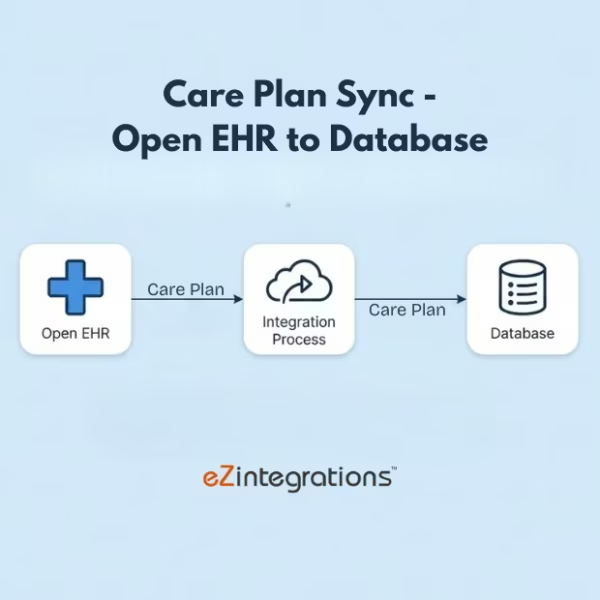
This workflow enables OpenEHR Care Plan data integration by automatically syncing patient care plans from OpenEHR into a centralized database. It ensures that clinical teams have accurate and up-to-date care plan information without manual entry.
Automated Care Plan Sync for Centralized Clinical Management
The system retrieves care plan data from OpenEHR, validates it, and updates the database in real time. This workflow helps clinicians and IT teams maintain centralized care plans, reduce errors, and improve patient care coordination.
Watch Demo
| Video Title: |
Integrating eMDs EHR Patient Immunization details to Database |
|---|---|
| Duration: |
07:16 |
Outcome & Benefits
| Time Savings: |
Faster access |
|---|---|
| Cost Reduction: |
Lower admin cost |
| Accuracy: |
High |
| Productivity: |
Improved workflows |
Industry & Function
| Function: |
Data Sync |
|---|---|
| System Type: |
EHR Integration Workflow |
| Industry: |
Healthcare |
Functional Details
| Use Case Type: |
EHR Integration |
|---|---|
| Source Object: |
Care Plan |
| Target Object: |
Care Plan Tables |
| Scheduling: |
Batch |
| Primary Users: |
Clinicians |
| KPI Improved: |
Care accuracy |
| AI/ML Step: |
Not required |
| Scalability Tier: |
Enterprise |
Technical Details
| Source Type: |
EHR |
|---|---|
| Source Name: |
OpenEHR |
| API Endpoint URL: |
OpenEHR REST API |
| HTTP Method: |
GET |
| Auth Type: |
OAuth 2.0 |
| Rate Limit: |
Configured |
| Pagination: |
Supported |
| Schema/Objects: |
Care plans |
| Transformation Ops: |
Mapping and validation |
| Error Handling: |
Log and retry |
| Orchestration Trigger: |
Scheduled sync |
| Batch Size: |
Configurable |
| Parallelism: |
Supported |
| Target Type: |
Database |
| Target Name: |
Care Plan Database |
| Target Method: |
DB insert/update |
| Ack Handling: |
DB response logged |
| Throughput: |
High volume |
| Latency: |
Seconds |
| Logging/Monitoring: |
Audit logs |
Connectivity & Deployment
| On-Premise Supported: |
Yes |
|---|---|
| Supported Protocols: |
HTTPS |
| Cloud Support: |
Hybrid |
| Security & Compliance: |
HIPAA compliant |
FAQ
1. What is the OpenEHR to Database Care Plan integration workflow?
It is an automated EHR integration workflow that synchronizes patient care plans from OpenEHR into a centralized database for easy access and management.
2. What types of care plan data are synced?
The workflow syncs care plan details including goals, interventions, schedules, statuses, and any associated clinical notes.
3. How does the care plan data sync process work?
The workflow extracts care plan records from OpenEHR, maps them to the database structure, validates the data, and updates the database automatically.
4. How frequently can care plan data be synchronized?
Care plan data can be synced in real-time, near real-time, or on a scheduled basis depending on clinical and IT requirements.
5. What happens if a care plan record fails to sync?
The workflow logs errors, retries automatically, and notifies IT or clinical teams for manual intervention if necessary.
6. Who uses this workflow?
Clinicians and IT teams use this workflow to maintain centralized, accurate, and up-to-date care plans.
7. What are the benefits of automating care plan data sync?
Automation ensures centralized care plans, reduces manual entry, improves data consistency, and supports better care coordination.
8. What system type does this workflow belong to?
This is an EHR Integration Workflow designed to sync care plan data from OpenEHR into a database.
Resources
Case Study
| Customer Name: |
Healthcare Provider |
|---|---|
| Problem: |
Care plan data silos |
| Solution: |
Automated care plan sync |
| ROI: |
Operational efficiency |
| Industry: |
Healthcare |
| Outcome: |
Care plans stored in database |
Related products
-
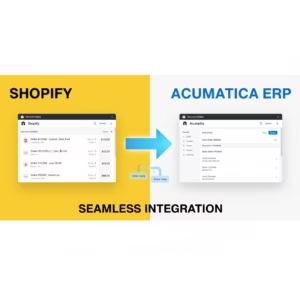
Shopify Orders to Acumatica ERP for 3X Faster Processing
 $0.00
Download
$0.00
Download
-
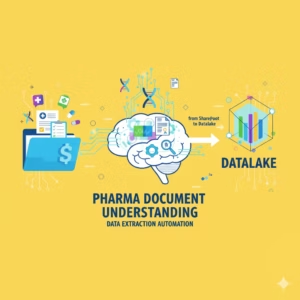
Pharma Document Understanding- Data Extraction Automation
 $0.00
Download
$0.00
Download
-
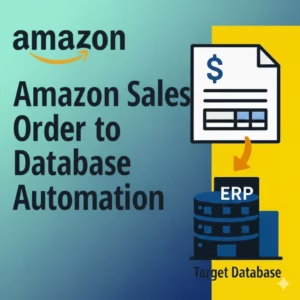
Amazon Sales Order to Database Automation- 10X Faster
 $0.00 / Month For 1 Month and 1 Month free trial
Download
$0.00 / Month For 1 Month and 1 Month free trial
Download
-
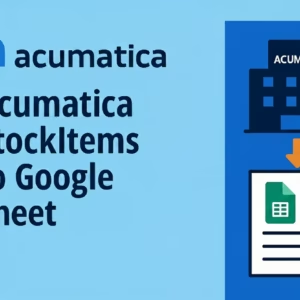
Acumatica stock item automation to Google Sheet-90% Faster
 $0.00
Download
$0.00
Download