

How to Automatically Sync Files from Any System to Amazon S3
$0.00
| Workflow Name: |
Any System to Amazon S3 |
|---|---|
| Purpose: |
Sync files from Oracle Database or any system to Amazon S3 buckets automatically |
| Benefit: |
Faster uploads; reduced manual work |
| Who Uses It: |
IT; Data Engineers; Operations |
| System Type: |
Data Integration Workflow |
| On-Premise Supported: |
Yes |
| Industry: |
IT / Enterprise |
| Outcome: |
Real-time files in Amazon S3 |
Table of Contents
Description
| Problem Before: |
Manual uploads caused delays and errors |
|---|---|
| Solution Overview: |
Automated transfer from system to S3 buckets via API |
| Key Features: |
API push; validation; logging; mapping |
| Business Impact: |
Faster data availability in S3 and fewer errors |
| Productivity Gain: |
Removes manual upload process |
| Cost Savings: |
Reduces labor and errors |
| Security & Compliance: |
Encrypted transfers; secure creds |
Any System to Amazon S3
This workflow enables cloud data transfer by automatically syncing files from Oracle Database or any system into Amazon S3 buckets. It eliminates manual uploads and ensures data is consistently available in the cloud.
Automated File Sync for Faster and Reliable Cloud Storage
The system retrieves files from source systems, validates them, and transfers them to Amazon S3 in real time. This workflow helps IT, data engineers, and operations teams reduce manual effort, accelerate file uploads, and maintain accurate cloud data storage.
Watch Demo
| Video Title: |
Stream Data to Amazon S3 Buckets in Real Time : Salesforce to Amazon S3 |
|---|---|
| Duration: |
8:43 |
Outcome & Benefits
| Time Savings: |
Eliminates manual file handling |
|---|---|
| Cost Reduction: |
Lowers manual effort |
| Accuracy: |
High via validated sync |
| Productivity: |
Faster data availability |
Industry & Function
| Function: |
File transfer and sync |
|---|---|
| System Type: |
Data Integration Workflow |
| Industry: |
IT / Enterprise |
Functional Details
| Use Case Type: |
File Integration |
|---|---|
| Source Object: |
Database Tables |
| Target Object: |
Amazon S3 Buckets |
| Scheduling: |
Real-time or batch |
| Primary Users: |
IT; Data Ops |
| KPI Improved: |
File transfer speed; accuracy |
| AI/ML Step: |
Not required |
| Scalability Tier: |
Enterprise |
Technical Details
| Source Type: |
Database or other system |
|---|---|
| Source Name: |
Oracle Database |
| API Endpoint URL: |
DB API or ETL endpoint |
| HTTP Method: |
POST |
| Auth Type: |
AWS IAM Credentials |
| Rate Limit: |
Based on AWS limits |
| Pagination: |
Supported via API |
| Schema/Objects: |
Files; folders; metadata |
| Transformation Ops: |
Validation; formatting for S3 |
| Error Handling: |
Retry failed transfers; log errors |
| Orchestration Trigger: |
Scheduled or event-based |
| Batch Size: |
Multiple files per batch |
| Parallelism: |
Concurrent transfers supported |
| Target Type: |
Cloud Storage |
| Target Name: |
Amazon S3 |
| Target Method: |
S3 PUT API |
| Ack Handling: |
Transfer logs recorded |
| Throughput: |
Thousands of files/day |
| Latency: |
Few seconds per batch |
| Logging/Monitoring: |
Transfer logs; errors; metrics |
Connectivity & Deployment
| On-Premise Supported: |
Yes |
|---|---|
| Supported Protocols: |
HTTPS; S3 API |
| Security & Compliance: |
Encrypted transfers; secure creds |
FAQ
1. What is the Any System to Amazon S3 workflow?
It is an automated workflow that syncs files from Oracle Database or any other system to Amazon S3 buckets, enabling centralized storage and management.
2. How does the workflow transfer files to Amazon S3?
The workflow extracts files from the source system, optionally applies transformations or validations, and uploads them automatically to designated Amazon S3 buckets.
3. What types of files can be synced?
It can sync structured or unstructured files including CSVs, PDFs, images, logs, and other data files depending on business needs.
4. How frequently can the workflow run?
The workflow can run in real-time, near real-time, on a scheduled basis, or on-demand depending on operational requirements.
5. What happens if a file upload fails?
The workflow logs the error, retries automatically, and notifies IT or operations teams for manual intervention if needed.
6. Who uses this workflow?
IT teams, data engineers, and operations staff use this workflow to automate file uploads and maintain data consistency in Amazon S3.
7. What are the benefits of automating file sync to Amazon S3?
Automation reduces manual work, speeds up uploads, ensures data accuracy, and enables centralized cloud storage management.
8. Does this workflow support on-premise systems?
Yes, this workflow supports on-premise and cloud systems as source for flexible integration with Amazon S3.
9. What system type does this workflow belong to?
This is a data integration workflow designed for syncing files from any system to Amazon S3 buckets.
Resources
Case Study
| Customer Name: |
Enterprise Customers |
|---|---|
| Problem: |
Manual uploads caused delays |
| Solution: |
Automated System → Amazon S3 Sync |
| ROI: |
Faster file availability; reduced errors |
| Industry: |
IT / Enterprise |
| Outcome: |
Real-time files in Amazon S3 |
Related products
-
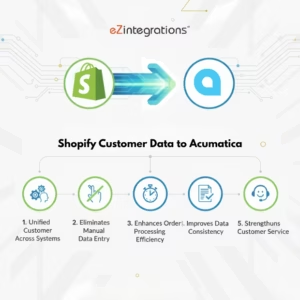
Transform Your Shopify Customer Data to Acumatica Integration – No Coding Needed
 $0.00
Download
$0.00
Download
-
10X Faster Sunrise EHR to NetSuite Integration
 $0.00
Download
$0.00
Download
-
Amazon Sales Order to Database Automation- 10X Faster
 $0.00 / Month For 1 Month and 1 Month free trial
Download
$0.00 / Month For 1 Month and 1 Month free trial
Download
-
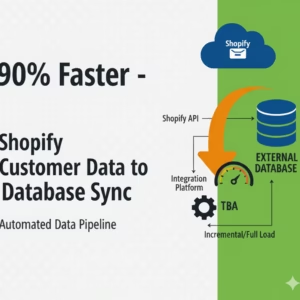
90% Faster-Shopify Customer Data to Database sync
 $0.00
Download
$0.00
Download