How to Automate 3PL Shipment Tracking Integration with ERP and CRM
$90.00
| Workflow Name: |
3PL Shipment Status to ERP/CRM |
|---|---|
| Purpose: |
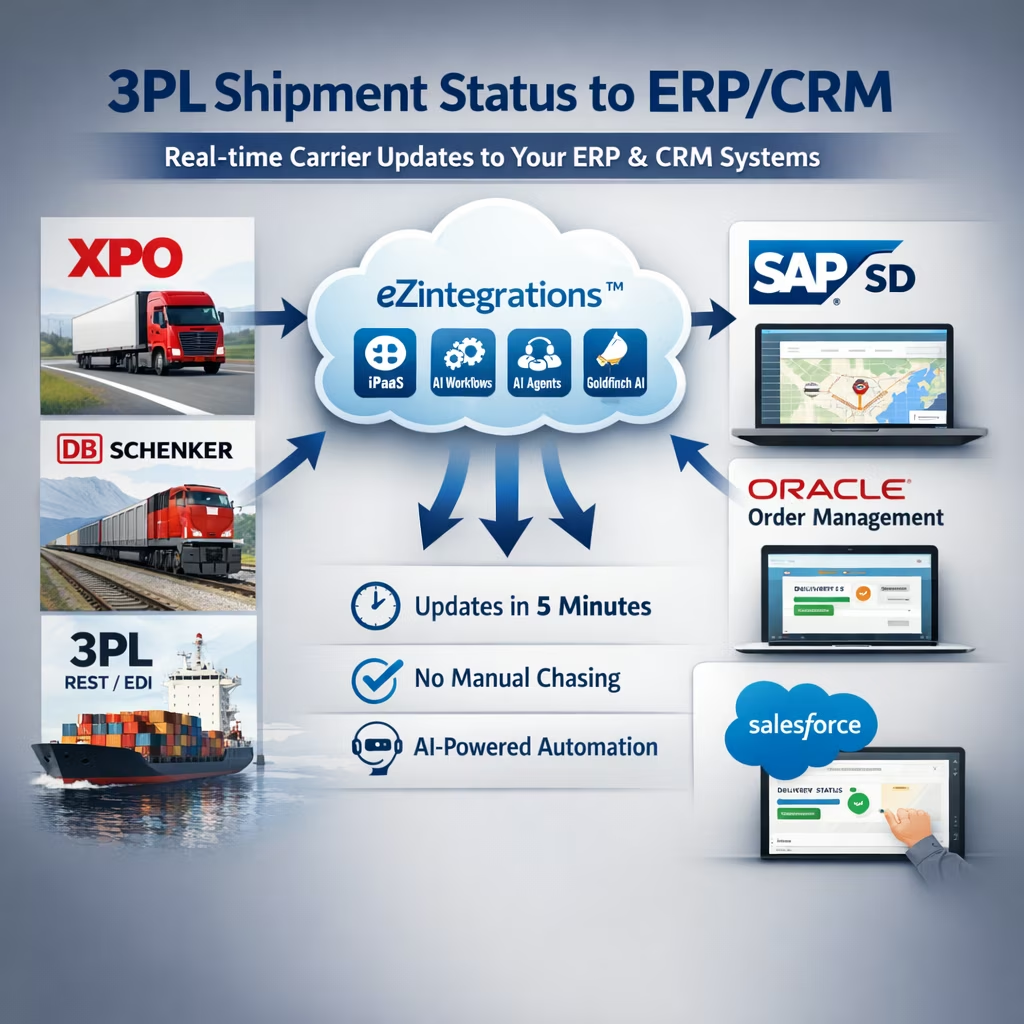
Pull real-time shipment status updates from 3PL carriers (XPO; DB Schenker) via REST API or EDI X12 856; push tracking data to SAP SD or Oracle Order Management ERP; update Salesforce CRM order and case records; and trigger customer notification emails – all without manual status chasing |
| Benefit: |
Eliminates manual shipment status checking; ensures ERP and CRM reflect real-time 3PL tracking data within minutes of carrier update; reduces Customer Service call volume from status inquiries; and prevents retailer chargebacks from late ASN confirmations |
| Who Uses It: |
Logistics Coordinator; Customer Service Representative; Supply Chain Operations Manager |
| System Type: |
Multi-Target Event-Driven Integration, 3PL-to-ERP-to-CRM Status Sync Workflow |
| On-Premise Supported: |
Yes – eZintegrations connects to on-premises SAP SD; Oracle EBS Order Management; and other ERP systems via IPSec Tunnel. eZintegrations is a browser-based; cloud-hosted platform and does not require any on-premises software installation. |
| Industry: |
Specialty Retail |
| Outcome: |
ERP and CRM now reflect live XPO carrier status within 10 minutes of each carrier scan. EDI 856 ASN compliance reached 100% in week 1. Customer Service team reallocated capacity from shipment inquiries to order resolution and upsell support. Customers receive automated shipped and delivered notifications – brand CSAT scores for delivery experience improved by 14 points in the post-deployment quarter. |
| Tags: |
3PL shipment tracking integration; 3PL ERP integration; shipment status CRM update; XPO Salesforce integration; EDI 856 ERP update; SAP SD shipment tracking; Oracle OM shipment status; supply chain visibility automation; 3PL API integration; shipment status automation; customer notification automation; logistics ERP CRM sync |
| AI Credits Required: |
No – all six workflow steps are standard iPaaS operations (3PL REST API polling or EDI X12 856 receive; data mapping; ERP shipment update via REST API; CRM case/order update via REST API; SMTP trigger). Covered fully under the Unlimited plan. No Goldfinch AI tools are invoked. |
Table of Contents
| Problem Before: |
Logistics Coordinators and Customer Service teams manually check 3PL carrier portals (XPO; DB Schenker) for shipment status updates and re-enter tracking information into SAP SD or Oracle Order Management for internal visibility; then copy the same status into Salesforce for customer-facing teams. At 200 to 500 shipments per day; this consumes 3 to 6 FTE hours daily. Customers call Customer Service for status because CRM does not show current tracking data – an estimated 25 to 35% of Customer Service contact volume is shipment status inquiries in retail and B2B distribution. Retailers issue chargebacks when they do not receive EDI 856 Advance Ship Notices (ASN) within the required window (typically 24 to 48 hours); adding $15,000 to $50,000 in annual chargeback exposure for mid-volume shippers. |
|---|---|
| Solution Overview: |
The 3PL Shipment Status to ERP/CRM workflow from eZintegrations polls 3PL carrier APIs or receives EDI X12 856 documents via AS2/SFTP; maps shipment tracking data (carrier; tracking number; status code; estimated delivery; proof of delivery) to the ERP shipment schema and CRM order record; updates both systems; and triggers a customer notification email via SMTP – all within 5 minutes of the carrier status update. |
| Key Features: |
Dual-mode 3PL data ingestion: REST API polling at configurable intervals (5 to 15 minutes) and EDI X12 856 ASN receive via AS2 or SFTP for retail trading partners Multi-target update: single 3PL status event updates both SAP SD delivery document or Oracle OM shipment and Salesforce Order or Case object Configurable status mapping from 3PL carrier event codes (In Transit; Out for Delivery; Delivered; Exception) to ERP delivery status and Salesforce picklist values Automated customer notification email triggered on configurable status events (Shipped; Out for Delivery; Delivered; Exception) via SMTP with tracking link included Exception handling for delivery exceptions (damage; delay; lost) with automatic escalation to Salesforce Case creation and Logistics Coordinator alert |
| Business Impact: |
Real-time 3PL tracking visibility in ERP and CRM eliminates manual status chasing; reduces Customer Service shipment inquiry volume by 60 to 80%; and ensures EDI 856 ASN compliance with retail trading partners to avoid chargeback exposure. |
| Productivity Gain: |
Logistics Coordinators and Customer Service teams at 200 to 500 shipments per day reclaim 3 to 6 FTE hours daily previously spent on manual carrier portal checking and status re-entry across ERP and CRM systems. |
| Cost Savings: |
Organizations shipping 5,000+ orders per month typically realize $60,000 to $120,000 in annual savings from labor reduction; eliminated retailer chargeback exposure from EDI 856 compliance; and reduced Customer Service cost from lower shipment inquiry call volume. |
Description
3PL shipment tracking integration from eZintegrations automatically pushes real-time carrier status updates from XPO, DB Schenker, or any REST or EDI-capable 3PL into SAP SD, Oracle Order Management, and Salesforce — within 5 minutes of each carrier event, with no manual status chasing. eZintegrations is an enterprise automation platform covering iPaaS, AI Workflows, AI Agents, and Goldfinch AI agentic automation.
How Does 3PL Shipment Tracking Integration Work to Push Real-Time Carrier Status Updates to ERP and CRM Automatically?
When a 3PL carrier updates a shipment status — in transit, out for delivery, delivered, or exception — the eZintegrations 3PL shipment tracking integration workflow captures the update via REST API poll or EDI X12 856 ASN. The tracking data is mapped to the ERP delivery schema and updates the SAP SD delivery document or Oracle OM shipment record. The same event updates the Salesforce Order or Case object. If the configured notification threshold is reached (shipped, delivered, exception), a customer email triggers via SMTP with the tracking link.
Customer Service teams in retail and B2B distribution receive an estimated 25 to 35% of their total contact volume from shipment status inquiries. 3PL shipment tracking integration eliminates those calls by making current carrier status visible in CRM in real time — and proactively notifying customers before they pick up the phone.
Deploy 3PL shipment tracking integration in under 1 business day. Pre-built connectors for the most common carriers and ERPs included.
Watch Demo
| Video Title: |
3PL Shipment Tracking Integration Demo: XPO Status to SAP SD; Salesforce; and Customer Email in Under 5 Minutes |
|---|---|
| Duration: |
3 to 5 minutes |
Outcome & Benefits
| Time Savings: |
Manual carrier portal checking and status re-entry eliminated; Logistics Coordinator and Customer Service daily hours on manual status updates reduced from 3 to 6 hours to under 30 minutes of exception review |
|---|---|
| Cost Reduction: |
$60,000 to $120,000 annual savings from labor reduction; EDI 856 chargeback elimination; and reduced Customer Service call volume at 5,000+ orders per month |
| Accuracy: |
100% ERP and CRM status currency (updated within 5 minutes of 3PL carrier event vs. hours or days with manual checking); 100% EDI 856 ASN compliance with configured retail trading partners |
| Productivity: |
200 to 500 shipments per day tracked automatically; Customer Service team sees live carrier status in Salesforce without calling the carrier or checking the 3PL portal; customers receive automated notifications on key status events |
Performance Metrics
| Metric | Before (Manual/Batch) | After (Real-Time Sync) | Improvement |
|---|---|---|---|
| ERP/CRM Status Update Lag | Hours to days behind carrier | Under 5 minutes | 99%+ faster |
| Daily FTE Hours on Status Re-Entry | 3 to 6 hours/day | Under 30 min/day (exceptions) | 90%+ reduction |
| Customer Service Shipment Inquiry Volume | 25 to 35% of CS contacts | Reduced 60 to 80% | 60-80% reduction |
| EDI 856 ASN Compliance Rate | Manual, at risk | 100% automated within SLA | 100% compliant |
Industry & Function
| Function: |
Logistics Operations; Supply Chain Operations; Customer Service; Order Management |
|---|---|
| System Type: |
Multi-Target Event-Driven Integration, 3PL-to-ERP-to-CRM Status Sync Workflow |
| Industry: |
Specialty Retail |
Functional Details
| Use Case Type: |
Multi-Target Event-Driven Integration; 3PL-to-ERP-to-CRM Status Sync; EDI and REST API Ingestion Workflow |
|---|---|
| Scheduling: |
REST API polling at configurable 5 to 15-minute intervals against 3PL carrier API for shipment status updates; EDI X12 856 receive via AS2 or SFTP for retail trading partner ASN compliance; webhook receipt where 3PL carrier API supports outbound event push |
| Primary Users: |
Logistics Coordinator; Customer Service Representative; Supply Chain Operations Manager |
| KPI Improved: |
ERP/CRM status update lag; Customer Service shipment inquiry contact volume; EDI 856 ASN SLA compliance rate; Logistics Coordinator FTE hours on manual status checking; retailer chargeback rate from late ASN |
| AI/ML Step: |
N/A – standard iPaaS workflow with no AI steps; covered under Unlimited plan |
| Scalability Tier: |
Enterprise – supports 500+ shipment status events per day at standard configuration; scales to 5,000+ shipments per day at enterprise tier with parallel processing threads |
Technical Details
| Source Type: |
3PL Carrier REST API and/or EDI Gateway (AS2/SFTP) Source Name (Carrier 1): XPO Logistics (https://developer.xpo.com/) – REST API for shipment tracking status; polling against shipment tracking endpoint with shipment ID or PRO number Source Name (Carrier 2): DB Schenker (https://developer.dbschenker.com/) – REST API for shipment status tracking; polling against tracking endpoint with tracking ID Source Name (EDI): EDI X12 856 Advance Ship Notice (https://x12.org/products/transaction-sets) received via AS2 or SFTP from 3PL partner; parsed by eZintegrations EDI engine for retail trading partner ASN compliance |
|---|---|
| API Endpoint URL: |
XPO: /api/v1/shipments/{proNumber}/tracking | DB Schenker: /api/v2/tracking/{trackingId} | EDI: AS2 endpoint or SFTP directory polling per trading partner configuration |
| HTTP Method: |
GET (REST polling for shipment status); POST (webhook push where 3PL carrier supports outbound event); AS2 POST (EDI 856 document receive) |
| Auth Type: |
OAuth 2.0 Bearer Token (XPO; DB Schenker REST APIs); AS2 with X.509 certificates and payload encryption (EDI); SFTP with SSH key (EDI fallback) |
| Rate Limit: |
XPO: configurable per API agreement; DB Schenker: configurable per agreement; EDI: not applicable (file-based receive) |
| Pagination: |
Not applicable for shipment status polling by ID; cursor-based pagination for bulk shipment list endpoints where used |
| Schema/Objects: |
3PL shipment status fields: shipment/PRO ID; carrier tracking number; carrier SCAC code; event code (D1 Delivered/I1 In Transit/X1 Exception per ANSI X12 standard); event timestamp; estimated delivery date; actual delivery date (if delivered); proof of delivery (POD signature name and timestamp); exception code and description; origin city/state/country; destination city/state/country. EDI 856 segments: ISA; GS; ST; BSN (shipment identification); DTM (dates); N1 (parties); HL (shipment/order/item hierarchy); TD1 (carrier); TD5 (carrier details); REF (references); CTT; SE. |
| Transformation Ops: |
Carrier event code mapping to ERP delivery status codes (SAP SD delivery status V/E/C or Oracle OM shipment status); Carrier event code mapping to Salesforce status picklist values; SCAC code resolution to carrier display name; date format normalization (ISO 8601); tracking URL construction from carrier SCAC and tracking number; EDI 856 segment parsing and HL loop processing for shipment/order/item hierarchy; exception code mapping to Salesforce Case priority and category; proof of delivery data formatting for ERP and CRM write |
| Error Handling: |
ERP API write failure (shipment ID not found in SAP SD or Oracle OM) routes to exception queue with carrier tracking number and ERP reference for Logistics Coordinator review. Salesforce API write failure retries up to 3 times with exponential backoff; persistent failure alerts Logistics Coordinator via email within 10 minutes. SMTP customer notification failure retries up to 3 times; persistent failure logged for manual send. Delivery exception events (damage; lost; address issue) auto-create a Salesforce Case with carrier exception detail and alert the Customer Service team. EDI 856 parsing errors route to exception queue with raw segment detail. |
| Orchestration Trigger: |
Scheduled REST polling at configurable interval (5 to 15 minutes) against 3PL carrier API for all active shipments; AS2 document receipt (EDI 856); SFTP file polling at configurable interval (EDI fallback); webhook receipt where 3PL carrier API supports outbound event push |
| Batch Size: |
All active shipments polled per API call (up to carrier API page limit); 1 EDI 856 document per receive event; individual status events processed as separate workflow instances |
| Parallelism: |
Up to 50 concurrent workflow threads per tenant; supports simultaneous processing from multiple 3PL carrier APIs and multiple trading partner EDI connections Target Type 1: Cloud ERP or On-Premises ERP (connected via IPSec Tunnel) Target Name 1: SAP S/4HANA Sales and Distribution (https://help.sap.com/docs/SAP_S4HANA_ON-PREMISE) – delivery document update (VL02N equivalent via OData API) or Oracle Fusion Cloud Order Management (https://docs.oracle.com/en/cloud/saas/supply-chain-management/order-management.html) – shipment line status update Target Type 2: Cloud CRM Target Name 2: Salesforce CRM (https://developer.salesforce.com/docs/atlas.en-us.api_rest.meta/api_rest/) – Order object or Case object status update via REST API PATCH |
| Target Method: |
SAP SD: OData REST API PATCH – /API_OUTBOUND_DELIVERY_SRV/A_OutbDeliveryHeader(‘{DeliveryDocument}’) | Oracle OM: REST API PATCH – /fscmRestApi/resources/latest/shipments/{shipmentId} | Salesforce: REST API PATCH – /services/data/v59.0/sobjects/Order/{OrderId} or /services/data/v59.0/sobjects/Case/{CaseId} |
| Ack Handling: |
SAP SD returns delivery document number with updated status on successful PATCH; Oracle OM returns shipment ID with updated status; Salesforce returns record ID with updated fields. All acknowledgments logged to workflow audit trail. SMTP customer notification delivery confirmed by 250 OK server response. |
| Throughput: |
500+ shipment status events per day at standard configuration; scales to 5,000+ per day at enterprise tier |
| Latency: |
Under 5 minutes from 3PL carrier status update to ERP delivery update; CRM record update; and customer notification trigger (REST polling mode at 5-minute interval); under 10 minutes at 15-minute polling interval; EDI 856 processing under 2 minutes from document receipt |
| Logging/Monitoring: |
Full execution log per shipment event (timestamp; carrier tracking number; ERP delivery document; CRM record ID; status mapped; customer email sent; exception flag); real-time monitoring dashboard in eZintegrations console; configurable aging alerts for shipments with no status update within configurable window (e.g. 24 hours without carrier scan triggers alert); EDI 856 compliance log with ASN document reference and SLA status per trading partner |
Connectivity & Deployment
| Supported Protocols: |
REST API; EDI X12 (856 ASN); AS2; SFTP; HTTPS; OAuth 2.0; X.509 certificates; SMTP; Webhooks; OData v2/v4; IPSec Tunnel (on-premises ERP connectivity) |
|---|---|
| Security & Compliance: |
HIPAA-eligible configuration available (for healthcare supply chain with patient-linked shipments); GDPR-compliant data handling with configurable customer PII masking in logs; SOC Type II certified. TLS 1.3 encryption in transit; AES-256 at rest. EDI documents encrypted in transit via AS2 payload encryption. Customer email addresses masked in workflow logs. RBAC enforced on carrier configuration; exception queue access; and audit log read access. |
| Tenancy Model: |
Both single-tenant and multi-tenant deployments are available. Single-tenant provides dedicated infrastructure recommended for high-volume shippers (5,000+ daily shipments) and retail organizations with multiple EDI trading partners. Multi-tenant is the default shared-cloud deployment. Both support on-premises ERP connectivity via IPSec Tunnel. |
| On-Premise Supported: |
Yes – eZintegrations connects to on-premises SAP SD; Oracle EBS Order Management; and other ERP systems via IPSec Tunnel. eZintegrations is a browser-based; cloud-hosted platform and does not require any on-premises software installation. |
FAQ
1. What is the 3PL Shipment Status to ERP/CRM workflow?
3PL shipment tracking integration by eZintegrations automatically pulls real-time shipment status updates from 3PL carriers (XPO, DB Schenker) via REST API or EDI X12 856, updates the corresponding delivery record in SAP SD or Oracle Order Management, updates the Salesforce Order or Case object, and triggers customer notification emails — all within 5 minutes of each carrier event, with no manual status checking or re-entry. The workflow eliminates the manual status chasing that consumes 3 to 6 FTE hours daily in logistics and Customer Service teams.
2. What data does this workflow process?
This workflow processes 3PL carrier shipment status records containing shipment ID, carrier tracking number, carrier SCAC code, status event code (In Transit, Out for Delivery, Delivered, Exception), event timestamp, estimated and actual delivery dates, proof of delivery (signature name, delivery timestamp), and exception code and description. EDI X12 856 ASN documents include all standard segments: ISA, BSN, HL shipment/order/item hierarchy, TD5 carrier details, and REF reference numbers.
3. How does 3PL shipment tracking integration improve supply chain visibility?
3PL shipment tracking integration eliminates the lag between carrier status update and ERP/CRM visibility that forces Customer Service teams to manually check carrier portals and call 3PL contacts for status. An estimated 25 to 35% of Customer Service contact volume in retail and B2B distribution is shipment status inquiries — a figure that drops 60 to 80% when current carrier status is visible directly in Salesforce and customers receive automated notifications. EDI 856 ASN compliance with retail trading partners is also enforced automatically, eliminating chargeback exposure from late ASN submission.
4. Who typically uses this workflow?
Logistics Coordinators and Supply Chain Operations Managers in retail, manufacturing, and B2B distribution configure and monitor this workflow. Customer Service Representatives benefit from live carrier tracking status visible directly in Salesforce CRM without switching to carrier portals or calling 3PL contacts. The exception queue is the primary daily touchpoint — your team reviews only shipments with delivery exceptions (damage, delay, lost), not the full daily shipment volume.
5. Can eZintegrations connect to on-premises systems like SAP SD on-prem or Oracle EBS?
Yes. eZintegrations connects to on-premises SAP SD, Oracle EBS Order Management, and other ERP systems via IPSec Tunnel — no on-premises software installation is required. eZintegrations is a browser-based, cloud-hosted platform, so your on-premises ERP participates in the 3PL shipment tracking integration securely through the encrypted tunnel without any agent deployed on your servers.
6. What systems does this workflow connect?
This workflow connects 3PL carrier APIs (XPO, DB Schenker) and EDI X12 856 ASN via AS2 or SFTP (source) to SAP S/4HANA SD or Oracle Fusion Cloud Order Management (target ERP) and Salesforce CRM (target CRM) via REST API and OData. Customer notification emails are triggered via SMTP. On-premises ERP deployments connect via IPSec Tunnel. Both REST polling and webhook modes are supported for carrier data ingestion.
7. What are the key benefits of 3PL shipment tracking integration?
Key benefits include ERP and CRM status updated within 5 minutes of 3PL carrier event (vs. hours or days with manual checking), 90%+ reduction in daily FTE hours on manual status re-entry, 60 to 80% reduction in Customer Service shipment inquiry contact volume, 100% EDI 856 ASN compliance with configured retail trading partners, and $60,000 to $120,000 in annual savings at 5,000+ monthly shipments from labor reduction, chargeback elimination, and reduced Customer Service cost. Deploys in under 1 business day.
8. How does this workflow handle exceptions or errors?
When a shipment ERP record is not found (tracking number not matched to an ERP delivery document), the event routes to an exception queue with carrier tracking number and error detail for Logistics Coordinator review. Delivery exception events from the carrier (damage, delay, address issue) automatically create a Salesforce Case with the full carrier exception detail and alert the Customer Service team. ERP and Salesforce API write failures retry up to 3 times with exponential backoff. No shipment status event is silently dropped.
Resources
Case Study
| Customer Name: |
Mid-market specialty retail brand (name withheld – reference available on request) |
|---|---|
| Problem: |
The logistics team managed 380 outbound shipments per day via XPO Logistics as primary carrier and one regional 3PL. Shipment status was manually checked in the XPO portal by two Logistics Coordinators each morning and afternoon and re-entered into SAP SD delivery documents and Salesforce Order records. Total daily manual effort: 4.5 FTE hours. Customer Service handled 110 to 130 shipment status inquiry calls per day; consuming 38% of CS team capacity. Three retail key accounts required EDI 856 ASN submission within 24 hours of shipment; missed ASN windows averaged 8 per quarter; generating $22,000 per quarter in retailer chargebacks. |
| Solution: |
Deployed eZintegrations 3PL shipment tracking integration in 2 business days; connecting XPO REST API as the primary carrier source with 10-minute polling interval; and EDI X12 856 receive via AS2 for the three key retail trading partners. SAP SD OData API configured for delivery status updates. Salesforce Order object configured for tracking number; status picklist; and estimated delivery date sync. SMTP customer notification email configured for Shipped and Delivered status events. Salesforce Case auto-creation configured for carrier exception events with Logistics Coordinator email alert. |
| ROI: |
Daily Logistics Coordinator manual effort reduced from 4.5 to under 20 minutes (exceptions only) – $67,000 annual labor savings at blended Logistics Coordinator cost. Customer Service shipment inquiry call volume reduced from 110 to 18 calls per day (83% reduction) – estimated $52,000 annual CS cost reduction. Retailer chargeback eliminated from quarter 1 post-deployment: $88,000 annual protection. |
| Industry: |
Specialty Retail |
| Outcome: |
ERP and CRM now reflect live XPO carrier status within 10 minutes of each carrier scan. EDI 856 ASN compliance reached 100% in week 1. Customer Service team reallocated capacity from shipment inquiries to order resolution and upsell support. Customers receive automated shipped and delivered notifications – brand CSAT scores for delivery experience improved by 14 points in the post-deployment quarter. |
Related products
-
Amazon Sales Order to Database Automation- 10X Faster
 $0.00 / Month For 1 Month and 1 Month free trial
Download
$0.00 / Month For 1 Month and 1 Month free trial
Download
-
Transform Your Shopify Customer Data to Acumatica Integration – No Coding Needed
 $0.00
Download
$0.00
Download
-
Walmart to SAP Inventory Automation – 10× Efficiency Boost
 $0.00
Download
$0.00
Download
-
10X Speed: Automate EHR Patient Data to Database
 $0.00
Download
$0.00
Download