Pipedream vs eZintegrations: Choosing a Platform That Grows With You
December 10, 2025TL; DR
-
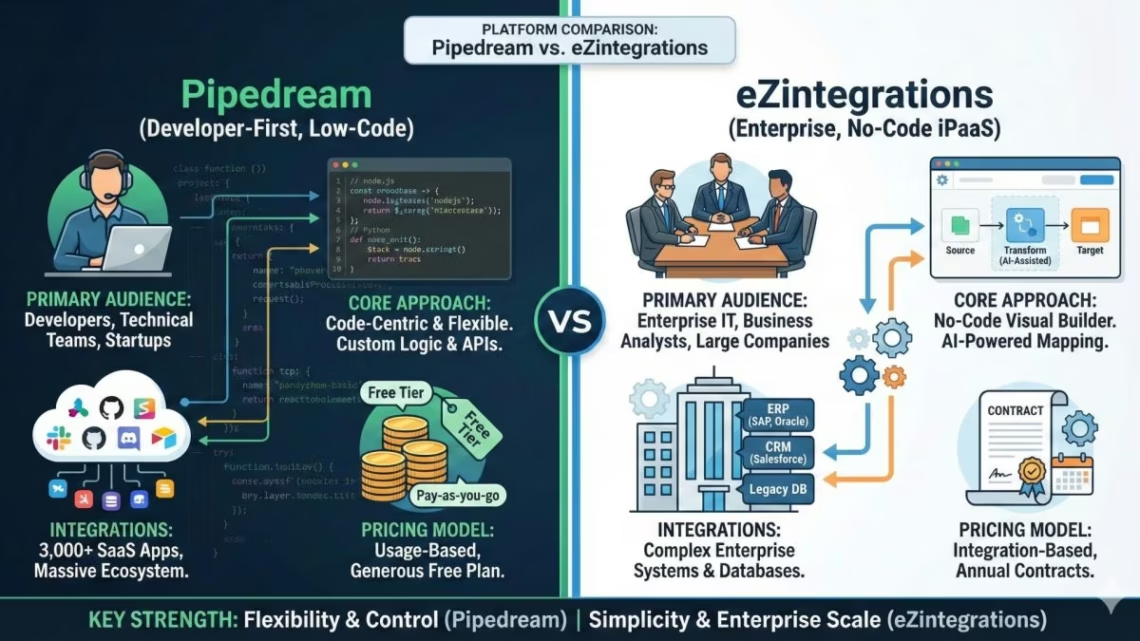
Pipedream: Developer-focused, code-based automation platform ideal for small, event-driven workflows. Supports REST APIs, webhooks, and lightweight data transformations. Best for teams experimenting with APIs or automating short tasks. Limited scalability, enterprise connectors, and compliance features.
-
eZintegrations: Enterprise-grade, low-code platform designed for large-scale, multi-system automation. Connects ERP, CRM, HR, legacy, and cloud systems with drag-and-drop workflows, AI-powered data transformations, and full business process automation. Supports cloud, hybrid, and on-prem deployments with enterprise security (RBAC, 2FA, GDPR/SOC 2/HIPAA compliance) and predictable subscription pricing.
Introduction
Businesses today rely on numerous applications that rarely communicate by default. Integrating these systems ensures smooth operations, automates repetitive tasks, and provides consistent information flow across departments. Two popular solutions are Pipedream and eZintegrations, but they address very different needs.
This comparison explores their capabilities, scalability, security, automation, deployment flexibility, integration depth, and enterprise suitability to help organizations make an informed choice.
Company Overview
What is Pipedream?
Answer: Pipedream is a developer-focused integration platform that allows users to create workflows primarily through code.
Supporting Sentence: It is best suited for automating small, event-driven tasks using APIs with custom scripts.
-
How it works: Developers write short scripts in JavaScript, Python, or TypeScript to connect APIs and trigger workflows.
-
When to use: Ideal for small teams or experimental projects needing rapid API integration.
-
Example: Sending notifications when a form is submitted or syncing a single API endpoint source.
What is eZintegrations?
Answer: eZintegrations is an enterprise-grade, low-code platform designed for complex, multi-system automation.
Supporting Sentence: It centralizes integrations across ERP, CRM, HR, and legacy systems while handling high-volume data and business workflows.
-
How it works: Users can drag-and-drop connectors, set triggers, map data, and orchestrate workflows visually.
-
When to use: Suitable for large organizations requiring scalable, secure, and continuous integration.
Integration Capabilities
How does Pipedream handle integrations?
Answer: Pipedream primarily manages API-based workflows and lightweight data transformations.
-
Definition: APIs (Application Programming Interfaces) allow applications to communicate programmatically.
-
How it works: Connect apps via webhooks, schedule triggers, or transform small datasets within code functions.
-
Limitation: Not ideal for connecting ERP, legacy systems, or high-volume internal workflows.
-
Example: Automating Slack notifications for Jira updates in real time.
How does eZintegrations manage integrations?
Answer: eZintegrations supports ERP, CRM, HR, databases, and on-premise systems with low-code connectors.
-
Definition: Low-code platforms allow visual workflow design with minimal programming.
-
How it works: Drag-and-drop mapping, event triggers, AI-powered data transformation, and multi-system orchestration.
-
Evidence: Supports business connectors and handles both batch and real-time operations, suitable for enterprises processing thousands of transactions daily.
Scalability and Performance
Can Pipedream handle enterprise-scale workflows?
Answer: Pipedream is serverless and efficient for small workloads but not designed for sustained enterprise-scale operations.
-
Definition: Serverless execution automatically manages server infrastructure but limits control over scaling large volumes.
-
Example: Works well for lightweight notifications but struggles with thousands of concurrent ERP transactions.
How scalable is eZintegrations?
Answer: eZintegrations is built for high-volume, continuous operations with fault tolerance and load balancing.
-
Process Steps: Real-time monitoring → Auto-scaling → Error handling → multi-system orchestration.
-
Evidence: Enterprises handling daily transactions report reliable performance across ERP, CRM, and finance systems
In 2023, Forrester reported a decline in contract value and revenues, highlighting the growing need for scalable, reliable, and integrated automation platforms to maintain operational efficiency.
Security and Governance
What security features does Pipedream offer?
Answer: Pipedream provides standard cloud security, including workflow encryption and access controls.
-
Limitation: Lacks enterprise-level audits, role-based governance, or strict compliance certifications.
How secure is eZintegrations?
Answer: eZintegrations offers enterprise-grade security with encryption, role-based access, two-factor authentication, and compliance with GDPR, SOC 2, HIPAA.
-
How it works: Secure credential storage → Multi-factor authentication → Fine-grained permissions → Audit trails
-
.Evidence: Used in healthcare and finance sectors where regulatory compliance is
Business Process Automation
Can Pipedream automate entire business workflows?
Answer: Pipedream is effective for small, code-based workflows but does not handle multi-department business processes.
-
Example: Triggering a notification when a new CRM entry is added.
How does eZintegrations automate complex processes?
Answer: eZintegrations manages end-to-end workflows including approvals, multi-step logic, AI-driven transformations, and multi-system orchestration.
-
Use Case: Automates order processing, HR onboarding, finance approvals, and supply chain updates.
-
Evidence: Companies report 30–50% reduction in manual process time after adopting eZintegrations.
Deployment and Connectivity
Where can Pipedream be deployed?
Answer: Pipedream is cloud-only.
-
Protocols supported: REST APIs and webhooks.
-
Limitation: Does not natively support legacy systems, SFTP, or large-scale batch operations.
How flexible is eZintegrations deployment?
Answer: eZintegrations supports cloud, hybrid, and on-premise deployments, connecting ERP, CRM, legacy, and database systems.
-
Protocols Supported: REST, SOAP, JDBC/ODBC, SFTP/FTP, EDI, and document ingestion (PDF, Excel).
-
Example: Integrates Oracle Cloud ERP with Microsoft Dynamics 365 in hybrid mode
Pricing Considerations
How is Pipedream priced?
Answer: Pipedream uses a consumption-based pricing model suitable for small workflows.
-
Tradeoff: Costs can rise with high-volume or complex workflows.
How is eZintegrations priced?
Answer: eZintegrations uses subscription-based pricing for predictable costs across large-scale enterprise operations.
-
Benefit: Easier to budget for thousands of automated tasks across multiple departments.
Comparison Table – Pipedream vs eZintegrations
| Feature / Area | Pipedream | eZintegrations |
|---|---|---|
| Primary Focus | Developer-driven automations and scripting | Enterprise-grade integrations and end-to-end business automation |
| Ease of Use | Best for developers comfortable with coding | Designed for broader teams with visual workflows and minimal coding |
| Integration Depth | Good for API-based tasks | Strong ERP, CRM, supply chain, finance, and manufacturing support |
| Deployment Options | Cloud only | Cloud, hybrid, and on-premise |
| Enterprise Connectors | Limited, code-heavy | Oracle, SAP, Microsoft, Salesforce, and more |
| Scalability | Small–medium workflows | High-volume enterprise processes |
| Security Features | Standard encryption | Role-Based Access Control (RBAC), Two-Factor Authentication (2FA), enterprise governance, and compliance with GDPR, SOC 2, and HIPAA |
| Customization | Code-based | Low-code /AI Transformation |
| Protocols Supported | REST APIs, Webhooks | REST, SOAP, JDBC, ODBC, EDI, Batch |
| Best Fit For | Developers & small teams | Enterprise & growing businesses |
Why eZintegrations Becomes the Preferred Platform
Companies that require a unified and stable integration environment tend to select eZintegrations for its scalability, security, deployment flexibility, multi system support, extensive protocol coverage, and ability to manage end to end business workflows.
Pipedream remains effective for development oriented environments that depend heavily on API experimentation or coding specific event driven tasks. For larger organizations, or those managing critical operations across multiple core systems, eZintegrations offers a structured, scalable, and reliable foundation for long term digital growth.
Conclusion
Pipedream excels for small, code-centric automation tasks, ideal for developers experimenting with APIs.
eZintegrations is the preferred choice for organizations requiring scalable, secure, and enterprise-grade automation. It handles large datasets, connects multiple core systems, and supports end-to-end workflows, making it suitable for Oracle, SAP, Microsoft, and Salesforce environments.
Recommendation: For long-term digital growth and cross-department workflow automation, eZintegrations provides a more structured, reliable, and scalable platform.
FAQ’S
1. . What is the main difference between Pipedream and eZintegrations?
Pipedream is a developer-focused platform that emphasizes code-based workflow automation, primarily using JavaScript and Python. eZintegrations, on the other hand, is an enterprise-grade integration and automation platform with low-code capabilities, prebuilt connectors, and support for hybrid deployments. While Pipedream suits small-to-medium, developer-driven workflows, eZintegrations is built for large-scale, multi-system automation.
2. Can eZintegrations integrate with both cloud and on-premise systems?
Yes. eZintegrations supports cloud, hybrid, and on-premise deployment models. It provides secure agents for on-premise systems, allowing enterprises to connect legacy applications, ERP systems, and cloud services while maintaining compliance and data security.
3. . Is coding knowledge required to use eZintegrations?
No. eZintegrations is designed with low-code functionality, allowing users to visually build workflows, map data, and automate processes without extensive programming. Developers can extend functionality with custom APIs or logic if needed, but basic integration tasks do not require coding.
4. Which platform is better for large-scale enterprise automation?
eZintegrations is better suited for enterprise-scale automation. It supports high-volume data processing, multi-application workflows, robust governance, and compliance features, making it ideal for large organizations with complex integration and automation needs. Pipedream is more optimized for lightweight or departmental-level workflows.
5.How do Pipedream and eZintegrations differ in security and governance?
Pipedream offers encryption, access control, and secure serverless execution, but its governance features are mostly developer-centric. eZintegrations provides comprehensive security, including end-to-end encryption, role-based access control, two-factor authentication, and regulatory compliance features suitable for finance, healthcare, and manufacturing industries.
Conclusion
Pipedream and eZintegrations each serve a different kind of need. Pipedream is handy when a team wants to connect a few apps quickly or write small bits of code to automate something on the fly. It’s useful for short workflows and one-off tasks that don’t require much planning.
eZintegrations fits better when a business needs something steady and long lasting. It handles heavy data movement, works well with big enterprise systems, and keeps everything secure without making the process complicated. Companies that use systems like Oracle, SAP, Microsoft, or Salesforce usually find eZintegrations easier to manage because it already understands how these applications work together.
If your goal is to have a platform you can rely on as your business grows and your systems become more connected, eZintegrations is the more practical choice. It gives you room to expand, keeps your data organized, and supports the kind of workflows modern businesses depend on every day.