The Real Cost of Oracle OIC: Full TCO Analysis for Enterprise Teams
March 15, 2026Oracle Integration Cloud (OIC) uses a message-pack-per-hour billing model. Your instance is billed continuously whether or not it is processing messages, making an idle Enterprise-edition instance cost approximately $30.97 per day ($11,304 per year) at zero usage. No dollar amounts are published on oracle.com/integration/pricing; all contracts require Oracle sales engagement. For enterprises connecting Oracle EBS, JD Edwards, Siebel, or SAP, the Enterprise edition is mandatory, which carries a higher hourly rate than Standard. When you add Oracle Integration specialist headcount ($110,482–$170,815/yr, Glassdoor December 2025), Gen 2-to-Gen 3 migration testing effort, and implementation through a certified Oracle partner, Year 1 total cost of ownership for a mid-market enterprise typically sits in the $200,000–$450,000 range. eZintegrations publishes all pricing at ezintegrations.ai/pricing, starting from free and scaling to $150/month per automation, with no message-pack billing and no idle-instance charges.
TL;DR
Oracle OIC has no published dollar amounts on its pricing page. It uses a message-pack-per-hour billing model billed continuously from the moment your instance is running, including idle time. A single Enterprise-edition OIC instance at minimum configuration costs approximately $30.97 per day ($11,304 per year) even at zero message usage, based on live OCI pricing data (chronicler.tech, November 2025). Enterprise edition is mandatory for Oracle EBS, JD Edwards, Siebel, and SAP adapter access. Standard edition cannot connect to these systems. Every generation upgrade (Gen 1 to Gen 2, Gen 2 to Gen 3) requires full integration regression testing. Process instance data does not migrate automatically. Gen 2 instance creation was disabled on March 20, 2025. Oracle Integration specialist headcount runs $110,482–$170,815/yr (Glassdoor, December 2025). Add implementation through a certified partner and Year 1 TCO for a mid-market enterprise sits at $200,000–$450,000 before productivity gains materialise. eZintegrations publishes all pricing at ezintegrations.ai/pricing. Per automation, annual billing, starting free. No idle-billing. No message-pack charges. No specialist developer required.
How Oracle OIC Billing Actually Works: Message Packs Explained
Before discussing whether Oracle OIC total cost, you need to understand precisely what you are being billed for. Because the structure is unlike most SaaS pricing models, and that difference has significant budget implications.
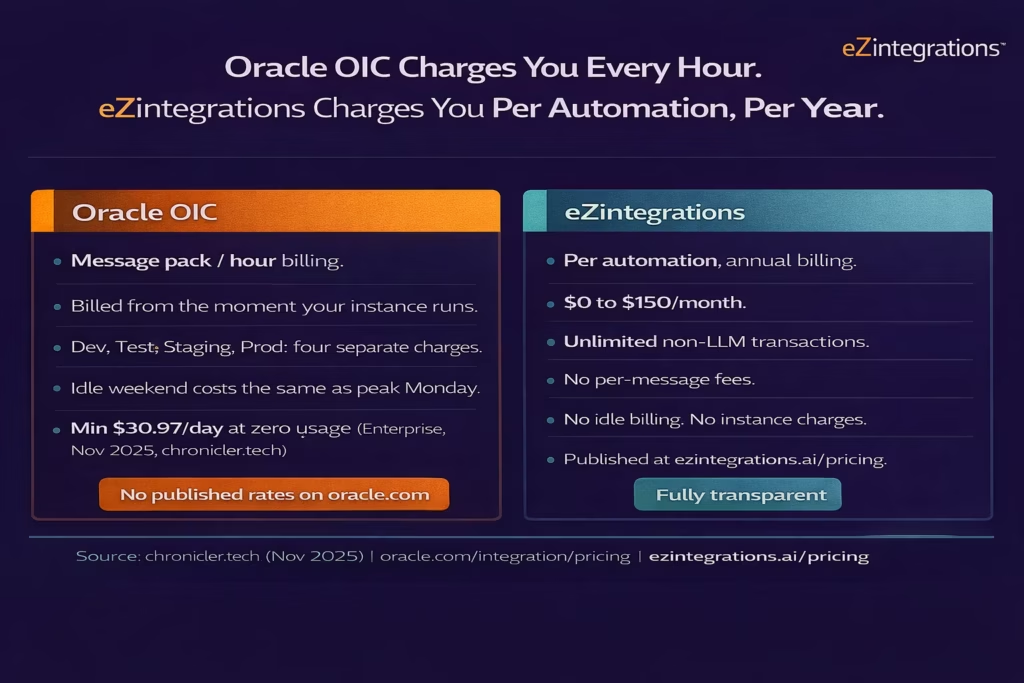
Oracle OIC bills on a message-pack-per-hour model. One message pack equals 5,000 messages per hour of capacity. When you provision an OIC instance, you select the number of message packs at configuration time, and that hourly rate starts immediately, whether your instance is actively processing integrations or sitting idle.
The billing rule is explicit in Oracle’s documentation: the customer will be charged 1 message pack per hour for the instance, whether messages are being used or not.
What constitutes a message for billing purposes: any data transfer of up to 50 KB counts as one message. If a payload exceeds 50 KB, it is counted as multiple messages. A payload of 754 KB, for example, counts as 16 messages. This means high-volume integrations with large payloads (bulk file transfers, ERP transaction batches, large document exchanges) can consume message packs at a rate significantly higher than the raw transaction count suggests.
The practical consequence of always-on billing: stopping development work, pausing integrations for a weekend, or running a Dev or Test instance that sits unused during nights and weekends does not stop the billing clock. Every hour the instance is provisioned, Oracle charges you.
A concrete data point from live OCI pricing (November 2025): a single OIC instance provisioned at minimum configuration, on a production shape with Enterprise edition and one message pack, zero disaster recovery, costs $30.97 per day at zero usage. That is $11,304 per year in minimum baseline infrastructure cost before a single integration has processed a single record.
This is the cost floor. As your integration count grows and your message volume increases, you add message packs and the hourly rate increases proportionally. Multiple environments (Dev, Test, Staging, Production) each require a separate instance, and each carries its own hourly charge from the moment it is running.
Oracle OIC Pricing Tiers: Standard, Enterprise, and Healthcare
Oracle Integration Cloud offers three editions. The edition choice is not cosmetic: it determines which adapters and capabilities you can access, and it is a binding selection at the instance level. Moving from Standard to Enterprise requires an instance edition change, not merely a feature toggle.
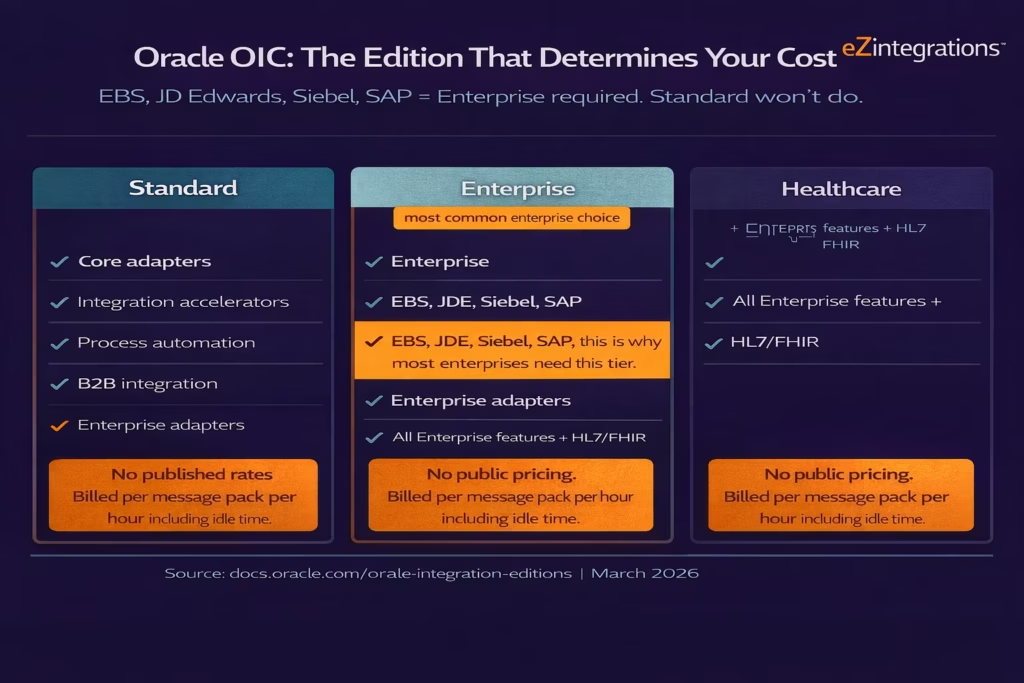
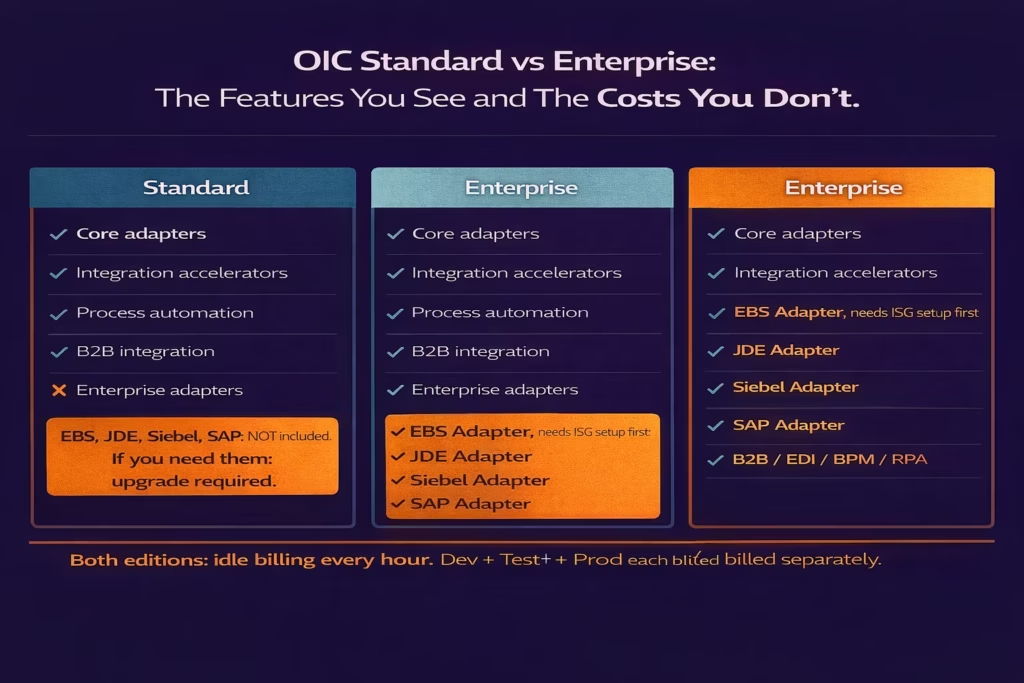
Standard Edition includes SaaS integration adapters (Salesforce, NetSuite, Workday, SAP SuccessFactors, ServiceNow, and others), technology adapters (REST, SOAP, FTP, Database), Visual Builder, File Server, and scheduled/app-driven integration patterns. It works well for organisations whose entire integration footprint involves only cloud SaaS applications on both sides.
Enterprise Edition includes everything in Standard plus the four on-premises enterprise application adapters that most Oracle EBS and JD Edwards shops require: the Oracle E-Business Suite Adapter, Oracle JD Edwards EnterpriseOne Adapter, Oracle Siebel Adapter, and SAP Adapter. Enterprise edition also adds B2B for EDI trading partner management (X12, EDIFACT), Process Automation (BPM), Robotic Process Automation, and Decision Management. Enterprise adapters require setup on the EBS side through Integrated SOA Gateway (ISG) before any integration development begins, adding a pre-project configuration step that does not exist in Standard deployments.
Healthcare Edition adds HL7 v2, FHIR, and NCPDP messaging capabilities on top of the full Enterprise stack. It is available only in tenancies using Universal Credits.
The critical implication: if your integration architecture connects Oracle EBS, JD Edwards, Siebel, or SAP to any other system, Standard edition is not licensed for that use case. Enterprise edition is mandatory. This is not a configuration option; it is a licensing boundary.
Enterprise edition carries a materially higher per-hour rate than Standard. Because Oracle publishes no dollar amounts on its pricing page, the exact premium requires a sales conversation. Third-party analysis and buyer community reports consistently note the difference as significant.
What Is Included at Each Edition Level
Beyond the adapter matrix, each edition’s practical scope shapes your total cost picture in three ways that matter at budget time.
What Standard buys you: Cloud-to-cloud integrations with supported SaaS adapters, scheduled file transfer, REST and SOAP API connectivity, and Visual Builder for lightweight app development. If your organisation has completed its Oracle EBS to Oracle ERP Cloud migration and operates entirely in the cloud, Standard may be sufficient. For organisations still running Oracle EBS on-premises alongside Oracle Fusion Cloud, Standard is not sufficient.
What Enterprise adds and what it costs you: The Enterprise edition adapter set unlocks on-premises ERP connectivity, but brings two additional cost layers. First, the EBS Integrated SOA Gateway setup is a prerequisite for any EBS integration development. This requires an Oracle DBA or Oracle Fusion technical consultant to configure ISG endpoints on the EBS side before a single OIC integration can be built. Second, EDI B2B setup for trading partner management requires additional specialist expertise in B2B document standards. Neither of these setup costs appears on the OIC subscription invoice.
What every edition shares: Idle-instance billing. Every edition, at every message pack configuration level, is billed per hour from the moment the instance is provisioned. Dev, Test, and Production instances each carry separate hourly charges. An organisation running three OIC environments (Dev, Test, Production) at minimum Enterprise-edition configuration pays the per-hour rate for all three simultaneously.
The OCI Cost Estimator at cloud.oracle.com/costestimator allows you to model OIC costs by selecting instance count, hours per day, and days per month. This is the closest thing to a public pricing tool Oracle provides for OIC; actual contract rates may differ based on Universal Credits commitments and Oracle Support Rewards.
True Cost of Ownership: Oracle OIC vs eZintegrations
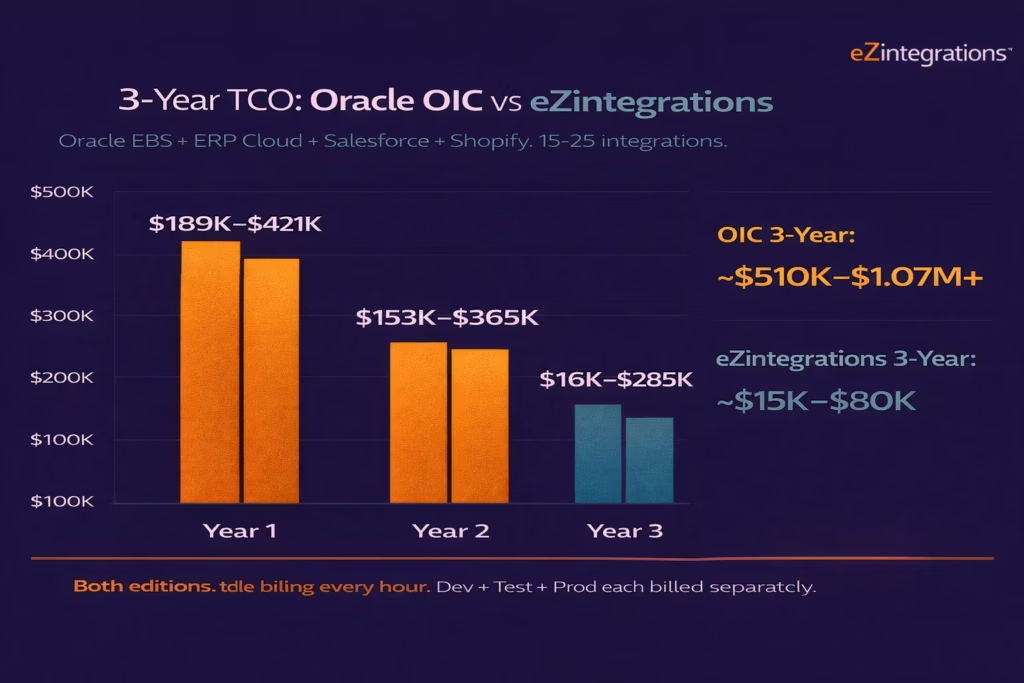
This section builds the full Year 1 TCO for a typical enterprise using Oracle OIC to connect Oracle EBS (on-premises), Oracle ERP Cloud, Salesforce, and Shopify. This is the most common Oracle integration profile that appears in competitive evaluations against eZintegrations.
| Cost Component | Oracle OIC (Year 1, Mid-Market Enterprise) | eZintegrations (Year 1, Same Profile) |
|---|---|---|
| Platform subscription / instance cost | Custom quote (no public rate). Idle baseline: ~$11,304/yr per Enterprise instance. Multiple environments multiply this (chronicler.tech, Nov 2025) | Published: ~$1,620–$27,000/yr (15–25 automations × $90–$150/mo × 12) |
| EBS Integrated SOA Gateway setup | Required pre-project. Oracle DBA or Fusion consultant: $15,000–$40,000 (third-party estimate) | Not required. eZintegrations connects to Oracle EBS via pre-built FBDI and REST adapters with no ISG dependency |
| OIC specialist headcount | $110,482–$170,815/yr per specialist (Glassdoor, December 2025). Mid-market minimum: 1 FTE | $0. Fully no-code canvas. No proprietary language required |
| Implementation through certified Oracle partner | $30,000–$80,000 (4–6 months typical, third-party analysis) | $0–$5,000 (template-based; days to weeks) |
| Training and Oracle certification | $5,000–$15,000 per team member for formal OIC training | $0 (platform onboarding included; no specialist certification required) |
| Dev and Test environment idle billing | ~$22,608/yr for 2 additional instances at minimum idle rate | $0 (Dev/Test pricing: ~one-third of production per automation) |
| Gen upgrade regression testing | Significant engineering effort on each generation upgrade; process instance data does not migrate (blog.data-and-analytics.com, September 2025) | No generation upgrade cycles. Continuous cloud-native updates with no re-testing required |
| Year 1 Total | $200,000–$450,000 | $1,620–$32,000 |
| Year 2 (renewal + maintenance) | $150,000–$300,000 | $1,620–$27,000 |
| Year 3 (renewal + potential upgrade) | $160,000–$320,000+ | $1,620–$27,000 |
| 3-Year Total | $510,000–$1,070,000+ | $4,860–$86,000 |
eZintegrations Year 1 figures based on 15-25 automations at $90–$150/month per automation, annual billing, published at ezintegrations.ai/pricing. LLM/AI automations are priced as a base tier plus AI credits. Dev/Test environments at approximately one-third of production cost. Oracle OIC subscription amounts are custom-quote only; idle baseline from chronicler.tech November 2025; developer salary from Glassdoor December 2025; implementation estimates from third-party analysis. OIC does not publish list prices.
Three cost lines in this table deserve close attention.
EBS Integrated SOA Gateway setup is a cost that appears before the first OIC integration line is written. ISG must be configured on the EBS application server, and the setup requires an Oracle DBA familiar with EBS middleware architecture. Many organisations discover this requirement after the OIC contract is signed.
Dev and Test environment idle billing is a cost line that surprises IT teams who model OIC cost solely against the Production instance. In a standard enterprise deployment with Development, Test, and Production environments, three OIC instances are running simultaneously. At the chronicler.tech idle baseline of $30.97/day per instance, three instances cost $33,912/year in idle baseline charges before a single integration is deployed.
Gen upgrade regression testing is the cost that makes Oracle OIC’s generation upgrade cycles an operational budget line rather than a one-time event. The Gen 2-to-Gen 3 migration required organisations to resolve upgrade precheck issues, pause development 48 hours before the upgrade window, and complete full post-upgrade testing of all integrations. For mid-market enterprises with 15-25 integrations, the internal testing effort across development and QA teams represents days to weeks of engineering time, depending on integration complexity.
What You Get for Your Money with Oracle OIC
To evaluate Oracle OIC’s cost fairly, you need to separate the use cases where it delivers genuine concentrated value from the scenarios where the cost-to-value ratio does not hold.
Where Oracle OIC delivers genuine value:
Oracle OIC is the native integration layer for Oracle Fusion Cloud (Oracle ERP Cloud, Oracle HCM Cloud, Oracle SCM Cloud). Oracle-designed recipe and accelerator templates for Fusion Cloud integrations are available out of the box and work with minimal configuration. If your organisation’s integration landscape is primarily Oracle Fusion Cloud talking to Oracle Fusion Cloud, with occasional connections to Salesforce or Workday, OIC’s first-party Oracle adapter quality is a genuine advantage that no third-party platform replicates at the same depth.
The Gen 3 architecture improvements are real. A performance benchmark confirmed Gen 3 outperforms Gen 2 consistently under higher transactional loads, with performance improvements of up to 50% in controlled testing, due to containerised architecture and independent service scaling (IJSRA, 2025). If your organisation is on OIC Gen 3 with well-scoped Oracle Fusion Cloud integrations, the platform performs well at its design purpose.
Where Oracle OIC’s value erodes against its cost:
The moment your integration architecture extends beyond Oracle Fusion Cloud to include non-Oracle ERP (SAP S/4HANA, Dynamics 365), e-commerce platforms with native GraphQL APIs (Shopify), third-party logistics, or Amazon Seller Central, OIC’s first-party adapter advantage evaporates. You are connecting OCI-hosted middleware to systems that have no architectural relationship to Oracle, using generic REST adapters, and paying Enterprise-edition rates for the privilege.
The idle billing model creates negative budget optionality. You cannot turn off the cost for a weekend or pause for a budget freeze without deleting the instance. You cannot reduce spend temporarily without losing configuration. This billing structure is fundamentally different from per-automation annual pricing where unused automations can simply not be renewed at the next billing cycle.
The generation upgrade cycle introduces a recurring hidden cost that compounds over a multi-year contract horizon. Gen 1 to Gen 2, Gen 2 to Gen 3: each upgrade required regression testing investment. The pattern indicates that future generation upgrades will carry the same testing overhead. For a platform sold as fully managed cloud infrastructure, the customer’s testing burden on each generation transition is a structural cost that is not priced into the subscription.
Is Oracle OIC Worth It? An Honest Assessment
The honest answer is conditional, and the condition is narrow.
Oracle OIC is worth the cost if:
Your integration architecture is Oracle Fusion Cloud-primary. If Oracle ERP Cloud and Oracle HCM Cloud are your systems of record, and your integrations are primarily Oracle-to-Oracle with a small number of well-supported third-party SaaS connections, OIC’s native first-party adapters, Oracle-maintained recipe library, and Fusion Cloud event subscriptions create a tight integration loop that justifies the Oracle ecosystem cost.
You are already committed to Oracle Universal Credits at a scale that absorbs OIC through existing credit allocations. Many large Oracle shops are already running OCI at a scale where OIC’s hourly charges are a small incremental line within a broader Universal Credits commitment. If that describes your organisation, the incremental OIC cost is lower in practice than for a standalone OIC-only buyer.
Oracle OIC is not worth the cost if:
You are still running Oracle EBS on-premises, have not yet migrated to Oracle ERP Cloud, and are using OIC as a bridge between on-premises Oracle and cloud SaaS. In this architecture, you are paying Enterprise edition rates for EBS adapter access, running the ISG pre-configuration overhead, managing multiple idle-billed environments, and accepting generation upgrade testing cycles as a recurring cost. The per-automation pricing model of eZintegrations eliminates all four of those cost layers simultaneously.
You need to connect Oracle systems to non-Oracle platforms at enterprise scale. Shopify GraphQL, Amazon Seller Central, Walmart Marketplace, EDI trading partner onboarding, third-party logistics APIs, and SAP S/4HANA alongside Oracle EBS represent a mixed-stack architecture for which OIC’s Oracle-first design provides no specific adapter advantage over alternatives that were designed for cross-platform enterprise integration from the start.
Your 2026 integration roadmap includes Agentic AI beyond Oracle Fusion Cloud. Oracle Integration 3 now supports conversion of integration flows into MCP servers for agent access, which is a genuine architectural innovation for Oracle-ecosystem agents. However, if your agentic AI requirement spans Oracle, Salesforce, SAP, and non-Oracle SaaS simultaneously, OIC’s MCP integration is Oracle-ecosystem-scoped. eZintegrations’ Goldfinch AI, through its Planner-Critic-Aggregator architecture and Integration Flow as MCP tool, provides cross-ecosystem agent orchestration across Oracle, SAP, Salesforce, Shopify, Amazon, and any connected system without Oracle-ecosystem scoping.
eZintegrations Pricing Explained
eZintegrations from Bizdata is the primary alternative evaluated in this TCO analysis. All pricing is published at ezintegrations.ai/pricing with no sales call required to get a budget number.
Pricing model: Per automation, annual billing. No platform fee. No connector fees. No idle-instance charges. Non-LLM automations run at unlimited transaction volume regardless of message count or payload size.
Tiers:
| Tier | Monthly per Automation | Best For |
|---|---|---|
| Free | $0 | Single automation, evaluation |
| Starter | $5/month | Simple SaaS-to-SaaS connections |
| Professional | $90/month | Standard ERP, CRM, e-commerce, database integrations including Oracle EBS FBDI, Oracle ERP Cloud, SAP, Shopify |
| AI Workflow Base | $120/month + AI credits | Document intelligence, invoice processing, classification |
| AI Workflow Advanced | $150/month + AI credits | Complex ERP integrations: Oracle FBDI/SOAP, FHIR/EHR, SAP IDocs |
| Dev/Test environments | ~1/3 of production cost | All tiers |
What this means for budget modelling: An enterprise running 20 integrations including Oracle EBS, Oracle ERP Cloud, Salesforce, and Shopify pays approximately $21,600/year (20 x $90 x 12) at the Professional tier. That is the complete platform cost. There is no ISG pre-configuration dependency, no OIC specialist headcount, no idle-instance charges for nights and weekends, and no generation upgrade regression testing cycle.
Goldfinch AI of eZintegrations: The Agentic AI capability of eZintegrations ships as a core platform feature and operates as a Planner-Critic-Aggregator multi-agent system with 9 native out-of-the-box tools: Knowledge Base Vector Search, Document Intelligence, Data Analysis, Data Analytics with Charts and Dashboards, Web Crawling, Watcher Tools, API Tool Call, Integration Workflow as Tool, and Integration Flow as MCP. Users can extend Goldfinch AI further through self-service addition of new tools. Unlike OIC’s MCP-based agent integration, Goldfinch AI orchestrates autonomously across Oracle, SAP, Salesforce, Shopify, Amazon, and any connected system simultaneously, not within a single ecosystem boundary.
Oracle EBS and ERP Cloud coverage: eZintegrations ships with production-ready Oracle EBS templates covering FBDI inbound automation, standard business events (AP, AR, PO, INV, HCM), and scheduled extract integration patterns. Oracle ERP Cloud coverage includes real-time event-based flows, FBDI inbound, and REST API orchestration. No ISG setup required; no Oracle DBA prerequisite.
Automation Hub: 1,000+ production-ready templates at ezintegrations.ai/automate-now/ cover Oracle EBS, Oracle ERP Cloud, SAP S/4HANA, Salesforce, Shopify (native GraphQL), Amazon Seller Central, Walmart, DHL, Kenco 3PL, and EDI trading partner onboarding. Implementation through templates is measured in days rather than months.
Frequently Asked Questions
1. How much does Oracle OIC cost
Oracle Integration Cloud does not publish dollar amounts at oracle.com integration pricing. The billing model is message pack per hour billed continuously including idle time. At minimum configuration Enterprise edition with one message pack and production shape an OIC instance costs approximately 30.97 dollars per day or 11304 dollars per year at zero message usage based on OCI pricing data from November 2025. For a mid market enterprise running three environments development test and production with OIC specialist headcount between 110482 and 170815 dollars per year according to Glassdoor December 2025 and implementation through a certified Oracle partner the year one total cost typically ranges from 200000 to 450000 dollars. Oracle does not publish subscription pricing and all figures are derived from third party analysis and OCI pricing tools.
2. Does Oracle OIC have a free trial
Yes Oracle offers a free trial through Oracle Cloud Free Tier and the OCI Always Free tier which includes limited Oracle Integration Cloud access for evaluation. However the Always Free tier does not include production grade OIC capacity or Enterprise edition capabilities. Enterprise adapters including Oracle EBS JD Edwards Siebel and SAP are not available in free tier configurations.
3. How does Oracle OIC pricing compare to eZintegrations
For a mid market enterprise connecting Oracle EBS Oracle ERP Cloud Salesforce and Shopify across approximately 15 to 25 integrations Oracle OIC year one total cost of ownership typically falls between 200000 and 450000 dollars when platform cost specialist headcount Integrated SOA Gateway setup and partner implementation are included. eZintegrations year one cost for the same integration profile ranges from 1620 to 32000 dollars at published per automation pricing with no specialist headcount no ISG dependency no idle billing and no generation upgrade testing overhead.
4. What are Oracle OIC hidden fees
Several recurring cost categories commonly appear in Oracle OIC deployments but are not visible directly on the platform invoice. These include idle instance billing where every environment development test and production is charged per hour regardless of usage at roughly 30.97 dollars per day per enterprise instance EBS Integrated SOA Gateway setup requiring an Oracle DBA or Fusion consultant before integration development can begin generation upgrade regression testing where each platform generation upgrade requires full re testing because process instance data does not migrate automatically Oracle Integration specialist headcount typically costing between 110482 and 170815 dollars annually according to Glassdoor December 2025 and separate idle billing charges for multiple environments.
5. Does Oracle OIC require specialist developers
Yes for production grade deployments. Oracle Integration Cloud provides a low code visual canvas but complex integration flows especially those involving Oracle EBS Integrated SOA Gateway configuration XSL transformations for FBDI payloads or B2B EDI document mapping generally require Oracle Integration specialist expertise. Enterprises without in house specialists typically rely on Oracle partners for implementation and ongoing maintenance which creates a recurring professional services dependency.
6. What is the Oracle OIC message pack billing model
One Oracle OIC message pack provides capacity for approximately 5000 messages per hour of processing. A message represents up to 50 kilobytes of inbound or outbound data and payloads larger than 50 KB are counted as multiple messages proportionally. Billing begins when the instance is provisioned and runs continuously per hour regardless of activity. Integrations with large payloads such as batch ERP transactions archive transfers or document exchanges consume message packs faster than simple API calls. The minimum configuration of any running OIC instance is one message pack making zero usage billing an inherent part of the pricing model.
7. Is there an alternative to Oracle OIC with transparent pricing
Yes eZintegrations publishes all pricing publicly at ezintegrations.ai pricing. Automations are priced per unit annually with tiers including Free five dollars per month ninety dollars per month one hundred twenty dollars per month plus AI credits and one hundred fifty dollars per month plus AI credits depending on integration complexity. There is no platform fee no idle billing no per message charges for non LLM automations and no connector fees. Oracle EBS integration also does not require Integrated SOA Gateway pre configuration.
Conclusion
Oracle Integration Cloud is a capable integration platform for its intended use case: connecting Oracle Fusion Cloud applications to each other and to a curated set of supported SaaS partners, within the Oracle OCI ecosystem.
The cost structure is not designed for organisations that need to compare it to alternatives before signing a contract. No dollar amounts are published. Message-pack-per-hour billing runs 24 hours a day from the moment your instance is provisioned, with no pause mechanism short of deleting the instance. Enterprise edition is mandatory for the four most common enterprise adapter connections, and that edition requirement is a pricing boundary, not a feature gate.
For the majority of enterprise IT teams evaluating an integration platform in 2026, the Oracle OIC cost structure creates three compounding problems: idle billing across multiple environments, specialist headcount costs that do not appear on any Oracle invoice, and generation upgrade testing cycles that recur at unpredictable intervals.
eZintegrations was built for the organisation that needs Oracle EBS, Oracle ERP Cloud, Salesforce, Shopify, SAP, Amazon, and EDI all integrated on a single platform, at published per-automation pricing, without idle billing, without a specialist headcount requirement, and with production-ready Agentic AI through Goldfinch AI that orchestrates across all of those systems simultaneously.
Before committing to another Oracle OIC renewal, run the four-environment idle billing calculation against your current OCI billing. Then add your OIC specialist’s fully-loaded salary. Then add your last gen upgrade testing sprint. Put that number next to your eZintegrations quote.
Book a free demo with the eZintegrations team.
Bring your Oracle EBS version, your current OIC instance count, your renewal date, and your 2026 integration roadmap. We will model your specific architecture on eZintegrations pricing before you commit to anything.