
2025 Automation Stack: Unlock iPaaS, Workflows & AI Power
November 12, 2025Quick Summary – Modern Automation Stack for 2025
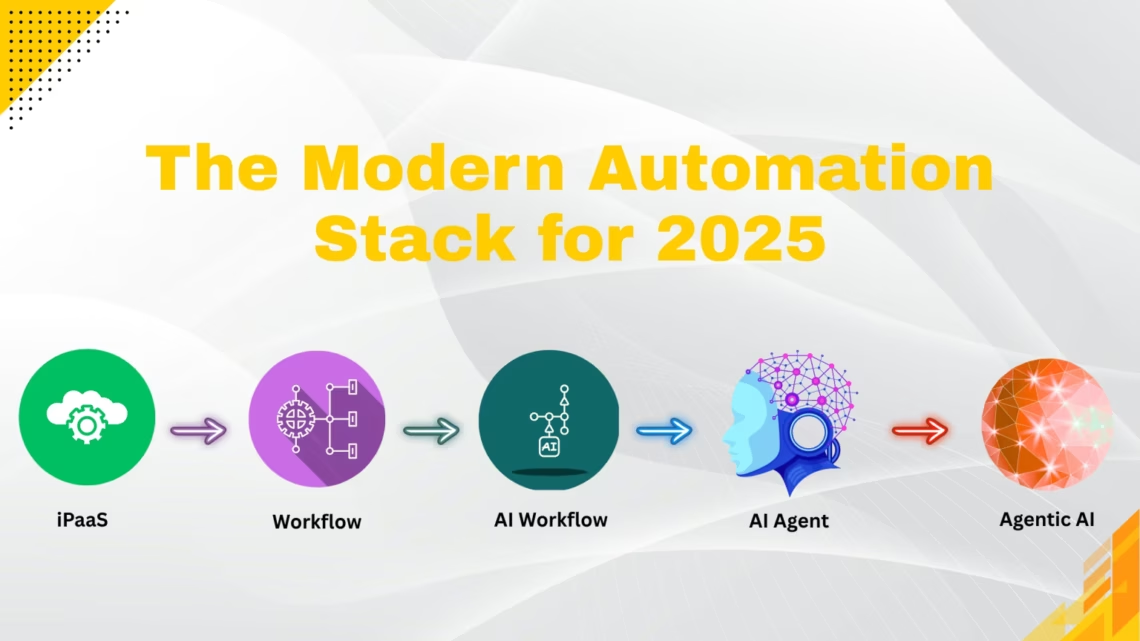
Start with an iPaaS to unify connectivity and data transformation. Add Workflow Automation for predictable tasks. Use AI Workflow Automation to convert unstructured inputs into structured decisions. Deploy AI Agents when steps depend on context. Finally, scale to Agentic AI to complete end-to-end outcomes across teams.
Platform overview
Why This Guide on the Modern Automation Stack?
If your organization runs on a tangle of SaaS apps, legacy systems, CSV drops, and heroic spreadsheets, “just add AI” won’t fix it.
What will help is a Modern Automation Stack — a layered approach with clear responsibilities:
-
Connect & clean the data.
-
Automate the routine steps.
-
Apply AI where human interpretation slows down workflows.
-
Introduce agents when decisions can’t be hard-coded.
-
Orchestrate multiple agents for complete outcomes.
This guide breaks down each layer, adds practical examples, and links to deeper explainers — so you can implement quickly without reinventing the wheel.
Modern Automation Stack – The Five Layers at a Glance
| Layer | What It Does | Best for | Inputs | Outputs | Learn More |
|---|---|---|---|---|---|
| iPaaS | Connects apps/DBs/files; transforms & governs data | Enterprise integration at scale | DB/JDBC, FTP/SFTP, REST/SOAP | Synced records, API calls | Guide · eZintegrations™ |
| Workflow Automation | Deterministic triggers → actions | Approvals, notifications, SaaS-to-SaaS tasks | Webhooks, schedules | CRM updates, Slack, tickets | Guide · eZintegrations™ |
| AI Workflow Automation | Adds LLM steps inside workflows | Unstructured → structured | Emails, PDFs, chats | Validated JSON, summaries | Guide · eZintegrations™ |
| AI Agent | Chooses next best step with planning & tools | Context-heavy tasks | Mixed & contextual | Actions, insights | Guide · Goldfinch AI |
| Agentic AI | Orchestrates multiple agents under a controller | End-to-end outcomes | Multi-system | Completed workflows | Guide · Goldfinch AI |
Why This Guide on the Modern Automation Stack?
Why doesn’t traditional automation or standalone AI solve enterprise complexity?
Because modern operations require both system-level integration and context-aware decision-making, which neither rules-based automation nor isolated AI tools can handle alone.
According to McKinsey, over 70% of digital transformations fail due to fragmented systems and poor orchestration rather than lack of AI models (McKinsey Digital, 2023).
The Modern Automation Stack addresses this by:
-
Separating integration from intelligence
-
Applying AI only where interpretation is required
-
Introducing agents only when workflows can’t be hard-coded
1. iPaaS – Your Integration Backbone
What is iPaaS?
iPaaS (Integration Platform as a Service) connects applications, databases, files, and APIs while handling transformation, validation, and governance at scale.
How does it work?
-
Ingests data from APIs, databases, FTP/SFTP, and webhooks
-
Transforms and validates data using business rules
-
Provides monitoring, retries, and error handling
When should you use it?
Use iPaaS when data reliability and scale matter—especially across ERP, CRM, marketplaces, or regulated industries.
Evidence & scale
-
Enterprises using centralized integration platforms reduce integration failures by 30–50% (Gartner Integration Magic Quadrant, 2024).
-
Healthcare interoperability standards like HL7/FHIR depend on iPaaS-style architectures (HealthIT.gov).
Use cases
-
-
Order-to-Cash automation
-
Customer 360 dashboards
-
Amazon / Walmart SP-API integrations
-
Healthcare data exchange
-
Learn more: What is iPaaS?
2.What is Workflow Automation?
Workflow automation executes predefined triggers → conditions → actions with no ambiguity or interpretation.
How does it work?
-
Triggered by events (new lead, ticket, payment)
-
Applies deterministic logic
-
Executes actions across tools
When should you use it?
Use workflows when outcomes are predictable and rules-based.
Evidence & impact
-
Workflow automation reduces cycle time by 40–60% in sales and support operations (Forrester TEI Reports).
-
SLA adherence improves by up to 25% when manual handoffs are removed.
Common examples
-
CRM updates
-
Approval routing
-
Notifications and ticket creation
Read: Workflow Automation Guide
3. AI Workflow Automation – When Inputs Get Messy
What is AI Workflow Automation?
AI Workflow Automation embeds LLM-powered steps inside workflows to convert unstructured data into structured outputs.
How does it work?
-
AI reads emails, PDFs, chats, or forms
-
Extracts intent, entities, or summaries
-
Outputs validated JSON for downstream systems
When should you use it?
Use AI workflows when human interpretation is the bottleneck, but the process itself is still structured.
Evidence & accuracy
-
LLM-based document extraction achieves 90–95% accuracy with validation layers (Stanford AI Index, 2024).
-
Reduces manual review time by up to 70% in finance and legal workflows.
Industries
Finance • Healthcare • HR • Legal
Explore: AI Workflow Automation
4. AI Agents – From “Do Steps” to “Decide Next Step”
What is an AI Agent?
An AI Agent is a system that plans, reasons, and chooses actions dynamically based on context, goals, and available tools.
How does it work?
-
Observes the current state
-
Plans next steps using reasoning
-
Executes actions via tools or APIs
When should you use it?
Use agents when:
-
Decisions depend on changing context
-
The correct path cannot be pre-defined
Evidence & outcomes
-
Context-aware agents reduce escalation rates by 30–40% in incident management (IBM Research, 2024).
Examples
-
Incident triage
-
Finance reconciliation
-
Complex customer issue resolution
Discover: AI Agent Explained
5. Agentic AI – Orchestrate Teams of Agents
What is Agentic AI?
Agentic AI coordinates multiple specialized agents under a controller to achieve end-to-end business outcomes.
How does it work?
-
Controller assigns goals
-
Specialized agents execute tasks
-
Results are validated and completed
When should you use it?
Use Agentic AI when you want outcome ownership, not just task automation.
Evidence & scale
-
Multi-agent systems outperform single-agent setups by 20–35% on complex, multi-step objectives (MIT CSAIL, 2024).
Industries
SaaS • eCommerce • Healthcare • Security
Learn more: Agentic AI Overview
Modern Automation Stack Adoption Roadmap (90 Days)
-
Weeks 1–3: Stabilize data via iPaaS
-
Weeks 2–5: Automate the routine with Workflows
-
Weeks 4–7: Add AI Workflow Automation
-
Weeks 6–9: Pilot an AI Agent
-
Weeks 8–12: Scale to Agentic AI
Modern Automation Stack KPIs That Matter
How do you measure success?
-
Integration reliability (success %, latency)
-
Workflow automation impact (cycle time, SLA adherence)
-
AI precision and cost per artifact
-
Agentic outcomes (end-to-end success rate)
Product Fit
eZintegrations™ → iPaaS • Workflow • AI Workflow
Goldfinch AI → AI Agents • Agentic AI
FAQs
The Modern Automation Stack is a multi-layered framework that integrates applications, automates workflows, and leverages AI for decision-making. It combines iPaaS, Workflow Automation, AI Workflows, AI Agents, and Agentic AI to create a unified automation ecosystem.
In 2025, organizations operate across multiple systems and platforms. The Modern Automation Stack helps simplify integrations, streamline workflows, and enable intelligent, context-aware automation that scales efficiently across business operations.
The Modern Automation Stack includes five key layers: iPaaS for integration, Workflow Automation for process management, AI Workflow Automation for intelligent data handling, AI Agents for adaptive decision-making, and Agentic AI for orchestrating complete outcomes.
Traditional automation is rule-based and rigid, while the Modern Automation Stack uses AI and machine learning to adapt dynamically, interpret data, and make context-driven decisions without constant human intervention.
The key benefits include improved data connectivity, faster process execution, enhanced decision-making through AI, reduced operational costs, and scalable automation across departments and industries. 1. What is the Modern Automation Stack?
2. Why is the Modern Automation Stack important in 2025?
3. What are the main components of the Modern Automation Stack?
4. How is the Modern Automation Stack different from traditional automation?
5. What are the key benefits of implementing the Modern Automation Stack?