eZintegrations vs Oracle OIC: Modern AI-Native Platform vs Legacy Oracle Stack
March 10, 2026eZintegrations vs Oracle OIC: eZintegrations wins for any enterprise running a mixed stack beyond Oracle. OIC excels inside the Oracle ecosystem but struggles with non-Oracle connectivity, has no native Agentic AI, requires Oracle-certified specialists, and uses a complex message-pack billing model. eZintegrations connects any stack with no platform fee, native Goldfinch AI, and implementation in hours.
TL;DR
Oracle OIC excels at Oracle-to-Oracle integration: Fusion Cloud, EBS, JDE, NetSuite all connect well within the Oracle ecosystem. The moment you need to integrate Oracle with Salesforce, SAP, Shopify, Amazon, Walmart, or a custom SaaS stack, the friction compounds significantly. – Oracle OIC pricing is based on message packs per hour, billed whether your integrations are running or not. Enterprise edition (required for EBS, JDE, Siebel, and SAP adapters) adds further cost. Pricing requires a custom Oracle quote. eZintegrations has no platform fee, no connector fees, and unlimited non-LLM transactions with transparent per-automation annual pricing. – Oracle OIC has no native Agentic AI. Oracle is adding MCP server capability in 2026 but has no Planner-Critic-Aggregator multi-agent architecture. Goldfinch AI of eZintegrations ships with 9 native agent tools out of the box and is self-service extensible. – Oracle OIC requires Oracle-certified integration specialists for non-trivial implementations. eZintegrations is no-code first – IT generalists and business users build and maintain integrations without specialist dependency. – eZintegrations has delivered Oracle Fusion Cloud, EBS, JDE, and NetSuite integrations with Shopify, BigCommerce, WooCommerce, Amazon Seller, Walmart, DHL, Kenco, and other 3PL providers, plus Oracle Fusion Cloud data archival to Data Vault – all using pre-built templates that go live in days.
Summary Comparison Table
| Feature | eZintegrations | Oracle OIC |
|---|---|---|
| Platform fee | None | Message-pack hourly billing (billed when idle) |
| Connector fees | None | Enterprise edition required for EBS, JDE, SAP adapters |
| Non-Oracle system connectivity | Any stack, all native | Workarounds and custom adapters often needed |
| AI Workflows | Yes, native | Partial, Oracle stack only |
| Document Intelligence | Yes, native | Not available outside Oracle apps |
| Goldfinch AI (Agentic AI) | Yes, Planner-Critic-Aggregator | No (MCP server capability only, 2026) |
| AI agent tools | 9 native + self-service extensible | No native agent tools |
| No-code builder | Yes, full | Partial |
| Oracle specialist required | No | Yes for complex implementations |
| Implementation time | 8 to 100 hours | Weeks to months |
| Oracle ERP to eCommerce (Shopify, BigCommerce) | Pre-built templates | Custom build required |
| Oracle ERP to marketplace (Amazon, Walmart) | Pre-built templates | Custom build required |
| Oracle to 3PL (DHL, Kenco) | Pre-built templates | Custom build required |
| Data archival to Data Vault | Supported | Requires additional tooling |
| GraphQL support | Full native | No |
| WebSocket support | Full native | No |
| MCP Protocol | Full native | Partial (2026 addition) |
| gRPC support | Yes | No |
| Fully managed | Yes, Bizdata | Yes, Oracle manages OCI |
| Uptime SLA | 99.9% | 99.9% |
| G2 rating | 4.7 stars | Varies |
eZintegrations vs Oracle OIC: The Quick Verdict
Oracle OIC is a well-built integration platform for enterprises running deep inside the Oracle stack. The moment your integration footprint extends beyond Oracle, eZintegrations is the stronger choice on connectivity, AI capability, pricing transparency, and implementation speed.
Oracle Integration Cloud has been part of the Oracle Cloud Infrastructure (OCI) ecosystem since 2017. It connects Oracle Fusion Cloud, Oracle EBS, JD Edwards, NetSuite, and Siebel applications with maturity and reliability. Oracle’s pre-built SaaS adapters for its own applications are among the best in the market. If your enterprise lives entirely inside the Oracle product family, OIC delivers on its promises.
The problem is that almost no enterprise lives entirely inside Oracle. Your sales team runs Salesforce. Your eCommerce operation runs on Shopify or BigCommerce. Your warehousing connects to DHL, Kenco, or another 3PL. Your marketplace channels include Amazon Seller and Walmart. Your data archival strategy involves a Data Vault outside Oracle. Every one of those connections is a workaround on OIC. On eZintegrations, every one of them is a pre-built template.
According to Gartner Peer Insights, Oracle OIC users consistently rate the platform highly for Oracle-to-Oracle integration and lower for mixed-stack connectivity and ease of use for non-Oracle applications.
The Oracle Ecosystem Lock-In Problem
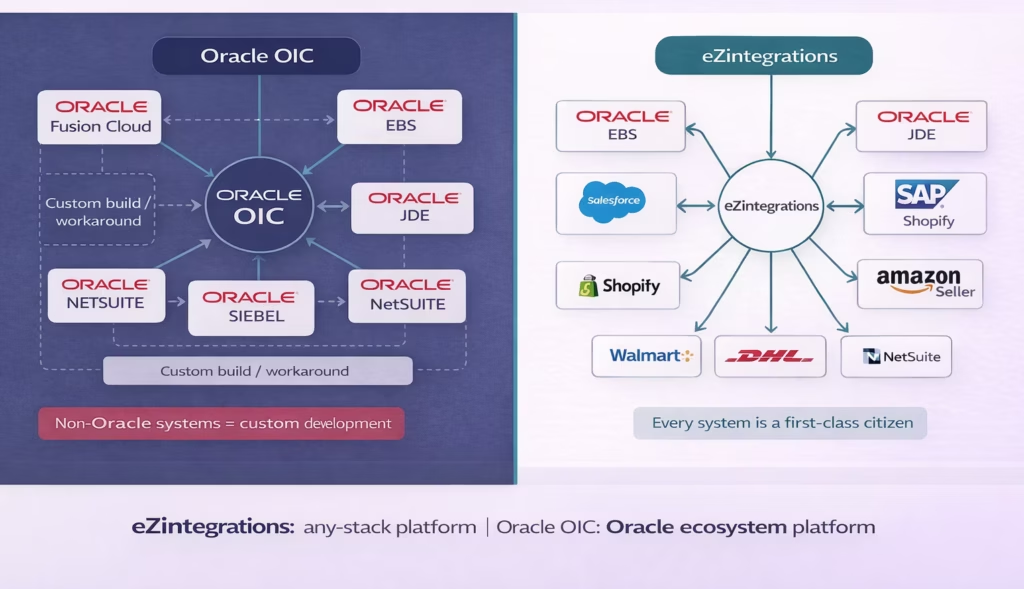
Oracle OIC is architected to be outstanding inside the Oracle stack and significantly more complex outside it. Its pre-built adapters are optimized for Oracle Fusion Cloud, EBS, JDE, NetSuite, and Siebel. Connecting non-Oracle systems like Salesforce, SAP, Shopify, or custom SaaS APIs requires substantially more effort, custom adapter configuration, and often specialist involvement.
This is not a bug. It’s a deliberate design decision. Oracle built OIC to make Oracle customers more productive within the Oracle ecosystem. The Fusion SaaS adapters for HCM, ERP, CX, and SCM are genuinely excellent. The on-premises adapters for EBS and JDE are among the most mature in the market.
The challenge emerges when real enterprise architecture is mapped against OIC’s strengths. Most enterprise IT environments that run Oracle ERP also run a dozen non-Oracle applications: Salesforce for CRM, Shopify or BigCommerce for eCommerce, Amazon Seller Central and Walmart Seller for marketplace channels, DHL or Kenco for 3PL logistics, Snowflake or a custom Data Vault for archival. Each of these requires either a generic REST/SOAP adapter (with custom development) or a third-party connector that OIC doesn’t maintain natively.
eZintegrations treats Oracle and non-Oracle systems with exactly the same level of native support. Oracle Fusion Cloud, EBS, JDE, and NetSuite all have pre-built templates in the Automation Hub, as do Salesforce, SAP, Shopify, BigCommerce, WooCommerce, Amazon Seller, Walmart, DHL, Kenco, and hundreds of other enterprise systems. There is no first-class vs second-class connectivity hierarchy. Every system in your stack is a first-class citizen.
The practical difference: an eZintegrations customer running Oracle EBS alongside Amazon Seller, Walmart, and a Kenco 3PL relationship imports pre-built templates for all four systems and has the integration framework live in days. The same customer on Oracle OIC builds custom adapters for the non-Oracle systems, engages Oracle-certified specialists for the implementation, and runs a project that takes months.
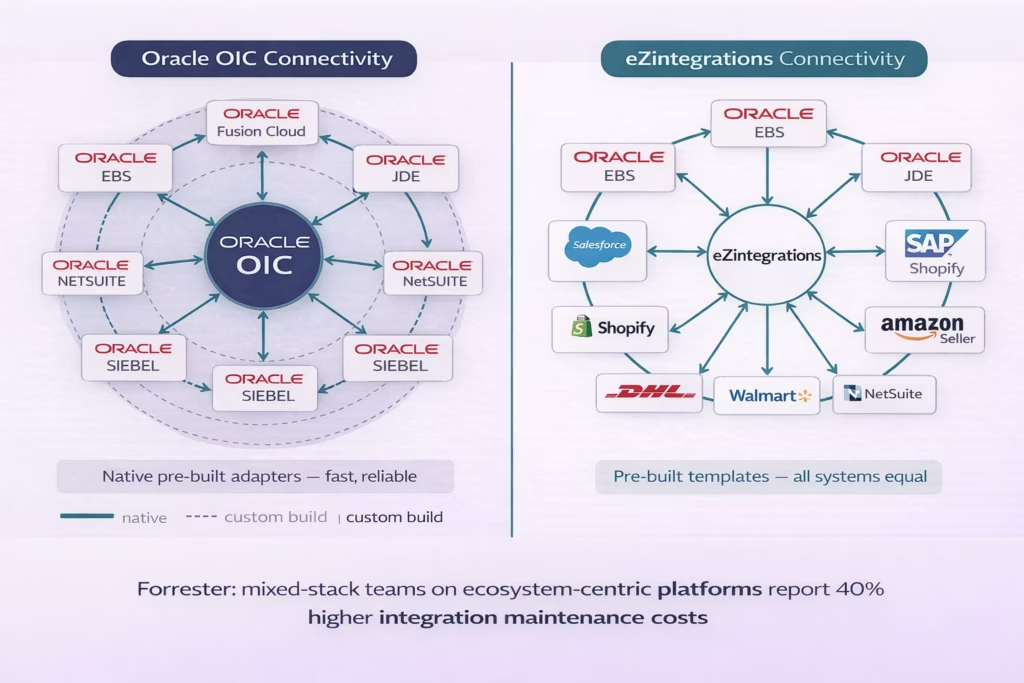
According to Forrester Research, enterprises that run mixed-stack architectures across four or more vendor ecosystems report 40% higher integration maintenance costs on ecosystem-centric platforms compared to vendor-neutral platforms.
Pricing: Message-Pack Complexity vs Transparent Per-Automation Model
Oracle OIC uses a message-pack per-hour billing model that charges you for capacity reserved, not just capacity used. eZintegrations uses a transparent per-automation annual pricing model with no platform fee, no connector fees, and unlimited transactions for non-LLM automations.
Understanding Oracle OIC’s pricing requires understanding its billing unit: the message pack. One message pack gives you 5,000 messages per hour on a standard instance. A message is defined as up to 50KB of data transmitted through OIC. Messages larger than 50KB count as multiple messages (a 320KB payload counts as 7 messages). You are billed for the message packs you provision per hour, whether those packs are being used or not.
This creates several cost dynamics that enterprise buyers often don’t anticipate upfront:
Idle billing: If your OIC instance is running and provisioned for 3 message packs but only uses 1 pack worth of messages in a given hour, you pay for 3 packs for that hour. The capacity you reserved costs money regardless of whether you use it.
Enterprise edition requirement: The standard OIC edition does not include on-premises application adapters. If you need to connect Oracle EBS, JD Edwards, Siebel, or SAP, you must use the Enterprise edition, which adds cost. Most Oracle ERP customers need Enterprise edition.
Scaling complexity: As your integration volume grows or your message payload sizes increase above 50KB, your message pack count grows with them. Budgeting for OIC at scale requires careful modeling of message volumes across all your integrations.
Oracle specialist for sizing: Correctly sizing your OIC deployment for message packs requires someone who understands OIC’s billing model. Under-provisioning causes performance issues. Over-provisioning means paying for unused capacity. Getting the sizing right is a specialist task.
Oracle’s pricing is not publicly listed. Oracle’s official pricing page (oracle.com/integration/pricing) shows the product structure and billing units but requires a cost estimator login or direct Oracle sales engagement for actual per-unit figures. This makes comparative budgeting difficult without an Oracle sales conversation.
eZintegrations’ pricing works the opposite way. It’s published transparently at ezintegrations.ai/pricing:
- No platform fee
- No connector fees
- Unlimited transactions for non-LLM automations, regardless of volume
- Per-automation annual pricing: free for simple automations, $5, $90, $120, or $150 per month depending on complexity
- Complex enterprise automations like Oracle FBDI integrations or EHR/FHIR workflows are priced at the $150 per month tier
- AI-driven automations (Document Intelligence, Goldfinch AI) are priced as base plan plus AI credits, with usage defined in advance for predictable budgeting
- Dev and Test environments at one-third of production cost
The key structural difference: eZintegrations’ cost does not grow with your non-LLM transaction volume. A Shopify-to-Oracle EBS order sync that processes 10,000 orders per month costs the same annual fee as one processing 500,000 orders per month. That is a fundamentally different relationship with integration cost as your business scales.
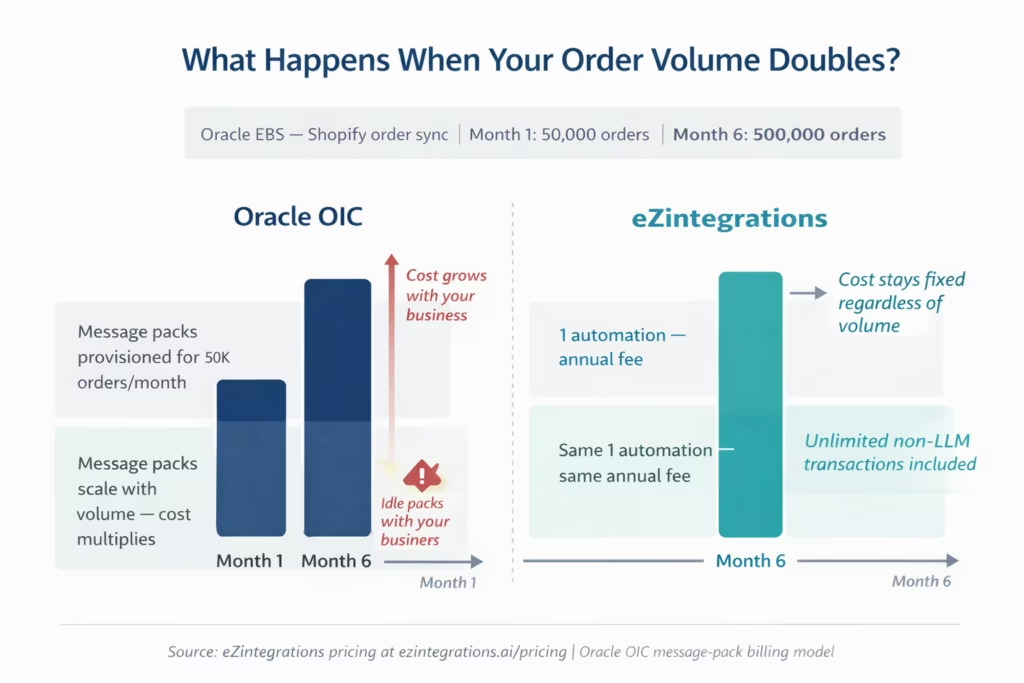
See exactly what your automations cost before you commit. View eZintegrations pricing — every automation shows its annual price transparently with no Oracle sales conversation required.
AI Capabilities: Oracle AI vs Goldfinch AI of eZintegrations
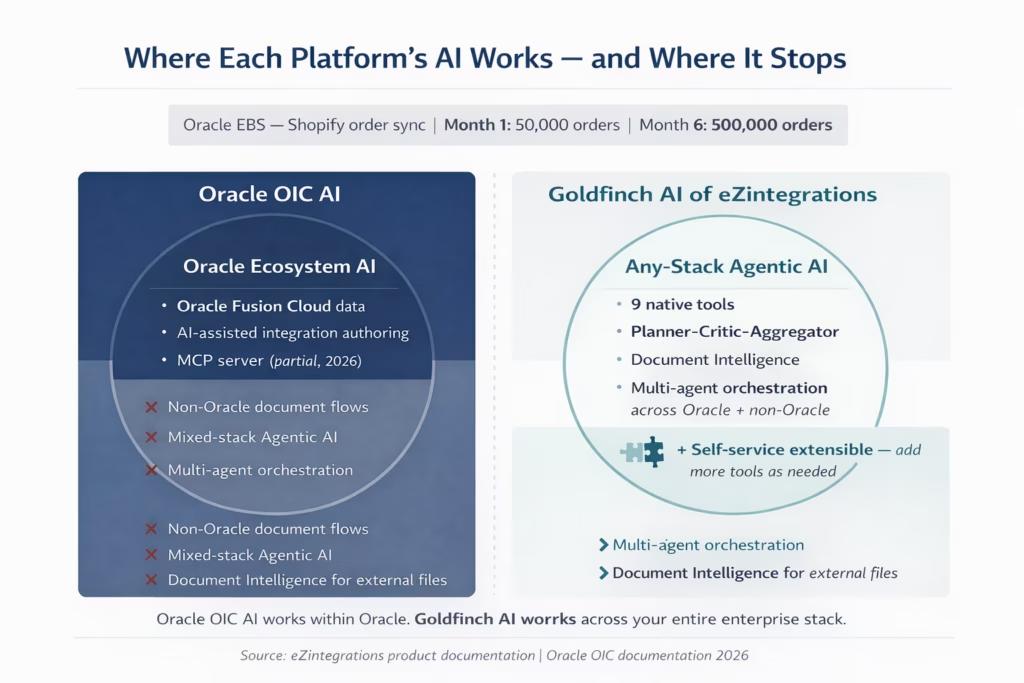
Oracle OIC’s AI capabilities are tightly bound to the Oracle application stack. Oracle AI Services work well for Oracle Fusion Cloud data. They do not extend to Document Intelligence for non-Oracle document flows, autonomous multi-agent orchestration, or Agentic AI for mixed-stack enterprise processes. Goldfinch AI of eZintegrations delivers all of that natively.
Oracle has made genuine AI investments in OIC. The 2026 release introduced MCP server capability, allowing Oracle integrations to be called by external AI agents. Oracle’s AI assistant helps with natural language authoring of integrations. The platform describes itself as “AI-powered” and positions OIC as what “makes AI agents work” within the Oracle ecosystem.
The critical qualifier is “within the Oracle ecosystem.” Oracle AI Services for data processing and AI-assisted authoring work on Oracle Fusion Cloud data. Document Intelligence for processing emails, PDFs, or EDI files from non-Oracle trading partners is not a native OIC capability. Autonomous multi-agent orchestration for a mixed-stack procurement process spanning Oracle ERP, Salesforce, and a 3PL API does not exist on OIC. The Planner-Critic-Aggregator multi-agent architecture that Goldfinch AI of eZintegrations uses has no equivalent in Oracle’s current or announced roadmap.
Here is the complete AI capability comparison:
| AI Capability | eZintegrations | Oracle OIC |
|---|---|---|
| AI native in workflow engine | Yes | Partial, Oracle apps only |
| Document Intelligence (email, PDF, EDI to structured data) | Yes, native | No, not outside Oracle apps |
| Email-to-ERP PO automation | Yes, native | No native capability |
| 2-way and 3-way invoice matching | Yes, native | Partial, Oracle Fusion data only |
| AI Agents with tools | Yes, 9 native tools | No native agent tools |
| Self-service tool extensibility | Yes | No |
| Dynamic Tool Calling | Yes (unique) | No |
| Goldfinch AI: Planner-Critic-Aggregator | Yes, native | No |
| MCP Protocol support | Yes, full native | Partial (2026 addition) |
| Any workflow to MCP endpoint | Yes, 1 click | Partial |
| Vector Knowledge Base | Yes | No |
| Human-in-the-Loop (Critic Agent) | Yes, built-in architecture | Manual step only |
| Multi-agent orchestration | Yes, Goldfinch AI | No |
Goldfinch AI of eZintegrations ships with 9 native agent tools out of the box: Knowledge Base Vector Search, Document Intelligence, Data Analysis, Data Analytics with Charts and Dashboards, Web Crawling, Watcher Tools, API Tool Call (all auth types including OAuth 1.0/2.0), Integration Workflow as a Tool, and Integration Flow as MCP. Beyond those 9, users can add more tools as self-service without developer involvement or additional licensing.
For an IT leader at an Oracle ERP shop evaluating where their AI automation roadmap goes, this capability gap is the most important decision factor in 2026. Oracle OIC will keep your Oracle-to-Oracle workflows running. It will not deliver autonomous procurement cycle management, supply chain disruption response, or multi-agent clinical data reconciliation across mixed enterprise systems. Goldfinch AI of eZintegrations does all three, natively, today.
Developer Dependency: Oracle Specialists vs No-Code First
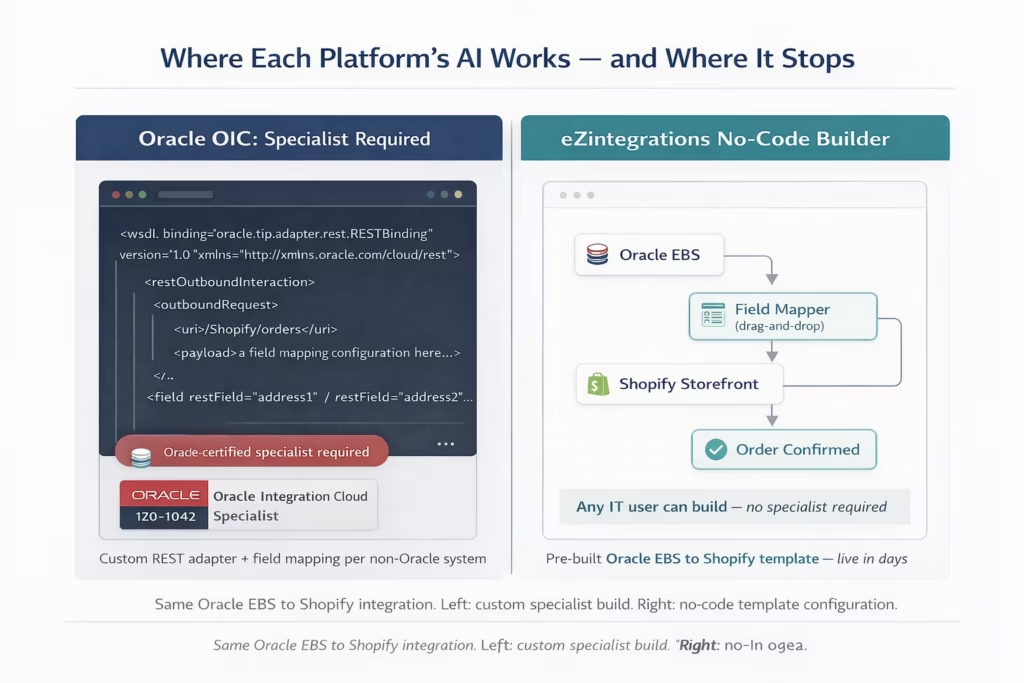
Oracle OIC implementations, particularly those involving on-premises adapters for EBS, JDE, or Siebel, or complex mixed-stack connectivity, require Oracle-certified integration specialists. eZintegrations is no-code first — your IT generalists and operations teams build and maintain integrations without specialist dependency.
Oracle OIC offers a visual integration canvas that is more accessible than pure code-based platforms. For straightforward Oracle SaaS-to-SaaS connections using pre-built adapters, a technically competent IT professional can build basic integrations. The complexity increases significantly when you move to:
- On-premises adapters requiring connectivity agent installation and configuration
- Complex data transformation for non-standard Oracle data models
- Custom REST adapter configuration for non-Oracle systems
- Multi-step orchestration flows with error handling and retry logic
- Process automation using OIC’s BPM capabilities
At each of these levels, Oracle recommends certified OIC specialists. Oracle’s certification path (the 1Z0-1042 Oracle Cloud Platform Application Integration Specialist exam and related certifications) creates a specialist dependency similar to MuleSoft’s DataWeave requirement. Finding, hiring, and retaining Oracle-certified integration developers adds cost and creates delivery bottlenecks.
eZintegrations is no-code across the full capability range. Your IT Director imports an Oracle EBS to Amazon Seller Central template, configures the credentials and field mappings through a point-and-click interface, and deploys. Your operations manager builds an Oracle Fusion Cloud data archival workflow to your Data Vault without writing a single line of code or understanding Oracle’s connectivity agent architecture. The platform’s no-code canvas handles all the complexity below the surface.
This difference has a direct impact on delivery velocity. When a business stakeholder requests a new Shopify-to-Oracle EBS integration on OIC, the request joins a queue for the Oracle specialist team. When the same request comes in on eZintegrations, the operations team imports the template and is live in hours.
Implementation Speed: Templates vs Custom Builds
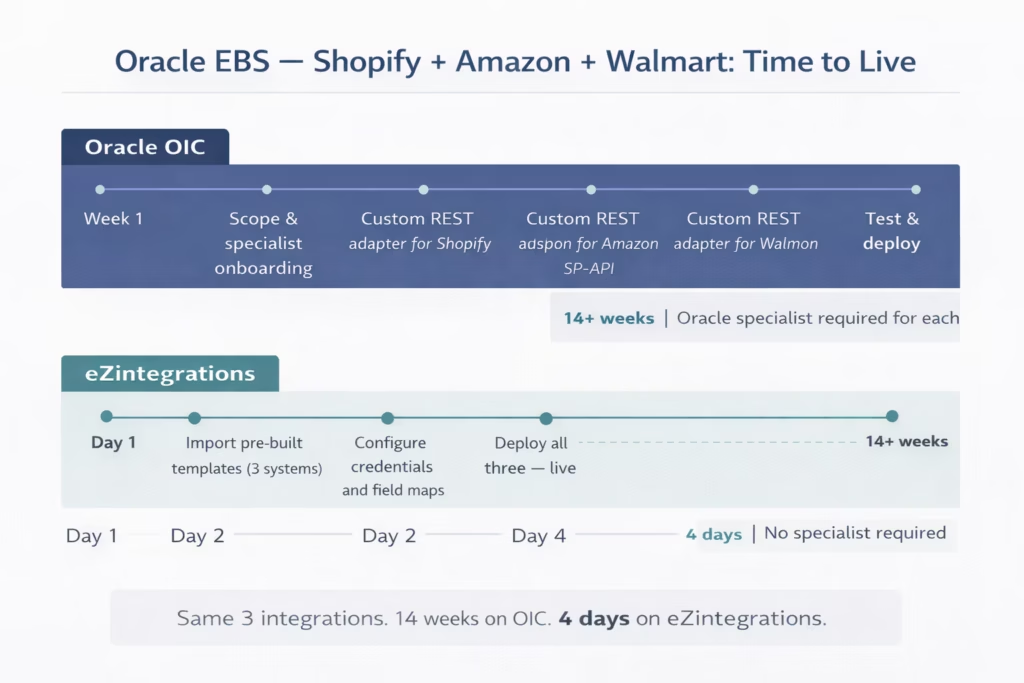
eZintegrations Oracle integrations go live in 8 to 100 hours using pre-built Automation Hub templates. The equivalent Oracle OIC implementations require weeks to months of specialist-led custom configuration.
The speed difference comes from the same structural advantage described throughout this comparison: eZintegrations starts from production-ready templates, while OIC starts from blank canvas builds requiring specialist knowledge.
Here’s what realistic implementation timelines look like across the use cases most relevant to Oracle ERP customers:
| Integration Use Case | Oracle OIC | eZintegrations |
|---|---|---|
| Oracle Fusion Cloud to Salesforce CRM sync | 4 to 8 weeks | 1 to 3 days |
| Oracle EBS to Shopify order management | 6 to 12 weeks | 2 to 5 days |
| Oracle EBS to Amazon Seller Central | 6 to 12 weeks | 2 to 5 days |
| Oracle EBS to Walmart Seller | 6 to 12 weeks | 2 to 5 days |
| Oracle NetSuite to BigCommerce or WooCommerce | 4 to 8 weeks | 1 to 3 days |
| Oracle JDE to DHL or Kenco 3PL | 6 to 12 weeks | 2 to 5 days |
| EDI trading partner onboarding (Oracle ERP) | 4 to 8 weeks per partner | Hours per partner |
| Oracle Fusion Cloud data archival to Data Vault | 8 to 16 weeks | 1 to 2 weeks |
| Email-to-ERP PO automation (non-Oracle documents) | Not natively supported | 1 to 3 days |
| 3-way invoice matching across mixed systems | Not natively supported | 2 to 5 days |
The EDI trading partner use case is particularly telling. Oracle EBS shops routinely have backlogs of 20, 30, or 40+ trading partner integrations waiting for specialist resource availability. On eZintegrations, each EDI trading partner onboards from a template in hours. A global Industrial Goods company cleared a 40+ trading partner backlog in under two months using eZintegrations, a project that would have taken 12 to 18 months on OIC.
Use Case Comparison: Six Real Mixed-Stack Scenarios
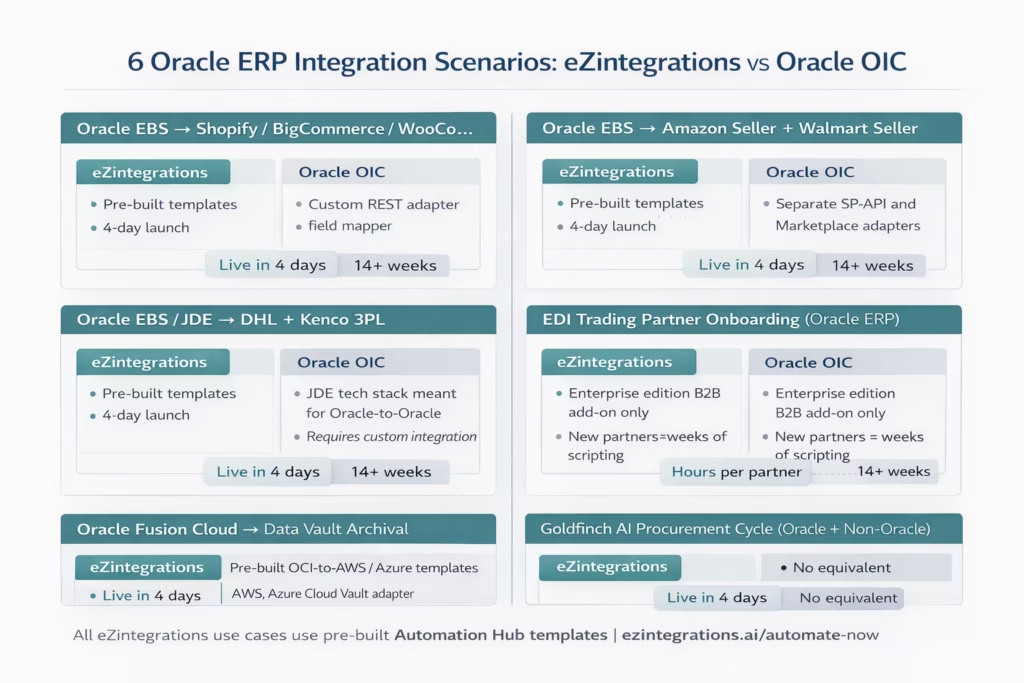
The clearest way to see the difference between eZintegrations and Oracle OIC is through the specific integration scenarios that Oracle ERP customers deal with every day. The ones that are straightforward on OIC, and the ones that aren’t.
Use Case 1: Oracle EBS to Shopify, BigCommerce, and WooCommerce
Oracle EBS is the backbone for order management, inventory, and financials at thousands of manufacturing, retail, and CPG companies. Their eCommerce storefronts run on Shopify, BigCommerce, or WooCommerce. Syncing product catalogues, inventory levels, order status, and shipment tracking between these systems is a daily operational requirement.
On Oracle OIC: there is no native Shopify, BigCommerce, or WooCommerce adapter. You build a custom REST adapter using OIC’s generic HTTP connector, map Oracle EBS data structures to each platform’s API schema, handle authentication (OAuth for Shopify, API keys for BigCommerce), build pagination logic, and manage error retry. Each platform is a separate custom build. Each requires an Oracle specialist.
On eZintegrations: pre-built templates for Oracle EBS to Shopify, BigCommerce, and WooCommerce cover order management, inventory sync, product catalogue, and shipment tracking. Configure credentials, map your specific fields, deploy. Live in 2 to 5 days per integration.
Use Case 2: Oracle EBS to Amazon Seller Central and Walmart Seller
Marketplace integrations are among the most technically demanding in retail and CPG. Amazon’s SP-API and Walmart’s Seller API both have complex authentication, paginated data models, and strict rate limits. Keeping Oracle EBS synchronized with multiple marketplace channels for inventory, orders, and fulfillment is a full-time integration challenge.
On Oracle OIC: no native Amazon Seller or Walmart Seller adapters. Custom REST adapter builds for each marketplace’s API, including handling Amazon’s complex SP-API signature authentication and Walmart’s OAuth 2.0 implementation. Each marketplace channel requires specialist development and ongoing maintenance as API versions change.
On eZintegrations: pre-built templates for Oracle EBS to Amazon Seller Central and Walmart Seller cover inventory sync, order pull, shipment confirmation, and returns handling. Multiple marketplace channels handled in parallel. Template configuration in days rather than custom builds over months.
Use Case 3: Oracle EBS and JDE to 3PL Providers (DHL, Kenco, Other)
Third-party logistics integrations require bidirectional sync between your Oracle ERP and your 3PL provider’s warehouse management system: outbound shipment orders, inbound goods receipt confirmations, inventory adjustments, and returns processing. Different 3PLs use different APIs, EDI standards, and data formats.
On Oracle OIC: 3PL connectivity is generic REST or EDI adapter territory. Each 3PL requires custom adapter configuration. DHL and Kenco are not native OIC adapters. Mixed EDI and API connectivity for the same 3PL partner requires multiple integration patterns.
On eZintegrations: pre-built templates for DHL, Kenco, and other major 3PL providers. EDI and API connectivity handled natively. New 3PL onboarding in days rather than weeks per provider.
Use Case 4: EDI Trading Partner Onboarding Across Oracle ERP Variants
Oracle ERP customers — whether running Fusion Cloud, EBS, JDE, or NetSuite — have trading partner networks that use EDI for purchase orders, invoices, advance ship notices, and inventory advisories. EDIFACT (ORDERS/850, INVOIC/810, DESADV/856) and X12 formats are standard. Each trading partner has specific schema variations.
On Oracle OIC: the Enterprise edition includes EDI/B2B capabilities. But configuring EDIFACT-to-JSON or X12-to-JSON conversion for each trading partner’s specific schema requires Oracle specialist involvement. With backlogs of 20 to 40+ trading partners, this creates a months-long implementation queue.
On eZintegrations: pre-built EDIFACT-to-JSON and X12-to-JSON templates cover all major transaction sets. Each trading partner onboards in hours. A global Industrial Goods company with 40+ pending Oracle ERP trading partner integrations cleared their entire backlog in under two months.
Use Case 5: Oracle Fusion Cloud Data Archival to Data Vault
Oracle Fusion Cloud ERP generates large volumes of transactional data: GL entries, AP/AR transactions, procurement records, and asset data. Organizations with 7-year or longer data retention requirements need to pull this data out of Oracle Fusion Cloud and archive it to a cost-efficient Data Vault (Snowflake, AWS S3, Azure Data Lake, or custom data warehouse).
On Oracle OIC: Oracle provides data extraction capabilities for Fusion Cloud, but building a full data archival pipeline to an external Data Vault requires additional tooling and custom development. OIC is not primarily designed as a data archival platform.
On eZintegrations: Oracle Fusion Cloud data archival to Data Vault is a supported integration pattern with template coverage. Pull Oracle Fusion Cloud transactional data on a scheduled or event-driven basis, transform to your Data Vault schema, load with full audit trail. Implementation in 1 to 2 weeks rather than 8 to 16 weeks of custom build.
Use Case 6: End-to-End Procurement with Goldfinch AI Spanning Oracle and Non-Oracle Systems
A global manufacturing company runs Oracle EBS for procurement and inventory, Salesforce for vendor relationship management, and a mix of EDI and API-based supplier connections. Their AP team manually handles invoice matching exceptions, vendor escalations, and PO discrepancies across these systems every day.
On Oracle OIC: no Agentic AI capability. The integration infrastructure moves data between systems but human intervention handles every exception, decision, and cross-system reconciliation.
On eZintegrations with Goldfinch AI: the full procurement cycle runs autonomously. A Planner Agent creates the execution blueprint spanning Oracle EBS, Salesforce, and supplier APIs. Sub-agents handle vendor validation, PO matching, goods receipt confirmation, and 3-way invoice matching in parallel using Document Intelligence for non-Oracle document processing. The Critic Agent flags genuine exceptions to the AP manager with full context. The Aggregator delivers a complete reconciliation report. What consumed 3 AP team members a full day completes in 2 to 4 hours.
 Any of these use cases match your current backlog? Explore 1,000+ production-ready templates including Oracle ERP integrations with eCommerce, marketplaces, 3PLs, and EDI trading partners — all with transparent annual pricing.
Protocol Support: Where eZintegrations Goes Further
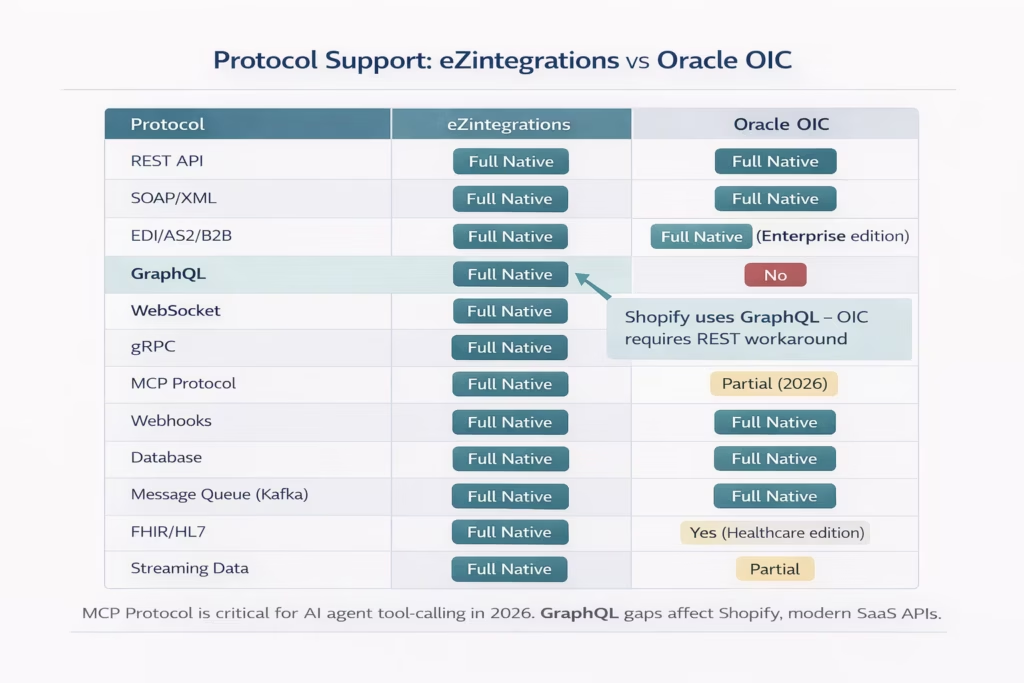
eZintegrations supports every integration protocol Oracle OIC supports, plus four that OIC either doesn’t support natively or only partially added in 2026: full native GraphQL, full native WebSocket, full native gRPC, and full native MCP Protocol.
Oracle OIC was built for enterprise application integration using REST, SOAP, and EDI patterns. These are well-supported and mature. The protocol gaps appear in modern API patterns and AI agent connectivity:
| Protocol | eZintegrations | Oracle OIC |
|---|---|---|
| REST API | Full native | Full native |
| SOAP/XML | Full native | Full native |
| EDI/AS2/B2B | Full native | Full native (Enterprise edition) |
| GraphQL | Full native | No |
| WebSocket | Full native | No |
| gRPC | Full native | No |
| MCP Protocol | Full native | Partial (2026 addition) |
| Webhooks | Full native | Full native |
| Database (SQL/NoSQL) | Full native | Full native |
| Message Queue (Kafka) | Full native | Full native |
| FHIR/HL7 (Healthcare) | Full native | Yes (Healthcare edition) |
| Streaming Data | Full native | Partial |
The GraphQL gap is particularly relevant for Oracle ERP customers integrating with modern eCommerce platforms. Shopify’s Storefront API and Admin API use GraphQL as the primary interface. Building a Shopify integration on OIC without native GraphQL requires REST adapter workarounds. eZintegrations handles GraphQL natively, which is why the Shopify-to-Oracle template works out of the box.
Who Should Choose Each Platform
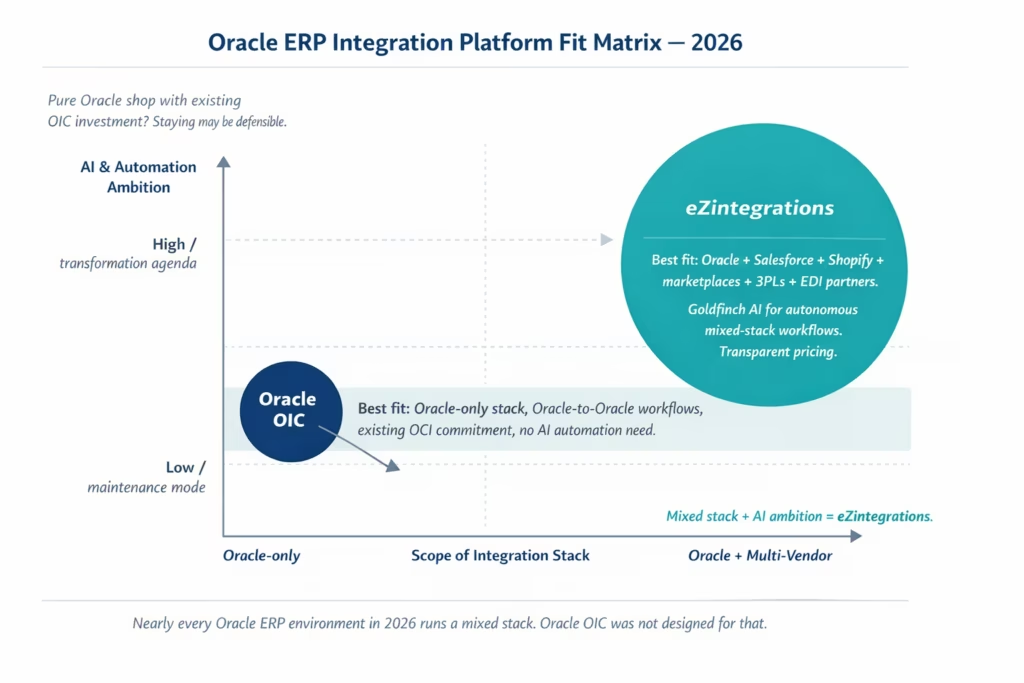
Choose Oracle OIC if:
- Your integration needs are primarily Oracle-to-Oracle: Fusion Cloud to EBS, Oracle HCM to Oracle ERP, Oracle CX to Oracle SCM
- You are already committed to the Oracle Cloud Infrastructure (OCI) and Oracle is your strategic cloud vendor across all workloads
- You run Oracle Fusion Cloud and want the tightest possible pre-built adapter support for Oracle SaaS modules
- Your enterprise has Oracle-certified integration specialists on staff and existing OIC implementations that would be expensive to migrate
- Your primary integration partner is another Oracle application and non-Oracle connectivity is a secondary requirement
Choose eZintegrations if:
- Your Oracle ERP (Fusion Cloud, EBS, JDE, or NetSuite) needs to connect with Salesforce, SAP, Shopify, BigCommerce, WooCommerce, Amazon, Walmart, DHL, Kenco, or any non-Oracle system
- You have an EDI trading partner backlog and need to onboard multiple partners quickly without specialist-led custom builds per partner
- You need Document Intelligence for email-to-ERP automation, invoice matching, or EDI conversion across non-Oracle document flows
- You want Goldfinch AI (Agentic AI) for autonomous procurement, supply chain, or finance workflows spanning Oracle and non-Oracle systems
- Your team needs no-code integration building without Oracle-certified specialist dependency
- You want transparent per-automation pricing with no message-pack billing complexity and no idle-instance cost
- You need Oracle Fusion Cloud data archival to an external Data Vault as part of your data strategy
Bottom Line Verdict
Oracle OIC is the right choice if Oracle is your only world. eZintegrations is the right choice for every Oracle customer whose world extends beyond Oracle, which in 2026 is nearly every Oracle customer.
Here is the direct verdict across the five dimensions that matter most:
Any-stack connectivity: eZintegrations wins decisively. Oracle EBS to Shopify, Amazon, Walmart, DHL, Kenco, BigCommerce, and WooCommerce are pre-built templates on eZintegrations. They are custom builds on OIC. For mixed-stack enterprises, this single difference justifies the evaluation.
Pricing model: eZintegrations wins on transparency and scalability. No platform fee, no connector fees, unlimited non-LLM transactions, per-automation annual pricing shown publicly. OIC’s message-pack hourly billing requires sizing expertise and charges for reserved capacity whether you use it or not.
AI capability: eZintegrations wins by a significant margin. Goldfinch AI with 9 native agent tools and self-service extensibility has no equivalent on OIC. Oracle’s MCP addition in 2026 is a step toward AI agent connectivity, not a multi-agent orchestration architecture.
Developer dependency: eZintegrations wins for mixed-stack environments. No-code first means your IT generalists build and maintain integrations. OIC’s complexity for non-Oracle connectivity creates specialist dependency for most real-world enterprise use cases.
Implementation speed: eZintegrations wins. 8 to 100 hours from templates vs weeks to months of OIC specialist-led custom builds for the mixed-stack use cases most Oracle ERP customers actually need.
The honest question for any Oracle ERP customer is: how much of your integration backlog is Oracle-to-Oracle, and how much of it involves the non-Oracle systems your business actually runs on? For most enterprises, the answer points clearly toward eZintegrations.
Conclusion: The Mixed-Stack Reality Most Oracle Customers Face
Your Oracle ERP is the backbone of your business. It handles your financials, your procurement, your inventory, your manufacturing records. That part isn’t changing. What is changing is everything around it.
Your sales team adopted Salesforce three years ago. Your eCommerce team launched on Shopify. Your marketplace strategy now spans Amazon and Walmart. Your logistics partner is DHL or Kenco. Your data strategy requires archiving Oracle Fusion Cloud data to a Snowflake Data Vault for seven-year compliance. And your CFO is asking why your AP team still manually handles invoice exceptions that should be automated.
Oracle OIC will connect your Oracle applications to each other beautifully. It will not connect them to Shopify, Amazon, Walmart, DHL, or Kenco through pre-built templates. It will not process email-to-ERP purchase orders from non-Oracle suppliers natively. And it will not run an autonomous multi-agent procurement cycle spanning Oracle EBS and your Salesforce vendor relationships.
eZintegrations does all of that. Oracle Fusion Cloud, EBS, JDE, and NetSuite are all first-class citizens in the Automation Hub alongside Shopify, BigCommerce, WooCommerce, Amazon Seller Central, Walmart Seller, DHL, Kenco, and hundreds of other systems your business runs on. No specialist required. No message-pack sizing exercise. No custom adapter builds for non-Oracle systems.
Goldfinch AI of eZintegrations takes it further: 9 native agent tools out of the box, self-service extensible, handling the autonomous workflows that sit above your integrations and make decisions your AP team currently makes by hand.
The most valuable hour your team can spend right now is seeing eZintegrations connect your Oracle ERP to the non-Oracle systems in your stack — and seeing how fast a mixed-stack integration that took months on OIC can go live from a template.
Book a Free Demo at ezintegrations.ai/book-a-demo
Or start by exploring 1,000+ production-ready templates including Oracle ERP integrations with every major eCommerce platform, marketplace, 3PL, and EDI trading partner network.
FAQs
1. Is eZintegrations better than Oracle OIC
For enterprises running mixed stacks beyond Oracle yes. eZintegrations connects Oracle ERP including Fusion Cloud EBS JD Edwards and NetSuite with Salesforce Shopify Amazon Walmart 3PL systems and custom SaaS using pre built templates. It has no platform fee no connector fees transparent per automation pricing and native Goldfinch AI which Oracle OIC does not provide. Oracle OIC is typically better suited only for pure Oracle to Oracle integration scenarios.
2. Can eZintegrations integrate with Oracle Fusion Cloud EBS JDE and NetSuite
Yes. eZintegrations includes pre built templates for all major Oracle ERP platforms including Oracle Fusion Cloud Oracle EBS JD Edwards and NetSuite. These templates support order management inventory synchronization procurement financial integrations and data archival to external Data Vault environments. Oracle ERP connectivity is implemented as first class integrations rather than workarounds.
3. How does Oracle OIC pricing compare to eZintegrations
Oracle OIC uses a message pack hourly billing model that is charged whether integrations are actively running or idle. Enterprise edition is required for adapters such as Oracle EBS JD Edwards and SAP which increases cost and pricing typically requires an Oracle sales engagement. eZintegrations publishes transparent pricing with no platform fee no connector fees unlimited non LLM transactions and per automation annual pricing ranging from free to 150 dollars per month. AI automations are priced using a base plan plus AI credits.
4. Does eZintegrations support Oracle EBS to Amazon Seller Central and Walmart
Yes. eZintegrations provides pre built templates for Oracle EBS integrations with Amazon Seller Central and Walmart Seller including inventory synchronization order management fulfillment confirmation and returns. Oracle OIC does not provide native Amazon Seller or Walmart connectors and typically requires custom REST adapter builds for each marketplace integration.
5. What is Goldfinch AI and does Oracle OIC have an equivalent
Goldfinch AI is the Agentic AI capability within eZintegrations built on a Planner Critic Aggregator multi agent architecture. It includes 9 native agent tools and supports self service extensibility. Goldfinch AI enables autonomous procurement cycles supply chain orchestration and finance workflows across Oracle and non Oracle systems. Oracle OIC introduced MCP server capability in 2026 but does not include multi agent orchestration a Planner or Critic agent model or an equivalent to the Goldfinch AI architecture.
6. How long does it take to migrate from Oracle OIC to eZintegrations
Oracle to Oracle integrations typically migrate in days to weeks using equivalent Automation Hub templates. Mixed stack integrations such as Oracle to Shopify Amazon Walmart or 3PL systems are often faster to rebuild directly on eZintegrations due to the availability of pre built templates. Bizdata supports the migration process end to end.
7. Can eZintegrations handle Oracle Fusion Cloud data archival to an external Data Vault
Yes. Oracle Fusion Cloud data archival to external Data Vault platforms including Snowflake AWS S3 Azure Data Lake or other data warehouses is a supported integration pattern within eZintegrations. The platform supports scheduled or event driven data extraction transformation and loading with full audit trails. Typical implementation takes one to two weeks.