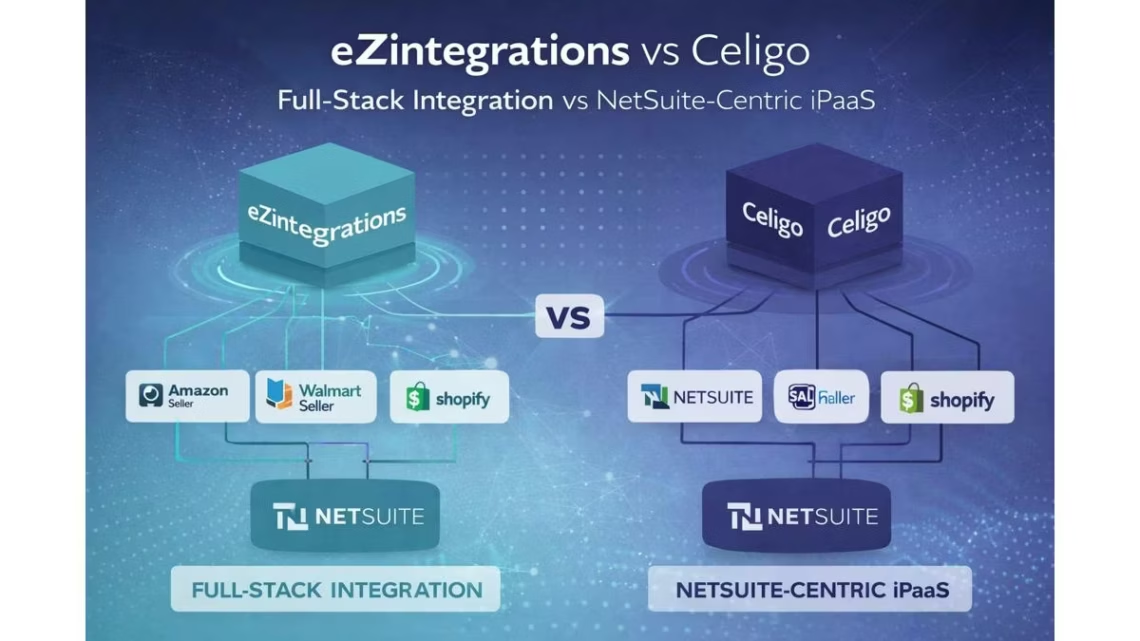
eZintegrations vs Celigo 2026: Full-Stack Integration vs NetSuite-Centric iPaaS
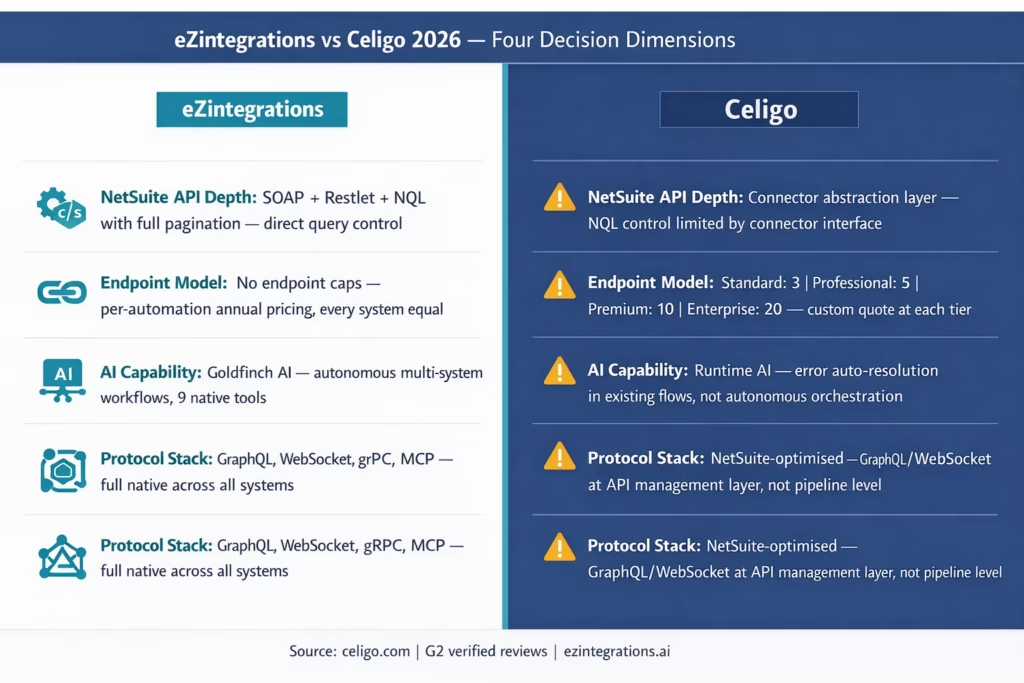
March 11, 2026eZintegrations vs Celigo: eZintegrations wins on NetSuite API depth (SOAP, Restlet, and NQL with full pagination), no endpoint caps as your trading partner network grows, Goldfinch AI autonomous workflows vs Celigo’s error-resolution AI, and full native GraphQL, WebSocket, gRPC, and MCP support for multi-stack enterprises beyond NetSuite.
TL;DR
eZintegrations connects to NetSuite via all three native API modes: SOAP API, Restlet API, and NetSuite Query Language (NQL) API with full pagination, numeric parameters, and time-based parameters. This gives your team direct, high-performance data access from NetSuite without connector workarounds. Celigo connects via its proprietary NetSuite connector, which handles standard flows well but adds an abstraction layer that limits direct query control. Celigo prices by endpoints and flows. Standard gives you 3 endpoints, Professional gives you 5, Premium gives you 10, Enterprise gives you 20. An enterprise connecting NetSuite to Amazon Seller Central, Walmart, Shopify, DHL, Kenco, a Vendor Portal, and a Customer Portal already needs 8 or more endpoints, which exceeds Celigo’s Professional tier and pushes you to a custom-quoted Enterprise plan. eZintegrations has no endpoint caps. Your trading partner network grows without triggering a pricing tier conversation. Celigo’s “runtime AI” auto-resolves up to 95% of integration errors automatically. That is a useful operational feature. Goldfinch AI of eZintegrations runs autonomous multi-system workflows: Planner, Specialist Sub-Agents, Critic, and Aggregator working across NetSuite, Amazon, Walmart, Shopify, and your 3PLs simultaneously. Error resolution and autonomous orchestration are not the same capability. Celigo is genuinely strong for NetSuite-first businesses. It markets itself explicitly as “NetSuite’s largest partner for over a decade” and has over 5,000 NetSuite customers. For enterprises where NetSuite is the sole ERP anchor and all integrations radiate from it, Celigo delivers well within its endpoint model. For enterprises running NetSuite alongside SAP, Oracle ERP, Salesforce, multiple marketplaces, 3PLs, and industry-specific platforms, eZintegrations treats every system as a first-class connection without endpoint penalty. eZintegrations is rated 4.7 stars on G2, Capterra, Software Advice, and GetApp across 50+ enterprise customers including a global Retail company and a Beauty and Cosmetics enterprise running NetSuite to Amazon, Walmart, Vendor Portal, Customer Portal, DHL, and Kenco in production today.
Summary Comparison Table
| Feature | eZintegrations | Celigo |
|---|---|---|
| Pricing model | Per-automation, annual, transparent | Per-endpoint and per-flow, custom quote for paid tiers |
| Public pricing | Yes, published at ezintegrations.ai/pricing | Free tier only; paid tiers require custom quote |
| Endpoint caps | None | Standard: 3 / Professional: 5 / Premium: 10 / Enterprise: 20 |
| Transaction / task volume charges | None for non-LLM automations | No per-task charges (endpoint + flow model) |
| NetSuite SOAP API | Yes, native | Yes, via Celigo NetSuite connector |
| NetSuite Restlet API | Yes, native | Yes, via Celigo NetSuite connector |
| NetSuite NQL (Query Language) | Yes, native with full pagination | Limited, abstracted through connector |
| NQL pagination (numeric + time-based) | Full native | Not directly exposed |
| GraphQL support | Full native | Yes (API management layer) |
| WebSocket support | Full native | Not native |
| gRPC support | Full native | No |
| MCP Protocol | Full native | No |
| REST API | Full native | Full native |
| EDI / B2B | Full native | Full native |
| Agentic AI (production) | Yes, Goldfinch AI | No multi-agent production system |
| AI type | Planner-Critic-Aggregator autonomous workflows | Runtime AI for error auto-resolution |
| Native AI agent tools | 9 tools + self-service extensible | No production agent tools |
| Document Intelligence | Yes, native | No |
| 1,000+ pre-built templates | Yes, Automation Hub | Integration templates and apps (NetSuite-focused) |
| Amazon Seller Central | Yes, native | Yes |
| Walmart Seller | Yes, native | Yes (recent addition) |
| 3PL connectors (DHL, Kenco) | Yes, native | Available via connector library |
| Vendor and Customer Portals | Yes, native | Available |
| Multi-ERP (SAP + Oracle + NetSuite) | Yes, all equal | NetSuite primary; others via generic connectors |
| No-code for complex transformations | Yes, Document Intelligence | Low-code; complex mapping can be difficult |
| G2 / review rating | 4.7 stars | Strong, #1 iPaaS on G2 for six straight quarters |
| Uptime SLA | 99.9% | 99.9% |
| Fully managed | Yes, Bizdata | Yes, Celigo cloud-managed |
eZintegrations vs Celigo: The Quick Verdict
Celigo is the most NetSuite-specialized iPaaS on the market. It has 5,000+ NetSuite customers, 80+ prebuilt NetSuite integration apps, and a decade-long partnership with Oracle NetSuite that gives it genuine depth in standard NetSuite-to-SaaS flows. For enterprises where NetSuite is the single ERP anchor and integration needs stay within Celigo’s endpoint model, it delivers.
The problems emerge in three specific situations: when your NetSuite connections require deeper native API control than Celigo’s connector abstraction allows, when your trading partner network grows past Celigo’s endpoint tier, and when you need autonomous AI-driven workflow orchestration rather than AI-assisted error management.
Celigo markets itself directly as “NetSuite’s largest partner for over a decade.” That positioning is both a strength and a structural signal: the platform is optimized for NetSuite at its centre. For enterprises running NetSuite as one system among many, alongside SAP, Oracle ERP, Salesforce, multiple marketplaces, 3PLs, and trading partner portals – the architecture that makes Celigo excellent for NetSuite-first companies creates friction when every additional system is another endpoint charge and another step away from the platform’s optimized core.
eZintegrations connects to NetSuite via SOAP API, Restlet API, and NQL with full pagination. It treats NetSuite, Amazon, SAP, Salesforce, Shopify, Walmart, DHL, and Kenco as equal first-class connections. No endpoint caps, no connector abstraction limits, and Goldfinch AI running autonomous workflows across all of them simultaneously.
NetSuite API Depth: Three Modes vs One Connector
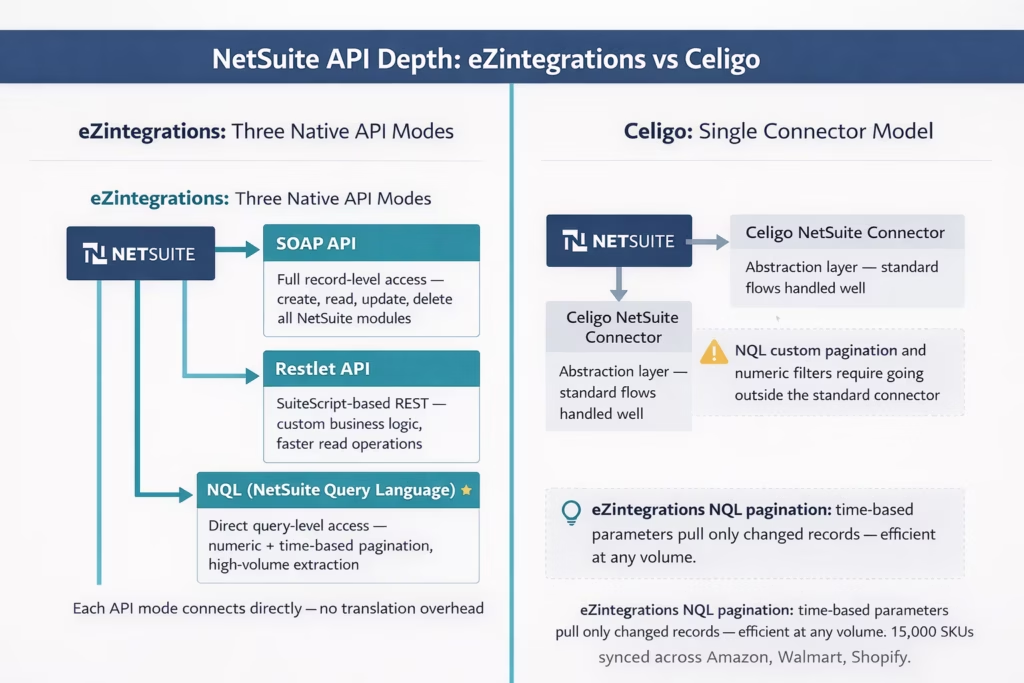
eZintegrations connects to NetSuite via all three native API modes: SOAP API, Restlet API, and NetSuite Query Language (NQL) API with full pagination including numeric and time-based parameters. This means your team can pull data directly from NetSuite at query level, with the precision and performance that NQL provides, without going through a connector abstraction layer. Celigo connects via its proprietary NetSuite connector, which handles standard flows effectively but abstracts the underlying NetSuite APIs behind its own interface.
This distinction matters most when you need high-volume, high-precision data extraction from NetSuite. Here is what each API mode delivers in practice:
SOAP API: NetSuite’s original web services interface. Full record-level access, reliable for transactional operations including creating, reading, updating, and deleting NetSuite records across all modules. eZintegrations supports the full SOAP API natively, meaning every NetSuite record type your business uses is accessible without limitations.
Restlet API: NetSuite’s SuiteScript-based REST interface. Faster than SOAP for read operations, supports custom business logic embedded in SuiteScript, and exposes data through RESTlets that your NetSuite team builds and maintains. eZintegrations connects to these Restlets directly, meaning your custom NetSuite logic is accessible to your integrations without any translation overhead.
NetSuite Query Language (NQL): This is where eZintegrations’ NetSuite depth is most distinctive. NQL is NetSuite’s native SQL-like query language, introduced to provide high-performance data access directly from NetSuite’s analytics data source. NQL lets you write precise queries against NetSuite data: filter by specific field values, apply numeric range conditions, use time-based parameters to pull records created or modified within a defined window, and retrieve exactly the data set you need.
eZintegrations supports NQL natively with full pagination. For high-volume scenarios, pulling 100,000 sales order records, extracting all open purchase orders modified in the last 24 hours, or synchronizing NetSuite inventory positions to Amazon and Walmart simultaneously, NQL pagination means your pipelines process data in controlled, reliable batches without hitting NetSuite’s API limits or creating timeout errors.
The operational impact for retail and eCommerce enterprises is direct. A global Retail company running eZintegrations connects their NetSuite ERP to Amazon Seller Central, Walmart, Shopify, DHL, Kenco, a Vendor Portal, and a Customer Portal. Order data flows from each marketplace into NetSuite via NQL-validated queries. Inventory positions sync from NetSuite outward to all channels using time-based NQL parameters to catch only records updated since the last sync cycle. Fulfillment confirmations return from DHL and Kenco and update NetSuite records via SOAP API. All three API modes working in the same enterprise pipeline, each doing what it does best.
Celigo’s NetSuite connector handles the most common NetSuite-to-SaaS flows well, which is why it serves 5,000+ NetSuite customers effectively. The limitation is that its connector is an abstraction layer rather than a direct API client. Direct NQL control with custom pagination parameters, custom numeric filters, and time-windowed queries requires going outside what the standard Celigo connector exposes, which typically means engaging Celigo’s professional services or building custom connector extensions.
The Endpoint Pricing Ceiling: Where Celigo’s Model Caps Growth
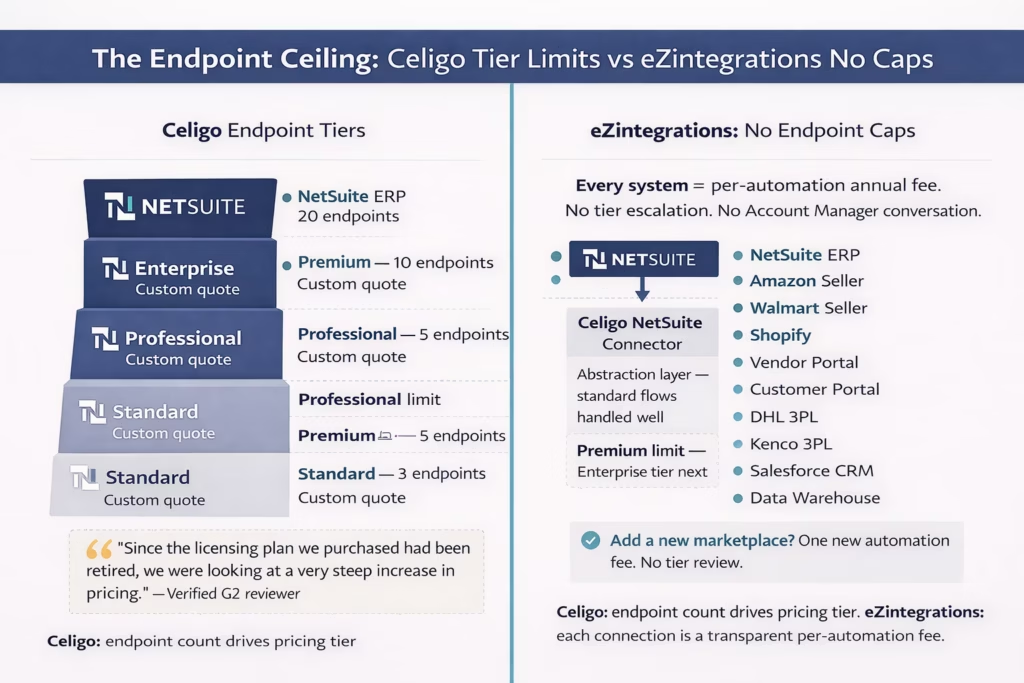
Celigo prices by endpoints and flows. An endpoint is any system or application connected to the platform. The Standard plan gives you 3 endpoints, Professional gives you 5, Premium gives you 10, and Enterprise gives you 20. For enterprises connecting NetSuite to a full trading partner and marketplace network, the endpoint count grows fast and the pricing tier follows. eZintegrations has no endpoint caps. Every trading partner, marketplace, and portal your business adds connects without triggering a tier conversation.
Celigo is direct about its pricing model on celigo.com: “Celigo charges based on endpoints and flows, so you can scale integrations without worrying about task-based overages.” The model genuinely eliminates per-task and transaction-volume surprises, which is a real advantage over platforms like Boomi that charge per message. But the endpoint tier itself creates a different kind of ceiling.
Here is what a realistic enterprise trading partner scenario looks like against Celigo’s endpoint tiers:
| Connected System | Endpoint Count |
|---|---|
| NetSuite ERP | 1 |
| Amazon Seller Central | 2 |
| Walmart Seller | 3 |
| Shopify storefront | 4 |
| Vendor Portal | 5 |
| Customer Portal | 6 |
| DHL (3PL) | 7 |
| Kenco (3PL) | 8 |
| Salesforce CRM | 9 |
| Internal Data Warehouse | 10 |
That is 10 endpoints for a retail or distribution enterprise with a standard operating stack. Celigo’s Professional plan covers 5 endpoints. The Premium plan covers 10 (with a custom quote). Adding one more trading partner, marketplace, or system pushes you to the Enterprise tier at 20 endpoints, again on a custom quote basis.
G2 reviewers flag the pricing escalation at renewal specifically. One verified G2 reviewer noted: “since the licensing plan we purchased had been retired, we were looking at a very steep increase in pricing.” For growing enterprises, the endpoint model means every business expansion: a new marketplace, a new 3PL partner, a new vendor portal, a new regional Shopify store, is also a potential pricing conversation with their Celigo Account Manager.
eZintegrations handles this differently. Pricing is per-automation on an annual basis, published transparently at ezintegrations.ai/pricing. Adding Amazon Seller Central to your NetSuite pipeline costs the per-automation annual fee for that connection. Adding Walmart Seller costs the per-automation fee for that connection. Adding a Kenco 3PL integration costs the per-automation fee for that integration. None of these additions changes your overall platform tier or requires a sales conversation about endpoint caps.
A Beauty and Cosmetics enterprise running eZintegrations connects NetSuite to their Amazon Seller Central, their Walmart marketplace presence, their DHL fulfillment partner, their Kenco distribution hub, and both a Vendor Portal for supplier order management and a Customer Portal for B2B account management. That is seven connections. On Celigo Professional (5 endpoints), they would need to upgrade to Premium. On eZintegrations, each connection is a transparent per-automation annual fee. No tier conversation. No Account Manager escalation.
The practical result: your integration architecture decisions are driven by your business requirements, not by endpoint arithmetic.
Want to see what your full trading partner stack costs before committing? View eZintegrations transparent pricing — every automation priced by connection, no endpoint tiers, no sales call required.
AI Capability: Autonomous Workflows vs Error Resolution
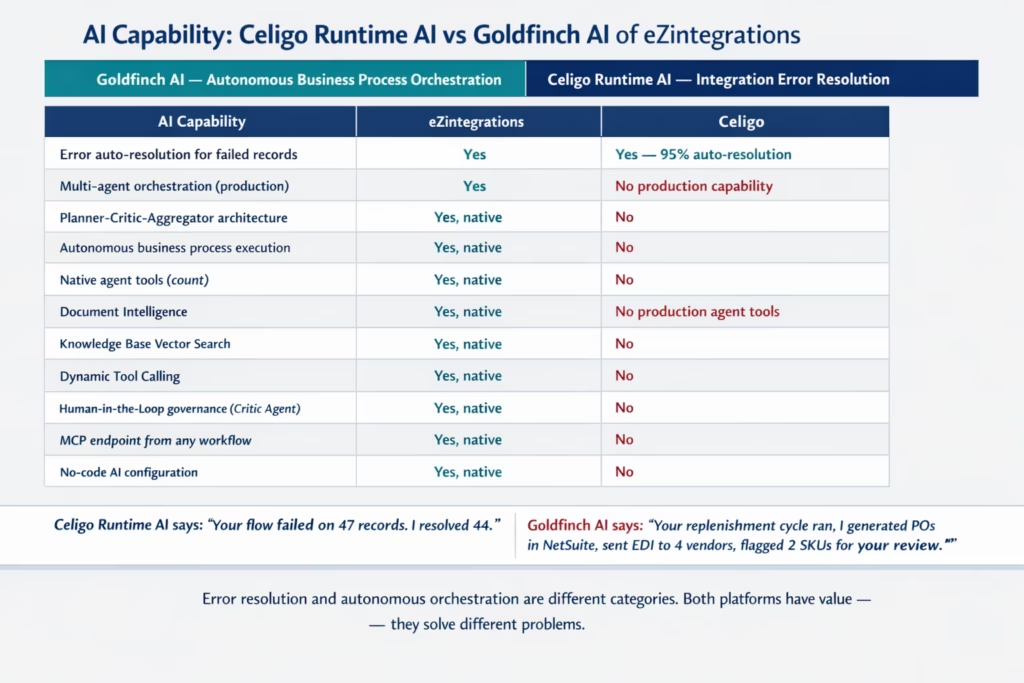
Celigo’s runtime AI automatically resolves up to 95% of integration errors, keeping workflows running without manual intervention. This is a genuinely useful operational feature for teams managing high volumes of integration flows. Goldfinch AI of eZintegrations is a different category of capability: a Planner-Critic-Aggregator multi-agent system that runs autonomous multi-system workflows across NetSuite, Amazon, Walmart, Shopify, and your 3PLs simultaneously. Resolving errors in running integrations and orchestrating autonomous business processes across multiple systems are not the same thing.
Understanding what each platform’s AI actually does is important for any enterprise making a platform decision with a 3 to 5 year horizon.
Celigo’s runtime AI monitors integration flows in real time, identifies error patterns, and automatically applies resolution logic to recover failed records without requiring a human to diagnose and reprocess them. When an Amazon order fails to create a NetSuite sales order due to a field mapping mismatch, Celigo’s AI detects the pattern and either resolves it automatically or routes it to a human with a clear diagnosis. This reduces the operational burden of managing integration error queues, which is a real and meaningful benefit for teams running dozens of active integration flows.
Goldfinch AI of eZintegrations does not manage integration errors. It orchestrates business outcomes across multiple systems autonomously. Here is the operational difference:
Celigo runtime AI: “Your Amazon-to-NetSuite order sync failed on 47 records. I resolved 44 automatically. Here are 3 that need your attention.”
Goldfinch AI of eZintegrations: “Your replenishment trigger fired for 12 SKUs across three regional warehouses. I pulled current inventory from NetSuite via NQL, compared against Amazon sell-through rates via the Selling Partner API, generated draft purchase orders in NetSuite for supplier approval, sent EDI 850 messages to four vendors via your vendor portal, and flagged two SKUs where lead time exceeds your stockout threshold for procurement manager review.”
The first capability improves operational efficiency for integration maintenance. The second capability replaces a multi-step manual business process with an autonomous system that makes decisions, executes actions across systems, and escalates only genuine judgment calls.
Here is the production AI comparison today:
| AI Capability | eZintegrations | Celigo |
|---|---|---|
| Error auto-resolution | Yes | Yes (95% auto-resolution) |
| Multi-agent orchestration (production) | Yes, Goldfinch AI | No |
| Planner-Critic-Aggregator architecture | Yes | No |
| Autonomous business process execution | Yes | No |
| Native agent tools out of the box | 9 tools + extensible | No production agent tools |
| Document Intelligence | Yes, native | No |
| Knowledge Base Vector Search | Yes | No |
| Dynamic Tool Calling | Yes | No |
| Human-in-the-Loop governance (Critic Agent) | Yes | Manual routing only |
| MCP endpoint from any workflow | Yes, 1 click | No |
| No-code AI configuration | Yes | No |
Goldfinch AI of eZintegrations ships with 9 native tools: Knowledge Base Vector Search, Document Intelligence, Data Analysis, Data Analytics with Charts and Dashboards, Web Crawling, Watcher Tools, API Tool Call supporting all authentication types, Integration Workflow as a Tool, and Integration Flow as MCP. Your team adds additional tools as self-service without developer involvement or additional licensing.
For enterprises evaluating both platforms for their 2026 and beyond integration strategy, the question is not which platform handles today’s integration error queue better. It is which platform positions your team to automate the business processes that are still manual today: procurement cycle management, order-to-cash orchestration, vendor onboarding, inventory replenishment decisions, and supply chain exception handling across NetSuite, Amazon, Walmart, and your 3PL network.
Full-Stack vs NetSuite-Centric: Protocol and Multi-System Support
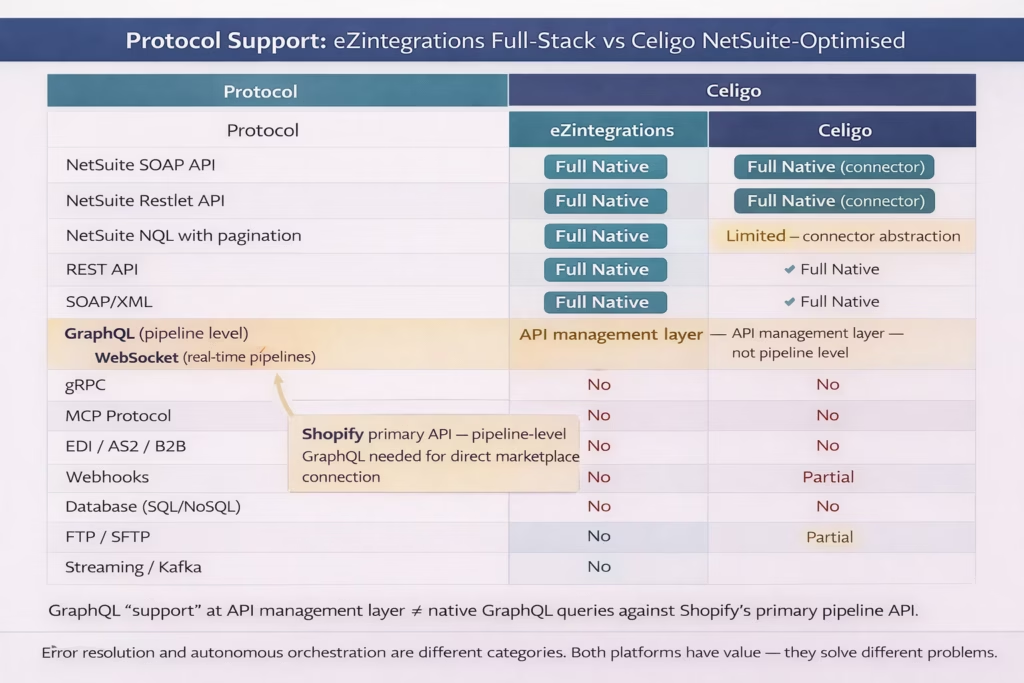
Celigo is optimized for NetSuite as the centre of its integration architecture. Enterprises running NetSuite as their sole ERP anchor benefit from this focus. Enterprises running NetSuite alongside SAP, Oracle ERP, Salesforce, and multiple marketplaces need a platform that treats every system with equal native capability. eZintegrations provides full native support for REST, GraphQL, WebSocket, gRPC, MCP Protocol, Webhooks, EDI, and Databases, with NetSuite’s three API modes as one part of a complete protocol stack.
Celigo states on its platform page that its API management supports RESTful, SOAP, GraphQL, and WebSocket APIs. This is accurate for its API management layer. The distinction is between API management capability (managing APIs you expose or consume through a gateway) and native protocol support for real-time integration patterns at the data pipeline level.
Here is the full protocol comparison:
| Protocol | eZintegrations | Celigo |
|---|---|---|
| NetSuite SOAP API | Full native | Full native (connector) |
| NetSuite Restlet API | Full native | Full native (connector) |
| NetSuite NQL with pagination | Full native | Limited (connector abstraction) |
| REST API | Full native | Full native |
| SOAP/XML | Full native | Full native |
| GraphQL (pipeline level) | Full native | API management layer |
| WebSocket (real-time pipelines) | Full native | API management layer |
| gRPC | Full native | No |
| MCP Protocol | Full native | No |
| EDI / AS2 / B2B | Full native | Full native |
| Webhooks | Full native | Full native |
| Database (SQL/NoSQL) | Full native | Full native |
| FTP / SFTP | Full native | Full native |
| Streaming / Kafka | Full native | Partial |
The GraphQL distinction is operationally important for Retail and eCommerce enterprises. Shopify’s primary API is GraphQL. Amazon’s Selling Partner API uses REST but its product catalog and inventory operations increasingly use GraphQL query patterns. For enterprises running NetSuite as their ERP backbone while selling across Shopify, Amazon, and Walmart simultaneously, GraphQL at the integration pipeline level means direct, high-performance connections to each marketplace’s primary interface. Celigo’s GraphQL support at the API management layer means it manages GraphQL APIs you expose outward, not that it natively queries GraphQL-first marketplace APIs at the pipeline level.
For multi-ERP enterprises, the difference is architectural. eZintegrations treats SAP, Oracle ERP, NetSuite, and Salesforce as equal first-class connections, each with full native API support. Celigo treats NetSuite as its primary connection and uses generic connectors for other ERPs. An enterprise running NetSuite for eCommerce and SAP for manufacturing, which is a common structure in global Retail and Consumer Goods, needs both ERP systems connected with equivalent depth. eZintegrations provides that. Celigo’s architecture positions NetSuite at the centre and treats SAP as a peripheral system.
Use Case Comparison: Four Real Enterprise Scenarios
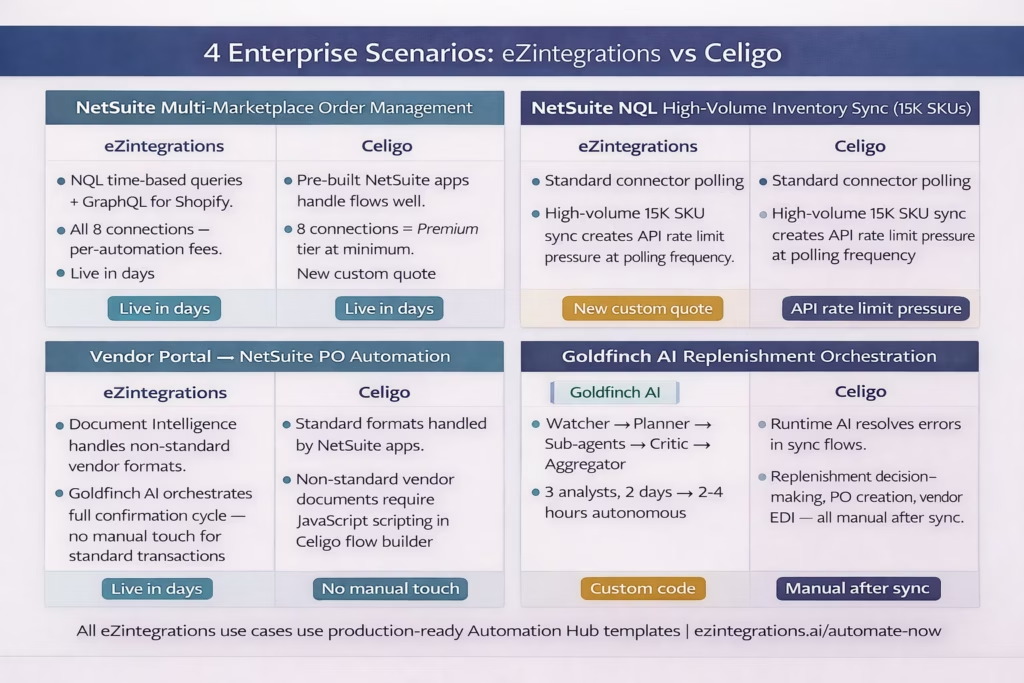
Use Case 1: NetSuite to Multi-Marketplace Order Management
A global Retail enterprise sells across Amazon Seller Central, Walmart, and their own Shopify storefront. Their ERP is NetSuite. They need real-time order ingestion from all three channels, NetSuite sales order creation, inventory reservation, and fulfillment confirmation returned to each marketplace as orders ship through DHL and Kenco.
On Celigo: Amazon, Walmart, Shopify, NetSuite, DHL, and Kenco represent 6 endpoints. Celigo’s Professional plan covers 5. Add a Vendor Portal for supplier purchase orders and a Customer Portal for B2B accounts, and you are at 8 endpoints: Premium tier at minimum, Enterprise depending on their Celigo edition at renewal. The order management flows themselves are well-handled by Celigo’s prebuilt NetSuite integration apps. The pricing escalation comes from the endpoint count of the full operating stack.
On eZintegrations: Amazon connects via REST API with full Selling Partner API support. Walmart connects via REST. Shopify connects via native GraphQL. NetSuite connects via NQL with time-based pagination to pull orders modified in the last sync window. DHL and Kenco connect via their respective APIs for fulfillment confirmation. Each connection is a per-automation annual fee. No endpoint tier. The global Retail company running this stack on eZintegrations today pays transparent, predictable costs as their marketplace network grows.
Use Case 2: NetSuite NQL for High-Volume Inventory Sync
A Beauty and Cosmetics enterprise manages 15,000 active SKUs across NetSuite. They need real-time inventory positions synchronized to Amazon, Walmart, and their Shopify storefront, updated whenever a NetSuite inventory record changes.
On Celigo: the NetSuite connector handles inventory sync through standard flow triggers. For 15,000 SKUs with frequent updates, the sync relies on Celigo’s polling mechanism against NetSuite’s standard API endpoints. High-volume scenarios with frequent updates can create performance pressure on the connector’s polling frequency and NetSuite’s API rate limits.
On eZintegrations: NQL with time-based pagination queries NetSuite directly: “Give me all inventory records modified in the last 5 minutes, paginated in batches of 500.” The query runs on a schedule, pulls only changed records, and pushes updates to Amazon, Walmart, and Shopify in parallel. No full-catalog polling. No API rate limit pressure. The time-based NQL parameter means only genuine inventory changes propagate, keeping sync efficient at any SKU volume.
Use Case 3: Vendor Portal to NetSuite Purchase Order Automation
The same Beauty and Cosmetics enterprise onboards new suppliers through a Vendor Portal. Vendors submit purchase order acknowledgments, advance ship notices, and invoices through the portal. All of these need to create and update corresponding NetSuite records: purchase orders, item receipts, and vendor bills.
On Celigo: the Vendor Portal connection is one endpoint. NetSuite is another. Two endpoints for this flow. Celigo’s prebuilt NetSuite integration templates handle purchase order and item receipt flows well for standard document formats. For non-standard vendor document formats or vendors using proprietary EDI schemas, additional customization is required, typically involving JavaScript scripting within Celigo’s flow builder.
On eZintegrations: the Vendor Portal connects via REST or Webhook depending on the portal’s architecture. NetSuite updates via SOAP API for transactional record creation. Document Intelligence handles non-standard vendor document formats natively, extracting purchase order acknowledgment data from PDFs, flat files, or proprietary schemas without scripting. Goldfinch AI can orchestrate the full vendor confirmation cycle autonomously: receive acknowledgment, validate against the NetSuite PO, flag discrepancies to the procurement team, and confirm receipt to the vendor portal, all without manual intervention for standard transactions.
Use Case 4: Goldfinch AI Replenishment Orchestration vs Celigo Runtime AI
A global Retail company runs their replenishment cycle manually: the supply chain team reviews NetSuite inventory weekly, compares against Amazon sell-through rates, calculates reorder quantities, creates NetSuite purchase orders, and sends POs to vendors via EDI. The process takes three analysts two days per week.
On Celigo: runtime AI monitors the integration flows that sync Amazon sell-through data to NetSuite and flags errors in those sync flows for automatic resolution. The replenishment decision-making itself, the comparison, the calculation, the PO creation, the vendor communication, remains a manual process that happens after the data is synced.
On eZintegrations with Goldfinch AI: a Watcher Tool monitors NetSuite inventory levels via NQL and triggers when any SKU crosses a reorder threshold. The Planner Agent designs the full replenishment execution. Data Analysis sub-agents pull Amazon sell-through rates, calculate reorder quantities using configurable business logic, and generate draft purchase orders in NetSuite via SOAP API. The Integration Workflow as a Tool sub-agent sends EDI 850 purchase order messages to vendors via the Vendor Portal connection. The Critic Agent flags purchase orders where the calculated quantity deviates significantly from historical patterns for procurement manager review. The Aggregator delivers a complete replenishment summary with full audit trail.
What took three analysts two days runs autonomously in 2 to 4 hours with human oversight at the decisions that genuinely require judgment.
Running NetSuite with Amazon, Walmart, Shopify, and 3PL connections? Explore 1,000+ production-ready templates including NetSuite SOAP, Restlet, and NQL integrations with Amazon Seller Central, Walmart, DHL, Kenco, and marketplace-to-ERP order management, all with transparent per-automation pricing.
Pricing Comparison: Endpoint Model vs Per-Automation Transparent
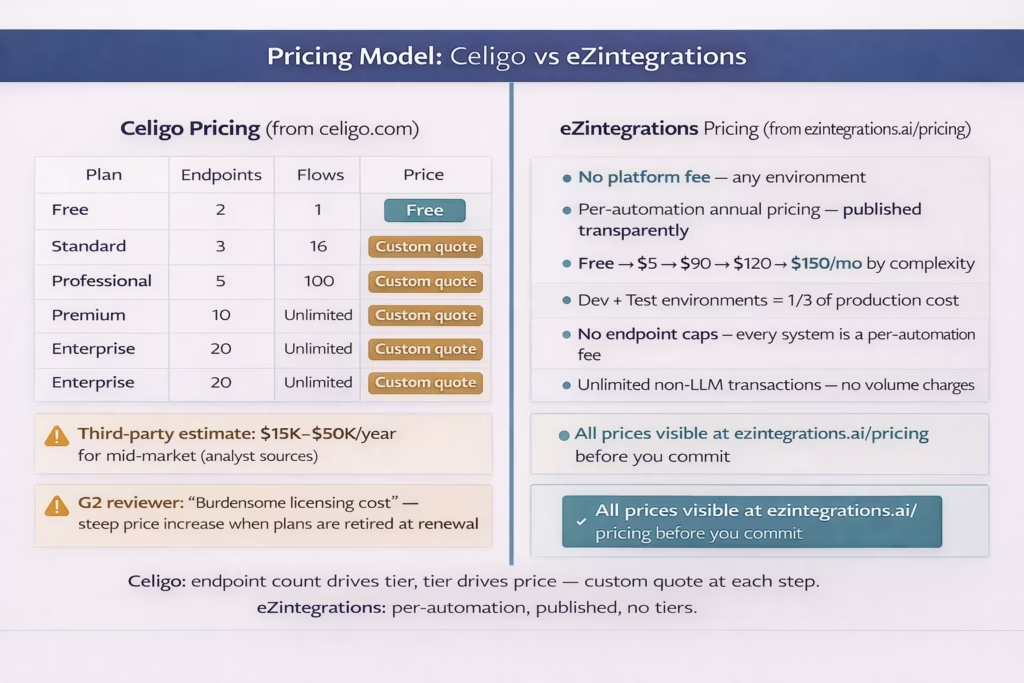
Celigo prices by endpoints and flows with no public dollar figures on its paid tiers. All paid plans require a custom quote via Account Manager. eZintegrations publishes all pricing transparently at ezintegrations.ai/pricing with per-automation annual fees and no endpoint caps.
Here is what is publicly known about each pricing model:
Celigo pricing structure (from celigo.com):
| Plan | Endpoints | Flows | Pricing |
|---|---|---|---|
| Free | 2 | 1 | Free |
| Standard | 3 | 16 | Custom quote |
| Professional | 5 | 100 | Custom quote |
| Premium | 10 | Unlimited | Custom quote |
| Enterprise | 20 | Unlimited | Custom quote |
Third-party analyst sources reference a budget range of $15,000 to $50,000 annually as a typical mid-market Celigo engagement. G2 reviewers describe the licensing cost as “burdensome” and flag steep price increases at renewal when licensing plans are retired. Celigo explicitly positions its endpoint-and-flow model as more predictable than per-task pricing, which is a fair claim: you will not face surprise volume overages. The unpredictability comes from endpoint tier escalation as your integration footprint grows and from renewal pricing changes.
eZintegrations pricing structure (from ezintegrations.ai/pricing):
- No platform fee on any environment
- Per-automation annual pricing, published transparently
- Dev and Test environments at one-third of production automation cost
- No endpoint caps: connect as many systems as your business requires
- No per-transaction or per-message charges for non-LLM automations
- No surprise tier escalation as your trading partner network grows
For a retail enterprise connecting NetSuite to Amazon, Walmart, Shopify, DHL, Kenco, a Vendor Portal, and a Customer Portal (7 connections), eZintegrations’ cost is the sum of per-automation annual fees for each connection plus one-third of that for Dev and Test environments. The cost is visible before you deploy. Adding an eighth connection (a new marketplace, a new 3PL partner, a new EDI trading partner) adds one per-automation fee. No Account Manager conversation. No tier review.
Who Should Choose Each Platform
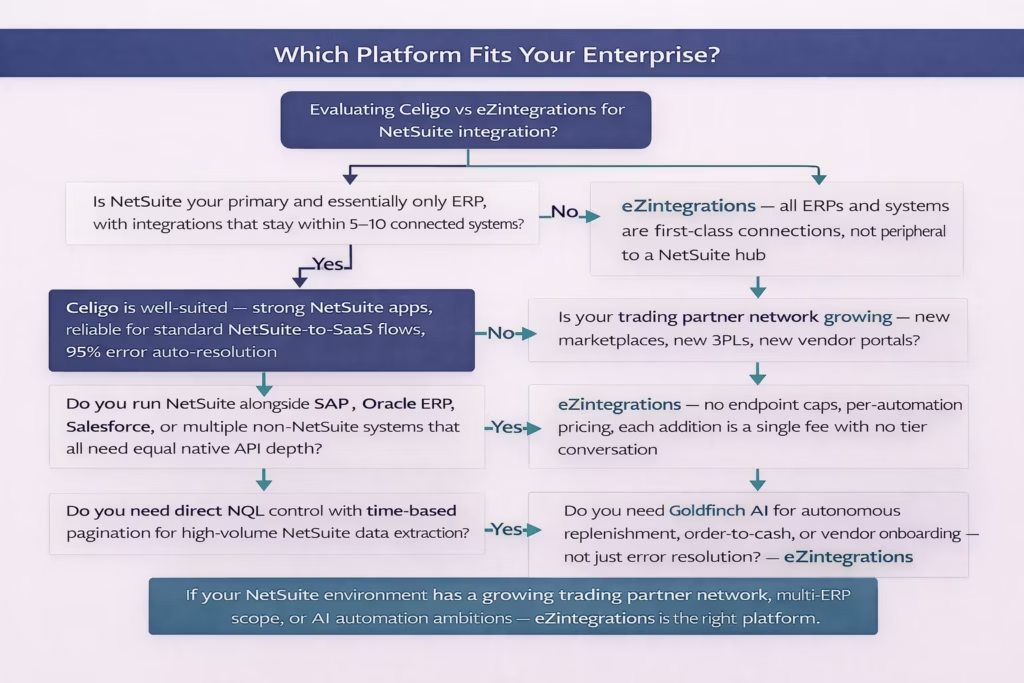
Choose Celigo if:
- NetSuite is your primary and essentially exclusive ERP, and all your integrations radiate from it as the central system
- Your integration footprint stays within Celigo’s endpoint tiers: Standard for 3 connections, Professional for 5, Premium for 10, and you are comfortable with custom quote renewal pricing at each tier
- You value Celigo’s specific NetSuite integration apps, which are pre-built, fully managed, and carry over a decade of NetSuite-specific implementation knowledge
- Your AI requirement is operational: you want error auto-resolution that keeps your integration flows running without manual intervention, and you do not need autonomous multi-system workflow orchestration
- You are a mid-market business in the $15,000 to $50,000 annual budget range for integration, within Celigo’s documented sweet spot, with straightforward NetSuite-to-SaaS connection needs
- Your team values Celigo’s customer support model, which Capterra and G2 reviewers consistently praise for responsiveness, and you want a platform that assigns a dedicated Account Manager
Choose eZintegrations if:
- Your enterprise runs NetSuite as one system among many: alongside SAP, Oracle ERP, Salesforce, multiple marketplaces, and industry-specific platforms, and you need all of them connected with equal native API depth
- You need direct NetSuite NQL control with full pagination, numeric parameters, and time-based query windows for high-volume data extraction and sync
- Your trading partner network is growing: new marketplaces, new 3PL partners, new vendor portals, new customer portals, and you need each addition to be a straightforward per-automation fee rather than a potential endpoint tier conversation
- You connect NetSuite to Amazon Seller Central, Walmart, Shopify, DHL, Kenco, or similar marketplace-and-3PL stacks and you want transparent, predictable pricing as that network expands
- You need Goldfinch AI for autonomous replenishment orchestration, order-to-cash automation, vendor onboarding, or procure-to-pay cycles across NetSuite and your trading partner network, not just error auto-resolution in existing flows
- You operate in Retail, Beauty and Cosmetics, Consumer Goods, Distribution, or Manufacturing, where your NetSuite ERP talks to multiple marketplaces, multiple 3PLs, and multiple trading partner portals simultaneously
Bottom Line Verdict
Celigo is the right NetSuite-first iPaaS for mid-market businesses where NetSuite is the centre of gravity and integrations stay within its endpoint tiers. eZintegrations is the right full-stack enterprise iPaaS for businesses that need deeper NetSuite API control, an unlimited trading partner network without endpoint tier escalation, and Goldfinch AI autonomous workflows that go beyond error resolution.
Here is the direct verdict across the five dimensions that matter most for this decision:
NetSuite API depth: eZintegrations wins for teams that need direct query control. SOAP API, Restlet API, and NQL with full pagination and time-based parameters give your team native NetSuite data access without connector abstraction. Celigo’s NetSuite connector handles standard flows well but limits direct NQL control. For high-volume NetSuite data extraction, inventory sync, and order management at scale, native NQL pagination is a meaningful operational advantage.
Endpoint pricing model: eZintegrations wins for growing trading partner networks. Celigo’s endpoint tiers (Standard: 3, Professional: 5, Premium: 10, Enterprise: 20) create a ceiling that enterprises connecting NetSuite to a full marketplace-and-3PL stack reach quickly. eZintegrations has no endpoint caps. Every new marketplace, 3PL, or trading partner connection is a per-automation annual fee, visible and predictable before you deploy.
AI capability: eZintegrations wins on capability depth. Celigo’s runtime AI auto-resolves integration errors, which is a useful operational feature. Goldfinch AI of eZintegrations orchestrates autonomous multi-system business workflows: replenishment cycles, order-to-cash automation, vendor onboarding, and procure-to-pay across NetSuite, Amazon, Walmart, Shopify, DHL, and Kenco simultaneously. These are different categories of AI value.
Protocol support for full-stack enterprises: eZintegrations wins on breadth. Full native GraphQL, WebSocket, gRPC, and MCP Protocol alongside NetSuite’s three API modes means enterprises running multi-ERP, multi-marketplace, and multi-3PL architectures have complete native connectivity. Celigo provides GraphQL and WebSocket through its API management layer, which serves different integration patterns than native pipeline-level protocol support.
Pricing transparency: eZintegrations wins clearly. All pricing is published at ezintegrations.ai/pricing. No Account Manager required to get a number. No endpoint tier uncertainty at renewal. Celigo’s endpoint-and-flow model is more predictable than per-task platforms, but all paid tiers require a custom quote and G2 reviewers have flagged steep renewal increases when licensing plans change.
The honest summary: if your business is NetSuite-first and your integration footprint fits Celigo’s endpoint tiers, Celigo delivers well. The moment you need native NQL query control, an endpoint-unlimited trading partner network, or Goldfinch AI running autonomous workflows across your full supply chain, eZintegrations is the more capable and more cost-predictable platform for where your enterprise is heading.
Frequently Asked Questions
1.Is eZintegrations better than Celigo
For enterprises needing direct NetSuite NQL control unlimited trading partner connections without endpoint tier escalation or Goldfinch AI autonomous workflow orchestration the answer is often yes. eZintegrations supports NetSuite SOAP Restlet and NQL APIs with full pagination has no endpoint caps as marketplace and 3PL networks grow and provides Goldfinch AI with nine production agent tools. Celigo remains a strong fit for NetSuite first mid market businesses where integrations remain within endpoint tiers and AI needs are primarily limited to runtime error auto resolution.
2.How does Celigo pricing compare to eZintegrations
Celigo pricing is structured around endpoints and flows with Standard supporting three endpoints Professional five Premium ten and Enterprise twenty. All tiers require a custom quote from a Celigo account manager and third party estimates place typical mid market deployments between fifteen thousand and fifty thousand dollars annually. eZintegrations publishes transparent pricing with per automation annual fees no endpoint caps no per transaction charges for non LLM automations and Dev and Test environments typically priced at one third of production cost.
3.Does eZintegrations connect to NetSuite as well as Celigo
eZintegrations connects to NetSuite through SOAP API Restlet API and NetSuite Query Language NQL with full pagination including numeric and time based parameters enabling direct high performance data access without a connector abstraction layer. Celigo connects through its proprietary NetSuite connector which provides more than eighty prebuilt integration apps and works well for standard flows. The difference becomes important in high volume scenarios requiring custom NQL queries time windowed data extraction and paginated batch processing.
4.What is the difference between Celigo runtime AI and Goldfinch AI of eZintegrations
Celigo runtime AI focuses on automatic resolution of integration errors helping keep flows operational with minimal manual intervention. Goldfinch AI from eZintegrations orchestrates autonomous multi system business workflows using a Planner Critic Aggregator architecture where specialist sub agents execute tasks across systems a Critic Agent manages human in the loop governance and an Aggregator Agent delivers validated outcomes.
5.Can eZintegrations connect NetSuite to Amazon Walmart Shopify DHL and Kenco without endpoint limits
Yes eZintegrations has no endpoint caps. NetSuite can connect to Amazon Seller Central Walmart Shopify DHL Kenco vendor portals customer portals and other systems through individual automation connections priced per automation without tier escalation. Celigo requires higher endpoint tiers such as Premium when integrations expand which may increase cost as new trading partners marketplaces or logistics providers are added.
6.How long does it take to migrate from Celigo to eZintegrations
Standard NetSuite to marketplace and NetSuite to 3PL integrations can migrate within days using Automation Hub templates. NQL based integrations are configured through the native query interface in eZintegrations with pagination support and often deploy faster than recreating equivalent flows in a new Celigo licensing tier. Bizdata provides end to end migration support during this process.
7.Does eZintegrations support EDI and B2B trading partner integrations alongside NetSuite
Yes eZintegrations provides native EDI capabilities together with NetSuite SOAP Restlet and NQL connectivity. It supports AS2 communication standard EDI documents such as 850 855 856 810 and 945 and custom EDI schemas. Goldfinch AI can automate the full EDI trading partner workflow including document receipt validation against NetSuite records creation of NetSuite transactions and automated acknowledgments and shipment notices.
Conclusion: The Four Questions Every Celigo Customer Should Answer Before Renewal
If your Celigo contract is coming up for renewal, four questions determine whether the platform still fits where your enterprise is going.
First: how many endpoints does your full operating stack actually require? Count NetSuite, every marketplace, every 3PL, every trading partner portal, every internal system, and every data warehouse your integrations touch. If that count is approaching or exceeding your current Celigo tier, your renewal will likely involve an endpoint tier conversation. eZintegrations has no endpoint caps. The question does not arise.
Second: do any of your NetSuite integrations need direct NQL control? High-volume inventory sync, time-windowed order extraction, custom record queries with numeric filters- these all benefit from direct NQL pagination that Celigo’s connector model abstracts away. If your team has ever wished for more direct NetSuite query control, eZintegrations’ native SOAP, Restlet, and NQL support is the answer.
Third: is your trading partner network growing? New marketplaces, new 3PL partners, new vendor portals, new regional storefronts. Every addition on Celigo is a potential endpoint tier conversation. Every addition on eZintegrations is a per-automation annual fee, published before you ask.
Fourth: does your AI automation roadmap need to go beyond error resolution? If autonomous replenishment, order-to-cash orchestration, vendor onboarding automation, or procure-to-pay cycles across NetSuite and your full marketplace-and-3PL network are on your 2026 plan, Goldfinch AI of eZintegrations delivers that today. Celigo’s runtime AI handles error resolution in your existing flows. It does not orchestrate new business processes autonomously.
One “yes” is enough to make the evaluation worthwhile. Enterprises connecting NetSuite to a full trading partner network will find two or three.
eZintegrations was built to answer exactly those gaps. Native SOAP, Restlet, and NQL with full pagination for the deepest NetSuite connectivity. No endpoint caps as your marketplace-and-3PL stack grows. Transparent per-automation pricing visible before you commit. Goldfinch AI with 9 native tools running autonomous workflows across your full supply chain today.
A global Retail company runs on eZintegrations connecting NetSuite to Amazon Seller Central, Walmart, DHL, Kenco, and both Vendor and Customer Portals. A Beauty and Cosmetics enterprise runs on eZintegrations with NetSuite NQL-powered inventory sync across their full marketplace footprint. Both chose eZintegrations because the NetSuite API depth was deeper, the trading partner network grew without endpoint arithmetic, and Goldfinch AI gave them autonomous supply chain orchestration no NetSuite-centric platform delivers today.
Book a Free Demo at ezintegrations.ai/book-a-demo
Or start by exploring 1,000+ production-ready templates including NetSuite SOAP API, Restlet API, and NQL integrations with Amazon, Walmart, Shopify, DHL, Kenco, and EDI trading partners, all with transparent per-automation annual pricing shown upfront.