eZintegrations vs Boomi: Enterprise Integration Platform Compared 2026
March 11, 2026eZintegrations vs Boomi: eZintegrations wins on pricing model, complex data transformation, real-time protocol support, and AI capability. Boomi’s per-environment licensing makes Dev, QA, Staging, and Production each a separate cost. Complex transformations require Groovy scripting. Goldfinch AI of eZintegrations is in production with 9 native tools. Boomi AgentStudio is still developing.
TL;DR
Boomi’s pay-as-you-go plan starts at $99/month with $0.05 per Boomi Message. Annual subscription tiers require a custom quote. The critical cost driver most buyers miss: Dev, QA, Staging, and Production are each licensed separately. TrustRadius reviewers specifically flag this as making Boomi “very expensive even for simple stuff.” eZintegrations has no platform fee, no per-environment licensing, and Dev/Test environments cost one-third of production pricing. – Boomi handles standard integrations well through its drag-and-drop canvas. Complex data transformations, including unstructured document processing, EDI conversion, and invoice matching, require Groovy scripting or external tools. eZintegrations handles all of these natively through Document Intelligence and its no-code canvas, with no scripting required. – Boomi’s cloud-based architecture creates latency concerns for real-time integrations, particularly for geographically dispersed systems. eZintegrations provides full native WebSocket, GraphQL, gRPC, and MCP Protocol support designed for low-latency real-time pipelines. – Boomi AgentStudio is announced and in active development but has no Planner-Critic-Aggregator multi-agent architecture in production today. Goldfinch AI of eZintegrations ships with 9 native agent tools out of the box and is self-service extensible right now. – eZintegrations is rated 4.7 stars on G2, Capterra, Software Advice, and GetApp across 50+ enterprise customers including the world’s largest FMCG company, a global Industrial Goods leader, and a recognized global Pharma company.
Summary Comparison Table
| Feature | eZintegrations | Boomi |
|---|---|---|
| Entry pricing | Free to $150/month per automation | Pay-as-you-go from $99/month + $0.05/message |
| Public pricing | Yes, published transparently | Pay-as-you-go published; annual plans require custom quote |
| Platform fee | None | None on PAYG; annual plans require quote |
| Per-environment licensing | No (Dev/Test at 1/3 of production cost) | Yes, Dev/QA/Staging/Prod each licensed separately |
| Non-LLM transaction charges | None (unlimited) | $0.05 per Boomi Message on PAYG; metered on annual plans |
| Complex data transformation | Native, no scripting required | Requires Groovy scripting or external tools |
| Document Intelligence | Yes, native | No native capability |
| Real-time WebSocket | Full native | Latency concerns documented by users |
| GraphQL support | Full native | No native support |
| gRPC support | Full native | No |
| MCP Protocol | Full native | Boomi MCP added 2026 |
| Native Agentic AI (production) | Yes, Goldfinch AI | AgentStudio in development |
| AI agent tools | 9 native + self-service extensible | No production agent tools yet |
| Dynamic Tool Calling | Yes (unique) | No |
| No-code for complex transformations | Yes | No, requires Groovy scripting |
| 1,000+ pre-built templates | Yes | Boomi Marketplace with community recipes |
| Fully managed | Yes, Bizdata | Yes, Boomi cloud-managed |
| Implementation speed | 8 to 100 hours | Hours for simple; weeks for complex |
| Developer salary (US, Glassdoor) | Not required | $102,000 to $167,000 per year |
| G2 / review rating | 4.7 stars | Well-rated for standard integrations |
| Uptime SLA | 99.9% | 99.9% |
eZintegrations vs Boomi: The Quick Verdict
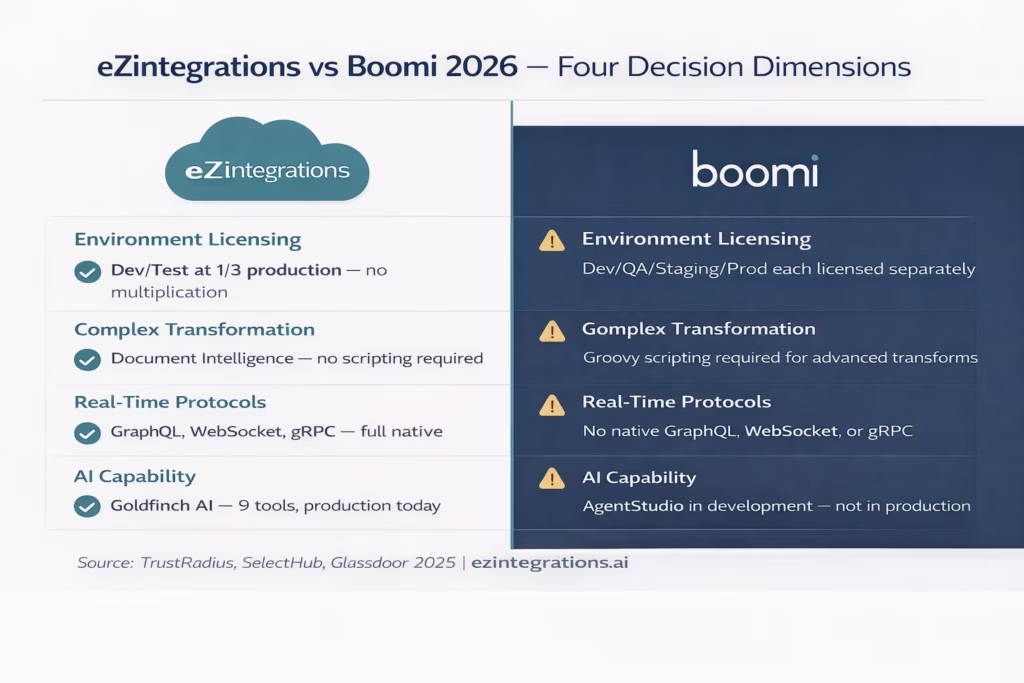
Boomi is a capable, mature iPaaS that handles standard integration scenarios well. The problems emerge in four specific areas: per-environment licensing that multiplies cost at every stage of your SDLC, a Groovy scripting ceiling on complex data transformations, latency concerns for real-time pipelines, and an AI roadmap that is still catching up to what eZintegrations delivers in production today.
Boomi was founded in 2007, acquired by Dell in 2010, and spun out as an independent company in 2021. It now serves over 30,000 customers and holds a Leader position in the 2025 Gartner Magic Quadrant for API Management. Its drag-and-drop canvas, pre-built connector library, and B2B/EDI capabilities are genuine strengths, particularly for mid-market enterprises running standard integration patterns.
The challenge isn’t Boomi’s ability to handle integrations. It’s the total cost structure once you account for every environment your team needs, the specialist involvement required when transformations go beyond standard mapping, and the gap between where Boomi’s AI roadmap is headed and where Goldfinch AI of eZintegrations is today.
For enterprise teams evaluating both platforms in 2026, understanding those four gaps is the whole decision.
The Environment Licensing Trap: Where Boomi’s Real Cost Lives
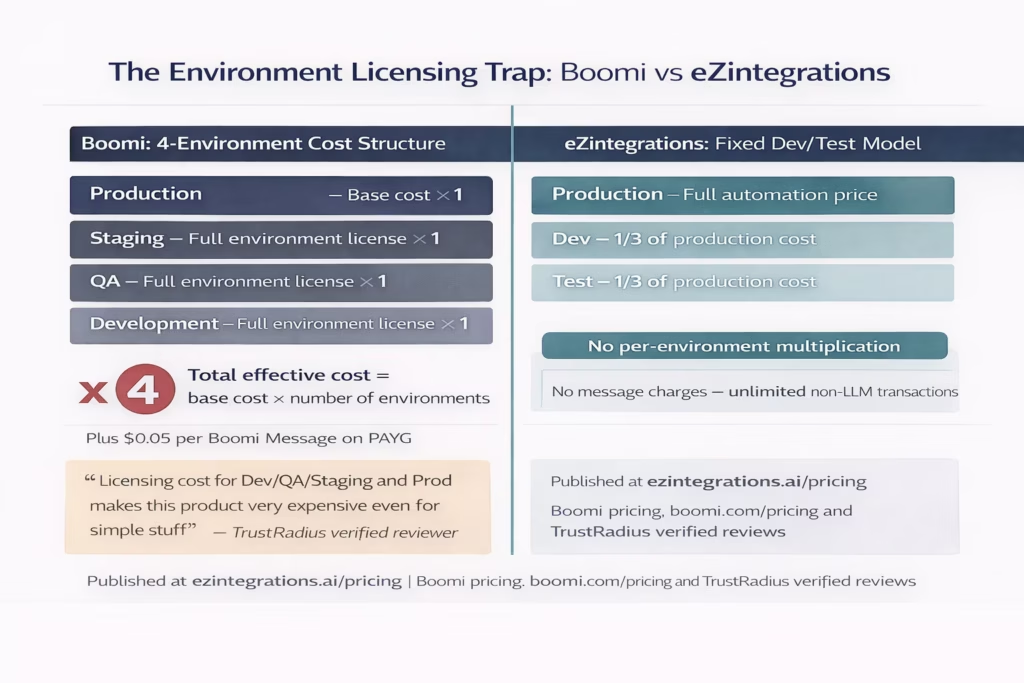
Boomi’s per-environment licensing model means every stage of your software development lifecycle, Development, QA, Staging, and Production, requires a separate license. For teams running a standard four-environment SDLC, the effective cost of Boomi is not what the entry price suggests. It is that entry price multiplied by the number of environments you need.
Boomi’s published pricing gives buyers a starting reference: the pay-as-you-go plan starts at $99/month and charges $0.05 per Boomi Message, where a Message is defined as a single document flowing through any component of the platform. Annual subscription plans exist for Integration, API Management, Data Hub, and Data Integration use cases and require a custom quote from Boomi’s sales team.
What the entry price does not communicate is the environment multiplication effect. Verified reviewers on TrustRadius are explicit about this: “Licensing cost for Dev/QA/Staging and Prod makes this product very expensive even for simple stuff.” Another reviewer notes: “The cost of the product is steep… It’s pretty expensive, and custom coding an integration system is almost the same price over a 3 to 5 year term.”
This is not a fringe complaint. It reflects Boomi’s architecture: each Atom (Boomi’s runtime execution engine) deployed in a separate environment requires its own licensing. For a typical enterprise running four environments, your real Boomi cost is substantially higher than the entry tier suggests.
The message-volume escalation adds a second layer. On the pay-as-you-go plan, every document flowing through the platform at $0.05 per message adds up quickly for high-volume integrations. A SAP to Salesforce order sync processing 100,000 documents per month generates $5,000 in message fees alone, before any subscription cost is counted.
eZintegrations handles environments differently on every dimension:
- No platform fee on any environment
- Dev and Test environments are priced at one-third of the production automation cost
- No per-message or per-transaction charges for non-LLM automations, regardless of volume
- A Shopify to NetSuite order sync processing 100,000 orders per month costs the same annual per-automation fee as one processing 10,000 orders
The practical impact for an enterprise running four environments: eZintegrations’ cost is the per-automation annual fee plus one-third of that for Dev and one-third for Test. Boomi’s cost is the automation cost multiplied across each licensed environment plus message volume charges on top.
Want to see exactly what your environments cost before committing? View eZintegrations pricing — every automation and environment cost is published transparently with no sales call required.
Complex Data Transformation: No-Code vs Groovy Scripting
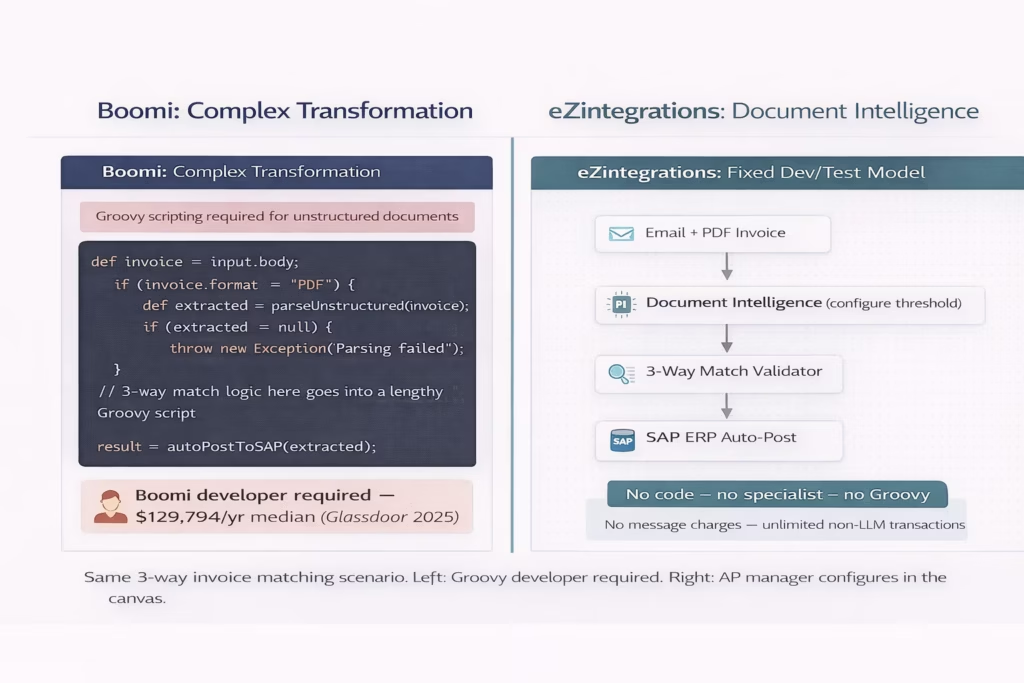
Boomi’s drag-and-drop canvas handles standard data mapping well. When transformations go beyond standard field mapping into complex logic, conditional processing, or unstructured document handling, Boomi requires Groovy scripting or external tools. eZintegrations handles all of these natively through Document Intelligence and its no-code transformation canvas, with no scripting required at any complexity level.
This is the most technically specific and defensible difference between the two platforms. It comes directly from Boomi’s own user community and verified review sources, not from competitor claims.
Multiple independent review sources document the same pattern. SelectHub’s Boomi analysis states: “Complex data transformations, a common need in large organizations, can push Boomi’s limits. Some users highlight the need for external tools or custom scripting to handle intricate data manipulation.” Capterra reviewers note the platform becomes “a little heavy to use without the proper technical background” for complex scenarios. TrustRadius reviewers flag the learning curve for complex transformations specifically.
The technical reason is structural. Boomi’s mapping engine is optimized for structured-to-structured data transformation between known schemas. When you need to:
- Extract data from unstructured sources: emails, PDFs, scanned documents, non-standard EDI files
- Apply conditional logic that varies by document content rather than by schema position
- Handle multi-document orchestration where the output of one transformation feeds conditional routing in the next
- Process invoice matching across three documents with varying field formats
…Boomi requires Groovy scripting inside the process canvas. Groovy is a Java-based scripting language. Writing it correctly, testing it across edge cases, and maintaining it as source document formats evolve requires a specialist. This is not a no-code operation.
eZintegrations handles all of these scenarios through Document Intelligence, which is native to the platform and requires no scripting at any level. Here is what that means in practice:
Email-to-ERP purchase order automation: An email arrives with a PDF purchase order attached. Document Intelligence extracts the vendor, line items, quantities, prices, and delivery dates with over 95% accuracy. The extracted data maps to your ERP schema through the no-code canvas. Exceptions route to a human review queue automatically. No Groovy. No external tool. No specialist.
EDI conversion with non-standard schemas: A trading partner sends EDIFACT ORDERS messages with custom segment qualifiers. Document Intelligence handles the non-standard schema without requiring a Groovy script to parse exceptions. Configuration through the no-code canvas.
Three-way invoice matching: The system compares a supplier invoice, the originating purchase order, and the goods receipt note across three separate document formats. Discrepancies above a configurable threshold route to the AP manager. All configured in the no-code canvas. No scripting.
The difference in team composition is direct. Boomi complex transformation projects require a developer who knows Groovy. According to Glassdoor data from 2025, Boomi developers earn a median of $129,794 per year with a typical range of $102,000 to $167,000. eZintegrations complex transformation projects require whoever is running your AP, procurement, or operations function. No developer required.
Real-Time Pipelines: Protocol Support and Latency
Boomi’s cloud-based architecture introduces latency concerns for sensitive real-time integrations, particularly across geographically dispersed systems. eZintegrations provides full native support for WebSocket, GraphQL, gRPC, and MCP Protocol, designed for real-time bidirectional pipelines with no architectural latency penalty.
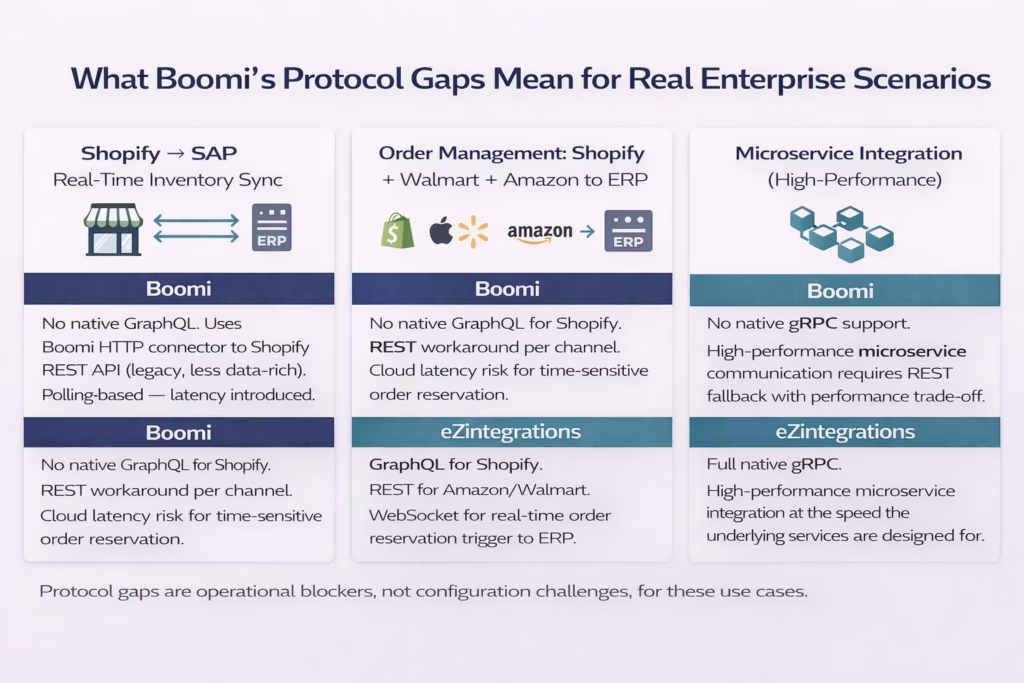
Boomi’s core architecture is cloud-native and multi-tenant, which delivers excellent reliability and managed infrastructure for batch and scheduled integration patterns. The same architecture creates a documented limitation for latency-sensitive real-time scenarios. SelectHub’s independent analysis specifically notes: “Cloud-based architecture may cause latency issues for sensitive real-time integrations, especially with geographically dispersed systems.” This is a structural characteristic of Boomi’s design, not a configuration problem.
The protocol gap compounds the latency concern. Boomi does not natively support GraphQL, which is the primary API interface for Shopify’s Storefront and Admin APIs, Salesforce’s GraphQL endpoint, and a growing number of modern enterprise SaaS tools. Boomi also lacks native WebSocket support for persistent bidirectional connections, which real-time inventory, order status, and logistics tracking pipelines depend on.
Here is the full protocol comparison:
| Protocol | eZintegrations | Boomi |
|---|---|---|
| REST API | Full native | Full native |
| SOAP/XML | Full native | Full native |
| GraphQL | Full native | No native support |
| WebSocket | Full native | No native support |
| gRPC | Full native | No native support |
| MCP Protocol | Full native | Boomi MCP added 2026 |
| EDI/AS2/B2B | Full native | Full native |
| Webhooks | Full native | Full native |
| Database (SQL/NoSQL) | Full native | Full native |
| Message Queue (Kafka) | Full native | Full native (Event Streams) |
| FHIR/HL7 | Full native | Full native |
| Streaming | Full native | Partial (Event Streams) |
For enterprise teams running real-time supply chain visibility, live inventory sync across eCommerce and ERP, or order management pipelines between Shopify, SAP, and a 3PL, the GraphQL and WebSocket gaps are operational blockers on Boomi, not configuration challenges.
eZintegrations’ full native GraphQL support means Shopify’s API connects directly without adapter workarounds. Full native WebSocket means real-time bidirectional inventory updates between your Shopify storefront and your SAP or NetSuite ERP run with persistent connections and no polling overhead. Full native gRPC means high-performance microservice integrations work at the speed the underlying services are designed for.
AI Capability: Goldfinch AI in Production vs Boomi AgentStudio in Development
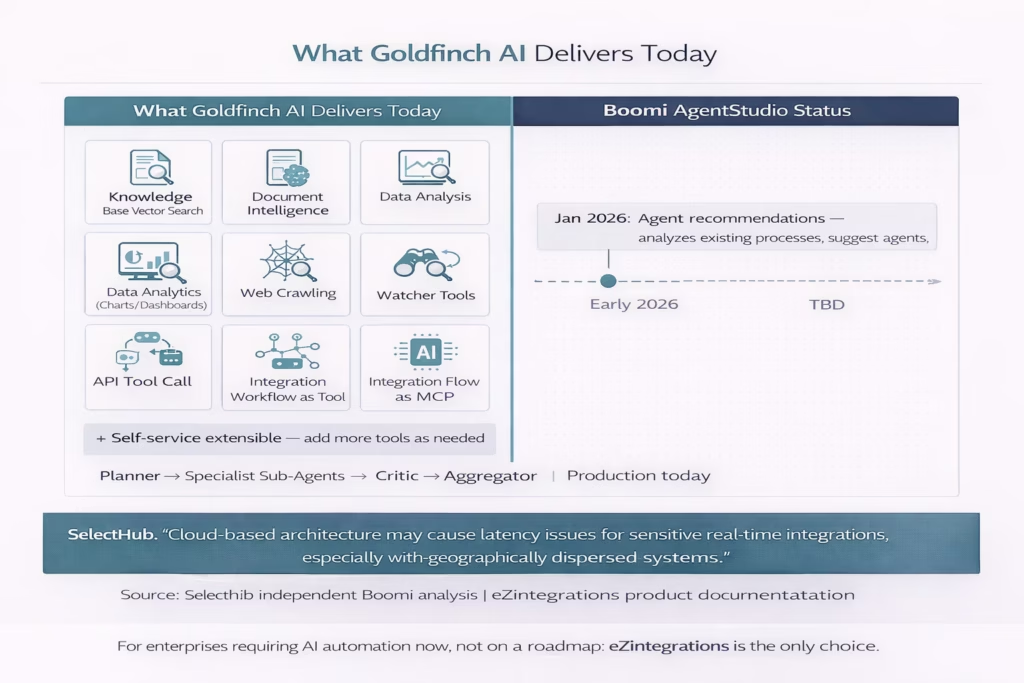
Goldfinch AI of eZintegrations is a production-ready Planner-Critic-Aggregator multi-agent system with 9 native tools available to your team today. Boomi AgentStudio is an announced capability currently in active development with agent recommendation features in early 2026, but no equivalent multi-agent orchestration architecture in production.
Boomi is investing seriously in AI. The January 2026 release introduced AgentStudio improvements including agent recommendations that analyze existing integration processes to suggest effective agents. Boomi MCP launched to allow integrations to be called by external AI agents. AWS Bedrock and Amazon Selling Partner connectors reached general availability. These are genuine steps forward.
The gap is the distance between what Boomi is building and what eZintegrations already ships.
Here is the production AI capability comparison today:
| AI Capability | eZintegrations | Boomi |
|---|---|---|
| Multi-agent orchestration (production) | Yes, Goldfinch AI | No, AgentStudio in development |
| Planner-Critic-Aggregator architecture | Yes, native | No |
| Native agent tools out of the box | 9 tools | No production agent tools |
| Self-service tool extensibility | Yes | No |
| Document Intelligence | Yes, native | No |
| Dynamic Tool Calling | Yes (unique) | No |
| Vector Knowledge Base | Yes | No |
| MCP endpoint from any workflow | Yes, 1 click | Partial (Boomi MCP 2026) |
| AI Workflows (unstructured to structured) | Yes, native | No native capability |
| Human-in-the-Loop governance | Yes, Critic Agent | Manual step only |
| No-code AI configuration | Yes | No (developer-configured) |
Goldfinch AI of eZintegrations ships with 9 native agent tools out of the box: Knowledge Base Vector Search, Document Intelligence, Data Analysis, Data Analytics with Charts and Dashboards, Web Crawling, Watcher Tools, API Tool Call supporting all authentication types, Integration Workflow as a Tool, and Integration Flow as MCP. Beyond those 9, your team adds more tools as self-service without developer involvement or additional licensing.
The four-agent Planner-Critic-Aggregator architecture means Goldfinch AI plans the full execution across multiple systems, deploys specialist sub-agents to handle each domain, applies a Critic Agent for human-in-the-loop governance on genuine exceptions, and delivers finished outcomes through an Aggregator. This is not a chatbot layer on top of integrations. It is autonomous multi-system orchestration built into the platform.
Boomi AgentStudio’s January 2026 update introduced agent recommendations: the system analyzes your existing integration processes and suggests which agents might be effective. This is a useful planning tool. It is not a deployed multi-agent system running autonomous workflows across your enterprise.
For IT leaders making a platform decision with a 3 to 5 year horizon, this gap matters. AI automation is not a future consideration. It is an operational requirement for AP automation, supply chain exception handling, procurement cycle management, and clinical data reconciliation right now. eZintegrations delivers it. Boomi is building toward it.
Implementation Speed: Templates vs Learning Curve
eZintegrations deployments go live in 8 to 100 hours using 1,000+ production-ready Automation Hub templates. Boomi’s drag-and-drop canvas reduces implementation time for simple integrations but its learning curve for complex scenarios and the Groovy scripting requirement for advanced transformations add weeks to delivery timelines.
Boomi is faster than MuleSoft for standard integrations. The drag-and-drop canvas, Boomi Suggest for guided mapping, and its community process library all reduce build time for straightforward application-to-application connections. For simple integrations, Boomi genuinely delivers faster than traditional code-based platforms.
The speed advantage narrows as complexity increases. Boomi’s own reviewers consistently note that while simple integrations are fast, complex scenarios require investment in platform knowledge and specialist involvement. As SelectHub notes: “Steep Learning Curve: Extensive features and customization options can overwhelm novices, demanding investment in training or skilled personnel.” Complex transformations requiring Groovy scripting add additional development and testing cycles.
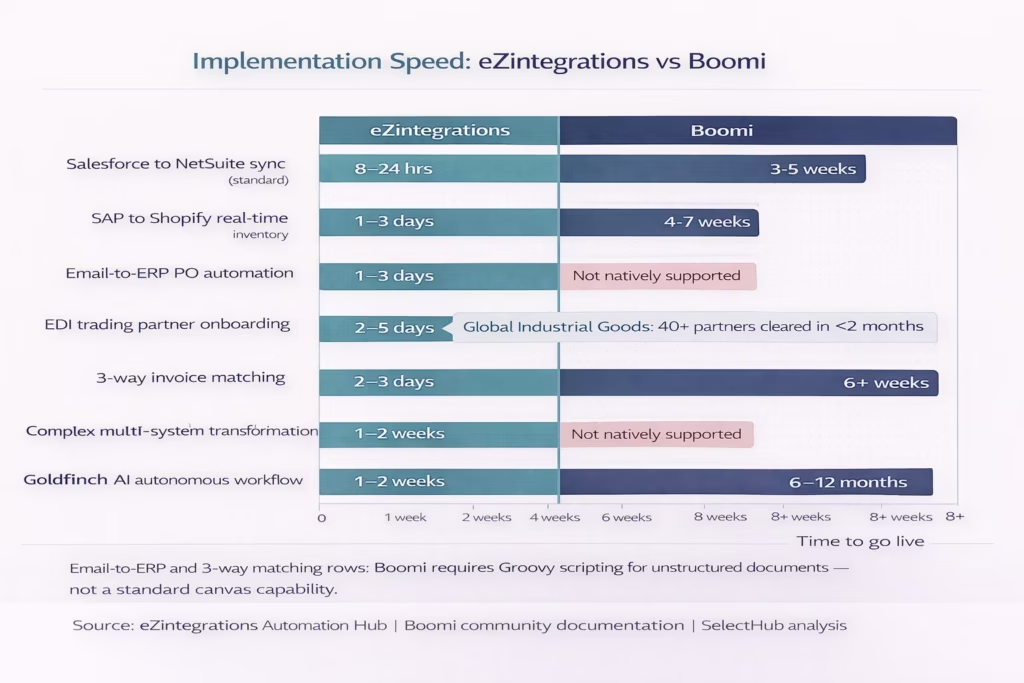
eZintegrations starts from production-ready templates at every complexity level, including complex ones. Here is what realistic implementation timelines look like for the scenarios most relevant to Boomi customers:
| Integration Use Case | Boomi | eZintegrations |
|---|---|---|
| Salesforce to NetSuite sync (standard) | Days to 1 week | 8 to 24 hours |
| SAP to Shopify real-time inventory | 2 to 4 weeks | 1 to 3 days |
| Email-to-ERP PO automation | Not natively supported | 1 to 3 days |
| EDI trading partner onboarding | 2 to 4 weeks per partner | Hours from template |
| 3-way invoice matching | Not natively supported | 2 to 5 days |
| Complex multi-system transformation | 4 to 8 weeks (with Groovy) | Days from template |
| Goldfinch AI autonomous workflow | Not available | Days to configure |
| Full enterprise deployment | Months | Weeks |
The email-to-ERP and 3-way invoice matching rows are particularly telling. These are not edge cases. They are daily operational requirements for AP and procurement teams at every mid-to-large enterprise. On Boomi they require custom Groovy scripting that Boomi itself doesn’t natively support for unstructured document flows. On eZintegrations they are production-ready templates.
Use Case Comparison: Four Real Enterprise Scenarios
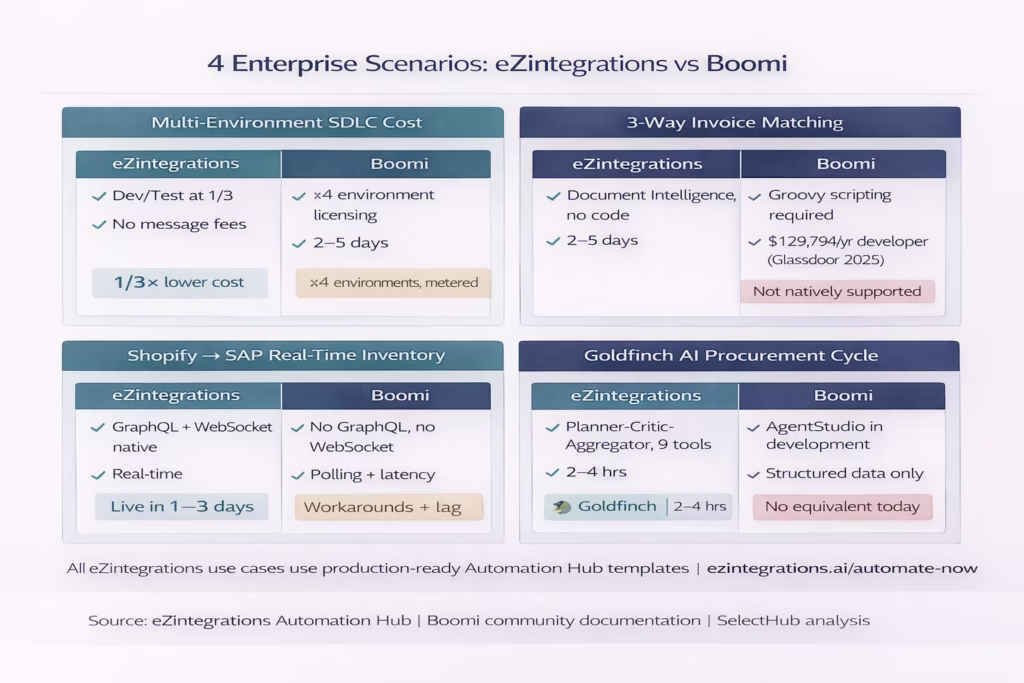
Use Case 1: The Multi-Environment Cost Trap in Practice
A mid-size manufacturing company standardizes on Boomi for SAP-to-Salesforce integration. They run four environments as any responsible enterprise SDLC requires: Development, QA, Staging, and Production. Each Atom environment requires separate licensing. Their integration cost is not Boomi’s entry price. It is that price multiplied across four environments, plus message volume charges as their order volume grows.
On eZintegrations, that same SAP-to-Salesforce integration is priced as a single per-automation annual fee. Dev is one-third of that production cost. Test is one-third of that production cost. Their order volume growth has no cost impact because non-LLM automations run at unlimited transaction volume.
Use Case 2: Invoice Matching Hitting Boomi’s Transformation Ceiling
A global Pharma company runs Oracle ERP and processes supplier invoices from 80 trading partners in different formats: PDFs, EDIFACT messages, and proprietary flat files. They need 3-way invoice matching comparing each invoice against the originating PO and the goods receipt note.
On Boomi: standard field mapping handles EDIFACT well. PDF extraction and flat file parsing with conditional logic require Groovy scripting. Each trading partner’s unique format variations need separate script maintenance. The AP team needs a Boomi specialist. According to Glassdoor, Boomi developers earn a median of $129,794 per year. That specialist cost sits entirely outside Boomi’s platform subscription.
On eZintegrations: Document Intelligence handles PDF extraction, EDIFACT parsing, and flat file processing natively. The 3-way matching logic runs through the no-code canvas. The AP manager configures exception thresholds without writing a line of code. No Boomi specialist. No Groovy scripts to maintain as supplier formats evolve.
Use Case 3: Real-Time Shopify to SAP Inventory Sync
A global retail company needs real-time bidirectional inventory sync between their Shopify storefront and SAP S/4HANA. Stock updates in SAP must reflect immediately on Shopify. Orders placed on Shopify must trigger SAP inventory reservation within seconds. Shopify’s primary API is GraphQL.
On Boomi: no native GraphQL support. The integration requires a workaround using Boomi’s generic HTTP connector to call Shopify’s REST API (an older interface with less data richness than the GraphQL API), or custom scripting to handle GraphQL queries. Real-time event-driven sync via WebSocket is also unavailable natively. The integration uses polling, which introduces latency and load.
On eZintegrations: full native GraphQL connects directly to Shopify’s primary API. Full native WebSocket enables persistent bidirectional connections for real-time inventory events. Stock updates propagate in real time. Order reservation triggers in real time. No polling overhead. No adapter workarounds.
Use Case 4: Goldfinch AI Procurement Cycle vs Boomi AgentStudio
A global FMCG company wants to automate their full procure-to-pay cycle: PO generation from demand signals, supplier confirmation, goods receipt matching, and invoice processing across SAP, Salesforce Vendor Management, and a network of EDI-connected suppliers.
On Boomi: the integration infrastructure connects SAP, Salesforce, and EDI suppliers reliably for structured data movement. Invoice processing for non-standard documents requires Groovy scripting. Multi-agent autonomous orchestration across the full procure-to-pay cycle is not available. Boomi AgentStudio is building toward agent-based automation but has no Planner-Critic-Aggregator system in production today.
On eZintegrations with Goldfinch AI: the Planner Agent designs the full procure-to-pay execution blueprint. Specialist Sub-Agents handle demand signal analysis, SAP PO generation, EDI supplier communication, goods receipt matching, and invoice processing using Document Intelligence in parallel. The Critic Agent flags genuine exceptions to the procurement manager with full context and recommended resolution. The Aggregator delivers a complete reconciliation report. What took a team of three procurement analysts a full working day completes in 2 to 4 hours with human oversight at exactly the right intervention points.
 Any of these scenarios match your current environment? Explore 1,000+ production-ready templates including SAP, Salesforce, NetSuite, Shopify, and EDI trading partner integrations, all with transparent annual pricing shown upfront.
Who Should Choose Each Platform
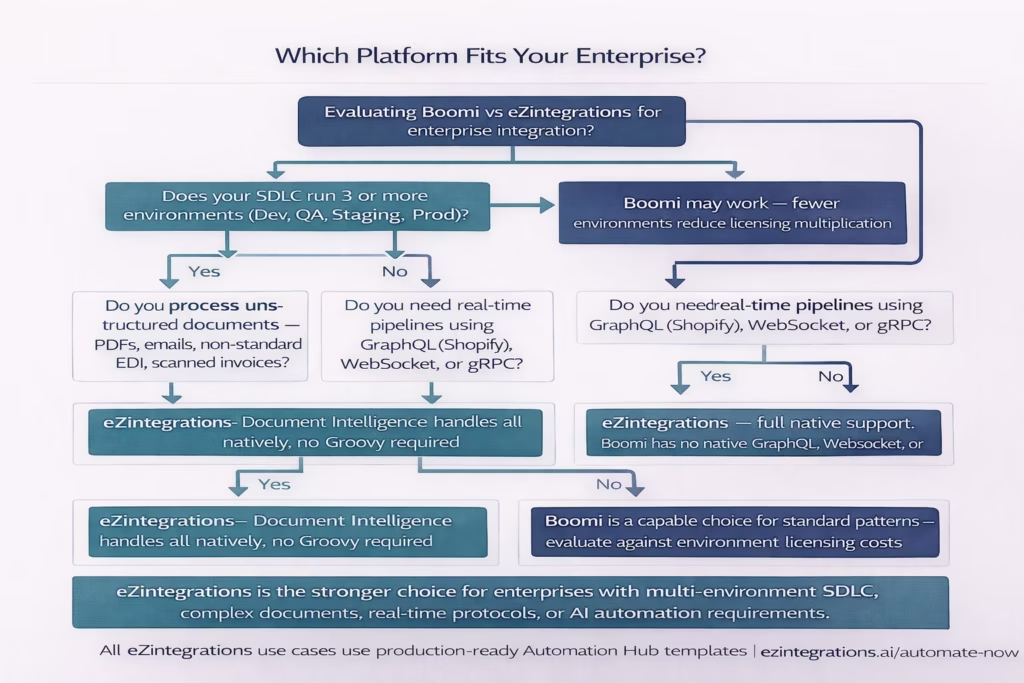
Choose Boomi if:
- Your integration needs are primarily standard application-to-application connections with structured data and known schemas on both sides
- You are already deeply invested in Boomi’s connector library and your team has built platform expertise over multiple years
- Your SDLC runs on fewer environments (one or two) and the per-environment licensing cost is manageable within your budget
- Your real-time requirements are modest and polling-based sync with acceptable latency is sufficient for your use cases
- You need Boomi’s specific B2B/EDI management capabilities combined with its broader integration suite and are comfortable with the associated environment licensing structure
- Your organization values Boomi’s 30,000-customer community, its process library crowd-sourced from real implementations, and Boomi Suggest for guided mapping assistance
Choose eZintegrations if:
- Your enterprise runs a full SDLC with Dev, QA, Staging, and Production environments and you need pricing that doesn’t multiply across each environment
- Your integration scope includes complex data transformations: unstructured document processing, multi-format invoice matching, email-to-ERP automation, or non-standard EDI that would require Groovy scripting on Boomi
- You need real-time bidirectional pipelines using GraphQL (Shopify, Salesforce GraphQL endpoint), WebSocket, or gRPC where Boomi’s cloud latency creates operational risk
- You need Goldfinch AI for autonomous procurement, AP automation, supply chain orchestration, or clinical data workflows today, not on a roadmap timeline
- Your team needs no-code access to complex transformation capabilities without hiring Boomi developers earning $102,000 to $167,000 per year (Glassdoor 2025)
- You operate in Manufacturing, Pharma, FMCG, Retail, Hi-Tech, or Industrial Goods and need industry-specific templates with transparent per-automation pricing and unlimited non-LLM transaction volume
Bottom Line Verdict
Boomi is a solid iPaaS for standard integration scenarios. Its per-environment licensing model, Groovy scripting ceiling, real-time protocol gaps, and AI roadmap position make eZintegrations the stronger choice for enterprises dealing with complex transformations, real-time pipelines, multi-environment SDLC costs, and AI-native automation requirements.
Here is the direct verdict across the five dimensions that matter most:
Pricing model: eZintegrations wins on structure and transparency. Boomi’s pay-as-you-go plan at $99/month plus $0.05 per message is accessible for small-scale use but scales painfully with volume. The per-environment licensing multiplier makes enterprise four-environment deployments significantly more expensive than the entry price suggests. eZintegrations has no per-environment licensing, no message volume charges for non-LLM automations, and Dev/Test at one-third of production cost, all published transparently.
Complex data transformation: eZintegrations wins by eliminating the specialist requirement. Document Intelligence handles unstructured document flows, multi-format EDI, PDF extraction, and 3-way matching natively. Boomi requires Groovy scripting for the same scenarios, adding specialist dependency at $102,000 to $167,000 per year (Glassdoor 2025) and ongoing script maintenance overhead.
Real-time pipelines: eZintegrations wins on protocol completeness. Full native GraphQL, WebSocket, gRPC, and MCP vs Boomi’s missing GraphQL and WebSocket support and documented cloud latency concerns for geographically dispersed real-time integrations.
AI capability: eZintegrations wins decisively on production availability. Goldfinch AI with 9 native tools, a Planner-Critic-Aggregator architecture, and self-service extensibility is available to your team today. Boomi AgentStudio is building toward agent capability but has no equivalent multi-agent system in production right now.
Implementation speed for complex scenarios: eZintegrations wins. 1,000+ templates handle both simple and complex scenarios from hours. Boomi’s drag-and-drop canvas is fast for simple integrations but adds specialist time and Groovy scripting cycles for anything beyond standard mapping.
The honest summary: if your integration needs stay within Boomi’s standard connector and mapping strengths, it delivers. The moment you need complex document transformation without scripting, real-time GraphQL or WebSocket pipelines, Goldfinch AI-powered autonomous workflows, or cost predictability across multiple SDLC environments, eZintegrations is the more capable and more cost-efficient platform.
FAQs
1. Is eZintegrations better than Boomi
For enterprises dealing with complex data transformations multi environment SDLC costs real time GraphQL or WebSocket pipelines or AI automation needs yes. eZintegrations handles complex transformations natively without Groovy scripting charges no per environment licensing fee provides full native GraphQL and WebSocket support and delivers Goldfinch AI with 9 production agent tools today. Boomi is a stronger fit for standard integration scenarios where its drag and drop canvas and community connector library are sufficient.
2. How does Boomi pricing compare to eZintegrations
Boomi pay as you go pricing starts at 99 dollars per month plus 0.05 dollars per Boomi Message and annual subscription plans require a custom quote. The major cost driver is per environment licensing where Dev QA Staging and Production each require separate licensing which TrustRadius reviewers describe as making Boomi very expensive even for simple integrations. eZintegrations has no platform fee no per message charges for non LLM automations no per environment licensing and publishes pricing transparently at ezintegrations.ai/pricing. Dev and Test environments cost one third of production pricing.
3. Does eZintegrations handle complex data transformations better than Boomi
Yes. Boomi handles standard field mapping well but requires Groovy scripting or external tools for complex data manipulation such as unstructured document processing PDF extraction multi format EDI conversion and conditional invoice matching. eZintegrations performs these operations through native Document Intelligence and a no code canvas without requiring scripting at any complexity level.
4. What is the difference between Boomi AgentStudio and Goldfinch AI of eZintegrations
Boomi AgentStudio is an AI agent development capability announced and in active development as of early 2026. Its January 2026 release introduced agent recommendations that suggest effective agents for existing processes but a Planner Critic Aggregator multi agent orchestration architecture is not yet in production. Goldfinch AI of eZintegrations is a production ready system with 9 native tools out of the box a four agent Planner Critic Aggregator architecture for autonomous multi system workflows and self service extensibility to add additional tools beyond the native set.
5. Does eZintegrations support GraphQL and WebSocket natively
Yes. eZintegrations provides full native GraphQL support enabling direct integration with Shopify GraphQL APIs Salesforce GraphQL endpoints and other GraphQL first SaaS platforms without adapter workarounds. It also supports full native WebSocket connections enabling persistent bidirectional communication for real time inventory order status and logistics pipelines. Boomi does not natively support GraphQL or WebSocket which typically requires workarounds or polling based alternatives.
6. How long does it take to migrate from Boomi to eZintegrations
Standard integrations migrate in days using equivalent Automation Hub templates. Complex integrations that previously required Groovy scripting on Boomi are often faster to configure on eZintegrations than the original Boomi implementation because Document Intelligence and the no code canvas replace scripting. Bizdata supports the migration process end to end and most customers report migration timelines are faster than expected due to template based starting points.
7. Can eZintegrations replace Boomi for SAP Salesforce NetSuite and Shopify integrations
Yes. eZintegrations provides production ready templates for SAP Salesforce NetSuite and Shopify along with full protocol support required by these systems. Shopify integrations use native GraphQL connectivity SAP integrations support both real time WebSocket and batch patterns and NetSuite and Salesforce templates include bi directional synchronization order management and financial data flows. All templates operate under transparent per automation annual pricing without message volume charges as transaction volumes grow.
Conclusion: The Four Questions Every Boomi Customer Should Answer at Renewal
If your Boomi contract is coming up for renewal, four questions determine whether staying or switching makes sense for your team.
First: how many environments are you running? If your SDLC uses Dev, QA, Staging, and Production, your real Boomi cost is the per-environment licensing multiplied by four plus message volume charges. eZintegrations’ Dev and Test at one-third of production cost with unlimited non-LLM transaction volume changes that calculation significantly.
Second: do any of your integrations hit Boomi’s transformation ceiling? Email-to-ERP, multi-format invoice matching, PDF extraction, non-standard EDI schemas — if any of these are in your backlog or have required Groovy scripting, eZintegrations handles them natively without a Boomi specialist earning $102,000 to $167,000 per year.
Third: do you run real-time pipelines using GraphQL or WebSocket? If your Shopify storefront, Salesforce GraphQL endpoint, or any event-driven supply chain pipeline needs low-latency real-time connectivity, Boomi’s architecture and missing protocol support creates workarounds that eZintegrations eliminates.
Fourth: does your AI automation roadmap need to deliver now? If autonomous procurement, AP automation, or multi-system orchestration is on your 2026 plan, Goldfinch AI of eZintegrations is in production with 9 native tools today. Boomi AgentStudio is building toward that capability.
One “yes” across those four questions is enough to make the evaluation worthwhile. Most enterprise Boomi customers will find two or three.
eZintegrations was built to answer exactly those gaps. Transparent per-automation pricing with Dev/Test at one-third of production cost. Document Intelligence for complex transformations without scripting. Full native GraphQL, WebSocket, gRPC, and MCP. Goldfinch AI with 9 native tools and self-service extensibility in production today. Fully managed by Bizdata with a 99.9% uptime SLA.
The world’s largest FMCG company runs on eZintegrations. A global Industrial Goods leader runs on eZintegrations. A recognized global Pharma company runs on eZintegrations. Each of them chose it because the pricing model made sense, the no-code transformation capability was decisive, and Goldfinch AI gave them autonomous workflow capability no other platform delivers today.
Book a Free Demo at ezintegrations.ai/book-a-demo
Or start by exploring 1,000+ production-ready templates — including SAP, Salesforce, NetSuite, Shopify, and EDI integrations, all with transparent annual pricing before you deploy.