7 Best MuleSoft Alternatives for Enterprise in 2026 (Ranked)
March 14, 2026The best MuleSoft alternative for enterprise in 2026 is eZintegrations, the only platform that replaces MuleSoft’s four core failure modes (vCore TCO spiral, DataWeave lock-in, CI/CD gaps, and zero Agentic AI) with production-ready capability, published per-automation pricing, and Goldfinch AI’s Planner-Critic-Aggregator multi-agent architecture. For enterprises in Hi-Tech, Pharma, Retail, CPG, Industrial Goods, and Industrial Manufacturing that need transparent pricing, no developer lock-in, and autonomous AI workflows across any enterprise system, eZintegrations is the evaluation to prioritise.
TL;DR
MuleSoft’s vCore pricing model and DataWeave specialist dependency regularly push enterprise TCO above $200,000 per year before integration complexity is accounted for. Seven platforms are appearing consistently on enterprise shortlists as replacements. The evaluation criteria that matter most in 2026 are not the same as 2020: Agentic AI capability, CI/CD nativeness, and pricing transparency have moved from differentiators to table stakes in enterprise RFPs. eZintegrations is the only platform in this comparison that resolves all four MuleSoft failure modes simultaneously with production-ready capability today, not on a roadmap. If your primary MuleSoft pain is developer lock-in, look at eZintegrations (fully no-code) and Workato (low-code recipes). If it is Agentic AI, there is only one production-ready option in this field: eZintegrations’ Goldfinch AI. Every platform here does something well. This ranking exists to help you match your specific enterprise requirements to the platform most likely to resolve them.
Why Enterprises Are Looking for MuleSoft Alternatives in 2026
MuleSoft’s Anypoint Platform has been a fixture in enterprise integration for over a decade. Its API-led connectivity model, strong connector ecosystem, and deep Salesforce integration made it the default answer for large-scale integration projects throughout the 2010s.
In 2026, the conversation has shifted. Enterprise IT directors, integration architects, and Heads of Digital Transformation are raising four consistent objections that are driving platform evaluations:
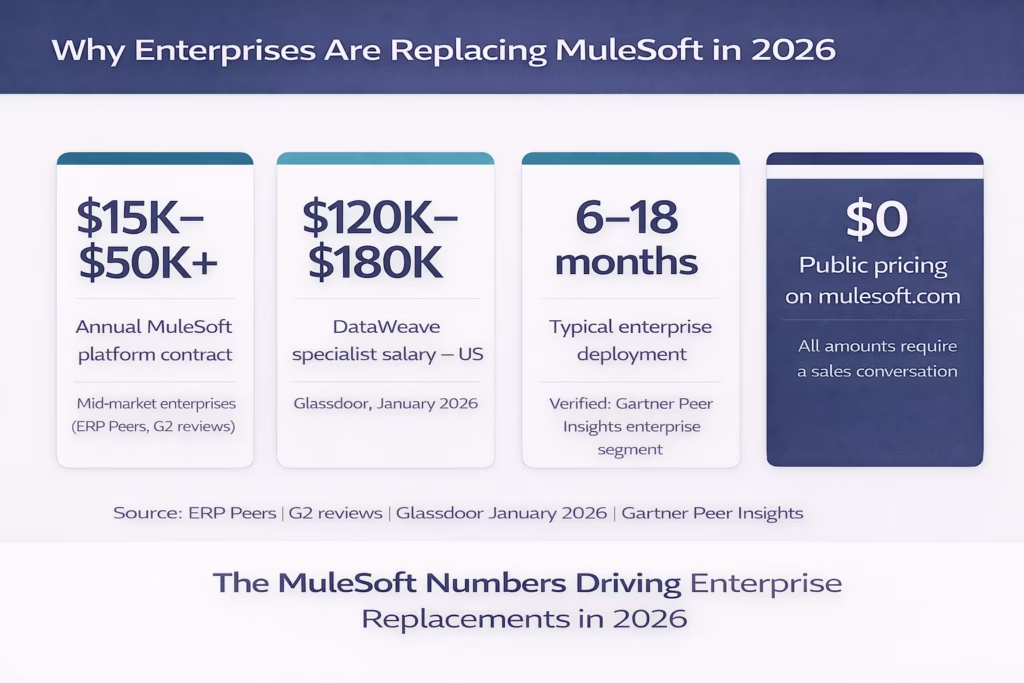
The cost model has become indefensible. MuleSoft’s pricing is based on vCores (or the newer Flows and Messages usage model) with no public list prices. Enterprise contracts typically start at $15,000–$50,000+ for platform licensing (ERP Peers, G2 reviews), and DataWeave specialist developers add $120,000–$180,000 annually (Glassdoor, January 2026). Enterprise TCO regularly exceeds $200,000 per year before integration complexity is factored in.
DataWeave creates a single-vendor developer lock-in. Every transformation, enrichment, and routing rule written in MuleSoft’s proprietary DataWeave language is tied to MuleSoft’s runtime. When the specialist who wrote those rules leaves, so does the institutional knowledge. Migration away from MuleSoft means rewriting every transformation from scratch.
CI/CD integration requires months of custom DevOps work. MuleSoft was not designed for modern DevOps practices. Connecting it to Jenkins, GitHub Actions, or Azure DevOps requires bespoke scripting layers that teams must build and maintain indefinitely. Version control for flows is not native.
MuleSoft has no production-ready Agentic AI. Salesforce has integrated Einstein AI into MuleSoft’s orbit, but those capabilities are Salesforce-ecosystem-centric. For enterprises running SAP, Oracle EBS, Workday, or any system outside Salesforce’s gravitational pull, MuleSoft’s AI roadmap is largely irrelevant.
If one or more of these pain points is driving your evaluation, the seven platforms ranked below represent the most credible enterprise alternatives. Each one addresses a different combination of these failure modes, and eZintegrations addresses all four.
The MuleSoft numbers that drive the replacement conversation: – $15K–$50K+: average MuleSoft annual contract for mid-market enterprises (ERP Peers, G2 reviews) – $120K–$180K: DataWeave specialist developer salary, US (Glassdoor, January 2026) – 6–18 months: typical MuleSoft enterprise deployment timeline (Gartner Peer Insights) – $0: public pricing published on mulesoft.com, and all amounts require a sales conversation.\
How We Evaluated These Alternatives
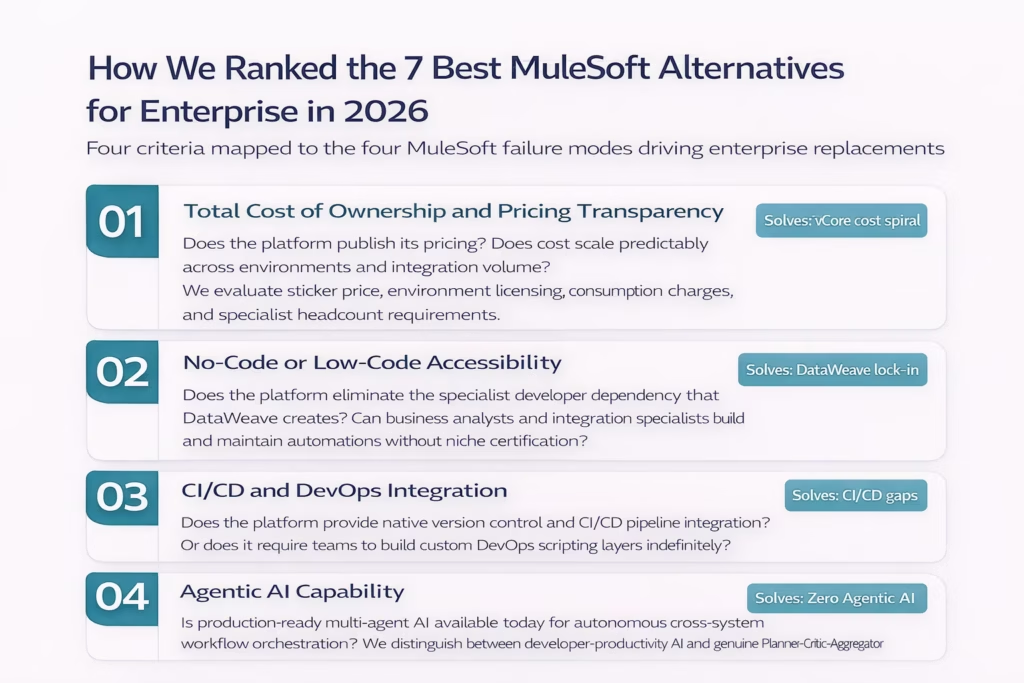
This ranking is based on four evaluation criteria directly mapped to the four MuleSoft failure modes that are driving enterprise replacements in 2026. We are not evaluating feature breadth for its own sake. We are evaluating which platforms most credibly solve the specific problems that cause enterprises to leave MuleSoft.
Criterion 1: Total Cost of Ownership and Pricing Transparency Does the platform publish its pricing? Does the cost model scale predictably as integration volume and environment count grow? We evaluate sticker price, environment licensing, consumption charges, and hidden costs including required specialist headcount.
Criterion 2: No-Code or Low-Code Accessibility Does the platform eliminate or significantly reduce the specialist developer dependency that DataWeave creates? Can business analysts and integration specialists maintain automations without dedicated certification or proprietary language expertise?
Criterion 3: CI/CD and DevOps Integration Does the platform provide native version control and CI/CD pipeline integration? Or does it require teams to build and maintain custom DevOps scripting layers?
Criterion 4: Agentic AI Capability Does the platform provide production-ready Agentic AI for autonomous cross-system workflow orchestration? We distinguish between AI features for developer productivity (recipe generation, auto-mapping) and genuine multi-agent orchestration capable of executing complex, multi-step business workflows autonomously.
Each platform below is evaluated against all four criteria, with a transparent summary of where it leads and where it falls short. We have been fair to every platform, including noting where each one genuinely outperforms the others in its category.
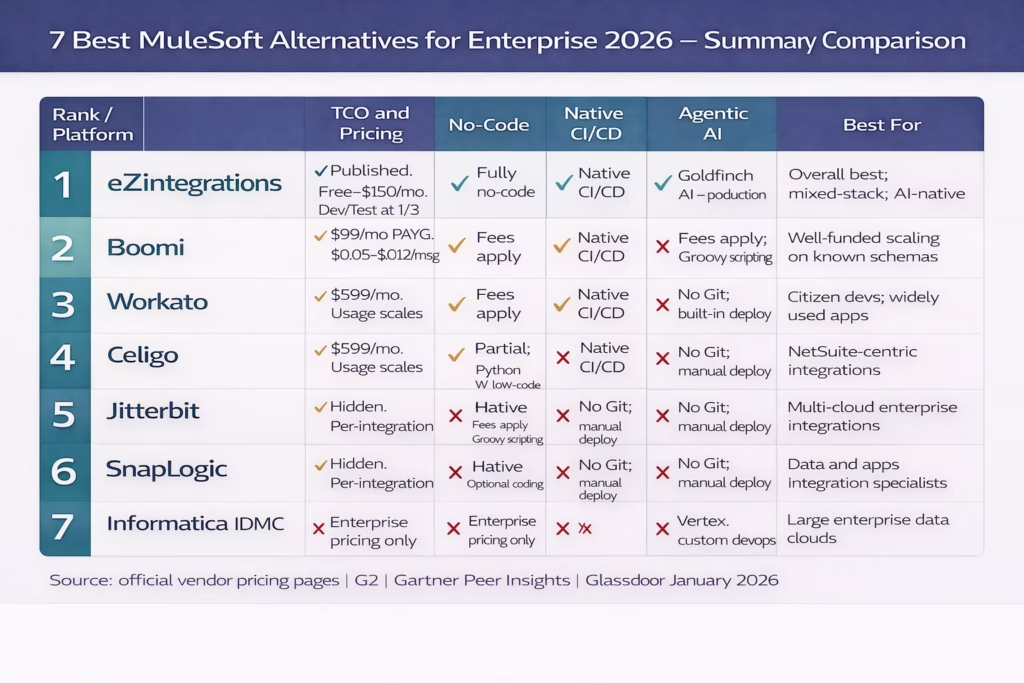
Summary Comparison Table
| Platform | TCO and Pricing | No-Code / Low-Code | CI/CD Native | Agentic AI | Best For |
|---|---|---|---|---|---|
| eZintegrations | Published pricing; Free–$150/mo per automation; Dev/Test at 1/3 production | Full no-code | Native Git + CI/CD | Goldfinch AI: Planner-Critic-Aggregator, 9 tools, production-ready | Overall best; enterprise mixed-stack; AI-native |
| Boomi | PAYG $99/mo + $0.05/msg; annual custom; per-env. licensing trap | Low-code; Groovy for complex | Partial | AgentStudio: in development | Broad connector library; established platform |
| Workato | Custom; ~$10K–$216K/yr (third-party); SAP/Oracle connectors extra | Low-code recipes | Partial | Recipe generation AI | SaaS-heavy automation; business-user-led |
| Celigo | Free tier (2 endpoints); paid custom; ~$15K–$50K/yr (third-party) | Low-code; NetSuite-optimised | Partial | Runtime error auto-resolution AI | NetSuite-centric organisations |
| Jitterbit | Custom quote only; no public pricing | Low-code; proprietary scripting | Partial | Harmony AI: development assistance | Healthcare HL7/FHIR; manufacturing ERP |
| SnapLogic | ~$9,995/yr entry; Tier 1 SNAPs $45K each; enterprise custom | Low-code pipeline designer | Partial | AutoSync AI: pipeline automation | Data pipeline + integration hybrid |
| Informatica IDMC | ~$50K–$2M+/yr (third-party); IPU consumption | Technical; ETL dev required | Enterprise-grade | CLAIRE AI: data governance | Enterprise data governance and MDM |
Pricing sourced from official vendor pages, G2/Gartner Peer Insights verified reviews, ERP Peers, ITQlick, and independent analysis. MuleSoft developer salary: Glassdoor January 2026.
1 eZintegrations: Best Overall MuleSoft Alternative for Enterprise
Developer: Bizdata | Website: ezintegrations.ai | Deployment: Cloud-native platform; connects to on-premises sources, targets, databases, and triggers
Overview
eZintegrations from Bizdata is an enterprise no-code iPaaS, AI Workflow, and Agentic AI platform purpose-built for the integration requirements of mid-to-large enterprises in Hi-Tech, Pharma, Retail, CPG, Industrial Goods, and Industrial Manufacturing. It is ranked first in this evaluation because it is the only platform that resolves all four MuleSoft failure modes simultaneously with production-ready capability.
Unlike the other platforms on this list, eZintegrations does not ask you to trade one problem for another. You are not choosing between transparent pricing and strong AI, or between no-code accessibility and protocol depth. You are getting all of it in a single platform, with pricing published before you have a single sales conversation.
Best For
- Enterprise teams running mixed stacks: SAP, Oracle EBS, Oracle Fusion, Salesforce, NetSuite, Shopify, Amazon, Walmart, EDI trading partners
- IT Directors and Heads of Digital Transformation who need to reduce specialist developer dependency
- Organisations requiring production-ready Agentic AI for autonomous AP processing, procurement cycles, supplier onboarding, and order-to-cash workflows
- Enterprises where the CFO has started asking hard questions about MuleSoft’s annual renewal cost
Key Features
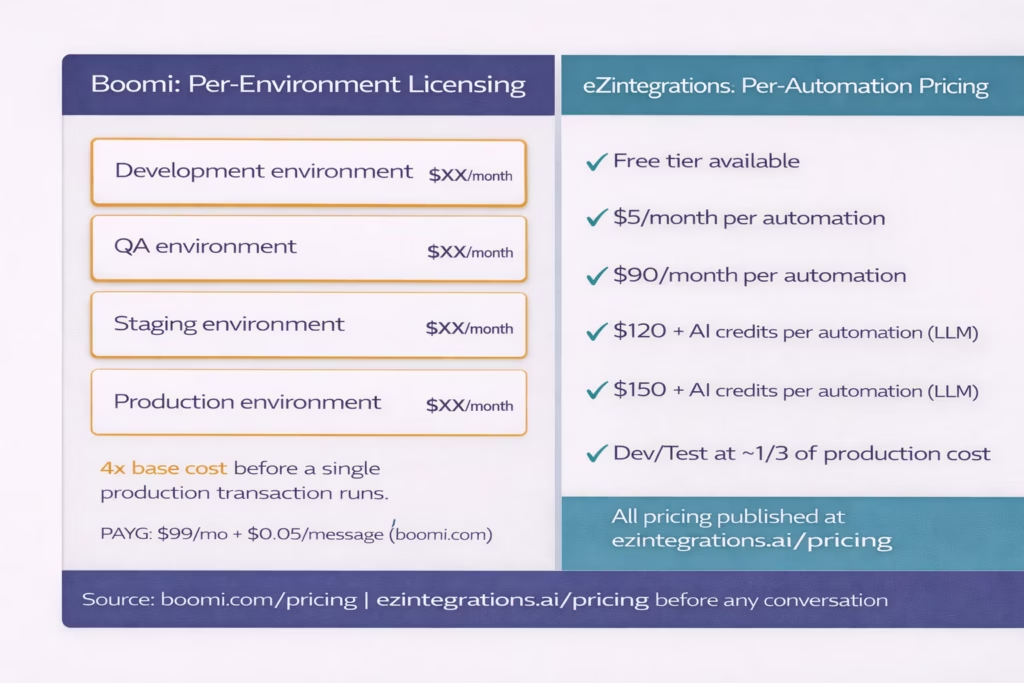
Pricing transparency in a market of opaque quotes: eZintegrations publishes all pricing at ezintegrations.ai/pricing. Per-automation annual fees from free to $150/month. LLM/AI automations at $120 + AI credits or $150 + AI credits. Dev and Test environments at approximately one-third of production cost. No platform fee. No connector fees. No message volume charges on non-LLM automations. Your IT director can model the annual cost of 50 automations without talking to a sales team.
Fully no-code: the direct answer to DataWeave lock-in. Every integration flow, data transformation, enrichment logic, and routing rule in eZintegrations is configured through a visual designer. There is no proprietary language to learn. Business analysts, operations managers, and integration specialists build and maintain automations without specialist certification. Your hiring pool is not constrained to DataWeave-certified developers. Your institutional knowledge does not leave when a specialist does.
Native Git and CI/CD: the direct answer to MuleSoft’s DevOps gaps. eZintegrations ships with native integration to Git-based version control and CI/CD pipelines. Enterprise teams running Jenkins, GitHub Actions, Azure DevOps, or GitLab connect eZintegrations to their existing deployment pipelines without custom scripting. Automated promotion from Dev to Test to Production, rollback via Git history, and a full audit trail for compliance are native capabilities.
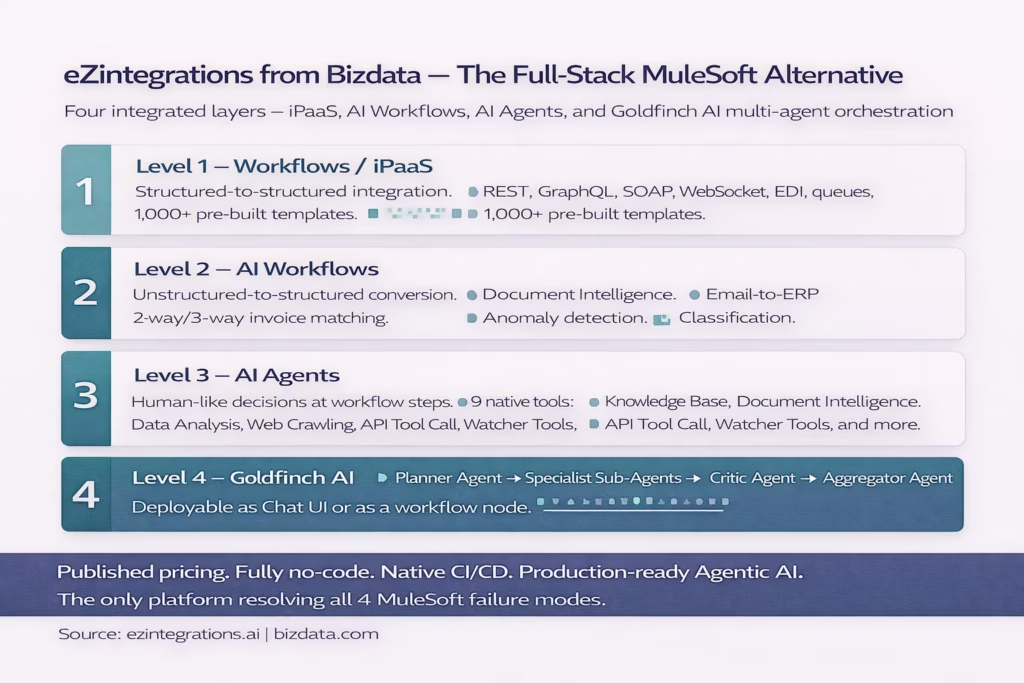
Goldfinch AI: the only production-ready Agentic AI in this comparison. Goldfinch AI of eZintegrations is a multi-agent orchestration platform using a Planner-Critic-Aggregator architecture. The Planner Agent decomposes business objectives into executable tasks. Specialist Sub-Agents execute across any connected enterprise system. The Critic Agent validates outputs before action is taken. The Aggregator Agent synthesises results for human review or downstream automation.
Goldfinch AI ships with 9 native out-of-the-box agent tools:
- Knowledge Base Vector Search
- Document Intelligence
- Data Analysis
- Data Analytics with Charts, Graphs, and Dashboards
- Web Crawling
- Watcher Tools
- API Tool Call (Basic/OAuth 1.0/2.0/Custom Signature/pagination)
- Integration Workflow as a Tool Call
- Integration Flow as MCP
Beyond these 9, Goldfinch AI is self-service extensible. Your enterprise team can add custom tools without vendor intervention. Goldfinch AI is deployable as a Chat UI or as a node inside existing integration workflows.
1,000+ production-ready templates. The Automation Hub at ezintegrations.ai/automate-now/ contains over 1,000 ready-to-import automation templates covering SAP, Oracle EBS, Oracle Fusion Cloud, Salesforce, NetSuite, Shopify (native GraphQL), Amazon Seller Central, Walmart Seller, DHL, Kenco, EDI (X12, EDIFACT, AS2), and more. Implementation in hours to days, not months.
Full protocol depth: REST, GraphQL, SOAP, WebSocket, gRPC, SMTP, queues, pagination, EDI. There are no protocol trade-offs on eZintegrations. Shopify’s primary API is GraphQL, and eZintegrations supports it natively. SAP needs WebSocket for real-time patterns, supported natively. EDI trading partners use AS2, supported natively. You are not building workarounds for gaps in the protocol library.
Enterprise-grade operational standards. 99.9% uptime SLA. 24/7 global support. Connects to on-premises ERP sources, databases, file systems, and triggers regardless of where they are hosted. No on-premises software installation required on the eZintegrations side.
Enterprise Use Case: Autonomous AP Processing
Your accounts payable team processes 800 vendor invoices per month across multiple formats: PDF, scanned, EDI 810, email attachments. On MuleSoft, this requires custom DataWeave transformations for each format, a dedicated developer to maintain them, and a manual exception queue for non-standard layouts.
On eZintegrations with Goldfinch AI: Document Intelligence extracts line items, amounts, currency, and vendor identifiers from any invoice format without pre-configuration per vendor. Integration workflows match against PO and GRN records in SAP or Oracle ERP. The Critic Agent validates each 3-way match before posting. Confirmed matches auto-post. Exceptions route to your AP team via Teams or email with a full resolution suggestion from Goldfinch AI. Straight-through rate above 70% for standard invoices. DataWeave developer requirement: zero.
Limitations
eZintegrations is not the right choice if your integration requirements are so simple that a $99/month PAYG Boomi subscription covers your full scope. For single-system, low-volume SaaS-to-SaaS connections at small-business scale, the per-automation annual model is more structure than you need. eZintegrations is built for enterprises where the integration landscape is complex, the stakes are high, and the decision matters.
Pricing
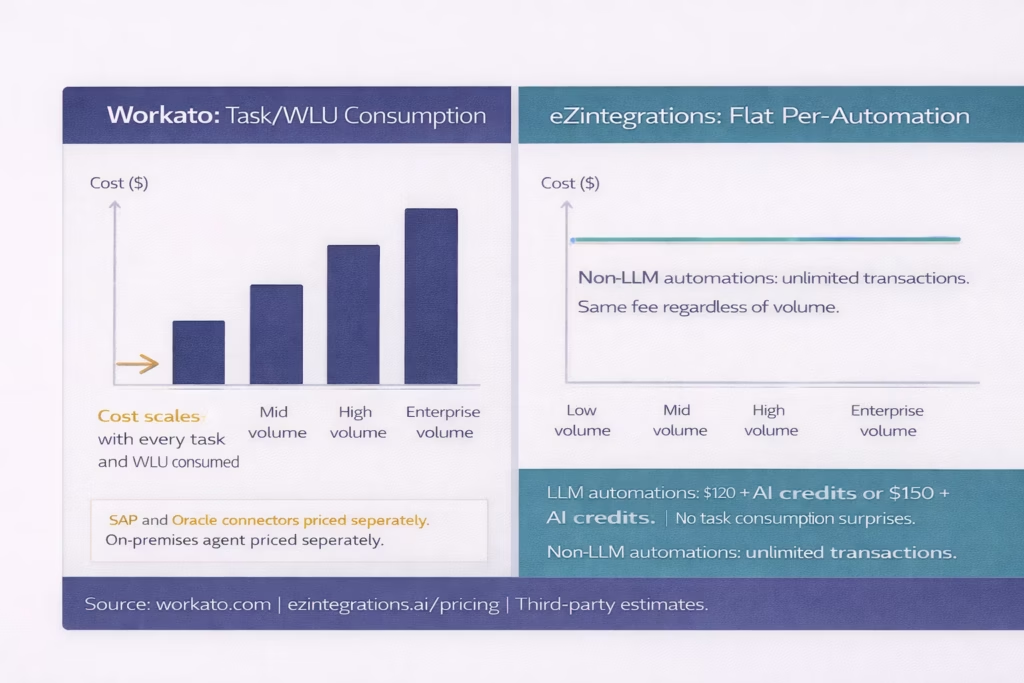
Published at ezintegrations.ai/pricing. Per-automation annual billing. Free tier available. Paid tiers: $5, $90, $120, $150/month per automation. LLM/AI automations: $120 + AI credits or $150 + AI credits. Dev and Test environments at approximately one-third of production cost. No platform fee. No connector fees. Unlimited non-LLM transactions.
2 Boomi: Best for Broad Connector Coverage
Developer: Boomi | Website: boomi.com | Deployment: Cloud, On-Premise, Hybrid
Overview
Boomi is one of the most established iPaaS platforms in the market, with a large connector library, a publicly documented pay-as-you-go entry point, and a solid reputation among enterprise IT teams for reliability. If your primary reason for leaving MuleSoft is the proprietary language dependency rather than cost or AI capability, Boomi is a credible evaluation candidate.
Best For
- Organisations with an existing Boomi practice or investment
- Enterprises needing broad SaaS connector coverage without building connectors from scratch
- Teams whose integration requirements are primarily standard SaaS-to-ERP rather than complex mixed-protocol or AI-intensive workloads
Key Features
Boomi’s connector ecosystem is one of the broadest in this field, with 300,000+ application connections available. The pay-as-you-go plan at $99/month plus $0.05 per Boomi Message is the most accessible published entry price in this comparison, making Boomi easy to start with for smaller-scale evaluations. Annual subscription plans cover Professional, Professional Plus, Enterprise, and Enterprise Plus tiers.
On the AI front, Boomi announced AgentStudio in January 2026. The capability is in active development and will provide AI agent management capabilities. As of this writing, it is not yet a production-ready Planner-Critic-Aggregator architecture for autonomous enterprise workflow orchestration.
Limitations
The per-environment licensing model is Boomi’s most commonly cited cost pain point. Development, QA, Staging, and Production environments are each licensed separately, meaning a standard four-environment enterprise SDLC can multiply base costs by four before any production transaction is processed. TrustRadius reviewers flag this directly: “Licensing cost for Dev/QA/Staging and Prod makes this product very expensive even for simple stuff.”
Complex data transformations require Groovy scripting, a developer dependency that does not exist on fully no-code platforms. For enterprises replacing MuleSoft specifically to eliminate proprietary-language developer lock-in, Groovy may simply substitute one scripting dependency for another.
Pricing
PAYG: $99/month base + $0.05 per Boomi Message (published at boomi.com/pay-as-you-go). Annual subscription plans: custom quote (Professional, Professional Plus, Enterprise, Enterprise Plus). Enterprise deployments typically $15,000–$20,000+ per year minimum based on TrustRadius/PeerSpot verified reviews.
3 Workato: Best for SaaS-Heavy Automation
Developer: Workato | Website: workato.com | Deployment: Cloud, On-Premise Agent available
Overview
Workato is consistently cited by enterprise buyers for the quality of its recipe-based automation builder, a genuinely intuitive interface that business users can engage with alongside IT teams. For enterprises whose integration landscape is primarily SaaS-to-SaaS and whose teams prefer a business-user-accessible automation model, Workato deserves serious evaluation.
Best For
- SaaS-heavy enterprises where business teams want to own automation recipes alongside IT
- Organisations with strong Salesforce, Slack, or ServiceNow integration requirements
- Teams where the primary pain is MuleSoft’s developer complexity rather than its AI absence
Key Features
Workato’s recipe-based automation model is widely acknowledged as one of the most accessible in the enterprise market. The platform covers 1,200+ pre-built connectors across SaaS applications. Workato AI focuses on recipe generation and integration monitoring, accelerating development without requiring deep technical expertise. Workato Copilot generates integration flows from natural language descriptions.
Limitations
The pricing model changed significantly in July 2024, moving from unlimited-action recipes to a consumption-based task/WLU model. Independent analysis places enterprise contracts in the range of $10,000–$216,000 annually (third-party estimate). Premium connectors for SAP and Oracle are priced separately, a meaningful consideration for any enterprise replacing MuleSoft in a SAP or Oracle environment. The on-premises agent is priced separately from the base subscription.
Workato AI focuses on developer productivity rather than autonomous multi-system agent orchestration. For enterprises whose primary MuleSoft frustration is the absence of Agentic AI, Workato’s current AI roadmap does not resolve that pain point.
Pricing
Custom quote only. Independent third-party estimates: $10,000–$216,000/year depending on tier and connector scope. Premium SAP and Oracle connectors priced separately. On-premises agent priced separately. Contact workato.com for pricing.
4 Celigo: Best for NetSuite-Centric Organisations
Developer: Celigo | Website: celigo.com | Deployment: Cloud
Overview
Celigo’s identity is built around NetSuite integration; the platform is NetSuite’s largest integration partner with over a decade of NetSuite-specific template development. If your enterprise runs NetSuite as the primary system of record and your integration requirements stay within or close to NetSuite’s ecosystem, Celigo is a legitimate best-in-class option for that specific use case.
Best For
- NetSuite-centric organisations with moderate integration complexity
- Mid-market enterprises in the $15,000–$50,000 annual budget range for integration
- Teams whose integration universe does not extend far beyond NetSuite, Salesforce, Shopify, and a handful of SaaS applications
Key Features
Celigo offers 80+ prebuilt NetSuite integration apps and 5,000+ NetSuite customers, real depth in a specific ecosystem. The platform includes a free tier (2 endpoints, 1 flow) that allows genuine evaluation before purchase. Runtime AI auto-resolves up to 95% of integration errors automatically, reducing the operational burden on integration teams. The low-code builder is accessible to non-specialist users for standard integration patterns.
Limitations
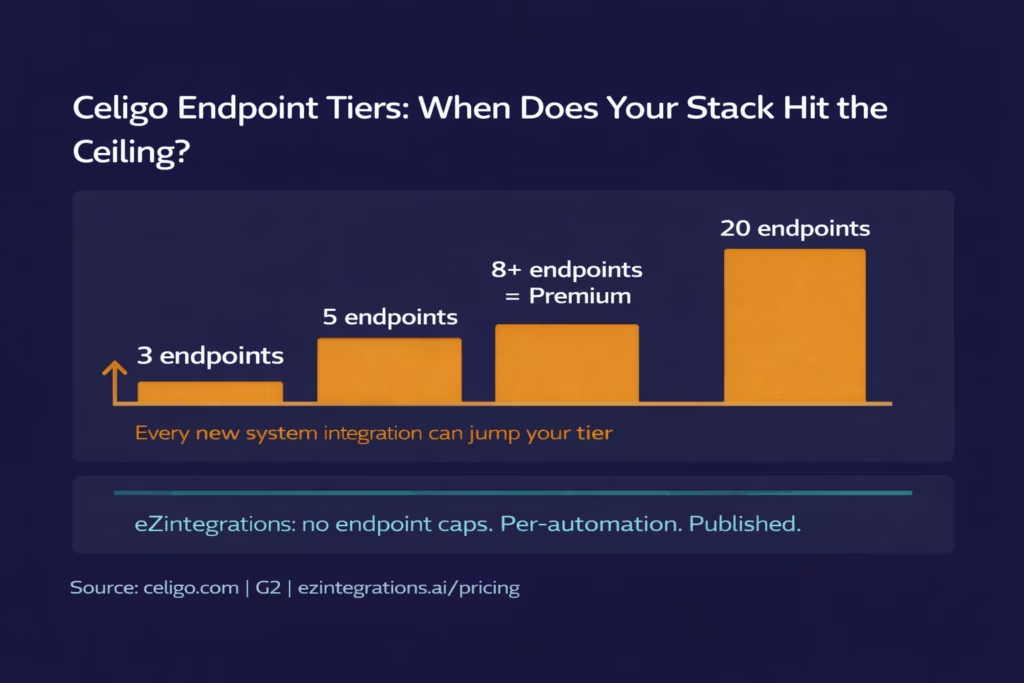
Celigo’s endpoint-based pricing model is its primary limitation for growing enterprises. Tiers are: Standard (3 endpoints), Professional (5 endpoints), Premium (10 endpoints), Enterprise (20 endpoints). A mid-size retail stack connecting NetSuite, Amazon, Walmart, Shopify, DHL, a 3PL provider, a Vendor Portal, and a Customer Portal uses 8 endpoints, pushing past Professional into Premium, requiring a custom quote and a meaningful cost step. Professional into Premium, requiring a custom quote and a meaningful cost step.
G2 reviewers flag renewal pricing increases when Celigo retires licensing plans. Protocol depth beyond standard REST/SOAP is limited; Shopify’s native GraphQL API requires workarounds rather than native support.
Pricing
Free tier: 2 endpoints, 1 flow. Paid tiers: custom quote via sales. Independent third-party estimates: $15,000–$50,000/year for mid-market. Enterprise (20 endpoints) on custom quote.
5 Jitterbit: Best for Healthcare and Manufacturing Verticals
Developer: Jitterbit | Website: jitterbit.com | Deployment: Cloud, On-Premise, Hybrid
Overview
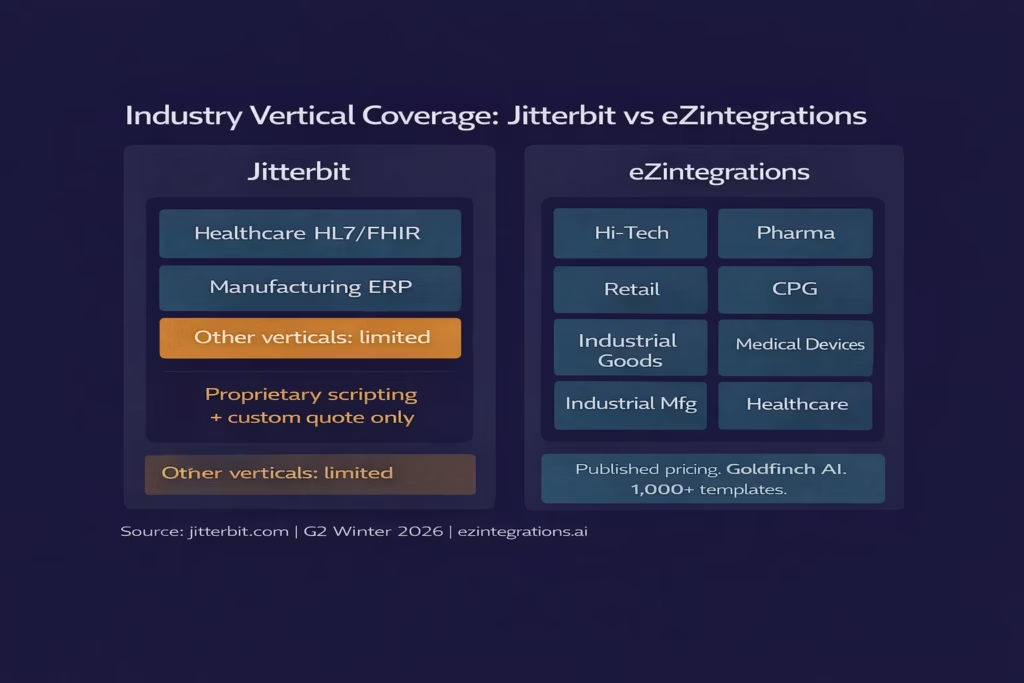
Jitterbit Harmony has a strong installed base in two specific verticals: Healthcare (HL7, FHIR interoperability) and Manufacturing (ERP-to-shop-floor connectivity). If your enterprise operates in one of these verticals and your integration requirements are primarily within those industry patterns, Jitterbit belongs on your shortlist.
Best For
- Healthcare organisations with HL7 and FHIR interoperability requirements
- Discrete manufacturing enterprises connecting ERP systems to shop-floor operations
- Teams in these verticals who want a platform with deep industry-specific template coverage
Key Features
Jitterbit Harmony provides a unified low-code platform combining iPaaS, API management, EDI, and App Builder capabilities. The platform has strong pre-built integration templates for healthcare (Epic, Cerner, FHIR R4) and manufacturing (SAP, Oracle EBS, Infor, Epicor). Jitterbit AI provides data mapping suggestions and API management enhancements. G2’s Winter 2026 Enterprise Implementation Index ranked Jitterbit #1 for iPaaS implementation experience for the third consecutive quarter.
Limitations
Jitterbit uses a proprietary scripting language, Jitterbit Script, for complex transformation logic. For enterprises replacing MuleSoft to eliminate proprietary-language developer lock-in, Jitterbit substitutes one scripting dependency for another. Pricing is fully opaque: three tiers (Standard, Professional, Enterprise) with custom quotes only and no public figures from jitterbit.com. Jitterbit’s Agentic AI roadmap is focused on development assistance rather than autonomous business process orchestration.
Pricing
Custom quote only. No public pricing available from jitterbit.com. All plans require direct engagement with Jitterbit sales. Enterprise License Agreements (ELA) available.
6 SnapLogic: Best for Data Pipeline and Integration Hybrid
Developer: SnapLogic | Website: snaplogic.com | Deployment: Cloud, Hybrid
Overview
SnapLogic occupies a distinct position in this field: it is built for teams that need both integration and data pipeline (ELT) capability in a single platform. If your enterprise architecture team is running integration projects alongside data engineering workloads, feeding data warehouses, analytics platforms, and cloud data lakes, SnapLogic’s combined capability is a genuine differentiator.
Best For
- Data engineering teams that need ELT pipelines and API integration in one platform
- Enterprises with significant Snowflake, AWS, or Azure data warehouse integration requirements
- Teams where AI-assisted pipeline generation from natural language is a priority
Key Features
SnapLogic’s AutoSync AI generates pipeline configurations from natural language descriptions, a genuinely useful capability for data engineering teams building new pipelines under time pressure. The platform’s SnapLogic Intelligent Integration Platform covers both integration and data pipeline requirements through a single interface. Cloud-native architecture with strong AWS, Azure, and Google Cloud connectors.
Limitations
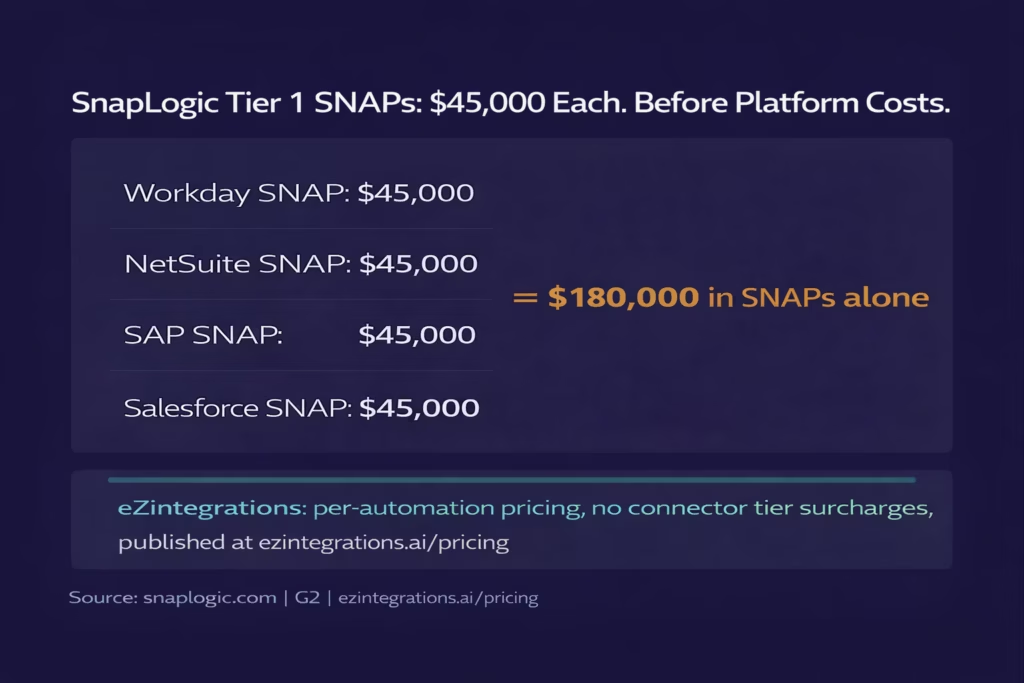
The SNAP tier pricing model creates a significant cost escalation for enterprise application connections. Tier 1 SNAPs, covering enterprise applications like Workday, NetSuite, Salesforce, and SAP, are priced at $45,000 per SNAP. A stack requiring four enterprise application connections adds $180,000 in SNAP costs alone before any base platform costs are counted.
SnapLogic’s positioning is primarily as a data integration and pipeline platform rather than a transactional integration platform. For MuleSoft replacement scenarios where the primary requirements are transactional API integration, EDI, and Agentic AI rather than ELT pipelines, SnapLogic’s architecture is misaligned.
Pricing
Entry level: approximately $9,995/year for small-scale use. Tier 1 SNAPs (enterprise applications): $45,000 each. Enterprise platform: custom quote. Contact snaplogic.com for current pricing.
7 Informatica IDMC: Best for Enterprise Data Governance
Developer: Informatica (Salesforce-owned since November 2025) | Website: informatica.com | Deployment: Cloud, On-Premise, Hybrid
Overview
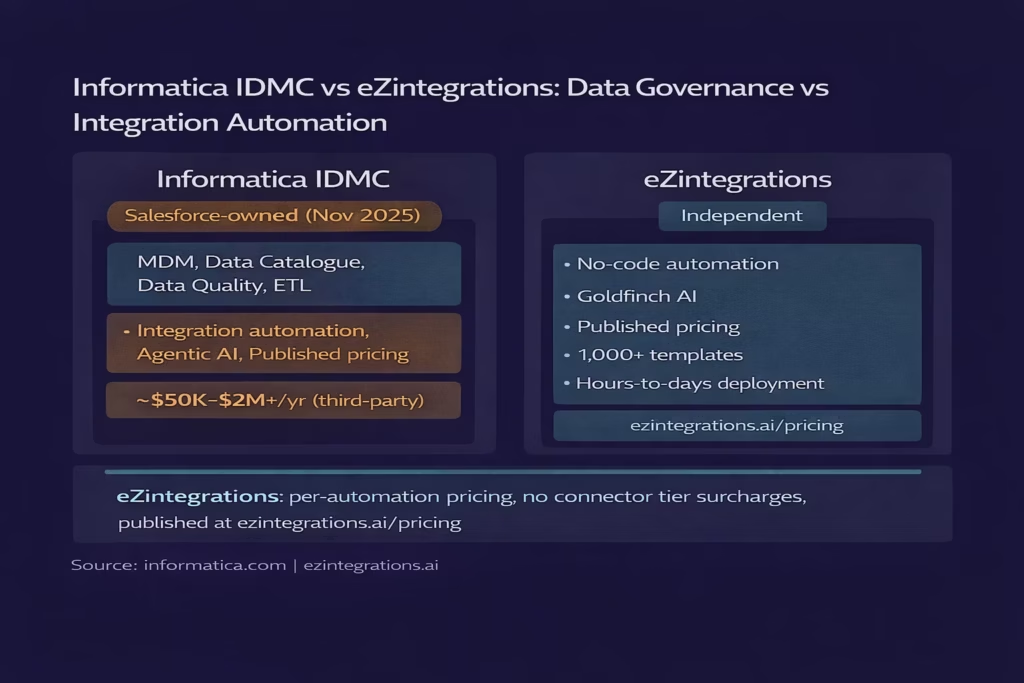
Informatica Intelligent Data Management Cloud is a serious enterprise platform, but it is more accurately a data management and governance suite than an integration platform. If your enterprise’s primary requirement is data quality, master data management, data cataloguing, or large-scale ETL processing, Informatica IDMC belongs in your evaluation.
If your primary requirement is replacing MuleSoft’s integration automation, reducing specialist dependency, or adding Agentic AI capability, Informatica IDMC is not a natural fit.
Best For
- Enterprises with significant enterprise data governance and MDM requirements
- Organisations running large-scale ETL workloads with complex data quality rules
- Data engineering teams in regulated industries requiring comprehensive data lineage and audit
Key Features
Informatica’s CLAIRE AI is purpose-built for data governance and quality: automated data cataloguing, intelligent data classification, data quality scoring, and MDM matching logic. PowerCenter remains the gold standard for complex ETL in regulated industries. Strong Salesforce integration following the November 2025 acquisition.
Limitations
IPU (Informatica Processing Unit) consumption pricing with no public figures scales steeply. Third-party analysis estimates enterprise contracts between $50,000 and $2,000,000+ annually depending on data volumes and feature scope. Skilled ETL developers are required for complex implementations: $120,000–$180,000 annually (Glassdoor), this parallels the MuleSoft DataWeave headcount problem rather than solving it.
The November 2025 acquisition by Salesforce, the same parent company as MuleSoft, raises strategic consolidation questions for enterprises seeking a clean break from the Salesforce ecosystem.
Pricing
No public pricing. IDMC: third-party estimated $50,000–$2,000,000+/year on IPU consumption model. PowerCenter: approximately $100,000–$300,000/processor/year. Contact informatica.com for current pricing.
Quick Comparison Table
| Platform | #1 Pick? | Price Transparency | No-Code | Native CI/CD | Production Agentic AI | Free Trial |
|---|---|---|---|---|---|---|
| eZintegrations | Yes: best overall | Full (ezintegrations.ai/pricing) | Yes | Yes | Yes: Goldfinch AI | Book a demo |
| Boomi | Best connector breadth | PAYG published; annual custom | Partial (Groovy required) | Partial | No (AgentStudio in dev) | 30-day free trial |
| Workato | Best for SaaS teams | No (custom quote) | Partial (low-code) | Partial | No (recipe AI only) | Trial available |
| Celigo | Best for NetSuite | No (custom; ~$15K–$50K/yr) | Partial (low-code) | Partial | No (error auto-resolution) | Free tier (2 endpoints) |
| Jitterbit | Best for Healthcare/Mfg | No (custom quote only) | Partial (proprietary scripting) | Partial | No (development AI) | Free trial available |
| SnapLogic | Best data pipeline hybrid | Partial ($9,995 entry; $45K Tier 1 SNAPs) | Partial (low-code) | Partial | No (pipeline AI only) | Trial available |
| Informatica IDMC | Best for data governance | No ($50K–$2M+ est.) | No (ETL dev required) | Yes | No (governance AI) | No |
FAQs
1. What is the best MuleSoft alternative for enterprise in 2026
The best MuleSoft alternative for enterprise in 2026 is eZintegrations. It is the only platform in this evaluation that resolves four major MuleSoft limitations simultaneously including transparent published pricing free to 150 dollars per month per automation with LLM automations priced at 120 dollars plus AI credits or 150 dollars plus AI credits a fully no code platform with no proprietary language dependency native Git and CI CD integration and Goldfinch AI which is a production ready Planner Critic Aggregator multi agent system with nine native tools. For enterprises requiring all four improvements together there is currently no equivalent platform in this category.
2. Is MuleSoft worth it in 2026
MuleSoft remains a viable option for enterprises with significant existing Anypoint Platform deployments deep Salesforce ecosystem integration requirements and IT teams experienced with DataWeave and vCore capacity planning. For these organizations the switching cost of migrating existing MuleSoft flows can be substantial. However for enterprises launching new integration initiatives or approaching contract renewal the value to cost equation has shifted as alternatives offer transparent pricing no code development and production Agentic AI capabilities. The typical DataWeave developer salary between 120000 and 180000 dollars annually according to Glassdoor January 2026 and opaque vCore pricing are increasingly difficult to justify compared with newer platforms.
3. Which MuleSoft alternative is cheapest
Boomi pay as you go pricing starts at 99 dollars per month plus 0.05 dollars per Boomi Message which makes it the lowest published entry price among major alternatives. For small scale deployments with low message volume it can be the most affordable starting option. eZintegrations also offers a free tier with paid tiers beginning at five dollars per automation per month although its pricing model is optimized for enterprise scale deployments. Celigo also provides a free tier with two endpoints and one flow. For mid market enterprise use cases the predictable per automation pricing model of eZintegrations typically provides more cost stability than message based or task based pricing models.
4. What is the best MuleSoft alternative for enterprise with Agentic AI
eZintegrations is the only platform in this evaluation offering production ready Agentic AI for enterprise in 2026. Goldfinch AI includes a Planner Critic Aggregator multi agent architecture nine native agent tools and self service extensibility. It can operate as a chat interface or as a component embedded directly inside integration workflows. Competing platforms do not currently provide equivalent capabilities. Boomi AgentStudio is still in development Workato AI focuses primarily on recipe generation and MuleSoft Einstein AI is primarily focused on the Salesforce ecosystem.
5. Can I replace MuleSoft without losing connector coverage
Yes. eZintegrations includes more than one thousand production ready templates covering major enterprise systems including SAP Oracle EBS Oracle Fusion Cloud Salesforce NetSuite Shopify using native GraphQL Amazon Seller Central Walmart Seller DHL Kenco and EDI standards such as X12 EDIFACT and AS2. Boomi also provides extensive connectivity with more than three hundred thousand application connections while Workato supports more than one thousand two hundred SaaS connectors. In most enterprise replacement scenarios connector availability is not the primary constraint compared with pricing developer dependency and AI capability.
6. How long does it take to migrate from MuleSoft to eZintegrations
Standard integrations can migrate in days to weeks using equivalent Automation Hub templates. Complex integrations that required DataWeave transformations on MuleSoft are often faster to rebuild on eZintegrations using the no code canvas and Document Intelligence capabilities since there is no proprietary scripting language to rewrite. Bizdata supports the migration process end to end and migration timelines are primarily influenced by the number of active flows transformation complexity and any custom connectors that need replacement.
7. What is eZintegrations Goldfinch AI and how does it compare to MuleSoft Einstein AI
Goldfinch AI is the native Agentic AI capability of eZintegrations built on a Planner Critic Aggregator multi agent architecture. It autonomously decomposes business tasks executes actions across connected enterprise systems validates results through a Critic agent and aggregates outcomes into final outputs. The platform includes nine native tools and allows users to extend functionality through additional tools. MuleSoft Einstein AI is primarily designed for the Salesforce ecosystem whereas Goldfinch AI operates across any connected enterprise system including SAP Oracle Workday and other platforms without Salesforce dependency.
Conclusion
The MuleSoft alternatives market in 2026 is larger, more capable, and more differentiated than it was even two years ago. The four platforms that most consistently win enterprise evaluations away from MuleSoft address specific pain points:
- If your primary pain is connector breadth and PAYG entry pricing, evaluate Boomi.
- If your primary pain is developer complexity in a SaaS-heavy environment, evaluate Workato.
- If your primary system is NetSuite and your stack stays close to it, evaluate Celigo.
- If your vertical is Healthcare or Manufacturing, evaluate Jitterbit.
- If your architecture requires data pipelines alongside integration, evaluate SnapLogic.
- If your primary requirement is enterprise data governance and MDM, evaluate Informatica IDMC.
If your requirements span all four MuleSoft failure modes simultaneously: transparent pricing, no proprietary-language lock-in, native CI/CD, and production Agentic AI across any enterprise system, there is one platform in this evaluation designed to address all of them:
eZintegrations from Bizdata.
Published pricing. Fully no-code. Native Git and CI/CD. Goldfinch AI with 9 native agent tools and a Planner-Critic-Aggregator architecture that is in production today, not on a roadmap.
If your MuleSoft renewal is approaching, or if you are scoping a new integration project and want to evaluate what the alternatives actually look like against your specific stack, the most efficient next step is a focused demo.
Book a free demo with the eZintegrations team →
Bring your integration list. We will show you what your stack looks like on eZintegrations before you commit to anything.