Amazon Settlement Report to ERP: What It Means in 2026
December 4, 2025TL;DR
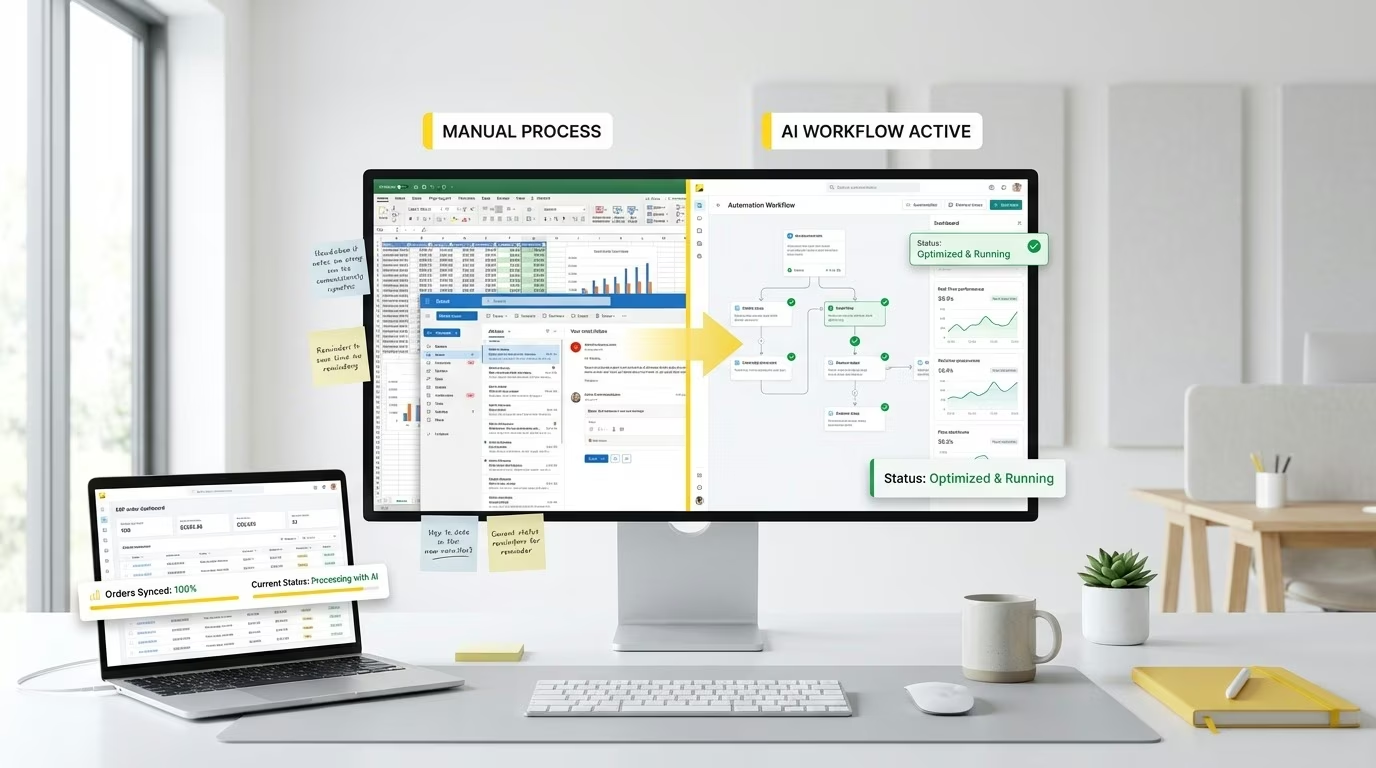
Amazon Settlement Report to ERP integration removes manual spreadsheets, reduces reconciliation time, prevents revenue leakage, posts transactions directly into ERP in real time, and speeds up the entire Order to Cash cycle. Instead of finance teams cleaning CSVs and matching payouts line by line, the integration automatically transforms the settlement report into structured financial entries that flow into ERP with accuracy, transparency and audit traceability.
In 2026, this shift is no longer a productivity improvement. It is a necessity for finance and operations teams scaling their Amazon business.
Overview
This guide explains what Amazon Settlement Report to ERP integration means, why it matters for modern ecommerce finance, how it works technically, and how automation is changing reconciliation in 2026. Businesses processing large volumes on Amazon already know how quickly financial data becomes complex. With payouts, fees, returns, reimbursements and taxation updates happening every settlement cycle, manual reporting cannot keep up.
Finance teams using spreadsheets face delays during:
• Month end close
• Order validation
• Reconciliation cycles
• Reporting workflows
• Revenue leak investigations
This is exactly why automated integration has become a turning point.
What Exactly Is an Amazon Settlement Report?
An Amazon Settlement Report is Amazon’s financial summary for sellers generated every fourteen days. It contains:
• Sales
• Refunds
• Returns
• Reimbursements
• Adjustments
• Fee deductions
• Chargebacks
• Taxes
It shows accurate marketplace performance, but the challenge is that the raw file is not ERP ready. It requires transformation, account mapping, and formatting before posting into ERP accounting ledgers.
What Does Amazon Settlement Report to ERP Actually Mean?
It means connecting Amazon Seller Central to your ERP, so that settlement reports sync automatically without manual downloads or spreadsheet cleaning.
The integration:
• Retrieves settlement data directly using Amazon APIs
• Organizes and validates financial events
• Cleans and structures records
• Maps every transaction to the correct accounts
• Creates journal entries automatically
• Posts into ERP in real time
With this setup, ERP always shows accurate and up to date profitability metrics, without human intervention.
Why This Matters More in 2026?
Manual reconciliation cannot keep pace anymore
Fee structures, taxes and adjustment rules keep evolving. Manual work leads to delays, inconsistencies and misallocated revenue. Automation transforms multi hour reconciliation into a process that runs in minutes, reliably and error free.
Clean data is mandatory for profitability clarity
To understand true margins, finance teams need structured system driven reporting instead of spreadsheet based patchwork. Automated pipelines give reliable data for decision making.
Revenue leakage often goes unnoticed without integration
Missed reimbursements, incorrect deductions and duplicate entries slip through manual checks. Integration ensures every financial entry is interpreted and categorized correctly.
Leadership requires real time monitoring
Decision making depends on visibility. Integration enables faster reporting dashboards with no waiting for manual preparation.
Compliance and audit readiness improves automatically
Every sale, refund, tax record and fee becomes traceable inside the ERP. This makes audits smooth and documentation simple to supply.
Industry documentation around Amazon SP API settlement workflows aligns with this automated structure, recommending transformation before ledger posting.
How the Integration Works Step by Step?
Most integration engines follow an automated workflow:
• Amazon settlement file is pulled securely using SP API
• Records are normalized and structured
• Fees, taxes, refunds and sales are categorized
• Data is mapped to ERP chart of accounts
• Journal entries are created automatically
• Posting happens inside ERP systems such as NetSuite, SAP, Microsoft Dynamics 365 and Oracle ERP Cloud
• Reconciliation dashboards surface exceptions to resolve quickly
This creates a single source of truth inside ERP instead of distributed spreadsheets.
The Bottom Line
Managing settlement data manually used to work at lower order volumes. But with growth, product count expansion and global marketplace activity, automation becomes a critical system requirement. Amazon Settlement Report to ERP integration gives financial clarity, prevents revenue loss, accelerates closing cycles and supports better business decisions.
For enterprises aiming for accuracy, governance and rapid financial visibility, integration is not optional anymore, it is strategic.
Available on Microsoft Marketplace

eZintegrations for Amazon Settlement Report ERP integration is available on the Microsoft Marketplace, enabling businesses to discover, evaluate, and deploy the solution within the Microsoft ecosystem. The Microsoft Marketplace listing simplifies procurement, supports enterprise-grade security and compliance standards, and accelerates onboarding for organizations seeking reliable Amazon-to-ERP automation. Learn more on the Microsoft Marketplace or visit https://marketplace.microsoft.com/en-us/product/bizdatainc1701924601293.amazonsellercentral_ezintegrations?tab=Overview.
FAQs
1. What is the difference between Workato and eZintegrations
Workato is a no code workflow automation platform built mainly for SaaS business processes, while eZintegrations is a complete enterprise iPaaS designed for large scale system integrations, ERP connectivity and automation at scale.
2. Which is better for enterprise automation Workato or eZintegrations
eZintegrations is generally better for enterprise automation due to real time orchestration, ERP support, SOC 2 Type 2 compliance, and ability to handle high volume data pipelines for finance and global operations.
3. Does eZintegrations support ERP integration
Yes, eZintegrations supports native ERP integrations including Oracle, SAP, NetSuite and other enterprise systems with real time sync and workflow execution.
4. When is Workato a better choice than eZintegrations
Workato is well suited for mid market teams that need fast SaaS automation such as CRM sync, HR onboarding, IT automation or marketing workflows with limited system depth.
5. Is eZintegrations secure
Yes, eZintegrations is SOC 2 Type 2, HIPAA and GDPR compliant making it suitable for regulated industries including finance, healthcare and enterprise data governance.
6. Does eZintegrations require coding
No, eZintegrations is a no code iPaaS platform allowing businesses to build integrations visually without engineering effort.
7. Which platform is more scalable for long term automation
eZintegrations scales better for long term use because it supports real time data pipelines, multi system workflows, monitoring and high throughput workloads end to end.