5 Smart AI Data Integration Solutions to Boost Productivity
November 6, 2025TL;DR
AI data integration helps companies eliminate manual processes, improve data accuracy, and unify information across systems in real time. With platforms like eZintegrations, businesses automate data flows, reduce errors by nearly 70 percent, speed up decision-making, and unlock seamless connectivity across applications, databases, and cloud systems.
Introduction
Data has become the backbone of modern business operations. However, most organizations still struggle with connecting system data spread across emails, spreadsheets, APIs, CRMs, ERPs, warehouses, and cloud apps. This leads to duplication, errors, delayed reporting, and operational inefficiencies.
AI Data Integration solves this problem. It intelligently automates data movement across systems, validates and cleans data, and ensures the right information reaches the right destination at the right time. Instead of relying on heavy coding or manual entry, AI-driven platforms streamline processes with accuracy, speed, and minimal human intervention.
eZintegrations plays a key role here by enabling companies to integrate applications, automate workflows, transform data, and maintain quality without engineering complexity.
What is AI Data Integration?
AI Data Integration refers to the use of artificial intelligence to automatically connect, transform, and synchronize data across multiple applications, databases, and platforms. It eliminates manual data transfers and ensures information is accurate, complete, and consistent.
AI does not just move data. It understands formats, validates records, detects duplicates, and enriches information for business decision-making.
Why AI Data Integration Matters Today?
As organizations scale, they face challenges like:
• Multiple disconnected systems
• Manual Excel-based reconciliation
• Delayed data reporting
• High error rates
• Time-consuming migrations
With AI, integration becomes smarter and self-managed. Automated flows boost productivity, reduce dependency on technical teams, and enable faster decision cycles.
5 Ways AI Data Integration Transforms Operations
1. Automates Data Flow and Saves Time
Manual data transfers drain productivity. AI integration automates movement from source to destination without human involvement. This results in up to 80 percent time savings on repetitive tasks like data entry, report generation, and sync updates.
Automation also reduces workforce load, freeing teams to focus on strategy instead of repetitive operations.
2. Ensures Data Accuracy and Quality at Scale
Human error is unavoidable in manual workflows. AI-driven validation checks every field, identifies missing values, detects incorrect entries, and unifies records with precision. Businesses adopting AI integration have observed a 70 percent drop in data errors, leading to more reliable reporting and compliance.
Accurate data = better decisions = higher business performance.
3. Enables Real Time Dashboards and Faster Decisions
Leadership depends on quick visibility. AI integration delivers real-time analytics through dashboards and alerts, allowing teams to take action instantly. Companies leveraging real time insights experience up to 95 percent faster decision-making compared to spreadsheet-driven reporting.
This is especially valuable for finance, supply chain, sales, and operations teams.
4. Simplifies Complex Connections Without Coding
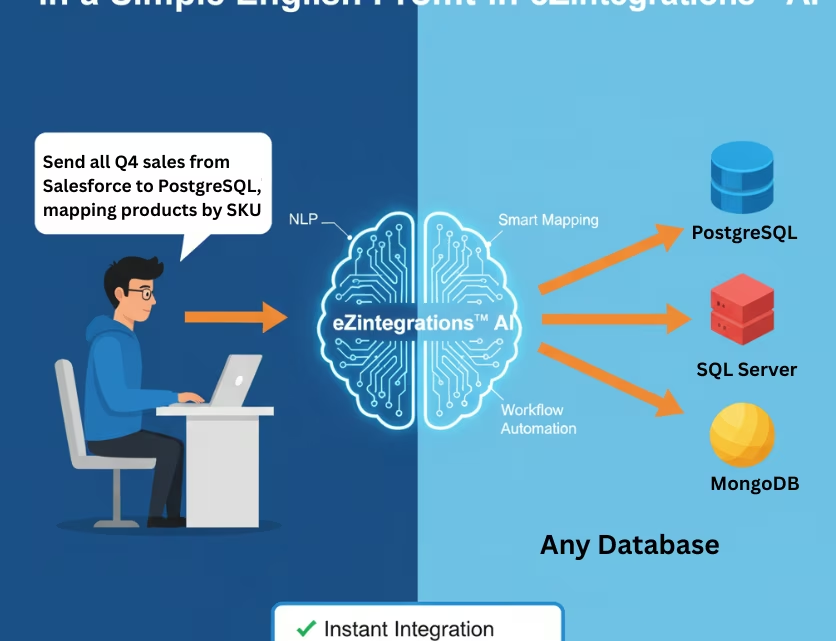
Connecting APIs and database pipelines traditionally requires skilled developers. With AI-enabled integration platforms like eZintegrations, even non-technical users can configure data flows conversationally using guided prompts.
Businesses report up to 60 percent reduction in IT effort, since engineers no longer manage manual mappings or scripts.
5. Boosts Overall Productivity Across the Organization
When data is synchronized, clean, and instantly accessible, teams operate more efficiently. Automated workflows handle everything from transactional posting to system updates, resulting in up to 50 percent improvement in team productivity.
Real World Example
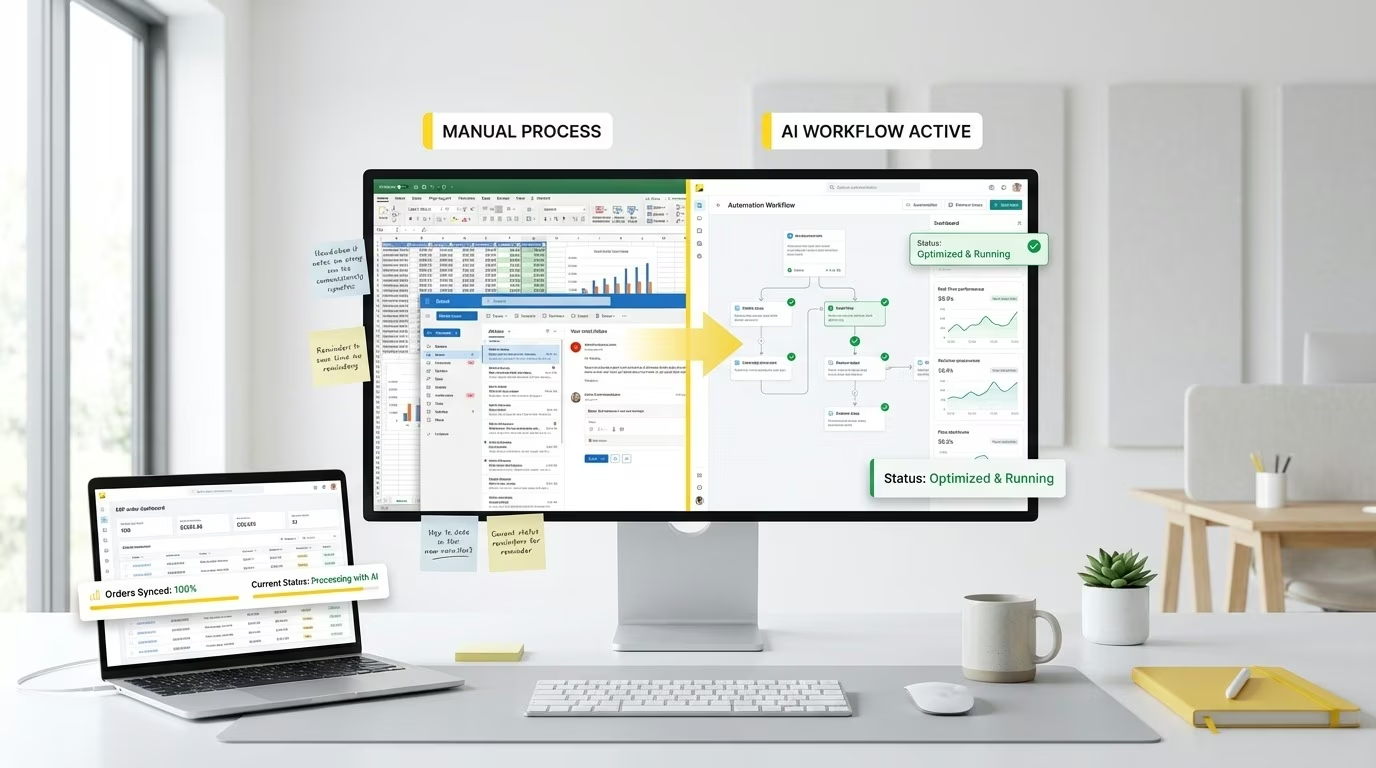
A mid-sized retail company struggled to synchronize customer orders between their e-commerce platform and warehouse database. Manual entry caused delays, errors, and missed shipments. After implementing AI Data Integration with eZintegrations, the company automated order syncing in real-time. This led to a 75% faster order processing and improved shipment accuracy, significantly enhancing customer satisfaction. Additionally, the finance team could reconcile payments faster, reducing invoice disputes by 60%.
For further reading on AI-based database automation, refer to AI in Data Integration: Trends and Best Practices.
Internal Links for Related Processes
-
Learn more about automated workflows in our AI Workflow Automation Guide.
-
Explore API integration solutions in how to integrate APIs with eZintegrations here.
Quick Feature Table
| Feature | AI Improves |
|---|---|
| Manual entry eliminated | Yes |
| Data accuracy improvement | Up to 70 percent |
| Time saved | Nearly 80 percent |
| Productivity increase | Up to 50 percent |
| Faster decisions | Up to 95 percent |
Benefits at a Glance
• Automates data movement end to end
• Ensures accuracy and compliance
• Delivers real-time visibility
• Reduces operational effort
• Handles scaling without extra hiring
• Integrates with cloud apps, ERPs, CRMs, databases
Why eZintegrations for AI Data Integration?
eZintegrations allows enterprises to:
• Connect cross-system data without coding
• Transform and validate records automatically
• Improve data health and business reliability
• Scale operations across departments
• Maintain governance across integrations
Whether it is finance, ecommerce, supply chain, or analytics, eZintegrations creates a central automation layer that ensures every process remains synchronized and error-free.
Conclusion
AI Data Integration is no longer a luxury, it is a necessity for digital businesses. It streamlines multiple systems, improves accuracy, accelerates reporting, and unlocks real operational efficiency. eZintegrations enables organizations to automate, validate, transform, and monitor data without heavy development. Teams move faster, systems stay aligned, and businesses scale confidently.
If you want to automate workflows, eliminate manual data handling, and gain real-time visibility, AI Data Integration with eZintegrations is the smartest way forward.
FAQs
1. What is AI Data Integration?
AI Data Integration is the use of artificial intelligence to automatically connect, clean, and synchronize data across multiple systems, databases, and applications. It eliminates manual data handling and ensures information flows accurately and efficiently between platforms.
2. How does AI Data Integration differ from traditional integration?
Traditional integration relies heavily on manual coding and configuration. AI Data Integration, on the other hand, uses machine learning and automation to detect data patterns, map fields, validate accuracy, and manage workflows with minimal human intervention.
3. What types of data sources can be connected with eZintegrations?
eZintegrations supports a wide range of data sources—including APIs, databases, CRMs, ERPs, emails, cloud applications, and WebSocket streams—allowing seamless data flow between systems without custom code.
4. How can AI Data Integration improve data accuracy?
AI-powered validation automatically checks for incomplete, duplicate, or inconsistent data. This reduces human errors by up to 70%, ensuring all records remain clean and reliable for reporting and analytics.
5. Is AI Data Integration suitable for non-technical teams?
Yes. eZintegrations is designed with an intuitive interface and AI-driven prompts, making it easy for business users to create and manage integrations without needing deep technical expertise.
6. Can AI Data Integration help with real-time decision-making?
Absolutely. Real-time dashboards and alerts provide instant insights into trends, anomalies, and performance metrics—helping teams make faster, data-driven decisions with 95% quicker access to actionable information.