AI Agents vs Traditional Automation: What Every Enterprise Needs to Know in 2026
March 17, 2026Traditional automation (RPA, rule-based workflows) executes fixed sequences on structured data and fails when inputs vary. AI agents perceive variable inputs, reason using LLMs, use tools to act across systems, and adapt their approach based on intermediate results. For structured, high-volume, zero-variation tasks: use traditional automation. For unstructured data, exception handling, and multi-step decisions: deploy AI agents.
TL;DR
Traditional automation (RPA, scripted workflows, rule-based pipelines) executes predefined sequences on structured data. It fails when inputs vary, when unstructured data appears, or when the underlying application UI changes. Maintenance consumes 70-75% of total RPA automation budgets. – AI agents perceive inputs (including unstructured documents, emails, and freeform data), reason using an LLM to determine the best approach, call tools (API endpoints, databases, document intelligence, web search), and adapt their plan based on intermediate results. – 30-50% of RPA projects fail to meet their intended objectives. 80% of enterprise data is unstructured, which RPA cannot process natively. – The enterprise answer in 2026 is not either/or. Structured, deterministic, high-volume tasks belong to traditional automation. Exception handling, unstructured data processing, and multi-step decisions belong to AI agents. – eZintegrations delivers both in one platform: traditional integration workflows for deterministic automation, and Goldfinch AI with 9 native agent tools for intelligent, adaptive processes.
Introduction
The question enterprises ask in 2026 is not “should we automate?” It’s “which automation technology applies to which process?” Traditional automation has been the enterprise standard for over two decades. RPA bots entered most large organisations around 2015. Rule-based integration workflows predate that. Both technologies work. Both have specific failure modes. And both are increasingly being deployed alongside AI agents rather than instead of them.
The confusion comes from vendors who market AI agents as a replacement for everything that came before, and from RPA vendors who market AI-enhanced bots as the same thing as genuine AI agents. Neither framing is accurate. The technologies are architecturally distinct, serve different task profiles, and have different cost and maintenance characteristics.
This guide gives you a precise comparison: what each technology does, where each fails, how to match your processes to the right technology, and what a hybrid deployment looks like in practice. The goal is a decision framework you can apply immediately to your automation backlog.
What Is Traditional Automation?
Traditional automation refers to software systems that execute predefined, rule-based sequences of actions on structured data: RPA bots, scripted integration workflows, scheduled ETL pipelines, and condition-triggered rule engines. They are reliable, fast, and deterministic. They are also brittle when inputs vary or when the underlying systems they interact with change.
The global RPA market was valued at approximately $28.31 billion in 2025 and continues to grow. Traditional automation isn’t going away. 66% of businesses have automated at least one process using rule-based technology, according to IBM and Morning Consult data. The technology has earned its place.
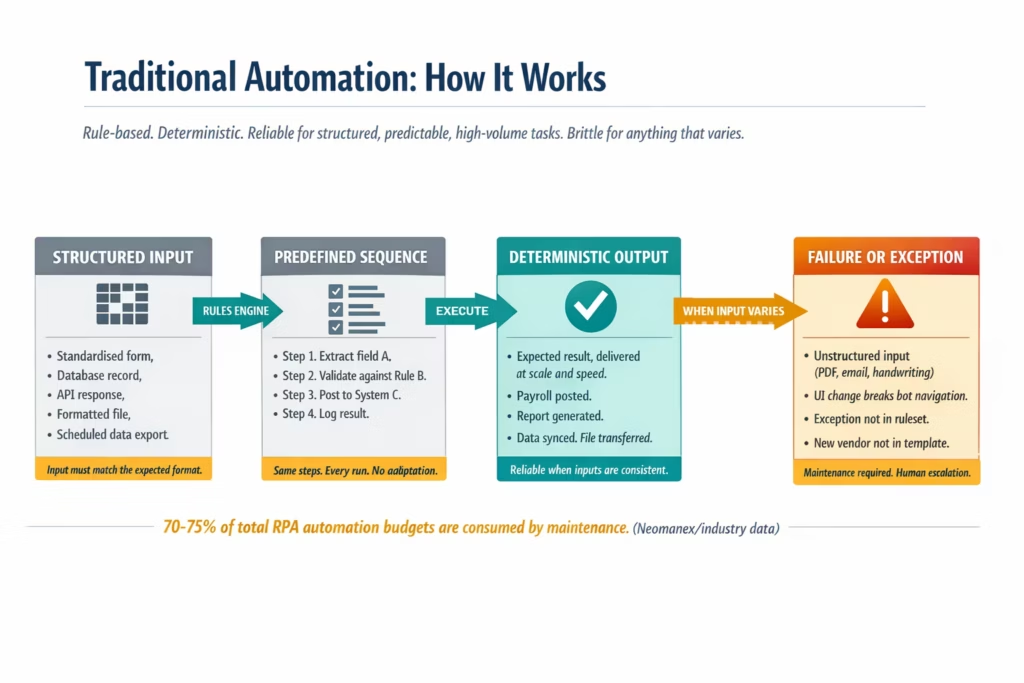
Traditional automation covers several technologies that share the same underlying architecture:
RPA bots interact with application user interfaces at the UI level, mimicking human actions: clicking, copying, pasting, navigating between screens. They’re excellent for legacy systems that expose no API, because the bot doesn’t need an API: it operates on the visual layer. The limitation is that any UI change (a button that moves, a field that’s renamed, a screen that’s added to a flow) breaks the bot and requires manual reconfiguration.
Scripted integration workflows connect systems via APIs according to a defined sequence. If System A sends a specific payload, the workflow extracts defined fields, transforms them according to a mapping rule, and posts them to System B. The sequence is fixed. The field mapping is fixed. Any deviation from the expected payload structure causes a mapping failure.
Rule-based decision engines evaluate structured inputs against a ruleset and route or action accordingly. Credit scoring systems, insurance underwriting rules, and order routing logic are common examples. They’re extremely reliable within their defined ruleset and fail silently or loudly when a case falls outside it.
Scheduled ETL pipelines extract data from a source system on a schedule, transform it according to predefined rules, and load it into a destination. They’re the backbone of data warehousing and reporting. They fail when source schemas change, when data quality degrades, or when the pipeline needs to respond to real-time events rather than scheduled runs.
All of these technologies share one characteristic: they require the process and its inputs to be defined and structured before automation is built. The more predictable the process, the more reliable the automation. The more variable the inputs, the more brittle the automation.
What Are Enterprise AI Agents?
Enterprise AI agents are software systems that perceive variable inputs (including unstructured documents, freeform emails, and natural language data), reason using a large language model to determine what steps to take, use tools (API endpoints, database queries, document intelligence, web search) to retrieve information or take action, and adapt their plan based on what each step returns.
Gartner predicts 40% of enterprise applications will embed task-specific AI agents by end of 2026, up from less than 5% in 2025. The AI agents market grew from $5.25 billion in 2024 to $7.8 billion in 2025, growing at a 46.3% CAGR toward $52.62 billion by 2030.
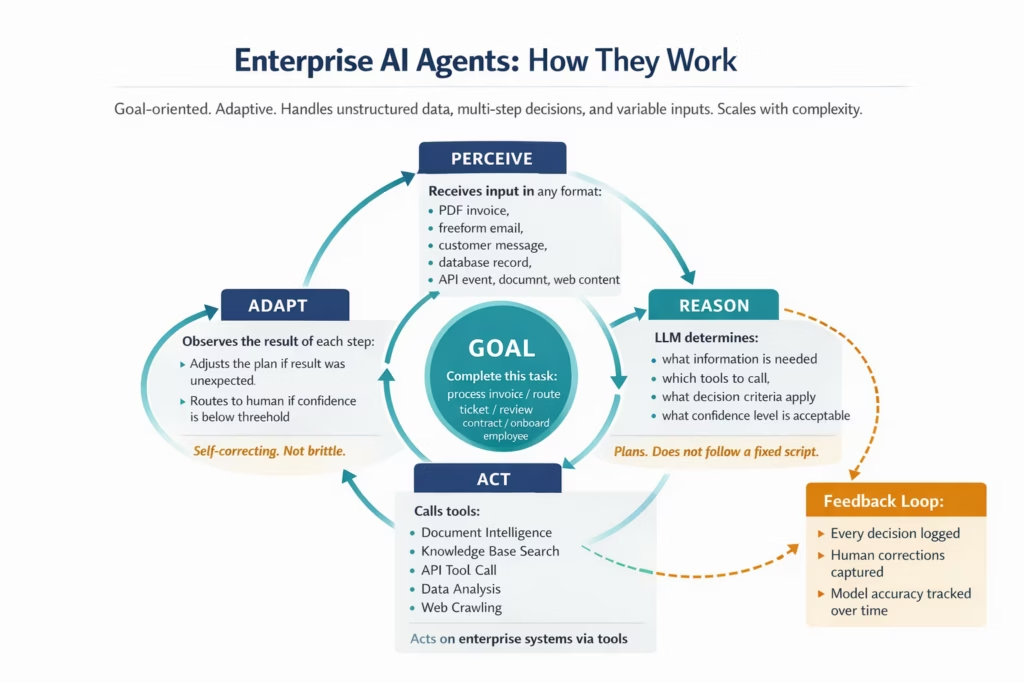
The architectural difference from traditional automation is the reasoning and adaptation loop. An RPA bot executes Step 1, Step 2, Step 3 regardless of what Step 1 returned. An AI agent executes Step 1, observes what it returned, and then determines whether Step 2 in the original plan is still the right next step, or whether the result of Step 1 suggests a different path. That capacity for mid-task plan adjustment is what allows AI agents to handle the “long tail” of cases that fall outside the coverage of any fixed ruleset.
The tool set available to the agent determines what it can actually do in production. Document intelligence lets the agent read PDFs, invoices, and contracts in any format without a vendor-specific template. Knowledge base vector search lets the agent retrieve relevant policy or regulation content. API tool call lets the agent write to your ERP, CRM, or HRIS. Web crawling lets the agent retrieve external regulatory or market information. The human approval gate pauses the agent when confidence is below the defined threshold and routes to a human reviewer.
Summary Comparison: AI Agents vs Traditional Automation
| Dimension | Traditional Automation (RPA, Scripted Workflows) | Enterprise AI Agents |
|---|---|---|
| Input type | Structured only (defined format, fields, schema) | Structured and unstructured (PDFs, emails, freeform text, images) |
| Task scope | Fixed, predefined sequence of steps | Goal-oriented, multi-step, adaptive |
| Decision-making | Rule-based: if X then Y, else Z | LLM-powered reasoning: evaluates context, selects approach, adapts |
| Handles exceptions | No: exceptions escalate to humans | Yes: agent reasons through exceptions, escalates only when confidence is insufficient |
| Unstructured data | No: requires structured input | Yes: document intelligence, NLP, natural language understanding |
| Maintenance burden | High: UI changes, schema changes, and new cases require reconfiguration (70–75% of RPA budgets) | Lower: agent adapts to input variation without reconfiguration |
| Failure mode | Silent or noisy failure when input varies or UI changes | Routes to human reviewer when confidence falls below threshold |
| Multi-system coordination | Limited: point-to-point or sequential API calls | Native: agent can call any tool, any system, in any order determined by reasoning |
| Skills to configure | Developer or RPA specialist for complex flows | Operations team using no-code agent canvas (on appropriate platforms) |
| Best for | High-volume, zero-variation, structured, deterministic tasks | Variable inputs, unstructured data, exception handling, multi-step decisions |
| Cost structure | Per-process licence, per-bot licence, or per-task pricing plus significant maintenance cost | Per-automation or per-workflow pricing on AI-native platforms |
| Governance | Execution logs, version control | Execution logs + per-decision audit trail + confidence tracking + human approval gates |
Where Traditional Automation Fails
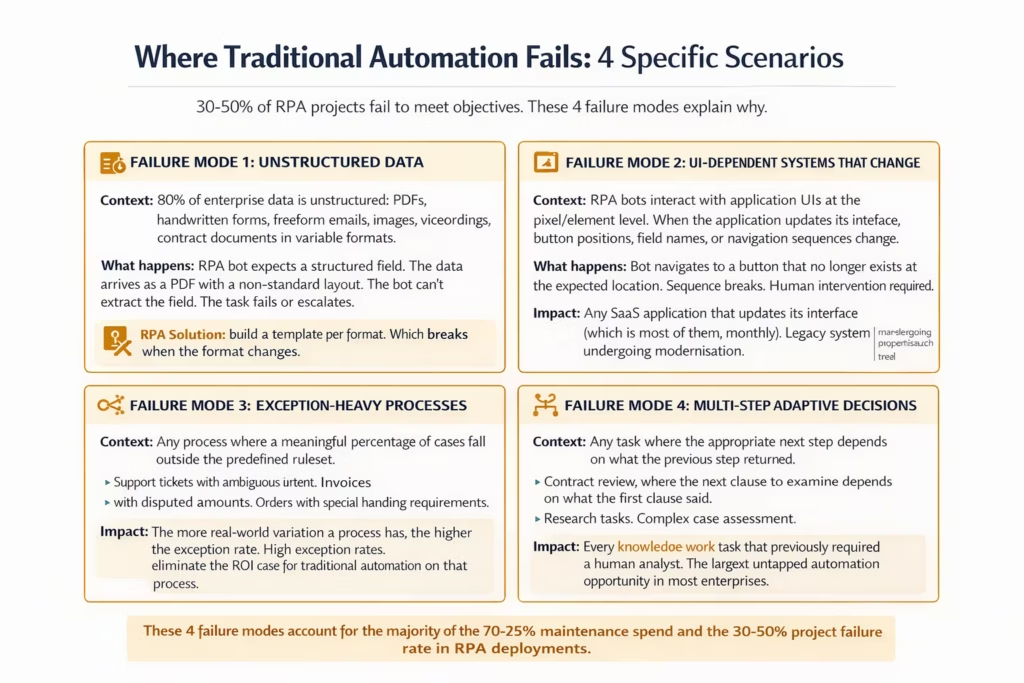
Traditional automation fails in four specific scenarios: unstructured data inputs, UI-dependent systems that change frequently, exception-heavy processes with cases outside the ruleset, and multi-step tasks requiring adaptive decision-making. These four scenarios account for the majority of the 30-50% RPA project failure rate.
Maintenance consumes 70-75% of total RPA automation budgets, according to industry data cited by Neomanex. That budget is almost entirely consumed by the four failure scenarios below.
Where AI Agents Outperform Traditional Automation
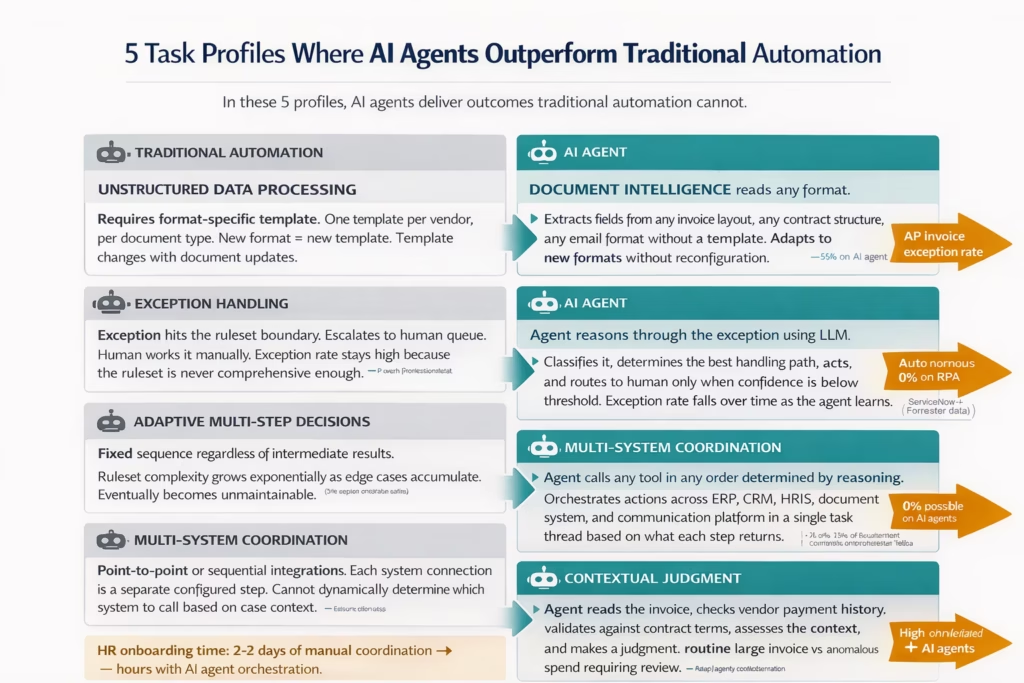
AI agents outperform traditional automation in five specific task profiles: unstructured data processing, exception handling, adaptive multi-step decision-making, multi-system coordination, and tasks that require contextual judgment. In these five profiles, AI agents deliver outcomes that traditional automation cannot, at a maintenance cost that traditional automation cannot match.
Early enterprise AI agent adopters report 300-500% ROI within six months, according to data compiled from verified enterprise deployments. Forrester’s TEI model for finance automation specifically shows 111% ROI with payback in under 6 months for intelligent automation combining AI with structured workflow execution.
The 5 Process Dimensions That Determine Which Technology to Use
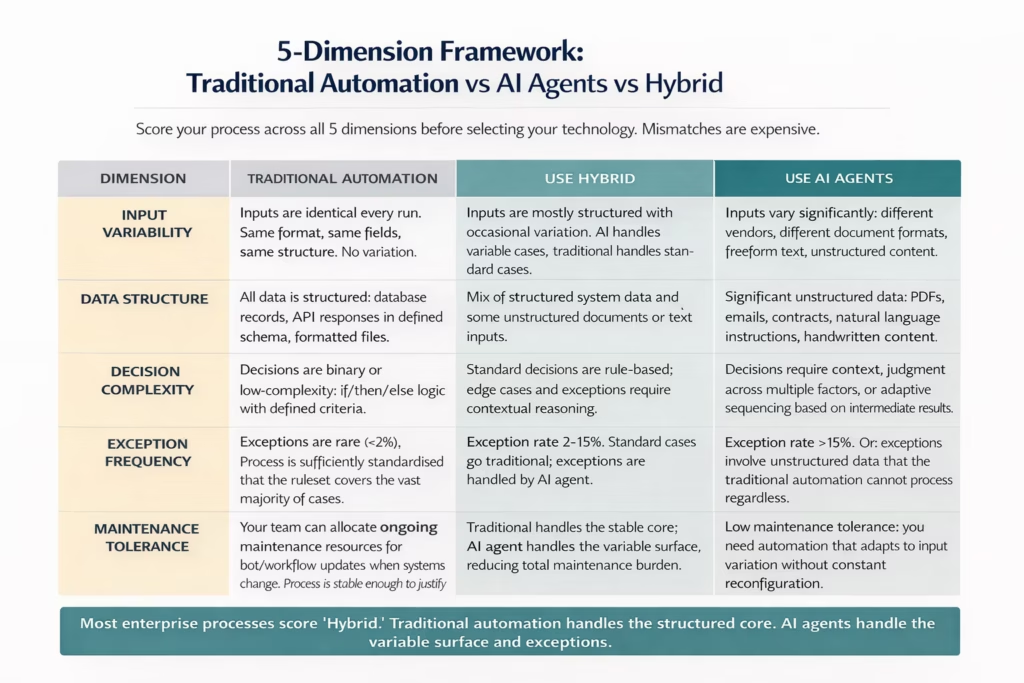
Before selecting between traditional automation and AI agents for any specific process, evaluate it against five dimensions: input variability, data structure, decision complexity, exception frequency, and maintenance tolerance. The answers determine which technology, or which combination, applies.
McKinsey’s 2025 survey reports that while 88% of organisations use AI, only 6% are “high performers” capturing significant value through automated workflow redesign. The gap between widespread AI use and high-value automation outcomes is explained by process-technology mismatches: deploying AI agents on processes that traditional automation handles efficiently, or deploying traditional automation on processes that require AI agent reasoning.
Detailed Feature Comparison
| Feature | Traditional Automation (RPA/Scripted Workflows) | Enterprise AI Agents (Goldfinch AI) |
|---|---|---|
| Input handling | Structured data only. Defined schema, format, and field positions required. | Structured and unstructured. PDF, email, freeform text, images, API events, database records. |
| Decision logic | If/then/else rules defined at configuration time. Cannot reason beyond the ruleset. | LLM reasoning at each step. Plans, evaluates intermediate results, adapts approach. |
| Exception handling | Exception hits ruleset boundary. Escalates to human. No learning from exception patterns. | Agent reasons through exception. Calls appropriate tools. Human gate only for low-confidence cases. |
| Unstructured data | Not supported without format-specific templates and custom preprocessing. | Native via Document Intelligence tool: PDFs, invoices, contracts, images in any format. |
| Multi-system coordination | Sequential or point-to-point. System call order defined at configuration. Cannot adapt. | Agent calls any tool in any order. Coordinates across ERP, CRM, HRIS, documents, web in one task thread. |
| Tool access | Defined integrations, configured API calls, UI automation scripts. | 9 native tools: Knowledge Base Search, Document Intelligence, Data Analysis, Charts/Dashboards, Web Crawling, Watcher, API Tool Call, Integration Workflow as Tool, Integration Flow as MCP. |
| Failure mode | Silent or noisy failure when input varies or UI changes. Requires human reconfiguration. | Routes to human reviewer when confidence falls below threshold. Adapts to input variation without reconfiguration. |
| Maintenance burden | High: 70–75% of total RPA budget. UI changes, schema changes, new cases require developer involvement. | Lower: adapts to input variation without reconfiguration. Human correction captured as feedback, not maintenance. |
| Governance | Execution logs, error logs, version control. | Step-level execution log, tool call log, model confidence per decision, human approval records, audit export for SOX/SOC2/GDPR. |
| Observability | Workflow execution log. Error alerting. | Unified log for AI steps and workflow steps. Model performance tracking. Confidence score distribution over time. |
| Skills required | RPA developer or integration developer. DataWeave or scripting for complex transformations. | Operations team using no-code agent canvas (on AI-native platforms like eZintegrations). |
| Extensibility | New process requires new workflow/bot. New system requires new connector or script. | Self-service tool addition beyond 9 native tools. Any REST API exposed as agent tool. |
| Cost model | Per-bot, per-process, or per-task licensing plus significant maintenance staff cost. | Per-automation pricing on AI-native platforms. AI capabilities included. |
Pricing and Cost Architecture
The total cost comparison between traditional automation and AI agents is not simply a licence comparison. It requires accounting for three cost dimensions: the licence cost, the implementation cost, and the ongoing maintenance cost. Traditional automation has a lower licence cost per process but a maintenance cost that compounds as process volume grows. AI agents have a higher capability cost but a significantly lower maintenance cost per process.
Maintenance consumes 70-75% of total RPA automation budgets across the industry. For every dollar spent on RPA licence costs, enterprises typically spend two to three dollars on maintenance over a five-year period. That TCO profile changes the licence-level comparison substantially.
Traditional automation licence costs vary widely by vendor. UiPath, Automation Anywhere, and Blue Prism each have their own pricing model (per bot, per process, per user, or enterprise licence). The licence cost is typically the most visible line item in the budget. It’s rarely the largest.
Traditional automation implementation costs include the RPA developer or integration specialist who builds and tests the bot or workflow, the testing cycles required to validate edge cases, and the documentation overhead. Simple processes: days to weeks. Complex multi-step processes: weeks to months.
Traditional automation maintenance costs are the hidden multiplier. Every UI change in an application that a bot navigates requires the bot to be reconfigured. Every schema change in a source API requires the mapping to be updated. Every new vendor format requires a new template. Every new exception category requires a new rule. These costs are individually small and collectively enormous: 70-75% of total RPA budgets, per industry data.
AI agent implementation costs include platform configuration (no-code on appropriate platforms, so no developer required for standard agent configuration), tool configuration (confirming API access to all required systems), confidence threshold calibration, and governance setup. The platform cost is higher than a basic RPA bot licence, but the implementation time is shorter and the developer dependency is lower.
AI agent maintenance costs are structurally lower because the agent adapts to input variation. A new invoice format doesn’t require reconfiguration: the document intelligence tool reads it. A new exception type doesn’t require a new rule: the agent reasons through it. The feedback loop captures human corrections and feeds them back into model accuracy. Maintenance shifts from reactive reconfiguration to proactive model performance monitoring.
eZintegrations publishes its pricing at eZintegrations pricing: Free, $5, $90, $120, and $150 per automation per month (annual billing). Goldfinch AI and AI Workflows are included in the automation pricing. No separate AI service licence. Dev and Test environments at approximately one-third of production pricing.
Who Should Use Each Technology?
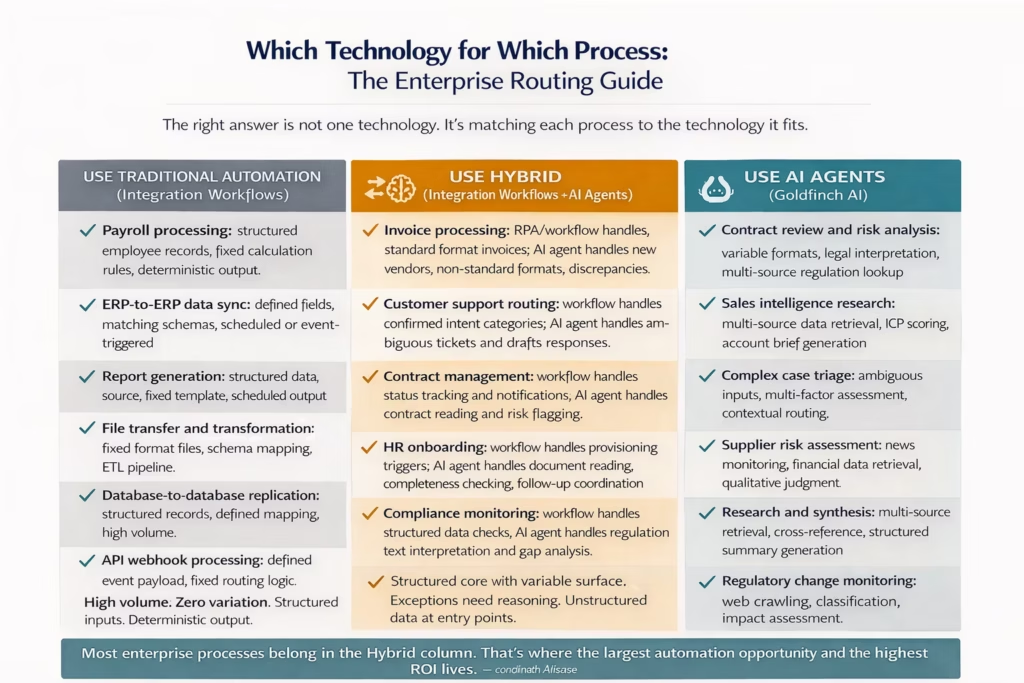
The “AI agents vs traditional automation” frame is misleading. The right question is which technology fits which process, not which technology wins overall. Use this section to match your specific automation backlog to the right technology.
The Hybrid Model: When to Deploy Both
The most successful enterprise automation programmes in 2026 deploy traditional automation and AI agents as complementary layers in a single process architecture. Traditional automation handles structured, deterministic execution. AI agents handle variable inputs, unstructured data, and exception reasoning. The combination delivers outcomes that neither technology achieves alone.
Blue Prism, one of the companies that pioneered RPA, has publicly stated: “The future isn’t retiring RPA. It’s fusing it with AI agents.” IDC projects that RPA spending will more than double between 2024 and 2028 to reach $8.2 billion. Traditional automation is not being retired. It’s being embedded within AI-powered orchestration systems as the reliable execution layer.
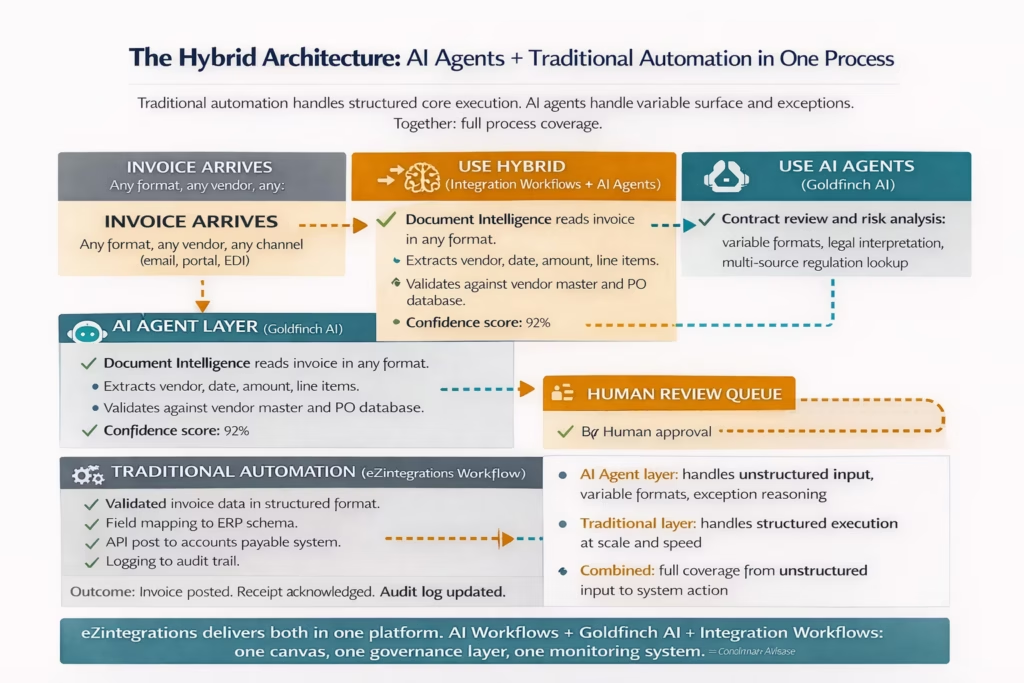
How eZintegrations Delivers Both in One Platform
eZintegrations is the only platform where traditional integration workflows and Goldfinch AI agent orchestration are native components of the same canvas, the same governance framework, and the same execution monitoring system. Your team builds the complete hybrid architecture without stitching together multiple tools.
Traditional integration workflows in eZintegrations connect to your enterprise systems via the 5,000+ endpoint API catalog. Any REST, SOAP, GraphQL, WebSocket, Webhook, or Database endpoint in your stack is available as a workflow step. If a system isn’t in the catalog, your team adds it via self-service without writing code. SFTP and file-based systems are dynamically converted to API/Database interfaces. Unlimited transactions on non-AI automations. No per-message charges.
Goldfinch AI multi-agent orchestration ships with 9 native out-of-the-box agent tools: Knowledge Base Vector Search, Document Intelligence, Data Analysis, Data Analytics with Charts/Graphs/Dashboards, Web Crawling, Watcher Tools, API Tool Call, Integration Workflow as Tool, and Integration Flow as MCP. Users can add more tools as self-service beyond these 9, without vendor involvement. Any integration workflow in the platform can be exposed as an agent tool immediately, which means your existing traditional workflows become Goldfinch AI agent capabilities without rebuilding them.
The Automation Hub includes 1,000+ pre-built templates covering both traditional integration workflows and AI agent workflows. Import a hybrid AP invoice processing template, configure it for your specific ERP and LLM preferences, set confidence thresholds, and deploy to production in days.
Unified governance means the same version control, environment isolation (Dev/Test/Staging/Production with approval-gated promotions), change management process, and audit trail export apply to both your traditional workflows and your Goldfinch AI agents. One compliance surface for SOX, SOC 2, and GDPR.
For a deeper look at how AI workflow automation is structured at the pipeline level, see our enterprise AI workflow automation guide.
Bottom Line / Verdict
Traditional automation and AI agents are complementary technologies, not competing ones. Traditional automation is the right choice for structured, deterministic, high-volume processes with consistent inputs. AI agents are the right choice for unstructured data, exception handling, adaptive multi-step decisions, and contextual judgment. Most enterprise processes benefit from both.
The case for choosing one platform that delivers both is straightforward: operational simplicity, governance consolidation, and the ability to expose traditional workflows as agent tools without rebuilding them. eZintegrations delivers the complete hybrid architecture in one platform.
Three numbers define where the automation market is heading. 30-50% of standalone RPA projects fail to meet their objectives. 80% of enterprise data is unstructured and inaccessible to traditional automation. 40% of enterprise applications will embed AI agents by end of 2026. The combination of those three numbers points to the same conclusion: hybrid architecture, with traditional automation handling the structured core and AI agents handling the variable surface, is the standard enterprise automation model of 2026 and beyond.
If your automation backlog includes any processes with unstructured inputs, exception-heavy routing, or multi-step adaptive decisions, and your current platform handles only traditional integration workflows without native AI agent capabilities, that gap is the most important decision your automation programme needs to address.
Book a free demo to see eZintegrations hybrid automation in action: traditional workflows and Goldfinch AI agents running in one canvas, one monitoring system, one governance layer.
Frequently Asked Questions
1. Is traditional automation being replaced by AI agents in 2026
No. Traditional automation such as RPA scripted integration workflows and rule based pipelines remains the best technology for structured deterministic high volume processes. AI agents complement it by handling what traditional automation cannot including unstructured data exception reasoning and adaptive multi step decisions. The enterprise standard in 2026 is a hybrid architecture that uses both technologies together. IDC projects RPA spending to more than double between 2024 and 2028 reaching 8.2 billion dollars.
2. When should I use AI agents instead of traditional automation
Use AI agents when your process involves unstructured data such as PDFs emails contracts or freeform text has a high exception rate where more than 5 to 10 percent of cases fall outside the ruleset requires contextual judgment or involves adaptive multi step decisions where each step determines the next action. Traditional automation is better suited for structured high volume deterministic processes with little or no variation.
3. Why do so many RPA projects fail
Around 30 to 50 percent of RPA projects fail to achieve their intended outcomes. The most common reasons include unstructured data inputs that bots cannot process without templates UI changes that break bot navigation sequences exception heavy processes where the rules do not cover enough cases and multi step processes where the next step depends on the output of the previous one. These scenarios are better handled by AI agents.
4. What is the difference between AI agents and RPA bots
RPA bots execute predefined scripts on structured data and always follow the same sequence of actions regardless of the outcome of each step. They do not reason or adapt to changing inputs. AI agents analyze variable inputs reason using large language models determine which tools to use retrieve information through APIs document intelligence or knowledge base search and dynamically adapt their execution plan based on the results of each step.
5. What does a hybrid automation architecture look like in practice
In a hybrid automation architecture the AI agent layer handles variable inputs unstructured documents and exception cases. For example in accounts payable invoice processing an AI agent reads invoices of any format extracts structured data and validates it. If the confidence score is above the threshold the structured data moves to a traditional workflow layer that posts the transaction to the ERP logs the result and sends notifications. If the confidence is below the threshold the case is routed to a human reviewer who validates the data before it continues through the workflow.
6. How does eZintegrations support both traditional automation and AI agents
eZintegrations supports both on a single platform. Traditional integration workflows connect to more than 5000 enterprise API endpoints using REST GraphQL WebSocket Webhooks and database connectors with unlimited transactions for non AI automations. Goldfinch AI provides multi agent orchestration with nine native tools including Knowledge Base Vector Search Document Intelligence Data Analysis Data Analytics with Charts and Dashboards Web Crawling Watcher Tools API Tool Call Integration Workflow as Tool and Integration Flow as MCP with extensibility beyond the initial tools. Both run on the same visual canvas governance model and unified execution monitoring system.
7. Is eZintegrations better than traditional RPA tools for AI agent workflows
For hybrid automation that combines traditional integration workflows with AI agent orchestration in one governed platform eZintegrations provides capabilities that standalone RPA tools typically do not including native multi agent orchestration nine out of the box AI tools a catalog of more than 5000 API endpoints AI workflow steps on the same canvas as integration steps and unified monitoring across both layers. Many RPA tools that added AI capabilities require separate product licenses and separate monitoring environments for the AI components.
Conclusion
The automation question in 2026 is not “traditional automation or AI agents?” It’s “which processes belong to each, and which need both?”
Traditional automation remains the most cost-effective technology for structured, high-volume, deterministic processes. AI agents are the first automation technology that can handle the 80% of enterprise data that’s unstructured, the exception-heavy processes that rule-based automation can’t cover, and the multi-step adaptive decisions that have historically required human analysts.
The hybrid architecture is the practical answer for most enterprise automation backlogs. Traditional workflow automation handles the structured core. Goldfinch AI agents handle the variable surface. Together, they deliver a higher automation rate, a lower exception queue, and a lower total cost of ownership than either technology deployed alone.
eZintegrations is the only platform where both layers are native: traditional integration workflows and Goldfinch AI agent orchestration on the same canvas, the same governance framework, and the same execution monitoring. Your existing integration workflows become agent tools immediately. Your AI agents can trigger integration workflows as tool calls. The hybrid architecture is built into the platform design.
Book a free demo to see the hybrid architecture live: a process that starts with a Goldfinch AI agent reading an unstructured document, makes a decision, and hands off to a traditional integration workflow for system-of-record execution, all in one canvas.
Explore Goldfinch AI multi-agent orchestration. Explore AI Workflows for the LLM-powered pipeline layer. Visit the Automation Hub for hybrid automation templates ready to import.