Jitterbit vs eZintegrations – Detailed Integration Platform Comparison
December 15, 2025TL;DR – Jitterbit vs eZintegrations
What is the core difference between Jitterbit and eZintegrations?
Jitterbit and eZintegrations both handle enterprise integration, but they work best in different scenarios.
Jitterbit:
Low-code iPaaS focused on API-led connectivity and structured workflows
Best for stable environments with infrequent changes to data models
Batch-based integrations
Workflow orchestration, schema updates, and exception handling often require manual work
eZintegrations:
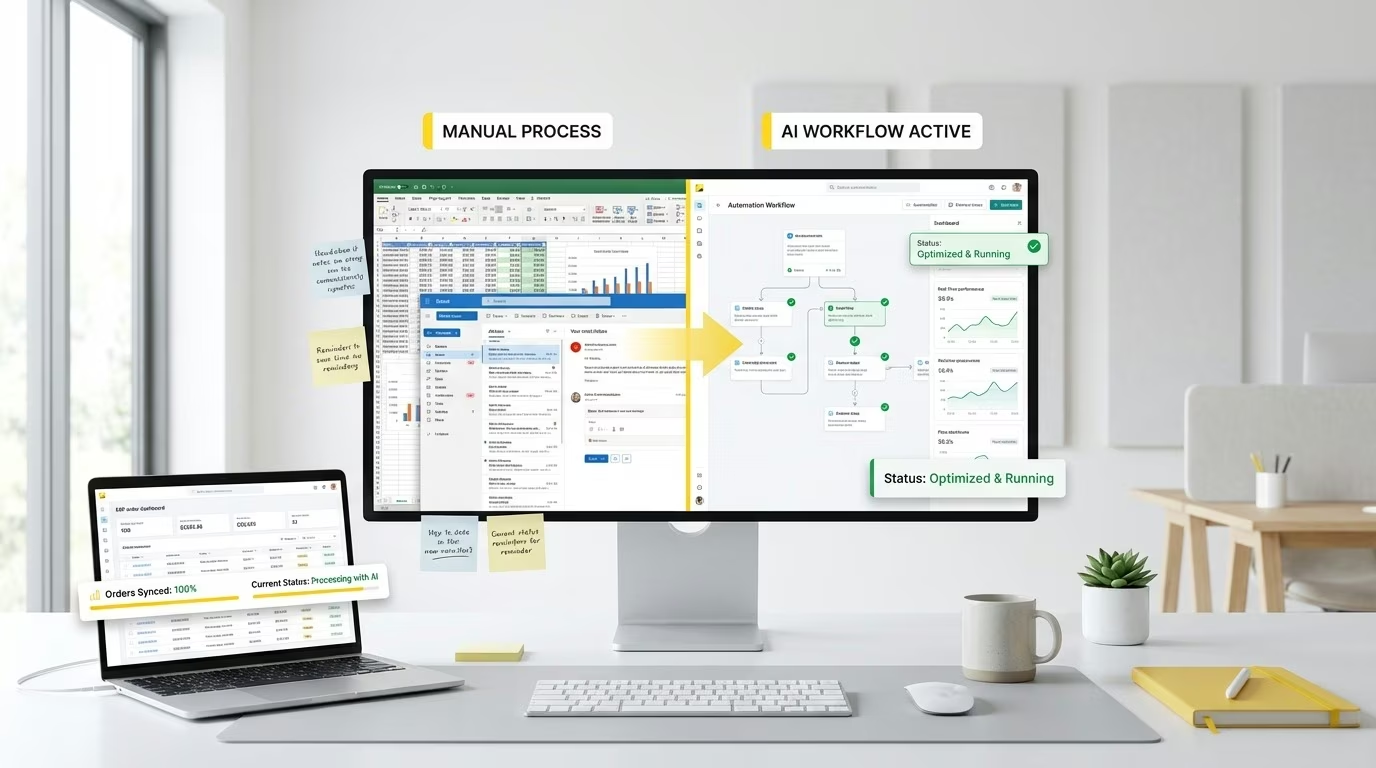
No-code/low-code AI-driven automation platform
Event-based, real-time workflows
Automates data transformation, document processing, routing, and validation
Keeps ERP, CRM, marketplaces, and financial systems continuously synchronized even as data and rules evolve
Reduces manual maintenance over time
When to choose:
Jitterbit: API management, predictable integrations, hybrid or legacy environments
eZintegrations: Real-time enterprise automation with lower operational effort and AI-driven intelligence
Introduction
Why Enterprises Need Modern Integration Platforms
Modern enterprises rely on smooth data exchange across ERP, CRM, eCommerce, marketplaces, financial tools, analytics platforms, and custom applications.
As organizations scale, integration platforms evolve from simple connectors into automation engines that must:
Maintain data consistency across systems
Execute workflows in real time
Adapt to changing schemas and business rules
Support analytics, compliance, and AI-driven decision-making
According to IDC FutureScape: Worldwide IT Industry 2024 Predictions, over 65% of enterprises see integration complexity as a major barrier to digital transformation, especially in omni-channel and AI-driven environments.
Jitterbit vs eZintegrations:
Jitterbit: Focuses on low-code integration and API lifecycle management
eZintegrations: Focuses on AI-driven, real-time workflow automation with minimal manual intervention
The architectural differences affect scalability, resilience, and long-term operational cost.
What Is an Integration Platform (iPaaS)?
What does iPaaS mean in practical terms?
According to Gartner, an Integration Platform as a Service (iPaaS) is a cloud-based platform that helps organizations connect, manage, and automate data and workflows across cloud and on-premises applications.
How it works:
Connects systems using APIs, connectors, or event streams
Transforms and validates structured and semi-structured data
Automates workflows across multiple applications
Provides governance, security, and monitoring
Why this matters:
IDC market research highlights that enterprises using unified integration platforms reduce operational silos and improve time-to-market by 30–40%, especially in retail, manufacturing, and financial services.
High-Level Comparison: Jitterbit vs eZintegrations
What is the main difference between Jitterbit and eZintegrations?
Jitterbit:
Low-code iPaaS
Focused on API-centric, structured workflows
Relies on manual workflow design and API governance
eZintegrations:
No-code, AI-based automation platform
Optimized for real-time enterprise orchestration
Emphasizes intelligent automation, adaptive routing, and continuous execution
Key Differences at a Glance
Jitterbit
What defines it: A low-code integration platform for structured, API-led environments.
Low-code integration platform
Strong API lifecycle management
Large connector ecosystem
Supports batch processing and hybrid deployments
Best used when: Data formats are stable and integrations are predictable
eZintegrations
What defines it: An AI-driven automation platform for real-time, adaptive enterprise workflows.
AI-driven no-code automation platform
Real-time, event-based execution
Intelligent routing and document processing
Built for complex enterprise workflows
Best used when: Data structures change frequently and real-time accuracy is critical
Jitterbit – Core Features Explained
Jitterbit Harmony
What it is: A low-code integration platform combining iPaaS and API management.
How it works:
Connects applications using predefined connectors
Builds and manages REST and SOAP APIs
Orchestrates data flows across enterprise systems
Connector Ecosystem:
Jitterbit supports connectors for:
Salesforce
SAP
Oracle NetSuite
Microsoft Dynamics
Workday
Databases and file systems
When this helps:
Prebuilt connectors speed up deployment when systems have stable schemas and well-defined APIs, such as CRM-to-ERP synchronization.
Strengths of Jitterbit:
Parallel Batch Processing:
Efficiently processes large datasets with parallel execution
Typical use cases: nightly ETL jobs, ERP data reconciliation, scheduled reporting
API Governance:
API versioning
Authentication and security policies
Usage monitoring and throttling
Aligns with Gartner’s API Management emphasis on enterprise-scale governance
Hybrid Deployment Support
Why is hybrid deployment important?
Jitterbit supports cloud, on-premises, and hybrid models, enabling integration with legacy systems behind firewalls.
Jitterbit AI Capabilities
What AI features are included today?
Mapping suggestions
Connector scaffolding
Basic workflow recommendations
Limitation:
Core logic, routing decisions, and exception handling still require manual configuration and ongoing updates.
eZintegrations – Core Features Explained
What is eZintegrations?
eZintegrations is a no-code, AI-driven integration and automation platform designed for real-time enterprise workflows.
One-line definition:
eZintegrations automates end-to-end enterprise workflows using AI reasoning rather than static integration design.
How eZintegrations Works
Process overview:
Ingests data via APIs, webhooks, or documents
Applies AI-based transformation and validation
Routes events in real time
Maintains continuous synchronization across systems
Example scenario:
An eCommerce order update instantly triggers:
Inventory adjustments in ERP
Invoice generation in finance systems
Shipment updates in logistics platforms
All actions occur in real time, without batch delays
Strengths of eZintegrations
AI-Driven Automation
Uses AI to interpret data structures and automate transformations without predefined schemas
Best for: Environments where supplier, marketplace, or ERP schemas change frequently
Real-Time Execution
Processes events instantly using webhooks and websocket pipelines
Eliminates batch delays and improves operational accuracy
Adaptive Workflows
AI adjusts routing and validation automatically as business rules or data patterns evolve
No-Code Interface
Business users and operations teams can modify workflows without developer support
Document Intelligence
Extracts structured data from unstructured documents (PDFs, invoices, order forms) without templates
Built-In Monitoring & AI Diagnostics
Live execution logs, real-time status views, and automated corrective suggestions
Reduces troubleshooting time and operational downtime
Compliance and Governance Controls
Role-based access control, enterprise-grade security, and audit-ready execution trails
Designed for regulated industries
Modular, Usage-Based Pricing
Pay only for needed capabilities, reducing unnecessary costs as workflows scale
Key Capabilities of eZintegrations
AI Data Operations
Schema-free data understanding
Document extraction
Intelligent validation and enrichment
Real-Time Execution Engine
Event-driven architecture
Instant response to operational changes
Natural-Language Workflow Design
Business-friendly workflow configuration
Reduces dependency on developers
Built-In Governance and Monitoring
Role-based permissions
Live execution visibility
Integration Capabilities
Jitterbit:
Integrations are built by manually linking connectors, mappings, and transformation logic
Best for: Well-defined processes, stable data formats, and predictable integration logic
eZintegrations:
Uses AI to interpret and adapt to data variations automatically
Best for: Frequently changing data structures, continuous multi-system exchanges, real-time accuracy
Deployment Options
Jitterbit:
Supports cloud, on-premises, and hybrid environments
Ideal for enterprises managing legacy infrastructure
eZintegrations:
Fully managed, cloud-native platform
Benefits: No server management, automatic upgrades, centralized security updates
Scalability and Performance
Jitterbit:
Scales via distributed processing and parallel batch execution
Trade-off: Workflow redesign may be needed as complexity grows
eZintegrations:
Scales with real-time, event-driven execution
Advantage: Workflows expand automatically as volume and complexity increase
Security and Data Protection
Jitterbit:
Encrypted data transfer
Secure credential storage
Role-based access
eZintegrations:
End-to-end encryption
Fine-grained access control
Compliance-ready architecture
Development and Customization
Jitterbit:
Low-code workflows
Optional scripting
Custom connectors
eZintegrations:
No-code workflows
AI-managed transformation and routing
Optional customization
Business Process Automation
Jitterbit:
Automates predefined workflows
Manual updates needed for changes
eZintegrations:
Automates document processing, validation, and routing
Adapts dynamically as business rules evolve
Analytics and Monitoring
Jitterbit:
Dashboards, logs, and performance metrics
eZintegrations:
Real-time execution visibility
AI diagnostics and corrective guidance
Pricing Transparency
Jitterbit:
Subscription-based with tiered capabilities and usage considerations
eZintegrations:
Modular, usage-based pricing aligned with operational needs
Comparison Table – Jitterbit vs eZintegrations
| Feature | Jitterbit | eZintegrations |
|---|---|---|
| Low-Code Integrations | ✔ | ✔ |
| Pre-Built Connectors | ✔ (Broad catalog) | ✔ (ERP & eCommerce focus) |
| API Creation & Governance | ✔ Advanced | ✔ With marketplace chaining |
| AI Workflow Automation | Limited | ✔ Multi-agent |
| Real-Time Sync | ✔ Parallel processing | ✔ Real-time AI insights |
| Enterprise Monitoring | ✔ Dashboards | ✔ Live logs |
| Agentic AI Support | Emerging | ✔ Advanced |
Strengths Summary
Strengths of Jitterbit
Mature API management
Broad connector ecosystem
Strong batch processing
Hybrid deployment support
Strengths of eZintegrations
AI-driven automation
Real-time orchestration
Document intelligence
Reduced manual maintenance
Compliance-ready architecture
Why Choose eZintegrations Over Jitterbit?
Reduced Manual Orchestration
eZintegrations adapts automatically to schema changes, ERP updates, and multi-system workflows.
End-to-End Real-Time Execution
Ideal for inventory updates, order processing, pricing changes, and settlement events.
Future-Ready Architecture
AI-driven platforms align with Gartner’s prediction that by 2026, over 50% of enterprise integrations will use AI-assisted automation.
Best Use Cases
Best for API-led automation: Jitterbit
Best for enterprise workflows: eZintegrations
Conclusion
Jitterbit:
- Reliable for API management and structured integrations
- Suited for hybrid environments and predictable workflows
eZintegrations:
- Designed for real-time, multi-system enterprise workflows
- AI-driven automation reduces manual maintenance
- Event-based execution supports scalability, speed, and resilience
Key Takeaway:
Both platforms are capable but serve different strategies
Enterprises prioritizing intelligent automation, real-time execution, and long-term efficiency will benefit more from eZintegrations