90% Faster No-Code SOAP to GraphQL Conversion Made Easy
November 25, 2025TL;DR
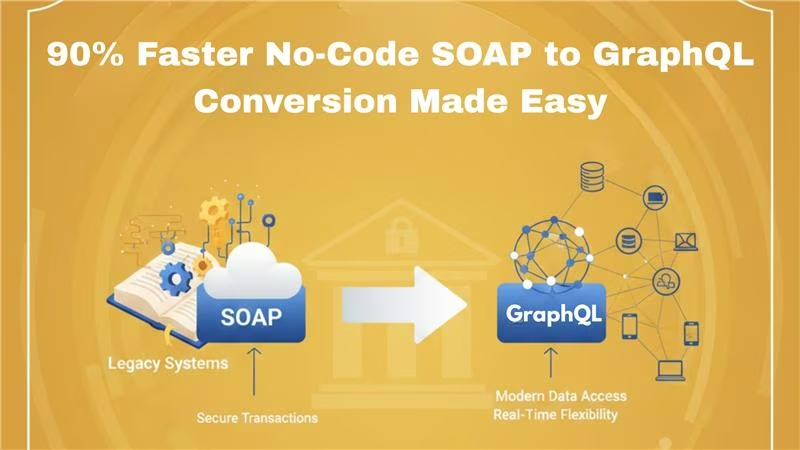
No-code SOAP to GraphQL Conversion in Banking enables banks to modernize their systems without replacing existing legacy infrastructure. Using eZintegrations, organizations can seamlessly work with both SOAP APIs (commonly used in core banking for secure, structured transactions) and GraphQL APIs (used in modern systems for flexible, real-time data access).
With AI-driven, no-code operations:
- SOAP XML responses are automatically extracted, transformed into clean JSON, and filtered based on business rules (e.g., active accounts only).
- GraphQL responses are processed in real time to enrich data with intelligence such as risk levels for fraud monitoring.
- Data is securely delivered to legacy CRMs (e.g., Microsoft Dynamics 365) and modern platforms (e.g., Salesforce Financial Services Cloud).
- Biweekly, timezone-aware scheduling ensures consistent and compliant data synchronization.
In essence, eZintegrations allows banks to bridge legacy SOAP systems and modern GraphQL applications effortlessly, accelerating modernization by up to 90%, reducing development effort, and enabling real-time insights—without writing code.
No-code SOAP to GraphQL Conversion in Banking
No-code SOAP to GraphQL Conversion is essential in modern banking application, showcases a use case where legacy SOAP APIs power secure, structured transactions, while modern GraphQL APIs enable flexible, real-time data access. eZintegrations simplifies the integration of both API types, allowing businesses to modernize operations by connecting these APIs to their existing systems. The article highlights eZintegrations ability to handle diverse API protocols effectively, with a focus on applications in the banking industry.
No-code SOAP to GraphQL Conversion: SOAP API Integration (Banking)
API: Account Balance Retrieval (SOAP)
Endpoint: http://bankapi.com/soap/accountService
Operation: GetAccountBalance
Description: Retrieves account details for customer management in a banking CRM.
Response (XML):
<soap:Envelope xmlns:soap="http://schemas.xmlsoap.org/soap/envelope/">
   <soap:Body>
      <GetAccountBalanceResponse xmlns="http://bankapi.com/account">
         <Account>
            <AccountNumber>987654321</AccountNumber>
            <AccountHolder>Jane Smith</AccountHolder>
            <Balance>15000.75</Balance>
            <LastTransaction>2025-10-20</LastTransaction>
         </Account>
      </GetAccountBalanceResponse>
   </soap:Body>
</soap:Envelope>
AI Operation Prompt for SOAP:
Extract account number, account holder name, balance, and last transaction date from the {%bizdata_dataset_response%}.
Add a field 'account_status' with value 'Active' if the balance exceeds 1000, otherwise 'Inactive'.
Format the data as a JSON object for the banking CRM and give the value in the 'Data'.
Output (JSON):
{
  "account_number": "987654321",
  "account_holder": "Jane Smith",
  "balance": 15000.75,
  "last_transaction_date": "2025-10-20",
  "account_status": "Active"
}
APPEND Operation:
{
  "status": "success"
}
FILTER Operation: Send only active accounts to the CRM:
data["account_status"] == "Active"
Target: The data is sent to a legacy banking CRM (e.g., Microsoft Dynamics 365) via a REST API to update customer account profiles.
Use Case: A bank uses the SOAP API to sync account details to Microsoft Dynamics 365, enabling relationship managers to track active accounts. Biweekly syncs (0 6 * * WED) in the IST timezone (Asia/Kolkata) ensure timely updates.
GraphQL API Integration (Banking)
API: Transaction Analytics (GraphQL)
Endpoint: http://bankapi.com/graphql
Description: Fetches transaction details for real-time fraud monitoring in a modern CRM.
Query:
query {
  transactionAnalytics(accountNumber: "987654321") {
    transactionId
    amount
    date
    merchant
  }
}
Response (JSON):
{
  "data": {
    "transactionAnalytics": {
      "transactionId": "TXN456",
      "amount": 250.50,
      "date": "2025-10-20",
      "merchant": "Retail Store"
    }
  }
}
AI Operation Prompt for GraphQL:
Extract transaction ID, amount, date, and merchant from the {%bizdata_dataset_response%}.
Add a field 'risk_level' with value 'Low' if the transaction amount is below 1000, otherwise 'Medium'.
Format the data as a JSON object for the fraud monitoring CRM and put the value in the key 'Data'.
Output (JSON):
{
  "transaction_id": "TXN456",
  "transaction_amount": 250.50,
  "transaction_date": "2025-10-20",
  "merchant": "Retail Store",
  "risk_level": "Low"
}
APPEND Operation:
{
  "status": "success"
}
FILTER Operation: Send only low-risk transactions to the CRM:
data["risk_level"] == "Low"
Target: The data is sent to a modern fraud monitoring CRM (e.g., Salesforce Financial Services Cloud) via a REST API to enhance real-time fraud detection.
Use Case: The bank uses the GraphQL API to feed transaction data into Salesforce for fraud analysis. Biweekly syncs (0 6 * * WED) in the IST timezone (Asia/Kolkata) ensure consistent monitoring.
Why eZintegrations?
The platform’s AI operations use natural language prompts, eliminating coding complexity. Businesses can test APIs in a sandbox, schedule syncs, and share integrations across teams, fostering efficiency and innovation.
Broader Impact: By supporting both legacy SOAP and modern GraphQL APIs, eZintegrations helps businesses modernize without replacing existing systems. This dual compatibility drives operational agility, enhances customer service, and strengthens security.
Frequently Asked Questions
90% Faster No-Code SOAP to GraphQL Conversion Made Easy
- What does ‘From SOAP to GraphQL’ mean in eZintegrations?‘From SOAP to GraphQL’ in eZintegrations refers to the platform’s ability to support legacy integration formats like SOAP while enabling modern API standards such as REST and GraphQL.
- How does eZintegrations simplify the transition from SOAP to GraphQL?eZintegrations provides prebuilt connectors, protocol translation, and automated mapping that help businesses migrate without rewriting backend systems.
- Can eZintegrations integrate both legacy and modern systems during migration?Yes. The platform supports hybrid integration models so SOAP, REST, and GraphQL systems can coexist and sync seamlessly during modernization.
- Why is moving from SOAP to GraphQL beneficial?GraphQL enables faster queries, flexible data access, reduced payloads, and improved performance, making integrations more efficient and scalable.
- Does eZintegrations require coding to support GraphQL integration?No. eZintegrations allows configuration-based integration, meaning users can build and deploy GraphQL-based workflows without writing custom code.
- What business value does modernizing from SOAP to GraphQL deliver?Organizations benefit from faster development cycles, reduced maintenance costs, improved API performance, and future-ready integration architecture.