How to Forecast Product Demand Using Social Trends
$0.00
| Workflow Name: |
Product Demand Using Social Trend |
|---|---|
| AI Model Type: |
LLM / Time-Series ML |
| Model Provider: |
Goldfinch AI / OpenAI |
| Task Type: |
Prediction / Forecasting |
| Input Type: |
API / Sales Data |
| Output Format: |
Google Sheets / CSV |
| Who Uses It: |
Product Managers; Marketing Teams |
Table of Contents
Description
| Problem Before: |
Reactive demand planning |
|---|---|
| AI Solution: |
Social trend + sales forecasting |
| Validation (HITL): |
Monthly forecast review |
| Accuracy Metric: |
Forecast Error % |
| Time Savings: |
60% planning time reduction |
| Cost Impact: |
Reduced overstock losses |
Product Demand Using Social Trend
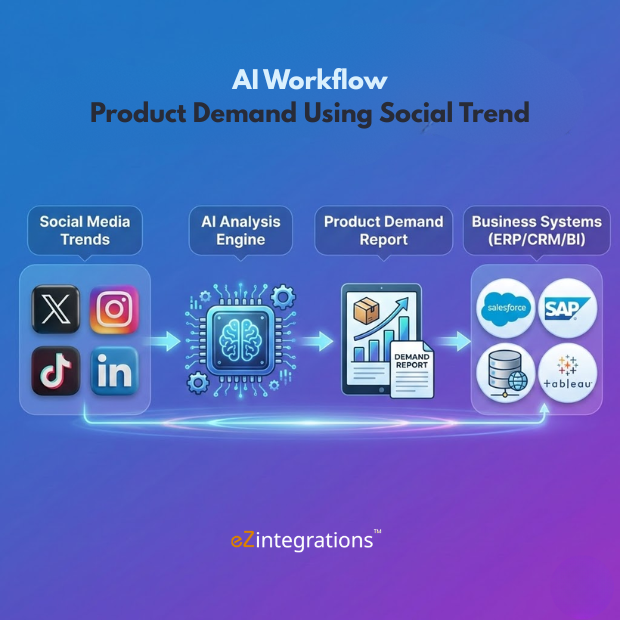
The Product Demand Forecast workflow leverages AI and time-series models to predict future product demand by analyzing social trends and historical sales data. It enables proactive inventory and marketing planning.
AI-Driven Demand Prediction for Smarter Decisions
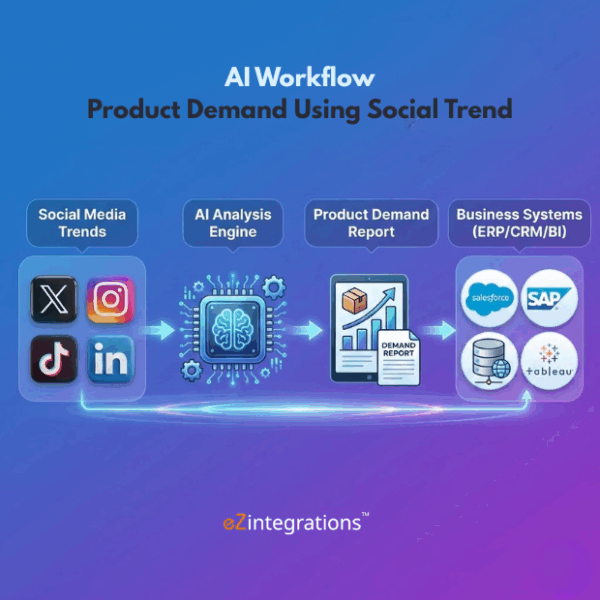
The system ingests sales and social trend data via API, applies LLM and time-series forecasting models, and outputs results to Google Sheets or CSV for easy access. This workflow helps product managers and marketing teams make data-driven decisions, optimize stock levels, and respond quickly to changing market trends.
Watch Demo
| Video Title: |
3 Benefits of AI Workflow Automation |
|---|---|
| Duration: |
0:50 |
Outcome & Benefits
| Accuracy: |
92% forecast accuracy |
|---|---|
| Touchless Rate: |
80% automated |
| Time Saved: |
From days to minutes |
| Cost Saved: |
10% – 15% inventory cost |
Functional Details
| Business Tasks: |
Demand planning |
|---|---|
| KPI Improved: |
Forecast accuracy; sell-through |
| Scheduling: |
Daily / Weekly |
| Downstream Use: |
Merchandising decisions |
Technical Details
| Model Name/Version: |
GPT-4o-mini + Forecast Model |
|---|---|
| Hosting Type: |
Cloud API |
| Prompt Strategy: |
Trend-aware prompts |
| Guardrails: |
Outlier & anomaly detection |
| Throughput: |
Daily trend updates |
| Latency: |
~2s/update |
| Data Governance: |
No PII usage |
FAQ
1. What is the 'Product Demand Using Social Trend' workflow?
It is an AI workflow that predicts product demand by analyzing social trends and historical sales data, helping businesses forecast demand accurately.
2. What AI model types are used in this workflow?
The workflow uses LLM (Large Language Models) and Time-Series Machine Learning models to analyze trends and predict product demand.
3. What types of input data does the workflow require?
It uses data from APIs and historical sales records to identify patterns and correlate them with social trend signals.
4. What is the output format of this workflow?
The workflow outputs predictions in Google Sheets or CSV format for easy analysis and reporting.
5. Who typically uses this workflow?
Product Managers and Marketing Teams use this workflow to make data-driven decisions on inventory planning, promotions, and product launches.
6. What are the key benefits of using this workflow?
It provides accurate product demand forecasts, reduces stockouts and overstocking, and helps align marketing and sales strategies with market trends.
7. Can this workflow be integrated with other systems?
Yes, the workflow can be integrated with sales, ERP, and marketing platforms to enhance decision-making across business units.
8. How often can the workflow update predictions?
The workflow can run on a scheduled basis—daily, weekly, or monthly—or in near real-time depending on business needs and data availability.
Resources
Case Study
| Industry: |
Retail / eCommerce |
|---|---|
| Problem: |
Stock mismatch |
| Solution: |
AI demand forecasting |
| Outcome: |
Better inventory planning |
| ROI: |
2-month payback |