How to Extract Document Layout Data and Send It to Any Target
$0.00
| Workflow Name: |
Extract Document Layout and Send It to Any Target |
|---|---|
| AI Model Type: |
Vision / Layout LLM |
| Model Provider: |
Goldfinch AI / OpenAI |
| Task Type: |
Layout Detection & Segmentation |
| Input Type: |
PDF / Image |
| Output Format: |
JSON / XML |
| Who Uses It: |
Document AI Teams; Data Engineers |
Table of Contents
Description
| Problem Before: |
Unstructured document layouts |
|---|---|
| AI Solution: |
AI-based layout segmentation |
| Validation (HITL): |
Sampled layout review |
| Accuracy Metric: |
Block detection accuracy % |
| Time Savings: |
80% faster preprocessing |
| Cost Impact: |
Lower manual tagging cost |
Extract Document Layout and Send It to Any Target
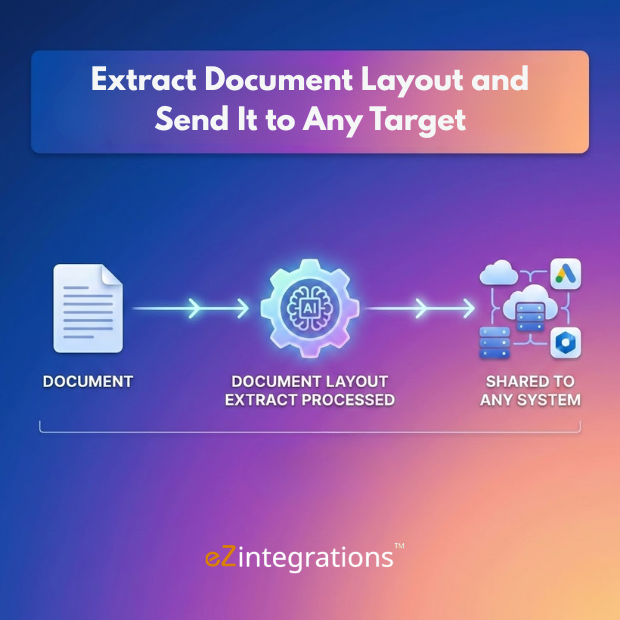
This workflow performs Document Layout Extraction from PDFs and images using vision-based layout models.
Structured Layout Intelligence for Downstream Systems
The system detects and segments document elements such as headers, tables, paragraphs, and sections, then converts the layout structure into JSON or XML. It enables document AI teams and data engineers to preserve document structure, improve downstream parsing, and accelerate intelligent document processing pipelines.
Watch Demo
| Video Title: |
Pharma Industry Document Automation: Use Cases, Data Flow |AI Document Understanding |
|---|---|
| Duration: |
13:18 |
Outcome & Benefits
| Accuracy: |
96% |
|---|---|
| Touchless Rate: |
85% |
| Time Saved: |
From 3m to 30s/page |
| Cost Saved: |
$0.20 per page |
Functional Details
| Business Tasks: |
Document preprocessing |
|---|---|
| KPI Improved: |
Parsing success rate |
| Scheduling: |
Batch / Real-time |
| Downstream Use: |
Datalake / Doc AI Pipelines |
Technical Details
| Model Name/Version: |
GPT-4o-mini Vision |
|---|---|
| Hosting Type: |
Cloud API |
| Prompt Strategy: |
Layout-aware prompting |
| Guardrails: |
Schema validation |
| Throughput: |
120 pages/min |
| Latency: |
~1s/page |
| Data Governance: |
No content retention |
FAQ
1. What is the Extract Document Layout and Send It to Any Target workflow?
It is an AI-powered workflow that detects, segments, and structures document layouts using vision and layout-aware LLMs, then sends the layout data to any target system.
2. How does the workflow work?
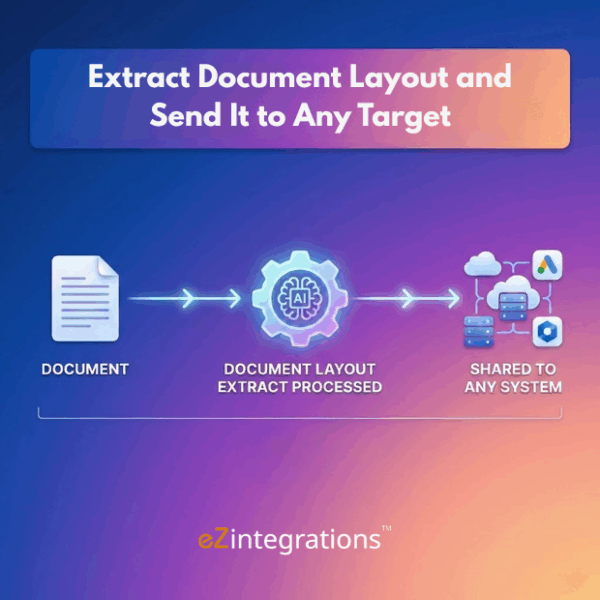
The workflow ingests documents in PDF or image format, applies vision and layout LLM models to identify sections, tables, headers, paragraphs, and forms, and exports the structured layout data to the configured target.
3. What layout elements can be detected?
It can detect and segment layout elements such as titles, headings, paragraphs, tables, columns, forms, images, footers, and page structure metadata.
4. What AI models are used in this workflow?
The workflow uses vision and layout-aware LLM models provided by Goldfinch AI and OpenAI to accurately understand and segment complex document layouts.
5. What is the output of the workflow?
The extracted layout structure is output in JSON or XML format and can be sent to downstream systems such as Document AI pipelines, search indexing engines, Datalakes, or content management systems.
6. Who uses this workflow?
Document AI Teams and Data Engineers use this workflow to build downstream extraction pipelines, improve document understanding, and standardize layout-aware processing.
7. What are the benefits of automating document layout extraction?
Automation enables accurate layout understanding, improves downstream extraction quality, supports complex document types, and accelerates scalable document AI workflows.
Resources
Case Study
| Industry: |
Legal / Enterprise Docs |
|---|---|
| Problem: |
Poor layout visibility |
| Solution: |
AI layout extraction |
| Outcome: |
Better downstream extraction |
| ROI: |
2-month payback |