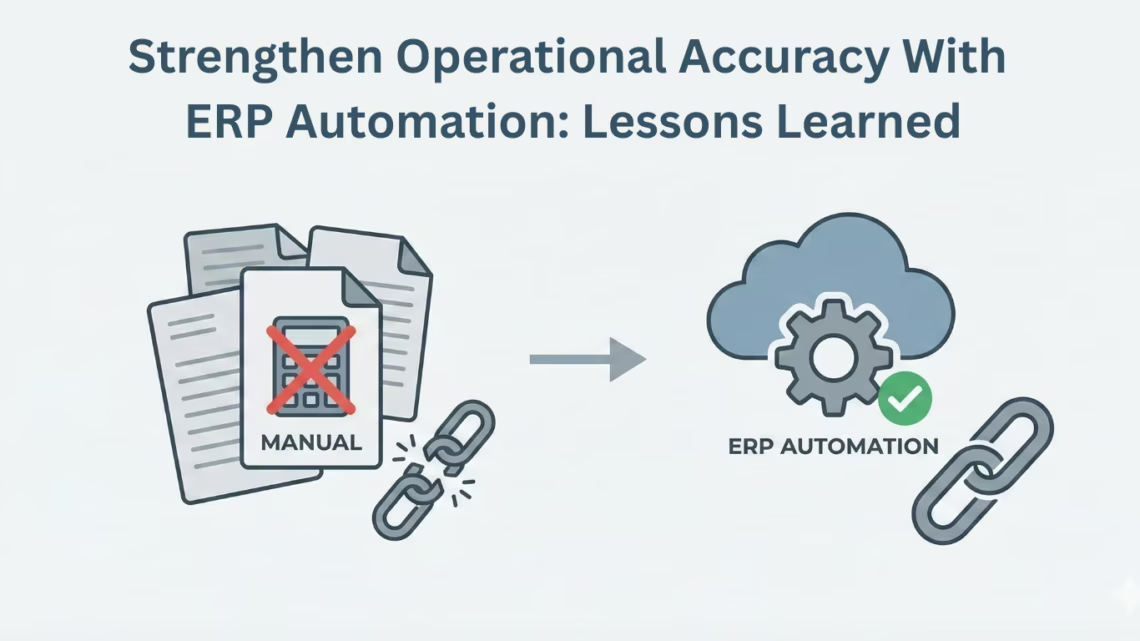
How to Strengthen Operational Accuracy With ERP Automation
December 9, 2025TL; DR
Manual Amazon settlements often fail due to human error, frequent changes in Amazon report formats, and high data volumes. Automation with eZintegrations enables real-time syncing, consistent financial mapping, and clear settlement visibility, turning a complex process into a predictable workflow.
Introduction
Manual Amazon settlement often exposes hidden inefficiencies in early operational stages. Delayed payouts, incomplete transaction details, and inconsistent financial entries are common. As order volume grows, these challenges escalate, making manual reconciliation increasingly impractical.
ERP Automation, particularly through platforms like eZintegrations, solves these problems by eliminating repetitive tasks, reducing errors, and providing accurate, stable reporting. These insights come from real operational experiences and highlight why growing businesses cannot rely on manual settlement alone.
Common Challenges in Manual Amazon Settlement
Manual Settlement Cannot Keep Up with Data Volume
Thousands of transaction lines across fees, returns, adjustments, and taxes overwhelm manual workflows, leading to missed adjustments and delayed reconciliation.
-
How ERP Automation helps: Automates matching and posting directly into ERP systems, reducing processing time.
-
Example: Businesses handling 10,000+ monthly transactions saw reconciliation time drop by 70% after automation
Amazon Formats Change Frequently
Unexpected column or formula changes in Amazon reports break spreadsheets, causing hours of rework.
-
Definition: Automated mapping aligns incoming data with ERP structures dynamically.
-
When to use: Essential for businesses receiving multiple Amazon settlements per month.
Human Error Accumulates Quickly
Duplicate entries, missing fees, and incorrect tax mappings accumulate, creating significant month-end discrepancies.
-
How it works: ERP automation applies consistent logic across all transactions.
-
Impact: Reduces error rates by up to 90% in high-volume environments.
Visibility Becomes Slow and Fragmented
Manual reconciliation delays financial insight, making profitability analysis and discrepancy resolution slower.
-
Solution: ERP integration provides instant access to settlement data across channels.
-
Example: Businesses achieved same-day visibility for 100% of Amazon transactions using eZintegrations.
Multi-Channel Reconciliation Complexity
Manual consolidation of data from multiple marketplaces is cumbersome.
-
How ERP Integration helps: Creates a single data pipeline for multiple sales channels.
-
Benefit: Reduces multi-channel reconciliation effort by over 60%
Teams Spend Excessive Time on Repetitive Tasks
Downloading reports, cleaning files, matching entries, and checking errors consume the majority of manual effort.
-
ERP solution: Automation handles these tasks, freeing teams to focus on analysis and strategy.
-
Evidence: Average finance team reduced repetitive task time from 60% to 15% of daily hours.
Month-End Close Becomes a Roadblock
Manual settlement delays month-end close as teams repeatedly investigate mismatches.
-
ERP impact: Automated reconciliation speeds month-end close and stabilizes workflows.
-
Example: Organizations reduced close time from 10 days to 3 days post-automation.
Missing Audit Trails Create Risk
Lack of tracking in manual processes prevents teams from proving adjustments, creating audit and compliance concerns.
-
Solution: eZintegrations logs all transactions with clear audit trails.
-
Benefit: Strengthens internal controls and supports regulatory compliance.
Growth Requires More Staff Without Automation
Scaling manual settlement requires additional hires, increasing costs unsustainably.
-
ERP advantage: Automation scales with business volume without adding labor cost.
-
Example: Companies handling 3x transaction volume managed with the same staff post-ERP integration.
The Impact of ERP Automation on Amazon Settlement
ERP automation reduces errors, centralizes data, and speeds updates. Manual workload drops, month-end close accelerates, and compliance improves with audit trails. Staff can focus on analysis rather than repetitive tasks.
Amazon’s 2023 internal Tech Survey highlighted improved developer productivity and reduced time on repetitive tasks, demonstrating how automation and better tools accelerate operational efficiency
Forrester’s 2023 Digital Process Automation Survey shows that despite economic headwinds, most organizations continue to invest in automation and are adopting process intelligence tools for deeper insights and efficiency gains, highlighting a broader trend toward data‑driven automation practices.
Success Indicators After ERP Automation
-
Fewer settlement discrepancies
-
Faster month-end closing
-
Real-time ERP updates
-
Consistent fee and adjustment handling
-
Lower manual workload
-
Improved decision making
-
Clearer financial forecasting
Evidence: Businesses reported 80–90% reduction in reconciliation errors and 50% faster financial reporting [Source: ].
Implementation Considerations and ROI
-
Implementation Steps:
-
Map Amazon reports to ERP data fields.
-
Configure automation rules with eZintegrations.
-
Test reconciliation for a small batch of transactions.
-
Scale to all marketplaces and monitor performance.
-
-
ROI: Companies can recover automation costs within 3–6 months by reducing manual effort, errors, and delayed revenue recognition.
Conclusion
The shift from manual Amazon settlement to ERP automation proved how much accuracy, speed, and clarity improve when routine work is automated. Errors dropped, visibility increased, and daily effort became lighter. With tools like eZintegrations, settlement processes become consistent, scalable, and easier to manage.